Why Nuance Matters
Language is a precision instrument. To "speak" is to transmit words; to "communicate" is to transmit meaning. The specific verb we choose carries the weight of our emotion, our intent, and our relationship.
Speak vs. Talk
One is formal and authoritative; the other is social and connective. Knowing the difference controls the room.
Scream vs. Shout
One is a primal reaction to fear or pain; the other is a functional tool to overcome distance. Don't confuse them.
Whisper vs. Whine
One builds intimacy and secrecy; the other destroys authority and patience. Tone defines the relationship.
The 9 Degrees of Intensity
A deep dive into the spectrum of vocal delivery, moving from the faintest breath to the loudest outcry. Understanding where you fall on this scale is the key to mastering emotional intelligence in communication.
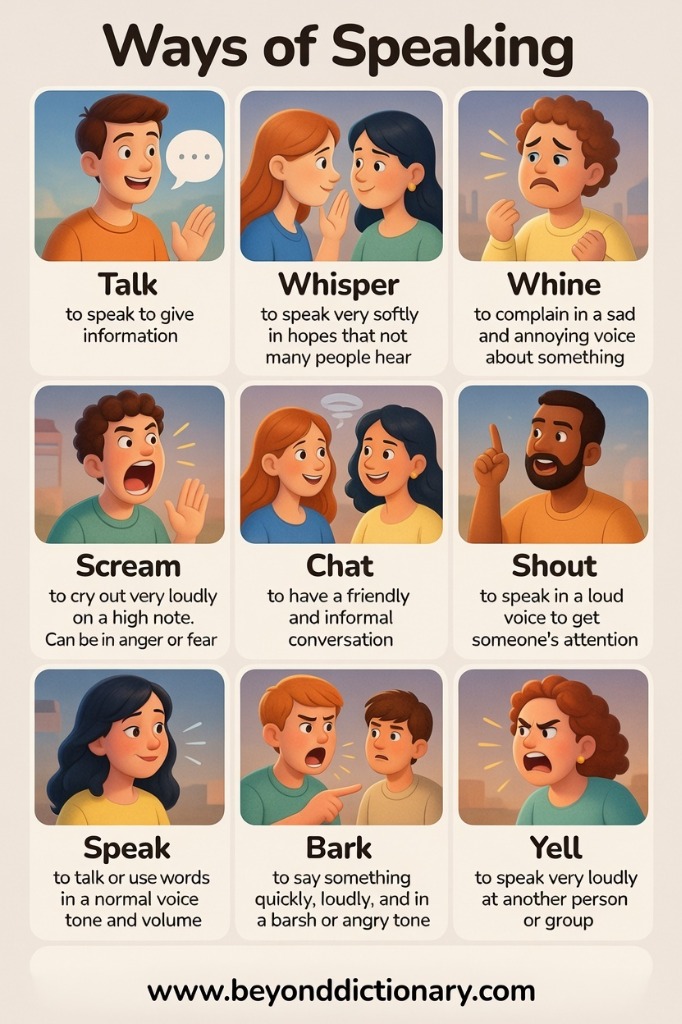
1. Whisper
To speak very softly using only breath, without vibrating the vocal cords. The primary psychological intent is secrecy or intimacy. By lowering the volume below the threshold of the environment, a whisper creates an exclusive "bubble" that only the intended listener can enter. It demands proximity and attention, signaling that the content is privileged, dangerous, or tender. However, prolonged whispering forces the vocal cords together tightly, causing more strain than normal speech.
- "Don't look now, but I think we're being followed."
- "I have a surprise for you later." (Intimacy)
- "The baby is finally asleep, be quiet."
- "Is that the answer? I'm not sure." (Cheating/Secrecy)
- "I love you." (Spoken directly into the ear)
2. Murmur
A low, continuous, and indistinct sound, often described as a "soft rumble." Unlike a whisper, a murmur involves vocal cord vibration but lacks clear articulation. It is the sound of a crowd in the background or a sleepy lover. Psychologically, it conveys a sense of comfort, contentment, or suppressed complaint. It is less about transmitting information and more about creating a textural soundscape of presence. "The brook murmured," suggests a peaceful, ongoing existence.
- "Mmm, this coffee is incredible." (Contentment)
- "I guess we could go there..." (Indecision)
- "Just five more minutes, please." (Sleepy)
- "Whatever you say, boss." (Low compliance)
- "Did you hear what happened?" (Low gossip in a crowd)
3. Mumble
Speaking quietly and indistinctly, often resulting from a failure to open the mouth or articulate consonants. While similar to a murmur in volume, a mumble is almost always negative in connotation. It signals insecurity, embarrassment, or passive-aggressive dissent. A teenager mumbles when they don't want to be heard but want to register their displeasure. It frustrates listeners because it breaks the contract of communication: the meaningful transmission of ideas.
- "I don't wanna do the dishes." (Sullenness)
- "It wasn't my fault anyway." (Defensiveness)
- "Stupid computer, always crashing." (Frustration)
- "I guess I'll just go then." (Resignation)
- "Dunno, maybe." (Apathy)
4. Chat
The baseline of social lubrication. To chat is to talk in a friendly, informal, and easy manner. The stakes are low; the connection is high. Chatting is less about the content (the weather, sports, gossip) and more about the act of bonding. It is the "phatic" function of language—speech used to maintain social relationships rather than impart deep information. A "chat" puts people at ease, signaling safety and belonging.
- "How about that game last night?"
- "Crazy weather we're having, isn't it?"
- "Have you tried the new pizza place downtown?"
- "Catch you later!"
- "So, what are your plans for the weekend?"
5. Speak
The standard unit of verbal communication, but with an edge of formality. While we "talk" with friends, we "speak" to an audience or "speak" a truth. It implies a degree of authority and unidirectional flow. To "speak up" is an act of courage. This is the neutral gear from which all other nuances shift. It allows for the full range of intonation and inflection without the distorting effects of extreme volume or secrecy.
- "I believe we have a viable solution to the problem."
- "The meeting is scheduled for 9:00 AM sharp."
- "I would like to propose a toast to the bride and groom."
- "Could you please clarify your last statement?"
- "My name is Sarah, and I will be your guide today."
6. Project
The functional amplification of the voice. Projection is not shouting; it is the technique of using the diaphragm to push air with force, filling a room without straining the throat. Actors and orators project. The intent is clarity and reach, not emotion. A projected voice signals confidence, competence, and leadership. It says, "I have something important to say, and I intend for everyone to hear it."
- "Ladies and gentlemen, may I have your attention please?"
- "Can everyone in the back row hear me clearly?"
- "The emergency exit is located to your left."
- "Next in line, please step forward!"
- "We will now begin the performance."
7. Shout
A loud utterance, often sudden. The key distinction from yelling is utility. You shout a warning ("Look out!"), you shout over the noise of a construction site, or you shout to a friend across the street. While it can be angry, shouting is largely a tool to overcome distance or ambient anxiety. It is a burst of energy designed to cut through the noise. It is urgent but not necessarily hostile.
- "Watch out for that car!" (Warning)
- "Hey! You dropped your wallet!" (Helpful)
- "Taxi! Over here!" (Utility)
- "Dinner is ready! Come and get it!" (Summons)
- "Pass the ball! I'm open!" (Sport)
8. Yell
To cry out loudly, usually in anger, pain, or excitement. Unlike shouting, yelling is emotional and personal. We typically yell at someone. It involves a loss of control and a desire to dominate or hurt the listener through sheer sonic force. Psychologically, yelling triggers a fight-or-flight response. It is the sound of conflict escalation. "Don't yell at me" is a plea for psychological safety as much as auditory relief.
- "Get out of my room right now!"
- "I told you I didn't do it!"
- "You never listen to a word I say!"
- "Stop touching that!"
- "That is not fair!"
9. Scream
The highest degree of intensity. A long, loud, piercing cry or sound expressing extreme emotion or pain. A scream often bypasses language entirely—it is a primal release. Terror, agony, or arguably extreme delight (on a roller coaster) produces a scream. It is the sound of the brain's limiter being hit. A scream commands absolute, immediate attention because it signals a threat to life or limb. It is the nuclear option of the voice.
- "Help! Somebody help me!"
- "Aaaaaah!" (On a rollercoaster drop)
- "There's a spider on my face!"
- "We won! We actually won the lottery!" (Extreme joy)
- "My leg! It's broken!" (Pain)
Three Themes of Speaking
Swipe through the three categories of vocal expression: The Standard Exchange, High Volume, and Distinctive Tones.
Self-Reflection
How do you use your voice? Be honest.
Your Default Mode
When you are excited, what happens to your voice?
The Annoyance Factor
Which sound irritates you the most?
Nuance Check
Test your understanding of the subtle differences.
Glossary of Terms
Conversationalist
Someone who is good at talking with others in a friendly way. They keep the flow going.
Diction
The choice and use of words and phrases in speech or writing. Doing it well means being clear.
Elocution
The skill of clear and expressive speech, especially distinctive pronunciation and articulation.
Utterance
A spoken word, statement, or vocal sound. The raw unit of speech.
Intonation
The rise and fall of the voice in speaking. It conveys emotion behind the words.
Cadence
The rhythmic flow of a sequence of sounds or words. It gives speech its musical quality and pace.
Projection
The strength of speaking or singing whereby the voice is used loudly and clearly. Essential for public speaking.
Timbre
The character or quality of a musical sound or voice as distinct from its pitch and intensity. Your unique sound.
Pitch
The degree of highness or lowness of a tone. High pitch can signal excitement; low pitch often signals authority.
Resonance
The quality in a sound of being deep, full, and reverberating. It adds weight and presence to the voice.
Articulation
The formation of clear and distinct sounds in speech. Good articulation ensures every syllable is heard.
Prosody
The patterns of rhythm and sound used in poetry and speech. It includes intonation, stress, and timing.
Inflection
The modification of a word to express different grammatical categories or relations. It's how we change our voice to convey meaning.
Mutter
To speak in a low, indistinct voice. Often done out of annoyance or to avoid being overheard.
Proclaim
To announce officially or publicly. Often used for important declarations or news.
Discourse
Written or spoken communication or debate. It refers to a formal discussion of a topic.
Orate
To make a speech, especially in a formal or pompous manner. Often implies a grand, eloquent style.
Audibility
The quality of being heard. Essential for effective communication, especially in public speaking.
Hesitation
The action of pausing or delaying in speech. Can indicate uncertainty, thought, or emotional distress.