Pawan Nayar
Everyone is asking what AI will take away. For six and a half years I have asked the opposite question: with thirty years of craft and AI, what could one small team give?

My answer is LLOS.ai, built at Cretorial since 2020. A school that follows the actual book in a child’s bag. A dictionary where one word opens into twenty thousand. A writing room of 476 voices, measured and not chosen. A hundred thousand drawings that carry their meaning. A map of 1,949 real jobs and what they truly do. Ninety games, for every age from one to ninety‑one. The Bhagavad Gita, presented verse by verse with three commentaries. A dictionary for the feelings you never had words for. 1.2 million pages, in two languages, growing daily, for every age from four to ninety — built by three people, with no funding.
- A school that follows the actual book in a child’s bag.
- A dictionary where one word opens into twenty thousand.
- A writing room of 476 voices, measured and not chosen.
- A hundred thousand drawings that carry their meaning.
- A map of 1,949 real jobs and what they truly do.
- Ninety games, for every age from one to ninety‑one.
- The Gita, shloka by shloka, with three commentators.
- A dictionary for the feelings you never had words for.
1.2 million pages, in two languages, growing daily, for every age from four to ninety — built by three people, with no funding.
Ground that would normally take seven companies, covered by one founder who refused to choose between his interests — because for the first time in history, he didn’t have to.
Underneath the site run engines that exist nowhere else — not in Google, not in ChatGPT, not inside the labs that make the models.
- A word engine that holds what a word means to a five‑year‑old and to a fifty‑year‑old, to a poet and to a recruiter, across fifty‑eight readings — and can draw it.
- A writing engine that gives one thought back the way Tagore would hold it, or Carlin, or Feynman — and reads its own recent output to ban the habits it has begun to repeat.
- A question engine where one well‑made question serves five examination boards without being copied.
- A shape engine that finds a drawing for courage, though courage has no shape.
- A work engine that starts from the job, not the button — seventy‑six programs turned around into 20,535 real tasks, each with its own prompt.
These aren’t merely features added to a model. They’re essential instruments, and the companies building the models haven’t created them.
More than twenty applications stand on those engines, each a product in its own right — in language, writing, design, work, learning and play. All of it was built the same way round: the machine first, then what the machine makes. What matters is not how much is on the site. It is what can go on making more of it.
Before that, thirty years of making complex things usable: Microsoft courseware at NIIT, chip‑design documentation at Cadence, then Creative Cloud content and community operations at Adobe.
Ask for an idea and a drawing of it comes back, in motion. Not one of these three words has a shape.
01 · One system. Your whole life.
What LLOS.ai is
Step into a lifelong learning journey. LLOS.ai guides you from your first words to your career and beyond. One flexible system adapts to your age, needs, and goals—always building your skills.
What you learn changes based on your needs. A four‑year‑old discovers her first hundred words in English and Hindi, each with a picture story, and taps a picture map to hear them. A nine‑year‑old works through CBSE maths built as things to handle, not worksheets. A fifteen‑year‑old takes English grammar at the depth that suits her and the physics her boards demand. An eighteen‑year‑old finds out what a job actually involves on a Tuesday — and what it pays, by government survey. A designer takes a seven‑part course on colour. A writer works in a studio with 476 voices creating short content, original like never before. Someone at thirty‑five, whose job now expects it, learns to hand real work to an AI — on their own documents, not a practice exercise. Someone at fifty reads the Gita shloka by shloka, or looks up a feeling she cannot name.
Most systems hand everyone the same thing, or keep four versions of it. Here one entry is re‑formed at the moment you ask — for your age, your work, your reason — so there is one thing to keep correct instead of four.
Beyond a dictionary
A normal dictionary gives you a definition. Then it stops.
Beyond Dictionary starts with the definition, then follows the word wherever you need it to go. It can explain a word to a three-year-old through a simple example, help a student understand how to use it in a sentence, or give a writer, teacher, or researcher its history, nuance, related ideas, and real-world concontent.
One word can become a full learning space.
In the Long Reference, a single word can include 41 sections, more than 20 interactive elements, and over 20,000 words of material. You might begin with “What does this mean?” and keep going into pronunciation, examples, opposites, word history, cultural references, questions, comparisons, and ideas connected to it.
The important part is that you do not have to read all of it. The system changes the starting point for you: your age, what you already know or what you do, and what you came to do. A quick answer can stay quick. Curiosity can become a deep dive.
The Short Reference gives each word about 3,500 words of useful explanation. That model already includes around 400,000 words. Another 10,000 words are being developed as Long References—each one a 20,000-word, interactive world of its own.
Together, this creates a reference system of roughly two billion words, with about one million questions woven through it. And the dictionary is only about five percent of the larger site.
The rest of LLOS.ai is the schooling, the map of work, the design school, the studios, the games and the inner life. More than 1.2 million pages, built by one person and a small team.
Seventy‑six of them- tools, hubs, libraries, series, and games- are listed next. Most open on a click; the ones that ask for a sign‑in or a password are marked.
Next · 02 · The work
02 · The work
The work
This section features 76 handpicked examples from across the LLOS.ai platform—tools, hubs, libraries, series, and games—organized into seven groups: Learn, Words, Write, Design, Career, Life, and Play. Each asset is fully functional and accessible directly from the site. Most open instantly with a click. A few, marked SIGN‑IN, require a free account only because they generate and save work on the server for you. All others are available without registration.
Behind the smallest card, a single word runs to twenty thousand words, with its own quizzes, its thousand‑year timeline and its drawings. Behind another, thirty written grammar chapters, each taught four times over. Behind another, a game a six‑year‑old plays for the light trails — which is quietly the whole of optics. The grid shows the breadth. The depth sits behind each card, and it goes further down than any card has room to say.
Tap or click any name below to open it — in a new tab, so you keep your place here.
Learnschool, from first counting to the boards
- CBSE TutorAPP1,853 chaptersClass 1 to 12, 26 subjects, and 300,838 bilingual practice questions drawn live from an approved bank.
- Grammar AcademyAPPone English system, age five to the endThirty chapters written, each taught four times over — Discover, Practice, Craft, Master — and every question honours the wrong answer before it corrects it. A question here even knows that a possessive is hard in a particular way for a Hindi, Tamil or Mandarin speaker: the difficulty moves off the child, and onto the language.
- Junior MathsAPPPre‑KG to Class 5“We don’t teach to boards. We teach mathematics.” Every level unlocked, because age is not ability.
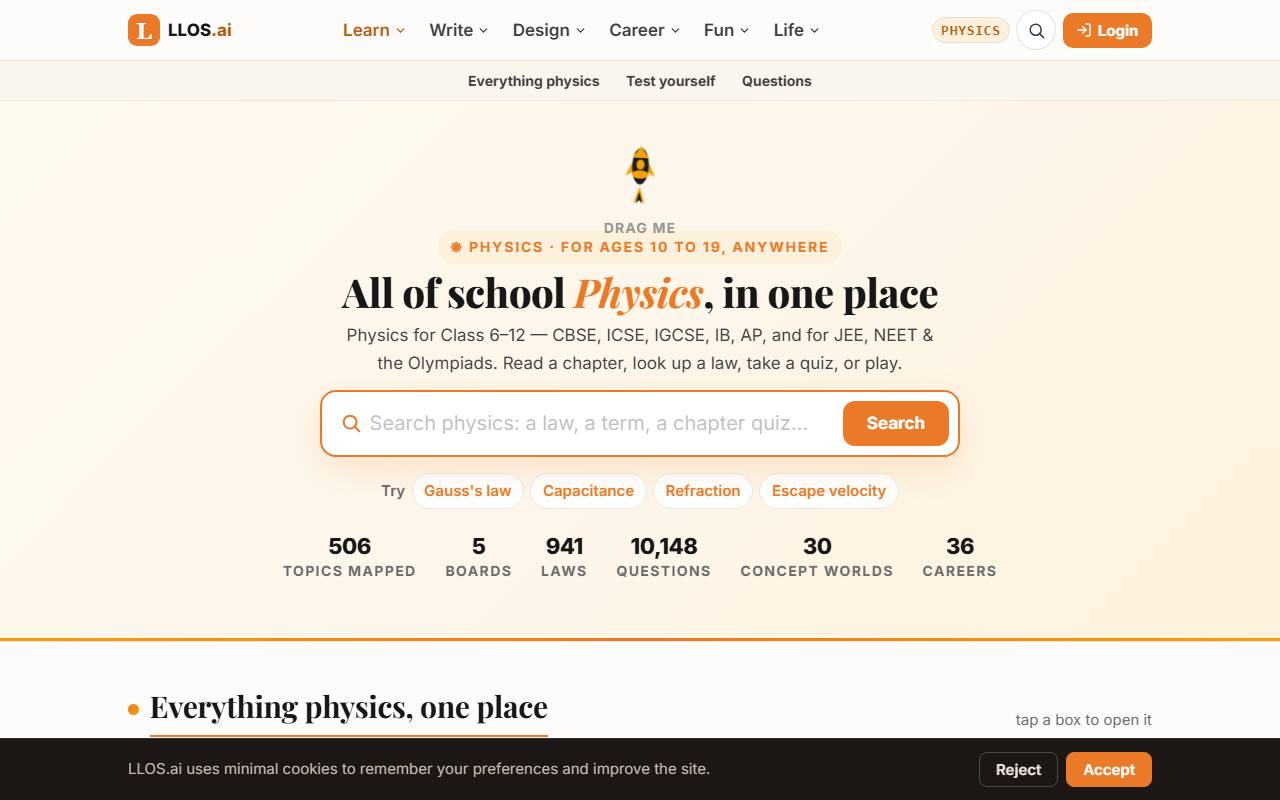
- Physics HubHUBthe mother engineAll of school physics in one place — and it answers back. The thing happens first: spin a disc, notice the law, then learn what it is called. Nine ways into one idea — play it, read it, work it out, look it up, drill it, say it aloud, test it at your board — and the system knows they are one idea. Built once at full depth, so chemistry and biology inherit an engine instead of starting again.
- Laws & PrinciplesLIBRARY8,700+ principlesTwenty disciplines. The rules the world actually runs on, before anyone sits an exam.
- KineticaGAMESThree distinct versions—each a world of its own—covering 29 core concepts that together make up about a quarter of the physics foundation taught in schools. Instead of rote equations, Kinetica lets you spin a disc and see the underlying laws in action. It’s built for learning by doing, not just memorizing.
- Thinking LabLIBRARYAn immersive library of 413 think cards with puzzles and ideas across 24 topics. For ages 6–19. No scores, no timers—just space to think, discuss, and explore how your mind works.
- Student HubHUBages 3 to 25Four life stages, each with a series of tools and experiences for sustained education for that age group.
- Stream ExplorerAPPUnderstand where Science, Commerce, or Arts can take you after Class 10—so you can explore careers and courses before you make a decision.
- Psychology for BeginnersSERIES3 theories“Psychology theories don’t compete — they take turns explaining the same moment.”
- Parent HubHUBguide, don’t hover“Praise effort, not cleverness. ‘You tried hard’ — not ‘you’re so smart.’”
- Teacher HubHUB86+ classroom gamesOrganised by the age you teach. “Project it for circle time.”
Wordsdictionaries, names, stories, and Indian colloquial speech from 1948 on
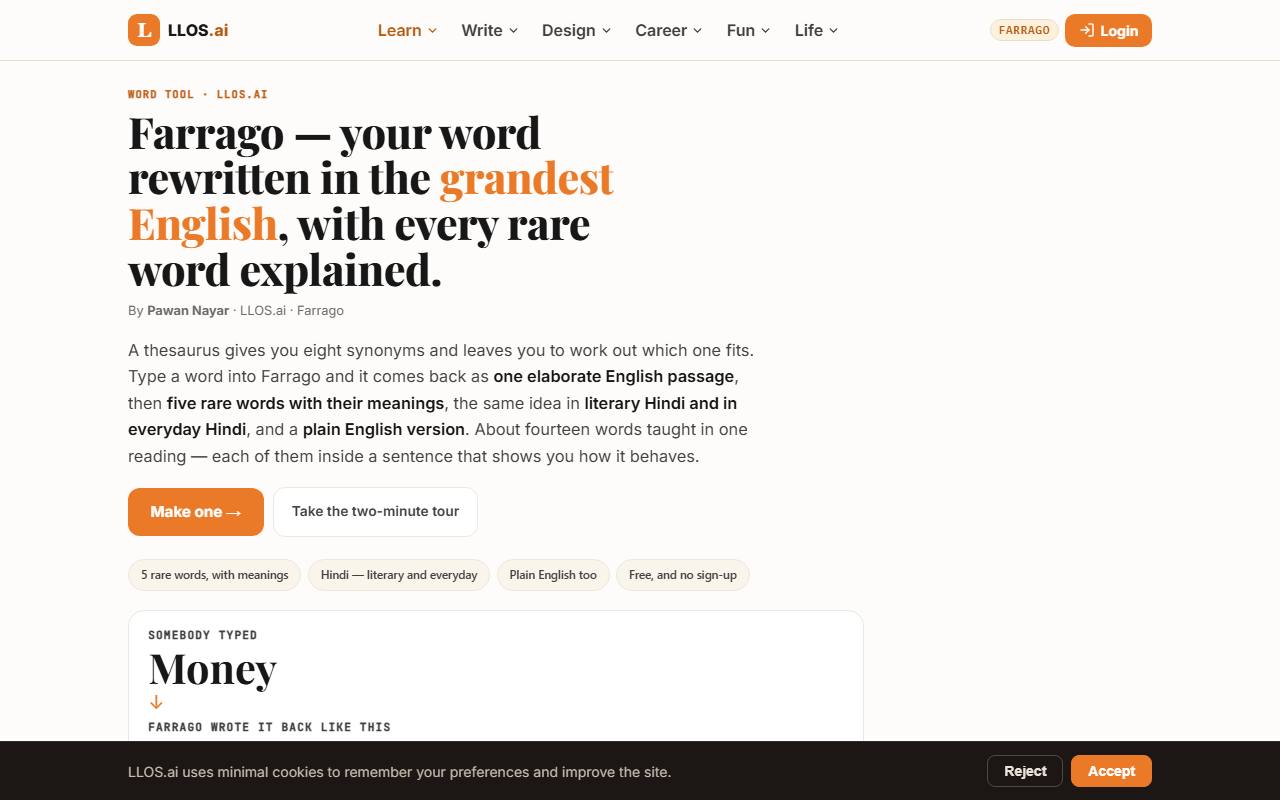
- FarragoAPPSIGN‑INTurn simple words into grand English. You type a word, a phrase, or even an emoji. Back comes an ornate sentence, five rare words that mean something similar, the same idea in Hindi, and a plain English version so you always understand what it says. One quotidian word returns magniloquent, and fifteen to twenty hard words arrive with it. A thesaurus gives you eight synonyms and leaves you to work out which one fits. Farrago sets each word on a stage inside a sentence and lets it perform — you see how it behaves before anyone asks you to use it. Take the hardest one and keep it. You arrived with one word; you leave with a cast.VisitA real turn · the word was “melancholy”melancholy — a deep, pervasive sadness or pensive gloom“One finds oneself enshrouded in a lachrymose atrabiliousness so exquisitely all‑pervading that even the consolations of literature offer but a palliative simulacrum of solace — a condition, I dare say, not of weakness but of the profoundly sensitised soul’s irrefutable awareness of the world’s transience.”atrabiliousness — a gloomy, ill‑tempered despondency, historically attributed to an excess of black bile.
- Name SearchLIBRARY11,000 names, growingA name card gives what the name means, where it comes from, how it is said in IPA, and three values the name has stood for.VisitOne name, openedAarav — peaceful, sound, musical note, or dawn.Often associated with the first rays of dawn, symbolising new beginnings and clarity, reflecting ancient Vedic reverence.
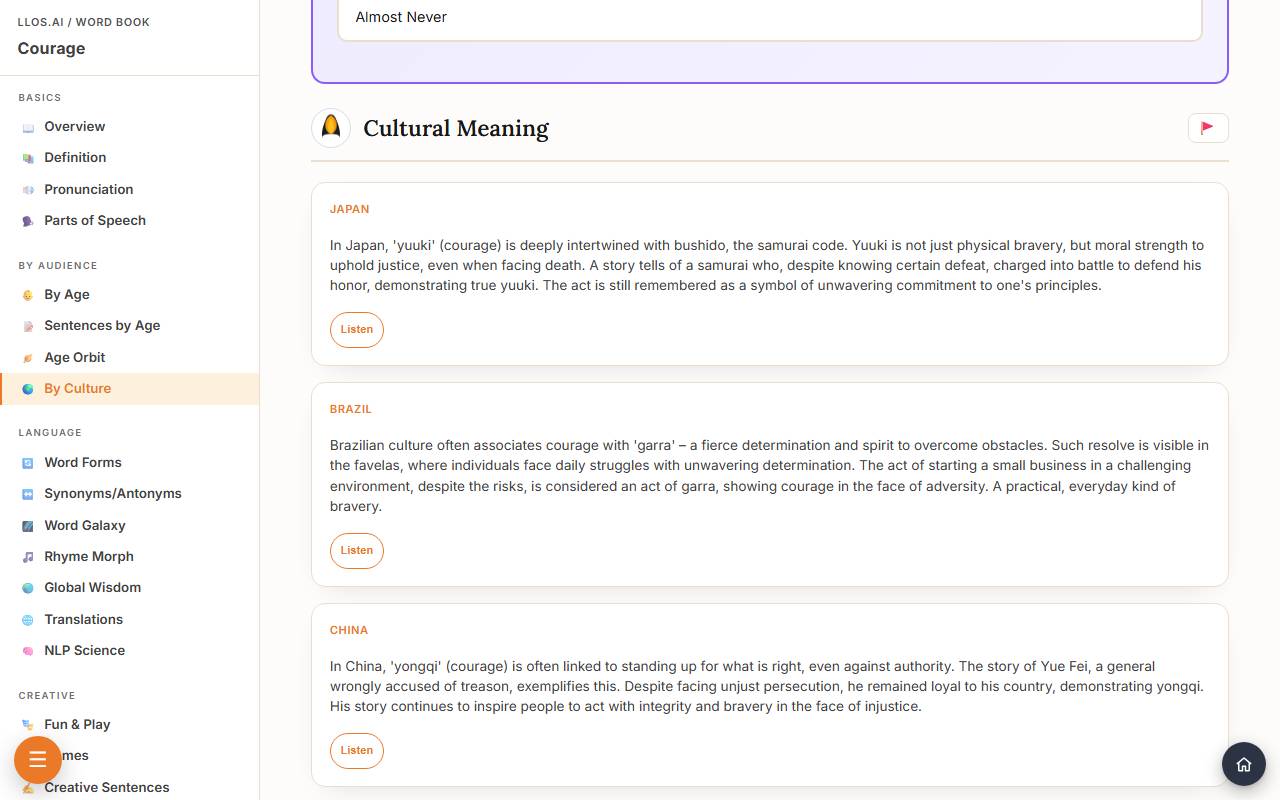
- Beyond WordsLIBRARY400,000 entriesEach ~20,000 words across 42 sections. Eight age bands, ten professional roles, seven cultural readings — per word.VisitOne word — pride — read four waysAge 3–6Pride is the happy feeling when you do something all by yourself.Age 14–17Pride is standing up for your beliefs, defending your story, or walking tall when it’s hard.IndiaSacrifice speaks louder than self-praise. A father paying school fees before eating, a grandmother sewing late into the night—these are acts of pride, rarely named but deeply lived.JapanJapanese tradition honors pride in refinement. A single bonsai pruned over fifty years.And its proverbs come from 24 cultures. Yoruba, Nigeria: “A swollen head does not mean a full stomach.”
- Kids DictionaryAPP2,114 playful, interactive lessons in 127 categories. Each word is shaped, sounded, and storied—paired in English and Hindi, never machine-translated—for children aged 2–7 to explore and learn.
- Picture ChartsLIBRARY70+ maps1,000+ words with sound, grouped by system and age band, English and Hindi.
- One word, openedARTICLE30+ sections, 20,000 wordsThe word is pride. Its proverbs draw on 24 cultures. A word‑relationship graph you can drag; a 1,000‑year meaning timeline.
- BolchaalLIBRARY234,000 entriesThe largest curated archive of Indian colloquialism — cinema, idiom and feeling from 1948 to today.
- SAT VocabularyAPP7,300 wordsAppreciate everyday words with several meanings — undermine, arbitrary, sanction — where the sentence decides which meaning is right. You choose between words you half-know.
- Bilingual ConversationsLIBRARYHindi · EnglishHow people actually talk, code‑switch and pause — with grammar notes and cultural context.
- Proverb ExplorerLIBRARYworld wisdomProverbs and idioms across civilizations, searchable by meaning, with lineage.
- Word GamesGAMES32 gamesOne plays against a 300K dictionary; another reassembles thousands of famous quotes. And many more.
- Bilingual StoriesLIBRARY37 cultures500+ tales for ages 4–6. Tap any word to learn it. “One story tonight. A whole world by the year’s end.”
- LetterpathAPP188,440 wordsGrow a word one letter at a time; every tile must lead somewhere real. Four modes, up to the full dictionary.
- TOEFL PrepAPPflashcard engineDifficulty and topic filters, round sizes, full keyboard control.
Writetools for writing, voice, editing and speech
Aphorist Studio, Creative Studio, and Expert Slogan are studios for language that must matter quickly.
Aphorist Studio turns an unfinished thought into a quote, aphorism, prose, or poetic line with weight, shape, and meaning. Creative Studio finds words for slogans, bylines, creatives, images, feelings, and relationships. Expert Slogan gives brands a concise phrase that can hold a position in the mind, and the option to select from hundreds of similar creative options.
Each studio begins with a text fragment: a word, feeling, image, brief, audience, occasion, or constraint. That fragment is developed through voice, tone, structure, rhythm, imagery, and controlled variation until it becomes language suited to a particular purpose, such as a slogan, quote, byline, prose, poem, or aphorism.
The work does not end when a sentence appears. The studios are built around the full life of a short line: how an idea enters; how voice, audience, and context shape it; how conflicting constraints are reconciled; how familiar language is avoided; how alternatives are made meaningfully different; how a promising line is refined; how sources and precedents are understood; and how the decisions behind the work remain available later.
A line can be tightened, elevated, reversed, repaired, or rebuilt from parts that almost succeeded. A discarded line can retain its reason for rejection and its settings — not as the centre of the product, but as part of a wider system that makes revision cumulative rather than repetitive.
These studios do not treat short writing as a sentence generated by chance. They treat it as designable work: the difficult and valuable task of making a few words carry a great deal.
- Aphorist StudioAPPSIGN‑IN476 voicesChoose how any line is made: build it around contrast, center it on one word, or leave space for the reader to complete it. You can also choose how unusual the vocabulary should be. Its rule is simple: “No comfort clichés.” With practice, learn to write like the greats of all time.
- Creative StudioAPPSIGN‑IN3 modesMake creative slogans and wishes like an advertising agency. Generate any magical line or slogan or creative byline on demand.
- Writer HubHUBfour stagesFoundations → Craft → Creative → Career, with a mode toggle so the same page reads for a learner and a working writer.
- Word FrequencyAPPSee the words and phrases you use most. Analyze single words or multi-word phrases, choose how contractions are handled, apply filters, and export the complete results.
- Note NinjaAPPCapture notes in two ways: dictate directly on your device with Whisper—nothing sent to a server and no usage cost—or write in a text command center with live Flesch readability scoring.
- TTS WizardAPP21 languagesAn empathy dial: “when the voice meets a word that carries weight — grief, hope, courage — should it slow down and hold it?”
- KeysmithAPPMaster the craft of typing through an original article, three interactive labs, 100 practical tips, and a four-mode training program designed for a month of practice. Finish it to earn a server-verified certificate.
Designa studio, a school, and a hundred thousand shapes
- Green RoomAPPGet ready for a meeting. Before you join a call, check your lighting, camera framing, and background live, and understand the single most useful thing to fix. Nothing is uploaded.
- Icon BlenderAPPSIGN‑IN17,000 rated vectorsCombine icons through eight visual relationships—not a stack of filters. Swap parts, apply one icon’s visual skin to another, fit forms together, create a true mix, separate elements, fill shapes, or use pathfinder-style operations. Every blend becomes a small visual sentence.
- TextStockAPPSIGN‑IN59 readings per wordExplore a word through 59 tailored readings: from age five to postgraduate level, across five regional contexts. Each entry includes a deliberately chosen silhouette whose form and symbolism connect to the word.
- The Design CoursesSERIES38 articles, 7 seriesLearn Color, Typography, Layout, Usability, Gestalt, Information Architecture, and Theory vs Practice through 38 authored articles. Each series combines explanation with live labs and a quiz, so you can test ideas rather than just read them.
- Design GlossaryGLOSSARYEvery termA practical visual glossary for design language. Each term comes with a plain-language definition, a relevant palette, a type pairing, a prompt, and a shape selected to carry the idea visually.
- Designer HubHUBThe whole craftOne place to learn, play, make, explore careers, and use the glossary. It connects the parts of design practice that are usually scattered across separate resources.
- Expressive ExplorerAPPSIGN‑IN100,000+ shapesSearch more than 100,000 shapes by what they mean, not simply what they are called. Every result is hand-rated, with five- and six-star selections identifying the strongest matches.
- Shape LibraryLIBRARYHand-ratedFind shapes in three ways: by role, category, or feeling. Search for the mood you need—not only the object you can name.
- Image → ShapesAPPSIGN‑IN11 output typesTurn a photograph into a clean, scalable vector in 11 distinct styles. Processing happens on your device: nothing is uploaded, and there is no AI usage cost.
- Train Your EyeAPP4 labs, 0 lecturesBuild visual judgment by doing. Squint to judge composition, kern type, build a palette, and discover why Harry Beck’s 1931 Tube map deliberately bends geography to make the system easier to read.
- Emotion of CharactersLIBRARY288 shapes, one engineExplore a structured map of human expression: eight emotion families, each shown at three intensities, creating 24 emotional states. Each is drawn across 12 character types by one adjustable system with nine movable parts.
- Designer SVGsLIBRARY800 shapesA collection built slowly, one shape at a time, with only the successful work retained. No scraped assets, API dumps, or generic clip art—just curated SVGs made for designers.
- Design GamesGAMES10 gamesLearn color, typography, and the reading of shape through play. The collection also includes a 987-question quiz spanning 50 design themes.
- Emoji → VectorAPPSIGN‑IN4,300+ emojiWork with real emoji path outlines, not screenshots. Choose from four finishes and six motion treatments, using assets available under an open license.
- QR StudioAPPScan-safeCreate QR codes that are designed to work in the real world. It checks contrast, module size, and quiet-zone spacing as you work—so you do not hand someone a code that fails at the till.
- Angle StudioAPPPortrait anglesFind the camera angle that works best for a face. Its diagrams are generated by the tool’s own function, meaning every image in the accompanying article is a real output, not a decorative mock-up.
- Design PlaygroundAPPA mood engineCreate visual directions by layering gradients, patterns, textures, shapes, and typography. Each composition is seed-based for repeatable exploration, and the generated CSS is available to copy and use.
Career1,949 jobs, their real tasks, and a prompt for each task
The Software Atlas starts from the job, not the user interface. Seventy‑six programs are turned around into the work people actually do with them — 20,535 real tasks, each with a ready prompt.
One of them, in Acrobat. A structural drawing set has gaps around a cantilever detail and the HVAC routing is missing, and you cannot tell whether that is deliberate. The page gives you the situation, a prompt that helps you decide whether to send the whole set back or mark it up and ask for targeted fixes, and the six steps in Acrobat to add the comments.
Behind it sits the Work Atlas: 1,949 jobs, the 1,265 tools they run on, and 38,525 ready prompts, drawn from O*NET, ESCO, the U.S. Bureau of Labor Statistics and UK National Occupational Standards.
The Software Atlas — seventy‑six programs, by the work they do
- The Work AtlasLIBRARYA map of real work, not imagined tasks. It contains 8,707 evidence-based tasks across 1,949 jobs and 1,265 tools, sourced from O*NET, ESCO, the U.S. Bureau of Labor Statistics, and UK National Occupational Standards. “Not one of them was invented.”
- Software AtlasLIBRARY76 programsEvery program turned around to the work people do with it: 20,535 real tasks, from Word, Acrobat and Photoshop to Excel and Canva, each with the situation, a ready prompt, and the steps in the program itself.
- AI for EveryoneLIBRARY15,413 promptsPractical AI guidance written for 12 distinct audiences, in language that fits their lives. That includes 975 prompts for mothers, 977 for fathers, 970 for teenagers, and 989 for teachers—rather than one generic prompt list for everyone.
- Career ExplorerHUBA more playful way to begin career discovery. Take a 12-question fit check, guess careers from clues, experience a week in someone’s working life, and solve a career-themed crossword.
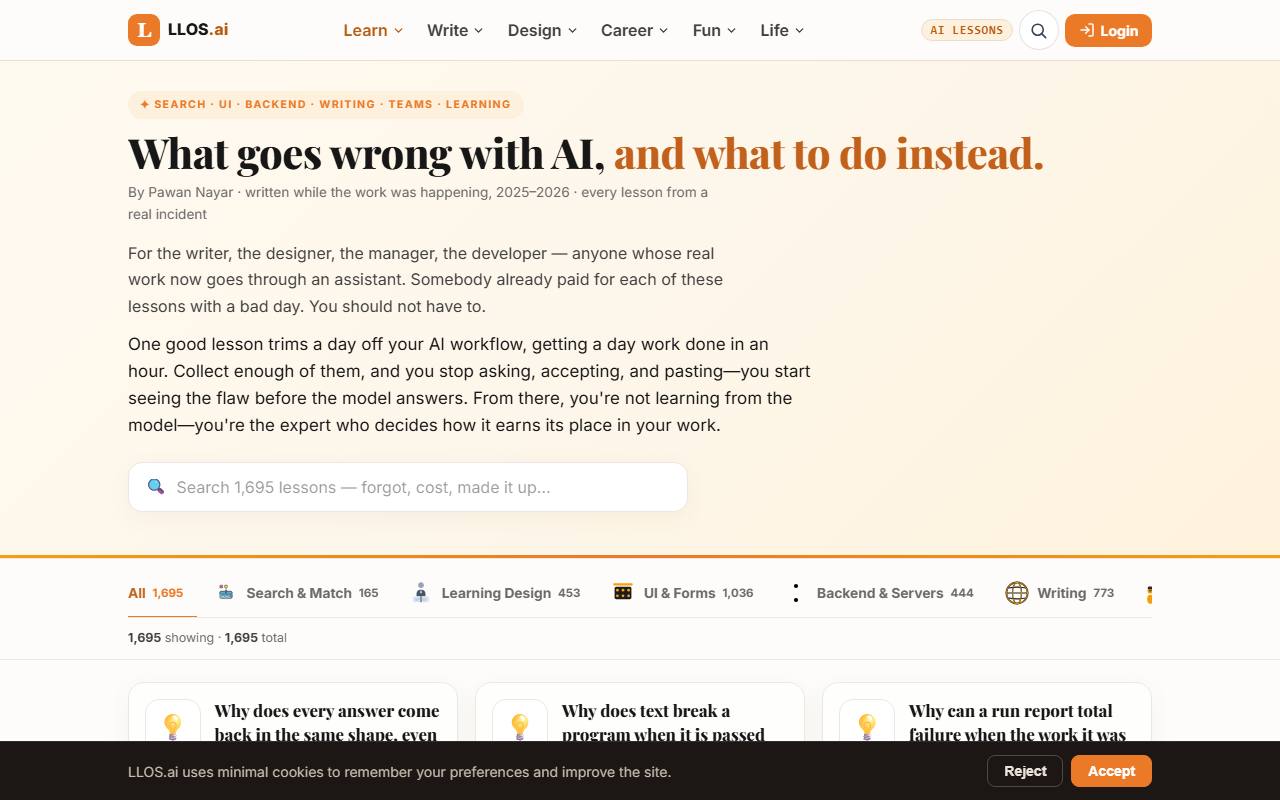
- What goes wrong with AISERIESFrom real incidentsA learning series built around things that have already gone wrong with AI. Each lesson starts from an actual failure, so readers can recognize risks before they have to learn them through a bad day of their own.
- The AI CourseSERIEStwenty‑five daysIn five weeks you stop asking an AI questions and start handing it real work — deciding whether it belongs in the task at all, choosing what to give it, judging what comes back, fixing it when it is wrong, and putting your name on the result. Every lesson runs on the learner’s own material: no invented company, no tidy scenario. If a lesson cannot be done on real work, it is the wrong lesson.
- Careers A–ZLIBRARY1,949 jobsExplore each career through 19 real tasks, not vague descriptions. Every entry includes pay data from a named government survey and year, plus task-specific prompts that show how AI can support the work.
- ActivitiesLIBRARYA practical guide to where AI can help, where it should only assist, and where it cannot take the place of a person. It includes the hard boundaries too: grief, dying, mourning, and other experiences where reality—not a model—holds the grading pen.
- Soft SkillsLIBRARY88 skills, 1,649 blueprintsBuild skills such as communication, judgment, negotiation, resilience, and leadership through usable blueprints. The guidance is grounded in named sources—and leaves room for where credible sources disagree.
- Prompt LibraryLIBRARYfive lensesFind prompts in the way you naturally think: by career, software, task, skill, or tag. With 8,569 routes into the collection, you can start from the work you need to do rather than from an empty chat box.
- Writer task libraryLIBRARY1,326 tasksA working library for the actual tasks writers face: not just “write an article,” but specific jobs within research, structure, drafting, revision, and publishing. Every task has a prompt written for that task alone.
- Career Thinking LabSERIES16 cardsCareer questions designed to make you think before the system helps. Write your own answer before the hints unlock, then test it against a built-in reality check that challenges the card’s own assumption.
- Professional HubHUBfour stagesPlan across four professional stages: early career, growth, leadership, and legacy. Explore purpose through Ikigai, identify skills that compound over time, and connect career choices with money.
- Auto CalculatorsAPP45 toolsTools for the financial questions that go beyond a standard EMI calculation: borrowing, saving, investing, salary, affordability, and more. The credit simulator also states its own limits, so a number is not mistaken for financial certainty.
Lifefeelings, relationships, reflection and sacred texts
- Bhagavad GitaLIBRARY700 shlokasRead all 18 chapters in Sanskrit, with transliteration, word-by-word meanings, and grammatical notes. Three named commentators offer distinct interpretations, so readers can encounter the text as a living conversation rather than a single fixed explanation.
- Inner GrowthHUBall traditionsBegin with Rumi, the Bhagavad Gita, Psalms, the Tao, and the Quran—placed side by side, without ranking one above another. A place to study how people have made meaning across traditions, never a place to be preached at.
- Feelings DictionaryGLOSSARYFind the more exact word for what you are feeling—beyond simply “good,” “bad,” “stressed,” or “fine.” Naming an emotion can make it easier to understand, communicate, and decide what to do with it. “You cannot work with what you cannot name.”
- Soothing JourneysAPPA short, browser-based pause for difficult moments. Follow a breathing circle, choose from ten paired sound-and-image soundscapes, and use six gentle questions to return attention to the present. Nothing needs to be installed or sent anywhere.
- Audio HubHUBExplore sound through 1,220 guided “recipes,” 39 nature sounds, and six listening games. Learn to identify instruments, notice rhythm, and hear subtle differences in sound—such as ship and sheep—by listening rather than memorizing.
- Relationship LabSERIESExplore relationships across romance, family, friendship, work, and the relationship with yourself. Designed for both students finding their way and parents who want better language for the conversations that matter.
- Wisdom ExplorerLIBRARYCompare how different traditions respond to enduring human questions: How should I live? What do I owe others? Why do people suffer? What makes a meaningful life? The aim is not to choose a winner, but to recognize patterns, differences, and possible sources of insight.
- Seeker HubHUBMove at your own pace through four stages: question, explore, practice, and deepen. Take what genuinely illuminates your life; leave what does not.
- MusingsLIBRARYas Grandpa saysA grandfather from the 1980s left thousands of short thoughts, and his grandson is bringing them in a few thousand at a time. Nothing is polished for print — it is the unedited waste‑book of a wise man, kept because the raw record is the treasure. He read moral life as bookkeeping, expectations as debt. Every line can be heard aloud.
Playninety‑plus games, ages one to ninety‑one
- Games ArenaHUB77 gamesSix categories, ages 1 to 91, free.
- Learn PianoAPP200+ tunesSeventeen eras from Baroque to Bhajan to Bollywood, with Sa Re Ga Ma named beside Do Re Mi.
- FuntainmentHUB70+ gamesFive worlds. No login, no ads, no wait.
- Kids GamesGAMESages 1–8Animated alphabets, emoji carousels, bilingual first words, read aloud — nothing to read to start.
- Math GamesGAMESages 3–12Fraction pizza, a BODMAS trainer with step‑by‑step animation, equation builders.
- Neon MazesGAMES20 hand‑drawnRecursive‑backtracking generation, eight solving algorithms, each with its own mascot.
These 76 are a selection. The full site runs past 1.2 million pages, reachable from the home navigation.
Next · 03 · Seven frameworks
03 · The assets
Seven frameworks
I built seven systems in order to make the platform, and each one outgrew it. They stand on their own and travel into other products, organisations and categories. The public site is what they produced.
And read their numbers the right way: not as stock, but as rate. 416,705 questions is not a pile — it is the reading on a running meter, what the engine had made by the morning I counted. Every number is growing. A million more is a scheduling decision, not a dream. The content is what these machines emit. The machines are the work.
How they connect
The seven are connected. A word reaches its phrases; the phrases reach a glossary entry; the entry carries the questions that test it, the subject it belongs to, the law or the how‑to it explains, the drawing that means it, the way it sounds in three accents, and the job someone does with it on a Tuesday. The same concept is then re‑formed for an age, an activity, a role, a purpose — or simply for someone who wanted to feel better about it.
One entry for the word pride carries a board‑mapped question bank, a line shaped the way Ghalib would shape it, a drawing that means it, an Indian‑English pronunciation, and a voice artist’s direction on which sound to soften.
Framework 01
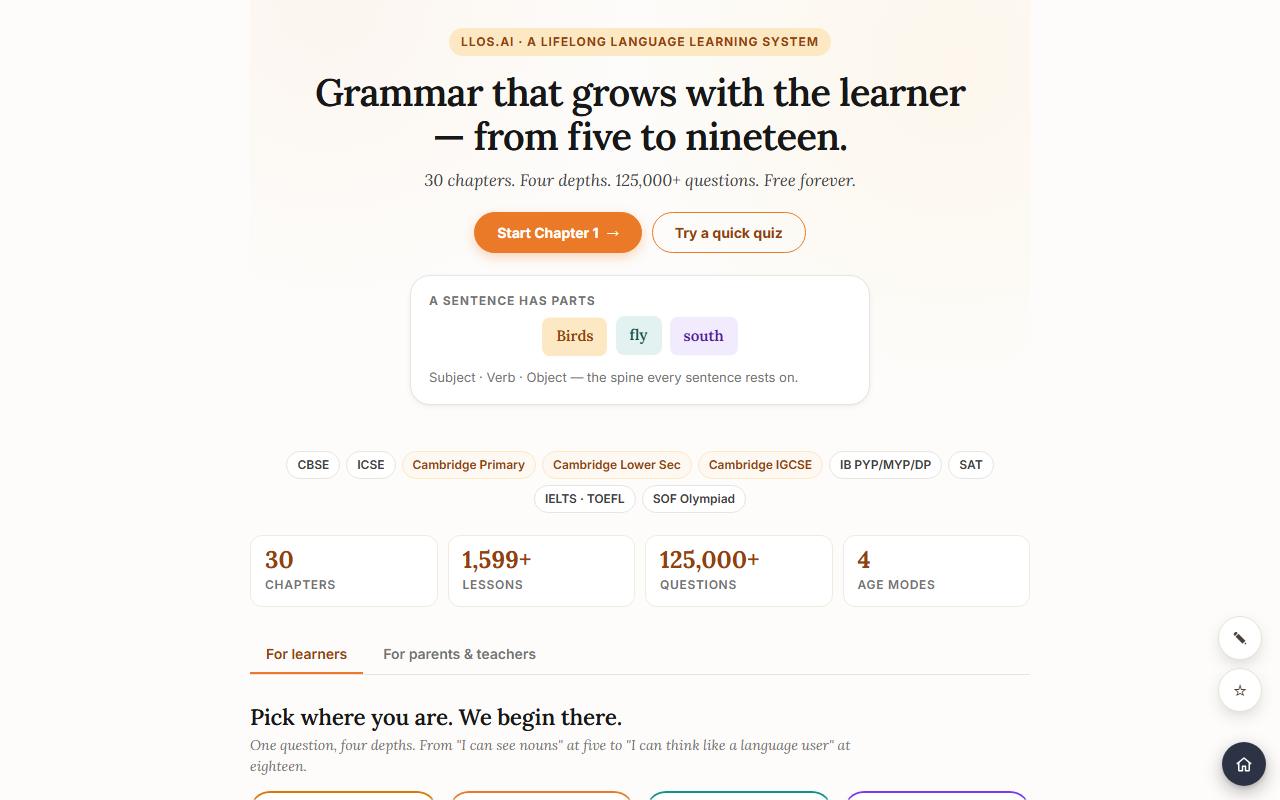
Question Server and Interaction Learning Framework
One question store holds 416,705 questions today, each recorded as a structured row with 88 typed fields. A question carries its subject, class, chapter, topic, skill, sub‑skill, difficulty, Bloom level, age range, region, and the boards or exams it fits. That structure lets the same verified question serve CBSE, IGCSE, IB, or a product‑specific pathway without being copied.
How it works
Designed to grow from thousands to hundreds of millions of questions without losing track of where each one came from.
For creators. Questions are data, not a screen. A delivery recipe can turn the same underlying rows into a spelling bee, a synonym match, a parts‑of‑speech activity, an error‑correction drill, a career quiz, or a reflective poll. Further, you can have quizzes with sounds and images. New learning experiences do not require rebuilding the question bank or rewriting every question; creators define a new interaction recipe, its rules, its feedback, and the rows it can use.
For learners. The system does not treat an answer as simply correct or incorrect. Each interaction is designed to reveal a distinct skill: noticing an error, correcting it, choosing an answer, explaining a choice, sorting examples, or producing an answer from scratch. Grammar alone has 16 authored interaction formats, because recognizing a mistake and repairing it are different kinds of learning.
When a learner is wrong, the feedback can identify the specific misconception behind that response, explain why the tempting answer fails in that context, and offer a next step: a smaller example, a contrasting case, a retry, or a related question. A bare message such as “Incorrect. The answer is B” fails the standard.
Where it stands. Each row carries its own review state: 44,458 approved, 57,441 active, and the remainder pending review. The system can show authors, operators, and learners what has been checked, what is live, and what still needs review.
Framework 02

Word Referencing and Understanding Framework
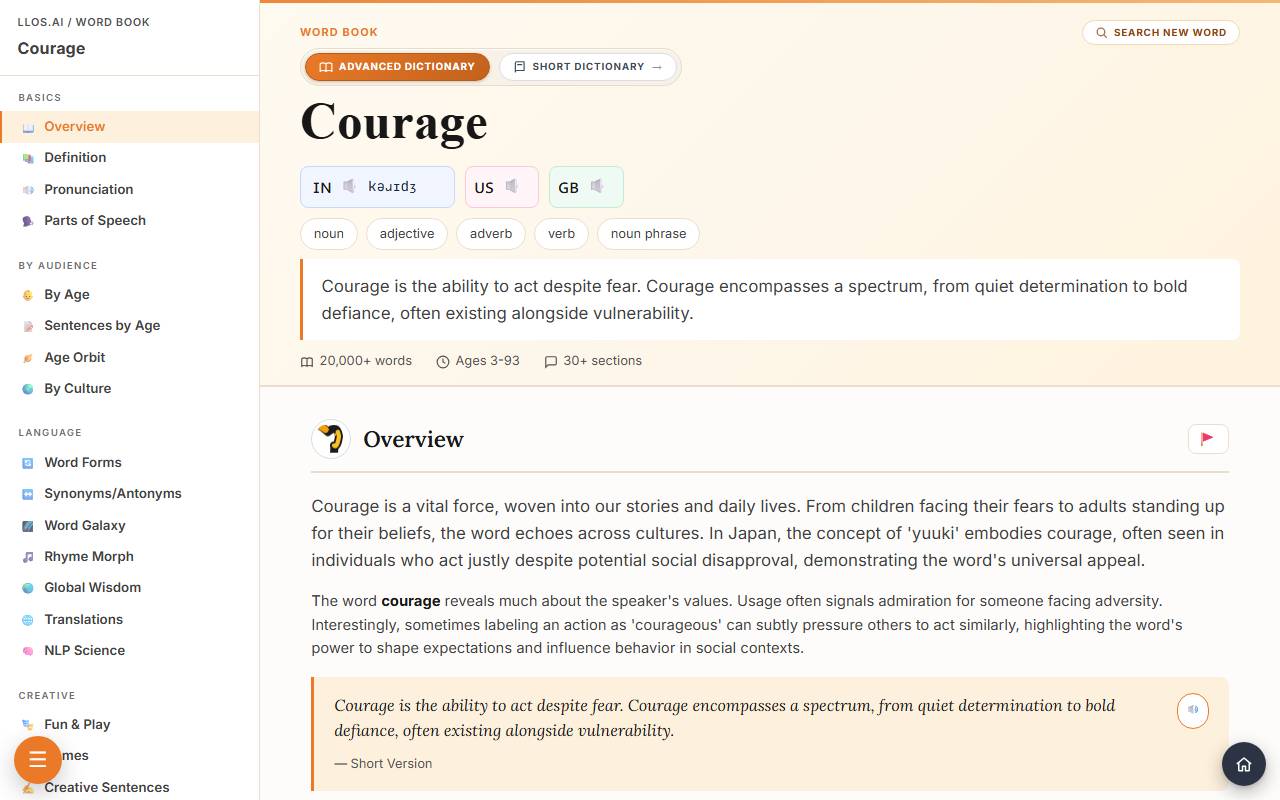
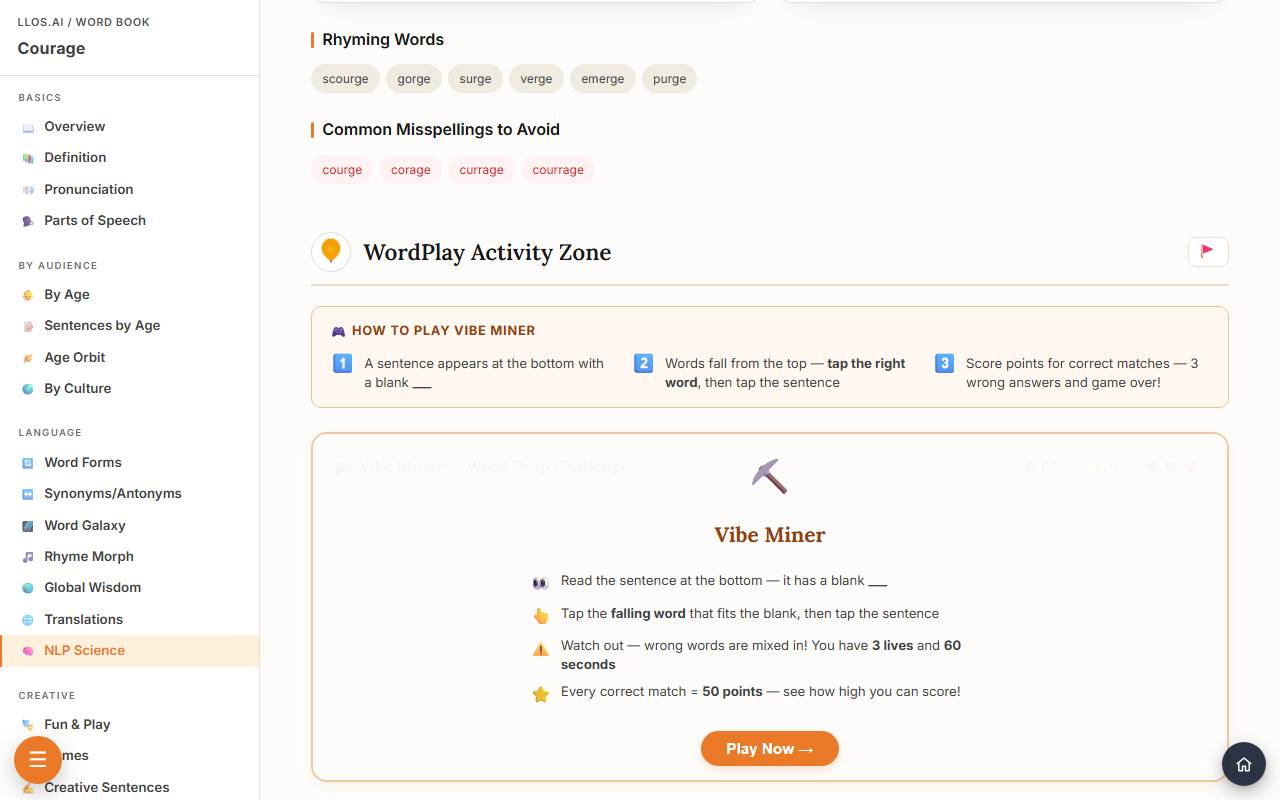
A word is treated as a connected learning object rather than a definition alone. One word entry can hold its meaning, how it is said in more than one accent, how it changes form, the words it sits beside in real sentences, what it means to a six‑year‑old and to a sixteen‑year‑old, how it is used at work, and where it appears in culture and literature. The same entry can answer in a line or open into a reference of thirty sections, depending on who asked.
How it works
For creators. A word is a structured record, not a page. Meaning, pronunciation, parts of speech, age bands, cultural readings, word forms, synonyms and antonyms, and example sentences each sit in their own block, and Hindi is authored as a parallel set of the same blocks rather than translated from the English. That lets one word be published as a short reference of about 3,500 words or expanded into a long reference of 20,000 words with its own interactions, without writing the word twice. What people search for and cannot find is logged, and that log becomes the build queue.
For learners. The entry meets you where you came from. A child gets the meaning in a sentence they can use. A student gets usage, opposites, and word history. A writer, a marketer, a designer and a voice artist each get a reading written for their work, down to which sound to soften when the word is read aloud to a child. And the word carries its own practice: 87,028 questions are tied to 29,217 individual words, so reading a word and being asked about it are the same system.
Where it stands. 400,000 words exist in the short reference. 10,000 are being built as long references. Anyone can ask for a word to be built to the full standard, and you can check the request status.
Framework 03
Writing Studios and Creative Line Framework
A set of writing tools for producing and improving a line with deliberate control. You choose the purpose, the voice, how rare the words may be, the shape of the sentence, where it turns and where it pauses, the sound effect, and which literary influence stands behind it. The combination of options making a unique sentence could give you 101 trillion combinations. It is built for the practical line, and the expressive one, and its own setting refuses comfort clichés.
How it works
For creators. We didn’t write the voice list by hand. 476 voices, distilled from a study of 465 writers across 20 languages, to find what actually varies in writing: 9,300 traits, clustered into 52 dimensions in nine groups, from pacing and point of view to how far a sentence departs from convention. Those dimensions now drive the controls. Choose Shakespeare, and the settings that don’t suit him fade, but none are blocked, because the combination nobody expected is often the one worth keeping.
For writers. The controls are the craft, not decoration. Vocabulary runs from a child’s words to a specialist’s. The shape of the sentence is its own control, separate from its tone. Translation carries a register, so a line can arrive in Hindi as ordinary speech or as literature. And Trace answers a different question: give it your line and it finds where that thought has been said before, drawing on 150,644 passages from 16,680 named sources across traditions, with chapter and verse.
Where it stands. The studios generate on the server, so they ask for a sign‑in. They keep what they produce, and the weakest part is the judgment layer: very little of the output has been rated by a person yet, which is the difference between a large collection and a selectable one.
The studio is complemented by a slogan‑byline system with 600k entries and scale readiness for 120 million on common themes. Diversify themes and expand further.
Framework 04
Animated scenes from the library the design studio runs on. Each is a few kilobytes, and each one is playing here rather than being a picture of itself.
Expressive Drawings and Interactive SVG Framework
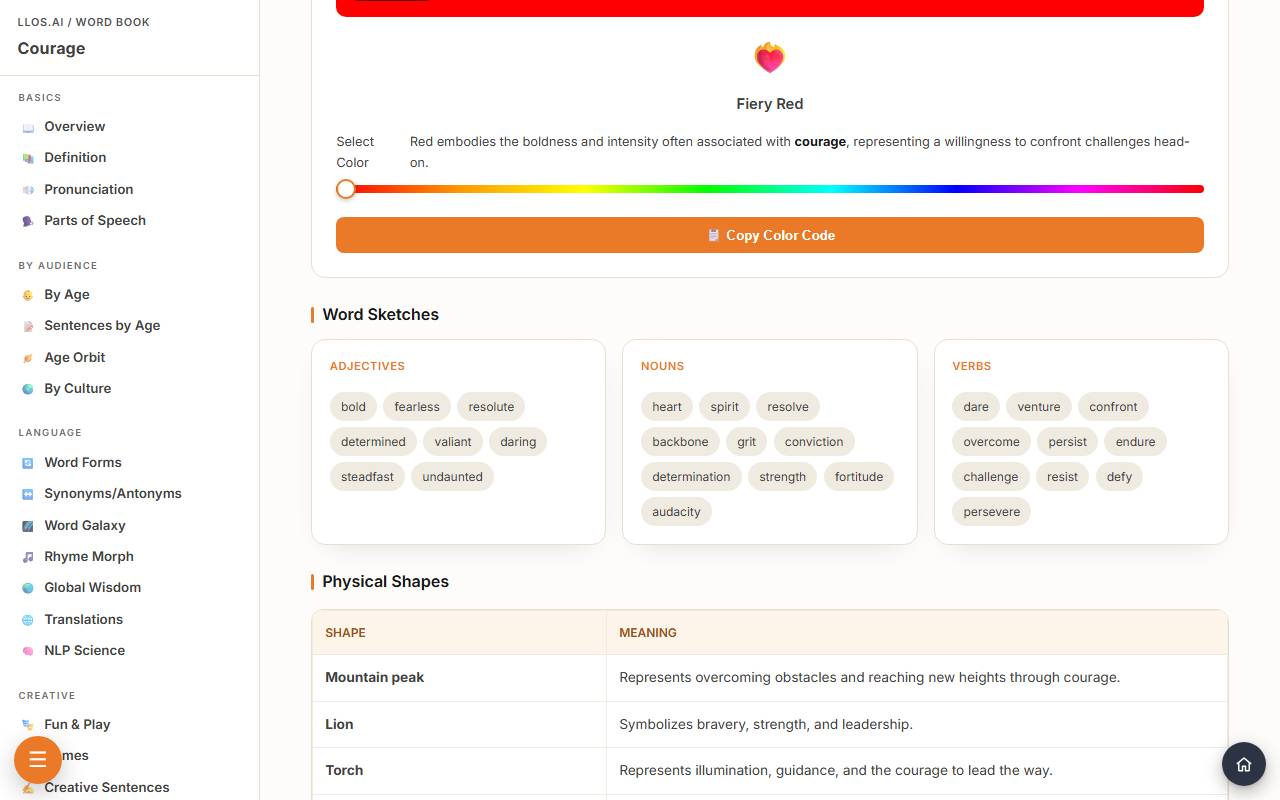
A visual system where a shape, an SVG (dual‑tone or multi‑colored, with or without motion), is chosen because it carries an idea, not because it decorates the space. Ask for courage, hospitality, or grief, and what arrives is a drawing of that idea, in two tones, usually in motion, weighing about a kilobyte. The picture can then explain, reinforce, or extend the sentence beside it. Never again suffer text walls or slow pages — always get what you get: an idea, seen, in a heartbeat.
How it works
For creators. The library covers 57,311 words (and growing), and it searches by meaning rather than filename, so an abstract word finds a real answer instead of a generic symbol. That matters most where no library exists: 37,233 of these shapes are qualities and states, and another 11,868 are thought and reasoning, which is the part every icon set skips because icons are made for objects and buttons. At about a kilobyte each and drawn as vectors, a site of a million pages can give every page its own meaningful drawing, with no image files and no designer in the loop.
For readers. The rules exist so the drawing is readable, not clever (unless that is what you want). A shape must fill enough of its frame to be recognized at a small size, motion must stay inside the frame at its furthest point, and the frame stays neutral so the accent colour still reads. A child should be able to name it.
Where it stands. 231,346 shapes today, and 50,575 of them rated by hand, one at a time, with 22,464 standing at five or six stars. Generating drawings is cheap and getting cheaper. Judging them is neither, and that judgment is the part that community socializing will scale.
Framework 05
Progressive Education Framework
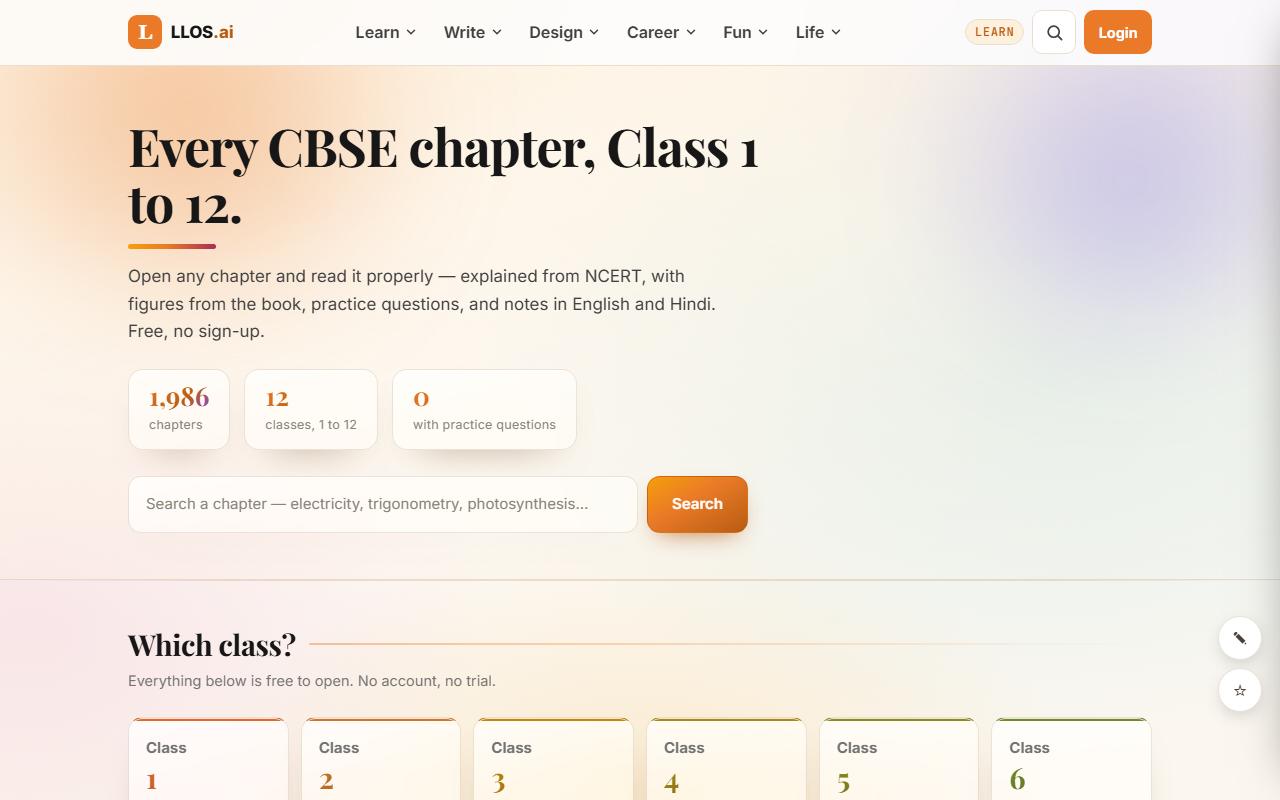
Most apps group by broad topic. LLOS is different: it follows the real schoolbook in your bag. You start from your exact class, book, and chapter—English or Hindi—so learning matches your real needs.
How it works
For creators. 1,986 chapters are mapped by class, book, and chapter, holding 13,740 topics and 19,452 concepts between them. The concept is the smallest unit, which lets a question, an explanation, or a practice set attach to the exact place a learner is stuck rather than to a whole chapter. 1,952 of the 1,986 carry both language streams, so Hindi is the default condition, not a later translation project.
For learners. You arrive with a real problem: tomorrow’s chapter, this week’s test. The system starts there, explains in the language you think in, gives you the practice inside that chapter, then shows how it sits in the book and the subject. Understanding comes from using the material, not from being handed more of it.
Framework 06
Subject Learning Framework
A reference and learning layer that teaches each subject in one place for all ages and boards. For example, Newton’s First Law is taught for classes 9, 10, and 11, and for CBSE, ICSE, Cambridge, and IB. The same lesson helps a child, a student preparing for an exam, or an adult who just wants to learn. No need for different books or apps.
How it works
For creators. 8,754 principles. 20 disciplines. Geography alone holds 1,233 — psychology 1,056 — both beating out physics. Around every concept, the same anatomy repeats: what it is, the formula, an interactive built for that concept alone, the everyday places it shows up, how to build it yourself, a glossary, the same words in Hindi, the questions people actually ask, the mistakes people actually make, and a test. A subject is produced, not written from a blank page each time.
For learners. You can enter at any depth and leave at any depth. The same concept can be a sentence, a demonstration you operate, an exam question with its hints, a game, or a piece of history. Nothing has to be finished in order.
Where it stands. The system compares what it teaches against real syllabi and names 241 places it hasn’t reached yet. The gap list is machine‑readable, so it serves as a build queue continually improving the system.
Framework 07
AI Lessons Framework
A method for using the AI tools that already exist as a dependable part of your work rather than an occasional helper. It is built from what actually went wrong: 11k lessons recorded, 1700 published, while building with these tools, each one written on the day it happened and turned into a rule with the reason attached.
A lesson is not a note. It carries the instinct that produced the error, what the error cost, the measurement that settled it, and the rule with its reasoning — so the next person meets the wall already knowing its shape.
How it works
If Google opened a window onto the internet, LLOS AI Learning opens a window onto the LLMs. It provides the right questions for the actual work you do — sorted by job, by the software you’re using, by the task at hand, by the skill you’re developing, and by the parts of life that have nothing to do with work. Roughly 170,000 prompts exist today, the library growing every day, each built for a single task rather than a broad category, and each comes with a follow‑up turn ready for when the response arrives.
For creators. Five different entry points, because people don’t all start from the same place. You can find the same task through the job that requires it, the tool that performs it, or the skill it falls under — built once, not rewritten three separate times.
- 1,952 careers · 39,300 prompts
- 9,019 software tools · 18,000
- 12 life areas · 15,500
- 470 activities · 14,811
- 88 skills · 1,649 blueprints
For learners. You begin with what you’re already doing, not a blank chat window. The prompts account for real conditions — an oven versus a pressure cooker, a return gift capped at eighty rupees, GST rules for a small business. And the system is honest about its limits: 500 activities are ranked by whether a model can actually see them through, and 71 are flagged as ones it can’t — grieving, dying, and mourning included on that list, not quietly omitted.
Where it stands. Underneath the AI learning process sits a running log of what went wrong: 11,000 lessons logged over 40k AI hours of work building these tools, 1,700 made public, each recorded the day it happened and converted into a rule with its reasoning attached. Of those, 270 are sequenced by when a person actually needs them — 45 for day one, 88 for the first week, 137 for the first month. Some have already been fed back into the systems generating this content, and the output has shifted as a result. Every figure shown to a learner carries its source and the date it was verified; anything untraceable stays hidden, and anything sourced secondhand says so.
What did not work is kept too. One voice experiment cut drift on some writers and made it worse on others; a fourteen‑point grid for describing how a writer writes held inside a batch and collapsed across 1,584 of them. Both are recorded with their measurements and the conclusion that the idea was right and the execution was not. A record that keeps only its wins cannot be used by anyone.
Next · 04 · The factory
04 · How it multiplies
The factory
Every part of LLOS.ai was made by directing these models — deliberately, from the first line. Not a site with AI features added. A site where AI did the making, under a method that was written down as it was invented: 40,000 hours of it, 1.2 million pages, six and a half years, three people, no funding. It is open. A four‑year‑old uses it and so does someone at fifty. The method is the work; the platform is what the method produced.
Everything above is what a user sees. This is how it gets made — starting with what it is not allowed to do. The machine writes nothing that cannot be traced to a source, and every part publishes the gaps it has not filled. Volume without those two rules is just faster mess.
It is also the part nobody can lift. A competitor with the same model cannot regenerate 55,000 acts of taste. The code can be copied; the corrections cannot.
The breadth was never the boast. This is: no company would build all of this, and until now, no small team could. AI didn’t do the work. It multiplied the one who did.
The thing that does the multiplying is one we had to build. You would never let a team delete its code at the end of every day, and that is what every AI tool does with the conversations — the corrections, the decisions, the answer that finally cracked the hard bug, gone when the tab closes. The Conversation Reviewer keeps them, so a correction made once becomes a rule the model follows afterwards: three to seven times the work done, measured on our own output.
See also · The Conversation Reviewer — request access
What it takes to make one
An article here is a specification. The same nineteen sections, in the same order, every time — and naming them is the fastest way to see what that means:
- What you will learn
- The formulas at a glance
- See it live — an interactive built only for this concept
- What is going on
- Solve it with me — a step‑by‑step wizard
- The maths, as small labs
- Myth‑busting
- Where it shows up in the real world
- How the technology arrived
- Build it yourself
- The glossary
- The same words in Hindi
- The questions people actually ask
- The mistakes people actually make
- Test yourself
- What to take away
- Where this leads next
Nineteen sections, in the same order, every time. The order is the specification — a build is not finished until every one of them is there.
Around it: twenty‑one drawn shapes, ten glossary terms each with a key question, six build‑it‑yourself projects, and a bank of exactly forty‑seven questions — sixteen shared, five written for each of six exam boards, one for Olympiad level. Every question carries three hints that escalate, and a written reply for each wrong answer.
The rules are in the repo, not in my head: the playbook runs to 251 lines, names the authority for every rule it summarises, forbids working from memory, and closes with the failure modes. A build is not finished until it serves clean at 360, 390, 412, 768 and 1280, every inline script passes a syntax check, and the demo, wizard and carousels all initialise.
Two rules in it do the real work. The subject picks the interaction — never a reused slider bolted on. The lenses article carries seven interactives that could not exist for any other concept: a ray builder, an impossible‑lens spotter, a design‑your‑own bench. And a quiz educates, it does not evaluate — options parallel in grammar and length so nobody answers by format bias, distractors plausible rather than absurd, and every wrong answer met with a sentence that reconnects. A wrong answer is part of the way forward.
Proof of concept: physics. Fifteen articles built to that standard, 660 questions total, each article running about 3,500 words and 200 kilobytes, with 200 drawings embedded.
And this is one article framework of seventeen: the same structure — shapes, glossary, projects, question banks, escalating hints, checked builds — repeats across sixteen other formats, each shaped to its own subject.
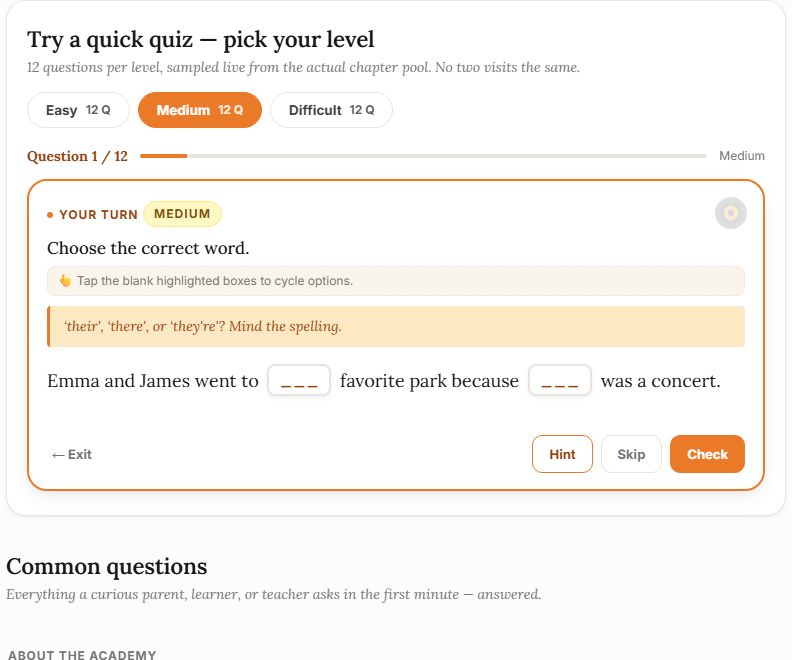

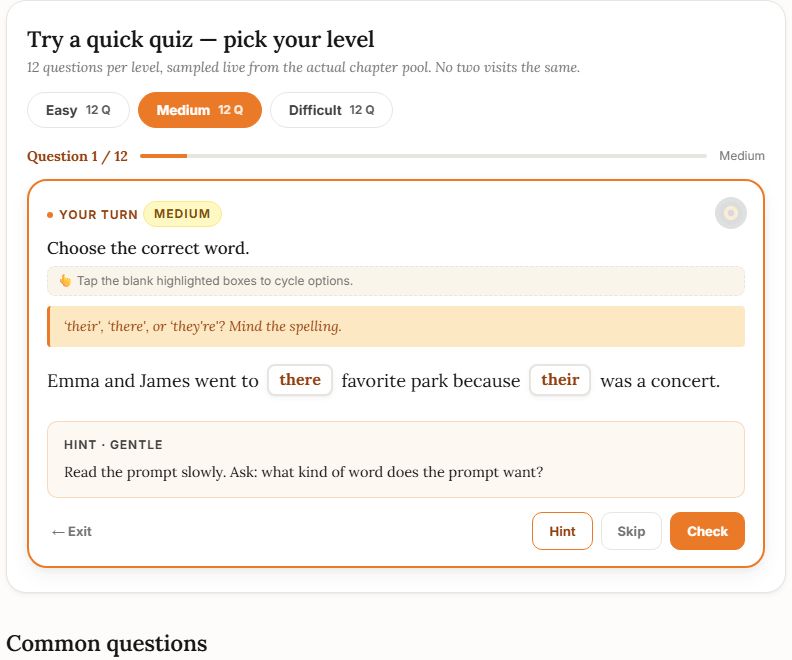
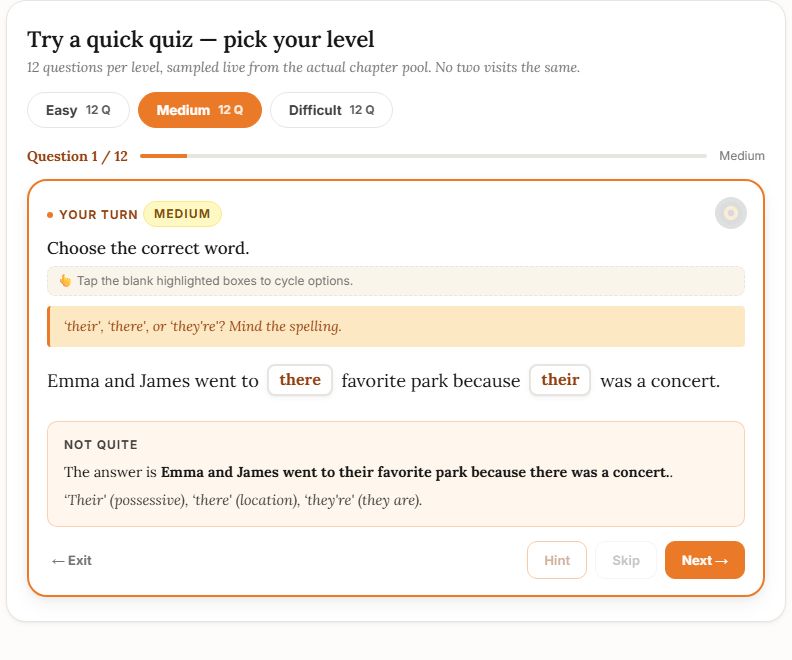
Four real states of the live Academy quiz. The wrong answer is not marked wrong — it is answered: the team is practising hard. Collective nouns take a singular verb when treated as a unit.
Every task here was seen in the real world. Someone doing the job named it, a real job ad asked for it, or a lot of people asked about it online.
If nothing real showed a task, it is not on the page. That is the whole rule.
Open it. Nine states are recorded for this one accordion — the last two are the ones nobody writes down, and they are why it takes ten to thirty passes.
The line the machine is not allowed to cross
Which parts must a person write, and how do you stop the machine reaching them? One of the builders answered it after measuring its own material: five hundred and seventy‑three entries in the corpus began with the same two words, and two hundred and forty with the same two after that. Assembled as written, the page would have been accurate and unreadable — a wall of one sentence shape.
So the rule was written into the builder, field by field. Structure is mechanical — sections, ordering, the questions people ask, the glossary, the quiz, the schema, all composed from data. Voice is authored — the title, the opening, and one framing line per section are written by a person, stored, and never generated. The list is short, which is why it scales. It is also exactly the part a reader judges the whole page by.
The same instinct runs through the build scripts themselves. Each one opens by naming the mistake that caused its own rewrite. One prints a two‑column table of what it invented against what the reference already had, and then deletes its own inventions. Another refuses to build at all if a heading begins with a pronoun. A third refuses to publish a section nobody has written an opening line for, rather than shipping a page with a tag for a headline. A rule a machine cannot check is not a rule.
How the rule holds at a million pages
A rule that says a person must write the important lines is easy to keep at a hundred pages and impossible at a million. The name pages answer it, and they are live. Twenty‑five names are written by hand — every meaning, every legacy line, every defence of an image. Any other name a visitor searches is built on the spot under the same rules, and arrives wearing a small badge saying it has not been read by a person yet. A person reads it later, and the badge comes off.
Where it goes from here
The same three layers are now being applied to subjects, careers and everyday activities. The template for each is a finished, working page.
And all three inherit the interaction density that a single word entry already carries: more than thirty sections, its quizzes and polls, a relationship graph you can drag and a thousand‑year timeline — on one word.
Where the judgment is kept
Four places collect the judgment behind this work. There is a page listing every component we trust, where each row opens the live page with that component highlighted, so the reference is the running thing and never a screenshot. There is a reader over every working session, with notes pinned to the moment they were made, so the reasoning behind a decision survives as well as the decision. There is a drawing workshop where every correction becomes a written rule that is fed into the next attempt, and where the measure of progress is how many corrections a reviewer still has to make — if that stops falling, the loop is not learning and the spending stops. And there are tens of thousands of drawings rated by hand, one at a time.
The record behind the method is public where it can be: 11,000 lessons were logged across 40,000 hours of this work — each written on the day the mistake happened and turned into a rule with its reason attached — and 1,700 of them are published for anyone to read. The reading room they came from — a reviewer that turns every working session into a foldable, annotated document — is one of the internal instruments, and it stays internal. Its lessons are on the site.
Every part publishes its own gaps
Every part of this publishes its own gaps, on the page, where a reader sees them. The map of what AI can do for five hundred human activities marks seventy‑one of them as ones where it cannot help at all, and says so on the page. The relationship set says thirty‑six of forty‑six are ready. The thinking cards say twenty‑two of four hundred and thirteen are fully built. The piano says which tunes have been checked by hand and which have not. The evidence rule for the AI course is stricter still: a figure traced to nothing is never shown, and a figure taken from someone else’s reporting must carry the words that say so — we do not launder a second‑hand number into first‑hand confidence.
What a thousand articles adds up to
Scale has two dimensions: breadth and depth. Depth means five examination boards, and every chapter inside each of them. A single concept — refraction, say — is one article, but it is answered differently for CBSE, ICSE, Cambridge, IB and AP, and it sits at a different point in each board’s chapter sequence. That is why a question is tagged with its board, its chapter and its class rather than copied five times: one question can belong to five syllabuses at once. Twenty subjects across five boards, every chapter covered, is roughly a quarter of a million questions and ten thousand glossary terms — and the same structure holds at that size.
Twenty subjects should come from a repeatable production system, not twenty separate acts of invention. Once that system exists, adding a hundred subjects — or a thousand — becomes a matter of extending a proven structure while preserving quality, consistency and depth. That is the difference between publishing content one subject at a time and building a platform that can keep growing.
Next · 05 · The thirty years
05 · The record
The last six years, and the thirty that made them possible
Six and a half years, twenty‑six quarters, self‑funded, with a very small team. That is LLOS.ai. What came before is the reason it could be built at all.
Microsoft courseware, then chip‑design documentation at Cadence, then content and community at Adobe. The through line never moved: someone was stuck in front of something difficult, and my job was to get them unstuck.
I have repeatedly been drawn to work that had not yet been done in that form. Each role became a first of some kind, not merely a promotion.
In 2001, I defined the basics for clear documentation: every document should give only one meaning — the right one. Start by asking: who is here? What do they want? What is their situation?
That paper is still the specification I build to, and the current work cites it by page number. The course on working with AI is governed by fourteen documents. Document four opens by quoting its own requirement — “the word list should prescribe the capitalization, article, and comma usage rules for all technical words in your document” (Nayar, IEEE PCS Newsletter, May/June 2001, p. 23) — and then does it, for a technology that did not exist when the sentence was written. Document five does the same for the style sheet.
I built the method at Cadence and again at Adobe, earning the Chairman’s Club Award at Cadence and the Founders’ Award at Adobe, then ran out of room — a book cannot reshape itself for the person holding it. Everything above is that method with software underneath it, organized the way I have organized this work since Adobe — the .
Summary. Thirty years in content, community, and machine‑learning operations, building centres of excellence at Cadence and Adobe. Since 2020, founder of Cretorial Media Services, building LLOS.ai.
| 2020 – now | Founder, Cretorial Media Services. Built LLOS.ai end to end: more than 1.2 million pages, 76 tools and hubs, six production systems, self‑funded, with a very small team. See achievements
|
| 2008 – 2020 | Director, Content & Community, Adobe Systems. Every support and community channel Adobe had — in‑product help, forums, HelpX, social, and the content built into the apps — across 35+ languages. When ownership became a subscription, I wrote the content architecture for the parts people actually live in: the account, billing, downloads, renewal and cancellation. Seven patents out of the team. Adobe Founders’ Award. See achievements
|
| 1999 – 2008 | Technical Publications Manager, Cadence Design Systems. Built the EDA industry’s first cross‑business‑unit tutorial system. Support calls fell 27%. Tech Support readiness rose 71%. Chairman’s Club Award. See achievements
|
| 1995 – 1999 | Senior Consultant, Instructional Design, NIIT / Microsoft CBTs. Lead designer on Microsoft CBT systems, Windows 95 through 2000. See achievements
|
Education. Executive Program in General Management, MIT Sloan, 2013–14. PG Diploma in Journalism & Mass Communication, IGNOU, 1995.
Three companies, three awards, three different reasons
Awards. The NIIT Achievement Award, the Cadence Chairman’s Club Award and Adobe’s Founders’ Award — one for building learning systems, one for making complex technical products easier to use, one for standing up content and community operations at scale.
Outside all of it, between 2017 and 2020, I ran Go2Words as a personal account — one of the first to pass a million followers and a billion views. It taught me how an idea spreads outside a company, and the research behind LLOS.ai grew out of it.
Thirty years taught me two things that usually belong to different people: how to do the work myself to a high standard, and how to build the system that lets good work happen reliably without me.
Next · 06 · Research and books
06 · Research
Research, books, what is next
- — To let a word find its image, and an image find the word it has been waiting for.
- — To let one piece of knowledge meet a student, parent, working adult, or lifelong learner in the form each one needs.
- — To trace the ideas that return across civilizations, centuries, and more than fifty bodies of knowledge—growing from five million relationships toward one hundred million.
- — To understand why the words a person reaches are not the words a statistical system expects.
- Universal Component System — To build a living common language of components: one that keeps evolving while serving almost every need most people bring to it.
- Billion Tree Foundation — To help Earth breathe again: restoring, each year, the living oxygen‑making capacity of one billion eight‑foot trees, with planting only part of the answer. Science research for a happier Earth.
Books
- Ultimate Midjourney for Creative Professionals — Orange Education, 2025
- Secrets of the Buried Self: Echoes Across Time — 2023
Published
- Improving Software Documentation Using Instructional Design — STC Intercom, republished by the IEEE Professional Communication Society Newsletter, Vol. 45 Nos. 3 and 4, 2001
- STC India, 2000–2004
- IPCOM prior art on word‑relationship relevance, 2010
- IPCC, 2005
- NAFEN National Prize, 1988
Next for LLOS.ai, this quarter. Generation is running now. By the close of 2026 the question engine is planned to reach five million questions, end‑to‑end: a million word questions classified onto chapter keys, with board and examination coverage across CBSE, ICSE, IB, Cambridge, IELTS and TOEFL. The component graph reaches full relationship coverage in the same quarter. Twenty subject hubs follow through 2027.
Next · 07 · Work with me
07 · The ask
Work with me
What I bring is a way of working that is written down — the method above, and the record of what it cost to learn it. Three kinds of problems, and I am glad to hear about any of them.
pnayar@cretorial.com or LinkedIn reaches me fastest. The site itself is at llos.ai if you would rather look before you write.
Access
Tools that ask for access
Every article and every hub on this page opens to read. Some tools ask for a sign‑in or a password before they run. The rows marked SIGN‑IN generate on the server, so the work is saved under a name. The internal build systems, among them the component shelf, the conversation reviewer and the shape forge, work on live project data, so they open by request.
To see any of them, send your name, LinkedIn profile, and email below. I read every request myself.
What happens next: I read every one of these myself and reply personally, usually within a day. It does not put you on a mailing list. The form sends one email to me and nothing else.
Copyright © Pawan Nayar · Cretorial Media Services · 2020–2026 — the building of LLOS.ai. Original research, pedagogy, voice, and system design — all rights reserved.