Overview
Introduction: "Separation of Substances" (Class 6 Science) introduces students to mixtures and simple physical methods used to separate components of mixtures. The chapter shows that most everyday materials are mixtures and that their components can be separated without chemical change by exploiting differences in physical properties such as particle size, solubility, density and magnetic behaviour. Importance: Understanding separation techniques is important for daily life (cleaning water, removing stones from grains, separating iron from sand) and for later science learning (laboratory work, industrial processes, environmental protection). Learning these methods builds observational skills and helps students choose appropriate techniques to solve practical problems. Key themes: - What mixtures are and how they differ from pure substances (homogeneous vs heterogeneous mixtures). - Physical properties used for separation: particle size, solubility, density, magnetic susceptibility, and volatility. - Simple separation methods: handpicking, sieving, winnowing, sedimentation and decantation, filtration, evaporation and crystallization, and magnetic separation. Each method is linked…
Learning Objectives
- Define mixture, solution, solute and solvent and give one classroom example of each
- Differentiate between homogeneous and heterogeneous mixtures with two examples of each
- Describe the principle and steps of handpicking, sieving and winnowing for separating mixtures of solids
- Explain sedimentation and decantation as methods to separate an insoluble solid from a liquid with everyday examples
- Demonstrate filtration to separate an insoluble solid from a liquid and record observations and results
- Explain evaporation and crystallization for obtaining a dissolved solid from its solution and state suitable examples
- Illustrate magnetic separation and list materials that can be separated by this method
- Apply appropriate separation techniques to given everyday mixtures and justify the choice of method
Topics in this chapter
9 topics · tap a topic title to jump straight to it.
Introduction and Need for Separation
What is separation? Separation is the process of taking a mixture apart into two or more substances so that each substance can be used or disposed of separately. In a mixture, the original substances keep their own properties and are not chemically changed, so they can be separated by physical methods.
Why do we need to separate substances?
- To obtain pure substances for use (for example, pure salt, pure water).
- To remove impurities or harmful materials (e.g., stones from grains, bacteria and dirt from water).
- To make use of valuable components from mixtures (e.g., recycling metals from waste).
- To make products safer, more effective, or fit for a specific purpose (food, medicines, industrial raw materials).
- To study the individual components in science and industry.
How and on what basis are substances separated? Substances are separated using physical differences such as particle size, solubility, density, magnetism or volatility. Some common methods taught in Class 6 are:
- Sieving: uses differences in particle size (e.g., removing stones from rice, or sifting flour).
- Filtration: separates insoluble solids from liquids (e.g., tea leaves from brewed tea).
- Decantation: pouring off a liquid from heavier solids or immiscible liquids (e.g., pouring oil off water).
- Evaporation: removes a solvent (usually water) to get a dissolved solid (e.g., getting salt from seawater).
- Magnetic separation: uses magnetism to remove magnetic material (e.g., iron filings from sand).
- Winnowing: uses wind or a current of air to separate lighter husk/chaff from heavier grains.
Practical importance (short scenarios): In homes and kitchens we clean rice, sieve flour, separate tea leaves and wash clothes; in farms and mills we winnow grain and remove stones; in factories and laboratories we purify chemicals and recover materials; in water treatment we remove dirt and harmful organisms so water becomes safe to drink.
Key point: Separation methods are chosen based on the physical properties of the components in the mixture — there is no chemical change involved during separation.
- Separating stones from rice by hand before cooking.
- Sieving flour to remove lumps and larger particles.
- Winnowing grain to remove husk (using wind or a blower).
- Using a magnet to pull iron nails or iron filings out of a mixture of sand and iron.
- Filtering tea leaves from brewed tea using a strainer or filter paper.
- Evaporating seawater to obtain salt crystals.
- Mixture = Substance A + Substance B (+ ... ) (no chemical change)
- Homogeneous mixture = uniform composition throughout (e.g., salt dissolved in water)
- Heterogeneous mixture = non-uniform composition (e.g., sand in water)
- Conservation of mass (practical note): Mass before separation = Mass after separation (sum of all separated parts)
Basic Terms and Definitions
Introduction
When we study Separation of Substances, the first step is to understand basic terms used to describe what we separate and how. These terms help explain why different methods (filtration, evaporation, magnet, sieving etc.) work for different mixtures.
Key terms
- Substance: A form of matter with definite properties. Substances can be elements (one type of atom) or compounds (two or more elements chemically combined).
- Pure substance: Contains only one kind of particle (e.g., distilled water, pure iron, oxygen gas). Its properties are uniform throughout.
- Mixture: Combination of two or more substances where each keeps its own properties. Components can be separated by physical methods. Example: salt + sand.
- Homogeneous mixture (Solution): Components are evenly distributed; composition is uniform (e.g., salt dissolved in water, sugar solution, air). A solution has a solute (substance dissolved) and a solvent (substance that does the dissolving).
- Heterogeneous mixture: Components are not evenly distributed; different parts can be seen (e.g., sand + water, salad). Components may settle out or be separable by physical means.
- Suspension: A heterogeneous mixture where particles are large enough to settle out on standing (e.g., muddy water, flour in water). Filtration can separate the solid part.
- Colloid: Particles intermediate in size between solution and suspension and do not settle quickly (e.g., milk, fog). They often show the Tyndall effect (scattering of light).
- Solute and Solvent: In a solution, the solute is the substance dissolved (e.g., salt), the solvent is the medium that dissolves the solute (e.g., water). Usually the solvent is the component present in greater amount.
- Solubility: The maximum amount of solute that can dissolve in a given quantity of solvent at a specified temperature (often expressed as grams of solute per 100 g of solvent).
- Saturated and Unsaturated solutions: A saturated solution contains the maximum dissolved solute at a given temperature. An unsaturated solution can dissolve more solute.
Why these terms matter for separation
The nature of a mixture (homogeneous vs heterogeneous) and properties of components (particle size, solubility, magnetic behaviour) determine which separation method will work. For example:
- If a solid is dissolved in a liquid (solution), evaporation can recover the solid.
- If particles are large and insoluble, filtration or sieving can separate them.
- If one component is magnetic (iron filings in sand), a magnet can remove it.
Visual/physical properties to note
- Particle size: smallest in solutions, largest in suspensions, intermediate in colloids.
- Transparency: solutions are transparent (clear), suspensions are often opaque or cloudy.
- Uniformity: homogeneous mixtures look the same throughout; heterogeneous do not.
- Salt dissolved in water (solution): salt = solute, water = solvent; can be separated by evaporation to get salt back.
- Sand mixed with iron filings (heterogeneous): use a magnet to remove iron filings, then use sieving/filtration for sand if mixed with water.
- Sugar dissolved in tea (solution): sugar is solute; tea is solvent. If heated and evaporated, sugar can be recovered as residue.
- Muddy water (suspension): large particles settle on standing (sedimentation); decanting or filtration can separate the solid.
- Milk (colloid): fat droplets dispersed in water; appears uniform but shows Tyndall effect and cannot be separated by simple filtration.
- Concentration (w/w %) = (mass of solute / mass of solution) × 100
- Solubility (general expression) = grams of solute that dissolve in 100 g of solvent at a specified temperature
Types of Mixtures
What is a mixture? A mixture is a combination of two or more substances where each substance keeps its own chemical identity. Mixtures can be separated into their components by physical methods.
Main types of mixtures
- Homogeneous mixtures (Solutions)
These have the same composition throughout. The different parts cannot be seen separately even under a microscope, the particles are very small (molecular or ionic size), and they do not settle on standing. They cannot be separated by simple filtration. Examples: salt dissolved in water, sugar in water, air, alloys (brass).
- Heterogeneous mixtures
These do not have the same composition throughout. Different parts can usually be seen and can often be separated by physical methods. Heterogeneous mixtures include:
- Suspensions — Large particles that settle on standing (e.g., muddy water, chalk in water). Can be separated by filtration or decantation.
- Colloids — Intermediate particle size; particles do not settle but are large enough to scatter light (Tyndall effect). Examples: milk, fog, gel-like jelly. Colloids cannot be separated by ordinary filtration but may be separated by centrifugation or ultrafiltration.
- Mechanical mixtures — Easily seen components, e.g., sand + iron filings, fruit salad. Components can be separated by simple mechanical methods like sieving, hand sorting, magnetic separation.
How to distinguish types quickly
- Look: Is the mixture uniform? If yes → homogeneous.
- Stand and observe: Do particles settle? If yes → suspension (heterogeneous).
- Shine a beam of light: If light scatters (Tyndall effect) but particles do not settle → colloid.
- Try filtration: If components are removed by filter → likely suspension or mechanical mixture; if not → solution or colloid.
Common separation techniques (linked to type)
- Filtration — separates suspensions and mechanical mixtures (solid from liquid).
- Decantation/sedimentation — allows heavy particles in suspensions to settle and then pour off liquid.
- Evaporation/crystallization — separates a dissolved solute from a solution (e.g., salt from seawater).
- Distillation — separates miscible liquids with different boiling points (e.g., ethanol from water).
- Magnetic separation — for mixtures containing magnetic and non-magnetic materials (e.g., iron filings from sand).
- Centrifugation — speeds up settling to separate colloids or very fine suspensions.
Key points for Class 6 students
- Homogeneous = uniform, heterogeneous = non-uniform.
- Suspension = particles settle; colloid = particles don’t settle but scatter light; solution = particles are not visible and don’t settle.
- Choose the separation method based on particle size and whether components dissolve in the medium.
- Salt dissolved in water — homogeneous mixture (solution); cannot be separated by filtration, can be separated by evaporation.
- Sugar in tea — homogeneous solution (unless solids remain undissolved).
- Air — homogeneous mixture of gases (oxygen, nitrogen, etc.).
- Muddy water — heterogeneous suspension; particles settle on standing and can be separated by filtration or decantation.
- Milk — colloid (liquid dispersed with tiny fat/protein particles); shows Tyndall effect and does not settle.
- Sand and iron filings — mechanical heterogeneous mixture; separated by sieving and magnetic separation.
- Mass percent (concentration) = (mass of solute / mass of solution) × 100
- If needed later: Concentration (w/v %) = (mass of solute in g / volume of solution in mL) × 100 (useful for simple concentration calculations)
Separation of Solid–Solid Mixtures
What is a solid–solid mixture? A solid–solid mixture contains two or more solid substances mixed together (for example: sand and iron filings, rice and small stones, wheat grains and chaff). These mixtures can be separated because the components usually differ in physical properties such as particle size, shape, density, magnetic property or surface property.
Basic principles used for separation
- Size (physical dimension): Larger particles do not pass through openings that smaller ones do — used in sieving and screening.
- Density / weight: Heavier particles behave differently under air or water currents — used in winnowing, panning and gravity separation.
- Magnetic property: Magnetic substances (iron, nickel) can be attracted by a magnet — used in magnetic separation.
- Shape or surface property: Differences in how particles interact with air or liquids allow methods like flotation (used in mineral processing).
Common methods to separate solid–solid mixtures (how and why they work)
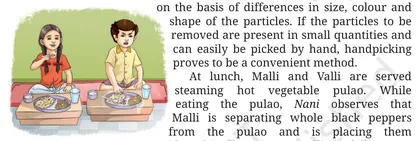
- Hand-picking: Picking out large or visibly different particles by hand (e.g., removing stones from pulses). Useful when difference is large and amount is small.
- Sieving (screening): Passing the mixture through a sieve with holes of a chosen size: particles smaller than the holes pass through, larger ones stay above. Used for flour, sand & gravel separation, grading pulses.
- Winnowing: Tossing a mixture into the air so that lighter particles (chaff) are carried away by wind while heavier grains fall almost vertically. Relies on differences in aerodynamic drag and mass.
- Magnetic separation: Using a magnet to attract magnetic particles (e.g., iron filings from sand). Fast and selective when one component is magnetic.
- Threshing and combined methods: Mechanical beating to free grains followed by winnowing or sieving to separate chaff and dust.
- Other specialized methods (brief): Panning and flotation use density and surface properties to separate minerals (used in mining); these are extensions of the same physical ideas.
Advantages and limitations
- Advantages: Many methods are simple, low-cost and can be done without chemicals. They preserve the original substances.
- Limitations: Some methods work only when physical differences are large (e.g., particle size or magnetism). Very fine or similar particles may need more advanced methods.
Practical tips and safety
- Choose the method based on the property that best distinguishes the components (size, density, magnetism).
- Use protective equipment (gloves, dust mask) when handling dusty or sharp materials.
- Combine methods for better purity (e.g., threshing → winnowing → sieving).
- Removing small stones and dirt from rice or pulses by hand-picking and sieving.
- Separating wheat grains from chaff using winnowing (tossing grain in the air so wind blows away the lighter chaff).
- Using a magnet to pick out iron filings from a mixture of sand and iron.
- Sieving sand to separate fine sand from gravel for construction.
- Panning for gold: shaking a pan so lighter sand is washed away while heavier metal particles remain (density-based separation).
- Density: density = mass ÷ volume (ρ = m / V). Density differences explain why heavier particles fall while lighter ones are carried by air.
- Percent by mass of a component: % = (mass of component ÷ total mass of mixture) × 100. Useful to express purity or recovery after separation.
- Separation efficiency (simple): efficiency (%) = (mass of component recovered ÷ mass of component originally present) × 100.
Separation of Solid–Liquid Mixtures
What it means: A solid–liquid mixture contains solid particles mixed with a liquid. We separate the components when we want either the solid, the liquid, or both in pure form. Solid–liquid mixtures occur as suspensions (solid particles visible and they may settle) or solutions (solute dissolved — particles not visible).
Common methods of separation and when to use them:
- Sedimentation and decantation: Let the mixture stand so heavier solid particles settle at the bottom (sedimentation). Carefully pour off the clear liquid (decantation). Use for coarse particles like sand in water.
- Filtration: Pour the mixture through filter paper or a cloth in a funnel. The solid (residue) stays on the filter; the liquid (filtrate) passes through. Use for suspensions where particles do not pass through the filter pores.
- Evaporation and crystallization: Heat the liquid to evaporate the solvent and leave the dissolved solid behind (evaporation). If you want crystals, allow slow cooling or slow evaporation (crystallization). Good for separating salt or sugar from water.
- Distillation (simple): Heat the mixture to boil and condense the vapor to collect the liquid (distillate) and leave dissolved solids behind. Use when you want to recover the liquid (e.g., get pure water from salty water).
- Centrifugation (advanced but common in labs): Spin the mixture rapidly so small particles are forced to the bottom, speeding up sedimentation. Useful for very fine solids that settle slowly.
How to choose a method: Consider particle size (large particles → decantation/filtration; very small particles → centrifuge), whether the solid is dissolved (solution → evaporation/distillation/crystallization), and whether you need the liquid back (distillation) or only the solid (evaporation).
Apparatus you might see: beaker, funnel, filter paper, evaporating dish, Bunsen burner or stove (for heating), conical flask, condenser (for distillation), centrifuge (in labs).
Safety notes: Heat with care; wear goggles and use tongs or heat-resistant gloves. Perform experiments with adult supervision.
Summary flow examples: sand + water → let settle → decant and then filter to remove fine sand; salt water → evaporate water to get salt (or distill to recover water).
- Separating sand from water collected after construction work: allow sedimentation, pour off water (decantation), then filter to remove remaining fine sand.
- Removing tea leaves from brewed tea: use a strainer or filter (filtration) to get clear tea.
- Obtaining salt from seawater: evaporate the water (evaporation) to leave salt crystals; or boil and condense the steam to get fresh water (distillation).
- Clearing muddy water in a jar: let mud settle (sedimentation), pour off clear water (decantation).
- Separating very fine blood cells from plasma in medical tests: use a centrifuge to force cells to the bottom.
- Concentration (mass %) = (mass of solute / mass of solution) × 100
- Density (ρ) = mass / volume (useful when liquids of different densities or settling behavior matter)
- Recovery (%) = (mass recovered / initial mass) × 100
- Solubility (simple definition) = grams of solute that dissolve in 100 g of solvent at a given temperature
- Advanced (optional): Stokes' law for settling velocity of small spheres (used in sedimentation theory): v = (2/9) × (r^2 (ρ_p − ρ_f) g) / η — where r = particle radius, ρ_p = particle density, ρ_f = fluid density, g = gravitational acceleration, η = fluid viscosity.
Separation of Liquid–Liquid Mixtures
What is a liquid–liquid mixture? A liquid–liquid mixture contains two liquids together. They may be immiscible (do not mix; form separate layers) or miscible (mix uniformly to form a single liquid).
Key idea: Immiscible liquids separate into layers because of differences in density and lack of mutual solubility. Miscible liquids mix but can be separated by differences in boiling points.
Methods to separate liquid–liquid mixtures
- Decantation – Let the mixture stand so denser liquid forms a lower layer and gently pour the top layer away. Works for immiscible liquids (e.g., oil on water).
- Separating funnel (separatory funnel) – A laboratory glass funnel with a stopcock. After layers form, open the stopcock to release the lower layer first and then close it to keep the upper layer. Gives clean separation of immiscible liquids.
- Centrifugation – Rapid spinning that forces denser liquid (or droplets) outward so layers form faster; useful when layers form slowly or in emulsions.
- Distillation – Used for miscible liquids. Heat the mixture; the component with lower boiling point vaporizes first, is condensed and collected. Simple distillation (large boiling point difference) or fractional distillation (smaller difference).
Emulsions and stabilizers – Some immiscible mixtures form emulsions (tiny droplets of one liquid dispersed in the other) and do not separate easily. Emulsifiers (soap, detergents) stabilize emulsions; mechanical methods or centrifugation are used to break them for separation.
Safety and practical notes – Always perform separations with care: do not heat flammable liquids near open flames, use proper glassware, and dispose of separated liquids responsibly.
- Oil and water in a bottle: after standing, oil forms the upper layer; separate by decantation or using a separating funnel.
- Kerosene and water: immiscible — use a separating funnel to collect kerosene (upper layer) and water (lower layer).
- Cream from milk: fat droplets form an emulsion; cream can be separated by centrifugation (milk centrifuge) or by letting it rise (traditional churning).
- Alcohol and water (miscible): separate by distillation because alcohol has a lower boiling point than water.
- Salad dressing (oil + vinegar): an emulsion that separates on standing unless an emulsifier (like mustard) is added.
- Density: density (ρ) = mass (m) / volume (V). Use density to predict which liquid forms the lower layer (higher ρ = lower layer).
- Percentage by volume: % by volume = (volume of component / total volume) × 100.
- Mass conservation (useful check): total mass = mass of liquid 1 + mass of liquid 2.
Practical Applications and Examples
What this topic covers: Practical applications of separation methods show how everyday mixtures are separated into their components using simple physical methods — handpicking, sieving, winnowing, sedimentation, decantation, filtration, magnetic separation, evaporation and crystallization. These methods are used in homes, laboratories and industries.
How to choose a method: Decide using three questions: (1) Is the mixture solid–solid, solid–liquid, or liquid–liquid? (2) Are the particle sizes large or small? (3) Are the components soluble in a solvent? Based on answers, pick the appropriate method (e.g., sieve for different particle sizes; filtration for insoluble solids in liquid; evaporation/crystallization for soluble solids).
Brief description of common methods and practical uses:
- Handpicking: Remove large visible unwanted pieces by hand. Used to remove stones from rice or bad fruits from a basket.
- Sieving (Sifting): Separate larger particles from smaller ones using a sieve. Used when flour is sifted to remove lumps or when sand and gravel are separated on construction sites.
- Winnowing: Use wind or a current of air to separate lighter husk (chaff) from heavier grains. Used in farms to clean wheat or rice.
- Sedimentation and Decantation: Allow heavy particles to settle (sedimentation) and pour off the clear liquid (decantation). Used to remove mud from water or to separate oil from water after settling (then decant).
- Filtration: Pass a mixture through filter paper or cloth to trap insoluble solids and let liquid pass. Used to make tea/coffee, to purify drinking water, and in laboratories.
- Magnetic separation: Use a magnet to attract magnetic substances (iron filings) from mixtures. Used in recycling plants and in workshops to remove iron filings from sand.
- Evaporation and Crystallization: Evaporate the solvent from a solution to obtain the dissolved solid. Evaporation is used to get salt from seawater; slow cooling/evaporation allows crystals to form (crystallization) — used for making sugar crystals and salts.
- Simple distillation (basic idea for Class 6): Separate liquids with different boiling points (e.g., obtaining pure water from salty water by evaporating and condensing the steam). In simple terms: boiling + condensation give purified water.
Short classroom experiment (example): To separate a mixture of salt and sand: (1) Add water to dissolve the salt while sand stays insoluble. (2) Filter the mixture to separate sand (residue) and salt solution (filtrate). (3) Evaporate the filtrate to recover salt. This shows filtration + evaporation used together.
Practical tips: Always select the simplest effective method. Combine methods when needed (e.g., sedimentation + decantation + filtration). Observe safety when heating or using sharp tools. Label samples when doing multi-step separations.
- Evaporating seawater in shallow pans to obtain common salt (evaporation/crystallization).
- Using a sieve to remove stones or husk from pulses or flour (sieving).
- Making tea: pouring the liquid through a strainer to separate tea leaves (filtration).
- Separating iron filings from sand with a magnet (magnetic separation).
- Winnowing rice or wheat by tossing grain in the wind to remove chaff (winnowing).
- Settling muddy water and pouring off the clear water (sedimentation and decantation).
- Density (ρ) = Mass (m) / Volume (V). Useful to predict whether a substance will float or sink (units: kg/m³ or g/cm³).
- Solubility (general expression) = grams of solute dissolved per 100 g of solvent at a given temperature. (Shows how much solid can dissolve.)
- Mass percent (concentration) = (mass of solute / mass of solution) × 100%. Useful to describe how concentrated a solution is before separation.
- Simple conservation (no chemical change): Total mass of mixture before separation = Sum of masses of separated components (mass balance).
Limitations and Choice of Method
What this topic means
When we have a mixture, we choose a method to separate its components based on the physical properties of those components. "Limitations and Choice of Method" explains why one method may work for some mixtures but fail for others and how to pick the best method in everyday situations.
Key properties to check before choosing a method
- Particle size (large grains vs fine powder)
- State of components (solid, liquid, gas)
- Solubility (does a solid dissolve in a liquid?)
- Density (will a particle sink or float?)
- Magnetic properties (is any component magnetic?)
- Boiling point or volatility (for evaporation/distillation)
- Cost, time, safety and available equipment
Common methods, when to use them and their limitations
- Handpicking: Pick visible, large particles by hand (e.g., stones from rice). Limitation: only works when particles are large and few; not practical for small or mixed-in particles.
- Sieving: Uses a sieve to separate coarse from fine particles (e.g., flour from husk). Limitation: particle size must be noticeably different and dry; wet mixtures clog the sieve.
- Winnowing: Uses wind or air to separate lighter particles (chaff) from heavier ones (grain). Limitation: requires a breeze or fan and a big difference in weight and shape; not usable indoors without air flow.
- Magnetic separation: A magnet attracts magnetic materials (e.g., iron filings from sand). Limitation: works only if one component is magnetic.
- Sedimentation and decantation: Let heavier particles settle, then pour off liquid (e.g., muddy water). Limitation: takes time, and fine particles may not settle completely; decanting may carry some suspended particles away.
- Filtration: Use filter paper or cloth to trap solids from a liquid (e.g., tea leaves from tea). Limitation: only separates insoluble solids; very fine or colloidal particles may pass through ordinary filters.
- Evaporation: Evaporate the solvent to get dissolved solids (e.g., obtain salt from salt solution). Limitation: cannot recover the solvent; requires heat and time; heat-sensitive substances may decompose.
- Crystallization: Concentrate a solution and cool it to form crystals (e.g., sugar crystals from sugar solution). Limitation: needs solubility difference with temperature; slower but gives purer solid than simple evaporation.
- Centrifugation (advanced for young learners): Spins mixtures to speed up settling of fine particles. Limitation: needs a centrifuge; not household equipment for most students.
How to choose a method — a simple flow of decisions
- Are solids visible and large? If yes, use handpicking or sieving.
- Does any part float or is lighter? Use winnowing or decantation if density difference exists.
- Is any part magnetic? Use a magnet.
- Is a solid dissolved in a liquid? If yes, consider evaporation (quick) or crystallization (for purity).
- Are solid particles suspended? Use sedimentation then filtration; for very fine particles consider centrifugation or finer filters.
Practical considerations
- Speed vs purity: Faster methods (decanting, simple evaporation) may give lower purity; slower methods (crystallization, repeated filtration) give better purity.
- Cost and equipment: Choose based on what is safe and available at home or in the lab.
- Safety: Heating and strong chemicals need supervision.
Summary
You must match the separation method to the mixture's characteristics — particle size, solubility, density and magnetic behaviour — and also consider time, cost and safety. Every method has limitations; understanding those limits helps you pick the best, simplest, and safest method for a particular mixture.
- Rice and stones: handpicking — limitation: only works if stones are visible and few.
- Wheat and chaff: winnowing — limitation: needs wind or a fan and a big density difference.
- Iron filings mixed with sand: magnetic separation — limitation: works only for magnetic materials.
- Mud from water: sedimentation followed by decantation or filtration — limitation: very fine clay may remain suspended unless filtered very finely or centrifuged.
- Salt from seawater: evaporation to recover salt — limitation: solvent (water) is lost; crystallization can give purer salt but takes longer.
- Tea leaves from tea: filtration (using strainer or filter paper) — limitation: very fine tea particles may pass through coarser filters.
- Density (useful to decide settling): density = mass / volume (ρ = m / V)
- Concentration (simple form): concentration = mass of solute / volume of solution
- Percent (w/w) of solute: percent = (mass of solute / mass of solution) × 100
- Simple solubility idea (qualitative): more solute can dissolve as temperature increases for many solids — used in crystallization
- Stokes' law (advanced concept, explains settling speed of small particles): terminal velocity v = (2/9) × (r^2 (ρ_particle − ρ_fluid) g) / η (shows settling depends on particle radius r and density difference)
Additional/Advanced Methods (Introduced Briefly)
This topic introduces a few additional or more advanced methods used to separate mixtures. Each method works on a specific physical property (like boiling point, solubility, volatility, particle size, magnetic properties or affinity for a solvent). Below are brief, clear descriptions of the common advanced methods and when they are used.
- Distillation (Simple and Fractional): Separate a liquid from a solution by heating to boil the more volatile component and then condensing the vapour. Simple distillation is used when components have very different boiling points (e.g., separating water from salt solution). Fractional distillation uses a column to separate liquids with closer boiling points (e.g., components of crude oil).
- Chromatography: Separates substances based on different affinities for a stationary phase and a mobile phase. Components travel at different speeds and form spots or bands. Useful for separating dyes and inks, and for analysis (e.g., paper chromatography for ink).
- Centrifugation: Uses rapid spinning to create a centrifugal force that separates substances of different densities or particles from a liquid (e.g., blood separation into plasma and cells, separating fine solids from liquids faster than sedimentation).
- Sublimation: Some solids change directly into vapour on heating and then re-solidify on cooling; this property is used to separate a sublimeable substance from a non‑sublimeable impurity (e.g., purifying iodine or ammonium chloride from a mixture).
- Magnetic and Electrostatic Separation: Magnetic separation removes magnetic materials (like iron filings) from mixtures using magnets. Electrostatic separation uses charge differences to attract or repel particles (used in mineral processing and recycling).
- Crystallization (Controlled Cooling / Evaporation): Used to obtain pure solid crystals from a saturated solution by changing conditions (cooling or evaporating slowly). Common for purifying salts or sugar.
- Filtration Variants: Beyond simple gravity filtration, there is vacuum filtration (faster) and membrane filtration (separates very small particles and microorganisms).
Each method is chosen depending on the properties (boiling point, solubility, particle size, density, magnetic properties, volatility, or chemical affinity) of the components in the mixture.
- Simple distillation: Getting pure water from seawater by boiling and condensing steam.
- Fractional distillation: Separating components of crude oil (petrol, diesel, kerosene) in an oil refinery.
- Paper chromatography: Separating and identifying different dyes in ink.
- Centrifugation: Separating blood into plasma and red blood cells in medical labs.
- Sublimation: Purifying iodine from a mixture by heating so iodine vaporises and then condenses on a cool surface.
- Magnetic separation: Removing iron filings from sand using a magnet.
- Rf (retardation factor) in chromatography = (Distance travelled by substance) / (Distance travelled by solvent front)
- Concentration (mass%) = (Mass of solute / Mass of solution) × 100
- Density = Mass / Volume (used to explain sedimentation and decantation decisions)
- Centrifugal acceleration: a = ω² r (ω = angular speed in rad/s, r = radius; shows why spinning speeds up separation)
Key Concepts
- Mixture
- A combination of two or more substances that retain their individual properties and can be separated by physical methods.
- Homogeneous mixture
- A mixture with uniform composition throughout; different parts are not visibly distinct.
- Heterogeneous mixture
- A mixture with non-uniform composition in which different parts are visible.
- Solution
- A homogeneous mixture of two or more substances, typically consisting of a solute dissolved in a solvent.
- Solvent
- The substance in a solution that dissolves the solute; usually present in larger amount.
- Solute
- The substance that is dissolved in the solvent to form a solution.
- Solubility
- The maximum amount of a solute that can dissolve in a given amount of solvent at a specified temperature.
- Suspension
- A heterogeneous mixture in which larger particles are dispersed in a liquid and will settle on standing.
- Sedimentation
- The process by which heavier or insoluble particles settle down at the bottom of a liquid on standing.
- Decantation
- Pouring off the liquid gently from a mixture to separate it from settled solid particles or a denser liquid.
- Filtration
- Separating insoluble solids from liquids by passing the mixture through a porous medium (like filter paper).
- Residue
- The solid material left on the filter after filtration.
- Filtrate
- The liquid that passes through the filter during the process of filtration.
- Evaporation
- Removing a liquid (often a solvent) from a solution by heating so that the liquid vaporizes and the dissolved solid remains.
- Crystallization
- A method to obtain pure solid crystals from a solution by slow evaporation or cooling of the solvent.
- Chromatography
- A technique to separate components of a mixture based on their movement through a medium (e.g., paper) carried by a solvent.
- Sieving
- Separating particles of different sizes by passing the mixture through a mesh or sieve with appropriate-sized holes.
- Winnowing
- Separating lighter particles from heavier ones by using wind or a current of air.
- Handpicking
- Removing visible large impurities or items from a mixture manually by hand.
- Magnetic separation
- Using a magnet to attract and remove magnetic substances from a mixture.
End-of-Chapter Trial Paper & Test Questions
Topic-wise questions to test your understanding of every concept in this chapter.
-
Which separation method uses wind to separate lighter husk from heavier grain? / किस पृथक्करण विधि में हल्की भूसी को भारी अनाज से अलग करने के लिए हवा का उपयोग किया जाता है? (a) Sieving / चालनी से छानना (b) Winnowing / ओसाई / फटकना (c) Filtration / निस्यंदन (d) Evaporation / वाष्पीकरण
Show answer
(b) Winnowing — lighter chaff/husk is blown away by wind while heavier grain falls down. This exploits the difference in density and aerodynamic properties. / ओसाई/फटकना — हल्की भूसी हवा से उड़ जाती है जबकि भारी अनाज नीचे गिरता है। यह घनत्व और वायुगतिकीय अंतर का उपयोग करता है।
-
To separate an insoluble solid from a liquid, the best method is: / एक अघुलनशील ठोस को तरल से अलग करने की सबसे अच्छी विधि है: (a) Winnowing / ओसाई (b) Evaporation / वाष्पीकरण (c) Filtration / निस्यंदन (d) Magnetic separation / चुंबकीय पृथक्करण
Show answer
(c) Filtration — the mixture is passed through filter paper or cloth; insoluble solid stays on the filter (residue) and liquid passes through (filtrate). Example: separating tea leaves from tea. / निस्यंदन — मिश्रण को फिल्टर पेपर या कपड़े से गुजारा जाता है; अघुलनशील ठोस फिल्टर पर रहता है (अवशेष) और तरल गुजर जाता है (निस्यंद)।
-
Salt can be recovered from salt solution by: / नमक के घोल से नमक को किस विधि द्वारा प्राप्त किया जा सकता है: (a) Filtration / निस्यंदन (b) Sieving / चालन (c) Evaporation / वाष्पीकरण (d) Winnowing / ओसाई
Show answer
(c) Evaporation — heating the salt solution evaporates the water (solvent), leaving behind salt crystals (solute). This is how salt is obtained from seawater. / वाष्पीकरण — नमक के घोल को गर्म करने से पानी (विलायक) वाष्पित हो जाता है और नमक के क्रिस्टल (विलेय) पीछे रह जाते हैं।
-
The substance that is dissolved in a solvent to form a solution is called a _______. / विलायक में घुलकर विलयन बनाने वाले पदार्थ को _______ कहते हैं।
Show answer
solute / विलेय — For example, in salt water, salt is the solute and water is the solvent. The solute disperses evenly in the solvent in a homogeneous mixture. / उदाहरण के लिए, नमक के पानी में नमक विलेय है और पानी विलायक है। विलेय समरूप मिश्रण में विलायक में समान रूप से फैल जाता है।
-
The liquid that passes through filter paper during filtration is called _______. / निस्यंदन के दौरान फिल्टर पेपर से गुजरने वाले तरल को _______ कहते हैं।
Show answer
filtrate / निस्यंद — The filtrate is the clarified liquid that passes through the filter, while the solid that stays behind on the filter is called the residue. / निस्यंद वह स्पष्ट तरल है जो फिल्टर से गुजरता है, जबकि फिल्टर पर रहने वाले ठोस को अवशेष कहते हैं।
-
True or False: Magnetic separation can be used to separate iron filings from a mixture of sand and iron. / सत्य या असत्य: रेत और लोहे के मिश्रण में से लोहे की छीलन को चुंबकीय पृथक्करण द्वारा अलग किया जा सकता है।
Show answer
True / सत्य — A magnet attracts iron filings (magnetic) while sand is non-magnetic. By passing a magnet over the mixture, iron filings are pulled away from the sand. / एक चुंबक लोहे की छीलन (चुंबकीय) को आकर्षित करता है जबकि रेत अचुंबकीय है। चुंबक को मिश्रण के ऊपर चलाने से लोहे की छीलन अलग हो जाती है।
-
In an experiment, a student mixes sand and salt in water, then filters it. What does the student get in the filtrate and what is the residue? / एक प्रयोग में, एक छात्र रेत और नमक को पानी में मिलाता है, फिर छानता है। छात्र को निस्यंद में क्या मिलता है और अवशेष क्या होगा?
Show answer
Filtrate / निस्यंद: salt solution (salt dissolved in water) / नमक का घोल (पानी में घुला नमक) — because salt is soluble and passes through the filter. Residue / अवशेष: sand / रेत — because sand is insoluble and stays on the filter paper. To get salt back, evaporate the filtrate. / नमक घुलनशील है इसलिए फिल्टर से गुजर जाता है; रेत अघुलनशील है इसलिए अवशेष रहती है।
-
Which separation method is most suitable for separating pebbles from fine sand? / बारीक रेत से कंकड़ अलग करने के लिए कौन-सी पृथक्करण विधि सबसे उपयुक्त है? (a) Evaporation / वाष्पीकरण (b) Sieving / चालन (c) Filtration / निस्यंदन (d) Magnetic separation / चुंबकीय पृथक्करण
Show answer
(b) Sieving — pebbles (larger particles) stay on the sieve while fine sand (smaller particles) passes through the holes. This works because of the difference in particle size. / चालन — कंकड़ (बड़े कण) चलनी पर रहते हैं जबकि बारीक रेत (छोटे कण) छेदों से निकल जाती है। यह कण आकार के अंतर के कारण काम करता है।
Related Laws & Principles
Explore allFoundational laws & principles behind this chapter. Each one opens a full page — what it says, why it matters, five practice questions and the mistakes to avoid.