Overview
This chapter introduces chemical reactions and their concise representation using chemical equations. It begins with observable signs of chemical change (colour change, gas evolution, precipitate formation, temperature change), then develops the skill of writing and balancing chemical equations to reflect the law of conservation of mass. Key classifications — combination, decomposition, displacement (single and double), and redox reactions — are explained with simple examples and rules (including activity series for metals). The chapter also covers energy changes (exothermic and endothermic reactions), oxidation and reduction in terms of electron transfer and oxygen/hydrogen transfer, and practical topics such as corrosion and rancidity with methods of prevention. Importance: mastering this chapter gives students the foundation for understanding how matter changes, how to symbolically represent and balance reactions, and how to predict products and energy flow. These skills are essential for later topics (stoichiometry, electrochemistry, chemical equilibrium) and for real-life applications (metallurgy, preservation, environmental chemistry). What the student will learn: how to…
Learning Objectives
- Define chemical reaction and represent it using word and symbolic chemical equations with appropriate state symbols
- Explain the law of conservation of mass and apply it to balance simple chemical equations
- Balance chemical equations for combination, decomposition, displacement and double displacement reactions
- Classify chemical reactions into combination, decomposition, displacement, double displacement, redox, exothermic and endothermic with suitable examples
- Write balanced chemical equations for reactions of metals with water, oxygen and acids using correct formulas and state symbols
- Predict products of displacement and double displacement reactions using the reactivity series and solubility/precipitation concepts
- Differentiate between exothermic and endothermic reactions and provide one representative equation for each type
- Describe oxidation and reduction in terms of electron transfer and change in oxidation states and identify oxidising and reducing agents in given reactions
Topics in this chapter
19 topics · tap a topic title to jump straight to it.
Introduction to Chemical Reactions
What is a chemical reaction?
A chemical reaction is a process in which one or more substances (reactants) are changed into new substances (products) with different chemical and physical properties. During a chemical reaction bonds are broken and new bonds are formed.
Key observations that indicate a chemical reaction
- Evolution of a gas (bubbling, effervescence)
- Formation of a precipitate (insoluble solid)
- Change of colour
- Change in temperature (heat released or absorbed)
- Change of smell or emission of light
Chemical equations
A chemical equation represents a chemical reaction using symbols and formulas. It shows reactants on the left, products on the right and an arrow between them. According to the law of conservation of mass, mass is conserved in a chemical reaction, so equations must be balanced (same number of atoms of each element on both sides).
Balancing and stoichiometry (brief)
Balancing an equation means adjusting coefficients (whole numbers before formulas) so that the number of atoms of each element is equal on both sides. Balanced equations let us compare relative amounts (moles or molecules) of substances involved in reactions.
Common types of chemical reactions (simple view)
- Combination (Synthesis): Two or more substances combine to form one product. General form: A + B → AB.
- Decomposition: A compound breaks down into two or more simpler substances. General form: AB → A + B.
- Displacement (Single): A more reactive element displaces a less reactive element from its compound. General form: A + BC → AC + B.
- Double displacement (Metathesis): Exchange of ions between two compounds to form new compounds, often producing a precipitate, gas, or water. General form: AB + CD → AD + CB.
- Redox reactions: Involve transfer of electrons (oxidation and reduction). Many of the above types (combustion, displacement) are redox reactions.
- Exothermic and endothermic: Exothermic reactions release heat (temperature rises), endothermic absorb heat (temperature falls).
Why this topic matters
Chemical reactions explain many everyday phenomena (rusting, burning, digestion, photosynthesis, respiration, cooking, medicines acting in the body). Understanding how to write and balance chemical equations is the basis for quantitative chemistry (stoichiometry) and safe chemical practices.
- Combustion of methane (burning of natural gas): CH4 + 2O2 → CO2 + 2H2O (exothermic; flame, heat, light)
- Rusting of iron: 4Fe + 3O2 → 2Fe2O3 (slow oxidation, change of colour, formation of a solid corrosion product)
- Photosynthesis (plants): 6CO2 + 6H2O → C6H12O6 + 6O2 (energy absorbed from sunlight; endothermic overall)
- Respiration (in cells): C6H12O6 + 6O2 → 6CO2 + 6H2O + energy (exothermic, releases energy for life processes)
- Neutralisation (acid + base): HCl + NaOH → NaCl + H2O (formation of salt and water; often heat evolved)
- Decomposition on heating: CaCO3 (s) → CaO (s) + CO2 (g) (thermal decomposition, gas evolved)
- General types: Combination: A + B → AB
- Decomposition: AB → A + B
- Single displacement: A + BC → AC + B
- Double displacement: AB + CD → AD + CB
- Combustion (complete, hydrocarbon): CxHy + (x + y/4) O2 → x CO2 + (y/2) H2O
- Photosynthesis: 6CO2 + 6H2O → C6H12O6 + 6O2
Word Equations and Symbolic (Skeletal) Equations
Definition — Word Equation: A word equation describes a chemical reaction using the names of reactants and products in words. It shows which substances react and what new substances are formed. Example format: Magnesium + Hydrochloric acid → Magnesium chloride + Hydrogen gas.
Definition — Symbolic (Skeletal) Equation: A symbolic or skeletal equation uses chemical formulas and symbols instead of names to represent the same reaction. It shows the kinds of atoms and molecules present but is not necessarily balanced. Example format: Mg + HCl → MgCl2 + H2 (this is skeletal until coefficients are added to balance atoms).
Key differences:
- Word equation: uses names; easy to write and read but not useful for calculations.
- Symbolic/skeletal equation: uses chemical formulas; needed for balancing, stoichiometry and showing physical states.
How to convert a word equation to a skeletal equation (step-by-step):
- Write the word equation: e.g., Zinc + Sulphuric acid → Zinc sulphate + Hydrogen.
- Replace names by correct chemical formulas: Zn + H2SO4 → ZnSO4 + H2.
- Add physical state symbols when known: (s) solid, (l) liquid, (g) gas, (aq) aqueous — e.g., Zn(s) + H2SO4(aq) → ZnSO4(aq) + H2(g).
- Balance the equation by adjusting coefficients so the number of atoms of each element is the same on both sides.
Important notation and conventions: '+' separates reactants or products; '→' (yields) separates reactants from products. Use coefficients (integers) in front of formulas to balance. Do not change chemical formulas (subscripts) when balancing — only change coefficients.
Conservation principle: The law of conservation of mass requires that the number of atoms of each element remains the same before and after the reaction, so skeletal equations must be balanced to represent real chemical reactions.
- Combustion of methane — Word: Methane + Oxygen → Carbon dioxide + Water. Skeletal: CH4 + O2 → CO2 + H2O. Balanced: CH4 + 2O2 → CO2 + 2H2O. (Common: LPG/stove flame)
- Reaction of magnesium with hydrochloric acid — Word: Magnesium + Hydrochloric acid → Magnesium chloride + Hydrogen. Skeletal: Mg + HCl → MgCl2 + H2. Balanced: Mg + 2HCl → MgCl2 + H2. (Example: lab reaction producing H2 gas)
- Neutralization — Word: Hydrochloric acid + Sodium hydroxide → Sodium chloride + Water. Skeletal: HCl + NaOH → NaCl + H2O. Balanced: HCl + NaOH → NaCl + H2O. (Example: antacid neutralizing stomach acid)
- Displacement — Word: Zinc + Copper(II) sulfate → Zinc sulfate + Copper. Skeletal: Zn + CuSO4 → ZnSO4 + Cu. Balanced: Zn + CuSO4 → ZnSO4 + Cu. (Example: metal displacement reaction in single replacement)
- Rusting (simplified) — Word: Iron + Oxygen → Iron oxide. Skeletal (one form): Fe + O2 → Fe2O3. Balanced (simplified): 4Fe + 3O2 → 2Fe2O3. (Example: corrosion of iron objects)
- General templates (word → skeletal): - Synthesis (combination): A + B → AB e.g., 2H2 + O2 → 2H2O - Decomposition: AB → A + B e.g., 2H2O2 → 2H2O + O2 - Single displacement: A + BC → AC + B e.g., Zn + CuSO4 → ZnSO4 + Cu - Double displacement (metathesis): AB + CD → AD + CB e.g., AgNO3 + NaCl → AgCl + NaNO3 - Combustion (hydrocarbon): CxHy + O2 → CO2 + H2O e.g., CH4 + 2O2 → CO2 + 2H2O
- State symbols to include in symbolic equations: (s) = solid, (l) = liquid, (g) = gas, (aq) = aqueous (dissolved in water).
- Balancing principle: ensure atoms of each element are conserved. Use integer coefficients a, b, c... to satisfy: a(reactant atoms) = b(product atoms). There is no change in subscripts.
- Example of converting and balancing: Word: Magnesium + Hydrochloric acid → Magnesium chloride + Hydrogen Skeletal: Mg + HCl → MgCl2 + H2 Balanced: Mg + 2HCl → MgCl2 + H2
Chemical Equations: Symbols and Conventions
What is a chemical equation? A chemical equation is a symbolic representation of a chemical reaction using chemical formulas and symbols. It shows the reactants (substances that start the reaction) on the left and the products (substances formed) on the right, separated by an arrow.
Basic structure and symbols
- Plus sign (+): separates two or more reactants or products. Example: A + B
- Arrow (→): shows the direction of the reaction from reactants to products. Example: A + B → C
- Equilibrium sign (⇌): used for reversible reactions where both forward and backward processes occur. Example: N2O4 ⇌ 2NO2
- State symbols (in parentheses): indicate physical states:
- (s) solid
- (l) liquid
- (g) gas
- (aq) aqueous solution (dissolved in water)
- Up arrow (↑): gas evolved (often written after a gaseous product). Example: H2↑
- Down arrow (↓): precipitate formed (insoluble solid). Example: AgCl↓
- Δ (delta) or the word "heat": heat is supplied to the reaction (often written above the arrow).
- cat. or catalyst name (written above/below the arrow): indicates a substance that speeds the reaction but is not consumed. Example: MnO2 as a catalyst for decomposition of H2O2.
- Conditions: temperature, pressure, light (hv), electricity, etc., are placed above or below the arrow when important.
Conventions and rules
- Write correct chemical formulas for all species (use element symbols and valencies).
- Balance the equation by changing only the stoichiometric coefficients (whole numbers before formulas). Do not change subscripts in formulas.
- Include appropriate state symbols to clarify physical states and reaction conditions.
- For ionic reactions in solution, you may write total ionic equations or net ionic equations by removing spectator ions.
- Respect the law of conservation of mass: the number of atoms of each element must be the same on both sides.
Why these conventions matter
They make chemical reactions unambiguous, allow stoichiometric calculations (relating amounts of reactants and products), show physical states and reaction conditions, and help predict observable changes like gas evolution or precipitation.
- 2Mg(s) + O2(g) → 2MgO(s) (combination; balanced; state symbols show solid and gas)
- CH4(g) + 2O2(g) → CO2(g) + 2H2O(l) (combustion of methane; heat and light released)
- Zn(s) + 2HCl(aq) → ZnCl2(aq) + H2(g)↑ (displacement; hydrogen gas evolves)
- AgNO3(aq) + NaCl(aq) → AgCl(s)↓ + NaNO3(aq) (precipitation; AgCl is insoluble precipitate)
- 2H2O2(aq) --MnO2 (cat.)--> 2H2O(l) + O2(g)↑ (decomposition of hydrogen peroxide with catalyst; catalyst shown above arrow)
- CaCO3(s) --Δ--> CaO(s) + CO2(g)↑ (thermal decomposition; heat indicated above arrow)
- n = m / M (number of moles n equals mass m divided by molar mass M)
- Mole ratio: nA / nB = coeffA / coeffB (stoichiometric ratios come from balanced coefficients)
- Mass relationship: massA / massB = (coeffA × M_A) / (coeffB × M_B) (useful for converting between masses of reactants/products)
- Law of Conservation of Mass: total atoms of each element on reactant side = total atoms of that element on product side
- For reactions in solution: net ionic equation found by removing spectator ions from the complete ionic equation
Balancing Chemical Equations
What is balancing a chemical equation?
Balancing a chemical equation means choosing integer coefficients for reactants and products so that the number of atoms of each element is the same on both sides. This follows the law of conservation of mass: mass (and hence atoms) are neither created nor destroyed in a chemical reaction.
Why balance?
An unbalanced equation only shows the types of substances participating in a reaction. A balanced equation gives the correct mole ratios needed for calculations (stoichiometry), experimental design and safe handling.
- Basic rules
- Never change subscripts in chemical formulas (that would change the substance).
- Only change coefficients (numbers placed before formulas).
- Balance one element at a time, usually leaving hydrogen and oxygen for last in organic or combustion reactions.
- If you get fractional coefficients temporarily, multiply the whole equation by the denominator to make all coefficients integers.
- Step-by-step method (inspection method)
- Write the correct formulas for all reactants and products.
- List the number of atoms of each element on both sides.
- Choose coefficients to make atom counts equal, starting with the most complex molecule.
- Recount atoms and repeat until balanced.
- Check that coefficients are the smallest possible whole numbers (divide by common factor if any).
- Worked example (water formation)
Unbalanced: H2 + O2 → H2O
Count atoms:- Reactants: H = 2, O = 2
- Products: H = 2, O = 1
- Alternative techniques
- Fractional-coefficient trick: Put 1/2 O2 to balance O then multiply whole equation by 2 to remove fraction.
- Algebraic method: Assign variables to coefficients and write linear equations for each element; solve for ratios (useful for complex reactions).
Connection to stoichiometry
Coefficients in a balanced equation give the mole ratio of reactants and products. Example: 2H2 + O2 → 2H2O means 2 moles H2 react with 1 mole O2 to give 2 moles H2O.
Common reaction types (Class 10)
- Combination: A + B → AB (e.g., 2Mg + O2 → 2MgO)
- Decomposition: AB → A + B (e.g., 2H2O → 2H2 + O2)
- Displacement: A + BC → AC + B (e.g., Zn + 2HCl → ZnCl2 + H2)
- Double displacement: AB + CD → AD + CB (e.g., AgNO3 + NaCl → AgCl + NaNO3)
Checks to perform after balancing
- Every element has the same number of atoms on both sides.
- Total charge is balanced (for ionic equations).
- Coefficients are smallest whole numbers.
- H2 + O2 → H2O (balanced: 2H2 + O2 → 2H2O). Shows water formation; coefficients 2:1:2 give mole ratios.
- C3H8 + O2 → CO2 + H2O (balanced: C3H8 + 5O2 → 3CO2 + 4H2O). Example of combustion of propane.
- Fe + O2 → Fe2O3 (balanced: 4Fe + 3O2 → 2Fe2O3). Example: formation of rust (iron(III) oxide).
- HCl + NaOH → NaCl + H2O (balanced as written: HCl + NaOH → NaCl + H2O). Neutralization reaction with 1:1 ratio.
- Zn + HCl → ZnCl2 + H2 (balanced: Zn + 2HCl → ZnCl2 + H2). Metal + acid displacement.
- AgNO3 + NaCl → AgCl + NaNO3 (balanced as written: AgNO3 + NaCl → AgCl + NaNO3). Double displacement producing precipitate AgCl.
- Law of conservation of mass: total mass of reactants = total mass of products (implies atom counts of each element remain equal).
- General balanced form: aA + bB → cC + dD (a,b,c,d are stoichiometric coefficients giving mole ratios).
- Stoichiometric relation: m1/M1 : m2/M2 = coefficients (where n = mass / molar mass, coefficients give mole ratios).
- Combustion formula (use fractional O2 then clear fractions): CxHy + (x + y/4)O2 → xCO2 + (y/2)H2O (multiply by 2 if fractions occur).
- Algebraic approach: assign variables to coefficients and write linear equations for element conservation; solve for smallest whole-number ratio.
Types of Chemical Reactions — Overview
This topic classifies common chemical reactions studied in Class 10 and explains how they occur, how to recognise them and how they are represented by balanced chemical equations. All chemical equations must obey the law of conservation of mass: total mass (and number of each type of atom) of reactants = total mass of products.
- Combination (Synthesis): Two or more reactants combine to form a single product. Typical form: A + B -> AB. Example equation:
2H2 + O2 -> 2H2O. Many formation reactions of compounds are combination reactions. - Decomposition: A single compound breaks down into two or more simpler substances. Typical form: AB -> A + B. Often requires heat, light or electricity. Example:
2KClO3 -> 2KCl + 3O2(on heating / with catalyst). - Single Displacement (Replacement): A more reactive element displaces a less reactive element from its compound. Form: A + BC -> AC + B. Example:
Zn + CuSO4 -> ZnSO4 + Cu. - Double Displacement (Metathesis): Ions are exchanged between two compounds: AB + CD -> AD + CB. Includes precipitation and neutralisation reactions. Example (precipitation):
AgNO3 + NaCl -> AgCl(s) + NaNO3. Example (neutralisation):HCl + NaOH -> NaCl + H2O. - Combustion: A substance (usually a hydrocarbon) reacts with oxygen producing heat and products such as CO2 and H2O in complete combustion. Form: hydrocarbon + O2 -> CO2 + H2O. Example:
CH4 + 2O2 -> CO2 + 2H2O. Incomplete combustion can give CO or C (soot). - Redox (Oxidation–Reduction): Reactions involving transfer of electrons — one species is oxidised and another is reduced. Many combination, decomposition and displacement reactions are redox. Example:
2Fe + 3Cl2 -> 2FeCl3(Fe is oxidised; Cl2 is reduced). - Reversible Reactions and Chemical Equilibrium: Some reactions proceed forward and backward: A + B ⇌ AB. At equilibrium forward and reverse rates are equal and concentrations become constant (dynamic equilibrium). Example:
N2 + 3H2 ⇌ 2NH3(Haber process). - Exothermic vs Endothermic: Exothermic reactions release heat (products lower in energy than reactants; ΔH negative). Endothermic reactions absorb heat (products higher in energy; ΔH positive). Combustion is typically exothermic; decomposition often endothermic.
Key practical points: identify reactants and products, check atom balance to obey conservation of mass, identify type by pattern (e.g., gas release, precipitate, colour change, temperature change) and recognise that a reaction may fit more than one category (e.g., many combustion reactions are also redox and exothermic).
- Rusting of iron (slow oxidation): 4Fe + 3O2 -> 2Fe2O3 (redox, exothermic, slow).
- Respiration (biological combustion): C6H12O6 + 6O2 -> 6CO2 + 6H2O (exothermic).
- Photosynthesis (endothermic, reversible steps): 6CO2 + 6H2O -> C6H12O6 + 6O2 (requires sunlight).
- Formation of plaster (combination): CaO + H2O -> Ca(OH)2.
- Electrolysis of water (decomposition): 2H2O -> 2H2 + O2 (requires electricity).
- Reaction producing precipitate (double displacement): Pb(NO3)2 + 2KI -> PbI2(s) + 2KNO3.
- Combination: A + B -> AB (example: 2H2 + O2 -> 2H2O).
- Decomposition: AB -> A + B (example: 2KClO3 -> 2KCl + 3O2).
- Single displacement: A + BC -> AC + B (example: Zn + CuSO4 -> ZnSO4 + Cu).
- Double displacement: AB + CD -> AD + CB (example: AgNO3 + NaCl -> AgCl + NaNO3).
- Combustion (complete): CxHy + (x + y/4)O2 -> xCO2 + (y/2)H2O (example: CH4 + 2O2 -> CO2 + 2H2O).
- Neutralisation: acid + base -> salt + water (example: HCl + NaOH -> NaCl + H2O).
Combination (Synthesis) Reactions
Definition: A combination (or synthesis) reaction is a chemical reaction in which two or more reactants combine to form a single product. General form: A + B → AB.
Characteristics:
- Usually exothermic (release heat), although not always.
- Can occur between elements, between elements and compounds, or between two compounds.
- Conditions such as heat, pressure or catalysts may be required for the reaction to proceed.
- Products are single substances (element, compound or complex).
Types with short notes:
- Element + element → compound (e.g., 2Mg + O2 → 2MgO). This can give ionic or covalent compounds depending on reactants.
- Element + compound → new compound (e.g., CaO + H2O → Ca(OH)2).
- Compound + compound → single compound (less common but possible).
How to represent and balance: Write the reactants and product symbolically as A + B → AB and then balance atoms on both sides using stoichiometric coefficients (example: 2H2 + O2 → 2H2O).
Practical notes: Many important industrial and natural processes are combination reactions (e.g., formation of ammonia by Haber process). Some combination reactions (like rusting) proceed slowly under ambient conditions; others (like burning magnesium) are fast and energetic.
- 2H2 + O2 → 2H2O — Formation of water (combination of hydrogen and oxygen; exothermic). Real life: combustion engines, rockets (as a product in lab demonstrations).
- N2 + 3H2 → 2NH3 — Haber process: synthesis of ammonia from nitrogen and hydrogen (requires high pressure, temperature and catalyst). Real life: production of fertilizers.
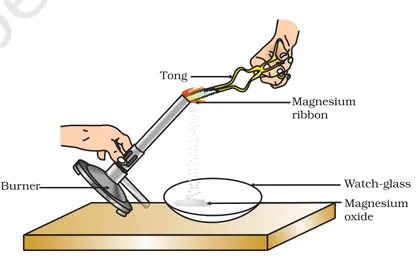
- 2Mg + O2 → 2MgO — Burning of magnesium in air (bright flame). Real life: demonstration in labs, production of magnesium oxide.
- 4Fe + 3O2 → 2Fe2O3 — Formation of iron(III) oxide (rusting is similar but also requires water). Real life: corrosion of iron structures (bridges, vehicles).
- CaO + H2O → Ca(OH)2 — Slaking of quicklime to make slaked lime. Real life: used in construction and plaster preparation.
- 2Na + Cl2 → 2NaCl — Formation of common salt from sodium and chlorine (illustrative; reaction is highly exothermic and hazardous).
- General: A + B → AB
- Element + element (nonmetal + nonmetal): H2 + Cl2 → 2HCl
- Element + element (metal + oxygen): 2Mg + O2 → 2MgO
- Compound + water (oxide + water): CaO + H2O → Ca(OH)2
- Industrial example (Haber): N2 + 3H2 → 2NH3
- Combustion example (carbon): C + O2 → CO2
Decomposition Reactions
Decomposition reactions are chemical changes in which a single compound breaks down into two or more simpler substances. They usually require an input of energy (heat, light or electricity) because the bonds in the compound must be broken. The general form is AB → A + B.
Key features:
- Energy input is required (endothermic in many cases).
- Can be induced by heat (thermal decomposition), light (photolysis) or electricity (electrolytic decomposition).
- Catalysts may speed up decomposition by lowering activation energy without changing the overall reaction.
Common types with their typical reactions:
- Thermal decomposition of carbonates: metal carbonate → metal oxide + carbon dioxide (MCO3 → MO + CO2). Example: CaCO3 → CaO + CO2.
- Thermal decomposition of hydroxides: metal hydroxide → metal oxide + water (M(OH)2 → MO + H2O). Example: Cu(OH)2 → CuO + H2O (on strong heating).
- Thermal decomposition of chlorates: metal chlorate → metal chloride + oxygen (2MClO3 → 2MCl + 3O2). Example (with catalyst MnO2): 2KClO3 → 2KCl + 3O2.
- Decomposition of peroxides and hydrogen peroxide: hydrogen peroxide → water + oxygen (2H2O2 → 2H2O + O2), often catalysed by MnO2 or catalase.
- Electrolytic decomposition: using electric current (e.g., electrolysis of water, 2H2O(l) → 2H2(g) + O2(g)).
- Photodecomposition: decomposition caused by light (e.g., 2AgCl → 2Ag + Cl2 in photographic processes under sunlight).
How to identify: if one reactant yields two or more products, especially when heat/light/electricity is applied, it's likely a decomposition reaction. In contrast, combination reactions have two or more reactants forming a single product.
Practical importance: used in oxygen production in labs (KClO3 decomposition), lime production (CaCO3 → CaO + CO2), manufacture and storage considerations (hydrogen peroxide stability), and in photographic chemistry (photodecomposition of silver halides).
- CaCO3(s) → CaO(s) + CO2(g) (Thermal decomposition of calcium carbonate: lime production)
- 2HgO(s) → 2Hg(l) + O2(g) (Decomposition of mercuric oxide on heating; used historically to obtain oxygen)
- 2KClO3(s) (Δ, MnO2 catalyst) → 2KCl(s) + 3O2(g) (Laboratory preparation of oxygen)
- 2H2O(l) (electricity) → 2H2(g) + O2(g) (Electrolysis of water producing hydrogen and oxygen gases)
- 2H2O2(aq) → 2H2O(l) + O2(g) (Decomposition of hydrogen peroxide; accelerated by catalysts like MnO2 or catalase)
- 2NaHCO3(s) → Na2CO3(s) + CO2(g) + H2O(g) (Thermal decomposition of baking soda)
- General: AB → A + B
- Metal carbonate: MCO3 → MO + CO2
- Metal hydroxide: M(OH)2 → MO + H2O
- Metal chlorate: 2MClO3 → 2MCl + 3O2
- Metal oxide (some): 2MO → 2M + O2 (e.g., 2HgO → 2Hg + O2)
- Hydrogen peroxide: 2H2O2 → 2H2O + O2
Displacement (Single Replacement) Reactions
Definition: A displacement (single replacement) reaction is a chemical reaction in which a more reactive element displaces a less reactive element from its compound. These reactions are typically redox reactions — the displacing element is oxidized and the displaced element is reduced.
General idea and types:
- Metal displacement: A metal A reacts with a salt BC (where B is a metal ion) to form AC and free metal B if A is more reactive than B. General form: A + BC → AC + B.
- Non‑metal (halogen) displacement: A halogen X2 can displace a less reactive halide Y− from its salt MY. Example general form: X2 + 2MY → 2MX + Y2 (X is more reactive than Y).
Reactivity requirement: Displacement occurs only when the free element is higher in the activity (reactivity) series than the element in the compound. For metals: K > Na > Ca > Mg > Al > Zn > Fe > Pb > Cu > Ag > Au. For halogens: F2 > Cl2 > Br2 > I2.
Observations and evidence: Common signs of a displacement reaction include change in color of the solution, deposition of a solid metal on the surface of the reacting metal, evolution or appearance of a colored liquid (e.g., halogen), formation of precipitate, or temperature change if reaction is exothermic/endothermic.
Applications and importance: Extraction of metals (e.g., displacement used in metallurgy and refining), purification of metals, displacement reactions used in laboratories to test reactivity, and halogen displacement used in qualitative analysis.
Factors affecting displacement: relative reactivity (most important), concentration of reactants, temperature, and surface area of the reacting metal.
Net ionic view: Representing only the species that change oxidation states clarifies the redox process. Example: Zn(s) + Cu2+(aq) → Zn2+(aq) + Cu(s).
- Zn + CuSO4 -> ZnSO4 + Cu (Zinc displaces copper; blue CuSO4 solution becomes colorless as Cu metal deposits)
- Fe + CuSO4 -> FeSO4 + Cu (Iron displaces copper)
- Mg + ZnCl2 -> MgCl2 + Zn (Magnesium displaces zinc)
- Cl2 + 2KBr -> 2KCl + Br2 (Chlorine displaces bromine from potassium bromide)
- F2 + 2NaBr -> 2NaF + Br2 (Fluorine displaces bromine; halogen displacement)
- Zn(s) + Cu2+(aq) -> Zn2+(aq) + Cu(s) (net ionic equation showing electron transfer)
- General (metal): A + BC -> AC + B (A must be more reactive than B)
- General (halogen): X2 + 2MY -> 2MX + Y2 (X more reactive than Y)
- Example balanced: Zn + CuSO4 -> ZnSO4 + Cu
- Example ionic/net ionic: Zn(s) + CuSO4(aq) -> ZnSO4(aq) + Cu(s) -> Net ionic: Zn(s) + Cu2+(aq) -> Zn2+(aq) + Cu(s)
- Activity (reactivity) series (short): K > Na > Ca > Mg > Al > Zn > Fe > Pb > Cu > Ag > Au (metal A above metal B can displace B2+)
Double Displacement (Metathesis) Reactions
Definition: A double displacement (metathesis) reaction is one in which two compounds exchange ions to form two new compounds. General molecular form: AB + CD → AD + CB.
Key features and driving forces:
- Occurs mainly in aqueous solutions where ions can move freely.
- The reaction proceeds when at least one of the products is: (a) an insoluble precipitate, (b) a weak electrolyte (e.g., H2O), or (c) a gas that escapes — these remove products from the solution and drive the reaction to completion.
- Spectator ions are ions that do not participate in the actual chemical change and remain in solution.
Types of double displacement reactions:
- Precipitation reactions — formation of an insoluble salt (precipitate).
- Neutralisation (acid–base) reactions — formation of water and a salt.
- Gas evolution reactions — formation of a gas (e.g., CO2, H2S, SO2) that escapes.
Ionic and net ionic equations: In aqueous double displacement reactions it is useful to write ionic equations: break soluble strong electrolytes into their ions. Then cancel spectator ions to obtain the net ionic equation which shows the actual chemical change.
Examples of ionic/net ionic:
- Molecular: AgNO3(aq) + NaCl(aq) → AgCl(s) + NaNO3(aq)
Ionic: Ag+(aq) + NO3-(aq) + Na+(aq) + Cl-(aq) → AgCl(s) + Na+(aq) + NO3-(aq)
Net ionic: Ag+(aq) + Cl-(aq) → AgCl(s) - Molecular (neutralisation): HCl(aq) + NaOH(aq) → NaCl(aq) + H2O(l)
Ionic: H+(aq) + Cl-(aq) + Na+(aq) + OH-(aq) → Na+(aq) + Cl-(aq) + H2O(l)
Net ionic: H+(aq) + OH-(aq) → H2O(l)
Solubility rules (brief, common points):
- All nitrates (NO3-) and alkali metal salts (Li+, Na+, K+, etc.) are soluble.
- Most chlorides (Cl-), bromides (Br-), iodides (I-) are soluble except with Ag+, Pb2+, Hg2+.
- Sulfates (SO4 2-) are generally soluble except with Ba2+, Sr2+, Pb2+ (and Ca2+ partly).
- Carbonates (CO3 2-), phosphates (PO4 3-), sulfides (S2-), and hydroxides (OH-) are generally insoluble except with alkali metals and NH4+.
Applications / importance: Precipitation reactions are used in qualitative analysis (to identify ions), water softening, pigment formation and waste treatment. Neutralisation is fundamental in titrations, antacid action and industrial acid/base neutralisation. Gas-evolving double displacement reactions are used in laboratory gas preparation and some industrial processes.
- AgNO3(aq) + NaCl(aq) → AgCl(s) + NaNO3(aq) — Precipitation (silver chloride forms a white precipitate).
- HCl(aq) + NaOH(aq) → NaCl(aq) + H2O(l) — Neutralisation (acid + base → salt + water).
- Na2CO3(aq) + CaCl2(aq) → CaCO3(s) + 2 NaCl(aq) — Precipitation (calcium carbonate precipitates).
- Na2S(aq) + 2 HCl(aq) → 2 NaCl(aq) + H2S(g) — Gas evolution (hydrogen sulfide gas is released).
- BaCl2(aq) + H2SO4(aq) → BaSO4(s) + 2 HCl(aq) — Precipitation (barium sulfate is insoluble).
- General molecular: AB + CD → AD + CB
- Complete ionic (example): AgNO3(aq) + NaCl(aq) → Ag+(aq) + NO3-(aq) + Na+(aq) + Cl-(aq) → AgCl(s) + Na+(aq) + NO3-(aq)
- Net ionic (example): Ag+(aq) + Cl-(aq) → AgCl(s)
- Neutralisation net ionic: H+(aq) + OH-(aq) → H2O(l)
Neutralization Reactions
Definition: A neutralization reaction is a chemical reaction between an acid and a base that produces a salt and usually water. It often releases heat (exothermic).
General description: When hydrogen ions (H+) from the acid combine with hydroxide ions (OH–) from the base, they form water: H+ + OH– → H2O. The remaining ions form a salt. For example, HCl + NaOH → NaCl + H2O.
Net ionic view: For strong acids and strong bases the principal change is the combination of H+ and OH– to give water. In ionic form: H+ (aq) + OH– (aq) → H2O (l).
Effect of acid/base strength: If both acid and base are strong, the equivalence (complete neutralization) pH is ~7. If a weak acid reacts with a strong base, the equivalence pH > 7 (basic); if a weak base reacts with a strong acid, equivalence pH < 7 (acidic). This affects choice of indicator in titrations.
Heat of neutralization: Neutralization of a strong acid by a strong base is typically exothermic with enthalpy ≈ –57 kJ per mole of H+ neutralized (value varies somewhat with conditions and strength of acids/bases).
Applications: Neutralization is used in medicine (antacids), industry (waste-water treatment), agriculture (liming acidic soils), laboratory analysis (acid–base titration), and safety (neutralizing spills).
- HCl (stomach acid) neutralized by NaHCO3 (baking soda) or antacids: HCl + NaHCO3 → NaCl + H2O + CO2
- Titration in the laboratory: HCl + NaOH → NaCl + H2O (used to find concentration of an acid or base)
- Treating acidic soil with lime: Ca(OH)2 neutralizes soil acidity, forming Ca-salts and water
- Neutralizing industrial acidic effluent with an alkaline reagent (e.g., NaOH) before discharge
- Ammonia (a weak base) reacting with HCl gas to form ammonium chloride: NH3 + HCl → NH4Cl
- General: Acid + Base → Salt + Water
- Ionic (strong acid + strong base): H+ (aq) + OH– (aq) → H2O (l)
- Example 1: HCl + NaOH → NaCl + H2O
- Example 2: H2SO4 + 2 NaOH → Na2SO4 + 2 H2O
- Example 3 (weak base): NH3 + HCl → NH4Cl
- Example 4 (carbonate): 2 HCl + Na2CO3 → 2 NaCl + H2O + CO2
Combustion Reactions
Definition: Combustion is a chemical reaction in which a substance (fuel) reacts rapidly with oxygen, giving out heat and usually light. It is an exothermic oxidation reaction.
Requirements: For combustion to occur we need (1) fuel (combustible substance), (2) oxidiser (usually O2), and (3) ignition temperature (heat). These three form the combustion triangle.
General characteristics: Heat and/or light is released; new products (commonly CO2 and H2O for hydrocarbons) are formed; the reaction rate depends on oxygen availability, temperature and nature of fuel.
Types of combustion:
- Complete combustion: Occurs with sufficient oxygen. Hydrocarbon fuels burn to give carbon dioxide and water and produce large heat. Flame is typically hotter and blue. General equation for a hydrocarbon CxHy: CxHy + (x + y/4)O2 → xCO2 + (y/2)H2O.
- Incomplete combustion: Occurs with limited oxygen. Products include carbon monoxide (CO), carbon (soot) and water, with less heat. Flame is yellow/sooty. Incomplete combustion is dangerous because CO is toxic.
- Combustion of non-hydrocarbons: Metals (e.g., magnesium) and non-metals (e.g., sulphur) also combust: metal oxides or sulphur dioxide are typical products.
Examples of observations: Bright white flame and white ash (Mg → MgO); blue flame and CO2 + H2O (methane); yellow sooty flame and deposits when oxygen is insufficient (burning candle/kerosene/coal incompletely).
Uses and hazards: Uses: cooking, heating, engines, power generation. Hazards: fire, burns, carbon monoxide poisoning, air pollution (soot, SO2, NOx).
- Complete combustion of carbon: C + O2 → CO2
- Complete combustion of methane (natural gas): CH4 + 2O2 → CO2 + 2H2O
- Incomplete combustion of methane (limited O2): 2CH4 + 3O2 → 2CO + 4H2O (gives CO and less heat)
- Combustion of magnesium: 2Mg + O2 → 2MgO (bright white flame)
- Combustion of sulphur: S + O2 → SO2 (blue flame, pungent gas)
- Burning of a candle (paraffin wax, a hydrocarbon) producing CO2, H2O and heat
- General hydrocarbon combustion: CxHy + (x + y/4)O2 → xCO2 + (y/2)H2O (complete combustion)
- Complete combustion (simple): Fuel + O2 → CO2 + H2O + energy
- Incomplete combustion (common products): Fuel + limited O2 → CO + C (soot) + H2O + less energy
- Balanced examples: C + O2 → CO2 ; CH4 + 2O2 → CO2 + 2H2O ; 2Mg + O2 → 2MgO ; S + O2 → SO2
Exothermic and Endothermic Reactions
Definition: Chemical reactions in which energy is released to the surroundings are called exothermic reactions. Reactions that absorb energy (usually heat) from the surroundings are called endothermic reactions.
Energy change and sign convention: The enthalpy change (ΔH) measures the heat change at constant pressure.
- For exothermic reactions: ΔH = H_products − H_reactants < 0 (negative). Heat is released; temperature of surroundings rises.
- For endothermic reactions: ΔH = H_products − H_reactants > 0 (positive). Heat is absorbed; temperature of surroundings falls.
Energy profile (potential energy diagram): Both types of reactions have an activation energy (E_a) — the energy barrier to start the reaction. In a potential energy vs reaction progress graph:
- Exothermic: the products lie below reactants (net release of energy). ΔH arrow points downward.
- Endothermic: the products lie above reactants (net absorption of energy). ΔH arrow points upward.
Both diagrams show an initial peak (E_a) above reactants.
How to detect experimentally: Use a thermometer (or calorimeter). In an exothermic reaction the temperature of the reaction mixture (or surroundings) increases; in an endothermic reaction it decreases. In calorimetry, measure q = m·c·ΔT and relate q to molar ΔH.
Important notes: Some physical processes (melting, evaporation, freezing) are also endothermic or exothermic but here we focus on chemical reactions. The law of conservation of energy applies: energy lost by the system is gained by the surroundings and vice versa.
- Combustion of methane (exothermic): CH4 + 2 O2 → CO2 + 2 H2O + heat
- Neutralisation (exothermic): HCl + NaOH → NaCl + H2O + heat
- Respiration (exothermic): C6H12O6 + 6 O2 → 6 CO2 + 6 H2O + energy
- Thermal decomposition of calcium carbonate (endothermic): CaCO3(s) + heat → CaO(s) + CO2(g)
- Photosynthesis (endothermic): 6 CO2 + 6 H2O + light energy → C6H12O6 + 6 O2
- Dissolution of ammonium nitrate in water (endothermic): NH4NO3(s) → NH4+(aq) + NO3−(aq) (temperature falls)
- ΔH = H_products − H_reactants
- Exothermic: ΔH < 0 (heat released)
- Endothermic: ΔH > 0 (heat absorbed)
- Calorimetry: q = m · c · ΔT (heat absorbed or released by solution)
- Molar enthalpy change: ΔH (per mole) = −q_solution / n_reaction (sign depends on convention; q_solution = m·c·ΔT)
- Activation energy (E_a): energy peak to initiate reaction (appears in energy profile diagrams)
Oxidation and Reduction (Redox)
Definition: Oxidation and reduction (together called redox) are chemical processes in which electrons are transferred between species. Oxidation is loss of electrons (an increase in oxidation state). Reduction is gain of electrons (a decrease in oxidation state).
How to identify:
- If a substance loses electrons, it is oxidized.
- If a substance gains electrons, it is reduced.
- The species that accepts electrons (and gets reduced) is the oxidizing agent.
- The species that donates electrons (and gets oxidized) is the reducing agent.
Oxidation numbers (brief rules used to detect redox):
- Element in elemental form: oxidation number = 0 (e.g., O2, H2, Fe).
- For a monoatomic ion, oxidation number = ion charge (e.g., Na+ = +1, Cl- = −1).
- Oxygen is usually −2 (except in peroxides where it is −1).
- Hydrogen is usually +1 with nonmetals and −1 with metals (hydrides).
- The sum of oxidation numbers in a neutral compound = 0; in a polyatomic ion = ion charge.
Representation by half-reactions: A redox reaction can be split into two half-reactions showing oxidation and reduction separately. Example: Zn → Zn2+ + 2e- (oxidation); Cu2+ + 2e- → Cu (reduction).
Balancing redox reactions: Two common methods: (1) Oxidation number method (track changes in oxidation states and equalize electron change), (2) Half-reaction method (balance atoms, O/H with H2O/H+ or OH-, then balance charges by adding electrons). In Class 10 you usually use oxidation number method for simple reactions.
Why redox matters: Many everyday phenomena are redox: combustion, corrosion (rusting), respiration, photosynthesis, bleaching, batteries/electrochemistry, metal extraction and displacement reactions.
- Zn + CuSO4 -> Cu + ZnSO4. Explanation: Zn goes from 0 to +2 (oxidized; Zn is reducing agent). Cu2+ goes from +2 to 0 (reduced; Cu2+ is oxidizing agent). Half-reactions: Zn -> Zn2+ + 2e-, Cu2+ + 2e- -> Cu.
- 2Mg + O2 -> 2MgO (burning of magnesium). Magnesium is oxidized (Mg: 0 -> +2); oxygen is reduced (O: 0 -> -2).
- CuO + H2 -> Cu + H2O (metal oxide reduced by hydrogen). CuO: Cu2+ -> Cu0 (reduced); H2: 0 -> +1 in H2O (oxidized).
- 4Fe + 3O2 -> 2Fe2O3 (rusting simplified). Iron is oxidized (Fe: 0 -> +3); oxygen is reduced (O: 0 -> -2).
- C6H12O6 + 6O2 -> 6CO2 + 6H2O (cellular respiration). Glucose is oxidized to CO2; oxygen is reduced to H2O. This process releases energy.
- In a displacement reaction: Fe + CuSO4 -> FeSO4 + Cu. Fe is oxidized (0 -> +2) and displaces Cu2+ which is reduced to Cu.
- Oxidation: loss of electrons. Example: A -> A^n+ + n e-
- Reduction: gain of electrons. Example: B^m+ + m e- -> B
- Oxidation state change rule: increase in oxidation number = oxidation; decrease = reduction.
- Oxidizing agent: species that gets reduced (accepts electrons). Reducing agent: species that gets oxidized (donates electrons).
- Half-reaction example (Zn/Cu system): Zn -> Zn2+ + 2 e- (oxidation); Cu2+ + 2 e- -> Cu (reduction).
- Basic steps for oxidation-number method to balance redox: 1) Assign oxidation numbers. 2) Identify atoms whose oxidation numbers change. 3) Determine total increase and decrease in oxidation numbers. 4) Multiply species so electron loss = electron gain. 5) Balance remaining atoms and charges.
Evidences and Examples of Redox in Common Reactions
Redox (reduction–oxidation) reactions are chemical processes in which oxidation states of some atoms change because electrons are transferred. Oxidation = loss of electrons (or gain of oxygen / loss of hydrogen). Reduction = gain of electrons (or loss of oxygen / gain of hydrogen). Every redox reaction can be split into two half‑reactions: an oxidation half and a reduction half. Evidence for redox includes change in oxidation number, formation or disappearance of colored ions, deposition of a metal, gas evolution (H2), heat/light release, and change in mass.
- How to identify: Assign oxidation numbers to elements before and after the reaction. If one element’s oxidation number increases it is oxidized; if it decreases it is reduced.
- Half‑reactions: Write oxidation and reduction half‑equations showing electron transfer, then combine them so electrons cancel.
- Common signatures: Displacement of a metal from solution, fading of coloured solutions (e.g., blue CuSO4), formation of gas (pop test for H2), deposition on electrodes in electrolysis, and corrosion/rusting.
Class 10 focus is on simple, observable redox changes such as metal displacement, combustion, corrosion, respiration, photosynthesis (conceptual), bleaching, and electrochemical reactions (electroplating/batteries).
- Zn + CuSO4 → ZnSO4 + Cu. (Displacement: Zn(0) → Zn(2+) oxidized; Cu(2+) → Cu(0) reduced. Evidence: blue CuSO4 solution fades and reddish Cu metal deposits.)
- 2HCl + Mg → MgCl2 + H2↑. (Metal + acid: Mg(0) oxidized to Mg(2+); H(+) reduced to H2 gas. Evidence: bubbling and 'pop' test on ignition of H2.)
- CH4 + 2O2 → CO2 + 2H2O. (Combustion: C in CH4 is oxidized to CO2; O2 is reduced to H2O. Evidence: heat and light released, CO2 formation.)
- 4Fe + 3O2 → 2Fe2O3. (Rusting/corrosion: Fe(0) → Fe(III) oxidized; O2 reduced. Evidence: change in mass, flaky reddish brown iron oxide.)
- 2Ag+ + Cu → 2Ag + Cu2+. (Metal displacement in AgNO3 solution: Cu(0) oxidized; Ag+ reduced; evidence: silver crystals form and solution color changes.)
- Cl2 + 2NaBr → 2NaCl + Br2. (Halogen displacement: Cl2 oxidizes Br- to Br2. Evidence: brown/red bromine vapour appears.)
- General: Oxidation: A → A^n+ + ne^- ; Reduction: B^m+ + me^- → B
- Oxidation number rules (useful): element in elemental form = 0; O usually = -2; H usually = +1; sum of oxidation numbers in neutral compound = 0; in ion = ion charge.
- Half‑reaction example (Zn/CuSO4): Zn → Zn^2+ + 2e^- (oxidation); Cu^2+ + 2e^- → Cu (reduction). Combine to give Zn + CuSO4 → ZnSO4 + Cu.
- Electron balance method: write half‑reactions → balance atoms except H and O → add H2O, H+, e^- (acidic) or H2O, OH^-, e^- (basic) → multiply to equalize e^- → add and cancel e^-.
- Combustion (example): CH4 + 2O2 → CO2 + 2H2O ; oxidation numbers: C: -4 → +4 (oxidized), O: 0 → -2 (reduced).
Catalysts and Effect on Reaction Rate
What is a catalyst?
A catalyst is a substance that increases the rate of a chemical reaction without being permanently consumed in the reaction. It provides an alternative reaction pathway with a lower activation energy (Ea).
How a catalyst works
- By lowering the activation energy, a catalyst increases the fraction of reactant molecules that have enough energy to react, so the rate increases.
- Catalysts participate in intermediate steps but are regenerated by the end of the reaction.
- Type of catalysts: Homogeneous (same phase as reactants), Heterogeneous (different phase, e.g., solid catalyst with gas/liquid reactants), and Biocatalysts (enzymes).
Important points
- A catalyst does not change the overall enthalpy change (ΔH) of the reaction or the equilibrium constant (K). It speeds up both the forward and reverse reactions equally, so equilibrium is reached faster but the position of equilibrium is unchanged.
- Because catalysts change the mechanism, they can change the observed rate law for a reaction (the rate-determining steps may differ).
Energy diagram (concept)
On a reaction coordinate vs potential energy graph, the uncatalyzed reaction has a higher peak (Ea). The catalyzed pathway shows a lower peak (Ea_cat). Both start and end energy levels (reactants and products) remain the same.
Relation to kinetics (brief)
According to the Arrhenius relation, the rate constant k depends on activation energy: k = A exp(-Ea/RT). Lowering Ea (by a catalyst) increases k, thus increasing the reaction rate.
- Decomposition of hydrogen peroxide: 2H2O2 (aq) --MnO2 (s)--> 2H2O (l) + O2 (g). MnO2 acts as a heterogeneous catalyst.
- Contact process (sulfuric acid manufacture): 2SO2 + O2 ⇌ 2SO3 with V2O5 as the catalyst (heterogeneous).
- Haber process (ammonia synthesis): N2 + 3H2 ⇌ 2NH3 with iron (Fe) catalyst (heterogeneous).
- Catalytic converter in cars: converts CO and hydrocarbons to CO2 and H2O, and reduces NOx to N2 using platinum, palladium, rhodium (heterogeneous).
- Enzymatic catalysis in biology: Catalase rapidly decomposes H2O2 in cells; amylase in saliva speeds up starch breakdown (biocatalysts).
- Arrhenius equation: k = A · e^(−Ea/(RT)) (A = frequency factor, Ea = activation energy, R = gas constant, T = temperature in K)
- Effect of lowered Ea: if Ea_cat < Ea_uncat then k_cat > k_uncat. Ratio: k_cat / k_uncat = exp[(Ea_uncat − Ea_cat)/(RT)]
- General rate law (may change if mechanism changes): rate = k [A]^m [B]^n (m, n are reaction orders)
- Catalyst effect on thermodynamics: ΔH (products − reactants) unchanged, equilibrium constant K unchanged
Corrosion
Definition: Corrosion is the gradual destruction of metals by chemical or electrochemical reaction with their environment. Rusting is a common example of corrosion — specifically the corrosion of iron.
Why corrosion happens (basic idea): Corrosion is usually an electrochemical process. Small regions on a metal surface act as anodic and cathodic sites, forming tiny cells. At the anode metal atoms lose electrons (oxidation) and go into solution as ions. At the cathode a reduction reaction consumes the electrons (often oxygen reduction). The presence of moisture and electrolytes (e.g., salt) speeds up this process.
Mechanism for iron (rusting):
- Anodic reaction (oxidation):
Fe → Fe2+ + 2e− - Cathodic reaction (in presence of oxygen and water):
O2 + 2H2O + 4e− → 4OH− - Formation of ferrous hydroxide:
2Fe2+ + 4OH− → 2Fe(OH)2 - Further oxidation to ferric hydroxide (rust):
4Fe(OH)2 + O2 + 2H2O → 4Fe(OH)3 - Dehydration (simplified overall):
4Fe + 3O2 + 6H2O → 4Fe(OH)3(Fe(OH)3 dehydrates to hydrated iron(III) oxide, often written as Fe2O3·nH2O).
Factors that accelerate corrosion:
- Presence of water (moisture) and dissolved salts (electrolytes)
- Acidic conditions (low pH) or pollutants like SO2
- Temperature (higher T usually increases rate)
- Presence of dissimilar metals in contact (galvanic corrosion)
Effects: Loss of metal, structural weakness (bridges, buildings), holes in pipes, failure of machines, economic loss and safety hazards.
Prevention methods (with short explanations):
- Coating/painting: isolates metal from air and moisture.
- Galvanization: coating iron with zinc. Zinc is more reactive and corrodes preferentially (sacrificial protection). Example reaction of zinc in acid:
Zn → Zn2+ + 2e−. If acid present:Zn + 2HCl → ZnCl2 + H2. - Cathodic protection: connect metal to a sacrificial anode (Mg or Zn) or use impressed current to make the protected metal a cathode.
- Alloying: stainless steel contains chromium which forms a passive Cr2O3 layer that prevents further corrosion.
- Electroplating and tinning: coat with less-reactive metal (e.g., tin-plated cans).
- Use of inhibitors: chemicals that slow corrosion when added to liquids (e.g., in cooling systems).
Summary: Corrosion is an electrochemical oxidation of metals, strongly influenced by moisture, oxygen, electrolytes and environmental conditions. Understanding the reactions and prevention helps protect structures and appliances in everyday life.
- Rusting of iron gates, grills and nails left outdoors (iron → hydrated iron(III) oxide).
- Corrosion of steel bridges and ships (pitting, weakening of structure).
- Tarnishing of silverware: silver reacts with sulfur compounds to form black Ag2S.
- Green patina on copper roofs and statues due to formation of copper carbonate/hydroxide (e.g., CuCO3·Cu(OH)2).
- Corrosion of underground pipelines accelerated by moisture and soil salts.
- Anode (iron oxidation): Fe → Fe2+ + 2e−
- Cathode (oxygen reduction): O2 + 2H2O + 4e− → 4OH−
- Initial product: 2Fe + O2 + 2H2O → 2Fe(OH)2
- Further oxidation (rust formation): 4Fe(OH)2 + O2 + 2H2O → 4Fe(OH)3
- Overall (simplified): 4Fe + 3O2 + 6H2O → 4Fe(OH)3 → Fe2O3·nH2O (rust)
- Galvanic/sacrificial (zinc oxidation): Zn → Zn2+ + 2e− (Zn corrodes instead of Fe)
Rancidity
Definition: Rancidity is the process by which fats and oils develop an unpleasant smell and taste on storage. It results from chemical changes in lipids that produce volatile compounds (aldehydes, ketones, short-chain acids) responsible for off‑odours and flavours.
Types of rancidity:
- Oxidative (autooxidation) — reaction of atmospheric oxygen with unsaturated fatty acids forming hydroperoxides and further breakdown products. This is the most common type in oils, butter and nuts.
- Hydrolytic (enzymatic or chemical) — breakdown of triglycerides by water (often aided by lipase enzymes or high temperature) to form glycerol and free fatty acids (which smell sour).
- Microbial rancidity — caused by growth of microorganisms that produce degradative enzymes; important when food is improperly stored.
Simple mechanism (oxidative rancidity) (chain reaction, simplified):
- Initiation: formation of lipid radicals (R•) from RH (a lipid) often by heat, light, or metal catalysts.
- Propagation: R• + O2 → ROO• (peroxyl radical); ROO• + RH → ROOH (hydroperoxide) + R•.
- Termination: radicals combine to form stable products.
Effects and importance: Rancid foods have lower nutritional value (loss of vitamins), unpleasant taste and smell, and sometimes produce toxic or harmful compounds. Rancidity shortens shelf life of oils, ghee, butter, nuts, and processed foods.
Prevention and control:
- Store foods in airtight containers to limit oxygen exposure.
- Use refrigeration or keep in cool, dark places to slow reaction rates.
- Antioxidants (natural: vitamin E, vitamin C, BHT, BHA) trap radicals and delay oxidation.
- Remove catalysts such as traces of metal; refine oils to remove pro-oxidants.
- Use nitrogen-flushed packaging and opaque containers to reduce oxygen and light exposure.
Detection: Peroxide value measurement, thiobarbituric acid (TBA) test, or sensory evaluation (taste/smell).
Class 10 connection: Rancidity is an example of chemical change in everyday life (Chapter: Chemical Reactions and Equations). It shows how reactions with oxygen and hydrolysis alter substances and why preservation methods are needed.
- Butter and ghee develop a sour or bitter smell on prolonged exposure to air and light (oxidative rancidity).
- Cooked foods or oils exposed to moisture and lipase-producing microbes may become sour due to hydrolytic rancidity.
- Nuts (e.g., peanuts, almonds) and chips become stale and taste unpleasant when their oils oxidize.
- Refined edible oils kept in dark, sealed bottles stay stable longer than oils stored in clear, open containers.
- Hydrolysis of a triglyceride (hydrolytic rancidity): C3H5(OOCR)3 + 3 H2O → C3H5(OH)3 (glycerol) + 3 RCOOH (free fatty acids)
- Simplified oxidative step (formation of hydroperoxide): RH + O2 → ROOH (where RH is a lipid; ROOH = lipid hydroperoxide)
- Radical chain (simplified): Initiation: RH → R• + H•; Propagation: R• + O2 → ROO•; ROO• + RH → ROOH + R•; Termination: R• + R• → R–R
Precipitation Reactions and Solubility
What is a precipitation reaction?
A precipitation reaction is a chemical reaction in which two soluble ionic solutions are mixed and an insoluble solid (called a precipitate) forms and separates from the solution. Precipitation occurs when ions in solution combine to form an ionic compound whose solubility is very low.
How it happens (mechanism)
When two aqueous solutions are mixed, all ions are present in water. If any pair of oppositely charged ions forms an insoluble salt, they remove themselves from solution as a solid. In ionic equation language:
- Molecular equation: shows reactants and products as compounds (e.g., AgNO3(aq) + NaCl(aq) → AgCl(s) + NaNO3(aq)).
- Full ionic equation: shows all strong electrolytes as ions.
- Net ionic equation: removes spectator ions and shows only the species that form the precipitate (e.g., Ag+(aq) + Cl−(aq) → AgCl(s)).
Spectator ions
Ions that remain in solution unchanged and do not participate in precipitate formation are called spectator ions (they appear in full ionic equation but not in the net ionic equation).
Solubility and solubility rules (quick guide)
Solubility indicates how much of a substance dissolves in a given amount of solvent at a given temperature. Useful general rules for common ionic salts at room temperature:
- Nitrates (NO3−) and most salts of Group 1 metals (Li+, Na+, K+) and ammonium (NH4+) are soluble.
- Chlorides, bromides and iodides are generally soluble except salts of Ag+, Pb2+, and Hg2^2+ (insoluble).
- Sulfates (SO4^2−) are generally soluble except BaSO4, PbSO4, and CaSO4 (sparingly soluble).
- Carbonates (CO3^2−), phosphates (PO4^3−), chromates, sulfides and hydroxides are generally insoluble except when combined with Group 1 ions and NH4+ (and some Group 2 exceptions for sulfides).
Quantitative view — Solubility product constant (Ksp)
For a sparingly soluble salt that dissociates as AxBy(s) ⇌ x A^{y+}(aq) + y B^{x-}(aq), the solubility product Ksp is defined as Ksp = [A^{y+}]^x [B^{x-}]^y at equilibrium. Ksp is a constant at a given temperature and describes the maximum product of ion concentrations that can coexist without precipitate formation.
Reaction quotient (Q) and predicting precipitation
When mixing solutions, compute Q (same form as Ksp but using initial instantaneous concentrations). Comparison:
- If Q > Ksp → precipitation occurs (solution is supersaturated).
- If Q = Ksp → saturated equilibrium (no net precipitate forms).
- If Q < Ksp → no precipitate (unsaturated).
Factors affecting solubility
- Temperature: solubility of most solids increases with temperature, but some (e.g., Ce2(SO4)3) behave differently; solubility of gases decreases with higher temperature.
- Common-ion effect: presence of an ion common to the salt decreases its solubility (Le Châtelier's principle).
- pH: affects solubility of salts containing anions that can react with H+ or OH− (e.g., metal hydroxides, carbonates).
- Complexation: formation of soluble complexes can increase solubility (e.g., Ag+ + 2NH3 ⇌ [Ag(NH3)2]+).
Typical classroom examples explained with equations
- Silver chloride formation:
Molecular: AgNO3(aq) + NaCl(aq) → AgCl(s) + NaNO3(aq)
Net ionic: Ag+(aq) + Cl−(aq) → AgCl(s) - Barium sulfate formation:
Molecular: BaCl2(aq) + Na2SO4(aq) → BaSO4(s) + 2 NaCl(aq)
Net ionic: Ba2+(aq) + SO4^2−(aq) → BaSO4(s) - Lead(II) iodide formation (bright yellow precipitate):
Molecular: Pb(NO3)2(aq) + 2 KI(aq) → PbI2(s) + 2 KNO3(aq)
Net ionic: Pb2+(aq) + 2 I−(aq) → PbI2(s)
Safety and real-life importance
Precipitation reactions are used in water purification (removing hardness by precipitating Ca2+ and Mg2+), qualitative inorganic analysis (identifying ions), metallurgy (extracting metals), and in everyday chemistry like cloud seeding or forming scale in kettles and pipes.
- AgNO3(aq) + NaCl(aq) → AgCl(s) + NaNO3(aq); net ionic: Ag+ + Cl− → AgCl(s) — used in photographic emulsions historically.
- BaCl2(aq) + Na2SO4(aq) → BaSO4(s) + 2 NaCl(aq); net ionic: Ba2+ + SO4^2− → BaSO4(s) — BaSO4 is used as a radiocontrast agent (insoluble and opaque to X-rays).
- Pb(NO3)2(aq) + 2 KI(aq) → PbI2(s) + 2 KNO3(aq); net ionic: Pb2+ + 2 I− → PbI2(s) — visible yellow precipitate used in demonstrations.
- Addition of Na2CO3 to hard water: Ca2+ + CO3^2− → CaCO3(s) removes Ca2+ (softening by precipitation).
- Adding AgNO3 to tap water tests for chloride: formation of white AgCl precipitate indicates Cl− presence.
- \[General solubility product: For AxBy(s) ⇌ x A^{y+} + y B^{x−}\]\[Ksp = [A^{y+}]^x [B^{x−}]^y\]
- For MX type salt (1:1): MX(s) ⇌ M+ + X−, Ksp = [M+][X−] = s^2 (if solubility = s mol L−1)
- For MX2 type salt: MX2(s) ⇌ M2+ + 2 X−, Ksp = [M2+][X−]^2 = (s)(2s)^2 = 4 s^3
- Reaction quotient (Q): Q = product of ion concentrations (same form as Ksp). Compare Q with Ksp to predict precipitation:
- Common-ion effect (approximate for a salt MX where common ion X− concentration = c ≫ s): new solubility s' ≈ Ksp / c
- Solubility vs temperature: no single formula; solubility is an experimentally determined function s(T) and often shown as solubility curves.
Applications and Importance of Chemical Equations
What a chemical equation represents: A chemical equation is a concise symbolic description of a chemical reaction showing reactants, products and their relative amounts (coefficients). It expresses which substances react, which are formed, and in what proportions.
Why chemical equations are important:
- They summarise reactions clearly and universally so chemists worldwide can read and reproduce them.
- They obey the Law of Conservation of Mass: total mass of reactants = total mass of products. Balancing equations ensures this law is satisfied.
- They provide mole ratios (from coefficients) that let you calculate quantities — masses, volumes (for gases), and numbers of particles — using stoichiometry.
- They help predict products and energy changes (exothermic vs endothermic), which is essential for safety and design of chemical processes.
- They underpin industrial processes, laboratory syntheses, environmental assessments and everyday technologies (fuel combustion, metallurgy, pharmaceuticals).
Applications (how equations are used):
- Quantitative calculations: Using balanced equations with n = m/M (m = mass, M = molar mass) to compute how much reactant is needed or product will form.
- Gas calculations: For reactions involving gases under same conditions, volumes are proportional to moles and thus to coefficients (V1/V2 = n1/n2 = coeff1/coeff2).
- Yield and efficiency: Equations give the theoretical yield; comparing with actual yield gives percent yield = (actual/theoretical) × 100%.
- Process design: Industries (Haber process, Contact process) use balanced equations to size reactors, supply raw material amounts and energy needs.
- Environmental monitoring: Equations for combustion, oxidation, and decomposition help predict pollutant formation (SO2, NOx, CO) and design mitigation (catalytic converters, scrubbers).
- Safety and hazard assessment: Knowing whether a reaction is strongly exothermic or produces gases helps design safe handling and storage procedures.
How to use them in problems: Balance the equation first. Convert given masses/volumes to moles (n = m/M or for gases n ∝ V). Use coefficient ratios to relate moles of known substances to unknown. Convert back to required units (mass, volume or molecules).
- Combustion of methane: CH4 + 2O2 → CO2 + 2H2O — explains energy from natural gas (heating, cooking) and how to calculate CO2 produced per mole of CH4 burned.
- Photosynthesis: 6CO2 + 6H2O → C6H12O6 + 6O2 — shows how plants convert CO2 and water into glucose and oxygen; important for agriculture and global carbon cycle.
- Respiration: C6H12O6 + 6O2 → 6CO2 + 6H2O — explains how organisms obtain energy and return CO2 to atmosphere; used to calculate O2 consumption and CO2 production.
- Rusting of iron: 4Fe + 3O2 → 2Fe2O3 — explains corrosion processes and helps estimate material loss and prevention measures (coatings, sacrificial anodes).
- Neutralisation (acid-base): HCl + NaOH → NaCl + H2O — used in medicine, titrations and wastewater treatment to determine acid or base amounts.
- Single displacement: CuSO4 + Fe → FeSO4 + Cu — used in metallurgy and demonstrates reactivity series; useful to calculate mass of metal displaced.
- Law of Conservation of Mass: mass(reactants) = mass(products)
- Number of moles: n = m / M (where m = mass, M = molar mass)
- Mass from moles: m = n × M
- Mole ratio from balanced equation: nA / nB = coeffA / coeffB
- Mass ratio using coefficients: mA / mB = (coeffA × MA) / (coeffB × MB)
- Gas volumes (same T and P): V1 / V2 = n1 / n2 = coeff1 / coeff2
Key Concepts
- Chemical reaction
- A process in which one or more substances change into new substances with different properties.
- Reactants
- Starting substances that undergo change in a chemical reaction.
- Products
- New substances formed as a result of a chemical reaction.
- Chemical equation
- A symbolic representation of a chemical reaction using formulas and symbols.
- Balanced equation
- A chemical equation with the same number of each type of atom on both sides, obeying the law of conservation of mass.
- Coefficient
- A number placed before a formula in an equation indicating how many molecules or moles participate.
- Subscript
- A small number written to the right of an element symbol in a formula showing how many atoms of that element are in the molecule.
- State symbols
- Symbols indicating the physical state of a substance: (s) solid, (l) liquid, (g) gas, (aq) aqueous (dissolved in water).
- Exothermic reaction
- A reaction that releases heat to the surroundings.
- Endothermic reaction
- A reaction that absorbs heat from the surroundings.
- Combination (synthesis) reaction
- A reaction in which two or more substances combine to form a single product.
- Decomposition reaction
- A reaction in which a single compound breaks down into two or more simpler substances.
- Displacement (single displacement) reaction
- A reaction in which a more reactive element displaces a less reactive element from its compound.
- Double displacement (metathesis) reaction
- A reaction in which two compounds exchange ions to form two new compounds.
- Precipitation reaction
- A double displacement reaction that produces an insoluble solid called a precipitate.
- Combustion reaction
- A rapid reaction of a substance with oxygen producing heat and often flame; usually yields oxides.
- Redox reaction
- A reaction involving transfer of electrons, consisting of oxidation and reduction processes.
- Oxidation
- Loss of electrons by a species or increase in oxidation state.
- Reduction
- Gain of electrons by a species or decrease in oxidation state.
- Catalyst
- A substance that increases the rate of a chemical reaction without being consumed in the process.
End-of-Chapter Trial Paper & Test Questions
Topic-wise questions to test your understanding of every concept in this chapter.
-
List any four observable signs that indicate a chemical reaction has taken place. / चार ऐसे प्रेक्षणीय संकेत बताइए जो दर्शाते हैं कि एक रासायनिक अभिक्रिया हुई है।
Show answer
Evolution of a gas, formation of a precipitate, change of colour, and change in temperature (heat released or absorbed). / गैस का निकलना, अवक्षेप का बनना, रंग में परिवर्तन, और तापमान में परिवर्तन (ऊष्मा का निकलना या अवशोषित होना)।
-
Why must a chemical equation be balanced? Which law does this follow? / रासायनिक समीकरण को संतुलित करना क्यों आवश्यक है? यह किस नियम का पालन करता है?
Show answer
It must be balanced so that the number of atoms of each element is equal on both sides, following the law of conservation of mass. / इसे संतुलित करना आवश्यक है ताकि प्रत्येक तत्व के परमाणुओं की संख्या दोनों ओर समान हो, जो द्रव्यमान संरक्षण के नियम का पालन करता है।
-
Balance the equation: Fe + O2 → Fe2O3. / समीकरण को संतुलित कीजिए: Fe + O2 → Fe2O3।
Show answer
4Fe + 3O2 → 2Fe2O3. / 4Fe + 3O2 → 2Fe2O3।
-
Identify the type of reaction and give one example: a compound breaks down into two or more simpler substances. / अभिक्रिया का प्रकार पहचानिए और एक उदाहरण दीजिए: एक यौगिक दो या अधिक सरल पदार्थों में टूट जाता है।
Show answer
It is a decomposition reaction; example: CaCO3 → CaO + CO2 on heating. / यह एक वियोजन अभिक्रिया है; उदाहरण: गर्म करने पर CaCO3 → CaO + CO2।
-
Explain oxidation and reduction in terms of electron transfer with one example. / इलेक्ट्रॉन स्थानांतरण के आधार पर ऑक्सीकरण और अपचयन को एक उदाहरण सहित समझाइए।
Show answer
Oxidation is loss of electrons and reduction is gain of electrons; e.g., in Zn + Cu²⁺ → Zn²⁺ + Cu, Zn is oxidised (loses electrons) and Cu²⁺ is reduced (gains electrons). / ऑक्सीकरण इलेक्ट्रॉनों का त्याग और अपचयन इलेक्ट्रॉनों का ग्रहण है; जैसे Zn + Cu²⁺ → Zn²⁺ + Cu में Zn ऑक्सीकृत होता है और Cu²⁺ अपचयित होता है।
-
Differentiate between exothermic and endothermic reactions using the sign of ΔH. / ΔH के चिह्न का उपयोग करते हुए ऊष्माक्षेपी और ऊष्माशोषी अभिक्रियाओं में अंतर कीजिए।
Show answer
Exothermic reactions release heat with ΔH negative (products lower in energy), while endothermic reactions absorb heat with ΔH positive (products higher in energy). / ऊष्माक्षेपी अभिक्रियाएँ ऊष्मा छोड़ती हैं जिसमें ΔH ऋणात्मक होता है, जबकि ऊष्माशोषी अभिक्रियाएँ ऊष्मा अवशोषित करती हैं जिसमें ΔH धनात्मक होता है।
-
Predict whether zinc can displace copper from copper sulphate solution and write the equation. / बताइए कि क्या जिंक कॉपर सल्फेट विलयन से कॉपर को विस्थापित कर सकता है और समीकरण लिखिए।
Show answer
Yes, because zinc is more reactive than copper: Zn + CuSO4 → ZnSO4 + Cu. / हाँ, क्योंकि जिंक कॉपर से अधिक क्रियाशील है: Zn + CuSO4 → ZnSO4 + Cu।
-
What is a double displacement reaction? Give the balanced equation for the reaction of silver nitrate with sodium chloride. / द्वि-विस्थापन अभिक्रिया क्या है? सिल्वर नाइट्रेट और सोडियम क्लोराइड की अभिक्रिया का संतुलित समीकरण दीजिए।
Show answer
It is a reaction in which two compounds exchange ions to form two new compounds: AgNO3 + NaCl → AgCl↓ + NaNO3. / यह वह अभिक्रिया है जिसमें दो यौगिक आयनों का आदान-प्रदान करके दो नए यौगिक बनाते हैं: AgNO3 + NaCl → AgCl↓ + NaNO3।
Related Laws & Principles
Explore allFoundational laws & principles behind this chapter. Each one opens a full page — what it says, why it matters, five practice questions and the mistakes to avoid.