Overview
This chapter (Transport in Plants) explains how water, minerals and organic solutes move within plants — essential for growth, photosynthesis, cooling and nutrient distribution. It introduces basic physical processes (diffusion, osmosis, imbibition), plant water relations (water potential, solute and pressure potentials), and the pathways by which water travels (apoplast, symplast, transmembrane). The structure and functions of xylem and phloem are studied, together with mechanisms that drive long-distance transport: ascent of xylem sap (root pressure and the cohesion-tension theory) and translocation of photosynthates by the pressure-flow (mass flow) hypothesis. The chapter also covers transpiration (types, mechanism, stomatal control, and environmental factors), practical demonstrations and experimental methods (plasmolysis, potometer, root pressure observation), and adaptive features that reduce water loss. Importance: Understanding transport in plants links cell-level physical chemistry (water potential) to whole-plant physiology and ecology. It explains how plants obtain water and minerals, distribute food, maintain turgor, respond to environmental change, and informs…
Learning Objectives
- Define water potential and calculate water potential (ψ = ψs + ψp) for given solute and pressure values
- Explain the apoplastic, symplastic and transmembrane pathways of water movement in roots with reference to plasmodesmata
- Describe the structure of xylem and phloem and differentiate their roles in long‑distance transport
- Explain the cohesion‑tension theory for the ascent of xylem sap and evaluate supporting experimental evidence such as guttation and cavitation
- Describe the mechanism of stomatal opening and closing and relate stomatal behavior to regulation of transpiration
- List factors affecting transpiration and apply potometer data to interpret changes in transpiration rate
- Explain root pressure, its causes and limitations, and interpret guttation as evidence of root pressure
- Explain the pressure‑flow (Münch) hypothesis for translocation in phloem and apply it to predict source–sink flow direction
Topics in this chapter
21 topics · tap a topic title to jump straight to it.
Introduction and Need for Transport
What is transport in plants?
Transport in plants means the movement of water, mineral ions, gases, organic solutes (sugars, amino acids), and signalling molecules (hormones) from one part of the plant to another. Transport occurs at two scales: short-distance (cell-to-cell) and long-distance (root to shoot, source to sink).
Why is transport needed?
- Size and multicellularity: Plants are multicellular and often large. Diffusion alone is too slow to deliver substances to inner cells and distant tissues. Effective long‑distance transport systems are therefore required.
- Supply of raw materials and removal of waste: Roots absorb water and minerals; leaves produce photosynthates. Transport distributes these where needed and removes metabolic wastes.
- Maintenance of concentration/energy gradients: Transport keeps ionic and osmotic balances (e.g., loading ions into vacuoles, maintaining membrane potentials) and supplies ATP and substrates to metabolically active tissues.
- Growth, development and reproduction: Meristems need water, minerals and sugars. Flowers, fruits and seeds require directed supply from source tissues.
- Physiological regulation and signalling: Hormones and mobile signals travel to coordinate responses to environment and stress (e.g., abscisic acid during drought).
- Thermoregulation and gas exchange: Transpiration cools leaves and enables CO2 uptake for photosynthesis.
Basic pathways and mechanisms
- Pathways: apoplast (cell walls and intercellular spaces), symplast (cytoplasm connected via plasmodesmata), and transmembrane/vacuolar routes.
- Mechanisms:
- Diffusion: passive movement down concentration gradients at short distances.
- Osmosis: water movement across semipermeable membranes driven by water potential differences.
- Active transport: carrier proteins (pumps) use metabolic energy (ATP) to move ions/solutes against gradients; necessary for mineral uptake and phloem loading.
- Bulk flow: mass flow of fluid driven by pressure gradients — xylem sap (cohesion-tension/transpiration pull) and phloem sap (pressure‑flow hypothesis for source-to-sink transport).
Limits of diffusion and need for bulk flow
Diffusion time increases with the square of distance (t ∝ x^2). For small cellular distances diffusion is adequate, but for centimetre-to-metre distances seen in plants, diffusion would be prohibitively slow. Bulk flow (driven by pressure differences) overcomes this limitation and enables rapid long-distance transport.
Biological importance (summary)
Transport allows plants to exploit heterogeneous environments (roots in soil vs leaves in air), maintain homeostasis, grow and reproduce, and respond to changes in environment. Without efficient transport systems, higher plants could not attain large sizes or complex body plans.
- Root uptake of nitrate and potassium by active transport followed by movement to the xylem for delivery to leaves.
- Transpiration pull: water evaporating from leaf mesophyll creates tension that draws a continuous water column up the xylem from roots to leaves.
- Phloem translocation: sucrose produced in a leaf (source) is loaded into sieve tubes, creating an osmotic gradient that drives bulk flow toward a root or fruit (sink).
- Stomatal opening/closing: K+ ions actively transported into guard cells cause water uptake by osmosis, increasing turgor and opening stomata—important for gas exchange and transpiration.
- Cut-flower preservation: placing cut stems in water with sugar and a biocide reduces desiccation and microbial blockages in xylem, illustrating the need to maintain transport pathways.
- Fick's first law (diffusion flux): J = -D (dC/dx). J = flux (amount per area per time), D = diffusion coefficient, dC/dx = concentration gradient.
- Van't Hoff (osmotic pressure for dilute solutions): π = CRT. π = osmotic pressure, C = molar concentration, R = gas constant, T = absolute temperature.
- Osmotic/water potential (plant water relations): Ψw = Ψs + Ψp (commonly used components: solute potential Ψs and pressure/turgor potential Ψp). Solute potential Ψs ≈ -CRT for dilute solutions.
- Poiseuille's law (laminar flow in a capillary—illustrates strong dependence on vessel radius): Q = (π r^4 ΔP) / (8 η l). Q = volumetric flow rate, r = radius, ΔP = pressure difference, η = viscosity, l = length.
- Simple transpiration relation (conceptual): E ≈ g_s × VPD. E = transpiration rate, g_s = stomatal conductance, VPD = vapour pressure deficit between leaf interior and air.
Modes of Transport
Modes of Transport (Class 11 Biology — Transport in Plants)
Plants move substances (water, ions, gases, organic solutes) by several physical and physiological processes. The principal modes are diffusion (including facilitated diffusion), osmosis, active transport, and bulk flow (mass flow). Each mode differs in mechanism, driving force, energy requirement and scale (cellular vs tissue/organ level).
1. Diffusion (Simple diffusion)
Definition: Passive movement of molecules from a region of higher concentration to a region of lower concentration down their concentration gradient until equilibrium.
Driving force: Concentration gradient (no metabolic energy required).
Examples: Movement of O2 and CO2 across leaf mesophyll; gas exchange through stomata; small nonpolar molecules across membranes.
Factors affecting rate: Concentration gradient, temperature, molecule size, medium (air/water), permeability.
2. Facilitated diffusion
Definition: Passive movement of specific molecules across membranes via transport proteins (channels or carriers) down their electrochemical gradient.
Features: Selective, faster than simple diffusion for charged or polar molecules, shows saturation when carriers are limited.
Examples: Movement of certain ions or sugars across plasma membrane via channels or carrier proteins.
3. Osmosis
Definition: Net movement of water across a selectively permeable membrane from region of higher water potential (less solute) to region of lower water potential (more solute).
Driving force: Water potential difference (Ψ). Important components: solute potential (Ψs) and pressure potential (Ψp).
Examples: Water uptake by root hairs into cortical cells; plasmolysis of cells placed in hypertonic solutions; turgor maintenance in guard cells for stomatal movement.
4. Active transport
Definition: Movement of ions or molecules across membranes against their electrochemical gradient using metabolic energy (ATP) and membrane proteins (pumps/transporters).
Features: Energy-dependent, carrier-mediated, can build up concentration differences, shows saturation and specificity.
Examples: Uptake of mineral ions (NO3-, K+, PO43-) by root hairs; proton pumps (H+-ATPase) at plasma membrane that generate proton gradients used for secondary active transport (co-transport of sucrose).
5. Bulk flow (Mass flow)
Definition: Movement of fluid (water with dissolved solutes) en masse driven by a pressure gradient. Important at tissue and organ level in xylem and phloem.
Xylem (water transport): Mainly driven by transpiration pull (cohesion-tension theory) — water column is pulled upward as water evaporates from leaves. Root pressure (positive pressure generated in roots) can contribute, notably in low transpiration conditions (can cause guttation).
Phloem (translocation of organic solutes): Pressure-flow (Münch) hypothesis — active loading of sucrose at source lowers water potential, water influx generates high turgor (pressure) at source; unloading at sink raises water potential, causing lower pressure; bulk flow from high to low pressure moves phloem sap.
Examples: Ascent of sap to tall trees, movement of photosynthates from leaves (source) to roots, growing fruits or seeds (sinks).
6. Special cases
- Imbibition: Absorption of water by dry colloidal substances (eg. dry seeds, wood), causing swelling. It is a type of diffusion with high affinity for water and large volume change.
- Plasmolysis and Deplasmolysis: Shrinkage of protoplast away from the cell wall in hypertonic solutions (plasmolysis); reversal when put into hypotonic solution (deplasmolysis).
Integrative notes
In plants these modes often act together: mineral uptake uses active transport at root cell membranes, water follows by osmosis, and bulk flow moves water through xylem to the shoot. Transpiration, root pressure and osmotic adjustments are coordinated to maintain water and nutrient supply and generate turgor required for growth.
Key terms to remember
Concentration gradient, electrochemical gradient, water potential (Ψ), turgor pressure, plasmolysis, cohesion, adhesion, transpiration pull, pressure-flow (Münch) mechanism, carrier saturation.
- Diffusion: CO2 entering mesophyll cells from intercellular air spaces during photosynthesis.
- Facilitated diffusion: Movement of ions through specific ion channels in root epidermal cells.
- Osmosis: Water uptake by root hairs into cortical cells due to lower water potential inside cells.
- Active transport: Uptake of nitrate (NO3-) into root hair cells by ATP-dependent carriers.
- Bulk flow — Xylem: Transpiration pull moving water from roots to leaves in tall trees.
- Bulk flow — Phloem: Translocation of sucrose from source leaves to growing roots/fruits (Münch pressure-flow).
- Fick's law (diffusion flux): J = -D (dC/dx) — J is flux, D is diffusion coefficient, dC/dx is concentration gradient.
- Van't Hoff (osmotic pressure): π = C R T — π is osmotic pressure, C is molar concentration of solute, R is gas constant, T is absolute temperature.
- Water potential (general): Ψ = Ψs + Ψp — Ψ is total water potential, Ψs is solute (osmotic) potential, Ψp is pressure potential (positive when turgid).
- Hagen–Poiseuille (flow in a tube): Q = (π r^4 ΔP) / (8 η l) — Q is volume flow rate, r is radius, ΔP is pressure difference, η is viscosity, l is length. (Shows strong dependence of flow on vessel radius.)
Diffusion and Facilitated Diffusion
Overview
Diffusion is the passive movement of particles (atoms, ions, or molecules) from a region of higher concentration to a region of lower concentration down their concentration gradient until equilibrium is reached. It does not require metabolic energy (ATP).
Simple diffusion (in biological systems)
- Occurs across open space (air, water) or across lipid bilayers for small non-polar molecules (e.g., O2, CO2, N2).
- Rate depends on concentration gradient, temperature, surface area, distance, and size/solubility of the molecule.
- In plants: gas exchange in leaves (CO2 in for photosynthesis, O2 out), diffusion of vapour from substomatal cavities to atmosphere, movement of small molecules through cell walls and intercellular spaces.
Facilitated diffusion
Facilitated diffusion (also called carrier- or channel-mediated diffusion) is passive transport of specific solutes across biological membranes through membrane proteins (channels or carriers). It does not use metabolic energy but requires a transport protein and also moves substances down their electrochemical or concentration gradient.
- Channel proteins: form hydrophilic pores for ions or water (e.g., K+ channels, aquaporins).
- Carrier (transporter) proteins: bind the solute and undergo conformational change to move it across (e.g., GLUT transporters in animals; plant carriers for sugars/ions).
- Features: specificity, saturation (limited number of transporters -> maximum flux), competition among similar solutes, and no direct energy expenditure.
- In plants: aquaporins facilitate rapid water movement across membranes (important in root water uptake and cell water balance); ion channels (e.g., K+ channels in guard cells) mediate ion fluxes important for stomatal movement; plasmodesmata allow diffusion of small molecules between cells.
Key differences (summary)
- Energy: Both are passive (no ATP).
- Requirement for proteins: Simple diffusion — no protein required; Facilitated diffusion — requires channels/carriers.
- Saturation: Simple diffusion rate increases linearly with gradient; facilitated diffusion can saturate (Vmax).
- Specificity: Facilitated diffusion is specific; simple diffusion is non-specific for small, permeable molecules.
Factors affecting both processes
- Concentration (or electrochemical) gradient
- Temperature
- Surface area available for diffusion
- Thickness/distance to be crossed (membrane or diffusion path length)
- Molecular size and solubility (lipid solubility for membrane crossing)
- Number/availability of transport proteins (for facilitated diffusion)
Additional plant-relevant notes
Osmosis (water movement across a selectively permeable membrane due to a water potential gradient) is a related passive process; aquaporins increase membrane water permeability and thus can be considered facilitative for osmosis. Many nutrient uptakes in plants are active (require ATP or proton gradients), but initial passive phases or intercellular diffusion may involve facilitated diffusion.
- Gas exchange in leaves: CO2 diffuses through stomata and intercellular air spaces to reach mesophyll cells (simple diffusion).
- Perfumed room: smell spreads from high concentration (near perfume) to low concentration areas (demonstration of diffusion in air).
- Aquaporins in root and leaf cells: water moves faster across membranes via aquaporin channels (facilitated diffusion/assisted osmosis).
- K+ channels in guard cells: K+ enters or leaves guard cells through channel proteins, changing osmotic balance and driving stomatal opening/closing (facilitated diffusion of ions).
- Plasmodesmata: small molecules (ions, signalling molecules) diffuse between adjacent plant cells through plasmodesmatal cytoplasmic strands.
- Fick's first law (steady-state flux): J = -D (dC/dx) — J is flux (amount · area⁻¹ · time⁻¹), D is diffusion coefficient, dC/dx is concentration gradient.
- Simplified steady-state across membrane or layer: J = D * (C1 - C2) / Δx — where Δx is distance (thickness) between the two regions.
- Permeability form: J = P (C1 - C2) — P is permeability coefficient (depends on D, partitioning and thickness).
- Facilitated diffusion (carrier saturation behaviour, Michaelis–Menten type): J = (Jmax · C) / (Km + C) — J approaches Jmax as external concentration C increases; Km is the concentration at half-maximal flux.
Active Transport and Membrane Transport Proteins
Overview
Active transport is the energy-requiring movement of molecules or ions across biological membranes against their electrochemical gradients. It is carried out by membrane transport proteins (pumps and transporters) that convert chemical energy (usually ATP) or energy stored in an ion gradient into work. In plants, active transport is central to nutrient uptake, phloem loading, stomatal movement and vacuole function.
Types of membrane transport proteins
- Channels – form aqueous pores allowing rapid passive diffusion of specific ions (e.g., K+ channels). They are often gated (voltage, ligand, or mechanically gated) and do not use metabolic energy.
- Carrier proteins / transporters – bind substrate and undergo conformational change to move it across the membrane. They include uniporters (single solute), symporters (co-transport same direction) and antiporters (exchange opposite directions).
- Pumps (primary active transporters) – use ATP directly to move ions/solutes against gradients (e.g., P-type ATPases, V-ATPases, ABC transporters).
Primary vs Secondary active transport
- Primary active transport: ATP is hydrolysed by a pump to move solutes (example: plasma membrane H+-ATPase in plants, P-type Ca2+ pumps, ABC transporters).
- Secondary active transport (co-transport): uses energy stored in an ion electrochemical gradient (usually H+ or Na+ gradient) established by a primary pump. Movement of that ion down its gradient drives transport of another solute uphill (symport or antiport).
Mechanism & characteristics of carrier-mediated transport
- Specificity: carriers bind particular substrates.
- Saturation: transport rate approaches Vmax when carrier sites are saturated (unlike simple diffusion).
- Competition & inhibition: similar molecules can compete for the same carrier; inhibitors can block conformational change or ATP hydrolysis.
Key plant examples & roles
- Plasma membrane H+-ATPase (P-type): hydrolyzes ATP to pump H+ out of the cell, creating a proton electrochemical gradient (proton motive force). This gradient energizes uptake of nutrients (e.g., NO3-, K+, sucrose co-transport) and generates membrane potential.
- H+-sucrose symporter: uses the H+ gradient to import sucrose into companion cells and sieve elements—critical for phloem loading.
- Vacuolar H+-ATPase and H+-PPase: acidify and energize the vacuole, driving sequestration of ions and secondary transport into the vacuole.
- Ion uptake in roots: K+ and NO3- uptake often occurs by H+-coupled transporters; root hairs increase surface area and express specific carriers.
- Stomatal opening: blue-light activation of guard-cell H+-ATPase hyperpolarizes the membrane, driving K+ uptake via inward-rectifying K+ channels and increasing turgor.
Energetics
Transport against a concentration and electrical gradient requires free energy. The generalized free-energy change for moving an ion/solute is:
- ΔG = RT ln(C2/C1) + zFΔψ — where R is gas constant, T temperature (K), C2/C1 concentration ratio, z charge, F Faraday constant, Δψ membrane potential (inside minus outside).
Physiological implications
By coupling different transporters, plant cells can control nutrient uptake, compartmentalize metabolites, respond to environmental signals, and maintain cell turgor and pH homeostasis.
Summary (key points)
- Active transport moves solutes uphill using ATP directly (primary) or indirectly using ion gradients (secondary).
- Membrane proteins include channels, carriers (uniport/symport/antiport) and pumps.
- In plants, H+-ATPases are central: they create proton motive force used for nutrient uptake and phloem loading.
- Carrier-mediated transport shows specificity, saturation and can be inhibited or competed.
- Plasma membrane H+-ATPase pumps H+ out of root cells → generates proton motive force used to co-transport NO3- and K+ into root cells (nutrient uptake).
- H+-sucrose symporter (co-transporter) uses the H+ gradient to load sucrose into phloem companion cells for long-distance translocation.
- Vacuolar H+-ATPase and H+-PPase create H+ gradient across tonoplast to drive secondary transport of ions (e.g., Na+/H+ antiporter for Na+ sequestration in vacuole).
- Guard-cell H+-ATPase activation leads to K+ uptake via inward K+ channels, water influx and stomatal opening (regulates transpiration and gas exchange).
- In animals (contrast), Na+/K+ ATPase maintains Na+ and K+ gradients used by secondary transporters — example of a P-type ATPase analogous to plant H+-ATPase function.
- ΔG = RT ln(C2/C1) + zFΔψ (free energy change for moving an ion from compartment 1 to 2)
- Nernst equation (equilibrium potential for ion): E = (RT / zF) ln([outside]/[inside]) (often in mV when multiplied by 1000 and using base-10: E = (2.303 RT / zF) log10([outside]/[inside]))
- Proton motive force (PMF) for H+: Δp = Δψ - (2.303 RT / F) ΔpH (Δψ in volts, ΔpH = pH_inside − pH_outside).
- Michaelis–Menten form for carrier-mediated transport kinetics: V = (Vmax [S]) / (Km + [S]) (shows saturation of carriers).
- Standard free energy of ATP hydrolysis (approx.): ΔG°' ≈ −30.5 kJ·mol−1 (standard) — physiological ΔG often ≈ −50 kJ·mol−1 depending on [ATP]/[ADP][Pi].
Water Relations and Imbibition
Water relations explains how water moves into, out of and within plant cells and tissues. Key passive processes are diffusion (movement of solutes from higher to lower concentration) and osmosis (movement of water across a selectively permeable membrane from lower solute concentration to higher). Water movement in plants is driven by differences in water potential (Ψ), which quantifies free energy of water and determines direction of flow.
Water potential (Ψ): the potential energy of water per unit volume compared to pure water at standard conditions (pure water Ψ = 0). Water moves from regions of higher Ψ to lower Ψ.
- Components of water potential (most commonly used):
- Solute (osmotic) potential, Ψs: effect of dissolved solutes (always <= 0). Adding solute lowers Ψ.
- Pressure potential, Ψp: physical pressure (can be positive, e.g. turgor, or negative, e.g. tension in xylem).
- Other components: matrix potential (Ψm, adhesion to cell walls/colloids) and gravitational potential (Ψg) are sometimes included for special cases. - Net: Ψw = Ψs + Ψp (or Ψw = Ψs + Ψp + Ψm + Ψg when relevant).
Biological consequences:
- Turgor: positive Ψp inside cell presses plasma membrane against cell wall; critical for cell expansion, stomatal opening and structural support.
- Plasmolysis: loss of water from cell into a hypertonic medium causing plasma membrane to pull away from cell wall (Ψw outside < inside).
- Water moves between cells, tissues and soil according to gradients of Ψ.
Imbibition is a special type of adsorption: the uptake of water by hydrophilic colloidal materials (e.g., dry seeds, dry wood, gelatin, cellulose). It does not require a membrane but is driven by affinity between water and the imbibant and by capillary forces. Imbibition causes marked swelling and generates considerable mechanical pressure (imbibitional pressure).
Mechanism of imbibition:
- Water molecules are attracted to polar groups in colloids (cellulose, proteins) and form hydration shells.
- Capillary action in fine pores and microfibrillar spaces draws water in.
- Adsorption and rearrangement of macromolecules cause swelling; this produces imbibitional pressure that can rupture seed coats or rock in geological contexts.
Characteristics and kinetics:
- Imbibition shows a rapid initial uptake (wetting and filling of pores) followed by a slower approach to equilibrium (plateau) as colloidal sites are saturated.
- Rate and extent depend on nature of imbibant, particle size/surface area, temperature, and presence of dissolved solutes (solute lowers driving water potential).
Significance:
- Initiates seed germination: imbibition of dry seed tissues is the first step that activates metabolism.
- Causes swelling of wood, seeds and other plant parts; influences storage and processing of agricultural products.
- Generates mechanical forces used in seed-coat rupture and soil-seed interactions.
- Dry bean seeds placed in water swell rapidly by imbibition; swelling breaks seed coat and begins germination.
- Dry wooden doors expand and stick during rainy season because wood imbibes moisture and swells.
- A paper towel or cotton wool quickly soaks up spilled water by capillarity and adsorption (related processes).
- Chestnuts or peas increase in size when soaked before cooking — practical example of imbibition aiding hydration.
- Plasmolysis in onion epidermal cells placed in concentrated salt solution: cells lose water because external Ψ is lower; deplasmolysis occurs when returned to pure water.
- Water uptake by root hairs: water moves from soil (higher Ψ) to root cortex (lower Ψ) through cell walls, membrane and cytoplasm following Ψ gradients.
- Water potential: Ψw = Ψs + Ψp (commonly used form)
- Extended: Ψw = Ψs + Ψp + Ψm + Ψg (include matrix and gravitational potentials when relevant)
- Solute (osmotic) potential (van't Hoff): Ψs = -iCRT where i = ionization constant, C = molar concentration (mol L−1), R = gas constant, T = temperature (K).
- Osmotic pressure π = iCRT and Ψs = -π (osmotic potential is negative of osmotic pressure).
- Units: If Ψ is expressed in MPa, use R = 0.008314 MPa·L·mol−1·K−1. Temperature T must be in Kelvin.
Water Potential and Its Components
Definition
Water potential (ψ) is the chemical potential of water — a measure of the free energy of water per unit volume. It predicts the direction in which water will move: from regions of higher (less negative) ψ to regions of lower (more negative) ψ. Water potential is expressed in pressure units (Pa or MPa). By convention, pure water at standard reference (usually atmospheric pressure and a chosen reference height) has ψ = 0.
General equation
The total water potential in a system is the sum of several component potentials:
- ψ = ψs + ψp + ψg + ψm
where
- ψs = solute (osmotic) potential
- ψp = pressure (turgor) potential
- ψg = gravitational potential
- ψm = matrix (matric) potential
1. Solute (osmotic) potential, ψs
Adding solute lowers the free energy of water, so ψs is always zero or negative. The more solute, the more negative ψs. For dilute solutions, van’t Hoff equation is used:
ψs = − i C R T
- i = van’t Hoff factor (number of particles per solute molecule; e.g., 2 for NaCl)
- C = molar concentration (mol·L⁻¹)
- R = gas constant (use R = 0.008314 MPa·L·mol⁻¹·K⁻¹ if ψ is in MPa and C in mol·L⁻¹)
- T = absolute temperature (K)
Example: a 0.1 M non‑ionizing solute at 25 °C (298 K) gives ψs ≈ −0.008314×0.1×298 ≈ −0.247 MPa.
2. Pressure (turgor) potential, ψp
ψp is the physical pressure on the water. It is positive when cells are turgid (cell interior presses against cell wall) and negative when water is under tension (as in xylem during transpiration). ψp helps cell expansion, drives stomatal opening, and counteracts ψs inside cells.
3. Gravitational potential, ψg
ψg accounts for height. It is calculated from weight of a water column:
ψg = ρ g h
- ρ = density of water (~1000 kg·m⁻³)
- g = acceleration due to gravity (~9.8 m·s⁻²)
- h = height above reference level (m)
In MPa units, a 10 m column of water gives ψg ≈ 0.098 MPa. Gravitational potential becomes important in tall trees.
4. Matrix (matric) potential, ψm
Matrix potential arises from adhesion of water molecules to surfaces (soil particles, cell walls). It is always zero or negative and is very important in dry soils and cell walls where capillarity/adhesion hold water against gravity. ψm reduces the free water available for uptake.
How plants use these components
Water moves from soil → root → stem → leaf → atmosphere because the overall water potential becomes progressively lower (more negative) along this pathway. Example sequence: wet soil (ψ ≈ −0.01 to 0 MPa) → root (ψ more negative due to solutes) → leaf mesophyll (very negative during transpiration) → air (vapour water potential extremely negative). The gradient drives uptake and long-distance transport.
Typical magnitudes
Pure water: 0 MPa; plant cells: around −0.1 to −1.0 MPa (depending on water status); dry soils: much more negative. Xylem water may have strongly negative ψp (tension), e.g. −1 to −2 MPa during high transpiration.
Practical notes
- Lowering external ψ (e.g., by adding salt or sugar) causes water to leave cells → plasmolysis.
- Adding solute to food (salting, sugaring) lowers water potential and reduces microbial growth (less free water).
- Plasmolysis: placing a plant cell in a concentrated salt or sugar solution lowers external ψ (more negative), so water moves out of the cell and the protoplast shrinks away from the cell wall.
- Stomatal opening: guard cells accumulate solutes (more negative ψs), water enters (positive ψp increases), cells become turgid and stomata open.
- Water uptake after rain: wet soil has higher (less negative) ψ than dry soil — roots take up water because their internal ψ is lower than that of the wet soil.
- Food preservation: salting or sugaring foods lowers the water potential of the food surface so microbes cannot obtain free water and growth is inhibited.
- Water transport in tall trees: gravitational potential (ψg) and large negative tensions in xylem (negative ψp) are important; ψ becomes progressively more negative from roots to leaves.
- Total water potential: ψ = ψs + ψp + ψg + ψm
- Solute (osmotic) potential (van't Hoff): ψs = − i C R T (where C = mol·L⁻¹, R = 0.008314 MPa·L·mol⁻¹·K⁻¹, T = K)
- Gravitational potential: ψg = ρ g h (ρ = density of water, g = 9.8 m·s⁻², h = height in m)
- Units: ψ is expressed in Pa or MPa (1 MPa = 10⁶ Pa).
Osmosis, Plasmolysis and Deplasmolysis
Osmosis
Osmosis is the passive diffusion of water (solvent) across a semi-permeable membrane from a region of lower solute concentration (higher water potential) to a region of higher solute concentration (lower water potential) until equilibrium is reached. In plant cells the plasma membrane acts as the semi-permeable membrane. Osmosis is driven by a water potential gradient (Ψw).
Mechanism
Water molecules move through aquaporins and the lipid bilayer. When a plant cell is placed in different external media:
- Hypotonic medium (external solute < cell sap): water enters → cell becomes turgid; Ψp (pressure potential) increases and opposes further influx.
- Isotonic medium (external solute ≈ cell sap): no net water movement → cell remains flaccid but not plasmolysed.
- Hypertonic medium (external solute > cell sap): water leaves → protoplast shrinks and may detach from the cell wall (plasmolysis).
Plasmolysis
Plasmolysis is the process in which the protoplast (cell membrane + cytoplasm) shrinks away from the cell wall because of loss of water by osmosis when a plant cell is placed in a hypertonic solution. Plasmolysis proceeds in stages:
- Initial: cell loses water and becomes flaccid.
- Incipient plasmolysis: the protoplast just begins to pull away from the wall — external solution concentration equals that of cell sap; this is the point of onset.
- Apparent/complete plasmolysis: protoplast markedly separated and often forms lobes; in extreme cases it may become almost spherical.
Types seen microscopically: concave plasmolysis (protoplast forms lobed depressions) and convex plasmolysis (protoplast becomes roughly spherical and completely detached).
Deplasmolysis
Deplasmolysis is the reverse process: when a plasmolysed cell is placed in a hypotonic or less concentrated solution, water re-enters, the protoplast swells and returns to contact with the cell wall. If the membrane or cell structures are irreversibly damaged during extreme plasmolysis, deplasmolysis may not fully restore the cell.
Biological significance
Turgor produced by osmotic water uptake supports non-woody tissues, drives cell expansion, and is essential for stomatal opening and movement of some herbaceous plants. Plasmolysis illustrates cell response to osmotic stress (saline soils, dehydration) and is a commonly used laboratory demonstration (onion epidermis).
Factors affecting osmosis
- Difference in solute concentration (water potential gradient)
- Temperature (higher T increases rate)
- Permeability and surface area of the membrane (presence of aquaporins)
- Hydrostatic/pressure opposing flow (turgor)
Reversibility
Plasmolysis is generally reversible (deplasmolysis) if the damage is not severe and the membrane remains intact. Repeated or extreme plasmolysis may lead to irreversible damage and cell death.
- Onion epidermal cells under a microscope: placing them in concentrated salt or sugar solution produces visible plasmolysis; returning to water causes deplasmolysis.
- Wilting of plants in dry or saline soil occurs because cells lose turgor (similar to plasmolysis at tissue level); watering restores turgor (deplasmolysis) if tissues are not damaged.
- Preservation of foods by salting or sugaring (e.g., pickles, jam): high external solute causes microbial cells to lose water by osmosis, inhibiting microbial growth.
- Soaking dried legumes/raisins in water: water enters by osmosis causing rehydration and swelling.
- Stomatal opening: guard cells take up water osmotically (accumulate K+ and organic solutes) and become turgid to open the pore; loss of solutes leads to water exit and pore closure.
- Application of hypertonic eye drops (e.g., for corneal edema): draws excess water out of corneal cells by osmosis.
- Water potential: Ψw = Ψs + Ψp (where Ψw = water potential, Ψs = solute/osmotic potential (usually negative), Ψp = pressure/turgor potential (usually positive)).
- Van't Hoff (ideal solution) for osmotic pressure: π = cRT (π = osmotic pressure; c = molar concentration (mol·L⁻¹ or mol·m⁻³ depending on units); R = gas constant; T = absolute temperature in K).
- Relation between osmotic potential and osmotic pressure: Ψs = -π (osmotic potential is the negative of osmotic pressure in the usual sign convention).
- If solute dissociates, use van't Hoff factor: π = i c R T (i = number of particles formed per formula unit).
Pathways of Water Movement
Overview: Water moves from soil into root cells and up through the plant to the atmosphere. Movement follows gradients in water potential (Ψ) and occurs via three anatomical/physiological pathways: apoplastic, symplastic and transmembrane. Driving forces include root pressure, capillarity, and chiefly the transpirational pull explained by the cohesion–tension mechanism.
1. The three pathways
- Apoplastic pathway: Water moves through the extracellular spaces and cell walls (the cell wall continuum) without crossing the plasma membrane. It is a fast, passive route until it reaches the endodermis.
- Symplastic pathway: Water moves from cell to cell through the cytoplasm via plasmodesmata (the cytoplasmic continuum). Movement is driven by osmotic/water-potential gradients.
- Transmembrane (or transcellular) pathway: Water repeatedly crosses the plasma membrane and vacuolar membrane as it moves through cells. This route is important where selective uptake or regulation is required and is aided by aquaporin channel proteins.
2. Role of the root endodermis and Casparian strip: The Casparian strip (suberin band) in endodermal cell walls blocks apoplastic flow into the stele, forcing water and dissolved ions to enter the symplast (i.e., cross a plasma membrane). This allows the plant to regulate ion uptake before entry into xylem.
3. Path from soil to xylem: Soil solution → root hairs (main entry points) → cortex (apoplast and symplast) → endodermis (Casparian strip forces symplastic entry) → pericycle → xylem vessels. From xylem, water ascends to stems and leaves.
4. Driving mechanisms for upward movement
- Transpirational pull / Cohesion–Tension theory: Evaporation of water from mesophyll cell walls (transpiration) creates negative pressure (tension) in the leaf air spaces and xylem. Cohesion between water molecules and adhesion to xylem walls transmit this tension as a continuous column pulling water upward from roots.
- Root pressure: Active accumulation of ions in the xylem lowers xylem water potential, causing osmotic influx of water and a positive hydrostatic pressure that can push water up (can cause guttation). Root pressure is generally insufficient to account for large tree heights.
- Capillarity: Small-diameter xylem conduits assist rise by capillary action, but capillarity alone cannot explain ascent in tall trees.
5. Water potential concept: Water moves from regions of higher Ψ to lower Ψ. Total water potential Ψ = Ψs (solute/osmotic potential) + Ψp (pressure potential). In leaves, Ψ becomes very negative due to transpiration, pulling water from xylem.
6. Regulation and special elements: Aquaporins (membrane water channels) modulate transmembrane water flow and can open/close in response to signals (drought, ABA, pH). Structural features (vessel diameter, pits, tyloses) influence flow rate and vulnerability to cavitation (embolism).
7. Practical implications / significance: Understanding pathways explains responses to drought and salinity (reduced soil Ψ), the need for root health and soil moisture for crop uptake, reasons for leaf wilting and guttation, and how xylem blockages (air) impair transport.
Key takeaways:
- Apoplast is fastest but blocked by Casparian strip; symplast and transmembrane allow controlled uptake.
- Transpirational pull (cohesion–tension) is the principal long-distance driving force in most plants.
- Water potential gradients determine direction of movement.
- Guttation in grasses and some herbaceous plants at night — visible droplets at leaf margins produced by root pressure when transpiration is low.
- Dye uptake experiment with celery or cut flower stems: dye moves through xylem, showing the apoplastic/xylem pathway and illustrating ascent of sap.
- Wilting of plants on a hot, dry day — high transpiration lowers leaf water potential, causing loss of turgor because supply cannot match transpiration.
- Salted soils reduce soil water potential (more negative Ψ), making it harder for roots to take up water (osmotic stress).
- Hydroponic cultures: roots directly access nutrient solution; aquaporins and symplastic flow are important for regulated uptake.
- Water potential: Ψ = Ψs + Ψp (Ψ in MPa or bars).
- Osmotic (solute) potential (approx., van't Hoff): Ψs = -C R T (for dilute solutions, where C = molar concentration, R = gas constant, T = absolute temperature).
- Hagen–Poiseuille relation (fluid flow in a cylindrical vessel) — explains sensitivity of flow to vessel radius: Q = (π r^4 ΔP) / (8 η l) (Q = volumetric flow rate; r = vessel radius; ΔP = pressure difference; η = viscosity; l = length).
Structure of Root for Absorption
Overview: The root is specialised to absorb water and minerals from soil. Key external and internal adaptations maximise contact with soil, create gradients for passive and active uptake, and direct water/minerals into xylem for upward transport.
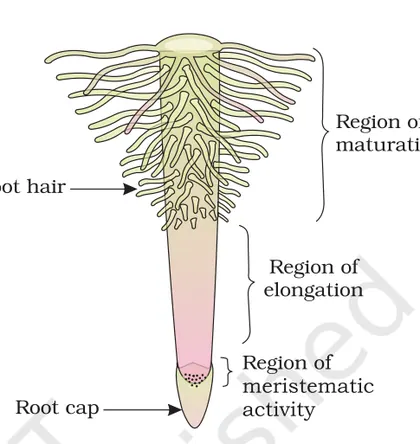
Zones of the root (longitudinal): root cap (protects tip, secretes mucilage), zone of cell division, zone of elongation, and zone of maturation (where root hairs form). Absorption mainly occurs in the zone of maturation.
Epidermis and root hairs: The epidermis is mostly one cell thick. Root hairs are unicellular outgrowths of epidermal cells that greatly increase surface area, penetrate soil pores, and bring soil solution close to the root surface. Root hairs are short-lived but abundant in the maturation zone.
Cortex and intercellular spaces: Cortex (made of parenchyma cells) stores food and provides a pathway for water. Large intercellular spaces permit apoplastic movement (through cell walls and spaces) of water and solutes until the endodermis.
Endodermis and Casparian strip: Endodermis is the innermost cortical layer with a Casparian strip (suberin) in radial and transverse walls. This strip blocks the apoplastic route, forcing water and solutes to cross a plasma membrane (symplastic or transmembrane routes) before entering the stele—allowing selective uptake and preventing backflow.
Pericycle and vascular tissues: Inside the endodermis, the pericycle gives rise to lateral roots. Xylem vessels and phloem transport absorbed water and minerals upward. Root xylem elements contribute to suction and transport but absorption itself involves the epidermis, cortex and endodermis.
Pathways for water/solute entry:
- Apoplast: along cell walls and intercellular spaces (blocked at Casparian strip).
- Symplast: via cytoplasm connected by plasmodesmata (through living cells).
- Transmembrane: repeated crossing of membranes (involves aquaporins and transport proteins).
Mechanisms involved: Water moves down a water-potential gradient from soil (higher Ψ) to root xylem (lower Ψ). Mineral ions often require active transport (carrier proteins, ATP) into root cells, creating osmotic gradients that drive water uptake. Root pressure (osmotic build-up in xylem) can push water upward in some conditions (night or low transpiration).
Additional adaptations and interactions: Mucilage from root cap eases root penetration and improves soil contact. Mycorrhizal associations (fungal hyphae) extend effective absorbing surface and are particularly important for phosphorus uptake. Root architecture (branching, depth) adapts to soil moisture and nutrient distribution.
Functional summary: Structural features (root hairs, thin epidermis, cortical parenchyma, Casparian strip) plus physiological mechanisms (membrane transporters, aquaporins, water-potential gradients) enable efficient, selective absorption and movement of water/minerals into the plant vascular system.
- Root hairs on young roots of bean seedlings increase surface area so seedlings rapidly take up water after sowing.
- Mycorrhizal associations in crops like wheat and maize increase phosphorus and water uptake—used in sustainable agriculture to reduce fertilizer needs.
- In waterlogged soils, plants may show reduced root hair function and depend more on aerenchyma or adventitious roots for gas exchange and limited uptake.
- Desert plants often develop deep or extensive lateral roots (rather than many root hairs) to access scarce water at different soil depths.
- Water potential: Ψ = Ψs + Ψp (Ψs = solute/osmotic potential, Ψp = pressure potential)
- Van't Hoff relation for osmotic potential: Ψs = -iCRT (i = ionization constant, C = molar concentration, R = gas constant, T = temperature in K)
- Flow (volume flux) driven by water-potential difference: Jv = Lp × ΔΨ (Lp = hydraulic conductivity, ΔΨ = water potential difference)
- Hagen–Poiseuille (relevance to xylem flow): Q = (π r^4 ΔP) / (8 η l) (Q = volumetric flow, r = vessel radius, ΔP = pressure difference, η = viscosity, l = length) — shows how vessel radius strongly affects flow rate
Endodermis and Casparian Strip
Location and general role
Endodermis is the innermost single layer of compact, barrel-shaped cells that forms the boundary between the cortex and the vascular cylinder (stele) in roots. It acts as a selective barrier regulating the entry of water and dissolved minerals into the xylem and preventing uncontrolled backflow.
Structure
- Endodermal cells are radially elongated and tightly packed with no intercellular spaces.
- The Casparian strip is a band-like, hydrophobic deposit present in the radial and transverse walls of mature endodermal cells. It is impregnated mainly with suberin (a waxy, fatty polymer) and also lignin.
- Many species also develop a suberin lamella on the inner face of endodermal walls; some endodermal cells remain thin-walled and unsuberized and are called passage cells, which help regulated transfer to the stele.
Functional consequences
- The Casparian strip blocks the apoplastic (cell wall/extracellular) route of water and solute movement at the endodermis. Because of this, water and dissolved ions moving via the apoplast are forced to cross the plasma membrane of endodermal cells to enter the symplast (cytoplasm connected by plasmodesmata) before reaching the xylem.
- By forcing membrane passage, the endodermis enables selective uptake and active transport of ions (nutrient regulation) and exclusion of harmful ions or pathogens.
- Prevents backflow of solutes from the stele into the cortex and soil, helping maintain root pressure and the concentration gradients needed for upward transport.
How it works (mechanistic summary)
Water and solutes approach the stele via three general pathways in the cortex: the apoplast (through cell walls), the symplast (through cytoplasm and plasmodesmata), and the transmembrane route (crossing membranes repeatedly). At the endodermis the apoplastic route is interrupted by the Casparian strip, so uptake into the stele proceeds by membrane-controlled pathways (symplasm or transmembrane). Active transporters and channels on endodermal plasma membranes can therefore control which ions enter the xylem and can generate osmotic gradients that contribute to root pressure.
Physiological significance
- Selective nutrient uptake: essential ions (K+, NO3–, PO4(3–)) can be accumulated while harmful ions (excess Na+, heavy metals) can be excluded or limited.
- Water relation control: by regulating solute concentration in the stele, the endodermis helps establish osmotic gradients that draw water into the stele and contribute (in some conditions) to root pressure and guttation.
- Protection: acts as a barrier to soil-borne pathogens and reduces uncontrolled leakage of solutes.
Developmental/variation notes
Casparian strips develop in the zone of maturation of roots (after root hairs form). Some plants (e.g., aquatic plants) may show reduced suberization; specialized passage cells remain unsuberized to allow more rapid transport in certain regions.
Key terms: endodermis, Casparian strip, suberin, passage cells, apoplast, symplast, transmembrane route, root pressure.
- Salt exclusion in roots: In saline soils, the Casparian strip forces sodium (Na+) entering the root apoplast to cross membranes where selective transporters and pumps reduce Na+ loading into the xylem, helping protect shoots from toxic salt accumulation.
- Guttation at night: When transpiration is low and soil moisture is high, solute accumulation in the stele (partly controlled by endodermal selectivity) can generate root pressure that pushes xylem sap out of leaf margins as guttation droplets.
- Hydroponic nutrient control: In hydroponically grown plants, the endodermis still regulates which ions enter the xylem; specifying nutrient solution composition influences endodermal uptake and thereby shoot nutrition.
- Water potential: Ψ = Ψs + Ψp (Ψ in MPa or bars; Ψs = solute potential, Ψp = pressure potential)
- Solute (osmotic) potential (van't Hoff): Ψs (≈ -π) = -CRT (C = molar concentration in mol m⁻³ or mol L⁻¹, R = gas constant, T = temperature in K). For dilute solutions Ψs ≈ -CRT.
- Fick's law for diffusion (relevant to symplastic and transmembrane transport): J = -D (ΔC / Δx), where J is flux, D is diffusion coefficient, ΔC is concentration difference and Δx is distance.
Mechanisms of Water Ascent (Ascent of Sap)
Overview
Ascent of sap is the upward movement of water and dissolved minerals from roots to aerial parts through xylem. Three main mechanisms contribute: transpiration pull (cohesion–tension), root pressure, and capillarity. Of these, transpiration pull is the principal mechanism in tall plants; root pressure and capillarity make smaller or local contributions.
Cohesion–Tension Theory (Transpiration Pull)
When water evaporates from mesophyll cell walls into intercellular spaces and diffuses out via stomata (transpiration), it lowers the water potential in leaf cells. This creates a continuous water-potential gradient from root xylem to leaf air spaces. Because water molecules are cohesive (hydrogen bonds) and adhesive to xylem walls, a continuous column of water is pulled up under tension (negative pressure). The tension generated at the leaf surface is transmitted down the continuous column to the roots, drawing water upward.
Key points:
- Requires continuous water column inside xylem vessels/tracheids.
- Relies on properties of water: cohesion, adhesion, and high tensile strength.
- Stomatal control regulates transpiration rate; hence controls the driving force.
- Negative pressures (tensions) measured in xylem via pressure chamber (Scholander) provide experimental support.
Root Pressure
Root pressure is a positive hydrostatic pressure generated in root xylem at night or when transpiration is low. Living cells of root cortex actively pump ions into xylem, lowering xylem water potential. Water enters by osmosis, producing a positive pressure that can push sap upward a short distance and may cause guttation (exudation of droplets at leaf margins) on humid nights.
Capillarity
Capillarity (capillary action) means rise of water in narrow tubes due to adhesion to tube walls and surface tension. It contributes near the base and in very narrow tracheids, but alone cannot lift water to the tops of tall trees because capillary rise decreases as tube radius increases and typical xylem vessel radii are too large for large rises.
Other Relevant Concepts
- Pathways of water from soil to xylem: apoplast (between cell walls), symplast (through plasmodesmata/cytoplasm), and transmembrane (across membranes and vacuoles).
- Cavitation and embolism: formation of air bubbles that break the water column; plants have adaptations (bordered pits, refilling, root pressure) to limit or repair embolisms.
- Transpiration stream: continuous upward flow that transports mineral nutrients, aids cooling, and maintains turgor.
Experimental Evidence
- Potometer experiments measure transpiration and show correlation of transpiration rate with water uptake.
- Scholander pressure chamber measures negative xylem pressures (tensions).
- Observation of guttation indicates root pressure.
Practical/Physiological Importance
Ascent of sap supplies water for photosynthesis and cell expansion, transports mineral ions, maintains leaf turgor and cooling, and supports nutrient distribution.
- Guttation in grass and garden plants (drops on leaf margins in the morning) — evidence of root pressure.
- Sap flow and bleeding of maple trees in spring — movement of xylem sap when temperatures fluctuate and root activity resumes.
- Wicking of water into a paper towel or cloth — everyday illustration of capillarity (adhesion + cohesion).
- Wilting of plants on hot, dry days — high transpiration and reduced water uptake break the transpiration stream causing loss of turgor.
- Repair of embolism after rain or at night when transpiration falls and root pressure can refill xylem conduits.
- Water potential: ψw = ψs + ψp + ψg (often ψ = ψs + ψp in short vertical distances) — ψs: solute potential, ψp: pressure potential, ψg: gravitational potential
- Capillary rise: h = (2 γ cosθ) / (ρ g r) where h = rise, γ = surface tension, θ = contact angle, ρ = density of liquid, g = gravity, r = radius of tube
- Hagen–Poiseuille law (flow in a tube): Q = (π r^4 ΔP) / (8 η l) — Q: volumetric flow, r: radius, ΔP: pressure difference, η: viscosity, l: length; indicates flow ∝ r^4
- van 't Hoff equation for osmotic (turgor) pressure: π ≈ iCRT — π: osmotic pressure, i: van 't Hoff factor, C: molar concentration, R: gas constant, T: temperature (K)
Transpiration
Definition: Transpiration is the loss of water vapour from aerial parts of plants (mainly leaves) to the atmosphere through stomata, cuticle and lenticels.
Types:
- Cuticular transpiration – through the cuticle (usually 5–10% of total).
- Stomatal transpiration – through stomata (major portion, up to 90%).
- Lenticular transpiration – through lenticels on stems (minor).
Pathways of water movement to the site of evaporation:
- Apoplast – along cell walls and intercellular spaces.
- Symplast – through plasmodesmata and cytoplasm.
- Transcellular – across cell membranes and vacuoles.
Mechanism (how transpiration drives water ascent):
- Water evaporates from thin film on mesophyll cell walls into substomatal chamber and diffuses out via stomata.
- Evaporation creates a negative pressure (tension) in the leaf apoplast; due to cohesion and adhesion of water molecules this tension is transmitted down the xylem as a continuous pull—the cohesion‑tension mechanism—pulling water column from roots to leaves.
- Root uptake replenishes water lost and maintains the transpiration stream that carries minerals.
Factors affecting transpiration (with direction of effect):
- External: Light (increases stomatal opening → increases), Temperature (↑ increases vapour pressure deficit → increases), Relative humidity (↑ decreases transpiration), Wind (↑ increases by removing boundary layer), Soil water availability (↓ soil water ↓ transpiration).
- Internal: Stomatal density & aperture (more/open → more), Cuticle thickness (thicker → less), Leaf area and orientation, Presence of hairs/trichomes, Xeromorphic adaptations.
Measurement methods: Potometer (measures water uptake as proxy), Porometer (measures stomatal conductance), Lysimeter (measures whole-plant or field evapotranspiration), Gravimetric methods (loss of weight).
Significance:
- Drives transpiration stream that transports mineral ions from roots to shoots.
- Helps leaf cooling by evaporative heat loss.
- Maintains cell turgor necessary for growth and leaf orientation.
- Causes water loss that must be balanced by root uptake—critical for irrigation scheduling and drought response.
Adaptations to reduce transpiration: Thick cuticle, sunken stomata, reduced leaf area or leaf rolling, trichomes, CAM photosynthesis, succulence.
Common confusions: Guttation is exudation of liquid water from hydathodes due to root pressure (occurs at night) and is not transpiration.
- Wilting of leaves on a hot, sunny afternoon: high transpiration rate exceeds root water uptake, reducing turgor.
- Eucalyptus trees feel cooler to touch in hot weather—evaporative cooling from high transpiration.
- Irrigation scheduling: farmers water fields in early morning to reduce water loss (less transpiration at low VPD) and improve efficiency.
- Xerophytes (cacti) reduce transpiration by having thick cuticles, reduced leaves, and stomata that open at night (CAM).
- Greenhouse management: controlling humidity and ventilation alters transpiration and plant water needs.
- Transpiration rate (per unit leaf area) = ΔW / (A × Δt), where ΔW = water loss (g or ml), A = leaf area (cm²), Δt = time (h).
- Water potential: Ψ = Ψs + Ψp (Ψ in MPa), where Ψs = solute potential, Ψp = pressure potential; water moves from higher Ψ to lower Ψ.
- Transpiration flux approximation: E = g_s × VPD, where E = transpiration flux density, g_s = stomatal conductance, VPD = vapour pressure deficit (units must be consistent).
- Poiseuille relation (applies qualitatively to flow in xylem vessels): Q = (π r^4 ΔP) / (8 η l), showing how flow depends strongly on vessel radius r.
Stomata and Guard Cell Physiology
Introduction
Stomata are microscopic pores on the leaf epidermis that control gas exchange (CO2 in, O2 out) and water loss (transpiration). Each stoma is bordered by two guard cells that regulate its aperture by changing turgor. Stomatal behavior integrates environmental signals (light, CO2, humidity, water status) and endogenous signals (ABA, circadian rhythm).
Structure and distribution
Stomata consist of a pore plus two guard cells; subsidiary (accessory) cells may be present. Typical locations: most dicots amphistomatic (both surfaces) or hypostomatic (lower surface), hydrophytes with stomata on upper surface, xerophytes with fewer and sunken stomata. Guard cells are the only epidermal cells with chloroplasts in many species.
Types of stomata (brief)
Based on guard cell shape: anisocytic, paracytic, diacytic, actinocytic, anomocytic, etc. (CBSE-level recognition is sufficient; these differ by arrangement of subsidiary cells.)
Mechanism of stomatal opening
Opening is an active, energy-dependent process driven by guard cell turgor increase:
- Light (especially blue light) activates plasma membrane H+-ATPase in guard cells, pumping H+ out and hyperpolarizing the membrane.
- Hyperpolarization opens inward-rectifying K+ channels; K+ enters the guard cells. Anions (Cl−) or organic anions (malate2− produced from starch → sugar → malate) balance charge.
- Solute accumulation lowers guard cell osmotic potential, so water enters by osmosis, increasing turgor (Ψp) and causing guard cells to swell and bow apart, widening the pore.
- Guard cell chloroplasts may supply ATP and convert starch to malate at dawn, aiding solute accumulation.
Mechanism of stomatal closing
Closing occurs when guard-cell turgor falls:
- Drought produces abscisic acid (ABA), which binds guard-cell receptors and triggers cytosolic Ca2+ increases.
- Ca2+ and ABA activate anion channels; anions (Cl−, malate2−) are released. Membrane depolarizes and K+ effluxes through outward-rectifying K+ channels.
- Loss of solutes raises osmotic potential, water leaves, turgor falls, guard cells become flaccid and pore closes.
Other controlling factors
- Light intensity (opens), especially blue wavelengths.
- Internal CO2 concentration (low CO2 promotes opening).
- Vapor pressure deficit (VPD) and humidity (high VPD increases transpiration and may close stomata).
- Soil water status and ABA (drought causes closing).
- Circadian rhythms: stomata show daily opening/closing cycles even in constant conditions.
Special adaptations
- CAM plants (e.g., Opuntia, Pineapple) open stomata at night to reduce water loss; CO2 fixed at night as malate.
- C4 plants (e.g., maize) have higher water-use efficiency and often different stomatal behavior due to CO2 concentrating mechanism.
- Xerophytes have fewer/sunken/stomatal crypts to reduce transpiration.
Physiological significance
Stomata balance CO2 uptake for photosynthesis against water loss. They regulate leaf temperature (via transpiration), plant water relations, and influence whole-plant water-use efficiency (WUE). Stomatal function is central to crop productivity and drought tolerance.
Useful indices
Stomatal Index (SI) measures stomatal frequency relative to epidermal cells and is useful in taxonomy and physiology.
Summary: Guard cell turgor, controlled by ion transport and metabolic changes, opens and closes stomata in response to environmental and hormonal signals, optimizing CO2 uptake while limiting water loss.
- Xerophytes (cactus, Nerium) have sunken/ reduced stomata or stomatal crypts to reduce transpiration; many open at night (CAM) — e.g., Opuntia.
- Hydrophytes (water lily) have stomata only on the upper leaf surface to exchange gases with air.
- Blue-light stomatal opening demonstrated in experiments using Vicia faba: stomata open rapidly under blue light and close in the dark.
- ABA-induced stomatal closure: during drought, increased ABA causes stomata to close — practical for irrigation scheduling and drought-tolerant crop breeding.
- Classroom experiment: peel lower epidermis of Tradescantia, observe stomata under microscope, count stomata and epidermal cells to calculate Stomatal Index.
- Stomatal Index (SI) = (Number of stomata / (Number of stomata + Number of other epidermal cells)) × 100
- Water potential: Ψ = Ψs + Ψp (Ψ: total water potential, Ψs: solute/osmotic potential, Ψp: pressure/turgor potential)
- Van't Hoff (osmotic potential approximation): Ψs ≈ -CRT (C: molar concentration, R: gas constant, T: absolute temperature)
- Fick's law (diffusion across stomatal pore approximate): J = -D × (ΔC / Δx) (J: flux, D: diffusion coefficient, ΔC: concentration gradient, Δx: path length)
- Transpiration (simplified relation): E ≈ g_s × VPD (E: transpiration rate, g_s: stomatal conductance, VPD: vapour pressure deficit = e_s - e_a)
Factors Affecting Transpiration and Water Transport
Overview
Transpiration is the loss of water vapour from aerial parts of plants (mainly leaves). Water transport refers to uptake from soil, movement through the plant (roots → xylem → leaves) and loss to the atmosphere. Transpiration drives the major mechanism of long-distance water transport—the cohesion–tension mechanism—by creating a negative pressure (tension) in xylem.
Pathways of water movement in the leaf
- Apoplastic route: along cell walls and intercellular spaces (fast).
- Symplastic route: through connected cytoplasm via plasmodesmata.
- Transmembrane route: repeated crossing of membranes and vacuoles (regulated).
Types of transpiration
- Stomatal transpiration (≈90%): through open stomata.
- Cuticular transpiration: through the cuticle (small, but important in xerophytes).
- Lenticular transpiration: through lenticels on stems.
Mechanisms of water transport
- Root uptake: water enters root hairs by osmosis driven by lower water potential in root cells.
- Root pressure: osmotic uptake can generate positive pressure in xylem causing guttation (at night) — important over short distances or in some species.
- Cohesion–tension theory: transpiration at the leaf air–water interface creates a tension (negative pressure) that pulls a continuous column of water through xylem; cohesion between water molecules (H‑bonding) and adhesion to xylem walls maintain the column.
- Capillarity and osmotic gradients also contribute but are insufficient alone for tall plants.
External (environmental) factors
- Light: Increases stomatal opening and raises leaf temperature → higher transpiration. Transpiration typically rises with light until stomata saturate.
- Temperature: Warmer air increases saturation vapour pressure and vapour pressure deficit (VPD) → increases transpiration rate and diffusion rate of water vapour.
- Humidity: Higher atmospheric humidity reduces VPD and lowers transpiration; dry air increases transpiration.
- Wind / air movement: Removes the boundary layer of humid air around leaf, increasing transpiration; effect levels off at high wind speeds.
- Soil water availability: Low soil water reduces root water potential and stomata close to conserve water → lowered transpiration and transport.
- Atmospheric pressure: Lower pressure (high altitude) can increase evaporation; usually minor for most plants.
Internal (plant) factors
- Stomatal number and aperture: Primary control of transpiration. Guard cell turgor (influenced by light, CO2, ABA) regulates aperture.
- Leaf area and shape: Larger or thinner leaves usually transpire more; leaf rolling and sunken stomata (xerophytes) reduce transpiration.
- Cuticle thickness: Thick cuticles reduce cuticular transpiration (common in xerophytes).
- Boundary layer resistance: Affected by leaf size, hairiness and surface roughness; increases resistance to water loss.
- Xylem anatomy and hydraulic conductivity: Vessel diameter, pit structure and embolism resistance determine how easily water moves; narrow vessels are safer but less conductive.
- Aquaporins: Membrane water channels that modulate cellular water permeability.
Limits and risks
Excessive transpiration can cause cavitation (formation of air embolisms) that breaks the water column and reduces hydraulic conductivity. Plants balance water loss and CO2 uptake by regulating stomata.
Practical/physiological consequences
- Transpiration cools leaves (evaporative cooling) and drives mass flow of minerals from root to shoot.
- Guttation (water droplets at leaf margins) is due to root pressure when transpiration is low and soil moisture is high.
- Agricultural implications: irrigation scheduling, greenhouse humidity control, windbreaks, and varieties with appropriate stomatal traits affect water use efficiency.
Measurement methods
Potometer (estimates transpiration by measuring water uptake), porometer (stomatal conductance), pressure chamber (xylem tension), sap flow sensors.
- Hot, dry, windy day: stomata open in morning for photosynthesis; as temperature and wind increase and humidity falls, transpiration rate rises — plants may close stomata midday to avoid excessive water loss, causing temporary wilting.
- Xerophytic adaptations: cacti have reduced leaves (spines), thick cuticle and sunken stomata — these reduce boundary layer removal and cuticular water loss to survive arid habitats.
- Guttation in well-watered lawns or potted plants at night: root pressure pushes water out through hydathodes, producing droplets on leaf margins when stomata are closed.
- Greenhouse humidity control: raising relative humidity lowers VPD and reduces transpiration, which can be used to conserve water but may increase disease risk (pathogens favoured by high humidity).
- Transpiration cooling: dense canopies of crop plants lower leaf temperature by evaporation, similar to how sweating cools humans.
- Water potential (general): Ψw = Ψs + Ψp (plus Ψg and Ψm if including gravitational and matrix potentials). Ψ in MPa (megapascal).
- Fick's law (diffusion of water vapour): J = -D * (ΔC / Δx), where J = flux, D = diffusion coefficient, ΔC = concentration difference, Δx = path length.
- Darcy's law for water flow (analogous form): J = K_h * (ΔΨ / L), where J = flow rate, K_h = hydraulic conductivity, ΔΨ = water potential difference, L = path length.
- Stomatal transpiration approximation: E ≈ g_v × VPD, where E = transpiration rate, g_v = conductance to water vapour, VPD = vapour pressure deficit (kPa).
Mechanisms of Mineral Uptake
Overview: Mineral uptake by plant roots supplies essential ions (N, P, K, Ca, Mg, Fe, etc.) needed for growth. Uptake uses three main physical/physiological routes: apoplast (cell walls + intercellular spaces), symplast (through cytoplasm connected by plasmodesmata) and transmembrane (repeated crossing of membranes). Transport occurs by passive processes (diffusion, mass flow, facilitated diffusion) and active processes (energy-dependent carrier transport).
Pathways of movement to the xylem: (1) Apoplastic pathway — movement through cell walls until blocked by the Casparian strip in the endodermis; (2) Symplastic pathway — entry into root hair cytoplasm then cell-to-cell via plasmodesmata; (3) Transmembrane pathway — successive crossing of plasma membranes via transport proteins. The Casparian strip forces selective entry into the symplast before xylem loading.
Passive mechanisms:
- Diffusion: ions move down a concentration gradient (from soil solution to root cells).
- Mass flow (bulk flow): movement of dissolved ions with water pulled through the plant by transpiration; important for mobile ions transported in xylem.
- Facilitated diffusion: ion channels permit movement down electrochemical gradients without ATP.
Active mechanisms:
- Primary active transport — H+-ATPase (proton pump) in the plasma membrane uses ATP to pump H+ out of root cells, generating an electrochemical proton gradient (ΔpH and membrane potential) across the membrane.
- Secondary active transport — co-transporters (symporters/antiporters) use the proton electrochemical gradient to drive uptake of ions (for example, H+/NO3− symport for nitrate uptake, H+/sugar symport for some organics). Some ions (K+) also enter via channels driven by membrane potential.
- Carrier-mediated transport — membrane proteins bind specific ions; shows saturation kinetics and can be inhibited by metabolic inhibitors (e.g., cyanide) demonstrating energy dependence.
Selectivity and regulation: Roots select ions by specific transporters, membrane potential and the Casparian strip checkpoint. Transporter expression is regulated by nutrient status (e.g., upregulation of phosphate transporters under P deficiency). Mycorrhizal associations extend absorptive area and enhance especially phosphorus uptake.
Soil and environmental influences: pH, temperature, moisture, cation exchange capacity (CEC), presence of competing ions and organic chelators affect mineral availability and uptake. For example, Fe availability decreases at high pH; P becomes fixed in certain soils and is made available by mycorrhizae or root exudates.
Physiological consequences: Uptake supplies building blocks and regulators (e.g., K+ for stomatal function). Imbalances/deficiencies produce characteristic symptoms (e.g., N deficiency — chlorosis; Fe deficiency — interveinal chlorosis).
- Nitrate (NO3-) uptake: mainly by H+/NO3- symporters (secondary active transport); nitrate is reduced in roots or translocated to shoots.
- Ammonium (NH4+) uptake: can enter directly via channels/transporters but excess NH4+ can be toxic; plants often prefer a balance between NO3- and NH4+.
- Phosphate (PO4^3-) uptake: low mobility in soil; uptake enhanced by root hairs and mycorrhizal fungi which extend absorptive surface.
- Potassium (K+) uptake: enters via K+ channels driven by membrane potential and by H+/K+ co-transporters; crucial for stomatal movement and enzyme activation.
- Iron uptake strategies: dicots/non-graminaceous monocots use acidification + reduction (Fe3+→Fe2+) while grasses release phytosiderophores to chelate Fe3+ and transport Fe3+-chelate.
- Fick's law of diffusion (one-dimensional): J = -D (dC/dx), where J = flux (mol m^-2 s^-1), D = diffusion coefficient (m^2 s^-1), dC/dx = concentration gradient.
- Michaelis–Menten for carrier-mediated uptake: V = (Vmax [S]) / (Km + [S]), where V = uptake rate, Vmax = maximum rate, Km = substrate concentration at half Vmax, [S] = external ion concentration.
- Nernst equation (equilibrium potential for ion): E = (RT / zF) ln([outside]/[inside]), where E = potential (V), R = gas constant, T = absolute temperature (K), z = ion charge, F = Faraday's constant.
- Electrochemical free energy change for moving an ion: ΔG = RT ln(C2/C1) + zFΔψ (J mol^-1). If ΔG < 0 movement is spontaneous.
- Q10 temperature coefficient (approximate effect of temperature on rate): Q10 = (Rate2 / Rate1)^(10/(T2 - T1)).
Role of Mycorrhizae and Root-Microbe Interactions
Overview
Roots interact with many soil microorganisms. Two major beneficial associations are mycorrhizae (fungus–root symbiosis) and root–bacteria interactions (notably nitrogen-fixing bacteria). These associations enhance nutrient and water uptake, improve soil structure and plant health, and are important in agriculture and ecosystems.
Mycorrhizae
Mycorrhizae are symbiotic associations between plant roots and fungi. Two main types are:
- Arbuscular mycorrhizae (AM or endomycorrhizae): Fungi (Glomeromycota, e.g., Glomus) penetrate root cortical cells and form arbuscules for nutrient exchange. Common in most herbaceous crops and grasses.
- Ectomycorrhizae: Fungi (many Basidiomycetes and Ascomycetes) form a sheath around root tips and a Hartig net between root cells; common in trees (pine, oak).
How mycorrhizae help plants
- Increase effective root surface area via fungal hyphae, extending nutrient and water uptake zones beyond root depletion zones (especially immobile nutrients like phosphorus).
- Improve absorption of P, Zn, Cu and sometimes N and water.
- Enhance soil aggregation and stability by fungal hyphal networks and glomalin production.
- Provide pathogen protection or induce systemic resistance in some cases.
- Plants supply fungi with carbohydrates (photosynthates); fungi supply mineral nutrients — a mutual exchange.
Root–Microbe Interactions (Nitrogen-fixing and other beneficial bacteria)
Many soil bacteria interact with roots. Key examples include:
- Symbiotic nitrogen fixation (Rhizobium–legume): Legume roots release flavonoids that attract compatible Rhizobium species. Bacteria respond by producing Nod factors that trigger root hair curling, infection thread formation and cortical cell division, producing nodules. Inside nodules bacteria differentiate to bacteroids and fix atmospheric N2 to NH3. Plant supplies carbon; bacteria supply fixed N.
- Actinorhizal symbioses (Frankia with non-leguminous trees like Alnus) produce root nodules and fix N2.
- Free-living and associative diazotrophs (Azotobacter, Azospirillum) fix N2 or promote growth by producing phytohormones.
- Phosphate-solubilizing bacteria and mycorrhiza-helper bacteria increase soil P availability or enhance mycorrhizal colonization.
Key steps in legume nodulation (simplified)
- Root exudes flavonoids → Rhizobium recognizes flavonoids → Rhizobium synthesizes Nod factors.
- Nod factors cause root hair curling and local cell division (nodule primordium) → infection thread forms allowing bacteria to enter root.
- Bacteria differentiate into bacteroids inside nodule cells and fix N2; plant produces leghemoglobin to regulate O2.
Physiological notes
Nitrogenase (enzyme complex in bacteroids) is extremely O2-sensitive. Leghemoglobin binds O2 to keep free O2 low for nitrogenase but supplies enough O2 for bacterial respiration. The symbiosis is energy demanding—ATP is required for N2 reduction.
Ecological and agricultural importance
These interactions reduce the need for chemical fertilizers (biofertilizers: Rhizobium, Azotobacter, mycorrhizal inoculants), improve crop yield and sustainability, aid reclamation of degraded soils, and support natural ecosystems by facilitating nutrient cycling.
- Soybean and Rhizobium japonicum: root nodules supply fixed nitrogen, reducing fertilizer needs.
- Glomus (AM fungus) associated with maize improves phosphorus uptake and drought tolerance.
- Pine trees with ectomycorrhizae (e.g., Suillus spp.) show better nutrient uptake in poor soils.
- Alnus (alder) trees with Frankia fix nitrogen and improve soil fertility in riparian zones.
- Use of Rhizobium and mycorrhizal inoculants in sustainable agriculture and nursery practices.
- Overall biological nitrogen fixation (simplified): N2 + 8H+ + 8e- + 16 ATP → 2 NH3 + H2 + 16 ADP + 16 Pi
- Ammonia assimilation (glutamine synthetase): Glutamate + NH4+ + ATP → Glutamine + ADP + Pi
- Nitrate reduction (two-step): NO3- + 2 e- + 2 H+ → NO2- + H2O (nitrate reductase); NO2- + 6 e- + 8 H+ → NH4+ + 2 H2O (nitrite reductase)
Translocation of Organic Solutes (Phloem Transport)
Overview: Translocation is the long-distance transport of organic solutes (mainly sucrose), amino acids, hormones and other metabolites through the phloem, from source regions (mature leaves where photosynthesis occurs) to sink regions (growing roots, fruits, seeds, storage organs).
Phloem structure related to transport:
- Sieve tube elements — elongated cells joined end-to-end with sieve plates; reduced organelles, cytoplasmic strands allow flow of sap.
- Companion cells — metabolically active cells linked to sieve tubes by plasmodesmata; they load and unload solutes and maintain sieve elements.
- Phloem parenchyma and fibres — storage and mechanical support.
Mechanisms of loading and unloading:
- Loading at sources — sucrose is concentrated in companion cells and sieve tubes by two main routes:
- Symplastic loading: movement via plasmodesmata; diffusion plus enzymatic conversion (e.g., sucrose to raffinose family oligosaccharides) to maintain gradient.
- Apoplastic loading: sucrose moves into cell wall space then is actively transported into companion cells/sieve tubes by H+‑sucrose co-transporters (secondary active transport driven by a proton gradient generated by H+-ATPase).
- Unloading at sinks — can be passive (down a concentration gradient) or active (requiring transporters), then solutes are used or stored (as starch in roots/tubers, fruits, seeds).
Pressure-flow (Münch) hypothesis — the accepted mechanism:
- At the source, active loading of sucrose into sieve tubes lowers water potential (Ψ), so water enters by osmosis from xylem raising turgor pressure (Ψp) in the sieve tube near the source.
- At the sink, sucrose is removed (used or stored), increasing Ψ and causing water to leave the sieve tube back to xylem, creating a lower turgor pressure at the sink.
- The resulting pressure difference (high at source, low at sink) drives bulk flow of phloem sap through sieve tubes from source to sink. This bulk flow carries dissolved solutes and is faster than diffusion alone.
- Flow continues as long as source loading and sink unloading are maintained.
Evidence in support:
- Girdling (ringing) experiments: removal of phloem causes accumulation of sugars above the girdle and starvation below it (shows directionality and role of phloem).
- Radioactive tracer experiments (e.g., 14C‑labelled CO2 fixed in leaves): label appears first in phloem and later in sinks.
- Aphid stylet technique: aphids tap sieve tubes and exude sap under pressure, allowing measurement of sap composition and pressure gradients.
- Measured pressure differences and rapid transport rates are consistent with pressure-driven bulk flow rather than molecular diffusion alone.
Factors affecting phloem transport: Temperature (affects enzyme activity and viscosity), rate of source loading, sink strength (rate of unloading/use), sieve-tube radius and viscosity of sap, physical damage (blocks flow), and plant water status (xylem-phloem water exchange).
Physiological significance: Distributes products of photosynthesis to growing and storage organs, moves nitrogenous compounds and signalling molecules (like hormones), transports defence compounds, and integrates whole-plant metabolism (e.g., support of fruits, seeds, root growth, and storage in tubers/beets).
Quick summary: Phloem translocation is an active, energy-dependent process of loading/unloading coupled to osmotically driven bulk flow (pressure-flow). Companion cells carry out active transport to generate concentration and pressure gradients that move sap through sieve tubes from sources to sinks.
- Transport of sucrose from leaves to developing potato tubers (storage as starch).
- Movement of photosynthates into sugarcane stems (sucrose accumulation) and sugar beet roots.
- Supplying developing fruits (tomato, mango) with sugars produced by leaves.
- Girdling a fruit branch leads to sugar accumulation above the girdle and fruit drop below it — used to demonstrate phloem function.
- Aphids tapping phloem sap: they obtain sugary sap; sap composition and pressure measured via aphid stylet technique.
- Systemic spread of plant viruses and signalling hormones (e.g., some forms of auxin/translocated signals) via phloem.
- Water potential: Ψ = Ψs + Ψp (Ψ in pressure units, Ψs = solute/osmotic potential, Ψp = pressure potential)
- Van't Hoff (osmotic potential approximation): Ψs ≈ -C R T (C = molar concentration, R = gas constant, T = absolute temperature)
- Hagen–Poiseuille law (flow in a cylindrical tube — used to estimate pressure-driven flow): Q = (π r^4 ΔP) / (8 η l) - Q = volumetric flow rate; r = radius of tube; ΔP = pressure difference; η = viscosity; l = length.
- Average linear velocity: v = Q / A (A = cross-sectional area = π r^2).
- Approximate driving pressure: ΔP ≈ Π_source - Π_sink (where Π is osmotic pressure generated by solute loading)
Experimental Evidence and Techniques
Overview
This topic summarizes the key experiments and techniques used to investigate transport of water, minerals and organic solutes in plants. Experiments provide evidence for mechanisms such as transpiration pull (cohesion–tension theory), root pressure, and phloem translocation (mass flow/Münch hypothesis).
Major experimental techniques and what they show
- Potometer (Ganong's potometer): measures rate of water uptake by a cut shoot. Procedure: assemble apparatus under water, insert shoot, record movement of air bubble or meniscus. Shows factors affecting transpiration (light, humidity, wind, temperature) and relative water uptake.
- Dye uptake (xylem tracing): place a cut stem (e.g., celery) in coloured dye; after some time, sections show dye in xylem vessels and up to leaves. Demonstrates upward movement of water through xylem and continuity of xylem vessels.
- Cut-stem under water and air-bubble experiments: cutting a transpiring shoot under water prevents air entry and allows continuous flow; introducing an air bubble breaks the column and stops flow. Supports cohesion–tension requirement for an unbroken water column.
- Pressure chamber / Scholander pressure bomb: used to measure xylem tension (negative pressure). The pressure required to force sap out of a cut twig approximates the tension in xylem, giving direct evidence of negative pressures predicted by cohesion–tension theory.
- Root pressure and guttation observations: some plants exude sap from cut stems or hydathodes early morning (guttation), and sap may appear on cut stumps — evidence that root pressure can generate a positive push in xylem under certain conditions.
- Greasing leaf surfaces (Vaseline) experiment: cover upper or lower leaf surface with grease and measure transpiration. A significant drop when the lower surface (where most stomata are) is blocked shows stomatal control of transpiration.
- Stomatal impressions / porometer / microscopic observation: nail-polish impressions or porometers measure stomatal density and stomatal conductance; used to correlate stomatal opening with transpiration and environmental factors.
- Girdling (ringing) and radioisotope tracing for phloem transport: girdling (removal of a bark ring) causes carbohydrate accumulation above the girdle, indicating downward flow in phloem. Autoradiography using 14C-labelled CO2 or labelled sugars shows direction and speed of translocation. These support bulk-flow (pressure-driven) translocation in phloem.
- Aphid stylet technique: when an aphid probes phloem, withdrawal of its body while stylet remains allows collection of phloem sap under pressure. Phloem sap exudes, indicating positive pressure in phloem consistent with source-to-sink pressure gradient.
How these experiments support theories
- Cohesion–tension theory: continuous dye columns, cut-under-water technique, negative xylem pressures measured by pressure chamber, and daily correlation of transpiration with xylem tension support this theory.
- Root pressure: bleeding from cut stems and guttation show that root-generated positive pressure can push xylem sap upward (usually small and not sufficient for tall trees).
- Phloem translocation (Münch hypothesis): girdling, radioisotope tracing and aphid stylet sampling provide evidence for pressure-driven mass flow from sugar sources (leaves) to sinks (roots, fruits).
Practical/experimental tips (classroom/lab)
- Always insert cut shoots under water to avoid embolism (air entry).
- Control environmental variables (light, humidity, temperature) when using potometers to compare treatments.
- Use replicates and measure leaf area when expressing transpiration per unit area.
- Place a celery stalk in coloured water — after a few hours/days coloured xylem vessels in the stalk and leaves show upward movement of water.
- Use a potometer to compare water uptake of two shoots, one with the lower leaf surface greased and one ungreased — greasing the lower surface (most stomata) reduces uptake, showing stomatal control.
- Observe guttation droplets on grass or beans early in the morning — result of root pressure pushing xylem sap out of hydathodes.
- Girdle a young fruiting branch (remove bark and phloem ring): sugars accumulate above the girdle and fruits below may be starved — demonstrates downward phloem transport and interruption by removing phloem.
- Expose a potted plant to different humidities and record mass loss over time — plot shows transpiration rate decreases as humidity increases.
- Transpiration rate (mass basis): Rate = Δm / Δt (where Δm = mass of water lost, Δt = time interval)
- Transpiration rate per unit leaf area: R = Δm / (A · Δt) (A = leaf area; units: g·cm⁻²·h⁻¹ or kg·m⁻²·s⁻¹)
- Water potential relation: Ψw = Ψs + Ψp (Ψw = water potential, Ψs = solute/osmotic potential, Ψp = pressure potential)
- Simplified diffusion (Fick's law) for stomatal transpiration: Rate ∝ (ΔC · A · D) / d (ΔC = concentration gradient of water vapour, A = area/open stomatal area, D = diffusion coefficient, d = path length)
Guttation and Related Phenomena
Definition: Guttation is the exudation of liquid droplets (xylem sap) from specialized structures called hydathodes at leaf margins or tips. It occurs when root-generated positive pressure (root pressure) forces water out of leaves.
Mechanism:
- Active absorption of mineral ions by root cells lowers the water (solute) potential in xylem.
- Water enters xylem by osmosis, generating a positive hydrostatic pressure in the root xylem — root pressure.
- When transpiration is low (night, high humidity), this pressure pushes xylem sap up and out through hydathodes as droplets.
- Hydathodes are openings connected to the xylem via epithem tissue; they lack the guarding mechanism of stomata and permit continuous exudation.
Conditions favoring guttation:
- High soil moisture and active roots.
- Low transpiration rate (night, cloudy, humid conditions, calm winds).
- Young plants or plants with many leaf hydathodes (grasses, tomato, strawberry).
Composition of guttation fluid: Mostly water, dissolved mineral salts, sugars, organic acids and sometimes secondary metabolites or systemic pesticides. After evaporation, salts or crystals may remain at the leaf margin.
How to distinguish guttation from dew:
- Location: guttation drops appear at leaf margins/tips (hydathodes); dew forms uniformly on exposed surfaces.
- Timing and conditions: guttation mainly at night/early morning even when air is humid; dew forms by atmospheric condensation when plant surface cools below dew point.
- Residue: guttation often leaves crystalline residues (salts); dew leaves none.
Related phenomena:
- Bleeding (Exudation): When a stem or root is cut, sap may ooze out due to root pressure — seen in herbaceous plants and some trees. This is similar in origin to guttation but occurs from wounds or cuts.
- Transpiration: Evaporation-driven loss of water through stomata. Guttation is pressure-driven exudation and occurs mainly when transpiration is low.
- Maple sap flow: Sap flow in maple during spring is driven by freeze–thaw cycles and osmotic changes in the stem, not classical guttation (different mechanism from root pressure).
- Extrafloral nectar/exudates: Secretions from specialized glands (nectaries) are similar in appearance but are biologically secreted for ecological interactions (e.g., attracting ants), not merely pressure-driven leakage.
Biological significance:
- Provides a pressure-relief pathway when root pressure builds up.
- Helps excrete excess salts and some metabolites.
- Can spread pathogens or chemical residues (systemic pesticides) because guttation droplets may contain these substances.
Practical notes: Guttation droplets on vegetable leaves can concentrate pesticides — they can be toxic to beneficial insects (e.g., bees) that visit plants early in the morning.
- Grass blades showing beads of water on their tips early in the morning (common lawn guttation).
- Tomato plants producing droplets at leaf margins; droplets often leave white crystalline residues after evaporation.
- Strawberry leaves forming guttation drops at leaf margins.
- Cut herbaceous stems (e.g., sunflower, young bean plants) that bleed sap due to root pressure after being severed.
- Water potential: Ψ = Ψs + Ψp (where Ψ is total water potential, Ψs = solute/osmotic potential, Ψp = pressure potential).
- Van't Hoff (osmotic pressure for dilute solutions): π ≈ CRT (π = osmotic pressure, C = molar concentration, R = gas constant, T = temperature in K). In plant-water terms Ψs ≈ -π.
- Hydrostatic pressure from a liquid column: P = ρgh (P = pressure, ρ = density of liquid, g = acceleration due to gravity, h = height of column). Root pressure measured as height of exuded sap can be related to this.
Adaptations Related to Transport
Overview
Adaptations related to transport are structural and physiological modifications in plants that optimize water, mineral and assimilate movement — from uptake at roots, long‑distance conduction in xylem and phloem, to regulation of loss via leaves. These adaptations enable survival in particular habitats (xeric, hydric, saline, epiphytic) and protect the transport system from dysfunction (embolism, ion toxicity).
Major types of adaptations
- Root adaptations for uptake and selectivity
- Root hairs: increase surface area for water/mineral absorption.
- Mycorrhizae: fungal hyphae extend effective absorbing surface and improve uptake of P and other immobile ions.
- Casparian strip in endodermis: suberin band that blocks apoplastic flow, forcing selective symplastic uptake into stele (controls ion entry into xylem).
- Velamen (epiphytes, e.g., orchids): multi‑layered epidermis on aerial roots that rapidly absorbs and stores water.
- Pneumatophores (mangroves): upward roots with lenticels for gas exchange in waterlogged soils.
- Xylem and stem adaptations for safe, efficient conduction
- Variation in vessel/tracheid diameter and length: wider vessels increase conductance but raise embolism risk; many plants balance vessel size and number for habitat conditions.
- Lignified walls and bordered pits: facilitate capillary movement and control of air-seeding between conduits.
- Tyloses and gums: occlude damaged xylem to limit spread of pathogens or air.
- Additional fibers and secondary thickening: mechanical support for tall plants to sustain continuous water columns.
- Leaf adaptations to control transpiration and gas exchange
- Thick cuticle, sunken stomata, stomatal crypts, leaf rolling and trichomes (hairy leaves): reduce transpiration in xerophytes.
- Stomatal distribution: hydrophytes often have stomata on upper (adaxial) surface; xerophytes may have fewer stomata per unit area.
- Aerenchyma in aquatic plants: large air spaces facilitate internal O2 transport to submerged tissues and lower resistance to gas diffusion.
- Physiological adaptations supporting transport
- Cohesion‑tension mechanism: structural traits (continuous water column, narrow conduits, hydrophilic walls) facilitate tensile transmission of transpiration pull.
- Root pressure and guttation: osmotic uptake in roots can generate positive pressure to exude water (seen when transpiration is low).
- CAM and C4 photosynthesis: reduce transpiration by stomatal behaviour/timing (CAM opens stomata at night) and increase water‑use efficiency; indirectly affect transpiration and phloem loading.
- Transfer cells: localized cell wall ingrowths increase membrane area for intense solute transport (e.g., phloem loading/unloading, seed coats).
- Phloem companion cells and plasmodesmatal connections: specialized for efficient loading/unloading of sucrose and maintaining sieve element function.
- Salt tolerance and saline habitat adaptations
- Salt glands/excreting hairs (some mangroves, e.g., Avicennia) and succulence (salt‑storing tissues) to avoid toxic ion accumulation in transport pathways.
How adaptations relate to transport function
- Increase uptake surface area (root hairs, mycorrhizae) → higher water/mineral flux into xylem.
- Control entry of solutes (Casparian strip) → selective long‑distance transport and protection of vascular tissue.
- Modify conduit architecture (vessel diameter, pits) → trade‑off between high conductance and embolism safety.
- Reduce transpirational water loss (cuticle, stomatal modifications, CAM/C4) → maintain water potential gradients without catastrophic cavitation.
- Provide gas pathways (aerenchyma, pneumatophores) → sustain root respiration and active uptake under hypoxic conditions.
Implications
These adaptations are often integrated: e.g., cacti combine succulent stems (water storage), reduced leaves and CAM physiology; mangroves combine pneumatophores, salt‑excreting glands and vivipary to survive saline, waterlogged environments while maintaining transport.
- Cactus and Opuntia (xerophytes): succulent stems for water storage, reduced leaves/spines, thick cuticle and CAM photosynthesis to reduce transpiration.
- Mangroves (Avicennia, Rhizophora): pneumatophores for gas exchange, salt glands or salt exclusion, specialized root aerenchyma.
- Water lily (Nymphaea) and Hydrilla (hydrophytes): thin or no cuticle, stomata on upper surface, large air spaces (aerenchyma) for buoyancy and O2 transport.
- Orchid (epiphyte): velamen on aerial roots to rapidly absorb water and reduce water loss; CAM in some epiphytes.
- Legume roots with mycorrhizae and root hairs: enhanced phosphorus and water uptake supporting xylem transport.
- Sedges and grasses in dry habitats: narrow leaves, sunken stomata and dense trichomes to reduce transpiration.
- Water potential: Ψw = Ψs + Ψp (+ Ψm + Ψg when relevant). Commonly Ψw = Ψs + Ψp (Ψs = solute/osmotic potential, Ψp = pressure potential).
- Osmotic (solute) potential (van 't Hoff approximation): Ψs ≈ -CRT (C = molar concentration, R = gas constant, T = Kelvin).
- Fick's law of diffusion (one‑dimensional): J = -D (ΔC/Δx) (J = flux, D = diffusion coefficient, ΔC/Δx = concentration gradient/thickness).
- Hagen‑Poiseuille law for laminar flow in a cylinder (relevant to xylem conduits): Q = (π r^4 ΔP) / (8 η l) (Q = volumetric flow rate, r = radius, ΔP = pressure difference, η = viscosity, l = length).
- Ohm's‑law analogy for water flow: Flow = ΔΨ / Resistance (ΔΨ = water potential difference between two points).
- Transpiration rate (basic experimental form): E = (Volume of water lost) / (Leaf area × Time).
Significance and Integration of Transport Processes
Overview
Transport processes in plants move water, mineral ions, organic solutes (sugars, amino acids), gases and signaling molecules between cells, organs and the environment. These processes maintain water and nutrient balance, generate turgor for growth, distribute photosynthates to sinks, and enable long-distance communication needed for development and stress responses.
Significance
- Supply of raw materials: Water and mineral ions from soil reach photosynthetic tissues where CO2 and light are used to make organic compounds.
- Distribution of photosynthates: Sugars produced in leaves (sources) are translocated to roots, developing fruits, seeds and growing tips (sinks) to support growth and storage.
- Turgor and growth: Water uptake into cells creates turgor pressure required for cell expansion, stomatal opening and mechanical support.
- Transpiration and cooling: Evaporative loss of water cools leaves and generates the transpiration pull that drives xylem flow.
- Mineral nutrition and metabolism: Ions delivered to tissues support enzymatic functions, osmotic adjustment and synthesis of macromolecules.
- Signaling and defence: Hormones (e.g., auxin, ABA), peptides and mobile RNAs move via phloem/xylem to coordinate development and stress responses.
- Homeostasis and environmental response: Integration of transport allows stomatal control, salt exclusion, drought avoidance and seasonal changes (e.g., leaf abscission).
Integration of transport processes
- Soil-Plant-Atmosphere Continuum (SPAC): Water moves along a continuous gradient of decreasing water potential from soil → roots → stem → leaves → atmosphere. Transpiration at leaf air spaces generates tension transmitted down the xylem to the roots which pulls water upward.
- Xylem and phloem coordination: Xylem supplies water and minerals to leaves where photosynthesis generates sugars. Phloem loads sugars at sources (leaf) and unloads at sinks; phloem loading and unloading alter local osmotic potentials and influence water movement between xylem and phloem.
- Pathways and selective uptake: Short-distance transport uses apoplast, symplast and transmembrane routes. The Casparian strip in the endodermis forces selective uptake into the symplast, enabling control of ion entry into the stele.
- Stomatal regulation links gas exchange and water loss: Guard cells modulate stomatal aperture in response to light, CO2, humidity and ABA. This balances CO2 uptake for photosynthesis with water conservation—affecting transpiration pull and thus xylem flow.
- Hydraulic and chemical signaling: Changes in water potential or solute concentration travel rapidly to trigger systemic responses (e.g., stomatal closure, mobilization of reserves).
- Source-sink dynamics: Sink strength (rate of sugar consumption or storage) and phloem loading mechanisms (symplastic vs apoplastic) determine the direction and rate of phloem transport; environmental conditions (light, drought) modify source activity and hence phloem flow.
Mechanistic highlights
- Cohesion-tension theory: Evaporation of water from mesophyll cell walls creates negative pressure (tension) in the xylem; cohesion between water molecules transmits this tension to pull a continuous column of water upward.
- Root pressure: Osmotic uptake of ions can produce positive hydrostatic pressure in the root xylem that can push water up short distances or cause guttation at night.
- Phloem transport (Pressure-flow/Münch hypothesis): Active loading of sugars at sources lowers sieve-tube osmotic potential, drawing water from xylem to raise pressure; unloading at sinks reverses the gradient, producing bulk flow from source to sink driven by a pressure difference.
- Membrane transport: Many ions and sugars cross membranes by carrier or pump proteins (active transport) creating concentration and electrical gradients essential for selective uptake and loading.
Practical/physiological consequences
Disruption of transport (e.g., blocked xylem, damaged phloem, drought, saline soils) leads to wilting, reduced growth, poor fruit filling, nutrient deficiencies or toxicity. Conversely, understanding transport allows agricultural interventions: irrigation scheduling, foliar feeding, rootstock selection, and breeding for drought/salt tolerance.
- Wilting on a hot day: High transpiration lowers leaf water potential faster than roots can supply water, causing loss of turgor and wilt.
- Guttation in the early morning: Root pressure pushes xylem sap out of hydathodes, observable as droplets on leaf margins.
- Sugar accumulation in storage organs: In sugarcane and potato, efficient phloem loading and unloading permit accumulation of sucrose and starch in stems/tubers.
- Transpiration cooling: On hot days, evaporative water loss from leaves lowers leaf temperature and protects photosynthetic enzymes.
- Salt exclusion by roots: The Casparian strip and selective transporters prevent excessive Na+ entry into the stele, protecting shoots from salinity.
- Water potential: ψ = ψs + ψp + ψg (ψ in MPa; ψs = solute/osmotic potential, ψp = pressure potential, ψg = gravitational potential)
- Van't Hoff (osmotic potential approximation): ψs ≈ -CRT (C = molar concentration, R = 0.00831 L·MPa·K⁻¹·mol⁻¹, T = absolute temperature in K)
- Fick's law of diffusion: J = -D (ΔC/Δx) (J = flux, D = diffusion coefficient, ΔC/Δx = concentration gradient)
- Hagen–Poiseuille equation (flow in a tube): Q = (π r^4 ΔP) / (8 η l) (Q = volume flow rate, r = radius, ΔP = pressure difference, η = viscosity, l = length)
- Michaelis–Menten (carrier-mediated uptake): v = (Vmax [S])/(Km + [S])
- Pressure-flow (phloem) — simplified relation: Flow ∝ ΔP / R (bulk flow rate proportional to pressure difference ΔP between source and sink and inversely related to resistance R)
Key Concepts
- Diffusion
- Passive movement of molecules from a region of higher concentration to a region of lower concentration until equilibrium is reached.
- Facilitated diffusion
- Passive transport of specific solutes across a membrane through channel or carrier proteins without energy expenditure.
- Osmosis
- Movement of water across a selectively permeable membrane from a region of higher water potential (lower solute concentration) to lower water potential (higher solute concentration).
- Imbibition
- Special type of diffusion where water is absorbed by hydrophilic colloids, causing them to swell.
- Active transport
- Energy-dependent movement of ions or molecules across membranes against their concentration gradient, mediated by carrier proteins.
- Plasmolysis
- Shrinkage of the protoplast away from the cell wall when a plant cell loses water in a hypertonic solution.
- Water potential (Ψ)
- Measure of the potential energy of water in a system; determines direction of water movement and equals the sum of solute potential and pressure potential (Ψ = Ψs + Ψp).
- Solute potential (Ψs)
- Component of water potential due to dissolved solutes; it is negative and reduces the overall water potential.
- Pressure potential (Ψp)
- Hydrostatic pressure exerted on the cell wall or by the cell contents; it can be positive (turgor) or negative (tension).
- Turgor pressure
- Internal pressure of the cell sap pushing the plasma membrane against the cell wall, resulting from water uptake.
- Cohesion and adhesion
- Cohesion is attraction between water molecules; adhesion is attraction between water molecules and xylem walls. Together they help maintain a continuous water column in xylem.
- Transpiration
- Evaporation of water vapor from aerial parts of the plant, mainly through stomata.
- Transpiration pull (Cohesion–tension theory)
- Negative pressure (tension) generated in leaf xylem by transpiration that draws water upward through the plant via the cohesive water column.
- Xylem
- Vascular tissue specialized for long-distance upward transport of water and dissolved minerals from roots to shoots; consists of tracheids, vessels, xylem parenchyma and fibres.
- Phloem
- Vascular tissue that translocates organic solutes (mainly sucrose) from source (e.g., leaves) to sink (e.g., roots, fruits) via sieve tubes and companion cells.
- Mass flow (Pressure flow) hypothesis
- Model explaining phloem transport where active loading of sucrose at source increases osmotic pressure, drawing water in to generate a pressure gradient that drives flow toward sink.
- Casparian strip
- A band of suberin (and sometimes lignin) in the radial and transverse walls of endodermal cells that blocks apoplastic movement into the stele, forcing selective uptake through the symplast.
- Root pressure
- Positive hydrostatic pressure developed in root xylem due to active accumulation of ions in the stele and consequent osmotic water entry; can push water upward slightly.
- Apoplast pathway
- Route of water and solute movement through cell walls and intercellular spaces without crossing plasma membranes until reaching a barrier like the Casparian strip.
- Symplast pathway
- Route of movement through the continuous cytoplasm of plant cells connected by plasmodesmata; solutes cross the plasma membrane once to enter the symplast.
End-of-Chapter Trial Paper & Test Questions
Topic-wise questions to test your understanding of every concept in this chapter.
-
Define water potential and write its equation in terms of components. / जल विभव को परिभाषित कीजिए और इसके घटकों के रूप में इसका समीकरण लिखिए।
Show answer
Water potential (Ψw) is the free energy of water per unit volume that determines the direction of water movement (from higher to lower Ψ); Ψw = Ψs + Ψp, where Ψs is solute potential and Ψp is pressure potential. / जल विभव (Ψw) प्रति इकाई आयतन जल की मुक्त ऊर्जा है जो जल की गति की दिशा निर्धारित करती है (उच्च से निम्न Ψ की ओर); Ψw = Ψs + Ψp, जहाँ Ψs विलेय विभव और Ψp दाब विभव है।
-
A cell has Ψs = -0.8 MPa and Ψp = 0.3 MPa. Calculate its water potential. / एक कोशिका में Ψs = -0.8 MPa और Ψp = 0.3 MPa है। इसका जल विभव ज्ञात कीजिए।
Show answer
Ψw = Ψs + Ψp = (-0.8) + (0.3) = -0.5 MPa. / Ψw = Ψs + Ψp = (-0.8) + (0.3) = -0.5 MPa।
-
Describe the three pathways of water movement across the root. / जड़ में जल की गति के तीन मार्गों का वर्णन कीजिए।
Show answer
Apoplastic pathway is through cell walls and intercellular spaces without crossing membranes; symplastic pathway is through the cytoplasm connected by plasmodesmata; transmembrane pathway involves water repeatedly crossing plasma membranes (aided by aquaporins). / एपोप्लास्ट मार्ग कोशिका भित्तियों और अंतरकोशिकीय अवकाशों से होकर बिना झिल्ली पार किए होता है; सिम्प्लास्ट मार्ग प्लाज्मोडेस्माटा से जुड़े कोशिकाद्रव्य से होकर होता है; पारझिल्ली मार्ग में जल बार-बार प्लाज्मा झिल्ली पार करता है (एक्वापोरिन से सहायता)।
-
What is the function of the Casparian strip in the endodermis? / अंतस्त्वचा में कैस्पेरियन पट्टी का कार्य क्या है?
Show answer
The Casparian strip is a suberin band that blocks the apoplastic pathway, forcing water and dissolved ions to cross a plasma membrane (symplastic route) before entering the stele, allowing selective control of ion uptake. / कैस्पेरियन पट्टी एक सुबेरिन की पट्टी है जो एपोप्लास्ट मार्ग को अवरुद्ध करती है, जिससे जल और घुलित आयनों को रंभ में प्रवेश से पहले प्लाज्मा झिल्ली (सिम्प्लास्ट मार्ग) पार करनी पड़ती है, जो आयन ग्रहण के चयनात्मक नियंत्रण की अनुमति देती है।
-
Explain the cohesion-tension theory for the ascent of sap. / रस के आरोहण के लिए संसंजन-तनाव सिद्धांत समझाइए।
Show answer
Evaporation of water from leaf mesophyll during transpiration creates tension (negative pressure) in the xylem; cohesion between water molecules and adhesion to xylem walls maintain an unbroken water column that is pulled upward from roots to leaves. / वाष्पोत्सर्जन के दौरान पत्ती के मध्योतक से जल वाष्पीकरण जाइलम में तनाव (ऋणात्मक दाब) उत्पन्न करता है; जल अणुओं के बीच संसंजन और जाइलम भित्तियों से आसंजन एक अखंड जल स्तंभ बनाए रखते हैं जो जड़ों से पत्तियों तक ऊपर खींचा जाता है।
-
What is guttation and what does it indicate? / बिंदुस्राव क्या है और यह क्या दर्शाता है?
Show answer
Guttation is the loss of water as liquid droplets from leaf margins (through hydathodes), usually at night when transpiration is low; it indicates the presence of positive root pressure. / बिंदुस्राव पत्ती के किनारों से (जलरंध्रों के माध्यम से) द्रव बूँदों के रूप में जल की हानि है, प्रायः रात में जब वाष्पोत्सर्जन कम होता है; यह धनात्मक मूल दाब की उपस्थिति दर्शाता है।
-
State the pressure-flow (Münch) hypothesis for translocation in phloem. / फ्लोएम में स्थानांतरण के लिए दाब-प्रवाह (मुंख) परिकल्पना बताइए।
Show answer
Sucrose loaded at the source lowers water potential, drawing in water and raising turgor pressure; at the sink, sucrose is unloaded and water leaves, lowering pressure; this pressure gradient drives bulk flow of phloem sap from source to sink. / स्रोत पर लदा सुक्रोज जल विभव घटाता है, जिससे जल अंदर आता है और स्फीति दाब बढ़ता है; गर्त पर सुक्रोज उतारा जाता है और जल निकलता है, जिससे दाब घटता है; यह दाब प्रवणता स्रोत से गर्त की ओर फ्लोएम रस के थोक प्रवाह को चलाती है।
-
How does opening of stomata occur through the role of potassium ions? / पोटैशियम आयनों की भूमिका के माध्यम से रंध्र खुलना कैसे होता है?
Show answer
Active uptake of K⁺ ions into guard cells lowers their water potential, causing water to enter by osmosis and increasing turgor; the swollen guard cells curve apart, opening the stomatal pore. / रक्षक कोशिकाओं में K⁺ आयनों का सक्रिय ग्रहण उनके जल विभव को घटाता है, जिससे परासरण द्वारा जल प्रवेश करता है और स्फीति बढ़ती है; फूली हुई रक्षक कोशिकाएँ अलग होकर मुड़ जाती हैं, जिससे रंध्र छिद्र खुलता है।
Related Laws & Principles
Explore allFoundational laws & principles behind this chapter. Each one opens a full page — what it says, why it matters, five practice questions and the mistakes to avoid.