Overview

This chapter covers the chemistry of alcohols, phenols and ethers — three important classes of oxygen-containing organic compounds studied in Class 12 CBSE Chemistry. It introduces their structures and bonding, IUPAC nomenclature, physical properties (boiling point, solubility, hydrogen bonding) and distinguishing features. Emphasis is on major methods of laboratory and industrial preparation, characteristic chemical reactions with reaction mechanisms (SN1/SN2, E1/E2, electrophilic aromatic substitution, nucleophilic substitution, oxidation, dehydration, cleavage), and important qualitative tests. The chapter explains the acidic behaviour of phenols (resonance stabilisation of the phenoxide ion) and compares acidity across alcohols, phenols and carboxylic acids. Practical importance and applications in everyday life and industry (solvents, fuels, medicines, antiseptics, synthesis intermediates) are highlighted. By the end, students will be able to name compounds, predict and explain physical and chemical behaviour from structure, write preparation and reaction mechanisms, perform common qualitative tests, and apply these concepts to problem-solving and synthesis.
Learning Objectives
- Define IUPAC rules for nomenclature of alcohols, phenols and ethers and name given organic structures
- Name common laboratory and industrial methods of preparation for alcohols, phenols and ethers
- Explain hydrogen bonding and correlate it with boiling points and solubility of alcohols, phenols and ethers
- Classify alcohols as primary, secondary or tertiary and explain their relative reactivity in oxidation and substitution reactions
- Describe mechanisms and conditions for key reactions: oxidation of alcohols, acid-catalyzed dehydration, and esterification
- Apply Williamson ether synthesis and SN2 concepts to propose reagents, mechanisms and predict ether products
- Predict products and mechanistic pathways for conversion of alcohols to alkyl halides (SOCl2, PCl5, HBr/HCl) and for ether cleavage by HI/HBr
- Explain the acidity of phenols using resonance, inductive and hydrogen-bonding effects and compare it with alcohols
Topics in this chapter
16 topics · tap a topic title to jump straight to it.
Introduction and Classification

Fig 1 — Educational Diagram: Introduction and Classification
Introduction and Classification
Core Principle: General alcohol (saturated): CnH2n+1OH or R–OH
Introduction
Alcohols, phenols and ethers are important classes of oxygen‑containing organic compounds. They differ in the way the oxygen atom is bonded: in alcohols and phenols oxygen is bonded to a hydrogen (–OH group), while in ethers oxygen bridges two carbon groups (R–O–R'). Their functional groups are responsible for characteristic physical and chemical behavior.
Functional groups & basic definitions
- Alcohol: R–OH, where R = alkyl or substituted alkyl. Example: ethanol CH3CH2OH.
- Phenol: Ar–OH, an –OH directly attached to an aromatic ring (benzene). Example: phenol C6H5OH.
- Ether: R–O–R', oxygen bonded to two carbon groups. Example: diethyl ether CH3CH2–O–CH2CH3.
Classification
- Alcohols (by carbon carrying –OH):
- Primary (1°): the –OH carbon is bonded to one other carbon (RCH2–OH). Example: ethanol, CH3CH2OH.
- Secondary (2°): –OH carbon bonded to two carbons (R1CH–R2–OH). Example: isopropyl alcohol, (CH3)2CHOH.
- Tertiary (3°): –OH carbon bonded to three carbons (R1C(OH)R2R3). Example: tert‑butyl alcohol, (CH3)3COH.
- Alcohols (by nature of R group): aliphatic (straight/branched chain), cyclic (cycloalkanols), aromatic alcohols (benzylic alcohols, e.g., benzyl alcohol C6H5CH2OH).
- Phenols: usually classified by substitution on the aromatic ring (mono‑, di‑, tri‑substituted) and by relative positions of substituents (ortho, meta, para).
- Ethers:
- Acyclic ethers: symmetrical (R = R') or unsymmetrical (R ≠ R'). Example: diethyl ether (symmetrical), methyl ethyl ether (unsymmetrical).
- Cyclic ethers: oxygen included in a ring (e.g., tetrahydrofuran, THF).
- Classified as aliphatic (R and R' alkyl), aromatic (one or both aryl groups), or mixed.
Key physical/chemical features (brief)
- Hydrogen bonding: Alcohols and phenols form intermolecular H‑bonding (strong in alcohols and especially in phenols when H is acidic), raising boiling points compared to ethers of similar molar mass. Ethers cannot hydrogen bond to each other (no –OH) but can accept H‑bonds from water.
- Acidity: Phenols (pKa ≈ 10) are considerably more acidic than aliphatic alcohols (pKa ≈ 16) because the phenoxide ion is resonance‑stabilized.
- Nomenclature: Alcohols are named by replacing –e of the parent hydrocarbon with –ol (e.g., methane → methanol). Ethers are often named as alkoxyalkanes (e.g., methoxyethane) or by common names (ethyl ether).
Why classification matters
Classification determines reactivity (e.g., oxidation: 1° alcohols → aldehydes → carboxylic acids, 2° → ketones, 3° resist oxidation), physical properties (boiling point, solubility), and laboratory/industrial uses.
- Methanol (CH3OH) — solvent, antifreeze, fuel precursor
- Ethanol (CH3CH2OH) — beverage alcohol, antiseptic, solvent, fuel additive
- Isopropyl alcohol ((CH3)2CHOH) — rubbing alcohol, disinfectant
- tert‑Butyl alcohol ((CH3)3COH) — solvent, intermediate in organic synthesis
- Phenol (C6H5OH) — disinfectant, precursor to plastics (phenol‑formaldehyde resins)
- Diethyl ether (CH3CH2–O–CH2CH3) — solvent, historical anesthetic
- \[General alcohol (saturated): CnH2n+1OH or R–OH\]
- \[General phenol: Ar–OH (Ar = aromatic ring\]\[e.g.\]\[C6H5–OH)\]
- \[General ether: R–O–R' or R2O\]
- \[Primary alcohol example: CH3CH2OH (ethanol)\]
- \[Secondary alcohol example: (CH3)2CHOH (isopropyl alcohol)\]
- \[Tertiary alcohol example: (CH3)3COH (tert‑butyl alcohol)\]
Nomenclature

Fig 2 — Educational Diagram: Nomenclature
Nomenclature
Core Principle: General: Alcohol = R–OH ; Phenol = Ar–OH ; Ether = R–O–R'
What is nomenclature? Nomenclature is the systematic way of naming organic compounds so that each name uniquely identifies a structure. For alcohols, phenols and ethers the IUPAC system gives rules to name molecules unambiguously, and common names are also widely used.
General functional-group formulas
- Alcohols: R–OH (R = alkyl)
- Phenols: Ar–OH (Ar = aryl/phenyl ring)
- Ethers: R–O–R' (R,R' = alkyl or aryl)
Stepwise IUPAC rules (concise)
- Find the longest carbon chain that contains the –OH group. That chain is the parent hydrocarbon.
- Number the chain so that the carbon bearing the –OH gets the lowest possible locant. The –OH has higher priority than alkyl/alkoxy substituents for numbering.
- Use the suffix -ol for one alcohol group (e.g., butan-2-ol). For two or more hydroxyls use -diol, -triol etc., with locants (e.g., butane-1,3-diol).
- If a higher-priority functional group (e.g., –COOH) is present, the –OH is named as a hydroxy- substituent.
Naming ethers
- Simple ethers can be named by the alkoxyalkane method: identify the longer alkyl chain as parent and treat the shorter alkyl group as an alkoxy- substituent (e.g., CH3–O–CH2CH2CH3 = methoxypropane).
- Common names persist for simple symmetric ethers: diethyl ether = ethoxyethane.
- When both R groups are complex or aromatic, prefix both groups alphabetically and use -ether only in trivial names (less preferred in IUPAC).
Naming phenols
- Phenol (C6H5–OH) is the parent. Number the benzene ring so the –OH is at C‑1. Substituents are then numbered relative to the OH.
- Common ortho/meta/para descriptors are o-, m-, p- and often used for disubstituted phenols (e.g., p-nitrophenol = 4-nitrophenol).
- If the –OH is not the principal group (rare), it is called hydroxy on the parent ring name.
Common-name vs IUPAC examples (rules applied)
- CH3CH2OH: IUPAC = ethanol; common = ethyl alcohol.
- CH3CHOHCH3: IUPAC = propan-2-ol; common = isopropyl alcohol (2-propanol).
- CH3OCH2CH3: IUPAC = methoxyethane; common = ethyl methyl ether.
- C6H5OH: IUPAC = phenol; common = carbolic acid (old name).
- HOCH2CH(OH)CH2OH: IUPAC = propane-1,2,3-triol; common = glycerol (glycerin).
Other important naming points
- Benzyl alcohol vs phenyl methanol: benzyl alcohol (C6H5CH2OH) is named as benzenemethanol (–CH2OH attached to ring). Phenol (C6H5OH) is the ring directly bonded to –OH.
- When multiple functional groups are present, use functional-group priority tables: carboxylic acids, aldehydes, ketones often outrank alcohols; then –OH is named as hydroxy if not principal.
- Use locants for every substituent and functional group; separate numbers with commas and numbers from letters with hyphens (e.g., 2-chloroethan-1-ol).
Why nomenclature matters: Correct naming lets you draw the exact structure, predict reactivity, and communicate clearly in exams and real life (chemical labels, safety data sheets, prescriptions).
- CH3CH2OH — ethanol (used in alcoholic drinks, solvents, antiseptics)
- (CH3)2CHOH — propan-2-ol (isopropyl alcohol; rubbing alcohol, disinfectant)
- CH3OCH2CH3 — methoxyethane (IUPAC) / ethyl methyl ether (common) (solvent historically used as anesthetic)
- C6H5OH — phenol (used in antiseptics, precursor for plastics; acidic, pKa ≈ 10)
- HOCH2CH(OH)CH2OH — propane-1,2,3-triol (glycerol; used in pharmaceuticals, cosmetics)
- HO–CH2–CH2–OH — ethane-1,2-diol (ethylene glycol; antifreeze)
- \[General: Alcohol = R–OH\]\[Phenol = Ar–OH\]\[Ether = R–O–R'\]
- \[Alcohol suffix/prefix: -ol (e.g.\]\[butan-2-ol)\]\[Multiple OH: -diol, -triol with locants (e.g.\]\[butane-1,3-diol).\]
- \[Ether naming: alkoxy + parent alkane (e.g.\]\[methoxypropane)\]\[Common names: alkyl alkyl ether (e.g.\]\[diethyl ether).\]
- \[Phenol naming: parent = phenol\]\[numbering starts at OH (e.g., 4-nitrophenol = p-nitrophenol).\]
- \[Acidity (approximate pKa): phenol ≈ 10\]\[water ≈ 15.7\]\[ethanol ≈ 16–18 — phenol is significantly more acidic due to resonance stabilization of phenoxide ion.\]
Preparation of Alcohols

Fig 3 — Educational Diagram: Preparation of Alcohols
Preparation of Alcohols
Core Principle: R–CHO + NaBH4 → R–CH2–OH (aldehyde → primary alcohol)
Overview
Alcohols (R–OH) are prepared by several distinct laboratory and industrial methods. Choice of method depends on the target alcohol (primary, secondary, tertiary), substrate availability and desired regioselectivity (Markovnikov vs anti‑Markovnikov).
Main laboratory methods
- Reduction of carbonyl compounds: Aldehydes and ketones are reduced to alcohols. Mild reagent: NaBH4 (in protic solvent) reduces aldehydes → primary alcohols and ketones → secondary alcohols. Stronger reagent: LiAlH4 (in ether, followed by hydrolysis) reduces aldehydes, ketones, carboxylic acids and esters to alcohols. Catalytic hydrogenation (H2 with Pt, Pd or Ni) also reduces C=O to C–OH when conditions permit.
- From carboxylic acids and esters: LiAlH4 reduces RCOOH and esters RCOOR' to primary alcohols (RCH2OH). Example: RCOOR' + 4[H] (LiAlH4) → RCH2OH + R'OH (depending on stoichiometry and workup).
- Grignard reagent addition to carbonyls: R–MgX adds to carbonyl compounds forming alcohols after aqueous workup. With formaldehyde → primary alcohol; other aldehydes → secondary alcohol; ketones → tertiary alcohol. (This is a key method for C–C bond formation.)
- Hydrolysis (nucleophilic substitution) of alkyl halides: R–X + OH– (aqueous) → R–OH. SN2 dominates for primary halides (inversion of configuration if chiral); SN1 for tertiary halides (carbocation intermediate, possible rearrangements).
- Hydration of alkenes:
- Acid‑catalyzed hydration (H2O/H+) gives Markovnikov alcohols via a carbocation intermediate; rearrangements possible.
- Oxymercuration–demercuration (Hg(OAc)2, H2O then NaBH4) gives Markovnikov alcohols without rearrangement.
- Hydroboration–oxidation (BH3/THF then H2O2/NaOH) gives anti‑Markovnikov alcohols (OH on the less substituted carbon) with syn stereochemistry.
- Epoxide ring opening: Acidic opening by water attacks the more substituted carbon (gives Markovnikov type alcohol); basic/ nucleophilic opening attacks the less substituted carbon. Useful for making vicinal (1,2) alcohols.
Industrial routes (examples)
Major industrial alcohols have dedicated processes: methanol (synthesis gas CO + 2H2 → CH3OH over Cu/Zn catalysts), ethanol (hydration of ethene over acid catalysts or fermentation of sugars: C6H12O6 → 2 C2H5OH + 2 CO2), isopropyl alcohol (hydration of propene or hydrogenation of acetone).
Regioselectivity & mechanism notes
- Acid hydration proceeds via carbocations: Markovnikov addition and possible rearrangement.
- Hydroboration–oxidation is concerted and proceeds with anti‑Markovnikov regiochemistry and syn addition.
- NaBH4 is selective (reduces C=O, not esters/COOH). LiAlH4 is more powerful (reduces esters, acids, nitriles).
- Grignard reagents are strong bases/nucleophiles — water/acid must be excluded until workup; they will also react with CO2 (to give carboxylates) if deliberately used.
Practical tips
For preparing primary alcohols from carboxylic acids or esters, use LiAlH4. For anti‑Markovnikov addition to alkenes, choose hydroboration–oxidation. To avoid rearrangement when hydrating alkenes, use oxymercuration–demercuration.
- Ethanol: produced industrially by hydration of ethene (C2H4 + H2O → C2H5OH over H3PO4/SiO2) or by fermentation of glucose (C6H12O6 → 2 C2H5OH + 2 CO2).
- Isopropyl alcohol (2‑propanol): from hydration of propene (CH3–CH=CH2 + H2O → (CH3)2CHOH) or by hydrogenation of acetone.
- Preparation of 1‑propanol from propene by hydroboration–oxidation: CH3–CH=CH2 → (BH3/THF then H2O2/NaOH) → CH3–CH2–CH2OH (anti‑Markovnikov).
- Conversion of ethyl bromide to ethanol (nucleophilic substitution): C2H5Br + KOH(aq) → C2H5OH + KBr (SN2 pathway for primary halide).
- Synthesis of tert‑butyl alcohol from acetone and a Grignard reagent is not typical; tert‑butyl alcohol is usually from hydration of isobutene or by other industrial routes.
- \[R–CHO + NaBH4 → R–CH2–OH (aldehyde → primary alcohol)\]
- \[R–CO–R' + NaBH4 → R–CHOH–R' (ketone → secondary alcohol)\]
- \[R–COOH + 4[H] (LiAlH4) → R–CH2OH + H2O (acid → primary alcohol)\]
- \[R–X + OH– (aq) → R–OH + X– (SN2 for primary\]\[SN1 for tertiary)\]
- \[R–CH=CH2 + H2O (H2SO4) → R–CH(OH)–CH3 (Markovnikov hydration)\]
- \[R–CH=CH2 + BH3 then H2O2/NaOH → R–CH2–CH2–OH (anti‑Markovnikov hydroboration–oxidation)\]
Physical Properties of Alcohols and Ethers

Fig 4 — Educational Diagram: Physical Properties of Alcohols and Ethers
Physical Properties of Alcohols and Ethers
Core Principle: n = c / v (refractive index relation: refractive index = speed of light in vacuum / speed in medium)
Overview: Alcohols (R–OH) and ethers (R–O–R') contain oxygen and are polar organic compounds. Their physical properties are governed mainly by molecular mass, molecular shape (branching), polarity and the ability to form hydrogen bonds.
1. Intermolecular forces
- Alcohols: can both donate and accept hydrogen bonds (O–H … O). Strong intermolecular H‑bonding raises boiling points, increases viscosity and often increases solubility in water.
- Ethers: lack an O–H bond so cannot donate H‑bonds to other ethers; they can only accept H‑bonds from donors (e.g., water). As a result, ethers have weaker intermolecular forces (mainly dipole–dipole and dispersion) compared with alcohols of similar molar mass.
2. Boiling point trends
- For a given molar mass: alcohols have higher b.p. than corresponding ethers because of hydrogen bonding between alcohol molecules.
- Boiling point increases with molecular weight (more dispersion forces) and decreases with branching (branching lowers surface area and dispersion interactions).
- Primary > secondary > tertiary (in ability to form intermolecular H‑bonds), so for isomeric alcohols: primary alcohols usually have slightly higher b.p. than tertiary ones of same formula.
3. Solubility in water
- Small alcohols (methanol, ethanol, 1‑propanol) are miscible with water due to H‑bonding; solubility decreases as the nonpolar alkyl chain length increases.
- Small ethers (dimethyl ether, ethyl methyl ether) are somewhat soluble because they can accept H‑bonds from water, but generally ethers are less soluble than comparable alcohols because they cannot donate H‑bonds.
4. Density and viscosity
- Low molecular weight alcohols and common ethers typically have densities lower than water (e.g., ethanol ≈ 0.789 g cm⁻³; diethyl ether ≈ 0.713 g cm⁻³). Extremely hydrogen‑bonded molecules (e.g., glycerol) can be denser and very viscous.
- Viscosity increases with hydrogen bonding and molecular size.
5. Volatility and vapour pressure
- Because alcohols have stronger intermolecular interactions, they are generally less volatile (lower vapour pressure) than ethers of similar molar mass.
6. Odour and miscibility with organic solvents
- Many lower alcohols and ethers are volatile with characteristic odours (alcohols: sharp/ethereal; ethers: sweet/etherous).
- Both dissolve well in many organic solvents; alcohols can act as polar protic solvents while ethers are polar aprotic solvents.
7. Special points
- Intramolecular hydrogen bonding (in suitably substituted molecules) reduces intermolecular H‑bonding and therefore lowers boiling point and water solubility relative to analogous compounds that form intermolecular H‑bonds.
- Boiling point comparisons (examples): methanol (bp 64.7 °C) > dimethyl ether (bp −24 °C) for same formula (CH4O) because methanol forms strong H‑bonds.
Pedagogical summary: When predicting physical properties, rank contributions: hydrogen bonding (strongest effect) > dipole–dipole > London dispersion; then adjust for molecular weight and branching. Alcohols typically show higher b.p., greater water miscibility and higher viscosity than ethers of comparable size because alcohols can both donate and accept hydrogen bonds.
- Ethanol (C2H5OH): colourless liquid, bp 78.37 °C, miscible with water—used as solvent and fuel (bioethanol).
- Methanol (CH3OH): bp 64.7 °C, miscible with water—used as solvent, antifreeze, and fuel; toxic.
- Diethyl ether (CH3CH2–O–CH2CH3): bp 34.6 °C, low water solubility, was historically used as an anaesthetic and is a common organic solvent.
- Glycerol (propane-1,2,3-triol): highly viscous, very high boiling point (decomposes before boiling under atmospheric pressure), very soluble in water due to extensive H‑bonding.
- Dimethyl ether (CH3–O–CH3): gas at room temperature (bp −24 °C); used as aerosol propellant and LPG substitute.
- \[n = c / v (refractive index relation: refractive index = speed of light in vacuum / speed in medium)\]
- \[Clausius–Clapeyron: ln(P2/P1) = -ΔHvap/R (1/T2 - 1/T1) — relates vapour pressure and temperature (useful to compare volatility/boiling behaviour).\]
- \[Molar refractivity (for correlating polarizability): R = [(n^2 - 1)/(n^2 + 2)] * (M / d) where n = refractive index\]\[M = molar mass\]\[d = density.\]
- \[Qualitative ranking (no single numeric equation): Boiling point ∝ strength of intermolecular forces (H‑bonding > dipole–dipole > dispersion) and ∝ molecular mass\]\[branching reduces bp.\]
Acidity and Basicity

Fig 5 — Educational Diagram: Acidity and Basicity
Acidity and Basicity
Core Principle: HA ⇌ H+ + A−
Overview: Acidity is the tendency of a species to donate H+ (Bronsted acidity) and basicity is the tendency to accept H+ (or donate an electron pair, Lewis basicity). In the context of alcohols, phenols and ethers (Class 12 topic), acidity and basicity are governed mainly by the stability/availability of the oxygen lone pairs and the stability of the conjugate base (alkoxide or phenoxide).
General equilibrium and definitions:
- HA <--> H+ + A−
- Acid dissociation constant: Ka = [A−][H+]/[HA]
- pKa = −log Ka (lower pKa → stronger acid)
Relative acidity (typical aqueous pKa values, approx.):
- Phenol: pKa ≈ 9.9–10.0
- Water: pKa ≈ 15.7
- Alcohols (primary/secondary/tertiary): pKa ≈ 16–19 (primary ~16, secondary ~17, tertiary ~18–19)
- Ethers: no O–H; extremely weakly acidic (if protonated, conjugate acid is an oxonium ion). Alpha C–H next to oxygen are only slightly more acidic than alkanes (pKa >> 30)
Why phenols are more acidic than alcohols:
- Resonance: Deprotonation of phenol gives a phenoxide ion whose negative charge is delocalized over the aromatic ring (resonance stabilization). This lowers energy of conjugate base → increases acidity.
- In alcohols, the alkoxide negative charge is localized on oxygen with no aromatic resonance, so less stabilized → less acidic.
Effects influencing acidity:
- Resonance stabilization: Greater delocalization of A− → greater acidity (key for phenols).
- Inductive effect: Electron-withdrawing groups (–NO2, –CN, –COOR) near OH stabilize A− by –I effect → increase acidity. Electron-donating alkyl groups (–CH3) destabilize A− → decrease acidity.
- Solvation/Hydrogen bonding: Smaller/more accessible conjugate bases are better solvated and stabilized. In solution, primary alkoxides are better solvated than tertiary → primary alcohols appear more acidic than tertiary (solvation + steric effects).
- Intramolecular H-bonding / ortho effect: Substituents at ortho positions can change acidity by providing intramolecular H-bonding which can either stabilize the un-ionized form (reduce acidity) or stabilize the ion (increase acidity) depending on the case. Overall substituent electronic effects typically dominate.
Basicity trends:
- Basicity involves availability of the lone pair on oxygen to accept a proton. Factors that delocalize or withdraw electron density reduce basicity.
- Phenols are much weaker bases than alcohols because the lone pair on phenolic oxygen is delocalized into the aromatic ring; it is less available to bind H+.
- Ethers are modest Lewis bases (lone pair on oxygen available), but are weaker Bronsted bases than amines; in water both alcohols and ethers are weak bases (they are easily protonated only in strongly acidic media).
- Alkoxides (RO−) are strong bases (typical reagents like NaOR) and strong nucleophiles, formed only with strong bases (NaH, Na metal).
Important consequences / chemical behavior:
- Phenols react with NaOH (a moderate base) to give phenoxide salts: ArOH + NaOH → ArO− Na+ + H2O. Alcohols do not react with NaOH (pKa difference too large) but do react with strong bases/metallic sodium to give alkoxides and H2.
- Ethers are generally neutral and are commonly used as aprotic solvents; they are cleaved by strong acids (HBr/HCl) after protonation.
Substituent effect summary for phenols:
- Electron-withdrawing groups (–NO2, –CN, –COOR) at ortho/para increase acidity (stabilize phenoxide by –I/–R).
- Electron-donating groups (–OH, –OCH3, –NH2, alkyl) decrease acidity.
Takeaway: Phenols >> alcohols in acidity (because of resonance stabilization). Ethers show negligible acidity. Basicity: alcohols/ethers are weak bases; phenols are weaker because of delocalization. Alkoxides are strong bases.
- Phenol + NaOH → Sodium phenoxide + H2O (C6H5OH + NaOH → C6H5O− Na+ + H2O). This shows phenol is acidic enough to be deprotonated by a base like NaOH.
- Ethanol does not react with dilute NaOH but reacts with sodium metal: 2 C2H5OH + 2 Na → 2 C2H5O− Na+ + H2 (requires a stronger reductant/base).
- p-Nitrophenol (stronger acid) vs p-methoxyphenol (weaker acid): –NO2 (electron withdrawing) stabilizes phenoxide, lowering pKa; –OCH3 (electron donating) destabilizes phenoxide, raising pKa.
- Use of ethers (diethyl ether, THF) as solvents: their oxygen lone pair can solvate cations (weak Lewis basicity) without showing Bronsted acidity under normal conditions.
- Industrial/household: Phenolic compounds as antiseptics (phenol derivatives) — their acidity affects solubility and reactivity; ethanol as beverage solvent—its weak acidity is chemically unimportant in daily use.
- \[HA ⇌ H+ + A−\]
- \[Ka = [A−][H+]/[HA]\]
- \[pKa = −log10(Ka)\]
- \[pH = pKa + log10([A−]/[HA]) (Henderson–Hasselbalch equation)\]
- \[pKa + pKb = 14.00 (for conjugate acid-base pair at 25 °C)\]
- \[Representative pKa values: phenol ≈ 10.0\]\[H2O ≈ 15.7\]\[ethanol ≈ 16\]\[tert-butanol ≈ 18–19 (approx.)\]
Chemical Reactions of Alcohols

Fig 6 — Educational Diagram: Chemical Reactions of Alcohols
Chemical Reactions of Alcohols
Core Principle: Combustion: C2H5OH + 3 O2 → 2 CO2 + 3 H2O
Alcohols (R–OH) undergo a characteristic set of reactions determined largely by the nature of the —OH group and the degree of the carbon bearing it (primary, secondary, tertiary). Important types of chemical reactions are oxidation, dehydration (elimination), substitution (to give alkyl halides), esterification, ether formation, reactions with metals, and combustion. Mechanistic pathways include nucleophilic substitution (SN1 or SN2), elimination (E1 or E2) and oxidation pathways.
1. Oxidation
- Primary alcohols (RCH2OH): can be oxidized to aldehydes (RCHO) and further to carboxylic acids (RCOOH) depending on the oxidizing agent and conditions. Common oxidants: PCC (mild, stops at aldehyde), KMnO4 or K2Cr2O7/H+ (strong, to acid).
RCH2OH + [O] → RCHO (aldehyde) RCHO + [O] → RCOOH (carboxylic acid)
- Secondary alcohols (R1R2CHOH): oxidized to ketones (R1R2C=O) with dichromate or permanganate. R1R2CHOH + [O] → R1R2C=O
- Tertiary alcohols (R1R2R3COH): generally resistant to oxidation unless C–C bond cleavage occurs under vigorous conditions; no simple oxidation to carbonyl without breaking carbon skeleton.
2. Dehydration (Elimination)
Acid-catalyzed dehydration converts alcohols to alkenes (Saytzeff rule for more substituted alkene). Mechanism: E1 for tertiary/secondary (via carbocation), E2 possible for primary.
RCH2CH2OH --H2SO4/heat--> RCH=CH2 + H2O
3. Substitution (formation of alkyl halides)
- Reaction with PX5, SOCl2, PBr3 or with HCl/HBr (Lucas reagent ZnCl2) converts OH to halides.
ROH + SOCl2 → RCl + SO2 + HCl (usually SN2) 3 R–OH + PBr3 → 3 R–Br + H3PO3 (SN2)
- Mechanism depends on structure: SN2 (inversion) for primary/benzylic/allylic; SN1 (via carbocation) for tertiary (fast in Lucas test).
4. Esterification (Fischer esterification)
Alcohol + carboxylic acid ⇄ ester + water (acid-catalyzed, reversible). Used to make fragrances and solvents.
R–OH + R'COOH ⇌ R'COOR + H2O (H+ catalyst)
5. Ether formation
- Dehydration of alcohols (acid-catalyzed) at moderate temperature gives symmetrical ethers (R–O–R).
- Williamson ether synthesis: alkoxide reacts with primary alkyl halide (SN2) to form ethers. R–O– + R'–X → R–O–R' + X–
6. Reaction with active metals
Alcohols react with sodium or potassium to give alkoxides and hydrogen gas. This demonstrates the weakly acidic character of alcohols.
2 R–OH + 2 Na → 2 R–O–Na + H2↑
7. Combustion
Alcohols burn in oxygen to give CO2 and H2O (used as fuels: methanol, ethanol).
CH3CH2OH + 3 O2 → 2 CO2 + 3 H2O
Mechanistic and reactivity trends
- Ease of oxidation: primary > secondary > tertiary (tertiary resist oxidation).
- Ease of dehydration (to give alkenes via E1): tertiary > secondary > primary (because of carbocation stability).
- SN1 substitution (e.g., Lucas test): tertiary > secondary > primary.
- SN2 substitution: favored for primary and methyl substrates (backside attack).
Understanding these reactions and their conditions (reagent, temperature, catalysts) is key for predicting and performing transformations of alcohols in organic synthesis and everyday chemistry (e.g., producing solvents, fuels, esters in fragrances, and polymer feedstocks).
- Ethanol oxidation to ethanoic acid (vinegar): CH3CH2OH + 2[O] → CH3COOH + H2O (industrial/biological relevance).
- Isopropyl alcohol (2°) oxidized to acetone: (CH3)2CHOH + [O] → (CH3)2CO (used in nail polish remover production).
- Dehydration of ethanol to give ethene (feedstock for plastics): CH3CH2OH --H2SO4/Δ--> CH2=CH2 + H2O.
- Fischer esterification forming ethyl acetate (solvent/fragrance): CH3CH2OH + CH3COOH ⇌ CH3COOCH2CH3 + H2O (H+).
- Williamson ether synthesis: sodium ethoxide + methyl iodide → anisotropic example: CH3CH2O–Na+ + CH3I → CH3CH2OCH3 + NaI (methyl ethyl ether).
- Conversion of tertiary butyl alcohol to tert-butyl chloride (Lucas test / SN1): (CH3)3COH + HCl → (CH3)3CCl + H2O (fast).
- \[Combustion: C2H5OH + 3 O2 → 2 CO2 + 3 H2O\]
- \[Primary oxidation (mild): RCH2OH + [O] → RCHO\]
- \[Primary oxidation (strong): RCHO + [O] → RCOOH\]
- \[Secondary oxidation: R1R2CHOH + [O] → R1R2C=O\]
- \[Dehydration: RCH2CH2OH --H2SO4/Δ--> RCH=CH2 + H2O\]
- \[Substitution (SOCl2): ROH + SOCl2 → RCl + SO2 + HCl\]
Mechanisms Relevant to Alcohol Chemistry

Fig 7 — Educational Diagram: Mechanisms Relevant to Alcohol Chemistry
Mechanisms Relevant to Alcohol Chemistry
Core Principle: SN2 rate law: rate = k [substrate] [nucleophile]
Overview
Alcohols undergo a limited set of fundamental reaction mechanisms that account for most transformations: nucleophilic substitution (SN1 and SN2), elimination (E1 and E2, e.g., dehydration), oxidation/reduction, nucleophilic substitution at phosphorus/chlorosulfite reagents (SOCl2, PBr3), Williamson ether synthesis and acid-catalyzed esterification. Below are concise, stepwise descriptions of each mechanism, the key features that determine which mechanism operates and typical outcomes.
1. Nucleophilic substitution: SN2
- Type: Bimolecular, one-step concerted displacement at carbon bearing –OH (usually after conversion to a better leaving group such as R–OSO2Cl, R–Br via PBr3, SOCl2, or protonation).
- Steps: Single transition state where nucleophile attacks from the back side as leaving group departs → inversion of configuration (Walden inversion).
- Rate law: rate = k[substrate][nucleophile].
- Favored by: primary substrates, strong nucleophiles, polar aprotic solvents, absence of stable carbocations.
2. Nucleophilic substitution: SN1
- Type: Unimolecular, two-step process.
- Steps: (1) Rate-determining ionization: R–LG → R+ + LG– (carbocation formation). (2) Fast nucleophilic attack on carbocation → product. Carbocation may undergo rearrangement. Racemization often observed for chiral centers.
- Rate law: rate = k[substrate].
- Favored by: tertiary substrates, weak nucleophiles, polar protic solvents, conditions stabilizing carbocations (e.g., resonance).
3. Elimination: E1 and E2 (Dehydration of alcohols)
- E1 (acid-catalyzed dehydration): Often for secondary and tertiary alcohols in acid. Steps: protonation of –OH → loss of water forming carbocation → deprotonation to give alkene. Follows Zaitsev's rule (more substituted alkene favored) and may show rearrangements.
- E2: Concerted base-induced proton abstraction and leaving group departure. Important for primary alcohols (or when a strong base is used) after converting –OH to a better leaving group. Stereochemistry: anti-coplanar requirement for hydrogen and leaving group.
- Factors: Temperature (higher favors elimination), base strength, substrate structure.
4. Oxidation of alcohols
- Primary alcohols: RCH2OH → (mild oxidant, e.g., PCC) → RCHO (aldehyde); strong oxidants (KMnO4, CrO3) → RCOOH (carboxylic acid).
- Secondary alcohols: R1R2CHOH → (oxidation) → R1R2C=O (ketone).
- Tertiary alcohols: Generally resistant to oxidation except under harsh conditions that break C–C bonds.
- Mechanistic note: Many oxidations proceed via hydride transfer from the carbon bearing OH to the oxidant (or via formation of a chromate ester followed by ß-hydride elimination).
5. Reagent-specific substitutions (practical routes to alkyl halides)
- PBr3 / PCl5: Convert alcohols to alkyl halides. PBr3 reactions proceed by an SN2-type displacement at carbon (inversion) via formation of a phosphorous intermediate.
- SOCl2 (thionyl chloride): Often converts alcohols to alkyl chlorides with retention or inversion depending on mechanism specifics; proceeds via chlorosulfite intermediate and then nucleophilic attack/elimination.
- Lucas reagent (HCl + ZnCl2): Promotes SN1 conversion of alcohols to alkyl chlorides — tertiary react fastest (observable turbidity).
6. Williamson ether synthesis and acid-catalyzed etherification
- Williamson: RO– (alkoxide) + R'–X → R–O–R' via SN2. Best when R'–X is primary or methyl. Gives predictable product with inversion at R' if chiral.
- Acid-catalyzed etherification: Two alcohol molecules (or alcohol + alkene) combine under acid to give ether (often via carbocation for secondary/tertiary alcohols).
7. Fischer esterification (acid-catalyzed ester formation)
- Mechanism: Protonation of carbonyl (or activation of carboxyl OH), nucleophilic attack by alcohol → tetrahedral intermediate → proton transfers → elimination of water → ester. Equilibrium process; removal of water shifts equilibrium to products.
Practical tips to predict mechanism
- Primary alcohols favor SN2 (if converted to a good leaving group) or E2 for strong bases. Secondary can go either SN1/SN2 or E1/E2 depending on conditions. Tertiary favor SN1 and E1 (carbocation pathways).
- Strong, unhindered nucleophiles and polar aprotic solvents favor SN2. Weak nucleophiles and polar protic solvents favor SN1.
- High temperature and strong bases favor elimination over substitution.
Common curved-arrow descriptions (how to write mechanisms)
- Show lone pair or bond movement as arrows from nucleophile (or base) to electrophilic center and from breaking bond to the atom that will carry the electrons (leaving group or base).
- When showing proton transfers, indicate the acid/base that accepts the proton to complete the step.
- Conversion of 2° alcohol to alkyl bromide with PBr3 proceeds by SN2 and gives inversion of configuration: R*–CH(OH)–R' + PBr3 → R*–CH(Br)–R' (+ inversion).
- Dehydration of tert-butanol with concentrated H2SO4 gives isobutene via E1 (carbocation intermediate): (CH3)3C–OH → (CH3)2C=CH2 + H2O.
- Oxidation of ethanol in presence of oxidant: CH3CH2OH (PCC) → CH3CHO (acetaldehyde); CH3CH2OH (CrO3, hot) → CH3COOH (acetic acid).
- Williamson ether synthesis: NaOCH3 + CH3I → CH3OCH3 (dimethyl ether) via SN2 on methyl iodide.
- Fischer esterification: CH3COOH + C2H5OH ⇌ CH3COOC2H5 (ethyl acetate) + H2O (acid-catalyzed equilibrium).
- \[SN2 rate law: rate = k [substrate] [nucleophile]\]
- \[SN1 rate law: rate = k [substrate]\]
- \[Primary alcohol oxidation (to aldehyde): RCH2OH + [O] → RCHO + H2O\]
- \[Primary alcohol oxidation (to acid): RCH2OH + 2[O] → RCOOH + H2O\]
- \[Secondary alcohol oxidation (to ketone): R1R2CHOH + [O] → R1R2C=O + H2O\]
- \[General dehydration: RCH(OH)R' → RCHR'=CH + H2O (acid-catalyzed\]\[product usually the more substituted alkene)\]
Phenols: Structure and Electronic Effects
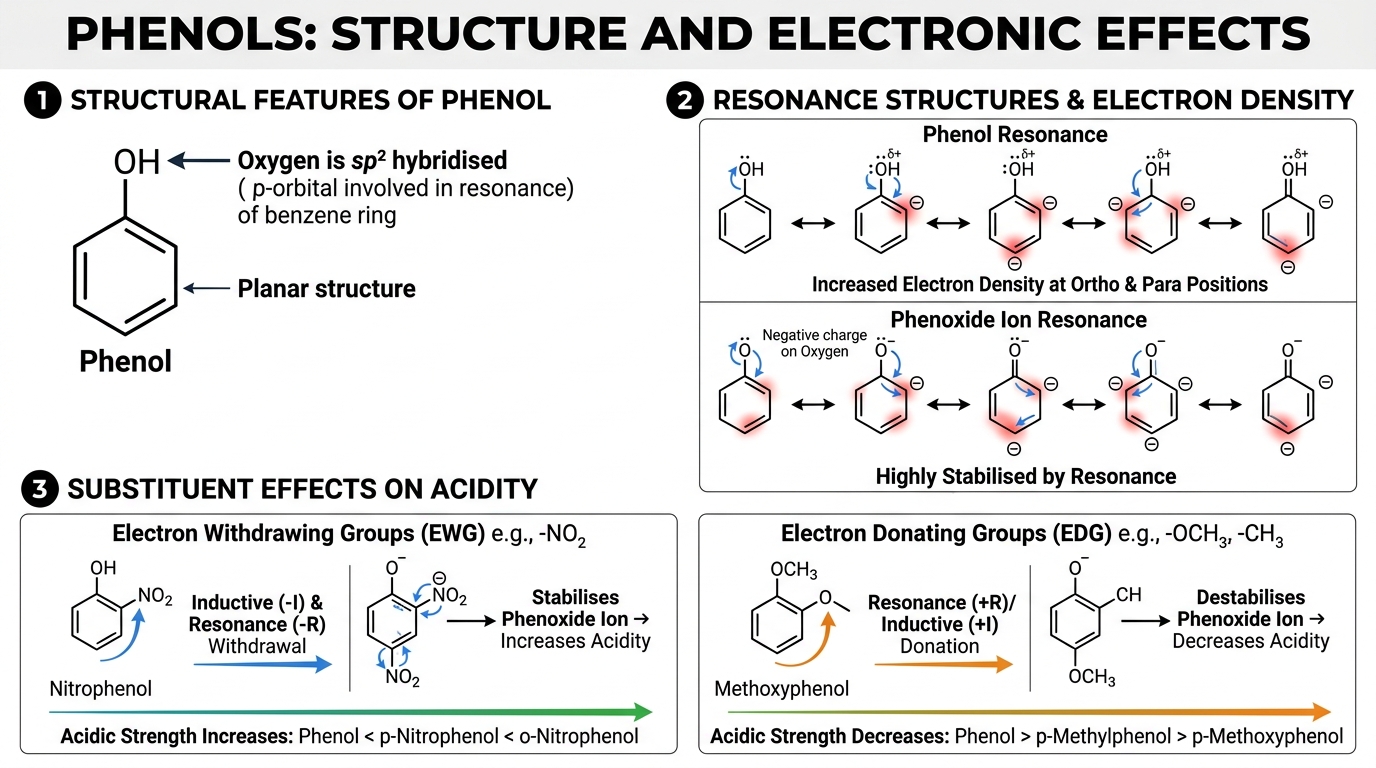
Fig 8 — Educational Diagram: Phenols: Structure and Electronic Effects
Phenols: Structure and Electronic Effects
Core Principle: Acid–base equilibrium: Phenol ⇌ Phenoxide− + H+
What is a phenol? Phenol is an aromatic compound in which a hydroxyl group (–OH) is directly bonded to a benzene ring. General formula: Ar–OH.
Atomic structure and hybridisation: In phenol the oxygen of –OH is sp2 hybridised (one lone pair in a p-orbital). The p-lone pair can overlap with the aromatic ring's π-system, allowing delocalisation.
Resonance and the phenoxide ion: When phenol loses H+, it gives phenoxide ion (Ar–O−). The negative charge is delocalised over the oxygen and the ortho and para carbon atoms of the ring. Drawn resonance structures show the negative charge at the ortho and para positions; this delocalisation stabilises the conjugate base and thus makes phenol appreciably acidic compared with aliphatic alcohols.
Electronic effects of –OH:
- Resonance effect (+R or +M): The oxygen donates electron density into the ring by resonance (lone pair → π system). This makes the ring electron-rich at ortho and para positions and activates phenol towards electrophilic aromatic substitution (EAS), directing electrophiles to ortho/para positions.
- Inductive effect (−I): Oxygen is more electronegative than carbon and withdraws electron density through σ-bonds; this is a weak electron-withdrawing effect.
- Net effect on reactivity: For EAS the resonance donation dominates, so –OH is an activating ortho/para director. For acidity, resonance stabilisation of phenoxide is the decisive factor making phenol more acidic than alcohols.
Relative acidity:
- Aliphatic alcohols (pKa ≈ 16–18) > Phenol (pKa ≈ 10) > Carboxylic acids (pKa ≈ 4–5). (Smaller pKa = stronger acid.)
- Reason: Phenoxide is resonance-stabilised; carboxylate is even more stabilised (charge delocalised over two oxygens), so carboxylic acids are stronger than phenols.
Effect of substituents on acidity (electronic effects):
- Electron-withdrawing groups (EWG) such as –NO2, –CN, –COOR increase acidity by stabilising phenoxide via −I and/or −R effects. Example: p-nitrophenol is much more acidic than phenol.
- Electron-donating groups (EDG) such as –CH3, –OCH3, –NH2 decrease acidity by destabilising phenoxide (they donate electron density into the ring).
- Position matters: Ortho and para substituents that can participate in resonance with the ring influence acidity strongly; meta substituents cannot stabilise/destabilise phenoxide via resonance, only via inductive effect.
Special cases — the ortho effect:
- Ortho-substituted phenols often show deviations from simple resonance predictions because of two additional factors: intramolecular hydrogen bonding and steric hindrance to solvation.
- Example: o-nitrophenol forms an intramolecular H-bond between OH and NO2, which stabilises the undissociated phenol and can reduce observed acidity relative to the para isomer. Also, bulky ortho groups can hinder solvation of the phenoxide ion, lowering acidity.
Directing effect in electrophilic aromatic substitution: The +R effect of the –OH group increases electron density at ortho and para positions; the resonance-stabilised sigma-complexes formed during substitution are lower in energy at o/p positions, so phenol is strongly activated and directs electrophiles to ortho and para.
Summary: Phenol's properties are governed by the interplay of resonance (+R) that donates electron density to the ring and stabilises the conjugate base, and inductive (−I) withdrawal through σ-bonds. Substituents and their positions (ortho/para/meta) modulate acidity and reactivity via these electronic effects.
- Phenol (carbolic acid) used historically as an antiseptic and precursor to plastics.
- Bisphenol A (BPA) — used to make polycarbonate plastics and epoxy resins; two phenolic units linked by a bridge.
- Bakelite — phenol-formaldehyde resin used in early plastics and electrical insulators.
- Salicylic acid (o-hydroxybenzoic acid) — a phenolic compound used to synthesize aspirin (acetylsalicylic acid).
- Eugenol — a phenolic compound in clove oil used as a local antiseptic and flavoring.
- Antioxidants such as BHT (butylated hydroxytoluene) — hinder oxidation by donating H from a phenolic –OH.
- \[Acid–base equilibrium: Phenol ⇌ Phenoxide<sup>−</sup> + H<sup>+</sup>\]
- \[Representative pKa values (approx.): phenol ≈ 10.0\]\[p-nitrophenol ≈ 7.1\]\[o-nitrophenol ≈ 7.2\]\[ethanol ≈ 16\]\[acetic acid ≈ 4.8\]
- \[Electronic-effect notation: –OH has +R (resonance donation) and −I (inductive withdrawal).\]
- \[Substituent effect (qualitative): EWG (−NO2, −CN) → increase acidity\]\[EDG (−OCH3, −NH2, −CH3) → decrease acidity.\]
- \[Hammett linear free-energy relation (advanced): log(K/K0) = ρ·σ (shows correlation between substituent constant σ and reactivity/acidity)\]
Preparation of Phenols

Fig 9 — Educational Diagram: Preparation of Phenols
Preparation of Phenols
Core Principle: Molecular formula: C6H5OH; Molar mass ≈ 94.11 g mol⁻¹
Overview: Phenol (C6H5OH, molar mass 94.11 g mol−1) is an aromatic compound with a hydroxyl group directly bonded to the benzene ring. Commercial and laboratory methods differ: the cumene (Hock) process dominates industry, while laboratory routes often use diazonium hydrolysis or sulfonation–fusion.
Major industrial method — Cumene (Hock) process
- Step 1: Alkylation of benzene with propene (Friedel–Crafts) gives cumene (isopropylbenzene).
- Step 2: Oxidation of cumene with O₂ (air) produces cumene hydroperoxide.
- Step 3: Acid-catalyzed cleavage of cumene hydroperoxide yields phenol and acetone (both are valuable products).
- Significance: This route is favored industrially because it couples phenol production with acetone (co-product), has high yields and economical operation.
From benzene via sulfonation (classical route)
- Benzene is sulfonated with fuming H₂SO₄ to give benzene sulfonic acid.
- Fusion of the sodium salt of benzene sulfonic acid with NaOH at high temperature produces sodium phenoxide.
- Acidification of sodium phenoxide yields phenol.
- Used historically and useful for teaching laboratory preparations.
From aniline (diazonium hydrolysis) — laboratory method
- Aniline is converted to benzene diazonium salt (NaNO₂ + HCl, 0–5 °C).
- Warm hydrolysis of the diazonium gives phenol with evolution of N₂.
- Advantage: mild conditions and good for small-scale lab synthesis.
Other laboratory/industrial routes
- Direct hydrolysis of aryl halides (e.g., chlorobenzene) under very harsh conditions (high T and pressure) or with catalysts — historically practiced as the Dow process variants.
- Grignard/O₂ method: formation of phenylmagnesium bromide from bromobenzene, oxidation with O₂ and subsequent acidification gives phenol (useful in lab when starting from aryl halide).
Summary of conditions and practical notes
- Cumene process: industrial, mild operational conditions, co-product acetone.
- Sulfonation–fusion: high temperature fusion with NaOH required (classical method).
- Diazonium hydrolysis: performed at low temperature for diazotization and then warmed for hydrolysis.
- Phenol is corrosive and toxic; handle with proper PPE and ventilation.
Spectroscopic fingerprints (brief): O–H stretch: broad band 3200–3600 cm⁻¹ (IR); C–O stretch ≈ 1200–1260 cm⁻¹; aromatic H signals ~7–8 ppm in 1H NMR with an exchangeable OH signal (variable).
- Industrial manufacture: Most phenol is made by the cumene process — benzene → cumene → cumene hydroperoxide → phenol + acetone. Phenol produced is used to make bisphenol A, phenolic resins (Bakelite), and drugs.
- Laboratory prep: Aniline → benzene diazonium chloride (NaNO2/HCl, 0–5 °C) → warm hydrolysis → phenol (useful for small-scale synthesis).
- Classical conversion: Benzene (H2SO4) → benzene sulfonic acid → fusion with NaOH → sodium phenoxide → acidify → phenol (teaching/lab method).
- \[Molecular formula: C6H5OH\]\[Molar mass ≈ 94.11 g mol⁻¹\]
- \[Cumene (Hock) sequence (overall): C6H6 + CH2=CHCH3 → C6H5CH(CH3)2 (cumene) C6H5CH(CH3)2 + O2 → C6H5C(CH3)2OOH (cumene hydroperoxide) C6H5C(CH3)2OOH + H+ → C6H5OH + (CH3)2CO (acetone)\]
- \[Sulfonation–fusion route: C6H6 + H2SO4 → C6H5SO3H (benzene sulfonic acid) C6H5SO3Na + 2 NaOH (fusion) → C6H5ONa + Na2SO3 + H2O C6H5ONa + HCl → C6H5OH + NaCl\]
- \[Diazotization + hydrolysis (aniline route): C6H5NH2 + HNO2 (+ HCl) → C6H5N2+ Cl− + 2 H2O C6H5N2+ + H2O (warm) → C6H5OH + N2 + H+\]
- \[Grignard oxidation (lab): C6H5Br + Mg → C6H5MgBr\]\[C6H5MgBr + O2 → C6H5O−MgBr → + H+ → C6H5OH\]
Chemical Reactions of Phenols

Fig 10 — Educational Diagram: Chemical Reactions of Phenols
Chemical Reactions of Phenols
Core Principle: Acid dissociation: Ar–OH ⇌ Ar–O⁻ + H⁺ ; pKₐ(phenol) ≈ 10
Overview: Phenols (Ar–OH) are aromatic compounds with a hydroxyl group directly bonded to a benzene ring. The –OH group withdraws/ donates electron density by inductive and resonance effects, making phenols more acidic than alcohols and much more reactive towards electrophilic aromatic substitution (EAS) than benzene.
1. Acid–base behavior
- Phenol is weakly acidic: pKa ≈ 10. It ionizes: Ar–OH ⇌ Ar–O− + H+. The phenoxide ion is resonance stabilized, which increases acidity vs aliphatic alcohols.
- Phenol reacts with strong bases to give phenoxide salts: Ar–OH + NaOH → Ar–O− Na+ + H2O. (But phenol does not react with NaHCO3 because it is not as acidic as carboxylic acids.)
2. Electrophilic aromatic substitution (EAS)
- The phenoxide form (or the free phenol via resonance) activates the ring strongly and directs electrophiles to ortho and para positions (o,p-directing).
- Bromination: Phenol is so activated that it undergoes bromination easily in aqueous Br2 at room temperature to give 2,4,6-tribromophenol as a white precipitate: Ar–OH + 3Br2 → 2,4,6-Br3Ar–OH + 3HBr.
- Nitration: Mild nitration gives mainly o- and p-nitrophenols; strong conditions can cause oxidation. Typical: Ar–OH + HNO3 (dilute) → o-/p-nitrophenol.
- Sulfonation: Phenol reacts with SO3/conc. H2SO4 to give o- and p-phenol sulfonic acids; the reaction is reversible on heating with dilute acid.
3. Reactions specific to phenols
- Kolbe–Schmitt carboxylation: Phenoxide + CO2 under pressure and heat gives salicylates (ortho-carboxylation). Example: sodium phenoxide + CO2 (high P, 100–150 °C) → sodium salicylate → acidification → salicylic acid (key step in aspirin manufacture).
- Reimer–Tiemann reaction: Phenol + CHCl3/NaOH → ortho-formylation → salicylaldehyde (o-formyl phenol).
- Oxidation: Phenols can be oxidized to quinones (e.g., hydroquinone → p-benzoquinone) under suitable oxidizing conditions.
- Esterification and etherification: Phenol reacts with acid chlorides/anhydrides to give esters (Ar–O–C(O)R) and with alkyl halides (via phenoxide) to give ethers (Williamson synthesis): Ar–O− + R–X → Ar–O–R.
- Azo coupling (electrophilic coupling): Phenols couple with diazonium salts to form brightly colored azo dyes (Ar–N=N–Ar').
- Tests: Ferric chloride gives characteristic color (purple, blue, green) with phenols on complexation; bromination gives a white precipitate of 2,4,6-tribromophenol.
4. Mechanistic highlights
- Resonance: The lone pair on O delocalizes into the ring, stabilizing carbocation intermediates at ortho/para positions; this is why phenol is strongly activating for EAS.
- Directing effects: –OH is an ortho/para director via resonance donation despite its inductive electron-withdrawing character.
- Control of regiochemistry: Steric hindrance often favors para substitution for bulky electrophiles; formation of phenoxide (by base) further increases reactivity.
Practical notes: Because phenols are more reactive, many reactions occur under milder conditions than for benzene. Phenols are important industrially (resins, pharmaceuticals, antioxidants, dyes).
- Kolbe–Schmitt reaction to form salicylic acid: sodium phenoxide + CO2 → sodium salicylate → salicylic acid (used to make aspirin).
- Phenol + formaldehyde (acid/alkaline) → phenolic resins (Bakelite) used in thermosetting plastics.
- Phenol derivatives (cresols) used as antiseptics and disinfectants; 2,4,6-tribromophenol used as a biocide/preservative.
- Azo coupling: phenol + diazonium salt → azo dye (many textile dyes and colorants are produced this way).
- Williamson synthesis: phenoxide + methyl iodide → anisole (an ether), used to prepare protected phenolic derivatives in synthesis.
- Reimer–Tiemann reaction producing salicylaldehyde, a useful intermediate in perfumery and organic synthesis.
- \[Acid dissociation: Ar–OH ⇌ Ar–O⁻ + H⁺\]\[pKₐ(phenol) ≈ 10\]
- \[Neutralization: Ar–OH + NaOH → Ar–O⁻ Na⁺ + H₂O\]
- \[Phenol + 3 Br₂ → 2,4,6-Br₃–C₆H₂–OH + 3 HBr (rapid bromination\]\[gives white precipitate)\]
- \[Nitration (mild): Ar–OH + HNO₃ → o- and p-nitrophenols + H₂O\]
- \[Kolbe–Schmitt: Ar–O⁻ Na⁺ + CO₂ (high P\]\[heat) → o-CO₂Na–Ar → (H⁺) → o-CO₂H–Ar (salicylic acid)\]
- \[Reimer–Tiemann: Ar–OH + CHCl₃ + NaOH → o-CHO–Ar + other products (formylation at ortho position)\]
Ethers: Structure, Nomenclature and Preparation

Fig 11 — Educational Diagram: Ethers: Structure, Nomenclature and Preparation
Ethers: Structure, Nomenclature and Preparation
Core Principle: General formula: R–O–R'
Introduction
Ethers are organic compounds in which an oxygen atom is bonded to two alkyl or aryl groups. General formula: R–O–R'. They are important solvents and intermediates in organic chemistry and appear in many everyday products (e.g., solvents, fuels, fragrances).
Structure and Bonding
- Oxygen in ethers is sp3 hybridized: it forms two sigma bonds (to R and R') and has two lone pairs.
- Geometry: the O atom has approximately tetrahedral electron geometry; the C–O–C bond angle is ~104–112°, typically around 110°.
- Polarity: C–O bonds are polar (oxygen is more electronegative). Ethers are polar molecules but cannot donate H-bonds (no O–H); they can accept H-bonds from water or alcohols.
- Physical properties: compared with isomeric alcohols, ethers have lower boiling points (lack of intermolecular hydrogen bonding) but higher boiling points than corresponding alkanes due to dipole–dipole interactions. Low molecular-weight ethers are fairly soluble in water (can accept H-bonds); solubility decreases as alkyl chain length increases.
Nomenclature
- IUPAC (preferred): name ethers as alkoxyalkanes. Identify the longest carbon chain as the parent alkane and the other alkyl group bound to oxygen as an alkoxy substituent.
Steps: (1) find longest chain attached to O — that becomes the parent alkane; (2) the other side is named as an alkoxy group (alkyl + 'oxy'). - Examples:
- CH3–O–CH3: methoxy methane = dimethyl ether (IUPAC: methoxy methane is rarely used; common name: dimethyl ether)
- CH3–O–CH2–CH3: methoxyethane (IUPAC); common name: ethyl methyl ether
- Ph–O–CH3: methoxybenzene (IUPAC); common name: anisole
- Symmetrical ethers (R = R') often have trivial/common names (e.g., diethyl ether for CH3CH2–O–CH2CH3). Cyclic ethers are named by replacing one CH2 by O: oxirane (epoxide), oxetane, tetrahydrofuran (oxolane) for a five-membered ring.
Preparation
- Williamson ether synthesis (most important, general method)
Mechanism: SN2 attack of an alkoxide ion (R–O–) on a primary (preferably) alkyl halide R'–X.
Typical reaction: R–O− Na+ + R'–X → R–O–R' + X−
Notes: best with primary alkyl halides (to avoid elimination or SN1). Secondary/tertiary halides give poor yields (elimination or carbocation formation). - Acid-catalyzed dehydration of alcohols
Two molecules of a primary alcohol can combine to give an ether in the presence of a strong acid (H2SO4/H3PO4) at moderate temperature:
2 R–OH --(conc. H2SO4, moderate temp)--> R–O–R + H2O
Example: 2 CH3CH2OH --(H2SO4, ~140 °C)--> CH3CH2–O–CH2CH3 (diethyl ether) + H2O.
Notes: at higher temperatures dehydration favors alkene formation; tertiary alcohols usually undergo dehydration to alkenes (via carbocations) rather than form ethers. - Other methods: alkylation of alcohols using silver oxide (R–X + Ag2O), and specific laboratory methods to make aryl ethers (e.g., methylation of phenols using methyl halides or dimethyl sulfate).
Chemical Reactions (brief)
- Cleavage by strong acids (HI, HBr): R–O–R' + HX → R–X + R'–OH (or two alkyl halides if conditions favor substitution). Primary ethers cleave via SN2, tertiary via SN1.
- Combustion: ethers burn to give CO2 and H2O like other hydrocarbons/oxygenates.
Summary
Ethers are R–O–R' compounds with sp3 oxygen, polar C–O bonds, no O–H hydrogen bonding donors, named by alkoxy + parent alkane (IUPAC), prepared mainly by Williamson synthesis and by acid-catalyzed dehydration of alcohols. They are widely used as solvents (diethyl ether, THF), fuel additives (MTBE), and in fragrances.
- Diethyl ether (CH3CH2–O–CH2CH3): common solvent and historically used anesthetic.
- Dimethyl ether (CH3–O–CH3): gas used as aerosol propellant and potential fuel.
- Anisole (methoxybenzene, Ph–O–CH3): used in fragrances and as a starting material in synthesis.
- Tetrahydrofuran (THF): a cyclic ether used as a polar aprotic solvent in polymer chemistry.
- MTBE (methyl tert-butyl ether, (CH3)3C–O–CH3): used as an oxygenate fuel additive (reduces knocking and emissions).
- \[General formula: R–O–R'\]
- \[Williamson ether synthesis: R–O− + R'–X -> R–O–R' + X− (SN2 mechanism)\]
- \[Acid-catalyzed dehydration of alcohols: 2 R–OH --(conc\]\[H2SO4\]\[moderate T)--> R–O–R + H2O\]
- \[Ether cleavage by hydrogen halides: R–O–R' + HX -> R–X + R'–OH (primary: SN2\]\[tertiary: SN1)\]
- \[Polarity/solubility guideline: small ethers (C1–C4) are miscible or highly soluble in water\]\[solubility decreases with increasing alkyl chain length.\]
Chemical Reactions of Ethers

Fig 12 — Educational Diagram: Chemical Reactions of Ethers
Chemical Reactions of Ethers
Core Principle: Williamson: R–O− + R'–X → R–O–R' + X− (SN2; R' = methyl or primary)
Overview
Ethers (R–O–R') are relatively unreactive compared with alcohols and alkyl halides because the C–O bond is strong and the oxygen lone pairs are delocalized by sigma bonds. However, ethers undergo a few important reactions that are vital in organic synthesis and industry: formation (Williamson synthesis), acid-catalyzed cleavage, reactions of aryl ethers (electrophilic aromatic substitution and selective cleavage), oxidation (autoxidation to peroxides), and dehydration of alcohols to give ethers.
1. Williamson Ether Synthesis (Nucleophilic substitution, SN2)
Method: An alkoxide ion (R–O−, generated from an alcohol + base) reacts with a primary (or methyl) alkyl halide (R'–X) by SN2 to give an ether.
Mechanism: R–O− attacks R'–X in a single concerted step (backside attack), displacing X−.
2. Acid-catalyzed cleavage of ethers
Strong hydrogen halides (HI, HBr) cleave ethers. The pathway depends on the substitution of the alkyl groups:
- Primary alkyl/ methyl (SN2): Protonation of oxygen makes a better leaving group; the nucleophile (Br−/I−) then attacks the less hindered alkyl group by SN2 giving R–X + R'–OH.
- Tertiary (SN1): Protonation followed by heterolysis to give a tertiary carbocation (stable) and an alcohol; nucleophile then captures the carbocation giving R–X + R'–OH.
- Unsymmetrical ethers: Cleavage gives the alkyl halide derived from the group that forms the more stable carbocation (if SN1) or from the less hindered alkyl group (if SN2).
General equation:
R–O–R' + HX (conc.) → R–X + R'–OH (or vice versa depending on mechanism and steric factors)
3. Cleavage of aryl alkyl ethers
C–O bond where one side is aryl (Ar–O–R) is stronger and cannot undergo SN2 at the aryl carbon. For aryl–alkyl ethers (e.g., anisole, Ar–O–CH3):
- Cleavage by HI/HBr usually yields Ar–OH + R–X when R is methyl or primary (nucleophile attacks the alkyl group by SN2). The Ar–O bond is not broken by SN2 at the aromatic carbon; Ar–O cleavage by SN1 is impossible because aryl carbocations are very unstable.
- Aryl ethers strongly activate the aromatic ring toward electrophilic aromatic substitution (EAS). The alkoxy group (–OR) is an electron-donating, ortho/para directing group (via resonance), e.g., nitration of anisole gives mainly ortho- and para-nitroanisole.
4. Oxidation and peroxide formation (autoxidation)
Simple ethers (diethyl ether, tetrahydrofuran) slowly react with atmospheric oxygen to form hydroperoxides and dialkyl peroxides (ROOR or ROOH), especially on exposure to air and light. This occurs by a radical chain mechanism (hydrogen abstraction at the α-carbon next to oxygen forming a stabilized radical which reacts with O2). These peroxides are shock-sensitive and pose explosion hazards; ethers should be stored with inhibitors and tested for peroxides before distillation.
5. Preparation of symmetrical ethers by dehydration of alcohols
Two molecules of a primary alcohol can be dehydrated using concentrated H2SO4 (at ~140 °C) to give a symmetrical ether (R–O–R) + H2O. Secondary/tertiary alcohols often give alkenes (elimination) due to carbocation formation.
6. Reactivity summary & selectivity
- Ethers are poor nucleophiles but good solvents.
- Cleavage and reactivity depend on the nature (primary/secondary/tertiary/aryl) of the alkyl groups attached to oxygen.
- For synthetic planning: use Williamson synthesis for unsymmetrical ethers when the alkyl halide is methyl or primary; avoid tertiary alkyl halides due to elimination.
Safety note
Ethers form peroxides on storage — label containers, store under inert atmosphere or with inhibitors, and test before distillation.
- Williamson synthesis: Sodium ethoxide (CH3CH2O− Na+) reacts with methyl iodide to give ethyl methyl ether (CH3CH2–O–CH3).
- Acidic cleavage: Diethyl ether + HI → Ethyl iodide (C2H5I) + Ethanol (C2H5OH) (SN2 at primary carbons).
- Aryl ether reactivity: Anisole (methoxybenzene) undergoes nitration to give mainly ortho- and para-nitroanisole (–OCH3 is an activating, ortho/para director).
- Aromatic ether cleavage: Anisole + HI (conc., heat) → Phenol (C6H5OH) + Methyl iodide (CH3I) (nucleophile attacks methyl group).
- Peroxide formation: Diethyl ether exposed to air slowly forms diethyl peroxide (C2H5–O–O–C2H5), a shock-sensitive compound; common practical hazard.
- \[Williamson: R–O− + R'–X → R–O–R' + X− (SN2\]\[R' = methyl or primary)\]
- \[Acidic cleavage (general): R–O–R' + HX → R–X + R'–OH (X = Br\]\[I\]\[path SN2 for primary R\]\[SN1 for tertiary R)\]
- \[Symmetrical ether by dehydration: 2 R–OH --(H2SO4, 140 °C)--> R–O–R + H2O\]
- \[Aryl ether (anisole) nitration: C6H5–OCH3 + HNO3 --(H2SO4)--> o-/p-NO2–C6H4–OCH3 + minor m-product\]
- \[Peroxide formation (simplified): R–CH2–O–R + O2 → R–CH(OOH)–O–R → ROOR (radical autoxidation)\]
Cyclic Ethers and Epoxides

Fig 13 — Educational Diagram: Cyclic Ethers and Epoxides
Cyclic Ethers and Epoxides
Core Principle: General formula for saturated monocyclic ethers: CnH2nO (for one ring and no unsaturation).
Definition: Cyclic ethers are ethers in which the oxygen atom is part of a ring. Epoxides (oxiranes) are the simplest cyclic ethers having a three-membered ring (R–CH–CH–O). Examples: ethylene oxide (oxirane), tetrahydrofuran (THF), tetrahydropyran.
Nomenclature: Three-membered cyclic ethers are called epoxides or oxiranes. Larger saturated cyclic ethers: 5-membered = tetrahydrofuran (THF), 6-membered = tetrahydropyran (THP).
Structure and Ring Strain: Epoxides have significant angle and torsional strain because O in a three-membered ring forces C–C–O angles (~60°) far from the ideal tetrahedral (~109.5°). This gives high ring strain (~25–30 kcal·mol⁻¹ for oxirane), making epoxides much more reactive toward ring-opening than larger cyclic ethers. Five- and six-membered cyclic ethers (THF, THP) are relatively strain-free and behave like typical ethers.
Preparation (major methods):
- Peracid (concerted) epoxidation of alkenes: RCH=CHR' + RCO3H → epoxide + RCO2H (stereospecific, syn addition).
- Intramolecular Williamson synthesis: halohydrin or haloalcohol → base-promoted intramolecular SN2 → epoxide.
- Base-induced cyclisation of halohydrins: vicinal halohydrin + OH⁻ → epoxide + X⁻ + H2O.
- From halides and diols for larger rings via intramolecular nucleophilic substitution.
Reactivity — Why epoxides are reactive: The high ring strain and polar C–O bonds make epoxides susceptible to nucleophilic attack (ring opening). Ring opening relieves strain and is usually exothermic.
Ring-opening reactions and regiochemistry:
- Under basic or neutral nucleophilic conditions (SN2 type): Nucleophile attacks the less substituted (less hindered) carbon atom (attack at the less substituted carbon center), causing inversion of configuration at the attacked carbon. Example: epoxide + RO⁻ → alkoxy alcohol.
- Under acidic conditions (protonation of O then nucleophilic attack): Protonation of the epoxide oxygen increases carbocation character. Nucleophile attacks the more substituted (more stabilized) carbon (carbocation-like) — regioselectivity reversed compared to basic conditions. Attack proceeds with inversion at the attacked center.
- Stereochemistry: Epoxidation of alkenes is stereospecific (syn addition): cis-alkenes → cis-epoxides, trans-alkenes → trans-epoxides. Ring-opening by SN2 inverts configuration at the attacked carbon.
Typical reactions (summary):
- Acid-catalysed hydrolysis: epoxide + H2O (H⁺) → trans-1,2-diol (nucleophile attacks more substituted carbon).
- Base/nucleophile opening: epoxide + Nu⁻ → Nu–C–C–OH (Nu attacks less substituted carbon).
- Reaction with organometallics: Grignard reagents or organolithiums open epoxides at less hindered carbon to give alcohols after workup (useful for chain extension).
- Polymerisation: ethylene oxide polymerises to form polyethylene glycol (PEG) under suitable conditions.
Physical properties & comparison: Small epoxides (ethylene oxide, propylene oxide) are typically gases or low-boiling liquids; THF is a common polar aprotic solvent (bp ~66 °C). Epoxides are more reactive than acyclic ethers due to ring strain; larger cyclic ethers behave similarly to acyclic ethers (stable, less reactive).
Applications / Importance:
- Ethylene oxide: sterilant for medical equipment, intermediate to ethylene glycol.
- Propylene oxide and epichlorohydrin: precursors to polyether and epoxy resins.
- THF: widely used solvent for Grignard reactions and polymer chemistry.
- Epoxides: key intermediates in synthesis — ring opening enables formation of multifunctional compounds (diols, amino alcohols, etc.).
Safety notes: Many low-molecular-weight epoxides (e.g., ethylene oxide) are toxic, flammable and potentially carcinogenic — handle with care.
Summary: Epoxides are strained, highly reactive three-membered cyclic ethers. They are prepared mainly by alkene epoxidation or intramolecular SN2 (halohydrin → epoxide) and undergo regio- and stereoselective ring-opening reactions (basic: attack at less substituted carbon; acidic: attack at more substituted carbon). Larger cyclic ethers (5- and 6-membered) are stable and useful as solvents.
- Ethylene oxide (oxirane) — used to make ethylene glycol and as a sterilizing gas.
- Propylene oxide — intermediate in production of polyether polyols and propylene glycol.
- Epichlorohydrin — used in epoxy-resin manufacture.
- Tetrahydrofuran (THF) — common polar aprotic solvent for organometallic reactions.
- Tetrahydropyran (THP) protecting groups — used in carbohydrate and organic synthesis.
- \[General formula for saturated monocyclic ethers: CnH2nO (for one ring and no unsaturation).\]
- \[Epoxidation (peracid method): RCH=CHR' + RCO3H → R-(epoxide)-R' + RCO2H\]
- \[Intramolecular Williamson (halohydrin cyclization): HO–CH2–CH2–CH2–X + base → epoxide + X⁻ + H2O (example for 3-membered ring formation).\]
- \[Halohydrin → epoxide (base): R–CHOH–CH2–X + OH⁻ → epoxide + X⁻ + H2O\]
- \[Acid-catalysed opening to give diol: epoxide + H2O (H⁺) → trans-1,2-diol\]
- \[Typical ring strain (approx.): oxirane (epoxide) ring strain ≈ 25–30 kcal·mol⁻¹ (makes epoxides reactive).\]
Tests, Identification and Laboratory Techniques

Fig 14 — Educational Diagram: Tests, Identification and Laboratory Techniques
Tests, Identification and Laboratory Techniques
Core Principle: Lucas reagent: ZnCl2 + conc. HCl (aqueous) — used to convert R–OH → R–Cl (SN1 for 2°/3°). Example: (CH3)3C–OH + HCl (ZnCl2) → (CH3)3C–Cl + H2O.
Overview: This topic covers simple qualitative tests and laboratory procedures used to identify and distinguish alcohols, phenols and ethers, and to perform common manipulations (separation, drying, distillation, reflux). Identification uses characteristic reactivity (acidic behaviour, ease of oxidation, substitution/cleavage), while laboratory techniques ensure pure isolation and analysis.
- Key qualitative tests and what they detect
- Lucas test (ZnCl2 + conc. HCl): distinguishes 1°, 2° and 3° alcohols by rate of formation of alkyl halide (turbidity). 3° → immediate; 2° → minutes; 1° → no reaction at room temp.
- Oxidation (K2Cr2O7/H2SO4 or PCC): primary alcohols → aldehydes → carboxylic acids (with strong oxidant); secondary → ketones; tertiary → resist oxidation unless harsh conditions break C–C bonds. Colour change with dichromate: orange → green.
- Iodoform test (I2/NaOH): positive for ethanol and secondary alcohols having a CH3CH(OH)– group (gives yellow CHI3 precipitate).
- Ferric chloride test (FeCl3): phenols give violet/coloured complexes; alcohols (aliphatic) do not.
- Bromine water / NBS: phenols (activated aromatic ring) decolourise Br2 and often give 2,4,6-tribromo product (white ppt); simple alcohols do not.
- Reaction with NaOH / Na: phenols dissolve in NaOH to give phenoxide salts (soluble) — useful to separate phenol from neutral organics; alcohols generally do not dissolve in NaOH. Both alcohols and phenols react with sodium metal to release H2, but phenoxide formation is the diagnostic test.
- Ether cleavage: ethers are generally inert to mild tests but are cleaved by HI/HBr (heat) to give alkyl halides and alcohols — used to identify ether type (symmetrical vs unsymmetrical) by analyzing cleavage products.
- Laboratory techniques for isolation and identification
- Extraction & separation: Use separating funnel to wash organic layer (remove acids/bases) and isolate the desired phase. Example: wash organic layer with 5% NaHCO3 to remove acids, with NaOH to remove phenols (forms water-soluble phenoxide).
- Drying: Remove dissolved water with anhydrous drying agents (CaCl2, MgSO4, Na2SO4). Choose MgSO4 for quick drying of most organics; CaCl2 for non‑polar solvents. Filter off drying agent before concentration.
- Distillation: Simple distillation for well-separated boiling points; fractional distillation (packed column) for closer bp values (e.g., separating alcohol–water mixtures). Steam distillation to isolate volatile, water-immiscible compounds (essential oils, phenol) at temperatures below decomposition.
- Reflux: Heat a reaction mixture under reflux to keep volatile reagents/solvents from escaping while allowing reaction to proceed at elevated temperature (typical for esterifications, oxidations).
- Purification: Recrystallization for solids; column chromatography or TLC for monitoring/purifying small amounts of organics.
- Monitoring: TLC to follow reaction progress; IR to detect O–H (broad 3200–3600 cm–1) and C–O stretches; NMR for structural identification (–OH proton chemical shift and coupling patterns; splitting to identify CH–OH, CH2–O, OCH3 etc.).
- How to design a simple identification scheme (example)
- Test solubility in NaOH: if soluble → phenol (phenoxide formed).
- If not phenol, try Lucas test: immediate turbidity → 3° alcohol; slow turbidity (minutes) → 2°; no turbidity → likely 1° or primary aromatic (run oxidation test).
- Oxidation with dichromate: if oxidised to give colour change and product that tests positive with Tollens/Fehling (aldehyde), it's primary; if gives ketone (no Tollens), it's secondary.
- Iodoform test positive narrows to ethanol or methyl‑substituted secondary alcohol.
Precautions & practical notes: use dry glassware for Williamson reactions; avoid over‑oxidation when isolating aldehydes (use PCC for milder oxidation); handle HI/HBr and bromine with care (corrosive); when performing steam distillation, ensure immiscibility and sufficient vapour flow; always dry organic layers and remove traces of acid before distillation to prevent bumping and decomposition.
- Distinguish tert‑butyl alcohol, isopropyl alcohol and ethanol using Lucas test: t‑BuOH → immediate turbidity; isopropyl → turbidity in minutes; ethanol → no turbidity at room temp.
- Identify phenol in a mixture: add NaOH — phenol dissolves (forms sodium phenoxide); confirm with FeCl3 to give violet colour.
- Separate and purify an organic product: after reaction, transfer mixture to separating funnel, wash with water, then aqueous NaHCO3 (if acidic impurities), dry organic layer with MgSO4, filter and distil under reduced pressure if boiling point is high.
- Isolate an essential oil (eugenol) from cloves by steam distillation — collects volatile oil at lower temperature than its normal bp, preventing decomposition.
- Detect ethanol among unknowns: iodoform test (positive), oxidize to acetaldehyde (Tollens positive for aldehyde transiently), and confirm boiling point around 78 °C by distillation (azeotrope with water at 95.6%).
- \[Lucas reagent: ZnCl2 + conc\]\[HCl (aqueous) — used to convert R–OH → R–Cl (SN1 for 2°/3°)\]\[Example: (CH3)3C–OH + HCl (ZnCl2) → (CH3)3C–Cl + H2O.\]
- \[Oxidation (dichromate): 3CH3CH2OH + K2Cr2O7 + 8H2SO4 → 3CH3COOH + Cr2(SO4)3 + K2SO4 + 11H2O (illustrative strong oxidation of ethanol to acetic acid).\]
- \[Iodoform: CH3CH(OH)R + 3I2 + 4NaOH → CHI3 (yellow ppt) + RCOONa + 3NaI + 3H2O (identifies methyl‑carbinol moiety or ethanol).\]
- \[FeCl3 test (phenol complexation): Ar–OH + FeCl3 → coloured Ar–O–Fe3+ complex (violet).\]
- \[Ether cleavage (acidic): R–O–R' + HI (heat) → R–I + R'–OH (or both halides depending on structure and conditions).\]
- \[Azeotrope: ethanol + water form azeotrope at ≈95.6% ethanol (bp 78.2 °C) — cannot obtain absolute ethanol by simple distillation.\]
Comparative Study and Applications

Fig 15 — Educational Diagram: Comparative Study and Applications
Comparative Study and Applications
Core Principle: General: Alcohol: R–OH ; Phenol: Ar–OH ; Ether: R–O–R'
Scope: This topic compares alcohols (R–OH), phenols (Ar–OH) and ethers (R–O–R) with respect to structure, bonding, physical properties, acidity/basicity, chemical reactivity and typical applications.
Structure and bonding
- Alcohols: general formula R–OH. The O–H bond is polar and the hydrogen can form hydrogen bonds (inter- and intramolecular).
- Phenols: Ar–OH (hydroxyl attached to an aromatic ring). The O–H is more acidic because the phenoxide ion (Ar–O−) is resonance stabilized over the ring.
- Ethers: R–O–R (or R–O–Ar). No O–H bond, so ethers cannot donate H-bonds to other molecules (they can accept H-bonds).
Physical properties
- Boiling point: alcohols > ethers of similar molar mass because alcohols hydrogen-bond strongly. Phenols also have high b.p. because they form strong H-bonds.
- Solubility in water: small alcohols and phenol are soluble due to H-bonding; solubility decreases with increasing alkyl chain length. Ethers are moderately soluble for small chains (they accept H-bonds) but less than corresponding alcohols.
- Volatility and odor: ethers are relatively volatile and often have characteristic sweet smells; many low-molecular-weight alcohols are less volatile than similar ethers.
Acidity and basicity
- Phenols are significantly more acidic than alcohols (typical pKa: phenol ~10, ethanol ~16). Resonance stabilization of the phenoxide ion lowers pKa.
- Alcohols are weak acids; their conjugate bases (alkoxides) are strong bases and good nucleophiles.
- Ethers are essentially neutral; their lone pairs can act as weak bases/ligands but they do not ionize like alcohols/phenols.
Chemical reactivity (summary)
- Alcohols
- Oxidation: primary → aldehyde → carboxylic acid; secondary → ketone; tertiary usually resistant to mild oxidation.
- Dehydration (acid-catalyzed) → alkenes or ethers (depending on conditions and alcohol).
- Esterification with carboxylic acids → esters (acid-catalyzed).
- Phenols
- Activated ring for electrophilic aromatic substitution: nitration, halogenation occur easily at ortho/para positions.
- Phenoxide formation on treatment with bases; can be oxidized to quinones under strong oxidants.
- Ethers
- Relatively inert; cleaved by strong acids (HI, HBr) to give alcohols/alkyl halides.
- Prepared commonly by Williamson ether synthesis (nucleophilic substitution of alkoxide on alkyl halide).
Why phenol is more acidic than alcohol: On deprotonation, phenoxide (Ar–O−) is resonance stabilized because the negative charge is delocalized into the aromatic ring. In contrast, alkoxide (R–O−) has the negative charge localized on oxygen and is less stabilized.
Practical implications: The differences affect solvent choice, reactivity in syntheses, safety and uses. For example, ethers are chosen as aprotic solvents for many reactions, alcohols are used where hydrogen bonding or reactivity (esterification, oxidation) is needed, and phenols serve as antiseptics and precursors to resins due to their reactivity and acidity.
- Ethanol (C2H5OH): used as solvent, disinfectant, and biofuel additive (gasohol).
- Phenol (C6H5OH): used as antiseptic, precursor to phenolic resins (Bakelite) and pharmaceuticals.
- Diethyl ether (C2H5–O–C2H5): historically used as an anesthetic and widely used as an organic solvent (low polarity, volatile).
- Tertiary butyl alcohol (t-BuOH): solvent and intermediate; less prone to oxidation than primary alcohols.
- Ethylene glycol (HO–CH2–CH2–OH): diol used as antifreeze and polyester precursor.
- \[General: Alcohol: R–OH\]\[Phenol: Ar–OH\]\[Ether: R–O–R'\]
- \[Acidity (approx.): phenol pKa ≈ 10\]\[ethanol pKa ≈ 16\]\[water pKa ≈ 15.7\]
- \[Oxidation (primary alcohol): CH3CH2OH + [O] → CH3CHO (acetaldehyde) + H2O\]\[further oxidation: CH3CHO + [O] → CH3COOH\]
- \[Oxidation (secondary alcohol): R–CHOH–R' + [O] → R–CO–R' (ketone)\]
- \[Dehydration (acid-catalyzed): C2H5OH (H2SO4\]\[heat) → C2H4 + H2O\]
- \[Esterification (Fischer): R–OH + R'–COOH ⇌ R'–COO–R + H2O (H+ catalyst)\]
Important Reagents and Named Reactions

Fig 16 — Educational Diagram: Important Reagents and Named Reactions
Important Reagents and Named Reactions
Core Principle: Lucas reagent: Conc. HCl + ZnCl2 (Lewis acid); used for R–OH → R–Cl (SN1).
This note summarises the important reagents and named reactions used for alcohols, phenols and ethers in Class 12 CBSE chemistry. For each reagent/reaction you get: what it is, how it acts, a short mechanism note and why it is important.
-
Lucas test (ZnCl2/HCl)
Purpose: Distinguish 1°, 2° and 3° alcohols by rate of reaction. Lucas reagent is concentrated HCl with anhydrous ZnCl2 (a Lewis acid).
Observation: 3° alcohols turn cloudy immediately (instant turbidity), 2° within minutes, 1° very slowly or not at room temperature. Mechanism: SN1 (carbocation formation) — faster for more stable carbocations.
-
Oxidising reagents (K2Cr2O7/H2SO4, KMnO4, PCC)
Purpose: Oxidation of alcohols.
Key behaviour: Primary alcohols → aldehydes → carboxylic acids (strong oxidants give acids); secondary alcohols → ketones; tertiary alcohols resist oxidation (except under extreme conditions).
Notes: K2Cr2O7/H2SO4 and KMnO4 are strong oxidants (give acids from 1°). PCC (pyridinium chlorochromate) is a milder reagent that oxidises 1° alcohols to aldehydes without further oxidation to acids under anhydrous conditions.
-
Williamson ether synthesis
Purpose: Preparation of ethers (especially unsymmetrical ethers).
Reaction: An alkoxide ion (R–O–) generated by deprotonation (NaH, Na) reacts with an alkyl halide (R'–X) by SN2 to give R–O–R'.
Limitations: SN2 requires a primary (or sometimes secondary) alkyl halide; tertiary alkyl halides give elimination or fail.
-
Acid-catalysed dehydration (ether synthesis) and ether cleavage
Formation of ethers: Two alcohol molecules (usually 1°) condense with conc. H2SO4 at moderate temperature to give R–O–R + H2O.
Ether cleavage: Ethers are cleaved by HX (HBr or HI). Primary/secondary cleavage proceeds by SN2 at the less hindered side; tertiary cleavage may proceed by SN1 (carbocation) giving the more substituted alkyl halide.
-
Reimer–Tiemann reaction
Purpose: Ortho-formylation of phenol to give o-hydroxybenzaldehyde (salicylaldehyde).
Reagents: Chloroform (CHCl3) + strong base (NaOH) which generates :CCl2 (dichlorocarbene) that reacts with the activated ortho position, followed by hydrolysis to give the formyl group.
-
Kolbe–Schmitt reaction (Kolbe's reaction / Kolbe–Schmidt)
Purpose: Carboxylation of phenoxide ion to produce salicylic acid (ortho) on acidification — major industrial route to salicylic acid (precursor of aspirin).
Reagents/conditions: Phenoxide (NaO–C6H5), CO2 under pressure and elevated temperature, then acidification → o-hydroxybenzoic acid.
-
Bromination and FeCl3 test for phenols
Bromination: Phenol reacts with Br2 (usually Br2/H2O) rapidly at room temperature to give 2,4,6-tribromophenol (white precipitate) — a qualitative test for phenol.
FeCl3 test: Phenols give coloured complexes (often violet‑purple) with neutral FeCl3 — a quick identification test.
-
Other useful transformations (brief)
- Conversion of aniline → diazonium → phenol (via diazonium hydrolysis) is an important route to phenol in the lab.
- Electrophilic aromatic substitution on phenol is strongly ortho/para directing (due to +R effect of –OH).
Summary of mechanistic types: SN1 (Lucas for 2°/3° alcohols; tertiary ether cleavage), SN2 (Williamson ether synthesis; ether cleavage for primary alkyl groups), electrophilic aromatic substitution for phenol (gives ortho/para products), and base-mediated carbanion / carbene processes (Reimer–Tiemann).
Practical importance: these reactions/tests are used for identification in labs (Lucas, FeCl3, bromination), for synthesis of ethers and carbonyl compounds (Williamson, oxidation, Reimer–Tiemann), and industrial manufacture of salicylic acid (Kolbe–Schmitt).
- Lucas test: (CH3)3COH + HCl (ZnCl2) → immediate turbidity (tertiary alcohol gives alkyl chloride quickly).
- Oxidation: CH3CH2OH + [O] → CH3COOH (ethanol oxidised to acetic acid by KMnO4 / K2Cr2O7).
- Williamson ether synthesis: C6H5O–Na+ + CH3I → C6H5–O–CH3 (anisole) + NaI.
- Reimer–Tiemann: C6H5OH + CHCl3 + 3NaOH → o−HO−C6H4−CHO (salicylaldehyde) + 3NaCl + 2H2O (overall, simplified).
- Kolbe–Schmitt: C6H5O–Na + CO2 (high P, heat) → o−HO−C6H4−COONa → H+ → o−HO−C6H4−COOH (salicylic acid).
- Bromination of phenol: C6H5OH + 3Br2 → 2,4,6‑tribromophenol (white ppt) + 3HBr.
- \[Lucas reagent: Conc\]\[HCl + ZnCl2 (Lewis acid)\]\[used for R–OH → R–Cl (SN1).\]
- \[Oxidation general: RCH2OH + [O] → RCHO (aldehyde) → RCOOH (carboxylic acid) with strong oxidants\]\[R1–CHOH–R2 + [O] → R1–CO–R2 (ketone).\]
- \[Williamson: R–O– (alkoxide) + R'–X → R–O–R' + X– (SN2).\]
- \[Acid dehydration (ether formation): 2 R–OH → R–O–R + H2O (conc\]\[H2SO4\]\[controlled T).\]
- \[Ether cleavage: R–O–R' + HX → R–X + R'–OH (SN2 at less hindered carbon) or R–X + R'–X (with excess HX or tertiary groups).\]
- \[Reimer–Tiemann (simplified): Phenol + CHCl3 + NaOH → o‑hydroxybenzaldehyde + salts + H2O (via :CCl2 intermediate).\]
Key Concepts
- Alcohol
- Organic compound with one or more hydroxyl (−OH) groups attached to a saturated carbon atom.
- Phenol
- Aromatic compound in which a hydroxyl (−OH) group is directly bonded to a benzene ring; shows acidic character.
- Ether
- Compound with an oxygen atom bonded to two alkyl or aryl groups (R–O–R'); generally inert and less polar than alcohols.
- Functional group
- Specific atom group in a molecule that determines its chemical properties and reactions.
- IUPAC nomenclature
- Systematic rules for naming organic compounds: alcohols end with −ol; ethers use alkoxy- prefix or 'alkyl alkyl ether'.
- Primary alcohol (1°)
- Alcohol in which the carbon bearing the −OH group is attached to only one other carbon atom (or none if methyl).
- Secondary alcohol (2°)
- Alcohol in which the carbon bearing the −OH group is attached to two other carbon atoms.
- Tertiary alcohol (3°)
- Alcohol in which the carbon bearing the −OH group is attached to three other carbon atoms; resistant to oxidation.
- Hydrogen bonding
- Strong dipole–dipole interaction between H bonded to electronegative atom (O) and lone pair on O or N; raises boiling points and solubility.
- Boiling point (influence)
- Temperature at which vapour pressure equals atmospheric pressure; affected by hydrogen bonding, polarity and molecular size.
- Acidity (pKa) of phenol
- Measure of tendency to lose H+; phenols (~pKa 10) are more acidic than alcohols (~pKa 16) owing to resonance stabilization of phenoxide ion.
- Williamson ether synthesis
- Method to prepare ethers by reacting an alkoxide ion with a primary alkyl halide (SN2 mechanism).
- Ether cleavage
- Acid-catalyzed breaking of R–O–R' into alkyl halide and alcohol or two alkyl halides depending on conditions and structure.
- Dehydration of alcohols
- Acid-catalyzed elimination of water from alcohols to form alkenes (E1/E2 mechanism depending on substrate).
- Oxidation of alcohols
- Conversion of alcohols to carbonyl compounds: primary → aldehyde → carboxylic acid; secondary → ketone; tertiary usually resistant.
- Esterification (Fischer esterification)
- Acid-catalyzed reaction of an alcohol with a carboxylic acid to form an ester and water.
- Electrophilic aromatic substitution (EAS) of phenols
- Aromatic substitution in which an electrophile replaces a hydrogen on the benzene ring; phenol activates ring and directs ortho/para.
- Reimer–Tiemann reaction
- Ortho-formylation of phenol using chloroform (CHCl3) and base to give mainly o-hydroxybenzaldehyde.
- Kolbe–Schmitt reaction
- Carboxylation of phenoxide ion with CO2 under heat and pressure to give salicylate (ortho-hydroxybenzoate), then acidification yields salicylic acid.
- Lucas test
- Test using ZnCl2/HCl to classify alcohols: tertiary gives immediate turbidity (alkyl chloride), secondary is slow, primary shows little/no reaction at room temp.
Practice Questions
-
Why are phenols more acidic than alcohols? / फीनॉल ऐल्कोहॉल की तुलना में अधिक अम्लीय क्यों होते हैं?
Show answer
On losing H+, phenol gives a phenoxide ion whose negative charge is delocalised over the aromatic ring (resonance), stabilising the conjugate base; in alkoxides the charge is localised on oxygen and not stabilised, so phenol (pKa~10) is more acidic than alcohols (pKa~16). / H+ खोने पर फीनॉल फीनॉक्साइड आयन देता है जिसका ऋणावेश ऐरोमैटिक वलय पर विस्थानीकृत (अनुनाद) होता है, संयुग्मी क्षार को स्थायित्व देता है; ऐल्कॉक्साइड में आवेश ऑक्सीजन पर स्थानीकृत व अस्थायी रहता है, अतः फीनॉल (pKa~10) ऐल्कोहॉल (pKa~16) से अधिक अम्लीय है।
-
Why do alcohols have higher boiling points than ethers of comparable molecular mass? / तुलनीय आण्विक द्रव्यमान वाले ईथरों की अपेक्षा ऐल्कोहॉल के क्वथनांक अधिक क्यों होते हैं?
Show answer
Alcohols have an O-H group and form strong intermolecular hydrogen bonds, whereas ethers lack O-H and cannot hydrogen bond to one another, so alcohols require more energy to vaporise. / ऐल्कोहॉल में O-H समूह होता है जो प्रबल अंतराआण्विक हाइड्रोजन आबंध बनाता है, जबकि ईथरों में O-H नहीं होता अतः वे परस्पर हाइड्रोजन आबंध नहीं बना सकते, इसलिए ऐल्कोहॉल को वाष्पित होने हेतु अधिक ऊर्जा चाहिए।
-
Describe Williamson ether synthesis and state why a primary alkyl halide is preferred. / विलियमसन ईथर संश्लेषण का वर्णन कीजिए तथा प्राथमिक ऐल्किल हैलाइड क्यों उपयुक्त है, बताइए।
Show answer
An alkoxide reacts with an alkyl halide by SN2: R-O^- + R'-X -> R-O-R' + X^-; a primary (or methyl) halide is preferred because secondary/tertiary halides undergo competing elimination to give alkenes. / ऐल्कॉक्साइड ऐल्किल हैलाइड से SN2 द्वारा अभिक्रिया करता है: R-O^- + R'-X -> R-O-R' + X^-; प्राथमिक (या मेथिल) हैलाइड उपयुक्त है क्योंकि द्वितीयक/तृतीयक हैलाइड प्रतिस्पर्धी विलोपन कर ऐल्कीन देते हैं।
-
What are the oxidation products of primary, secondary and tertiary alcohols? / प्राथमिक, द्वितीयक तथा तृतीयक ऐल्कोहॉलों के ऑक्सीकरण उत्पाद क्या हैं?
Show answer
Primary alcohols give aldehydes (mild, PCC) and then carboxylic acids (strong oxidant); secondary alcohols give ketones; tertiary alcohols resist oxidation under mild conditions as they lack an alpha-H. / प्राथमिक ऐल्कोहॉल ऐल्डिहाइड (मृदु, PCC) तथा फिर कार्बोक्सिलिक अम्ल (प्रबल ऑक्सीकारक) देते हैं; द्वितीयक ऐल्कोहॉल कीटोन देते हैं; तृतीयक ऐल्कोहॉल में अल्फा-H न होने से मृदु परिस्थिति में ऑक्सीकरण नहीं होता।
-
How does the Lucas test distinguish primary, secondary and tertiary alcohols? / ल्यूकास परीक्षण प्राथमिक, द्वितीयक तथा तृतीयक ऐल्कोहॉलों में किस प्रकार विभेद करता है?
Show answer
With Lucas reagent (conc. HCl + ZnCl2), tertiary alcohols give immediate turbidity (SN1), secondary in about 5 minutes, and primary show no turbidity at room temperature. / ल्यूकास अभिकर्मक (सांद्र HCl + ZnCl2) से तृतीयक ऐल्कोहॉल तुरंत मलिनता (SN1) देते हैं, द्वितीयक लगभग 5 मिनट में, तथा प्राथमिक कक्ष ताप पर कोई मलिनता नहीं देते।
-
Why is p-nitrophenol more acidic than phenol while p-methoxyphenol is less acidic? / p-नाइट्रोफीनॉल फीनॉल से अधिक अम्लीय तथा p-मेथॉक्सीफीनॉल कम अम्लीय क्यों है?
Show answer
The -NO2 group is electron-withdrawing (-I, -R) and stabilises the phenoxide ion lowering pKa (more acidic), whereas the -OCH3 group is electron-donating and destabilises the phenoxide raising pKa (less acidic). / -NO2 समूह इलेक्ट्रॉन-आकर्षी (-I, -R) है तथा फीनॉक्साइड आयन को स्थायित्व देकर pKa घटाता है (अधिक अम्लीय), जबकि -OCH3 समूह इलेक्ट्रॉन-दाता है और फीनॉक्साइड को अस्थायी कर pKa बढ़ाता है (कम अम्लीय)।
-
Write the reaction and mechanism type for acid-catalysed dehydration of an alcohol to an alkene. / ऐल्कोहॉल से ऐल्कीन के अम्ल-उत्प्रेरित निर्जलीकरण की अभिक्रिया तथा क्रियाविधि का प्रकार लिखिए।
Show answer
RCH2CH2OH --(conc. H2SO4, heat)--> RCH=CH2 + H2O; it proceeds mainly by E1 for secondary/tertiary alcohols via a carbocation intermediate and follows Saytzeff's rule. / RCH2CH2OH --(सांद्र H2SO4, ताप)--> RCH=CH2 + H2O; यह द्वितीयक/तृतीयक ऐल्कोहॉलों के लिए मुख्यतः कार्बोकैटायन मध्यवर्ती द्वारा E1 क्रियाविधि से होती है तथा साइटज़ेफ नियम का पालन करती है।
-
How is an ether cleaved by HI, and which products form with an alkyl aryl ether? / HI द्वारा ईथर का विदलन कैसे होता है तथा ऐल्किल ऐरिल ईथर से कौन-से उत्पाद बनते हैं?
Show answer
HI cleaves ethers after protonation of oxygen; with an alkyl aryl ether such as anisole, cleavage gives the aryl-O bond intact, yielding phenol and the alkyl iodide (e.g., C6H5OCH3 + HI -> C6H5OH + CH3I). / HI ऑक्सीजन के प्रोटॉनीकरण के बाद ईथर का विदलन करता है; एनिसोल जैसे ऐल्किल ऐरिल ईथर में ऐरिल-O बंध अक्षुण्ण रहता है, जिससे फीनॉल तथा ऐल्किल आयोडाइड बनते हैं (जैसे C6H5OCH3 + HI -> C6H5OH + CH3I)।
Related Laws & Principles
Explore allFoundational laws & principles connected to this chapter — tap to open in the Laws Explorer.