Overview
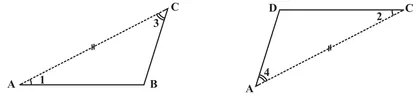
This chapter introduces quadrilaterals — four-sided closed figures — and studies their classification, properties and key theorems. Starting from simple definitions, students learn to recognise and distinguish between different types (trapezium, kite, parallelogram, rectangle, rhombus, square) and understand their characteristic properties related to sides, angles and diagonals. The chapter develops reasoning through proofs (for example, the angle-sum property that the interior angles of any quadrilateral add to 360°) and applies these results to solve construction and problem‑solving exercises. Understanding quadrilaterals is important because it builds geometric intuition used in higher geometry, mensuration and real‑life applications (architecture, design, engineering). By the end of the chapter students will be able to classify quadrilaterals, state and prove basic properties, use angle and diagonal relations to solve problems, and perform simple constructions.
Learning Objectives
- Define a quadrilateral and name its main types (parallelogram, rectangle, square, rhombus, trapezium, kite).
- Classify quadrilaterals based on sides and angles and identify them from given diagrams.
- State and prove that the sum of interior angles of a quadrilateral is 360° and apply this to find missing angles.
- Explain the defining properties of a parallelogram (opposite sides equal and parallel, opposite angles equal, diagonals bisect each other) and use them in problem solving.
- Prove and apply criteria for a quadrilateral to be a parallelogram (e.g., both pairs of opposite sides equal or diagonals bisect each other).
- Distinguish between rectangle, rhombus and square by their side, angle and diagonal properties and apply these distinctions to classify figures.
- Explain properties of diagonals in rectangle, rhombus, square and kite (equal, perpendicular, bisecting) and use these properties to solve exercises.
- Apply triangle congruence (SAS, RHS, ASA where appropriate) to prove properties of quadrilaterals formed by their diagonals.
Topics in this chapter
11 topics · tap a topic title to jump straight to it.
Introduction to Polygons and Quadrilaterals
What is a polygon? A polygon is a closed plane figure made of a finite number of straight line segments joined end to end. Each segment is a side and the meeting points are vertices. Polygons are named by their number of sides: triangle (3), quadrilateral (4), pentagon (5), hexagon (6), etc.
Key types and properties of polygons
- Convex polygon: every internal angle is less than 180° and any line joining two points of the polygon lies inside it.
- Concave polygon: has at least one internal angle greater than 180°; it has a ‘dent’ or indentation.
- Regular polygon: all sides and all interior angles are equal.
Angle properties (general)
- Sum of interior angles of an n-sided polygon = (n − 2) × 180°.
- Each interior angle of a regular n-gon = [(n − 2) × 180°] / n.
- Sum of exterior angles (one at each vertex, taken in the same direction) = 360°.
Quadrilaterals (4-sided polygons)
A quadrilateral has 4 sides, 4 vertices and 4 interior angles. For every quadrilateral the sum of interior angles = 360°. Common kinds of quadrilaterals and their distinguishing properties:
- Parallelogram: opposite sides are parallel and equal; opposite angles equal; diagonals bisect each other.
- Rectangle: a parallelogram with four right angles; diagonals are equal and bisect each other.
- Square: a rectangle with all sides equal (or a rhombus with right angles); diagonals are equal, perpendicular, and bisect angles.
- Rhombus: all four sides equal; opposite sides parallel; diagonals are perpendicular and bisect opposite angles.
- Trapezium (trapezoid): at least one pair of opposite sides parallel. Area uses the average of parallel sides times height.
- Kite: two distinct pairs of adjacent equal sides; one pair of opposite angles equal; diagonals are perpendicular, one diagonal bisects the other.
Diagonals
Diagonals are segments joining opposite vertices. Their properties (e.g., equal, perpendicular, bisecting) help identify the type of quadrilateral.
Perimeter and area (basic ideas)
Perimeter of any polygon = sum of its side lengths. For many quadrilaterals there are simple area formulas (see list). For irregular quadrilaterals area can be found by dividing into triangles or using coordinate methods.
- A window frame is often a rectangle — opposite sides equal and four right angles.
- A diamond playing card symbol is a rhombus — all four sides equal and diagonals perpendicular.
- A square tile used in floors — square: equal sides and right angles; area = side².
- A kite flown in parks — kite-shaped quadrilateral; diagonals perpendicular, one diagonal bisected.
- A slanted book cover or parallelogram-shaped board — opposite sides parallel and equal.
- A trapezium appears in the top view of a slanted shelf where only one pair of sides is parallel.
- Sum of interior angles of an n-sided polygon: (n − 2) × 180°
- Each interior angle of a regular n-gon: [(n − 2) × 180°] / n
- Sum of exterior angles (one per vertex): 360°
- Quadrilateral interior angles sum: 360°
- Perimeter of a polygon/quadrilateral: sum of all side lengths
- Area of rectangle: A = length × breadth
Angle Sum Property of a Quadrilateral
What is a quadrilateral? A quadrilateral is a four-sided polygon with four vertices and four interior angles. Examples: rectangle, square, trapezium, kite, etc.
Angle Sum Property (Statement): The sum of the four interior angles of any simple quadrilateral (convex or concave, not self-intersecting) is 360°.
Proof (using triangle angle-sum):
- Take a quadrilateral ABCD. Draw a diagonal, for example AC, which divides the quadrilateral into two triangles: triangle ABC and triangle ADC.
- By the triangle angle-sum property, the angles inside triangle ABC add up to 180° and the angles inside triangle ADC add up to 180°.
- Adding these two results gives 180° + 180° = 360°. The four interior angles of ABCD are exactly the three angles of triangle ABC plus the three angles of triangle ADC, but two angles (at A and C) are counted once each, so together they equal 360°.
Conclusion: therefore ∠A + ∠B + ∠C + ∠D = 360° for any simple quadrilateral.
Notes: This follows from the polygon formula sum = (n − 2)×180° with n = 4, so (4 − 2)×180° = 360°. The property holds for convex and concave quadrilaterals (for concave, one interior angle is > 180°, but the algebraic sum of the four interior angles is still 360°). It does not apply to self-intersecting quadrilaterals (complex quadrilaterals) in the same straightforward way.
- Example 1 (find a missing angle): In quadrilateral ABCD, ∠A = 95°, ∠B = 85°, ∠C = 70°. Find ∠D. Solution: ∠D = 360° − (95° + 85° + 70°) = 360° − 250° = 110°.
- Example 2 (real-life: rectangular picture frame): A rectangular frame has four right angles. Check: 90° + 90° + 90° + 90° = 360°, consistent with the property.
- Example 3 (concave quadrilateral): Suppose a concave quadrilateral has three interior angles 120°, 90°, and 110°. The fourth angle = 360° − (120° + 90° + 110°) = 40° (note: in a concave quadrilateral one interior angle could be >180°, but the sum still equals 360°).
- Example 4 (using polygon formula): For any quadrilateral n=4, sum = (n−2)×180° = 2×180° = 360°.
- Sum of interior angles of a quadrilateral: ∠A + ∠B + ∠C + ∠D = 360°
- General polygon interior-angle sum: Sum = (n − 2) × 180°, where n is number of sides (for n=4 gives 360°)
- Sum of one exterior angle at each vertex (taken consistently) = 360° (for a convex polygon)
- Special quadrilaterals: rectangle/square → each interior angle = 90° (4×90° = 360°); parallelogram → opposite angles equal and adjacent angles supplementary (sum of any pair of adjacent interior angles = 180°)
Classification of Quadrilaterals
What is a quadrilateral? A quadrilateral is a polygon with four sides, four vertices and four angles. The sum of its interior angles is always 360°.
Classification overview — Quadrilaterals are classified by their sides, angles and diagonals. Main types studied in Class 8 are:
- Parallelogram: Opposite sides are parallel and equal; opposite angles are equal; diagonals bisect each other.
- Rectangle: A parallelogram with four right angles. Opposite sides equal; diagonals are equal and bisect each other.
- Square: A rectangle with all sides equal (equivalently, a rhombus with right angles). Diagonals are equal, bisect each other at 90° and bisect angles.
- Rhombus: All four sides equal; opposite angles are equal; diagonals bisect each other at 90° and bisect the angles.
- Trapezium (Trapezoid): Exactly one pair of opposite sides are parallel (called bases). Other properties depend on height and bases.
- Kite: Two distinct pairs of adjacent equal sides. One diagonal bisects the other; diagonals are perpendicular.
Special relationships: A square is simultaneously a rectangle, a rhombus and a parallelogram. A rectangle and a rhombus are both types of parallelograms.
Convex and concave quadrilaterals: If all interior angles are less than 180°, the quadrilateral is convex. If one interior angle is > 180°, it is concave.
How to identify: Look for parallel sides, equal sides, right angles, and diagonal behaviour (equal, perpendicular, bisecting). These properties help classify any given quadrilateral.
- Rectangle: A door frame, blackboard or sheet of paper (right angles; opposite sides equal).
- Square: A chessboard square or a window tile (all sides equal; all right angles).
- Parallelogram: A slanted rectangular signboard or a leaning table top (opposite sides parallel and equal).
- Rhombus: A diamond-shaped kite or some floor tiles (all sides equal; diagonals perpendicular).
- Trapezium: The shape of some bridges or ramps where top and bottom edges are parallel but sides are not.
- Kite: A flying kite (actual kite shape) or some decorative motifs (two pairs of adjacent equal sides).
- Sum of interior angles of any quadrilateral: ∠A + ∠B + ∠C + ∠D = 360°
- Area of rectangle: A = length × breadth
- Area of square: A = side²
- Area of parallelogram: A = base × height
- Area of rhombus (using diagonals): A = (d1 × d2) / 2
- Area of kite: A = (d1 × d2) / 2
Parallelogram: Definition and Properties
Definition: A parallelogram is a quadrilateral in which both pairs of opposite sides are parallel. If ABCD is a parallelogram, then AB ∥ CD and BC ∥ AD.
Basic properties (with short reasons):
- Opposite sides are equal: AB = CD and BC = AD. (Because corresponding sides of two congruent triangles formed by a diagonal are equal.)
- Opposite angles are equal: ∠A = ∠C and ∠B = ∠D. (Parallel-line angle relationships give equal alternate interior or corresponding angles.)
- Consecutive angles are supplementary: ∠A + ∠B = 180°. (Each pair of consecutive angles are interior angles on the same side of a transversal.)
- Diagonals bisect each other: The diagonals AC and BD intersect at O such that AO = OC and BO = OD. (Triangles formed by the diagonals are congruent by side–angle–side: equal pairs of sides and included angles from parallelism.)
- Each diagonal divides it into two congruent triangles: Diagonal AC makes ΔABC ≅ ΔCDA, etc.
Area and perimeter: If base = b and corresponding height = h, then area = b × h. Perimeter = 2(a + b) where a and b are lengths of adjacent sides.
Coordinate/vector viewpoint (short): Put one vertex at origin and adjacent sides as vectors u and v. Vertices are 0, u, u+v, v. Diagonals are u+v and their midpoint is (u+v)/2, showing diagonals bisect each other. Area = |u × v| (magnitude of the cross product / determinant in 2D).
Conditions to test a quadrilateral ABCD being a parallelogram:
- Both pairs of opposite sides are parallel (slopes equal in coordinate geometry): slope(AB) = slope(CD) and slope(BC) = slope(AD).
- Both pairs of opposite sides are equal: AB = CD and BC = AD.
- Diagonals bisect each other: mid-point of AC = mid-point of BD.
- One pair of opposite sides is both parallel and equal (sufficient condition): e.g., AB ∥ CD and AB = CD.
Special parallelograms: A rectangle (all angles 90°), a rhombus (all sides equal), and a square (both) are specific types of parallelograms.
Quick proofs (sketches):
- Opposite sides equal: In parallelogram ABCD, draw diagonal AC. Triangles ΔABC and ΔCDA have AB = CD (corresponding sides) and BC = DA; also ∠BCA = ∠DAC (alternate interior). So triangles are congruent → AB = CD, etc.
- Diagonals bisect each other: Let diagonals intersect at O. In ΔAOB and ΔCOB: AO and CO correspond by sides AB = CD and parallelism give equal angles; by SAS, AO = CO. Similarly BO = DO.
- Area formula: Drop perpendicular from one vertex to the base; the parallelogram can be rearranged into a rectangle of base b and height h, so area = b × h.
- A slanted table top or drafting board (rectangle turned into an oblique shape forms a parallelogram).
- The opposite faces of many roof tiles or a ‘leaning’ rectangular window appear as parallelograms when viewed at an angle.
- A parallelogram-shaped field or plot of land with opposite sides equal and parallel.
- The side view of a leaning ladder between two parallel rails often forms a parallelogram with the rails and rung segment.
- Definition: AB ∥ CD and BC ∥ AD for parallelogram ABCD.
- Opposite sides: AB = CD, BC = AD.
- Opposite angles: ∠A = ∠C, ∠B = ∠D.
- Consecutive angles: ∠A + ∠B = 180°.
- Diagonals: If diagonals AC and BD meet at O, then AO = OC and BO = OD.
- Perimeter: P = 2(a + b) where a and b are adjacent side lengths.
Rectangle and Square
Definition: A rectangle is a quadrilateral with four right angles. Opposite sides are parallel and equal. A square is a special rectangle with all four sides equal and each angle 90° (so a square is also a rhombus).
Basic properties:
- Opposite sides of a rectangle are equal and parallel.
- All angles in a rectangle (and square) are 90°.
- The diagonals of a rectangle are equal in length and bisect each other.
- The diagonals of a square are equal, bisect each other at right angles, and bisect the vertex angles.
- Symmetry: a rectangle has two lines of symmetry (through midpoints of opposite sides) and 180° rotational symmetry. A square has four lines of symmetry and 90° rotational symmetry.
- Square is a special case: square = rectangle + all sides equal = rhombus + all angles 90°.
Why diagonals are equal (short justification): In a rectangle with side lengths l (length) and b (breadth), consider two triangles formed by one diagonal. Both triangles have legs l and b and a right angle between them, so by RHS (right-angle, hypotenuse, side) congruence they are congruent. Hence diagonals are equal and they bisect each other.
Using coordinates: Put a rectangle with vertices at (0,0), (l,0), (l,b), (0,b). The diagonal from (0,0) to (l,b) has length sqrt(l^2 + b^2) by the distance formula (Pythagoras). For a square of side a, vertices can be (0,0), (a,0), (a,a), (0,a) and diagonal length = a√2.
Applications: Understanding rectangles and squares helps in area/tiling problems, design (floor plans, windows, screens), coordinate geometry, and proofs in geometry.
- Real-life: Door, window frame, writing notebook page, computer monitor (often rectangular).
- Real-life: A chessboard or bathroom tile that is a perfect square; square gift box base, square post-it note.
- Problem example: Find area and perimeter of a rectangle with length 12 cm and breadth 7 cm. Area = 12 × 7 = 84 cm². Perimeter = 2(12 + 7) = 38 cm.
- Problem example: Find the diagonal of a rectangle with sides 6 m and 8 m. Diagonal = sqrt(6² + 8²) = sqrt(100) = 10 m.
- Problem example (square): A square tile has side 30 cm. Area = 30² = 900 cm²; Perimeter = 4 × 30 = 120 cm; Diagonal = 30 × √2 ≈ 42.43 cm.
- Area of rectangle: A = length × breadth (A = l × b)
- Perimeter of rectangle: P = 2(length + breadth) (P = 2(l + b))
- Diagonal of rectangle: d = √(l² + b²)
- Area of square: A = side² (A = a²)
- Perimeter of square: P = 4 × side (P = 4a)
- Diagonal of square: d = a√2
Rhombus
Definition: A rhombus is a quadrilateral with all four sides equal in length. It is a special kind of parallelogram (opposite sides are parallel) but its angles need not be right angles. A square is a special rhombus with all angles 90°.
Key properties:
- All four sides are equal (AB = BC = CD = DA).
- Opposite sides are parallel and opposite angles are equal.
- Diagonals bisect each other (they cut each other into equal halves).
- Diagonals are perpendicular (they meet at 90°).
- Each diagonal bisects the vertex angles it joins.
- Area can be found using diagonals: area = (d1 × d2) / 2.
Why diagonals are important (area and relations): The diagonals divide the rhombus into four congruent right triangles. If the diagonals have lengths d1 and d2, each triangle has legs d1/2 and d2/2, so the total area is 4 × (1/2 × (d1/2) × (d2/2)) = (d1 × d2)/2. Also, by Pythagoras on one of those right triangles, the side length a satisfies a^2 = (d1/2)^2 + (d2/2)^2.
Relation with interior angle A (between two adjacent sides): If side = a and one interior angle = A, then
- d1 = 2a sin(A/2)
- d2 = 2a cos(A/2)
- Area = a^2 sin A (equivalently area = base × height, where height = a sin A).
Short geometric reasoning (congruence idea): In a rhombus ABCD, consider diagonals AC and BD meeting at O. Triangles AOB and COD are congruent by SSS (AO = CO, BO = DO, AB = CD), so AO = CO and BO = DO (diagonals bisect each other). Similar congruences show diagonals make right angles and they bisect the vertex angles.
Summary: A rhombus is an equal-sided parallelogram whose diagonals bisect each other at right angles and bisect the internal angles. These diagonal properties make area and many other calculations easy.
- Playing-card diamonds (the diamond suit symbol approximates a rhombus).
- Road/traffic warning signs (many countries use diamond-shaped signs).
- Lozenge-shaped tiles and floor patterns (tessellations using rhombi).
- Certain windowpanes, lattice designs and stained-glass elements shaped as rhombi.
- Crystal faces in minerals (some crystals form rhombus-like faces).
- Design elements and logos that use a diamond/tilted-square shape.
- Perimeter: P = 4a (where a is the side length).
- Area (using diagonals): Area = (d1 × d2) / 2 (d1 and d2 are diagonal lengths).
- Area (base × height): Area = a × h, where h = a × sin(A) (A is one interior angle).
- Diagonal lengths in terms of side and angle: d1 = 2a sin(A/2), d2 = 2a cos(A/2).
- Relation between side and diagonals: a^2 = (d1/2)^2 + (d2/2)^2.
- Area in terms of side and angle: Area = a^2 × sin A.
Trapezium (Trapezoid) and Isosceles Trapezium
Trapezium (Trapezoid): A trapezium is a quadrilateral with exactly one pair of parallel sides. The parallel sides are called the bases and the non-parallel sides are called the legs.
Isosceles Trapezium: An isosceles trapezium is a trapezium whose legs are equal in length. It has an axis of symmetry perpendicular to the bases.
- Labels: Let the parallel sides (bases) be a and b (a || b), legs be c and d, and the perpendicular distance between the bases be h (height).
- Basic properties of any trapezium: The sum of interior angles = 360°. Angles on the same side of a leg are supplementary (they add to 180°). Exactly one pair of opposite sides are parallel.
- Properties of an isosceles trapezium: Legs c and d are equal. Base angles are equal (angle at one end of a base equals the angle at the other end of the same base). Diagonals are equal in length. It is symmetric about a line perpendicular to the bases through their midpoints.
- Special cases: Right trapezium — one leg is perpendicular to the bases (so two right angles appear).
How to identify and use: To compute area you need the lengths of both bases and the perpendicular height between them. For geometry problems you often use supplementary angles on legs, equal base angles in isosceles trapezium, and equal diagonals to prove congruence or symmetry.
- A trapezoid-shaped table top where the two opposite sides are parallel but unequal (e.g., a conference table wider at one end).
- Lampshades that are wider at the bottom and narrower at the top — the top and bottom edges are parallel (bases).
- Bridge supports or trusses formed with a trapezium frame for stability.
- The side profile of some handbags or purses that taper from one side to the other.
- A roof segment that has two parallel horizontal edges but sloped sides (often appears as a trapezium in elevation).
- Area = 1/2 × (sum of parallel sides) × height = 1/2 × (a + b) × h
- Median (mid-segment) length = (a + b)/2 (segment joining midpoints of legs)
- Perimeter P = a + b + c + d (sum of all four sides)
- In an isosceles trapezium: legs c = d, diagonals are equal in length
- Adjacent angles on a leg are supplementary: angle1 + angle2 = 180°
- If coordinates are used (x1,y1),(x2,y2),(x3,y3),(x4,y4) in order, area can be found by the polygon area (shoelace) formula or by Area = 1/2*(a+b)*h where h is perpendicular distance between lines containing the bases.
Kite
Definition: A kite is a quadrilateral with two distinct pairs of adjacent equal sides. If ABCD is a kite, then AB = AD and BC = CD (or the equal pairs may be at the other vertices).
Key properties:
- Two pairs of adjacent equal sides (AB = AD and BC = CD).
- One pair of opposite angles are equal — specifically, the angles between the unequal sides are equal.
- The diagonals are perpendicular (they meet at 90°).
- One diagonal bisects the other. The diagonal that joins the vertices where the equal sides meet is the axis of symmetry: it bisects the other diagonal and also bisects the angles at the vertices it joins.
- Area = (1/2) × (product of the diagonals).
- Perimeter = 2 × (sum of the two distinct adjacent side lengths) = 2(a + b) when side lengths are a, a, b, b.
Remarks / special cases: Every rhombus (all four sides equal) is a kite, but a kite need not have all sides equal. The perpendicular-diagonals property is characteristic of kites studied in Class 8 (with the convention that the diagonals are perpendicular and one bisects the other).
- A flying kite (toy) — the typical diamond/boat-shaped kite is a kite quadrilateral.
- Bow ties and diamond-shaped jewellery motifs — many have two pairs of adjacent equal sides.
- Certain road signs or pavement tiles with asymmetric diamond shapes (a kite that is not a rhombus).
- A kite-shaped sail or decorative flags and motifs (symmetrical about one diagonal).
- Definition (sides): two pairs of adjacent equal sides — sides a, a, b, b.
- Perimeter: P = 2(a + b) where a and b are the lengths of the two distinct adjacent sides.
- Area: Area = (1/2) × (d1 × d2), where d1 and d2 are the lengths of the diagonals.
- Diagonals: They intersect at right angle (d1 ⟂ d2) and one diagonal bisects the other.
- Side lengths from half-diagonals (general): if diagonals AC and BD meet at O with AO = p1, CO = p2, BO = q1 and DO = q2, then AB = sqrt(p1^2 + q1^2), BC = sqrt(p2^2 + q1^2), CD = sqrt(p2^2 + q2^2), DA = sqrt(p1^2 + q2^2). (Simplifies in symmetric cases.)
Diagonals Across Quadrilaterals
What is a diagonal? In any polygon, a diagonal is a line segment joining two non-adjacent vertices. In a quadrilateral ABCD the diagonals are AC and BD.
Basic facts
- Number of diagonals in a quadrilateral = 2 (use n(n-3)/2 with n = 4).
- A diagonal divides a quadrilateral into two triangles. So area(quad) = area(triangle formed by one diagonal) + area(triangle formed by the other triangle).
Properties in special quadrilaterals
- Parallelogram: Diagonals bisect each other (they meet at their midpoints). They are generally not equal.
- Rectangle: Diagonals are equal and bisect each other (meet at midpoint).
- Rhombus: Diagonals bisect each other at right angles (perpendicular) and each diagonal bisects opposite angles.
- Square: Diagonals are equal, bisect each other, are perpendicular, and bisect the angles (combines properties of rectangle and rhombus).
- Kite: Diagonals are perpendicular; one diagonal bisects the other and one diagonal bisects a pair of opposite angles.
- Trapezium (general): Diagonals do not generally bisect or equal each other; no special relation unless it is isosceles trapezium (then diagonals are equal).
Why diagonals are useful
- To prove properties of quadrilaterals (e.g., show a quadrilateral is a parallelogram if diagonals bisect each other).
- To compute areas by splitting into triangles.
- To use coordinate geometry: lengths and midpoints of diagonals give algebraic tests for types of quadrilaterals.
Coordinate tools (brief) If vertices are A(x1,y1), B(x2,y2), C(x3,y3), D(x4,y4):
- Length of diagonal AC = sqrt((x3-x1)^2 + (y3-y1)^2) (distance formula).
- Midpoint of AC = ((x1+x3)/2, (y1+y3)/2). If midpoints of AC and BD are equal, diagonals bisect each other.
- If slopes of AC and BD multiply to -1, diagonals are perpendicular.
- Count diagonals: For a quadrilateral (n=4) diagonals = n(n-3)/2 = 4(1)/2 = 2 (AC and BD).
- Rectangle example: A(0,0), B(4,0), C(4,3), D(0,3). Diagonals AC and BD length = sqrt(4^2 + 3^2) = 5. Their midpoints both = (2, 1.5), so they bisect each other and are equal.
- Rhombus example: A(0,0), B(2,1), C(4,0), D(2,-1). Diagonal AC length = 4, BD length = 2. Slopes: AC is 0 (horizontal), BD is infinite (vertical) → diagonals are perpendicular. Midpoints coincide → they bisect each other.
- Area split: For quadrilateral ABCD, choose diagonal AC. area(ABCD) = area(ΔABC) + area(ΔCDA). This helps compute total area when triangle areas are easier.
- Number of diagonals in an n-sided polygon: n(n - 3) / 2 (for n = 4 gives 2).
- Distance formula (length of diagonal between (x1,y1) and (x2,y2)): sqrt((x2 - x1)^2 + (y2 - y1)^2).
- Midpoint formula (midpoint of diagonal between (x1,y1) and (x2,y2)): ((x1 + x2)/2, (y1 + y2)/2).
- Slopes and perpendicularity: If slope(AC) * slope(BD) = -1 then diagonals are perpendicular (provided slopes are defined).
- Area relation: area(ABCD) = area(ΔABC) + area(ΔCDA) (if AC is a diagonal).
Constructions, Tests and Reasoning
What this topic covers
Constructions, Tests and Reasoning teaches how to construct quadrilaterals using ruler and compass or coordinate methods, how to test a given four-sided figure to identify which kind of quadrilateral it is (parallelogram, rectangle, rhombus, square, trapezium, kite etc.), and how to use known properties (reasoning) to deduce missing sides or angles.
Key ideas and properties
- Sum of interior angles of any quadrilateral = 360°.
- Parallelogram: opposite sides are equal and parallel, opposite angles are equal, consecutive angles are supplementary, diagonals bisect each other.
- Rectangle: all properties of a parallelogram + each angle = 90°; diagonals are equal and bisect each other.
- Rhombus: all sides equal + diagonals are perpendicular bisectors of each other; opposite angles equal.
- Square: rectangle + rhombus (all sides equal and all angles 90°); diagonals equal, perpendicular and bisect angles.
- Trapezium (trapezoid): exactly one pair of opposite sides parallel; in an isosceles trapezium the non-parallel sides are equal and base angles are equal, diagonals are equal.
- Kite: two pairs of adjacent equal sides; diagonals are perpendicular and one diagonal bisects the other.
Constructions — general methods
- Using ruler and compass: construct given sides and angles step-by-step. Typical constructions: parallelogram given two adjacent sides and included angle; rhombus given side and an included angle; trapezium given two bases and one leg or height.
- Using parallel-line method: to complete a parallelogram ABCD given AB and BC, draw AB and BC at vertex B, then through A draw a line parallel to BC and through C draw a line parallel to AB; their intersection is D.
- Using diagonal method: if diagonals and one vertex are given, draw diagonals first and mark midpoint where they must bisect each other (for parallelogram/rhombus/rectangle).
- Coordinate method: place one vertex at origin and another on x-axis, compute coordinates for other vertices using lengths and slopes, then draw on graph paper or software. This is useful to check algebraically (slope, distance, midpoint formulas).
Tests (how to identify a quadrilateral)
- Test for parallelogram: check if opposite sides are equal (AB = CD and BC = AD), or check if diagonals bisect each other (midpoint of AC = midpoint of BD).
- Test for rectangle: check parallelogram test + verify one angle = 90° (or check diagonals are equal and bisect each other).
- Test for rhombus: check all four sides are equal (AB = BC = CD = DA) or check diagonals are perpendicular bisectors of each other.
- Test for square: both rectangle and rhombus tests hold (all sides equal and one angle 90°), equivalently diagonals equal and perpendicular and bisect angles.
- Test for trapezium: verify one pair of opposite sides are parallel while the other pair is not. For isosceles trapezium check non-parallel sides equal.
- Use coordinate tests: compute slopes of opposite sides (equal slopes → parallel), slopes multiplying to −1 → perpendicular, use midpoint formula to test if diagonals bisect each other, and distance formula to test equal sides/diagonals.
Reasoning and short proofs
- Why diagonals of a parallelogram bisect each other: In parallelogram ABCD, triangles AOB and COD (O is intersection of diagonals) are congruent by SAS (opposite sides equal), so AO = OC and BO = OD.
- Opposite angles in a parallelogram are equal because alternate interior angles formed by a transversal cutting parallel lines are equal.
- In a rhombus diagonals are perpendicular because they form right triangles with equal sides; they also bisect the vertex angles because of symmetry.
Practical approach in exams
- Start by listing the given data and mark them on a neat diagram.
- Use properties (equal sides, parallel sides, equal/90° angles, diagonals) as tests to identify the quadrilateral quickly.
- For constructions, state the tools and follow stepwise construction with justification (e.g., draw through A a line parallel to BC because opposite sides of a parallelogram are parallel).
- Constructing a parallelogram ABCD given AB = 6 cm, BC = 4 cm and angle ABC = 60°: draw BC = 4 cm. At B construct ∠ABC = 60°. On that ray cut AB = 6 cm to locate A. Through A draw a line parallel to BC and through C draw a line parallel to AB; their intersection is D.
- Test if quadrilateral ABCD is a parallelogram using diagonals: draw diagonals AC and BD. If their midpoints coincide (AO = OC and BO = OD) then ABCD is a parallelogram.
- Reasoning example: Given ABCD is a parallelogram and ∠A = 70°, find ∠B, ∠C, ∠D. Since consecutive angles are supplementary, ∠B = 110°. Opposite angles equal so ∠C = 70° and ∠D = 110°.
- Sum of interior angles of a quadrilateral = 360°
- Perimeter P = AB + BC + CD + DA
- Area of rectangle = length × breadth
- Area of square = side^2
- Area of parallelogram = base × height
- Area of trapezium = 1/2 × (sum of parallel sides) × height = (1/2) × (a + b) × h
Summary and Important Results
What is a quadrilateral? A quadrilateral is a polygon with four sides and four vertices. Examples: square, rectangle, rhombus, parallelogram, trapezium, kite and general (irregular) quadrilaterals.
Basic results (short proofs/ideas):
- Sum of interior angles: Any quadrilateral ABCD can be split by a diagonal into two triangles. Each triangle has angles summing to 180°, so the quadrilateral's interior angles sum to 360°.
- Sum of exterior angles: The sum of one exterior angle at each vertex (taken in the same sense) of any polygon is 360°. For a quadrilateral this also totals 360°.
Key types and their important properties:
- Parallelogram (opposite sides parallel): opposite sides equal, opposite angles equal, diagonals bisect each other, adjacent angles are supplementary (sum 180°).
- Rectangle (parallelogram with right angles): all properties of a parallelogram plus each angle = 90° and diagonals are equal in length and bisect each other.
- Square (rectangle + rhombus): all sides equal and all angles 90°. Diagonals are equal, bisect each other at right angles and bisect the angles.
- Rhombus (parallelogram with all sides equal): opposite angles equal, diagonals bisect each other at right angles and diagonals bisect the interior angles. Area = (1/2) × (product of diagonals).
- Kite: two distinct pairs of adjacent equal sides; one diagonal is perpendicular to the other; one diagonal bisects the other and bisects the vertex angles (depending on symmetry).
- Trapezium (US: trapezoid): one pair of opposite sides parallel (called bases). Non-parallel sides are legs; mid-segment (line joining midpoints of legs) is parallel to bases and equals half their sum.
- Cyclic quadrilateral (vertices on a circle): opposite angles are supplementary (sum 180°).
Why these results matter: These properties allow you to identify quadrilaterals, compute missing angles/lengths, find areas and perimeters, and solve geometry problems involving congruence, similarity and symmetry.
- Rectangle: A classroom door is usually a rectangle. If length = 2 m and width = 0.9 m, area = 2 × 0.9 = 1.8 m² and diagonal = √(2² + 0.9²) m.
- Square: A square tile of side 30 cm has area 30² = 900 cm² and diagonals that meet at right angles and are equal (diagonal = 30√2 cm).
- Rhombus: A diamond-shaped sign whose diagonals are 10 cm and 24 cm has area = (1/2) × 10 × 24 = 120 cm². Each side = √[(10/2)² + (24/2)²] = √[(5)² + (12)²] = 13 cm.
- Trapezium: A small ramp cross-section with parallel top and bottom edges 8 m and 4 m and height 2 m has area = 1/2 × (8 + 4) × 2 = 12 m².
- Kite: A toy kite often has two pairs of equal adjacent sides; if diagonals are 6 m and 8 m, area = (1/2) × 6 × 8 = 24 m².
- Sum of interior angles of a quadrilateral: 360°
- Area of rectangle: A = length × breadth
- Perimeter of rectangle: P = 2(length + breadth)
- Area of square: A = side², Perimeter: P = 4 × side
- Area of parallelogram: A = base × height
- Area of rhombus: A = (1/2) × d1 × d2 (d1,d2 are diagonals)
Key Concepts
- Quadrilateral
- A polygon with four sides and four vertices. The sum of its interior angles is 360°.
- Polygon
- A closed plane figure formed by three or more straight line segments meeting at vertices.
- Convex Quadrilateral
- A quadrilateral where all interior angles are less than 180° and every line segment joining two points lies inside the figure.
- Concave Quadrilateral
- A quadrilateral with one interior angle greater than 180°, causing a 'dent' in the shape.
- Parallelogram
- A quadrilateral with both pairs of opposite sides parallel. Opposite sides are equal and opposite angles are equal.
- Rectangle
- A parallelogram with all interior angles equal to 90°. Opposite sides are equal and diagonals are equal.
- Rhombus
- A parallelogram with all four sides equal. Its diagonals are perpendicular and bisect opposite angles.
- Square
- A quadrilateral with four equal sides and four right angles; it is both a rectangle and a rhombus.
- Trapezium (Trapezoid)
- A quadrilateral with at least one pair of parallel sides. In CBSE usage, usually exactly one pair is parallel.
- Isosceles Trapezium
- A trapezium whose non-parallel sides are equal in length; base angles are equal.
- Kite
- A quadrilateral with two distinct pairs of adjacent equal sides. Diagonals are perpendicular and one diagonal bisects the other.
- Diagonal
- A line segment joining two non-adjacent (opposite) vertices of a quadrilateral.
- Adjacent Sides
- Two sides of a quadrilateral that meet at a common vertex.
- Opposite Sides
- Two sides of a quadrilateral that do not share a common vertex.
- Interior Angle
- An angle formed inside a quadrilateral at a vertex by the two sides meeting there.
- Exterior Angle
- An angle formed by one side of a quadrilateral and the extension of an adjacent side. Exterior angle = 180° − corresponding interior angle.
- Sum of Interior Angles
- The total measure of the four interior angles of any quadrilateral equals 360°.
- Supplementary Angles
- Two angles whose measures add up to 180°. In many quadrilaterals, adjacent interior angles are supplementary.
- Perimeter
- The total length around a quadrilateral, found by adding the lengths of all four sides.
- Area
- The measure of the region enclosed by a quadrilateral. Formulas vary by type (e.g., rectangle area = length × breadth).
End-of-Chapter Trial Paper & Test Questions
Topic-wise questions to test your understanding of every concept in this chapter.
-
The sum of all interior angles of any quadrilateral is: (a) 180° (b) 270° (c) 360° (d) 540° / किसी भी चतुर्भुज के सभी आंतरिक कोणों का योग होता है: (a) 180° (b) 270° (c) 360° (d) 540°
Show answer
(c) 360° — Drawing a diagonal divides the quadrilateral into two triangles each with angle sum 180°, so total = 360°. This can also be derived from the polygon formula: (4−2)×180° = 360°. / एक विकर्ण खींचने पर चतुर्भुज दो त्रिभुजों में विभाजित होता है, प्रत्येक का कोणयोग 180° होता है, अतः कुल = 360°। बहुभुज सूत्र से भी: (4−2)×180° = 360°।
-
In a parallelogram, the diagonals ________ each other. / एक समांतर चतुर्भुज में, विकर्ण एक-दूसरे को ________ करते हैं।
Show answer
bisect (द्विभाजित) — In a parallelogram ABCD, if diagonals AC and BD meet at O, then AO = OC and BO = OD, i.e., each diagonal cuts the other into two equal halves. / समांतर चतुर्भुज ABCD में, यदि विकर्ण AC और BD बिंदु O पर मिलते हैं, तो AO = OC और BO = OD, अर्थात प्रत्येक विकर्ण दूसरे को दो बराबर भागों में काटता है।
-
Which quadrilateral has ALL four sides equal AND all angles equal to 90°? (a) Rhombus (b) Rectangle (c) Parallelogram (d) Square / किस चतुर्भुज की सभी चार भुजाएँ बराबर हों और सभी कोण 90° हों? (a) समचतुर्भुज (b) आयत (c) समांतर चतुर्भुज (d) वर्ग
Show answer
(d) Square / वर्ग — A square is both a rhombus (all sides equal) and a rectangle (all angles 90°), making it the most special parallelogram. / वर्ग समचतुर्भुज (सभी भुजाएँ बराबर) और आयत (सभी कोण 90°) दोनों है, जो इसे सबसे विशेष समांतर चतुर्भुज बनाता है।
-
In quadrilateral ABCD, ∠A = 95°, ∠B = 85°, ∠C = 70°. Find ∠D. / चतुर्भुज ABCD में, ∠A = 95°, ∠B = 85°, ∠C = 70° है। ∠D ज्ञात करें।
Show answer
∠D = 360° − (95° + 85° + 70°) = 360° − 250° = 110° — Using the angle sum property of a quadrilateral: all four angles sum to 360°. / चतुर्भुज के कोण-योग गुण का उपयोग करते हुए: चारों कोणों का योग 360° होता है। अतः ∠D = 360° − (95° + 85° + 70°) = 110°।
-
A quadrilateral with exactly one pair of parallel sides is called a: (a) Parallelogram (b) Kite (c) Trapezium (d) Rhombus / एक चतुर्भुज जिसमें ठीक एक जोड़ी समांतर भुजाएँ हों, उसे कहते हैं: (a) समांतर चतुर्भुज (b) पतंग (c) समलंब (d) समचतुर्भुज
Show answer
(c) Trapezium / समलंब — A trapezium (trapezoid) has exactly one pair of opposite sides that are parallel (called the bases); the other two sides are the legs. / समलंब में ठीक एक जोड़ी विपरीत भुजाएँ समांतर होती हैं (जिन्हें आधार कहते हैं); अन्य दो भुजाएँ टाँगें होती हैं।
-
True or False: The diagonals of a rhombus are equal in length. / सत्य या असत्य: एक समचतुर्भुज के विकर्ण लंबाई में बराबर होते हैं।
Show answer
False / असत्य — In a rhombus, the diagonals are perpendicular bisectors of each other but are generally NOT equal in length (they are only equal if the rhombus is a square). / समचतुर्भुज में विकर्ण एक-दूसरे के लंब समद्विभाजक होते हैं, लेकिन वे सामान्यतः लंबाई में बराबर नहीं होते (वे केवल तभी बराबर होते हैं जब समचतुर्भुज वर्ग हो)।
-
What is the area formula for a rhombus whose diagonals are d1 and d2? / यदि एक समचतुर्भुज के विकर्ण d1 और d2 हैं, तो उसके क्षेत्रफल का सूत्र क्या है?
Show answer
Area = (d1 × d2) / 2 — The two diagonals of a rhombus divide it into four congruent right triangles, and their combined area equals half the product of the diagonals. / क्षेत्रफल = (d1 × d2) / 2 — समचतुर्भुज के दो विकर्ण उसे चार सर्वांगसम समकोण त्रिभुजों में विभाजित करते हैं, और उनका संयुक्त क्षेत्रफल विकर्णों के गुणनफल का आधा होता है।
-
Name any two special properties that make a rectangle different from a general parallelogram. / कोई भी दो विशेष गुण बताएँ जो आयत को एक सामान्य समांतर चतुर्भुज से अलग करते हैं।
Show answer
1) All four angles in a rectangle are right angles (90°), whereas in a general parallelogram opposite angles are equal but need not be 90°. 2) The diagonals of a rectangle are equal in length, whereas in a general parallelogram the diagonals are usually unequal. / 1) आयत में सभी चार कोण समकोण (90°) होते हैं, जबकि सामान्य समांतर चतुर्भुज में विपरीत कोण बराबर होते हैं लेकिन 90° नहीं होना आवश्यक। 2) आयत के विकर्ण लंबाई में बराबर होते हैं, जबकि सामान्य समांतर चतुर्भुज में विकर्ण सामान्यतः असमान होते हैं।
Related Laws & Principles
Explore allFoundational laws & principles behind this chapter. Each one opens a full page — what it says, why it matters, five practice questions and the mistakes to avoid.