Overview
This chapter introduces coordination compounds — complexes formed by central metal atoms/ions bonded to surrounding ligands. It covers historical context (Werner’s coordination theory), basic terminology (ligand, coordination number, coordination sphere, complex ion), and the methods used to represent and name complexes. The chapter explains types of ligands, common coordination geometries (octahedral, tetrahedral, square planar), and structural and stereoisomerism in coordination compounds. It presents bonding models used to rationalize structure and properties: valence bond theory (VBT) and crystal field theory (CFT) (including d-orbital splitting, pairing energy, and factors affecting splitting). Using these models the chapter explains magnetic behavior, colour of complexes, and relative stability (formation/stability constants). Practical aspects and applications are emphasized — roles of coordination compounds in qualitative inorganic analysis, metallurgy (extraction/purification), catalysis, biological systems (haemoglobin, chlorophyll, vitamin B12), and medicine (chelating agents). The chapter builds skills in writing formulas and names of complexes, drawing isomers,…
Learning Objectives
- Define coordination compound, coordination entity, coordination number and ligand.
- Explain Werner's theory and use it to account for composition and isomerism of coordination complexes.
- Write IUPAC names and molecular formulas of coordination compounds from given formulas and names.
- Describe different types of ligands (monodentate, bidentate, ambidentate) and state their denticity with examples.
- Distinguish between structural and stereoisomerism in coordination compounds and identify isomers for given complexes.
- Calculate oxidation states and d-electron counts of central metal ions in coordination compounds.
- Apply valence bond theory and crystal field theory to explain bonding, magnetic behaviour and geometry of coordination complexes.
- Determine magnetic moments using the spin-only formula and correlate results with electronic configuration and CFT predictions.
Topics in this chapter
18 topics · tap a topic title to jump straight to it.
Introduction & Basic Definitions
Coordination compounds (also called coordination complexes) are substances in which a central metal atom or ion is bonded to a set of surrounding molecules or ions called ligands by coordinate (dative) covalent bonds. In a coordinate bond the ligand donates an electron pair to the metal.
Basic parts and terminology
- Central atom/ion (M): usually a transition metal but can be p-block or s-block in some cases.
- Ligand (L): an ion or molecule that donates one or more lone pairs to the metal (e.g. NH3, H2O, Cl−, CN−, CO).
- Coordination entity / complex: the species formed by the central atom and its ligands, usually written in square brackets, e.g. [Co(NH3)6]3+.
- Coordination sphere: the central metal plus the ligands directly attached (inside the square brackets). Species outside the brackets are counter ions (e.g. [Co(NH3)6]Cl3 — Cl− are counter ions).
- Coordinate (dative) bond: shown by an arrow in structural formulas (→) from donor atom to metal.
Types of ligands (by donor atoms and denticity)
- By donor atom: O-donor (H2O, OH−), N-donor (NH3, CN−), C-donor (CO, CN− as isocyanide), S-donor (RS−), etc.
- By denticity (number of donor atoms that bind to the same metal center):
- Monodentate (one donor atom) — e.g. NH3, Cl−.
- Bidentate (two donor atoms) — e.g. ethylenediamine (en), oxalate (C2O4 2−).
- Polydentate or chelating ligands — e.g. EDTA4− (hexadentate).
- Ambidentate ligands: can bind through two different atoms but only one at a time (e.g. NO2− binds as –NO2 (N-bound) or –ONO (O-bound)).
Important definitions
- Coordination number (CN): number of ligand donor atoms directly bonded to the metal. Common CNs and typical geometries:
- CN = 2: linear (e.g. [Ag(NH3)2]+)
- CN = 4: tetrahedral (e.g. [NiCl4]2−) or square planar (e.g. [PtCl4]2−, d8 metals)
- CN = 6: octahedral (very common, e.g. [Fe(CN)6]4−, [Co(NH3)6]3+)
- Oxidation state of the central metal: determined by treating ligands as neutral molecules or anions and balancing the overall charge. Example: in [Fe(CN)6]4−, CN− is −1 so oxidation state of Fe is +2.
- Homoleptic vs heteroleptic: homoleptic = all ligands identical (e.g. [Ni(CO)4]); heteroleptic = different ligands (e.g. [Co(NH3)4Cl2]+).
- Chelate: a complex containing a polydentate ligand that forms one or more rings with the metal. Chelates are generally more stable (chelate effect).
Stability and formation
Complex formation is an equilibrium: M + nL ⇌ MLn. The overall formation (stability) constant Kf (also called β) expresses how favored the complex is:
Kf = [MLn] / ([M][L]^n)
Stepwise formation constants (K1, K2, ...) can also be defined for successive ligand addition. The chelate effect means polydentate ligands usually give larger Kf values than the corresponding monodentate ligands — largely due to an entropy gain (release of more species like solvent/ligand into solution) and sometimes enthalpic factors.
Why coordination compounds are important (real-life contexts)
- Biological: hemoglobin (Fe2+ porphyrin complex binds O2), vitamin B12 (Co complex), metalloenzymes.
- Medicinal: cisplatin [Pt(NH3)2Cl2] is an anticancer drug that binds DNA by coordination.
- Industrial: catalysts (e.g. Wilkinson’s catalyst), dyes, electroplating, water treatment (EDTA chelation).
Summary — how to write/interpret formulas
- Complex ions are written with the coordination sphere in square brackets: [M(L)x]^{charge}. Example: K4[Fe(CN)6] contains the complex ion [Fe(CN)6]4− and K+ counter ions.
- To find oxidation state: sum of oxidation state of metal + sum of ligand charges = overall charge of complex.
- [Co(NH3)6]Cl3 — hexamminecobalt(III) chloride; coordination sphere [Co(NH3)6]3+ and 3 Cl- counter ions.
- K4[Fe(CN)6] — potassium hexacyanoferrate(II); octahedral complex [Fe(CN)6]4−.
- [Cu(NH3)4]SO4 — tetraamminecopper(II) sulfate; example of complex cation [Cu(NH3)4]2+ with SO4 2− counter ion.
- [Ni(CO)4] — homoleptic carbonyl complex (neutral), example of a covalent metal–carbon ligand bond.
- [Fe(C2O4)3]3− — tris(oxalato)ferrate(III); oxalate is a bidentate ligand that forms chelate rings.
- Cisplatin, Pt(NH3)2Cl2 — square planar platinum complex used as an anticancer drug.
- \[General complex notation: [M(L)_n]^{charge} (coordination sphere inside square brackets).\]
- Complex formation (overall): M + nL ⇌ ML_n
- Overall formation constant: K_f = [ML_n] / ([M][L]^n)
- Stepwise formation constants: K_1 = [ML]/([M][L]), K_2 = [ML_2]/([ML][L]), etc.
- \[Oxidation state: Ox(M) = overall charge − sum(charges of ligands)\]\[Example: in [Fe(CN)_6]^{4−}\]\[each CN = −1 so Ox(Fe) = (−4) − (6×(−1)) = +2.\]
- Coordination number (CN) = number of donor atoms attached to the metal (not the same as oxidation state).
Werner's Coordination Theory
Overview
Alfred Werner (1893) proposed a model for coordination compounds that explained their composition, bonding and stereoisomerism. He introduced two types of valence for a metal:
- Primary valence — corresponds to the oxidation state of the metal; satisfied by anions and is ionisable (appears as counter‑ions).
- Secondary valence — corresponds to the coordination number (number of ligand donor atoms attached to the metal); these are directed in space and are non‑ionisable (form the complex ion).
Main postulates
- Metals have two valences: primary (ionic) and secondary (coordinate).
- Primary valences are satisfied by negative ions (ionisable) and determine the oxidation state.
- Secondary valences are satisfied by ligands (neutral molecules or anions) and determine the coordination number and geometry.
- The arrangement of secondary valences in space leads to definite geometries (e.g., octahedral for CN = 6, tetrahedral for CN = 4, square planar for some d8 metals) and explains stereoisomerism in coordination compounds.
Experimental evidence
Werner studied cobalt ammine chlorides (same composition but different properties). By measuring the number of free chloride ions (e.g., using AgNO3 precipitation) and using conductivity, he showed that the same elemental formula could give different numbers of ionizable chloride ions — implying some Cl− are bound to the metal (inside complex) while others are outside as counter‑ions. He also observed geometric isomers (e.g., cis/trans in [Co(NH3)4Cl2]+), proving directional bonding of secondary valences.
Importance
Werner's theory introduced the concepts of the complex ion, coordination number and fixed spatial arrangement of ligands. It laid the foundation for modern coordination chemistry, explaining isomerism, bonding and reactivity of metal complexes and connecting to biological complexes (e.g., hemoglobin, vitamin B12) and medicinal compounds (e.g., cisplatin).
- [Co(NH3)6]Cl3 — hexaamminecobalt(III) chloride. Here primary valence = +3 (three Cl− outside as counter‑ions), secondary valence = 6 (six NH3 ligands coordinate to Co, giving an octahedral complex ion [Co(NH3)6]3+).
- [Co(NH3)5Cl]Cl2 — pentaamminechlorocobalt(III) chloride. One Cl− is coordinated (inside complex) and two Cl− are free counter‑ions; CN = 6 (5 NH3 + 1 Cl), oxidation state of Co = +3.
- [Co(NH3)4Cl2]Cl — tetraammine dichlorocobalt(III) chloride. Two Cl− coordinated, one free. The coordinated Cl− can be arranged cis or trans about the octahedral center (cis/trans isomerism), demonstrating spatial orientation of secondary valences.
- Hemoglobin (Fe center bound to porphyrin and O2) and vitamin B12 (corrin ring with central Co) — biological coordination compounds where ligand arrangement and coordination number determine function.
- Cisplatin, Pt(NH3)2Cl2 — a square‑planar Pt(II) coordination complex used as an anticancer drug; its activity depends on the cis geometry (Werner’s ideas on geometry anticipate such considerations).
- General complex formula: [M(L)n]x ± Am- (where [M(L)n]x± is the complex ion and Am− are counter ions to balance charge).
- Coordination number (CN) = number of ligand donor atoms directly bonded to the metal.
- Charge on complex ion: z = oxidation state of metal − Σ(charges of anionic ligands). For neutral ligands, their charge contribution is 0.
- Example calculation: For [Co(NH3)6]Cl3, let oxidation state of Co = +3 (primary valence). NH3 are neutral → complex ion charge = +3, so three Cl− are counter‑ions: [Co(NH3)6]3+ · 3Cl−.
- Relationship for charge balance: charge([M(L)n]z) + (sum of counter‑ion charges) = 0.
Nomenclature of Coordination Compounds
Nomenclature of coordination compounds follows systematic IUPAC rules so that every complex can be named unambiguously. A coordination compound consists of a central metal atom/ion bonded to ligands (neutral molecules or anions). Naming proceeds in steps: identify the complex (cationic, anionic or neutral), name ligands (with correct endings and multiplicative prefixes), give the metal name (modified if the complex is an anion), and state the oxidation state of the metal in Roman numerals in parentheses.
- General formula and order:
Write the name of the cation first and the anion next (as in ordinary ionic compounds). If the coordination entity is the cation, name it first; if the coordination entity is the anion, name the counter-cation first.
- Naming the ligands:
- Anionic ligands: root + "o" (common CBSE/IUPAC forms) — e.g. Cl– = chloro (or chlorido in some IUPAC usage), OH– = hydroxo, CN– = cyanido or cyano (CBSE: cyanide → cyano/ cyanido), O2– = oxo.
- Neutral ligands: use the molecule name or special ligand names — H2O = aqua, NH3 = ammine, CO = carbonyl, NO = nitrosyl, NH2CH2CH2NH2 = ethylenediamine (en).
- For ligands that can bind through different atoms (linkage isomers) the bonding atom is indicated when needed: e.g. NO2– bound through N = nitro-, bound through O = nitrito-.
- Use multiplicative prefixes to show how many identical ligands are present: mono-, di-, tri-, tetra-, penta-, hexa-. For complex or polydentate ligand names use bis-, tris-, tetrakis- (e.g. tris(ethylenediamine)).
- Alphabetical order of ligands:
List ligands alphabetically by their ligand name (ignore multiplicative prefixes such as di-, tri-, bis-, but include prefixes that are part of ligand name like 'iso' when comparing). Metal name follows after listing all ligands.
- Naming the metal and oxidation state:
- If the coordination entity is a cation or neutral complex, use the metal name as usual and give its oxidation state in Roman numerals in parentheses: e.g. chromium(III), copper(II).
- If the coordination entity is an anion, the metal name is given an "-ate" ending (often using the English/Latin root for the metal where traditional): e.g. iron → ferrate, copper → cuprate, platinum → platinate. Then give the oxidation state in Roman numerals: hexacyanoferrate(III).
- Oxidation state and coordination number:
Determine the oxidation state of the metal from the overall charge on the complex by summing the ligand charges (neutral ligands are 0). Coordination number = sum of the denticities (number of donor atoms) of all ligands (e.g. en is bidentate, ox2– is bidentate etc.).
- Bridging ligands and special notation:
For bridging ligands use the mu (μ) prefix to indicate bridging between metal centers (e.g. μ‑oxo, μ‑chloro). For polynuclear complexes, multiplicative prefixes are used with μ if needed (e.g. bis(μ‑oxo)).
Examples below show the practical application of these rules. Common pitfalls: (i) alphabetize ligand names, ignoring prefixes like di-/tri-; (ii) change metal name to "-ate" only when the complex is an anion; (iii) state oxidation number of the metal in parentheses in Roman numerals; (iv) use "ammine" (not amine) for NH3 and "aqua" for H2O in coordination names.
- [Co(NH3)6]Cl3 → hexaamminecobalt(III) chloride
- K3[Fe(CN)6] → potassium hexacyanoferrate(III)
- [Cu(NH3)4]SO4 → tetraamminecopper(II) sulfate
- Na2[PtCl6] → sodium hexachloroplatinate(IV)
- [Ag(NH3)2]+ → diamminesilver(I) (often written as [Ag(NH3)2]+, e.g. Tollens' reagent species)
- [Cr(en)3]Cl3 → tris(ethylenediamine)chromium(III) chloride
- General complex unit: [M(L)x]charge (M = metal, L = ligand)
- Oxidation state of metal: x + Σ(charges of ligands) = overall charge on complex (solve for x)
- Coordination number (CN) = Σ(denticity of each ligand × number of that ligand)
- Example oxidation calculation: For [Fe(CN)6]4- → Fe + 6(−1) = −4 ⇒ Fe = +2
Ligands: Classification and Properties
Definition: A ligand is an ion or molecule that donates one or more pairs of electrons to a central metal atom/ion to form a coordinate (dative) covalent bond. The number of donor atoms from all ligands bound to the metal is the coordination number.
Key concepts:
- Donor atom: Atom in the ligand that donates the electron pair (common donors: O, N, S, P, C).
- Coordinate bond: M ← L (electron pair from L to metal).
- Denticity (κ): Number of donor sites of a ligand that bind to a single metal center: monodentate (1), bidentate (2), tridentate (3), polydentate (many). Chelating ligands form rings with the metal.
- Hapticity (η): Number of contiguous atoms of a ligand bonded to a metal (used for π-ligands, e.g., η5-C5H5 in ferrocene).
- Bridging (μ): Ligands that connect two or more metal centers (e.g., μ-OH, μ-Cl).
Classification of ligands (concise):
- By denticity: monodentate (NH3, H2O, Cl-), bidentate (en = ethylenediamine), polydentate (EDTA, oxalate).
- By donor atom: O-donors (H2O, OH-, CO3(2-)), N-donors (NH3, CN-, en), S-donors (thiolates), P-donors (PR3), C-donors (CO, carbenes).
- By charge: anionic (Cl-, CN-, OH-), neutral (NH3, H2O, CO), cationic (rare: NO+).
- By binding mode: terminal (bound to one metal), bridging μ (binds two or more metals), haptic η (π-bonded ligands like cyclopentadienyl).
- By donor behaviour: ambidentate (can bind through different atoms, e.g., SCN- binds via S or N) — leads to linkage isomerism.
- By electronic effect: σ-donor, π-donor (I-, Br-), π-acceptor (CO, CN-) — important for metal electronic structure.
Important properties and consequences:
- Stability (formation constant): Strength of complex formation is quantified by formation (stability) constants. Higher denticity usually increases stability (chelate effect).
- Chelate effect: Polydentate ligands (e.g., EDTA, en) form more stable complexes than equivalent monodentate ligands. This is largely entropy-driven: formation of one chelate complex typically releases more particles (free ligands) to the solution than formation of many monodentate-bound complexes, increasing disorder.
- Ligand field and spectrochemical series: Ligands split the d-orbitals of the metal; the magnitude Δ (splitting) depends on ligand strength. Strong-field ligands (CO, CN-) give large Δ and often low-spin complexes; weak-field ligands (I-, Br-) give small Δ and typically high-spin complexes. This affects color, magnetism and reactivity.
- Linkage isomerism: Ambidentate ligands (NO2-, SCN-) can bind through different atoms, giving different isomers with different properties.
- Lability vs inertness: Some ligands exchange rapidly (labile complexes, e.g., many 2+ first-row metal aqua complexes), others are slow (inert, e.g., [Co(NH3)6]3+).
- Biological and industrial roles: Ligands determine function: heme (porphyrin N-donors) binds O2; vitamin B12 (corrin ring) contains multidentate N-donors to Co; EDTA sequesters metal ions in water treatment; cisplatin (Cl- and NH3 ligands) is an anticancer drug.
Spectrochemical series (typical order; weak → strong field): I- < Br- < S2- < SCN- (S-bonded) < Cl- < N3- < F- < OH- < C2O4(2-) < H2O < NCS- (N-bonded) < pyridine < NH3 < en < bipy < phen < NO2- < PPh3 < CN- < CO.
Examples of ligand effects: Color and magnetism: [Ti(H2O)6]3+ (d1) vs. [Fe(CN)6]4- (low-spin d6) — different absorption and magnetic behaviour due to different ligand strengths. Cis–trans isomerism can arise when ligands are different (geometrical isomers).
Notation reminders: μ – bridging ligand; ηn – hapticity (number n of contiguous atoms coordinated); κ – denotes denticity when specifying which atoms of a ligand bind.
Practical tip for students: Identify ligand type first (donor atom, denticity, charge) — this often predicts coordination number, geometry and magnetic/color behaviour via the spectrochemical series and HSAB concepts.
- Hemoglobin: Fe2+ in heme is coordinated to four N atoms of porphyrin (tetradentate), a proximal histidine (N), and O2 as a ligand (reversible binding).
- Vitamin B12 (cyanocobalamin): Co centre bonded to a corrin ring (multiple N-donors) and CN- (strong-field ligand).
- Cisplatin: [PtCl2(NH3)2] — Pt(II) with two NH3 (neutral, monodentate) and two Cl- (anionic, monodentate); used as an anticancer drug.
- EDTA: hexadentate ligand used to chelate and remove metal ions (water softening, metal poisoning treatment).
- Ferrocene: Fe(η5-C5H5)2 — example of hapticity (η5) where the cyclopentadienyl rings bind through 5 contiguous C atoms.
- Metal carbonyls (e.g., Ni(CO)4): CO is a strong π-acceptor ligand affecting electron density and stability.
- General complex formation: M + nL ⇌ MLn
- Overall formation (stability) constant: βn = [MLn] / ([M][L]^n)
- Stepwise formation constants: K1 = [ML]/([M][L]), K2 = [ML2]/([ML][L]), … ; βn = K1 × K2 × … × Kn
- Notation: μ for bridging ligands (e.g., μ2-OH), ηn for hapticity (e.g., η5-C5H5), κ for denticity specification.
Coordination Number and Geometry
Definition: The coordination number (CN) of a coordination compound is the total number of donor atoms of ligands that are directly bonded to the central metal ion.
Why it matters: Coordination number largely determines the geometry of the complex (arrangement of ligands around the metal) and hence its properties, reactivity and colour.
Common coordination numbers and typical geometries:
- CN = 2: linear (bond angle 180°)
- CN = 3: trigonal planar (120°) or trigonal pyramidal
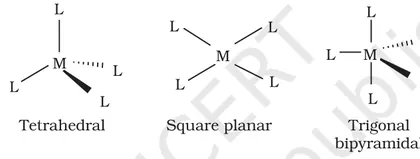
- CN = 4: tetrahedral (109.5°) or square planar (90°)
- CN = 5: trigonal bipyramidal (90° and 120°) or square pyramidal
- CN = 6: octahedral (90°)
- Higher CN (7, 8, 9): pentagonal bipyramidal, square antiprismatic, tricapped trigonal prismatic etc., seen for large metal ions or multidentate ligands
Factors influencing coordination number and geometry:
- Size of metal ion: Larger metal ions can accommodate more ligands (higher CN).
- Size and steric bulk of ligand: Bulky ligands lower the number of ligands that can fit around the metal.
- Denticity of ligand: Polydentate ligands occupy multiple coordination sites (eg, en is bidentate, EDTA hexadentate), increasing the effective CN even with fewer ligand molecules.
- Electronic factors / d-electron count: Crystal field / ligand field stabilization energies (LFSE) can favour one geometry over another (eg, d8 often gives square planar complexes like Pt(II)).
- Oxidation state: Higher oxidation states reduce metal radius and may reduce CN or change geometry.
- Jahn-Teller effect: Distortions of ideal geometry (commonly in Cu(II) d9) may produce elongated or compressed octahedra.
Hybridisation connections (useful rule-of-thumb): Typical hybridisations associated with CN/geometry are:
- CN 2 → sp (linear)
- CN 3 → sp2 (trigonal planar)
- CN 4 → sp3 (tetrahedral) or dsp2 (square planar)
- CN 5 → sp3d (trigonal bipyramidal) or sp3d (square pyramidal)
- CN 6 → d2sp3 or sp3d2 (octahedral)
Ionic radius ratio rule (for ionic cases): The possible CN for a cation surrounded by anions depends on the radius ratio r_cation / r_anion. Approximate limits are:
- CN = 2: < 0.155
- CN = 3: 0.155 – 0.225
- CN = 4: 0.225 – 0.414
- CN = 6: 0.414 – 0.732
- CN = 8: > 0.732
Special cases: d8 metal ions (eg, Pt(II), Pd(II), Ni(II)) often form square planar complexes; d10 metals (eg, Zn(II), Cd(II)) commonly form tetrahedral complexes. Chelation (multidentate ligands) stabilises complexes and can lock a particular geometry.
Practical significance and notes: Predicting geometry requires considering CN, ligand denticity and electronic effects together. Many textbook examples for CN 4 and 6 dominate coordination chemistry and bioinorganic systems (eg, haem, vitamin B12).
- [Ag(NH3)2]+ — linear, CN = 2; used in Tollens reagent for aldehyde tests.
- [Ni(CN)4]2- — square planar, CN = 4 (d10/d8 behaviour depending on metal and ligand field).
- [Pt(NH3)2Cl2] (cisplatin) — square planar, CN = 4; an anticancer drug.
- [Cu(H2O)6]2+ — octahedral, CN = 6 (common hydration geometry for many metal ions in aqueous solution).
- [Fe(CN)6]3- / [Fe(CN)6]4- — octahedral, CN = 6 (hexacyanoferrate complexes).
- Haem (iron in hemoglobin) — Fe is typically 6-coordinate when O2 is bound (4 N from porphyrin + proximal histidine + O2).
- Coordination number (CN) = number of donor atoms directly bonded to the central metal ion.
- Effective CN for a polydentate ligand = sum of donor atoms the ligand donates (eg, en = 2, EDTA = 6).
- Radius ratio = r_cation / r_anion. Approximate ionic CN boundaries: CN2 (<0.155), CN3 (0.155–0.225), CN4 (0.225–0.414), CN6 (0.414–0.732), CN8 (>0.732).
- Common hybridisation rules: CN2→sp, CN3→sp2, CN4→sp3 or dsp2, CN5→sp3d, CN6→d2sp3 or sp3d2.
- Ligand field consideration: geometry is influenced by ligand field stabilization energy (LFSE); eg, strong-field ligands can stabilise square planar d8 complexes.
Isomerism in Coordination Compounds
Definition: Isomerism in coordination compounds means two or more compounds have the same molecular formula but different arrangements of atoms or ligands, giving different properties.
Classification
1. Structural (constitutional) isomerism — connectivity of atoms differs. Main types:
- Ionization isomerism: An anion present inside the coordination sphere in one isomer is outside as a counter‑ion in the other. Example: [Co(NH3)5Br]SO4 and [Co(NH3)5SO4]Br. They give different ions in solution (Br− vs SO42−).
- Hydrate (solvate) isomerism: Water (or solvent) molecules occur either inside or outside the coordination sphere. Example: [Cr(H2O)6]Cl3 and [CrCl(H2O)5]Cl2·H2O.
- Linkage isomerism: An ambidentate ligand binds through different donor atoms. Example: [Co(NH3)5NO2]Cl2 (nitro, bound through N) vs [Co(NH3)5ONO]Cl2 (nitrito, bound through O).
- Coordination isomerism: In salts containing complex cations and anions, ligands can be exchanged between the metal centers. Example: [Co(NH3)6][Cr(CN)6] and [Cr(NH3)6][Co(CN)6].
- Polymerization isomerism: Same formula but one is monomeric and the other polymeric (different connectivity leading to chain or network structures). Example: some copper(II) nitrate complexes form polymeric vs monomeric salts.
2. Stereoisomerism — same connectivity but different spatial arrangement.
- Geometrical (cis–trans, fac–mer):
- Square planar: cis and trans (example: cis‑ and trans‑[PtCl2(NH3)2]; cis‑ is cisplatin, an anticancer drug).
- Octahedral: cis/trans (two identical monodentate ligands) and fac/mer for complexes with three identical ligands (facial vs meridional arrangements), e.g., fac‑ and mer‑[CoCl3(NH3)3].
- Optical isomerism: Non-superimposable mirror-image isomers (enantiomers). Typical in octahedral complexes with three bidentate ligands, e.g., Δ and Λ forms of [Co(en)3]3+ (en = ethylenediamine).
How to distinguish isomers experimentally
- Ionization isomers: different ions in solution — qualitative tests / conductivity.
- Linkage isomers: different IR bands (NO2 vs ONO) and different chemical reactivity.
- Geometrical isomers: different dipole moments, NMR patterns, melting points, colours.
- Optical isomers: rotate plane‑polarized light in opposite directions; separated by chiral resolution.
Why it matters (real-world relevance)
- Cisplatin (cis‑[PtCl2(NH3)2]) is an effective anticancer drug; its trans isomer is largely inactive — a direct demonstration that isomerism changes biological activity.
- Optical coordination complexes interact differently with chiral biomolecules, affecting drug action and catalysis.
Summary tips: Identify ligand denticity, geometry (square planar vs octahedral), and possible ambidentate ligands to predict possible isomers. Use oxidation state and coordination number to write plausible formulas before checking isomer types.
- [Co(NH3)5Br]SO4 and [Co(NH3)5SO4]Br — Ionization isomerism
- [Cr(H2O)6]Cl3 and [CrCl(H2O)5]Cl2·H2O — Hydrate (solvate) isomerism
- [Co(NH3)5NO2]Cl2 (nitro) and [Co(NH3)5ONO]Cl2 (nitrito) — Linkage isomerism
- [Co(NH3)6][Cr(CN)6] and [Cr(NH3)6][Co(CN)6] — Coordination isomerism
- cis‑[PtCl2(NH3)2] (cisplatin) vs trans‑[PtCl2(NH3)2] — Geometrical isomerism with biomedical relevance
- [Co(en)3]3+ (Δ and Λ) — Optical isomerism (enantiomers)
- Oxidation state of metal: x = (overall charge of complex) − Σ(charge of ligands). (Equivalently, x + Σ(ligand charges) = complex charge.)
- d‑electron count: d\u2080 = group number of metal − oxidation state
- Coordination number (CN) = total number of donor atoms directly bonded to the metal (important to predict geometry)
- For predicting possible geometrical isomers in octahedral MX4Y2: cis and trans; for MX3Y3: fac and mer
Valence Bond Theory (VBT)
What VBT says (short): Valence Bond Theory for coordination compounds describes metal–ligand bonds as coordinate covalent bonds formed by overlap of filled ligand orbitals (lone pairs) with appropriate metal atomic orbitals (s, p, d). Hybridization of the metal orbitals gives the observed geometry; whether inner (using inner d orbitals) or outer (using outer d orbitals) orbitals are involved depends on ligand field strength and pairing energy.
Key assumptions and steps to apply VBT:
- Determine the oxidation state of the central metal and its d-electron count (d^n).
- Decide ligand field strength from the spectrochemical series: strong-field ligands (CN-, NH3, en) tend to cause pairing; weak-field ligands (F-, Cl-, H2O) do not.
- Compare pairing energy (P) vs ligand-field splitting (Δ0): if Δ0 > P, pairing occurs and inner d orbitals can be used for hybridization (inner-orbital complex); if Δ0 < P, no pairing and outer d orbitals are used (outer-orbital complex).
- Assign hybridization (d2sp3, sp3d2, sp3, dsp2, etc.), predict geometry, and predict number of unpaired electrons → magnetic behavior.
Common hybridizations and geometries (VBT):
- Octahedral: inner orbital d2sp3 (uses inner d) or outer orbital sp3d2 (uses outer d).
- Tetrahedral: sp3 (outer orbitals) — usually high-spin.
- Square planar: dsp2 (common for d8 with strong-field ligands, e.g., Pt(II), Ni(II), Pd(II)).
Magnetism prediction: Use the count of unpaired electrons from the chosen electron arrangement. For spin-only moment: μ = √[n(n+2)] BM, where n = number of unpaired electrons.
Worked examples (brief):
- [Fe(CN)6]4−: Fe2+ → d6. CN− is strong-field → pairing occurs → inner-orbital d2sp3 hybridization → octahedral, low-spin d6 (all electrons paired) → μ ≈ 0 BM (diamagnetic).
- [FeF6]4−: Fe2+ → d6. F− is weak-field → no pairing → sp3d2 hybridization (outer d) → octahedral, high-spin d6 with 4 unpaired electrons → μ ≈ √[4(4+2)] ≈ 4.90 BM (paramagnetic).
- [Ni(CN)4]2−: Ni2+ → d8. CN− strong-field causes pairing → dsp2 hybridization → square planar, low-spin d8 (no unpaired electrons) → diamagnetic. (Example: many Pt(II), Pd(II), Ni(II) complexes show dsp2 square planar geometry.)
Limitations of VBT: VBT gives qualitative geometry and magnetic properties for many complexes but has limitations: it does not provide quantitative splitting energies (Δ), cannot always predict spectra or exact magnetic moments when orbital contribution is significant, and struggles with complexes where bonding is more covalent/delocalized (ligand field / molecular orbital theory is more complete).
Practical tip for students: Always write the metal oxidation state and d^n first, consult the spectrochemical series for ligand strength, decide pairing, then choose hybridization to predict geometry and magnetism; check against experimental data (if given).
- [Fe(CN)6]4− — Fe2+ (d6), CN− strong-field → inner-orbital d2sp3 → octahedral, diamagnetic
- [FeF6]4− — Fe2+ (d6), F− weak-field → outer-orbital sp3d2 → octahedral, paramagnetic (4 unpaired electrons)
- [Ni(CN)4]2− — Ni2+ (d8), CN− strong-field → dsp2 → square planar, diamagnetic
- cisplatin [Pt(NH3)2Cl2] — Pt(II) dsp2 square-planar geometry (basis for anticancer drug action)
- Hemoglobin (Fe in heme) — an example of biological coordination chemistry; VBT provides a simple bonding picture but more advanced ligand-field/MO approaches are needed for full explanation of O2 binding
- d-electron count: n = (group number of metal) − (oxidation state of metal); write configuration as d^n
- Spin-only magnetic moment: μ = √[n(n+2)] Bohr magneton (BM), where n = number of unpaired electrons
- Pairing condition (qualitative): if Δ0 > P → electrons pair (low-spin, inner-orbital hybridization); if Δ0 < P → no pairing (high-spin, outer-orbital hybridization)
- Oxidation state (example formula): oxidation state of M = (complex charge) − Σ(ligand charges) (rearrange depending on notation)
- Typical hybridization → geometry mapping: d2sp3 (octahedral, inner), sp3d2 (octahedral, outer), sp3 (tetrahedral), dsp2 (square planar)
Crystal Field Theory (CFT)
What is CFT?
Crystal Field Theory (CFT) explains the electronic structure, magnetism and colour of transition‑metal complexes by considering the effect of ligand electric fields on the metal d‑orbitals. It treats ligands as point charges or dipoles that lift the degeneracy of the five d‑orbitals by altering their energies.
Basic assumptions (simple model used in Class 12)
- Metal ion provides five degenerate d‑orbitals; ligands are treated as point negative charges (or dipoles).
- Electrostatic interactions between ligands and d‑electrons split d‑orbital energies; electrons occupy these split levels according to Hund's rule and Pauli principle.
- Key competing energies: crystal field splitting (Δ), and pairing energy (P). Whether electrons pair or occupy higher levels depends on Δ vs P.
Octahedral complexes (most common)
In an octahedral field (six ligands along axes) the five d‑orbitals split into two sets: lower energy t2g (dxy, dxz, dyz) and higher energy eg (dx2−y2, dz2). The energy gap between them is Δo (or 10Dq). By convention each t2g electron is stabilized by −0.4Δo and each eg electron is destabilized by +0.6Δo (per electron).
Tetrahedral and square‑planar
Tetrahedral (four ligands) gives a reverse splitting: eg (lower) and t2 (higher) with overall smaller splitting Δt ≈ (4/9)Δo; tetrahedral complexes are nearly always high spin. Square planar (common for d8, e.g. Pt(II), Pd(II)) produces large splitting with dx2−y2 highest, leading often to low‑spin configurations.
CFSE (Crystal Field Stabilization Energy)
Calculate CFSE by summing contributions from electrons in t2g and eg levels: CFSE = [n(t2g)×(−0.4Δo) + n(eg)×(+0.6Δo)] + pairing energy adjustments. If Δ is large (strong‑field ligands), electrons pair in lower orbitals (low‑spin). If Δ is small (weak‑field ligands), electrons remain unpaired occupying higher orbitals (high‑spin).
Magnetism & Colour
Magnetic behavior: count unpaired electrons (spin‑only magnetic moment μ = √[n(n+2)] BM). Colour: photons promoting electrons between split levels (t2g ↔ eg) absorb particular wavelengths; the complex appears as the complementary colour of the absorbed light. Stronger field (larger Δ) absorbs shorter wavelength (higher energy).
Spectrochemical series (qualitative)
Ligands arranged by increasing field strength (weak → strong): I− < Br− < SCN− < Cl− < F− < H2O < NH3 < en < NO2− < CN− < CO. Stronger ligands increase Δ and favor low‑spin states.
How to decide high‑spin vs low‑spin
Compare energy: total energy = CFSE + pairing energies. Low‑spin favored when gain in CFSE (larger negative orbital energy) exceeds extra pairing energy required. Otherwise high‑spin occurs.
Limitations
CFT is mainly electrostatic and neglects covalency. Ligand Field Theory (an extension) and molecular orbital theory treat covalency explicitly. Nonetheless CFT gives correct qualitative predictions for splitting patterns, magnetism and colour in many cases studied in Class 12.
- [Cu(H2O)6]2+ — blue colour of hydrated copper(II); d9 with characteristic absorption due to d–d transition.
- [Fe(H2O)6]2+ and [Fe(CN)6]4− — Fe2+ in water (weak field, often high‑spin) vs CN− (strong field, low‑spin) illustrating spin state change.
- Hemoglobin (Fe in heme) — ligand environment around Fe alters spin and facilitates reversible O2 binding (bioinorganic example of ligand effect on metal properties).
- Tetrachlorocuprate(II), [CuCl4]2− — tetrahedral geometry gives different colour (green/blue) versus octahedral Cu2+.
- K2Cr2O7 and transition‑metal salts — colours in paints, dyes and indicators arise from d‑electron transitions influenced by ligand environment.
- Splitting for octahedral: Δo (also written 10Dq); for tetrahedral: Δt ≈ (4/9) Δo.
- CFSE (general for octahedral): CFSE = [n(t2g) × (−0.4 Δo) + n(eg) × (+0.6 Δo)] + (pairing energy terms when extra pairing occurs).
- Spin‑only magnetic moment: μ = √[n(n + 2)] Bohr magneton (BM), where n = number of unpaired electrons.
- Photon energy ↔ splitting: Δ (kJ mol−1) = (1.196 × 10^5) / λ(nm).
- Wavenumber (cm−1) ↔ wavelength: ν̅ (cm−1) = 10^7 / λ(nm).
- Examples of octahedral CFSE values (orbital part only): d1: −0.4Δo; d2: −0.8Δo; d3: −1.2Δo; d4 (HS): −0.6Δo, d4 (LS): −1.6Δo; d5 (HS): 0, d5 (LS): −2.0Δo; d6 (HS): −0.4Δo, d6 (LS): −2.4Δo.
Molecular Orbital (MO) Theory for Complexes
Overview
The Molecular Orbital (MO) theory for coordination complexes extends MO ideas from molecules to metal–ligand systems. Metal atomic orbitals (mainly valence d, s, p) interact with symmetry-adapted linear combinations (SALCs) of ligand orbitals to form bonding, non-bonding and antibonding molecular orbitals. MO theory explains bonding, magnetism, colour, π-backbonding and the relative stability of complexes (including the 18‑electron rule) in a more detailed way than crystal field theory.
Steps to build a qualitative MO diagram for an octahedral complex [ML6]
- Identify metal valence orbitals: (n−1)d, ns, np (five d, one s, three p).
- Construct SALCs of ligand donor orbitals (usually ligand lone-pairs directed at the metal for σ-bonding). These SALCs have specific symmetries (eg, t2g, eg in octahedral symmetry).
- Allow only orbitals of the same symmetry to interact. Strong σ-interaction occurs between metal eg (dz2, dx2−y2) and ligand σ-SALCs (giving bonding and antibonding eg*). Metal t2g (dxy, dxz, dyz) have poor σ overlap but can interact by π-backbonding with ligand π-acceptor orbitals (e.g. CO, CN−) or with ligand π-donor orbitals (e.g. I−, Cl−).
- Place resulting orbital energy levels: bonding orbitals (mostly ligand in character) at low energy; non-bonding or moderately shifted t2g orbitals; antibonding eg* at higher energy. The energy gap between t2g and eg* corresponds to the ligand-field splitting Δo (from MO viewpoint it is the energy difference between predominantly metal t2g and eg* MOs).
Role of π-interactions
- π-acceptor ligands (CO, CN−): they accept electron density from metal t2g orbitals (π-backbonding), which lowers the energy of t2g (increasing Δo) and strengthens metal–ligand bonds. These often produce low-spin complexes.
- π-donor ligands (halides, OR−): they donate into t2g orbitals, raising t2g energy (reducing Δo) and favouring high-spin complexes.
Consequences explained by MO theory
- Magnetism: number of unpaired electrons depends on how electrons occupy the MO energy levels (compare Δo with pairing energy P). If Δo > P, electrons pair (low-spin); if Δo < P, electrons remain unpaired (high-spin).
- Colour: d–d transitions (t2g → eg*) and charge-transfer transitions (metal→ligand or ligand→metal) are explained by MO energy differences. Stronger field ligands shift transitions to different wavelengths.
- Stability / 18‑electron rule: many stable complexes have a filled set of metal valence MOs corresponding to 18 valence electrons (analogous to noble-gas configuration): s (2) + p (6) + d (10) = 18. MO theory rationalises why some complexes (e.g., Fe(CO)5, Ni(CO)4) follow this rule.
Comparison with Crystal Field Theory (CFT)
CFT treats ligands as point charges and considers only electrostatic splitting of d-orbitals (useful for simple predictions). MO theory is more complete: it includes covalent metal–ligand interactions (σ and π), ligand orbital contributions, and explains spectrochemical series and bonding strengths qualitatively.
Practical remarks for CBSE Class 12
- For octahedral complexes, sketch MO diagrams showing: ligand σ-SALCs interacting with metal eg to give bonding + antibonding eg*; t2g orbitals being nonbonding or involved in π interactions depending on ligand.
- For tetrahedral complexes, interactions are weaker; splitting Δt ≈ (4/9)Δo and usually lead to high-spin configurations because Δt is small.
- Use MO theory to reason about examples: why [Fe(CN)6]4− is low-spin (CN− is a strong π-acceptor) while [Fe(H2O)6]2+ is high-spin (H2O weak field, mainly σ-donor).
- [Fe(CN)6]4− (d6): CN− is a strong π-acceptor. t2g orbitals are stabilized by π-backbonding → large Δo → low-spin, diamagnetic complex.
- [Fe(H2O)6]2+ (d6): H2O is a weak σ-donor, little π-backbonding → small Δo → high-spin, paramagnetic (unpaired electrons) complex.
- Ni(CO)4 and Fe(CO)5: CO is a strong σ-donor and π-acceptor. Backbonding stabilizes t2g MOs and these complexes satisfy the 18‑electron rule and are diamagnetic.
- Cu2+ solutions (e.g., [Cu(H2O)6]2+): partially filled d-orbitals and d–d transitions give characteristic blue colour explained by MO splitting.
- Hemoglobin/myoglobin (Fe–porphyrin): Fe d-orbitals interact with porphyrin ligand orbitals; CO/NO binding involves π-backbonding and explains strong binding and changes in spectral features.
- Valence electron count (VE) for complex: VE = (metal valence electrons) − (oxidation state) + (electrons donated by ligands). Example: for [Fe(CN)6]4−, Fe(II) → Fe contributes 8 d-electrons; each CN− donates 2 → VE = 8 + 6×2 = 20 (counting conventions vary; 18‑electron target applies to many stable complexes).
- Ligand-field splitting (octahedral): Δo = E(eg*) − E(t2g) (energy difference between predominantly eg* and t2g MOs).
- Tetrahedral splitting relation: Δt ≈ (4/9) Δo (Δt is smaller than Δo).
- Pairing criterion: if Δo > P (pairing energy) → electrons pair → low-spin; if Δo < P → high-spin.
- Magnetic moment (spin-only): μ_eff = sqrt[n(n + 2)] Bohr magnetons (BM), where n = number of unpaired electrons.
Electronic Spectra and Color of Complexes
Overview
Transition metal complexes are often coloured because they absorb visible light. The colours arise mainly from two types of electronic transitions: d–d transitions (between split d orbitals) and charge transfer transitions (metal-to-ligand or ligand-to-metal). The wavelength (and hence colour) absorbed depends on the energy gap between the initial and final electronic states.
Crystal (Ligand) Field Splitting
In a free transition-metal ion all five d orbitals are degenerate. Surrounding ligands split these d levels by an energy Δ (often called Δo for octahedral complexes and Δt for tetrahedral). For an octahedral complex the d orbitals split into t2g (lower) and eg (upper) levels. The magnitude of Δ depends on:
- Nature of the ligand (spectrochemical series: I− < Br− < S2− < SCN− < Cl− < F− < OH− < H2O < NH3 < en < CN− < CO).
- Oxidation state of the metal (higher oxidation → larger Δ).
- Identity of the metal (period and d-electron count).
- Geometry (octahedral vs tetrahedral; Δt ≈ 4/9 Δo).
- Covalency (more covalent bonding often increases splitting; nephelauxetic effect influences Racah interelectronic repulsion).
Electronic Transitions
- d–d transitions: An electron is promoted from a lower d level to a higher d level (e.g., t2g → eg). These are partially forbidden by the Laporte rule in centrosymmetric complexes and therefore are typically weak (low molar absorptivity).
- Charge transfer (CT) transitions: Electron transfer from ligand to metal (LMCT) or metal to ligand (MLCT). These transitions are usually very intense (high molar absorptivity) and often dominate the visible spectrum.
- Interconfigurational transitions: Involving different electronic configurations (less commonly encountered at class 12 level).
Selection Rules
- Spin selection rule: ΔS = 0 (spin-forbidden transitions are weak).
- Laporte rule: In centrosymmetric (e.g., octahedral) systems transitions that do not involve a change in parity (g ↔ g) are forbidden. Vibronic coupling and lack of perfect symmetry relax this rule.
Relation between energy and wavelength
The energy difference ΔE between the two electronic levels determines the wavelength λ of light absorbed:
- ΔE = h c / λ (single photon energy)
- For per mole quantities: ΔE (kJ mol−1) ≈ 119.63 / λ(nm)
- Wavenumber (in cm−1): Δ̄ = 1 / λ(cm) = 10^7 / λ(nm)
Observed colour
A complex absorbs light of wavelength λabs (colour absorbed). The observed colour is the complementary colour of the absorbed light (e.g., absorption in red → complex appears green/blue). Intensity of colour depends on molar absorptivity (ε) and concentration (Beer–Lambert law): A = ε c l.
High-spin vs Low-spin
If Δ is small (weak-field ligands) electrons occupy higher orbitals to maximize spin (high-spin). If Δ is large (strong-field ligands), pairing occurs and the complex is low-spin. This changes the electronic transitions and hence the colour.
Practical consequences and examples
- Different ligands around the same metal can give very different colours (e.g., Co2+ in water is pink but in chloride medium turns blue due to different ligand coordination).
- Charge-transfer bands are responsible for very intense colours (e.g., Fe3+–SCN− producing deep red [Fe(SCN)]2+).
- Biological colours (heme in hemoglobin, chlorophyll) arise from metal–ligand interactions and conjugated ligand systems causing characteristic absorptions.
Summary
The colour of coordination compounds is explained by electronic transitions whose energies depend on ligand field splitting, metal and ligand identity, oxidation state and geometry. d–d transitions give weak bands and are sensitive to selection rules; charge-transfer transitions give strong, intense bands.
- [Cu(H2O)6]2+: Blue color due to d–d transitions of Cu(II) in an octahedral hydrated complex.
- [Ti(H2O)6]3+: Violet/blue due to d–d transitions of Ti(III) (d1) in octahedral field.
- [Cr(NH3)6]3+: Violet/green depending on ligand field; Cr(III) d3 with t2g-eg splitting.
- [Fe(SCN)]2+ (in solution): Intense blood-red colour due to ligand-to-metal charge-transfer (LMCT).
- Hemoglobin (Fe2+–porphyrin): Color change on O2 binding due to change in electronic transitions of the heme complex.
- CoCl2·6H2O vs CoCl4^2−: Co2+ in water (octahedral, pink) vs in chloride-rich medium (tetrahedral, blue) demonstrates geometry/ligand effect on colour.
- ΔE = h c / λ (single photon energy, J)
- ΔE (kJ mol−1) ≈ 119.63 / λ(nm)
- Wavenumber Δ̄ (cm−1) = 10^7 / λ(nm)
- Beer–Lambert law: A = ε c l (A = absorbance, ε = molar absorptivity L mol−1 cm−1, c = concentration M, l = path length cm)
- Relation for tetrahedral splitting: Δt ≈ 4/9 · Δo (approximate)
- Selection rules: Spin: ΔS = 0 (allowed), Laporte: g ↔ u required for strong intensity in centrosymmetric complexes
Magnetic Properties of Complexes
Overview: Magnetic properties of coordination complexes arise from the presence (or absence) of unpaired electrons in the metal centre and from interactions between magnetic centres. These properties help determine electronic configuration, oxidation state, geometry and ligand field strength.
Origin of magnetism:
- Diamagnetism — all electrons paired; weakly repelled by a magnetic field (e.g., Zn2+ complexes, many low-spin d6 complexes).
- Paramagnetism — one or more unpaired electrons; attracted by a magnetic field (most high-spin 3d complexes, many transition-metal ions).
- Ferromagnetism, antiferromagnetism, ferrimagnetism — cooperative (ordered) behaviour produced by exchange interactions between magnetic centres (seen in solids like Fe3O4, some polymeric/bridged complexes).
Spin-only magnetic moment: For many first-row (3d) transition-metal complexes the orbital contribution is small (quenched), so the magnetic moment can be estimated from unpaired electrons using the spin-only formula:
μs = √[n(n+2)] μB
where n = number of unpaired electrons and μB is the Bohr magneton. This yields magnetic moment in Bohr magnetons (BM).
High-spin vs low-spin (effect of crystal field):
- In an octahedral field the five d-orbitals split into t2g and eg levels separated by Δoct. In a tetrahedral field the splitting Δt is smaller (≈4/9 Δoct).
- If pairing energy (P) > Δ, electrons remain unpaired => high-spin (larger μ).
- If P < Δ, electrons pair in lower orbitals => low-spin (smaller μ, possibly diamagnetic).
- Ligands are ordered by the spectrochemical series: strong-field ligands (CN−, CO) tend to produce large Δ (low-spin), weak-field ligands (I−, Br−, Cl−, H2O) give small Δ (high-spin).
Orbital contribution & exceptions: In many 3d complexes orbital angular momentum is largely quenched but not always; Co2+, Ni2+ and some V2+ or Cr2+ complexes can show significant orbital contributions, and heavier transition metals and lanthanide complexes (e.g., Gd3+) often require consideration of orbital and spin–orbit coupling.
Measurement and temperature dependence:
- Molar magnetic susceptibility (χm) is measured experimentally (Gouy or SQUID magnetometers).
- Curie law: χm = C/T for ideal paramagnets (C = Curie constant).
- Effective magnetic moment (from measured susceptibility): μeff = 2.828 √(χm·T) μB. Deviations from Curie behaviour indicate magnetic interactions (antiferromagnetism, ferromagnetism) or temperature-dependent effects.
Interpretation: By comparing experimental μeff with spin-only values, one can deduce number of unpaired electrons, identify high-spin vs low-spin states, and detect significant orbital contributions or magnetic coupling.
Practical note: For CBSE Class 12 problems you will commonly use the spin-only formula and spectrochemical ideas to predict and rationalize magnetic behaviour of first-row transition-metal complexes.
- [Fe(H2O)6]2+ (aq): Fe2+ is d6; with weak-field H2O it is high-spin (4 unpaired, μs ≈ 4.90 BM) — paramagnetic.
- [Fe(CN)6]4−: Fe2+ in a strong-field CN− environment is low-spin d6 (all electrons paired) — diamagnetic.
- [Co(NH3)6]3+: Co3+ (d6) with moderately strong-field NH3 is usually low-spin and diamagnetic.
- Cu2+ complexes (e.g., [Cu(NH3)4]2+): d9 with one unpaired electron gives μs ≈ 1.73 BM — paramagnetic; Jahn–Teller distortions often present.
- O2 (dioxygen): molecular paramagnet (two unpaired electrons) — explains attraction of liquid oxygen to a magnet.
- Fe3O4 (magnetite): mixed-valence solid (Fe2+/Fe3+) showing ferrimagnetism — real-world magnetic material.
- Spin-only magnetic moment: μs = √[n(n+2)] μB (n = number of unpaired electrons, μB = Bohr magneton)
- Effective magnetic moment from susceptibility: μeff = 2.828 · √(χm · T) (μeff in μB, χm = molar susceptibility, T in K)
- Curie law for paramagnets: χm = C / T (C = Curie constant)
- Curie constant (relation): C = (N_A μ_eff^2) / (3 k_B) (N_A = Avogadro number, k_B = Boltzmann constant)
Stability and Formation of Complexes
Overview: A coordination complex is formed when ligands (Lewis bases) bind to a central metal ion (Lewis acid). Stability of a complex refers to how far the formation equilibrium lies towards the product (thermodynamic stability) and how fast / slowly the complex changes by substitution (kinetic stability).
Formation equilibria and constants
- For the reaction M + nL ⇌ MLn, the overall formation (stability) constant is defined as βn = [MLn]/([M][L]^n). Large βn means a more stable complex.
- Stepwise (successive) formation constants: K1 = [ML]/([M][L]), K2 = [ML2]/([ML][L]), and βn = K1·K2·…·Kn.
- The standard-free-energy change is related: ΔG° = −RT ln βn. So bigger βn → more negative ΔG° → thermodynamically more stable.
Thermodynamic vs Kinetic stability
- Thermodynamic stability: how favorable the formation is at equilibrium (measured by βn).
- Kinetic stability (inert vs labile): rate at which ligand substitution occurs. A complex may be thermodynamically stable but kinetically labile, or vice versa.
Factors affecting stability
- Metal ion properties: charge (higher positive charge increases attraction to ligands), ionic radius (smaller radius increases charge density), and electronic configuration (CFSE — Crystal Field Stabilization Energy — can stabilize certain d-electron counts).
- Ligand properties: charge (anionic ligands generally give stronger binding), donor atom (O, N, S, P — HSAB concept; hard acids prefer hard bases), denticity (multidentate ligands increase stability), and ability to delocalize charge.
- Chelate effect: multidentate ligands (chelates) form more stable complexes than equivalent monodentates. This is mainly entropic — formation reduces the number of particles less when one chelator replaces several monodentate ligands, increasing disorder of the surroundings.
- Macrocyclic effect: cyclic multidentate ligands (macrocycles) often give extra stability over open-chain analogues due to preorganization and entropic/enthalpic advantages.
- pH and protonation: protonation of ligand donor sites reduces available ligand concentration and lowers the effective (conditional) stability constant.
- Solvent and competing equilibria (hydrolysis, other complexing species) also influence observed stability.
Conditional stability: When ligands are partially protonated (e.g., EDTA), the effective or conditional formation constant at a given pH is lower than βn. One accounts for the fraction of ligand in the unprotonated (binding) form.
Electronic factors (CFSE and geometry): Formation of a complex that yields a favorable CFSE (e.g., certain d-electron counts in octahedral fields) increases its thermodynamic stability. Geometry (octahedral vs square planar) also affects both thermodynamic and kinetic behavior; e.g., many square planar d8 complexes are substitution-inert in certain pathways and show strong trans effects.
Practical consequences
- Chelating agents (EDTA, DTPA) strongly sequester metal ions — used in titrations, water softening, and metal detoxification.
- Biological complexes (hemoglobin, vitamin B12) rely on specific complex stabilities for function.
- Medicinal and industrial processes exploit kinetic vs thermodynamic control (e.g., slow ligand exchange for stable drug delivery; fast exchange for catalysis).
Summary: Stability of complexes is governed by equilibrium constants (βn) and thermodynamic quantities (ΔG°, ΔH°, ΔS°) and is modulated by metal/ligand properties, chelate and macrocyclic effects, electronic factors (CFSE), and pH. Kinetic stability (rates) is a separate concept important in reactivity and applications.
- EDTA with Ca2+: EDTA forms a very stable Ca–EDTA complex (used in water softening and in complexometric titrations). The formation constant depends on pH because EDTA has multiple protonatable sites.
- Hemoglobin: Fe2+ in heme is coordinated to a porphyrin (multidentate) and O2 binding/release depends on specific stability and kinetics of the Fe–O2 interaction.
- Vitamin B12 (cobalamin): cobalt bound in a corrin ring (macrocyclic ligand) — macrocyclic effect contributes strongly to stability.
- Gadolinium chelates (Gd–DTPA): stable chelates are used as MRI contrast agents to prevent release of toxic free Gd3+ (chelate stability and kinetic inertness are both important).
- Chelation therapy: Dimercaprol and EDTA bind toxic metal ions (Pb2+, Hg2+) to form stable complexes that can be excreted.
- Cisplatin (Pt complex) in chemotherapy: platinum complex stability and ligand-exchange kinetics determine biological activity and side effects.
- Overall formation constant: βn = [MLn] / ([M][L]^n)
- Stepwise constants: K1 = [ML]/([M][L]), K2 = [ML2]/([ML][L]), … , and βn = K1·K2·…·Kn
- Gibbs relation: ΔG° = −RT ln βn (R = gas constant, T = temperature)
- Relationship with enthalpy/entropy: ΔG° = ΔH° − TΔS° (chelate effect largely due to favorable ΔS°)
- Conditional (effective) constant at given pH: K' = βn × (α_L)^n, where α_L is the fraction of ligand present in the deprotonated binding form
- Fraction unprotonated for a polyprotic ligand (example): α = 1 / (1 + [H+]/Ka1 + [H+]^2/(Ka1·Ka2) + …)
Reactivity and Mechanisms
Overview
Reactivity and mechanisms in coordination chemistry deal with how and why metal complexes undergo chemical change — mainly ligand substitution and electron-transfer reactions — and the step-by-step pathways (mechanisms) by which these reactions proceed.
Types of reactions
- Ligand substitution: replacement of one ligand by another (L + MLn → MLn-1L').
- Redox (electron transfer): transfer of electron(s) between metal centres (outer-sphere or inner-sphere).
- Acid–base and hydrolysis reactions of aqua complexes.
- Catalytic reactions involving coordination changes (oxidative addition, reductive elimination, migratory insertion).
Ligand substitution mechanisms
There are three idealized classes of substitution pathways for coordination complexes:
- Associative (A): incoming ligand begins to bind before an existing ligand leaves. Coordination number increases in the transition state/intermediate. Rate law typically depends on both complex and incoming ligand concentrations (rate ∝ [MLn][L]). Characteristic of square‑planar d8 (e.g. Pt(II), Pd(II)) and some 5/6‑coordinate centres. ΔS‡ is often negative (more ordered).
- Dissociative (D): a ligand first leaves to give a lower‑coordinate intermediate; the incoming ligand then binds. Rate law depends only on complex concentration (rate ∝ [MLn]). Common for many octahedral complexes (labile ones). ΔS‡ is often positive (less ordered).
- Interchange (I): no detectable intermediate; bond making and breaking occur simultaneously. Two limiting types: Ia (associative character) and Id (dissociative character). Experimental dependence on [L] and activation parameters distinguish these.
Experimental diagnostics
- Dependence of rate on [incoming ligand]: significant dependence → associative or Ia; no dependence → dissociative (D).
- Activation entropy ΔS‡: negative → associative; positive → dissociative.
- Intermediate detection (spectroscopy) or isolation indicates an A mechanism.
Factors affecting rates
- Metal ion: oxidation state (higher charge → more electron deficient → often less labile), ionic radius and electron configuration (d‑count; d8 square planar tends to be associative).
- Ligand properties: strong π‑acceptors can stabilize metal and slow substitution; bulky ligands slow associative approaches; chelating ligands increase complex stability (chelate effect) and lower lability.
- Trans effect (in square‑planar complexes): certain ligands increase the lability of the ligand trans to them (important in synthetic pathways for Pt(II) complexes).
- Solvent and temperature: polar solvents stabilize charged transition states; higher temperatures increase rates (Arrhenius/Eyring behaviour).
Redox mechanisms: outer-sphere vs inner-sphere electron transfer
- Outer‑sphere: electron transfer occurs without breaking or making bonds between the two complexes; no ligand bridging; reaction rate depends on electronic coupling and reorganization energy. Example type: electron exchange between two solvated metal centres where coordination spheres remain intact.
- Inner‑sphere: a ligand (often halide, OH−, or other bridging ligand) temporarily bridges the two metal centres; electron transfer occurs through the bridge and is often accompanied by ligand transfer. Identification: ligand from one complex ends up bound to the other after reaction.
Thermodynamics and kinetics (key relations)
- Arrhenius: k = A exp(−Ea/RT) — relates rate constant k to activation energy Ea and temperature T.
- Eyring (transition state theory): k = (kB T / h) exp(−ΔG‡/RT) = (kB T / h) exp(ΔS‡/R) exp(−ΔH‡/RT), where ΔG‡, ΔH‡ and ΔS‡ are Gibbs free energy, enthalpy and entropy of activation.
- Marcus theory for outer‑sphere electron transfer (simplified): ΔG‡ = (λ/4)(1 + ΔG°/λ)^2, where λ is the reorganization energy and ΔG° the reaction free energy change. Rate ∝ exp(−ΔG‡/RT).
Kinetic rate laws — simple forms
- Dissociative first step (rate-determining): MLn → MLn-1 + L, rate = k_d[MLn] (first order).
- Associative rate-determining capture: rate = k_a[MLn][L] (second order overall).
- Interchange: observed rate law and activation parameters give the character (Ia or Id).
Importance and real-life connections
- Biological ligand binding (e.g., O2 binding and release by hemoglobin/myoglobin involves reversible ligand coordination and cooperativity).
- Medicinal chemistry: activation of cisplatin (Pt(II) drug) involves aquation (ligand substitution) to form the reactive species that binds DNA.
- Catalysis: many homogeneous catalysts operate by cycles of ligand substitution, oxidative addition and reductive elimination (e.g., hydrogenation with Wilkinson's catalyst).
Summary
Understanding whether a substitution is associative, dissociative or interchange, and whether electron transfer is inner‑ or outer‑sphere, allows prediction and control of reaction rates and pathways. Experimental probes (rate dependence on nucleophile, activation parameters, spectroscopic detection of intermediates) are used to assign mechanisms.
- Aquation of cisplatin (approx.): [Pt(NH3)2Cl2] + H2O → [Pt(NH3)2Cl(H2O)]+ + Cl− — a square‑planar Pt(II) complex where substitution shows associative character (five‑coordinate intermediate).
- Substitution at cobalt(III): [Co(NH3)5Cl]2+ + H2O → [Co(NH3)5(H2O)]2+ + Cl− — often proceeds by dissociative or interchange pathways depending on conditions; used to illustrate ligand‑dependent rates.
- Chelate effect: formation of [Fe(EDTA)]− is thermodynamically more favourable than complexes with equivalent monodentate ligands, explaining stronger binding and lower lability.
- Inner‑sphere electron transfer (illustrative): reduction of a metal complex by another metal where a halide ligand bridges the metals and electron transfer occurs through the bridge (a bridging ligand ends up transferred or shared transiently).
- Outer‑sphere electron transfer (illustrative): electron exchange between two isostructural metal complexes where coordination spheres remain intact and no ligand transfer occurs.
- Arrhenius: k = A·e^(−Ea/RT)
- Eyring: k = (kB·T/h)·e^(−ΔG‡/RT) = (kB·T/h)·e^(ΔS‡/R)·e^(−ΔH‡/RT)
- Relation between activation parameters: ΔG‡ = ΔH‡ − T·ΔS‡
- Dissociative rate law (RDS = ligand dissociation): rate = k_d[MLn] (first order)
- Associative rate law (RDS involves incoming ligand): rate = k_a[MLn][L] (second order)
- Marcus (outer‑sphere electron transfer, simplified): ΔG‡ = (λ/4)·(1 + ΔG°/λ)^2
Isomer Specifics and Examples
Overview
Isomerism in coordination compounds means two or more complexes have the same chemical formula but different arrangements of atoms or ligands. Isomers often differ in physical properties (colour, solubility, melting point) and chemical behaviour (reactivity, biological activity).
Major types
- Structural (constitutional) isomerism: different connectivity of ligands or ions.
- Ionization isomerism: an anion inside the coordination sphere exchanges with a counter‑ion. Example formulaic interchange: [Co(NH3)5Br]SO4 ⇄ [Co(NH3)5SO4]Br.
- Coordination isomerism: in compounds containing both cationic and anionic complexes, ligands exchange between the two metal centres. Example: [Co(NH3)6][Cr(CN)6] vs [Cr(NH3)6][Co(CN)6].
- Linkage isomerism: ambidentate ligands coordinate through different atoms. Examples: nitro (–NO2) vs nitrito (–ONO): [Co(NH3)5(NO2)]Cl2 (nitro) ⇄ [Co(NH3)5(ONO)]Cl2 (nitrito); thiocyanate SCN− gives M–S–C (isothiocyanato) or M–N=C–S (thiocyanato).
- Hydrate (solvate) isomerism: different number of solvent (usually water) molecules coordinated vs crystallization water. Example: [Cr(H2O)6]Cl3 vs [Cr(H2O)5Cl]Cl2·H2O (coordination vs lattice water).
- Stereoisomerism: same connectivity but different spatial arrangement.
- Geometrical isomerism (cis/trans, fac/mer):
- Square planar: cis and trans (e.g., cis‑[Pt(NH3)2Cl2] = cisplatin; trans‑[Pt(NH3)2Cl2] is largely inactive medically).
- Octahedral: cis/trans for MA4B2 or MA2B4; fac/mer for MA3B3 (facial = three identical ligands occupy one face; meridional = form a meridian).
- Optical isomerism (enantiomerism): non-superimposable mirror-image isomers. Common in octahedral complexes with three bidentate ligands, e.g. [Co(en)3]3+ (en = ethylenediamine) exists as Δ (right‑handed) and Λ (left‑handed) enantiomers. Optical isomers rotate plane‑polarized light in opposite directions.
- Geometrical isomerism (cis/trans, fac/mer):
How to identify isomer types
- Check formula and counter ions to spot ionization/coordination isomers.
- Look for ambidentate ligands (NO2−, SCN−, CN−) to suspect linkage isomers.
- Examine geometry (coordination number and ligand denticity): square planar, tetrahedral and octahedral arrangements determine possible stereoisomers (fac/mer, cis/trans, optical).
Practical importance / real‑life consequences
- Medicinal chemistry: cis‑[Pt(NH3)2Cl2] (cisplatin) is an anticancer drug; its trans isomer is not effective — a direct outcome of geometric isomerism.
- Catalysis and materials: isomers can have different catalytic activities, colours, magnetic and electronic properties.
- Analytical identification: different isomers give distinct IR, UV‑Vis and NMR spectra and different solubilities.
- Ionization isomerism: [Co(NH3)5Br]SO4 and [Co(NH3)5SO4]Br — different ions in solution; give different anions upon precipitation.
- Coordination isomerism: [Co(NH3)6][Cr(CN)6] vs [Cr(NH3)6][Co(CN)6] — ligands exchanged between metal centres producing different complexes.
- Linkage isomerism: [Co(NH3)5(NO2)]Cl2 (nitro, bound through N) and [Co(NH3)5(ONO)]Cl2 (nitrito, bound through O).
- Hydrate isomerism: [Cr(H2O)6]Cl3 vs [Cr(H2O)5Cl]Cl2·H2O — different number of coordinated water molecules.
- Geometrical isomerism: cis‑[Pt(NH3)2Cl2] (cisplatin, active anticancer) vs trans‑[Pt(NH3)2Cl2] (inactive).
- Optical isomerism: [Co(en)3]3+ exists as Δ and Λ enantiomers (non-superimposable mirror images) which rotate plane-polarized light in opposite directions.
- [Co(NH3)5Br]SO4 ⇄ [Co(NH3)5SO4]Br (ionization isomerism)
- [Co(NH3)6][Cr(CN)6] ⇄ [Cr(NH3)6][Co(CN)6] (coordination isomerism)
- [Co(NH3)5(NO2)]Cl2 ⇄ [Co(NH3)5(ONO)]Cl2 (linkage isomerism: nitro vs nitrito)
- cis-[Pt(NH3)2Cl2] vs trans-[Pt(NH3)2Cl2] (geometrical isomerism — square planar)
- Δ‑[M(AB)3] and Λ‑[M(AB)3] notation for optical isomers of octahedral tris(bidentate) complexes (e.g., [Co(en)3]3+)
Special Topics: Jahn–Teller and Nephelauxetic Effects
Overview: Two important advanced ideas in coordination chemistry that explain distortions and spectral changes in transition‑metal complexes are the Jahn–Teller effect (structural distortion to remove electronic degeneracy) and the nephelauxetic effect (reduction of interelectronic repulsion due to metal–ligand covalency).
Jahn–Teller effect (JT)
- Statement: Any non‑linear molecular system in an electronically degenerate ground state will distort to remove the degeneracy and lower the total energy.
- Why it occurs: Degenerate electronic occupation produces unequal electron density in equivalent orbitals; by distorting the coordination geometry the orbitals split in energy and the lower‑energy arrangement is stabilized.
- Typical situations: Octahedral complexes with uneven occupancy of eg orbitals show the strongest effect (e.g., d9, high‑spin d4, low‑spin d7). Other degenerate cases (t2g degeneracy: d1, d2, etc.) can also be JT active but usually produce weaker distortions.
- Common distortions: In octahedral complexes the usual distortion is axial elongation (two M–L bonds lengthen) or axial compression (two M–L bonds shorten). Elongation lowers energy of the orbital with major z‑axis character (dz2) relative to dx2−y2; compression reverses this ordering.
- Consequences: Observable bond‑length differences, changes in magnetic/spectroscopic properties, splitting of d–d absorption bands; important in solid‑state properties (e.g., manganite oxides and colossal magnetoresistance).
Simple JT energy model (qualitative): Consider a distortion coordinate Q that couples to the electronic energy. Total energy E(Q) = E_electronic(Q) + (1/2)kQ^2. With linear coupling E_electronic ≈ −gQ, minimization gives equilibrium Q = g/k and a stabilization (Jahn–Teller) energy E_JT = −g^2/(2k). This shows stabilization is proportional to the square of the coupling strength and inversely to the stiffness.
Nephelauxetic effect
- Meaning: Derived from Greek meaning "cloud‑expanding," the nephelauxetic effect is the decrease in interelectronic repulsion among d‑electrons (Racah parameter B) when a metal ion forms a complex, due to increased covalency (electron sharing) between metal and ligand.
- How measured: By comparing the Racah B value of the complex (B_complex) with that of the free ion (B_free). Because covalency reduces electron–electron repulsion, B_complex < B_free.
- Key idea: More covalent/strong‑overlap ligands produce a larger nephelauxetic effect (greater reduction of B), which shifts electronic transitions to lower energy and changes spectral patterns.
- Spectroscopic consequence: On Tanabe–Sugano and free‑ion term diagrams the terms move and interelectronic repulsion is reduced, affecting positions and splitting of absorption bands and their intensities.
Relation between the two effects: Both are consequences of metal–ligand interactions: JT is an electronic‑degeneracy driven geometric response; nephelauxetic is a bonding/covalency driven reduction of Coulomb repulsion that affects electronic term energies and spectra. In practice, strongly covalent bonding (large nephelauxetic effect) can influence the magnitude of JT distortions and observed spectral bands.
Practical/real‑world significance: Jahn–Teller distortions alter crystal structures and influence magnetism, conductivity and catalytic sites (important in many transition‑metal oxides and enzymes). Nephelauxetic effects explain why complexes of the same metal with different ligands have different colours and spectra, and why free‑ion spectroscopic parameters must be adjusted for complexes.
- Jahn–Teller: [Cu(H2O)6]2+ (d9) in solution or crystals often shows axial elongation — two Cu–O bonds longer than four equatorial ones — producing an elongated octahedron and characteristic spectra of Cu(II) complexes.
- Jahn–Teller in solids: Mn3+ (d4, high spin) in perovskite oxides (e.g., LaMnO3) induces cooperative JT distortions of MO6 octahedra; these distortions strongly affect magnetic and electronic transport (colossal magnetoresistance materials).
- Nephelauxetic: Comparing spectra of Ni2+ complexes — NiF6 (more ionic ligand) has a larger Racah B and higher‑energy d–d bands than Ni(CN)4^2– (more covalent ligand), where B is substantially reduced and bands are shifted to lower energy.
- Nephelauxetic in colour tuning: Transition‑metal dyes and pigments (e.g., complexes used in solar cells or dyes) change colour when ligands are changed because covalency (nephelauxetic effect) alters d–d and charge‑transfer transition energies.
- Jahn–Teller stabilization (linear coupling model): E_total(Q) = −gQ + (1/2)kQ^2; minimizing gives Q_eq = g/k and stabilization energy E_JT = −g^2/(2k).
- Nephelauxetic parameter (reduction factor): β = B_complex / B_free (β < 1).
- Nephelauxetic reduction (fractional decrease): Δ = 1 − β = (B_free − B_complex)/B_free (often expressed as a percent reduction).
- Spectroscopic note: Positions of atomic terms in Tanabe–Sugano and free‑ion diagrams depend on B; a smaller B (due to nephelauxetic effect) lowers interelectronic term energies and alters d–d transition energies.
Analytical Methods and Laboratory Aspects
Overview
Analytical methods and laboratory aspects for coordination compounds cover how chemists determine composition, structure, oxidation state, stoichiometry and stability of metal–ligand complexes and how such complexes are prepared, purified and handled safely in the lab.
Main analytical techniques
- Qualitative tests and classical analysis: color, precipitations (e.g., CN−, OH−), ligand-exchange tests, spot-tests to identify metal ions and common ligands.
- Complexometric titrations (EDTA): determine metal ion concentration. Includes masking/demasking and use of indicators (e.g., murexide for Ca2+/Mg2+).
- Spectrophotometry / UV–Vis: measures electronic (d–d and charge-transfer) transitions. Used to determine concentration (Beer–Lambert law) and to study ligand field strength and geometry.
- Infrared (IR) spectroscopy: identifies ligand vibrations (e.g., CO, CN, NO) and indicates bonding modes (terminal vs bridging).
- Magnetic susceptibility: gives number of unpaired electrons; helps distinguish high-spin vs low-spin and infer geometry (Gouy or Evans method).
- NMR and ESR / EPR: NMR for diamagnetic complexes and ligand environment; ESR/EPR for paramagnetic species with unpaired electrons.
- X-ray crystallography: provides definitive coordination geometry, bond lengths and absolute structure when good crystals are available.
- Mass spectrometry & elemental analysis: confirm molecular weight and percent composition (CHN, metal content).
- Thermal analysis (TGA/DSC): studies hydration, decomposition steps and thermal stability.
- Conductivity and potentiometry: ionic nature, charge of complex and redox behaviour.
How these methods are used together
No single technique answers all questions. Typical workflow: qualitative screening (color/test) → spectrophotometric titrations to get stoichiometry and Kf → IR/NMR to identify ligands → magnetic data to find electron count → X-ray for final geometry if needed.
Laboratory aspects: synthesis, purification and handling
- Synthesis: control ligand:metal ratio, pH, temperature and order of addition (some complexes form only under acidic/basic conditions or inert atmosphere).
- Purification: recrystallization, vacuum filtration, washing with appropriate solvents, drying in a desiccator or oven. Avoid decomposition by controlling temperature.
- Sample preparation for analysis: dilute accurately for UV–Vis, remove particulates by filtration for spectroscopy, degas for air-sensitive samples.
- Safety: many coordination compounds contain toxic metals (Cd, Pb, Co) or toxic ligands (CN−). Use gloves, fume hood and follow disposal rules for heavy metals and cyanides.
- Storage: protect from light and moisture when required; store air-sensitive complexes under inert gas or in sealed ampoules.
Practical laboratory tips (class/lab scale)
- Standardize EDTA solutions with primary standards (e.g., CaCO3 or Ca2+ solution) before titrations.
- Use appropriate indicators (e.g., Eriochrome Black T for Mg/complexometric, murexide for Ca) and maintain recommended pH (e.g., pH 10 for many EDTA titrations).
- When doing UV–Vis, choose solvent that does not absorb in the region of interest; use matched cuvettes and blank the instrument.
- When measuring magnetic moments by the Gouy method, ensure accurate mass and temperature control; for Evans method, use an internal reference in NMR.
Why these analyses matter (applications)
Identifying composition and stability of complexes is crucial in fields such as medicine (cisplatin, contrast agents), biology (hemoglobin, vitamin B12), water treatment (EDTA, hardness), catalysis (metal complexes as catalysts) and materials (Prussian blue pigments, coordination polymers).
- EDTA titration to determine hardness of water: EDTA forms strong 1:1 complexes with Ca2+ and Mg2+. Indicator (Eriochrome Black T) changes color at endpoint.
- UV–Vis analysis of a Cu(II) complex: characteristic d–d band near 600–800 nm gives insight into ligand field strength and concentration via Beer–Lambert law.
- Magnetic susceptibility to distinguish [Ni(CN)4]2− (square planar, diamagnetic) from [Ni(H2O)6]2+ (octahedral, paramagnetic) by counting unpaired electrons.
- X-ray crystallography of vitamin B12 to determine coordination geometry around Co and confirm ligand arrangement.
- Thermogravimetric analysis (TGA) of a hydrated complex to determine number of water molecules by mass loss steps on heating.
- Beer–Lambert law: A = ε · l · c (A = absorbance, ε = molar absorptivity L·mol⁻¹·cm⁻¹, l = path length cm, c = concentration mol·L⁻¹)
- Formation (stability) constant (stepwise): K1 = [ML]/([M][L]), overall (βn) = [M Ln]/([M][L]^n)
- Gibbs free energy relation: ΔG° = −RT ln Kf (R = 8.314 J·mol⁻¹·K⁻¹, T in K)
- Spin‑only magnetic moment (Bohr magneton μB): μs.o. = √[n(n + 2)] μB (n = number of unpaired electrons)
- Percent yield (for synthesized complex): % yield = (actual mass / theoretical mass) × 100
- Molar conductivity (useful to check electrolytic nature): Λm = κ × 1000 / c (κ = specific conductivity S·cm⁻¹, c = concentration mol·m⁻³ or convert units appropriately)
Biological, Industrial and Medicinal Applications
Overview
Coordination compounds (complexes of a central metal ion with ligands) play crucial roles in biological systems, industrial processes and medicine. Their properties — variable oxidation states, ability to form stable chelates, specific geometry and ligand-exchange kinetics — make them useful as catalysts, transporters, reagents and drugs.
Biological Applications
- Oxygen transport and storage: Hemoglobin (Fe2+ in a porphyrin ring) reversibly binds O2; myoglobin stores O2 in muscle. The Fe–porphyrin coordination controls O2 affinity and cooperativity.
- Photosynthesis and electron transport: Chlorophyll (Mg2+ porphyrin complex) absorbs light and initiates electron transfer; cytochromes (Fe in heme) shuttle electrons in respiration and photosynthesis.
- Vitamin and enzyme cofactors: Vitamin B12 (cobalamin; Co complex) is essential for methyl group transfer and DNA synthesis. Many enzymes contain metal centers (Zn2+ in carbonic anhydrase, Cu in electron-transfer proteins, Fe–S clusters in redox enzymes) that are coordination complexes enabling catalysis.
- Storage and transport of metals: Transferrin (Fe3+ binding protein) transports iron in blood as a coordination complex with protein ligands.
Industrial Applications
- Catalysis: Coordination complexes are widely used as homogeneous catalysts: Wilkinson's catalyst [RhCl(PPh3)3] for hydrogenation, Vaska-type complexes for oxidative addition/reductive elimination, and metal carbonyl/pincer catalysts in hydroformylation, polymerization and cross-coupling reactions.
- Extraction and metallurgy: Leaching and recovery of metals often proceed via complex formation (e.g., cyanide complexes of gold: Au(CN)2− in gold extraction).
- Analytical chemistry and water treatment: EDTA (a hexadentate ligand) is used in complexometric titrations to determine hardness (Ca2+, Mg2+) and in water-softening processes.
- Electroplating and surface treatment: Metal complexes control deposition rates and film quality in electroplating baths.
Medicinal Applications
- Anticancer drugs: Cisplatin (Pt(NH3)2Cl2) forms coordination bonds with DNA bases (N7 of guanine), causing cross-links that inhibit replication and kill cancer cells. Derivatives (carboplatin, oxaliplatin) offer modified toxicity profiles.
- Diagnostic agents: Gadolinium-based chelates (e.g., Gd-DTPA) are used as MRI contrast agents — the stable chelate reduces free Gd3+ toxicity while altering relaxation times of nearby water protons.
- Radiopharmaceuticals: Technetium-99m complexes (Tc complexes) are used in imaging (heart, bone scans) because their coordination chemistry permits attachment of targeting ligands and appropriate biodistribution.
- Metal chelation therapy: EDTA and other chelators treat heavy-metal poisoning by forming strong complexes (e.g., EDTA chelation of Pb2+).
Key Concepts That Enable These Applications
- Chelate effect: Multidentate ligands (EDTA, porphyrins) form more stable complexes than equivalent monodentate ligands — increases thermodynamic stability and kinetic inertness.
- Stability constants: The formation (stability) constant Kf quantifies complex stability; large Kf indicates a strongly bound complex relevant to transport, storage and detoxification.
- Ligand field and electronic structure: Ligand field strength and geometry determine colours, redox potentials and reactivity (important in pigments, photosensitizers and catalysts).
- Lability vs inertia: Kinetic exchange rates control whether a complex acts as a transient catalyst or a long-term storage/transport site (e.g., hemoglobin must bind and release O2 rapidly; vitamin B12 must form specific inert cofactor bonds).
Practical Notes for Class 12 Exams
Remember illustrative examples (Hb, chlorophyll, vitamin B12, cisplatin, Gd-chelate, EDTA titration) and state the relevant chemical principle (chelate effect, Kf, substitution kinetics, ligand field). You may be asked to write formation equilibria and use ΔG° = −RT ln Kf to relate thermodynamics to stability.
- Hemoglobin: Fe2+ in a porphyrin ring reversibly binds O2 — example of biological oxygen transport.
- Chlorophyll: Mg2+ porphyrin complex absorbs visible light for photosynthesis.
- Vitamin B12 (cobalamin): Co–C coordination important in methyl transfer reactions in metabolism.
- Cisplatin (Pt(NH3)2Cl2): binds DNA bases (N7 of guanine) to inhibit cancer cell replication.
- Gd-DTPA (gadolinium chelate): MRI contrast agent where DTPA stabilizes toxic Gd3+.
- EDTA titration: determination of water hardness (Ca2+, Mg2+) by complexometric titration with EDTA.
- General formation equilibrium: M + nL ⇌ MLn
- Overall stability constant (formation constant): Kf = [MLn] / ([M][L]^n)
- Stepwise constants: β1 = [ML]/([M][L]), β2 = [ML2]/([M][L]^2), etc.; overall βn = [MLn]/([M][L]^n]
- Relationship to free energy: ΔG° = −RT ln Kf
- EDTA chelation (simplified): M2+ + Y4− ⇌ MY2− (Y4− = EDTA4−); high Kf makes EDTA effective for metal sequestration
- Conditional stability / pM: pM = −log[free M], used to compare effective metal binding at a given pH and ligand concentration
Important Examples and Common Ligands
Overview
In coordination chemistry a ligand is an ion or molecule that donates one or more pairs of electrons to a central metal atom/ion to form a coordination complex. Ligands are classified by donor atom (N, O, Cl, S, C, etc.), denticity (number of donor atoms bound to the same metal), and binding mode (terminal, bridging, ambidentate).
Common ligand types and typical examples
- Monodentate (η = 1): H2O (aqua), NH3 (ammine), Cl− (chloro), Br−, I−, CN− (cyano), NO2− (nitro/nitrito), SCN− (thiocyanato/isonitrile).
- Bidentate (η = 2): en (ethylenediamine, H2NCH2CH2NH2), oxalate C2O4^{2-}, 2,2′-bipyridine (bipy), 1,10-phenanthroline (phen).
- Polydentate (multidentate): diethylenetriamine (trien, η = 3), EDTA^{4-} (hexadentate, commonly used chelator), porphyrin/corrin (tetradentate in heme and vitamin B12).
- Pi-acceptor (carbonyls): CO — strong field ligand that binds by σ-donation and π-backbonding (important in metal carbonyls: Fe(CO)5, Ni(CO)4).
- Ambidentate ligands: NO2− (can bind through N as nitro, or O as nitrito), SCN− (binds through S or N), giving rise to linkage isomerism.
Key concepts illustrated by examples
- Coordination number and geometry: CN = 6 → usually octahedral (e.g., [Cu(H2O)6]^{2+}, [Fe(H2O)6]^{2+/3+}); CN = 4 → tetrahedral (e.g., [CuCl4]^{2-}) or square planar (e.g., Pt(II) complexes like cisplatin [Pt(NH3)2Cl2]).
- Chelate effect: multidentate ligands (en, oxalate, EDTA) form more stable complexes than equivalent monodentate ligands because of entropic and enthalpic advantages — e.g., [Cu(en)2]^{2+} and [Cr(C2O4)3]^{3-} are much more stable than complexes with the same number of monodentate ligands.
- Linkage isomerism: [Co(NH3)5(NO2)]^{2+} (nitro, bound through N) vs [Co(NH3)5(ONO)]^{2+} (nitrito, bound through O).
- Biological and technological importance: heme in hemoglobin (Fe–porphyrin tetradentate + axial ligand O2 or CO), vitamin B12 (Co–corrin), cisplatin as an anticancer drug, EDTA and DTPA used to chelate heavy metals and in MRI (Gd–DTPA).
- Electronic effects: strong-field ligands (CN−, CO) influence splitting of d-orbitals and affect colour, magnetism and reactivity of complexes.
Practical notes for CBSE Class 12
- Remember representative complexes and their ligands (student must be able to identify donor atoms and denticity).
- Be able to explain why chelates are more stable (qualitative chelate effect) and to give examples like [Fe(EDTA)]^{-} or [Cu(en)2]^{2+}.
- Know simple linkage isomers (NO2/ONO, SCN/NCS) and give an example showing the two linkage forms.
- [Cu(H2O)6]2+ — aqua complex (octahedral)
- [Cu(NH3)4]2+ — deep blue ammine complex (tetrahedral/square planar tendencies depending on counter ion and environment)
- [Fe(H2O)6]2+/3+ — hydrated iron(II/III) ions
- [Fe(CN)6]4- (ferrocyanide) and [Fe(CN)6]3- (ferricyanide) — stable cyanide complexes
- [Cu(en)2]2+ — chelate complex with ethylenediamine (bidentate)
- [Cr(C2O4)3]3- — tris(oxalato)chromium(III), a chelate complex
- General formation (overall) constant: βn = [ML_n] / ([M][L]^n)
- Stepwise formation constant: K1 = [ML] / ([M][L]), K2 = [ML2] / ([ML][L]), ...
- Chelate/denticity notation: η (eta) = number of donor atoms of a ligand bound to the metal (e.g., en is η = 2, EDTA is η = 6)
- Coordination number (CN) = number of donor atoms bonded directly to the metal (e.g., CN = 6 for octahedral complexes)
- Back-bonding (qualitative): Metal d-electrons → CO π* orbitals; CO acts as σ-donor + π-acceptor, affecting CO stretching frequency in IR (lowered on stronger back-bonding)
Key Concepts
- Coordination compound
- A compound containing a central metal atom/ion bonded to surrounding molecules or ions called ligands, forming a complex.
- Central metal atom/ion
- The metal species at the center of a coordination compound that accepts electron pairs from ligands.
- Ligand
- An ion or molecule that donates one or more pairs of electrons to the central metal to form coordinate bonds.
- Monodentate ligand
- A ligand that donates one pair of electrons to the metal via a single donor atom.
- Bidentate ligand
- A ligand that donates two pairs of electrons through two donor atoms, forming two bonds to the metal.
- Polydentate ligand
- A ligand that has more than two donor atoms and can bind to a metal through several sites (also called multidentate).
- Chelate
- A complex in which a polydentate ligand forms a ring(s) with the central metal; such ligands are called chelating agents.
- Chelate effect
- The increased stability of complexes formed with chelating (multidentate) ligands compared to equivalent complexes with monodentate ligands.
- Ambidentate ligand
- A ligand that has two different donor atoms but uses only one at a time to bind to the metal.
- Linkage isomerism
- Isomerism arising when an ambidentate ligand binds through different donor atoms to the metal, giving different coordination compounds.
- Coordination isomerism
- Isomerism occurring in compounds with more than one complex ion, where ligands are exchanged between metal centers giving different complexes.
- Coordination number
- The number of ligand donor atoms directly bonded to the central metal atom/ion in a complex.
- Coordination sphere
- The central metal and all ligands directly attached to it, usually written in square brackets in the formula.
- Complex ion
- A charged species consisting of a central metal ion bonded to ligands; the coordination sphere carrying net charge.
- Coordination polyhedron
- The geometric arrangement of ligand donor atoms around the central metal (common shapes: octahedral, tetrahedral, square planar).
- Geometrical isomerism
- Isomerism due to different spatial arrangements of ligands around the metal, typically in square planar or octahedral complexes.
- Optical isomerism
- Isomerism where non-superimposable mirror-image forms (enantiomers) of a complex exist, usually requiring chiral arrangement of ligands.
- Oxidation state (of metal)
- The formal charge on the central metal in a complex after assigning electrons in bonds to the more electronegative atoms.
- Valence bond theory (VBT)
- A theory explaining bonding and shape of coordination compounds by hybridization of metal atomic orbitals and ligand pair donation.
- Crystal field theory (CFT)
- A model describing metal–ligand interactions as electrostatic effects that split metal d-orbital energies, influencing color, magnetism and spin state.
End-of-Chapter Trial Paper & Test Questions
Topic-wise questions to test your understanding of every concept in this chapter.
-
Define ligand, coordination number and coordination sphere. / लिगैंड, उपसहसंयोजन संख्या और उपसहसंयोजन मंडल को परिभाषित कीजिए।
Show answer
A ligand is an ion/molecule that donates a lone pair to the metal; coordination number is the number of donor atoms bonded to the metal; the coordination sphere is the central metal plus its directly attached ligands (inside square brackets). / लिगैंड एक आयन/अणु है जो धातु को एकाकी युग्म दान करता है; उपसहसंयोजन संख्या धातु से जुड़े दाता परमाणुओं की संख्या है; उपसहसंयोजन मंडल केंद्रीय धातु और उससे सीधे जुड़े लिगैंड हैं।
-
State the two postulates of Werner's theory regarding primary and secondary valences. / प्राथमिक और द्वितीयक संयोजकता पर वर्नर सिद्धांत के दो अभिगृहीत बताइए।
Show answer
Primary valence equals the oxidation state, is ionisable and satisfied by anions; secondary valence equals the coordination number, is non-ionisable, directed in space and satisfied by ligands. / प्राथमिक संयोजकता ऑक्सीकरण अवस्था के बराबर होती है, आयनित होती है और ऋणायनों से संतुष्ट होती है; द्वितीयक संयोजकता उपसहसंयोजन संख्या के बराबर है, अनायनित, दिशात्मक और लिगैंड से संतुष्ट होती है।
-
Write the IUPAC name of K3[Fe(CN)6] and find the oxidation state of Fe. / K3[Fe(CN)6] का IUPAC नाम लिखिए और Fe की ऑक्सीकरण अवस्था ज्ञात कीजिए।
Show answer
Potassium hexacyanoferrate(III); Fe: x + 6(−1) = −3 → x = +3. / पोटैशियम हेक्सासायनोफेरेट(III); Fe: x + 6(−1) = −3 → x = +3।
-
What is an ambidentate ligand? Give an example with its linkage isomers. / उभयदंती लिगैंड क्या है? इसके बंधन समावयवों सहित एक उदाहरण दीजिए।
Show answer
An ambidentate ligand can bind through either of two different donor atoms (one at a time); e.g., NO2− binds via N (nitro) or O (nitrito), as in [Co(NH3)5NO2]Cl2 vs [Co(NH3)5ONO]Cl2. / उभयदंती लिगैंड दो भिन्न दाता परमाणुओं में से किसी एक से बंध सकता है; जैसे NO2− N (नाइट्रो) या O (नाइट्रिटो) से बंधता है।
-
Explain the chelate effect. / कीलेट प्रभाव समझाइए।
Show answer
Polydentate (chelating) ligands form ring structures and give more stable complexes (higher Kf) than equivalent monodentate ligands, mainly due to a favourable increase in entropy. / बहुदंती (कीलेटी) लिगैंड वलय संरचना बनाते हैं और समतुल्य एकदंती लिगैंड की तुलना में अधिक स्थायी संकुल (उच्च Kf) देते हैं, मुख्यतः एन्ट्रॉपी में अनुकूल वृद्धि के कारण।
-
Using VBT, explain why [Fe(CN)6]4− is diamagnetic while [FeF6]4− is paramagnetic. / VBT का उपयोग करके समझाइए कि [Fe(CN)6]4− प्रतिचुंबकीय और [FeF6]4− अनुचुंबकीय क्यों है।
Show answer
Both have Fe2+ (d6). CN− is strong-field, causes pairing → inner-orbital d2sp3, no unpaired electrons → diamagnetic. F− is weak-field, no pairing → outer-orbital sp3d2, 4 unpaired electrons → paramagnetic. / दोनों में Fe2+ (d6) है। CN− प्रबल-क्षेत्र है, युग्मन कराता है → d2sp3, कोई अयुग्मित इलेक्ट्रॉन नहीं → प्रतिचुंबकीय। F− दुर्बल-क्षेत्र है, युग्मन नहीं → sp3d2, 4 अयुग्मित इलेक्ट्रॉन → अनुचुंबकीय।
-
Using CFT, sketch d-orbital splitting in an octahedral field and explain high-spin vs low-spin. / CFT से अष्टफलकीय क्षेत्र में d-कक्षक विपाटन दर्शाइए और उच्च-चक्रण बनाम निम्न-चक्रण समझाइए।
Show answer
In an octahedral field the five d-orbitals split into lower t2g (3) and higher eg (2) separated by Δo; if Δo > P electrons pair (low-spin), if Δo < P they remain unpaired in eg (high-spin). / अष्टफलकीय क्षेत्र में पाँच d-कक्षक निम्न t2g (3) और उच्च eg (2) में विभाजित होते हैं, अंतराल Δo; यदि Δo > P तो इलेक्ट्रॉन युग्मित (निम्न-चक्रण), यदि Δo < P तो अयुग्मित (उच्च-चक्रण)।
-
Name the types of stereoisomerism in [Co(en)3]3+ and cis-/trans-[PtCl2(NH3)2]. / [Co(en)3]3+ और सिस-/ट्रांस-[PtCl2(NH3)2] में त्रिविम समावयवता के प्रकार बताइए।
Show answer
[Co(en)3]3+ shows optical isomerism (Δ and Λ enantiomers); [PtCl2(NH3)2] shows geometrical (cis–trans) isomerism, the cis form being the anticancer drug cisplatin. / [Co(en)3]3+ प्रकाशिक समावयवता (Δ और Λ) दर्शाता है; [PtCl2(NH3)2] ज्यामितीय (सिस–ट्रांस) समावयवता दर्शाता है, जिसमें सिस रूप कैंसर-रोधी औषधि सिसप्लैटिन है।
Related Laws & Principles
Explore allFoundational laws & principles behind this chapter. Each one opens a full page — what it says, why it matters, five practice questions and the mistakes to avoid.