Overview
This chapter introduces respiration as the biological process by which organisms obtain energy from food. It distinguishes breathing (physical intake of air) from cellular respiration (chemical release of energy), and describes types of respiration — aerobic and anaerobic. The human respiratory system (nose, nasal cavity, pharynx, larynx, trachea, bronchi, bronchioles, alveoli and diaphragm), the mechanism of breathing, and gas exchange at alveoli are explained; transport of oxygen and carbon dioxide in blood is introduced. Respiration in other organisms is compared: plants (through stomata and lenticels), unicellular organisms (through the cell membrane), and examples of anaerobic respiration in yeast and muscle are given. The chapter emphasizes the importance of respiration for energy, growth, movement and maintenance of body functions, and includes simple experiments and observations to reinforce concepts.
Learning Objectives
- Define respiration and distinguish it from breathing
- Explain aerobic and anaerobic respiration with simple chemical equations and examples
- Describe the structure and functions of the human respiratory system (nose, pharynx, larynx, trachea, bronchi, lungs, diaphragm, alveoli)
- Explain the mechanism of breathing in humans (inspiration and expiration) including the role of diaphragm and intercostal muscles
- State how oxygen is transported in the blood and how carbon dioxide is carried away
- Illustrate the exchange of gases at alveoli and compare it with gas exchange in leaves (stomata) and lenticels
- Compare different respiratory organs in organisms (lungs, gills, tracheal system, skin) and relate form to function
- Identify adaptations of respiratory structures to different habitats (aquatic vs terrestrial)
Topics in this chapter
12 topics · tap a topic title to jump straight to it.
Overview of Respiration
What is respiration?
Respiration is a life process in which organisms break down food to release energy. The energy released is used for growth, movement, keeping the body warm and carrying out various life activities.
Breathing vs Respiration
Breathing is the physical process of taking in oxygen and giving out carbon dioxide (in animals). Respiration is a chemical process that happens inside cells where energy is released from food. Breathing helps supply oxygen for cellular respiration.
Types of respiration
- Aerobic respiration: Takes place in the presence of oxygen. It yields a large amount of energy. In eukaryotic cells it occurs mainly in mitochondria. General equation: glucose + oxygen → carbon dioxide + water + energy.
- Anaerobic respiration (fermentation): Takes place without oxygen. It yields less energy and produces different end products in different organisms — in animals it produces lactic acid, in yeast it produces ethanol and carbon dioxide.
Where it occurs
In single-celled organisms, respiration steps begin in the cytoplasm. In multicellular eukaryotes, the initial breakdown of glucose (glycolysis) occurs in the cytoplasm and further steps (Krebs cycle, electron transport) occur in mitochondria.
Why respiration is important
Energy released by respiration is stored temporarily in molecules of ATP (adenosine triphosphate). Cells use this energy to build new molecules, contract muscles, transport substances across membranes and maintain body temperature.
Factors affecting rate of respiration
Rate of respiration depends on availability of food (glucose), oxygen, temperature and the activity level of the organism. For example, rate increases with exercise in humans and with higher temperature (to a limit) in cold-blooded animals.
- Human breathing and cellular respiration while walking or running (increased breathing and oxygen use during exercise).
- Yeast fermentation in bread-making: sugar → ethanol + CO2 (the CO2 makes dough rise).
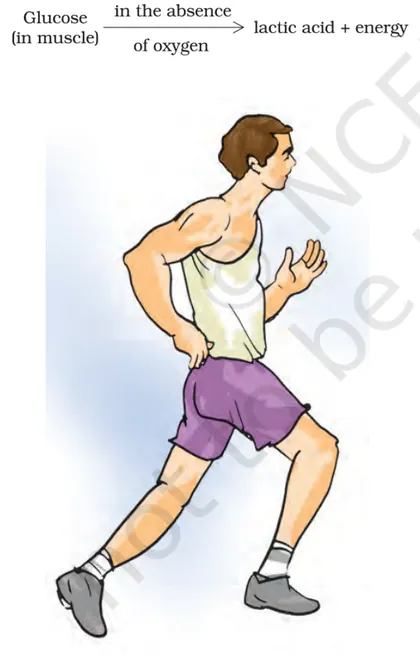
- Muscle cells producing lactic acid during intense exercise when oxygen is scarce (causes muscle fatigue).
- Plants respire all the time — during the day photosynthesis produces oxygen but respiration still occurs; at night only respiration happens, consuming oxygen and releasing CO2.
- Fish using gills to obtain dissolved oxygen from water for respiration.
- Aerobic respiration (general): C6H12O6 + 6 O2 → 6 CO2 + 6 H2O + energy
- Anaerobic respiration in muscles (lactic acid): C6H12O6 → 2 C3H6O3 + small amount of energy
- Anaerobic fermentation in yeast (alcoholic): C6H12O6 → 2 C2H5OH + 2 CO2 + small amount of energy
- Approximate energy yield (typical): Aerobic ≈ 36–38 ATP per glucose; Anaerobic ≈ 2 ATP per glucose
Types of Respiration
Definition: Respiration is a biochemical process by which organisms break down food (mainly glucose) to release energy required for life processes. Note: breathing (inhalation/exhalation) is a physical process for gas exchange; respiration is the cellular process releasing energy.
Aerobic Respiration
What it is: Respiration in presence of oxygen. Glucose is completely oxidized to carbon dioxide and water, releasing large amounts of energy.
Where it occurs: In mitochondria of eukaryotic cells (cytoplasm partly for glycolysis, then mitochondria for Krebs cycle and electron transport chain).
Reactants & products: Glucose + oxygen → carbon dioxide + water + energy.
Energy yield: High (about 36–38 ATP per glucose molecule; large amount of heat energy released).
Anaerobic Respiration (Fermentation)
What it is: Respiration in absence of oxygen. Glucose is partially broken down; products depend on organism/type of fermentation.
Types & products: • Lactic acid fermentation (animals and some bacteria): glucose → lactic acid + small amount of energy. • Alcoholic fermentation (yeast and some plant cells): glucose → ethanol + carbon dioxide + small amount of energy.
Where it occurs: Cytoplasm (glycolysis and subsequent fermentation steps).
Energy yield: Low (about 2 ATP per glucose molecule).
Biological categories related to respiration
- Obligate aerobes: need oxygen (e.g., humans, most animals, many plants).
- Obligate anaerobes: cannot tolerate oxygen and use anaerobic respiration (some bacteria).
- Facultative anaerobes: can switch between aerobic and anaerobic (e.g., yeast, some bacteria).
Key differences (brief)
- Aerobic: requires O2, complete oxidation, higher energy yield, products CO2 + H2O.
- Anaerobic: no O2, incomplete oxidation, low energy yield, products vary (lactic acid or ethanol + CO2).
Importance
Respiration provides energy for growth, movement, temperature maintenance, synthesis of molecules and all life activities. Anaerobic pathways allow survival when oxygen is scarce and are exploited by humans (bread rising, alcohol, fermented foods).
- Human muscles during rest and moderate exercise: aerobic respiration (O2 present) — glucose + O2 → CO2 + H2O + energy.
- Human muscles during intense exercise (short oxygen supply): lactic acid fermentation — glucose → lactic acid + small amount of energy; leads to muscle fatigue and cramps.
- Yeast in bread-making (alcoholic fermentation): glucose → ethanol + CO2 + energy; CO2 causes dough to rise, ethanol evaporates during baking.
- Anaerobic bacteria in waterlogged soils or marshes produce methane and other gases via anaerobic pathways (important in wetlands).
- Facultative anaerobes like E. coli can use aerobic respiration when oxygen is present and switch to fermentation when it is absent.
- Aerobic respiration (overall): C6H12O6 + 6 O2 → 6 CO2 + 6 H2O + energy (~36–38 ATP; ΔG° ≈ –2870 kJ/mol glucose).
- Alcoholic fermentation (yeast): C6H12O6 → 2 C2H5OH + 2 CO2 + energy (~2 ATP).
- Lactic acid fermentation (animal cells): C6H12O6 → 2 C3H6O3 + energy (~2 ATP).
Respiratory Organs and Modes in Various Organisms
Respiratory Organs and Modes in Various Organisms
Living organisms obtain oxygen for cellular respiration and remove carbon dioxide. Different organisms use different respiratory organs and modes depending on size, habitat and activity level. Key requirements for any respiratory surface are: thinness (to allow diffusion), large surface area, moist surface, and rich blood supply (in multicellular animals).
1. Single-celled organisms
Organisms like Amoeba, Paramecium and many bacteria exchange gases directly across their cell membrane by simple diffusion because they have large surface-area-to-volume ratios and thin membranes.
2. Aquatic animals (gills)
Fish and many aquatic animals use gills. Gills are thin, filamentous structures rich in blood vessels; they provide large surface area for gas exchange. Many bony fishes use counter-current exchange: water flows one way over the gill filaments while blood flows the opposite way, maintaining a high oxygen gradient along the gill and maximizing diffusion.
3. Animals that respire through the body surface (cutaneous respiration)
Some animals such as Hydra, earthworms and many amphibians (partly) exchange gases through their moist skin. Their skin must stay moist, thin and well-supplied with blood vessels.
4. Insects (tracheal system)
Insects (e.g., cockroach, grasshopper) have a system of air-tubes called tracheae that open to the outside by small holes called spiracles. Air moves through tracheae into finer tracheoles that reach individual cells; gas exchange occurs directly between tracheoles and tissues—blood generally does not transport oxygen in insects.
5. Lungs in terrestrial vertebrates
Mammals (humans), birds, reptiles and adult amphibians use lungs, but structure and ventilation differ:
- Mammals: Lungs contain branching bronchi and bronchioles ending in alveoli—tiny sacs with very large combined surface area and thin walls for gas exchange. Breathing uses a diaphragm and chest muscles to change thoracic volume (inhalation and exhalation).
- Birds: Have lungs plus air sacs; airflow through lung tissue is largely unidirectional (through parabronchi) which is highly efficient for oxygen extraction and supports high metabolic demands of flight.
- Amphibians: Frogs use lungs for breathing air but also rely on skin for gas exchange; they swallow air to inflate lungs (buccal pumping).
How exchange happens (basic mechanism)
- Oxygen diffuses from region of higher concentration/partial pressure (air or water) to lower (blood or cells).
- Carbon dioxide diffuses in the opposite direction.
- Ventilation (movement of medium—air or water—over the respiratory surface) and circulation (blood flow) maintain the concentration gradients required for continuous diffusion.
Adaptations that help respiration
- Thin and moist respiratory surfaces (skin, alveoli, gill lamellae)
- Large surface area (many alveoli, gill filaments, branching bronchioles)
- Rich blood supply and close contact between blood and respiratory surface
- Special mechanisms to ventilate (diaphragm, air sacs, buccal pumping, flapping/ventilating gills)
- In aquatic animals, counter-current flow between water and blood in gills
Summary: Simple diffusion suffices for single-celled organisms. Multicellular animals evolved specialised respiratory organs—skin, gills, tracheae, lungs—each adapted to the animal's size, activity level and environment.
- Amoeba and Paramecium: Gas exchange directly through the cell membrane by diffusion.
- Hydra: Respiration across the entire body surface (epidermis and gastrodermis) since it is thin and in contact with water.
- Earthworm: Respiration through moist skin; skin must remain moist and is richly supplied with blood vessels.
- Fish (bony fish like Rohu): Use gills with filaments and lamellae; counter-current exchange increases oxygen uptake from water.
- Insects (cockroach, grasshopper): Tracheal system with spiracles, tracheae and tracheoles delivering air directly to tissues.
- Frog: Uses lungs and also cutaneous respiration (skin); larvae (tadpoles) have gills.
- Rate of diffusion ∝ (Surface area × Concentration difference) / Thickness (qualitative form of Fick's law)
- Fick's law (simplified): Rate = (D × A × ΔC) / Δx, where D = diffusion coefficient, A = surface area, ΔC = concentration (or partial pressure) difference, Δx = thickness of membrane
- Surface area to volume ratio for a sphere: SA:V = (4πr²) : (4/3πr³) = 3/r (shows smaller animals have higher SA:V)
- Respiratory minute ventilation (mammals): Minute Ventilation = Tidal Volume × Respiratory Rate (simple physiology formula: e.g., ml/min = ml/breath × breaths/min)
Human Respiratory System Anatomy
Introduction
The human respiratory system is the group of organs that help us breathe and perform gas exchange — taking in oxygen (O2) and removing carbon dioxide (CO2). It consists of air passages, lungs and muscles that produce breathing movements.
Main parts and their functions
- Nose (nasal cavity): Filters, warms and moistens incoming air using hairs and mucus; smell receptors are present here.
- Pharynx (throat): Common passage for air and food; directs air to the larynx.
- Larynx (voice box): Contains vocal cords; also prevents food entering the lower airways.
- Trachea (windpipe): A tube with C-shaped cartilage rings that keeps it open and carries air to the lungs.
- Bronchi and Bronchioles: The trachea splits into two bronchi (one for each lung), which branch into smaller bronchioles spreading air throughout the lungs.
- Alveoli: Tiny balloon-like sacs at the ends of bronchioles where gas exchange occurs. They have very thin walls and are surrounded by many capillaries to allow diffusion of O2 into blood and CO2 out of blood.
- Lungs: Two spongy organs (right lung has three lobes, left has two) that contain bronchi, bronchioles and alveoli.
- Diaphragm and Intercostal Muscles: The diaphragm is a dome-shaped muscle under the lungs. Contraction and relaxation of the diaphragm and rib muscles change chest volume and cause breathing (inhalation and exhalation).
- Pleura: A double-layered membrane around each lung that reduces friction during breathing.
How breathing works (mechanism)
Inhalation: The diaphragm contracts and moves down, intercostal muscles lift the ribs; chest volume increases and internal pressure falls, so air flows into the lungs.
Exhalation: The diaphragm relaxes and moves up, ribs move down; chest volume decreases and internal pressure rises, so air is pushed out. This is a physical process; gas exchange at alveoli is by diffusion (from high to low concentration).
Gas exchange in alveoli
Alveoli walls are one cell thick and closely associated with capillaries. Oxygen diffuses from the alveolar air (high concentration) into blood (low concentration). Carbon dioxide diffuses from blood (high) into alveolar air (low) to be exhaled.
Breathing vs Cellular Respiration
Breathing (external respiration) supplies oxygen and removes carbon dioxide. Cellular respiration is a chemical process inside cells where glucose reacts with oxygen to release energy.
Important points
- Average resting breathing rate for children varies with age; in adults it's about 12–20 breaths per minute.
- Alveoli provide a very large total surface area (millions of alveoli) to make diffusion efficient.
- Health impacts: smoking, pollution and infections damage air passages or alveoli and reduce gas exchange.
- During exercise your breathing rate and depth increase so more oxygen reaches muscles and more carbon dioxide is removed.
- Holding your breath temporarily stops gas exchange; CO2 builds up in blood, creating a strong urge to breathe.
- At high altitude (mountains) the air has less oxygen per breath, so people breathe faster and their bodies adapt over time.
- Smoking destroys cilia and damages alveoli, reducing oxygen uptake and causing breathlessness.
- Asthma: bronchioles narrow due to inflammation or spasm, making breathing difficult; inhalers relax airways.
- Chemical equation for cellular respiration: C6H12O6 + 6 O2 → 6 CO2 + 6 H2O + energy (ATP)
- Minute ventilation (volume of air breathed per minute) = Tidal volume × Breathing rate
- Respiratory quotient (RQ) = CO2 produced / O2 consumed (typical values: carbohydrate ≈1.0, fat ≈0.7)
Mechanism of Breathing
Mechanism of Breathing
Breathing (ventilation) is the physical process that moves air into and out of the lungs. It depends on changes in the volume of the thoracic (chest) cavity produced by the diaphragm and the rib muscles. These volume changes cause pressure differences between the inside of the lungs and the atmosphere, so air flows in or out.
Main structures involved: lungs, diaphragm (a dome-shaped muscle below the lungs), intercostal muscles (between the ribs), rib cage, and pleural membranes that surround each lung.
How inspiration (inhalation) occurs:
- The diaphragm contracts and flattens (moves downward).
- The external intercostal muscles contract, pulling the ribs upward and outward; the chest cavity expands.
- Thoracic cavity volume increases; because the lungs are attached to the chest wall by the pleura, lung volume increases too.
- As lung volume rises, the pressure inside the lungs (intrapulmonary pressure) falls below atmospheric pressure.
- Air flows from outside (higher pressure) into the lungs (lower pressure) until pressures equalize.
How expiration (exhalation) occurs:
- The diaphragm relaxes and returns to a dome shape; external intercostals relax so the ribs move down and in.
- Thoracic cavity and lung volumes decrease.
- Intrapulmonary pressure rises above atmospheric pressure.
- Air flows out of the lungs until pressures equalize.
Forced breathing (during exercise or blowing out candles) uses additional muscles (internal intercostals and abdominal muscles) to push air out more forcefully and rapidly.
Role of pleura and surface tension: The pleural fluid between membranes keeps the lungs attached to the chest wall so they expand when the chest expands. Alveoli have a thin layer of moisture; surfactant reduces surface tension to prevent alveoli from collapsing and to make breathing easier.
Why pressure changes drive airflow: Air moves from higher to lower pressure. When lung volume increases, pressure decreases (and vice versa). This inverse relation between pressure and volume is described by Boyle’s law (useful for understanding ventilation).
Typical resting values: tidal volume (volume moved in normal breath) ≈ 500 mL; respiratory rate ≈ 12–16 breaths per minute; minute ventilation (air moved per minute) ≈ 6–8 L/min.
Important note: Ventilation (movement of air) is distinct from gas exchange (diffusion of O2 and CO2 across alveolar walls). The mechanism of breathing provides fresh air to alveoli so diffusion can occur.
- Taking a deep breath before diving under water — diaphragm contracts strongly, increasing lung volume and intake of air.
- Blowing up a balloon or blowing out birthday candles — forced expiration using chest and abdominal muscles.
- Rapid, shallow breathing during running — both tidal volume and respiratory rate change to meet oxygen demand.
- Dog panting — increases air flow over moist surfaces to help heat loss and increase evaporation (also a form of ventilation).
- Holding your breath then releasing it — you feel air rush out as pressure and volume return toward equilibrium.
- Boyle's law (qualitative basis for breathing): P1 × V1 = P2 × V2 (pressure is inversely proportional to volume at constant temperature).
- Minute ventilation (total air breathed per minute): VE = TV × RR (VE = tidal volume × respiratory rate). Example: VE = 0.5 L × 12 breaths/min = 6 L/min.
- Vital capacity (useful lung capacity measure): VC = TV + IRV + ERV (tidal volume + inspiratory reserve volume + expiratory reserve volume).
- Simplified flow relation (conceptual): Flow ∝ ΔP / Resistance, where ΔP is pressure difference between atmosphere and alveoli.
Exchange and Transport of Gases
What it means
Exchange and transport of gases is the process by which oxygen (O2) from the environment enters an organism and is carried to cells, and carbon dioxide (CO2) produced by cells is removed from the body. This involves two linked steps: (a) gas exchange between the outside environment and the blood (or body fluids), and (b) transport of gases in the blood to and from body cells.
How gas exchange happens
- Gases move by diffusion—from a region of higher concentration (or partial pressure) to a region of lower concentration.
- To make diffusion efficient, respiratory surfaces have three main features: large surface area, thin diffusion barrier, and moisture.
- In humans and many animals: air enters the lungs, reaches tiny air sacs called alveoli. O2 diffuses from alveolar air into blood in nearby capillaries. CO2 diffuses from blood into alveoli to be exhaled.
Transport of gases in blood
- Oxygen transport: most O2 is carried by binding to haemoglobin in red blood cells as oxyhaemoglobin; a very small amount is dissolved in blood plasma.
- Carbon dioxide transport: CO2 is carried in three forms—dissolved CO2 in plasma, chemically bound to haemoglobin (carbamino compounds), and mainly as bicarbonate ions (HCO3−) formed inside red blood cells.
- In the lungs the reactions reverse: bicarbonate is converted back to CO2 which diffuses into alveoli and is exhaled; haemoglobin releases CO2/absorbs O2 according to local concentrations.
Examples of different organisms
- Fish: use gills with thin filaments and a large surface area; counter-current flow of blood and water increases efficiency.
- Insects: use a system of tubes (tracheae) that deliver air directly to tissues—no blood transport of O2 for most insects.
- Earthworms and amphibians: exchange gases across moist skin.
- Plants: leaves exchange gases (O2 and CO2) through stomata; roots exchange gases with soil.
Why gradients matter
At every step diffusion depends on a concentration or partial pressure difference. For example, PO2 (partial pressure of oxygen) is high in alveolar air and low in deoxygenated blood, so O2 moves into blood. In tissues PO2 is lower than in blood, so O2 moves from blood into cells.
Summary
Effective gas exchange requires suitable structures (alveoli, gills, tracheae, skin), maintenance of concentration gradients, and transport systems (blood with haemoglobin in vertebrates) to carry gases between respiratory surfaces and body cells.
- Human breathing: oxygen enters lungs → diffuses into blood at alveoli → binds haemoglobin → delivered to muscles. During exercise muscles use more O2, so more O2 is released from haemoglobin and more CO2 is produced and transported back to lungs.
- Fish gills: water passes over gill filaments; blood flows opposite to water (counter-current exchange), maximizing O2 uptake from water.
- Insects: air enters through spiracles and travels in tracheae directly to cells, so oxygen transport does not rely on blood haemoglobin.
- Earthworms: moist skin allows diffusion of O2 into and CO2 out of the body; movements and moist environment help maintain gas exchange.
- Houseplant leaves: stomata open in daylight allowing CO2 in for photosynthesis and O2 out; at night stomata often close reducing gas exchange.
- Cellular respiration (balanced): C6H12O6 + 6 O2 → 6 CO2 + 6 H2O + energy
- Simple diffusion relation (Fick's law, qualitative form): Rate of diffusion ∝ (Surface area × Concentration difference) / Thickness of barrier
- Dalton's law (concept): Total pressure = sum of partial pressures; gases diffuse according to their partial pressures (PO2, PCO2)
- Henry's law (qualitative): Amount of gas dissolved ∝ partial pressure of the gas above the liquid (useful to understand dissolved O2 in blood)
- Bicarbonate formation (CO2 transport): CO2 + H2O ⇌ H2CO3 ⇌ H+ + HCO3− (enzyme carbonic anhydrase speeds this in red blood cells)
Cellular Respiration and Energy
What is cellular respiration?
Cellular respiration is the biochemical process by which cells break down food molecules (mainly glucose) to release energy that the cell can use. The energy released is stored in the form of ATP (adenosine triphosphate). Cellular respiration happens in every living cell — in animals, plants and microorganisms.
Why it matters
The energy from cellular respiration powers all cellular activities: movement, growth, active transport, synthesis of molecules and repair.
Types of cellular respiration
- Aerobic respiration — occurs in presence of oxygen; it is the most efficient way to release energy. It takes place partly in the cytoplasm (glycolysis) and mainly inside mitochondria (Krebs cycle and electron transport chain).
- Anaerobic respiration (fermentation) — occurs without oxygen; it yields much less energy and produces by-products such as lactic acid (in muscles) or ethanol and CO2 (in yeast).
Summary of the main steps (simple)
- Glycolysis (cytoplasm): Glucose is split into smaller molecules; a small amount of ATP and NADH is produced.
- In mitochondria (aerobic): Products of glycolysis enter the Krebs cycle (citric acid cycle) producing carriers (NADH, FADH2), then the electron transport chain uses those carriers to make most ATP. Oxygen is the final electron acceptor and water is formed.
Energy currency — ATP
ATP stores energy in its high-energy phosphate bonds. When ATP is hydrolysed to ADP + Pi, energy is released and used by the cell.
Connection to breathing and organisms
Breathing supplies oxygen for aerobic respiration and removes carbon dioxide produced. Plants also perform cellular respiration (they respire day and night) using sugars made in photosynthesis.
Key points for Class 7
- Aerobic respiration gives much more energy than anaerobic respiration.
- Respiration is different from breathing: breathing is physical intake of oxygen and release of CO2; cellular respiration is the chemical process inside cells.
- Mitochondria are called the 'powerhouses' of the cell because they produce most ATP in aerobic respiration.
- Muscle activity during exercise: When oxygen supply is limited, muscles temporarily do anaerobic respiration producing lactic acid, causing fatigue and cramps.
- Yeast in bread making: Yeast cells ferment sugar anaerobically to produce CO2 (which makes dough rise) and ethanol.
- Germinating seeds: Seeds break down stored starch into glucose and respire to provide energy for growth before photosynthesis begins.
- Plants at night: Plants continue cellular respiration to release energy from sugars even when photosynthesis is not occurring.
- Overall balanced equation (aerobic): C6H12O6 + 6 O2 → 6 CO2 + 6 H2O + energy (ATP + heat)
- ATP hydrolysis: ATP + H2O → ADP + Pi + energy (≈ 30.5 kJ/mol under standard conditions)
- Net ATP yield (typical school-level values): glycolysis → 2 ATP (net); aerobic respiration (from one glucose) → ≈36–38 ATP total; anaerobic (fermentation) → 2 ATP (net)
Adaptations of Respiratory Organs
Respiratory organs are adapted to allow efficient gas exchange (oxygen in, carbon dioxide out) between the organism and its environment. Different habitats (air or water) and body sizes require different structural and functional adaptations. The main principles of adaptation are to maximize the surface area for exchange, keep the respiratory surface thin and moist, maintain a steep concentration gradient, and provide a good blood supply or direct air channels to transport gases.
Key adaptations and how they work
- Large surface area: Respiratory surfaces have large area to increase diffusion. Examples: alveoli in lungs, lamellae in gills, and branching tracheae in insects.
- Thin and moist surface: A single layer of thin cells with a moist film eases diffusion of gases. Alveoli and gill filaments are thin and kept moist; skin respiration (as in frogs) requires a moist outer surface.
- Rich blood supply or direct channels: Close association of blood capillaries (in lungs/gills) or air tubes that reach cells (insects’ tracheal system) ensures quick transport of gases, maintaining concentration gradients.
- Mechanisms to maintain concentration gradient: Ventilation (breathing movements in animals, water flow over gills, counter-current flow in fish gills) and circulation keep oxygen concentration low in blood and high in the environment so diffusion continues.
- Specialized structural features:
- Gills: thin filaments and many lamellae increase area; counter-current exchange (water flows opposite to blood) maximizes O2 uptake.
- Lungs: branching bronchial tree ending in millions of alveoli (huge area); surfactant keeps alveoli from collapsing.
- Tracheal system (insects): external spiracles lead to branching tubes (tracheae) that deliver air directly to tissues—no blood transport needed for O2 delivery.
- Cutaneous respiration: thin, moist skin (earthworms, amphibians) with dense capillaries allows gas exchange with the environment.
- Protective and supportive features: ribs, diaphragm, and valves (epiglottis) protect and assist proper airflow in terrestrial animals.
Functional outcome: These adaptations ensure efficient uptake of oxygen to meet metabolic needs and removal of carbon dioxide. Active animals or those living in low-oxygen media (water) show more extreme or specialized adaptations.
- Fish gills: many thin filaments with lamellae and counter-current flow — efficient O2 extraction from water.
- Human lungs: branching bronchi → bronchioles → alveoli (large surface area, thin walls, rich capillary network).
- Insect tracheal system: spiracles and branching tracheae deliver air directly to cells without using blood to carry O2.
- Frog skin and lungs: moist skin allows cutaneous respiration, supplemented by lungs when on land.
- Earthworms: moist skin with dense capillary network enables gas exchange with soil air.
- Minute ventilation = Tidal volume × Respiratory rate (useful to compare breathing output).
- Rate of diffusion ∝ (Surface area × Concentration difference) / Thickness of barrier (simplified Fick's law).
- Surface area to volume ratio (SA:V) = Surface area / Volume — smaller animals have higher SA:V, affecting heat and gas exchange.
Respiration in Plants
What is respiration?
Respiration is a metabolic process in which living cells break down food (mainly glucose) to release energy. Plants respire continuously — day and night — to obtain energy for growth, repair, active transport and other life processes.
Where does respiration occur?
Glycolysis occurs in the cytoplasm. Most energy release occurs in mitochondria (the cell's “powerhouse”).
Types of respiration
- Aerobic respiration: takes place in presence of oxygen; gives large amount of energy.
- Anaerobic respiration (fermentation): occurs when oxygen is limited (e.g., waterlogged roots); gives small amount of energy and produces by-products like ethanol and carbon dioxide in plants.
Basic steps (simple view)
Glucose breakdown → small energy release in cytoplasm (glycolysis) → further breakdown in mitochondria (Krebs cycle and electron transport) → ATP (usable energy) + CO2 + H2O.
Gas exchange in plants
Gases (O2 and CO2) move in and out through stomata (leaves), lenticels (bark), and root surfaces/root hairs. During daytime, photosynthesis (in chloroplasts) consumes CO2 and releases O2, while respiration consumes O2 and releases CO2; net gas exchange depends on the balance between the two.
Day versus night
Photosynthesis occurs only in light, so during the day a leaf may show net O2 production and CO2 uptake. At night, photosynthesis stops but respiration continues, so leaves release CO2 and consume O2.
Importance of respiration
Energy from respiration is used for growth, movement of materials (translocation), root uptake, seed germination, flowering and fruiting, and repair. Controlled atmosphere storage (low temperature and low O2) slows respiration to prolong shelf life of fruits and vegetables.
Simple experiment/observation
Germinating seeds show increased heat and CO2 production compared to dry seeds — evidence of active respiration. A respirometer can measure gas exchange and rate of respiration.
- Germinating seeds (e.g., bean seeds) respire actively to provide energy for root and shoot growth — they release CO2 and heat.
- Potato tubers and fruits respire while in storage; higher temperature speeds up respiration and causes faster spoilage.
- Waterlogged soils reduce oxygen around roots, forcing root cells into anaerobic respiration and often causing root damage or plant death.
- At night, a leaf continues to respire (uses O2 and releases CO2) even though photosynthesis has stopped.
- Controlled atmosphere storage (reduced O2) slows down fruit respiration and prolongs freshness (used for apples, pears).
- Aerobic respiration (overall): C6H12O6 + 6 O2 → 6 CO2 + 6 H2O + energy (≈ 36 ATP)
- Anaerobic respiration in plants (alcoholic fermentation): C6H12O6 → 2 C2H5OH + 2 CO2 + small amount of energy (≈ 2 ATP)
- Simple energy-use statement: Glucose + O2 → CO2 + H2O + ATP (usable energy for cell activities)
Practical Activities and Experiments
Practical activities for the topic "Respiration in Organisms" help students observe that respiration is a chemical process that uses oxygen (in aerobic respiration) and releases carbon dioxide, water and energy. Class 7 experiments focus on simple, safe demonstrations using seeds, yeast, limewater and human observation (breathing/pulse).
Below are three classroom-friendly experiments with aim, materials, step-by-step procedure, expected observations, inferences and safety/precautions.
Experiment 1: Show that exhaled air contains CO2 (Limewater test)
- Aim: To demonstrate that carbon dioxide is present in exhaled air.
- Materials: A test tube or small bottle, limewater (calcium hydroxide solution), straw or glass tube.
- Procedure: Fill the test tube half with limewater. Blow gently through a straw into the limewater for 10–20 seconds (do not inhale through the straw). Alternatively, exhale directly into the test tube mouth while avoiding contamination.
- Observation: The clear limewater turns milky/cloudy.
- Inference: Carbon dioxide in exhaled air reacts with limewater to form calcium carbonate (white precipitate), proving that respiration produces CO2.
- Precautions: Use gentle blowing to avoid saliva contaminating the limewater. Dispose of limewater according to school lab rules.
Experiment 2: Compare respiration of germinating seeds and boiled (dead) seeds (Respirometer idea)
- Aim: To show that germinating seeds respire (use oxygen and produce CO2) while dead seeds do not.
- Materials: Two small sealed bottles or test tubes, sprouted (germinating) seeds (e.g., gram/green gram), boiled (killed) seeds, soda lime or KOH (to absorb CO2) if available, a small bent glass tube or pipette, water trough or syringe/manometer setup, colored water column for measuring volume change.
- Procedure (simple version): Place equal masses of germinating seeds in one sealed bottle and boiled seeds in the other. Invert a small graduated tube or pipette with colored water connected to each bottle (or use a simple manometer). If soda lime/KOH is used in a side tube it will absorb CO2 so volume change reflects O2 consumption. Leave for 1–2 hours at room temperature and observe any movement of water in the manometer.
- Observation: The bottle with germinating seeds shows a measurable inward movement of the water column (reduced air volume) indicating gas consumption; the boiled seed bottle shows little or no change.
- Inference: Germinating seeds respire actively using O2; boiled seeds (dead) do not. If CO2 absorber is used, the fall in volume corresponds to O2 used. If no absorber is used, CO2 production can complicate volume change—use soda lime to get clearer O2-consumption results.
- Precautions: Do not taste chemicals (KOH/soda lime). Handle glassware carefully. Use seeds rather than live animals for classroom ethics and safety.
Experiment 3: Measure breathing rate before and after exercise
- Aim: To show that physical activity increases the rate of breathing.
- Materials: Stopwatch or clock with second hand, volunteer students.
- Procedure: Count the number of breaths (inhalations or full breaths) for one minute while the student is at rest. Record the resting breathing rate. Ask the student to run on the spot or do jumping jacks for 2 minutes. Immediately after exercise, count breaths per minute again (and optionally at 1-minute intervals during recovery).
- Observation: Breathing rate increases immediately after exercise and gradually returns toward resting rate during recovery.
- Inference: Muscles need more oxygen during exercise and produce more CO2; breathing rate increases to meet oxygen demand and remove CO2.
- Precautions: Ensure volunteers are medically fit for mild exercise; do not overexert students; have adult supervision.
General notes for experiments: Use seeds and yeast instead of animals for ethical and safety reasons. When using chemical indicators (limewater, soda lime, KOH), follow teacher instructions for safe handling and disposal. Record time, temperature and amounts carefully—respiration rate depends on temperature and activity level.
Scientific ideas to connect: Respiration is a chemical process; aerobic respiration requires oxygen and produces CO2, water and energy. Some organisms (or conditions) use anaerobic respiration (fermentation) producing lactic acid or alcohol + CO2. Practicals often measure gas changes (CO2 appearance, O2 consumption) or physiological responses (breathing/pulse).
- Exercise: During running or physical activity, breathing and pulse rates rise because muscles need more oxygen and produce more CO2.
- Baking: Yeast respires anaerobically in dough, producing CO2 that makes bread rise (fermentation).
- Muscle fatigue: When oxygen supply is insufficient, human muscles use anaerobic respiration and form lactic acid, which can cause cramps and soreness.
- Seed germination: Germinating seeds respire actively using stored food; they produce CO2 even in the dark.
- Fruit ripening and storage: After harvest, fruits continue to respire; higher respiration speeds up ripening and spoilage.
- Aerobic respiration (general): C6H12O6 + 6 O2 → 6 CO2 + 6 H2O + energy
- Anaerobic respiration in muscles (lactic acid): C6H12O6 → 2 C3H6O3 + energy
- Anaerobic respiration in yeast (alcoholic fermentation): C6H12O6 → 2 C2H5OH + 2 CO2 + energy
- Breathing rate (simple): Breaths per minute = number of breaths counted / time in minutes (typically count for 1 minute)
- Respiration rate (experimental, volumetric): Rate = (Change in gas volume) / (Time) — e.g., ml O2 consumed per hour
Regulation, Effects of Activity and Disorders
Regulation of Breathing
Breathing is an automatic process controlled by the brain. The medulla oblongata (part of the brainstem) monitors the levels of carbon dioxide (CO2) and hydrogen ions in the blood. When CO2 rises, it forms carbonic acid and increases H+ concentration; chemoreceptors detect this change and send signals to the medulla. The medulla then increases the rate and depth of breathing by sending nerve impulses to the diaphragm and intercostal muscles. Peripheral chemoreceptors in the carotid and aortic bodies also respond when oxygen (O2) levels fall.
Effects of Physical Activity
During exercise or increased activity: (1) Muscles need more energy, so cellular respiration increases and more O2 is used while more CO2 is produced. (2) Breathing rate (breaths per minute) and tidal volume (air per breath) both increase, raising minute ventilation to supply extra O2 and remove CO2. (3) Heart rate and blood flow to muscles increase to transport gases faster. Short intense exercise can also cause anaerobic respiration in muscles, producing lactic acid and causing temporary muscle fatigue.
Common Disorders
- Asthma: Airways are hypersensitive and narrow, causing difficulty in breathing, wheezing and coughing. Triggers include allergens, cold air or exercise. Treated by inhalers that relax airways.
- Bronchitis: Inflammation of the bronchi, often with cough and mucus. It may be acute (infection) or chronic (smoking).
- Pneumonia: Infection of air sacs (alveoli) leading to fluid-filled lungs, causing breathing difficulty and fever.
- Tuberculosis (TB): Bacterial infection that mainly affects lungs, causing prolonged cough, weight loss and fever. Preventive measures include vaccination, hygiene and early treatment. Smoking increases risk and worsens all respiratory disorders.
Simple Practical Notes
- Holding your breath increases CO2 and triggers strong urge to breathe. High altitude reduces available O2, so breathing becomes faster and deeper. Deep breathing exercises help increase lung expansion and improve ventilation.
- Running up stairs: breathing becomes faster and deeper to meet increased O2 demand and remove CO2.
- Sleeping vs awake: breathing rate is slower and shallower during deep sleep because metabolic needs are lower.
- Asthma attack when exposed to pollen: airways constrict, causing wheezing and shortness of breath; relieved by bronchodilator inhaler.
- High-altitude hiking: lower atmospheric O2 leads to faster breathing and possible shortness of breath until body acclimatizes.
- After sprinting: muscles may switch partly to anaerobic respiration, producing lactic acid and temporary muscle fatigue.
- Balanced cellular respiration: C6H12O6 + 6O2 -> 6CO2 + 6H2O + energy
- Respiratory rate = number of breaths per minute (breaths/min)
- Minute ventilation (V̇E) = Tidal volume (VT) × Respiratory rate (RR). Example units: V̇E (L/min) = VT (L) × RR (breaths/min)
- Alveolar ventilation (approximate) = (Tidal volume - Dead space) × Respiratory rate
- Oxygen consumption rate (simple) ≈ (Volume of O2 inhaled − Volume of O2 exhaled) / time
Key Terms and Definitions
Respiration is a biochemical process in which organisms break down food (mainly glucose) to release energy. This energy is stored in the form of ATP (adenosine triphosphate) and used for growth, movement and other life processes.
Breathing is the physical process of taking in oxygen (inhalation) and releasing carbon dioxide (exhalation) through organs such as lungs, trachea and diaphragm in animals or stomata and lenticels in plants. Breathing supplies oxygen for cellular respiration.
Cellular respiration refers to the chemical reactions inside cells that convert glucose and oxygen into carbon dioxide, water and energy (ATP). Cellular respiration can be aerobic (with oxygen) or anaerobic (without oxygen).
Aerobic respiration — occurs in presence of oxygen. It yields large amount of energy and produces carbon dioxide and water.
Anaerobic respiration (fermentation) — occurs when oxygen is absent or limited. It yields less energy and produces products like alcohol and carbon dioxide (in yeast) or lactic acid (in animals’ muscle cells).
Alveoli are tiny air sacs in mammalian lungs where exchange of O2 and CO2 between air and blood takes place. Trachea is the windpipe; bronchi are branches of the trachea; diaphragm is the muscle that helps change chest volume during breathing.
Stomata are small pores on leaf surfaces used by plants for gas exchange; lenticels are pores on stems for gas exchange. Gills are respiratory organs in many aquatic animals where dissolved oxygen is extracted from water.
Fermentation is a type of anaerobic respiration used by microorganisms (e.g., yeast) to produce energy and by-products such as alcohol or lactic acid.
ATP (adenosine triphosphate) is the cellular energy currency produced during respiration; cells use ATP to perform work (movement, synthesis, transport).
Important distinctions: breathing is a mechanical exchange of gases; cellular respiration is a chemical process inside cells. Aerobic respiration gives more energy per glucose molecule than anaerobic respiration.
- Human breathing: At rest a person inhales oxygen which is used by cells for aerobic respiration. During exercise, breathing rate and depth increase to supply more oxygen and remove CO2.
- Yeast fermentation: In dough or brewing, yeast performs anaerobic respiration (fermentation) producing alcohol and CO2 — CO2 makes bread rise and alcohol is used in brewing.
- Muscle lactic acid fermentation: During intense exercise when oxygen supply is limited, human muscle cells produce lactic acid and small amounts of energy, causing muscle fatigue.
- Fish gills: Fish extract dissolved oxygen from water with their gills and release carbon dioxide back into the water.
- Plant gas exchange: Leaves take in CO2 for photosynthesis during the day via stomata and respire (release CO2) continuously; lenticels allow gas exchange in woody stems.
- Aerobic respiration (general equation): C6H12O6 + 6O2 → 6CO2 + 6H2O + energy (ATP)
- Anaerobic respiration in yeast (alcoholic fermentation): C6H12O6 → 2 C2H5OH + 2 CO2 + energy (small amount of ATP)
- Anaerobic respiration in animal muscles (lactic acid fermentation): C6H12O6 → 2 C3H6O3 (lactic acid) + energy (small amount of ATP)
- Approximate ATP yield: Aerobic ≈ 36 ATP per glucose (eukaryotic cells), Anaerobic ≈ 2 ATP per glucose
- Simple rate expression for experiments: Respiration rate = (volume of CO2 released) / (time) or = (volume of O2 absorbed) / (time)
Key Concepts
- Respiration
- Chemical process in living organisms that breaks down food to release energy.
- Breathing
- Physical process of taking air in and out of the lungs.
- Inhalation
- Phase of breathing when air is drawn into the lungs; diaphragm contracts.
- Exhalation
- Phase of breathing when air is pushed out of the lungs; diaphragm relaxes.
- Lungs
- Main respiratory organs in many animals where gaseous exchange occurs.
- Trachea
- Windpipe; a tube that carries air from the throat to the bronchi.
- Bronchi and bronchioles
- Bronchi are two main air passages from the trachea; bronchioles are their smaller branches inside the lungs.
- Alveoli
- Tiny air sacs in the lungs with thin walls where oxygen and carbon dioxide are exchanged with blood.
- Diaphragm
- A dome-shaped muscle beneath the lungs that helps in breathing by changing chest volume.
- Gaseous exchange
- Transfer of oxygen and carbon dioxide between an organism and its environment across a respiratory surface.
- Cellular respiration
- Metabolic process inside cells that converts biochemical energy from nutrients into ATP.
- Aerobic respiration
- Cellular respiration that requires oxygen and yields more energy (ATP).
- Anaerobic respiration
- Energy-releasing process that occurs without oxygen and produces less ATP and byproducts like lactic acid or alcohol.
- Fermentation
- Type of anaerobic respiration in microorganisms that produces products such as alcohol or lactic acid.
- Stomata
- Tiny pores mostly on leaf surfaces that allow gas exchange in plants.
- Lenticels
- Small openings in the bark of woody stems that permit gas exchange.
- Spiracles
- External respiratory openings on the body of insects used for gas exchange.
- Gills
- Respiratory organs of many aquatic animals that extract dissolved oxygen from water.
- Respiratory surface
- The area or structure where exchange of gases takes place; must be thin and moist with a large area.
- Respiratory pigment (Hemoglobin)
- Pigment in blood that binds and transports oxygen (hemoglobin in many animals gives blood its red color).
End-of-Chapter Trial Paper & Test Questions
Topic-wise questions to test your understanding of every concept in this chapter.
-
What is the chemical equation for aerobic respiration? / वायवीय श्वसन का रासायनिक समीकरण क्या है? (a) C6H12O6 → 2 C2H5OH + 2 CO2 + energy / C6H12O6 → 2 C2H5OH + 2 CO2 + ऊर्जा (b) C6H12O6 + 6 O2 → 6 CO2 + 6 H2O + energy / C6H12O6 + 6 O2 → 6 CO2 + 6 H2O + ऊर्जा (c) C6H12O6 → 2 C3H6O3 + energy / C6H12O6 → 2 C3H6O3 + ऊर्जा (d) 6 CO2 + 6 H2O → C6H12O6 + 6 O2 / 6 CO2 + 6 H2O → C6H12O6 + 6 O2
Show answer
(b) C6H12O6 + 6 O2 → 6 CO2 + 6 H2O + energy / C6H12O6 + 6 O2 → 6 CO2 + 6 H2O + ऊर्जा — In aerobic respiration, glucose is completely oxidised using oxygen to release energy, carbon dioxide and water. / वायवीय श्वसन में ग्लूकोज को ऑक्सीजन का उपयोग करके पूरी तरह ऑक्सीकृत किया जाता है जिससे ऊर्जा, कार्बन डाइऑक्साइड और जल निकलता है।
-
Anaerobic respiration in yeast produces ______ and ______ along with a small amount of energy. / यीस्ट में अवायवीय श्वसन से थोड़ी ऊर्जा के साथ ______ और ______ उत्पन्न होता है।
Show answer
ethanol (alcohol); carbon dioxide / इथेनॉल (एल्कोहल); कार्बन डाइऑक्साइड — Yeast ferments glucose anaerobically: C6H12O6 → 2 C2H5OH + 2 CO2 + energy. This is used in bread-making (CO2 makes dough rise). / यीस्ट ग्लूकोज का अवायवीय किण्वन करता है: C6H12O6 → 2 C2H5OH + 2 CO2 + ऊर्जा। इसका उपयोग ब्रेड बनाने में होता है (CO2 से आटा फूलता है)।
-
Which part of the human respiratory system is responsible for the actual exchange of oxygen and carbon dioxide with the blood? / मानव श्वसन तंत्र का कौन सा भाग ऑक्सीजन और कार्बन डाइऑक्साइड का रक्त से वास्तविक आदान-प्रदान करता है? (a) Trachea / श्वासनली (b) Bronchi / श्वसनी (c) Alveoli / वायुकोष (एल्वियोली) (d) Diaphragm / डायाफ्राम
Show answer
(c) Alveoli / वायुकोष (एल्वियोली) — Alveoli are tiny air sacs with thin walls and rich blood supply where O2 diffuses into blood and CO2 diffuses out. / एल्वियोली पतली दीवारों वाले छोटे वायु थैलियाँ हैं जिनमें प्रचुर रक्त आपूर्ति होती है जहाँ O2 रक्त में और CO2 रक्त से बाहर विसरित होती है।
-
True or False: Breathing and cellular respiration are the same process. / सत्य या असत्य: श्वास लेना और कोशिकीय श्वसन एक ही प्रक्रिया है।
Show answer
False / असत्य — Breathing is the physical process of taking in oxygen and releasing carbon dioxide; cellular respiration is the chemical process inside cells that breaks down glucose to release energy. / श्वास लेना ऑक्सीजन ग्रहण करने और कार्बन डाइऑक्साइड छोड़ने की शारीरिक प्रक्रिया है; कोशिकीय श्वसन कोशिकाओं के अंदर की रासायनिक प्रक्रिया है जो ऊर्जा मुक्त करने के लिए ग्लूकोज को तोड़ती है।
-
During inhalation, the diaphragm ______ and moves ______, increasing the volume of the chest cavity. / सांस लेते समय (श्वासांतरण के दौरान), डायाफ्राम ______ होता है और ______ की ओर जाता है, जिससे वक्ष गुहा का आयतन बढ़ता है।
Show answer
contracts; downward / संकुचित; नीचे — When the diaphragm contracts and flattens downward, the chest cavity volume increases and pressure falls, so air flows in. / जब डायाफ्राम संकुचित होकर नीचे की ओर चपटा होता है, तो वक्ष गुहा का आयतन बढ़ता है और दाब कम होता है, जिससे हवा अंदर आती है।
-
Name the respiratory organs used by (i) insects and (ii) fish. / (i) कीटों और (ii) मछलियों द्वारा उपयोग किए जाने वाले श्वसन अंगों के नाम बताइए।
Show answer
(i) Insects use a tracheal system (spiracles → tracheae → tracheoles). (ii) Fish use gills. / (i) कीट श्वास नलिका तंत्र (श्वासरंध्र → श्वास नलिका → श्वास कोशिकाएँ) का उपयोग करते हैं। (ii) मछलियाँ गलफड़ों (गिल्स) का उपयोग करती हैं।
-
When you run fast, your muscles may switch partly to anaerobic respiration producing ______. / जब आप तेज दौड़ते हैं, तो आपकी मांसपेशियाँ अंशतः अवायवीय श्वसन में चली जाती हैं जिससे ______ बनता है।
Show answer
lactic acid / लैक्टिक अम्ल — In anaerobic respiration in muscle cells: C6H12O6 → 2 C3H6O3 (lactic acid) + small amount of energy. Lactic acid build-up causes muscle fatigue and cramps. / मांसपेशी कोशिकाओं में अवायवीय श्वसन: C6H12O6 → 2 C3H6O3 (लैक्टिक अम्ल) + थोड़ी ऊर्जा। लैक्टिक अम्ल के संचय से मांसपेशियों में थकान और ऐंठन होती है।
-
How do plants exchange gases during respiration? / पौधे श्वसन के दौरान गैसों का आदान-प्रदान कैसे करते हैं?
Show answer
Plants exchange gases mainly through stomata (small pores on leaves) and lenticels (pores on stems). / पौधे मुख्यतः रंध्रों (पत्तियों पर छोटे छिद्रों) और वातरंध्रों (तनों पर छिद्रों) के माध्यम से गैसों का आदान-प्रदान करते हैं।
Related Laws & Principles
Explore allFoundational laws & principles behind this chapter. Each one opens a full page — what it says, why it matters, five practice questions and the mistakes to avoid.