Overview
This chapter introduces the concept of heat as a form of energy, distinguishes heat from temperature, and explains how temperature is measured using thermometers (laboratory and clinical). It explores how substances respond to heating — expansion of solids, liquids and gases — and demonstrates practical consequences and applications (e.g., gaps in railway tracks, bimetallic strips, mercury thermometers). The chapter also covers transfer of heat by conduction, convection and radiation, identifying common conductors and insulators and showing everyday examples (cooking, warming by sunlight, insulating vessels). Emphasis is on simple experiments, observation and reasoning so students can explain everyday phenomena and understand safety and design choices related to heat. Overall, the chapter builds basic conceptual and observational skills needed to study energy and thermal effects in higher classes.
Learning Objectives
- Define heat and temperature and distinguish between the two with examples
- Explain the construction and working of mercury and alcohol thermometers, including the significance of fixed points (0°C and 100°C)
- Measure temperature accurately using clinical and laboratory thermometers and record readings with proper precautions
- Describe thermal expansion in solids, liquids, and gases and give real-life applications (e.g., expansion joints, railway tracks, thermometers)
- Calculate simple numerical problems on linear expansion using ΔL = α L ΔT and interpret the results
- Demonstrate heat transfer by conduction, convection, and radiation through simple experiments and identify the dominant mode in given situations
- Compare the thermal conductivities of metals and non-metals and classify materials as good conductors or good insulators with examples
- Apply the concept of insulation to suggest suitable materials and methods to reduce heat loss in daily life (e.g., thermos flasks, house insulation)
Topics in this chapter
13 topics · tap a topic title to jump straight to it.
Heat (as a form of energy)
What is heat? Heat is a form of energy that flows from a hotter object to a colder object because of the temperature difference between them. When two bodies at different temperatures are placed in contact, energy transfers until thermal equilibrium (same temperature) is reached.
Units: The SI unit of heat is the joule (J). An older unit is the calorie (cal): 1 cal ≈ 4.186 J. Temperature is measured in degree Celsius (°C) or Kelvin (K), but temperature and heat are different physical quantities.
How heat is transferred — three main modes:
- Conduction: Transfer of heat through direct contact inside solids (and between solids in contact). Example: heat moving along a metal rod heated at one end. Energy is passed from particle to particle.
- Convection: Transfer of heat by the bulk movement of fluids (liquids or gases). Example: warm air rising from a heater sets up convection currents in a room.
- Radiation: Transfer of heat by electromagnetic waves (infrared). Does not need a medium. Example: heat from the Sun reaches Earth by radiation.
Effects of heating include:
- Rise in temperature.
- Change of state (melting, boiling, condensation, freezing) when enough heat is supplied or removed.
- Expansion of solids, liquids and gases on heating (thermal expansion).
- Change in properties such as electrical resistance of materials.
Heat vs Temperature (difference) — Heat is energy transferred between bodies; temperature is a measure of the average kinetic energy of particles in a body. A large amount of heat may cause a small temperature change in a material with high heat capacity.
Conservation idea: Heat energy lost by a hotter body ≈ heat energy gained by a colder body (neglecting losses), which is the basis for experiments like mixing hot and cold water to find final temperature.
- Touching a metal spoon left in a hot cup of tea — the spoon becomes hot by conduction.
- Warm air rising above a radiator and cool air moving down to replace it — convection currents warming a room.
- Feeling warmth from sunlight on your face — heat reaching you by radiation.
- Ice melting in a glass of water — heat from the water causes the ice to change state.
- A railway track expanding on a hot day — thermal expansion of solids.
- Q = m × c × ΔT (Heat required to change temperature) — where Q is heat (J), m is mass (kg), c is specific heat capacity (J/(kg·°C)), ΔT is change in temperature (°C).
- Q = m × L (Heat for change of state) — where L is latent heat (J/kg) and m is mass (kg). For example, Lf for fusion (melting), Lv for vaporization (boiling).
- Fourier's law (conduction, basic form): Q = (k × A × ΔT × t) / d — where Q is heat transferred in time t, k is thermal conductivity, A is cross-sectional area, ΔT is temperature difference, and d is thickness/length. (Often introduced qualitatively in Class 7.)
Temperature
What is temperature?
Temperature is a measure of how hot or cold a body is. It indicates the average kinetic energy of the particles in a substance — higher temperature means particles move faster on average.
Temperature vs Heat
Temperature is not the same as heat. Temperature is a measure (a property) of a body. Heat is energy transferred between bodies because of a temperature difference.
Thermal equilibrium
Two bodies are in thermal equilibrium when they have the same temperature and no net heat flows between them.
How temperature is measured
Temperature is measured using thermometers. Common types: mercury-in-glass (traditional), alcohol-in-glass, and digital thermometers (electronic sensors). A thermometer measures expansion (or electrical response) that changes with temperature and is marked on a temperature scale.
Temperature scales
- Celsius (°C): used commonly in daily life and science (0°C for ice melting, 100°C for water boiling at 1 atm).
- Fahrenheit (°F): used in some countries (32°F = 0°C, 212°F = 100°C).
- Kelvin (K): SI unit; K = °C + 273.15. Absolute zero (no particle motion) is 0 K = −273.15°C.
Practical points and precautions when using thermometers
- Allow the thermometer to reach the temperature of the object (wait for reading to stabilise).
- Do not expose mercury thermometers to sudden shocks (they can break).
- Ensure correct placement: e.g., for body temperature, use recommended positions (oral, axillary, etc.).
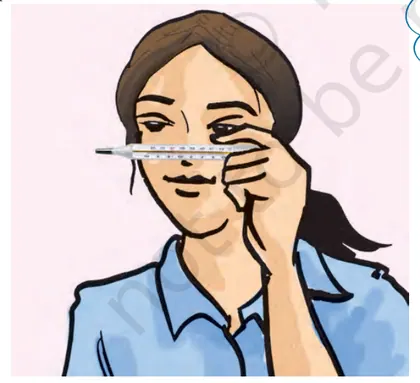
- Read scale at eye level to avoid parallax error.
Everyday significance
Temperature controls weather reports, cooking, refrigeration, health (fever), industrial processes, and scientific experiments.
- Human body temperature ~ 37°C (fever if significantly higher, e.g., ≥ 38°C).
- Melting point of ice: 0°C; boiling point of water: 100°C (at 1 atm).
- Freezer temperature: about −18°C; room temperature: about 20–25°C.
- Weather: a hot day might be 35°C, while a cold winter morning might be 0°C or below.
- Mixing hot and cold water: the final temperature depends on masses and temperatures — the two reach a common temperature (thermal equilibrium).
- Thermometer use: clinical thermometer measures body temperature for fever detection; kitchen thermometer checks cooking temperatures.
- °F = (9/5) × °C + 32
- °C = (5/9) × (°F − 32)
- K = °C + 273.15
- °C = K − 273.15
- Q = m × c × ΔT (heat required to change temperature by ΔT; useful when linking temperature change to heat energy)
- ΔL = α × L × ΔT (linear thermal expansion: change in length ΔL for a temperature change ΔT; α is coefficient of linear expansion)
Thermometers and Measurement of Temperature
What is temperature? Temperature is a measure of how hot or cold a body is. It indicates the average kinetic energy of the particles in a substance.
What is a thermometer? A thermometer is an instrument used to measure temperature. Most thermometers work on the principle of thermal expansion — substances expand when heated and contract when cooled.
Types of common thermometers (Class 7 level):
- Liquid-in-glass thermometers: A liquid (mercury or coloured alcohol) is enclosed in a glass tube with a narrow capillary. When temperature rises the liquid rises in the capillary proportionally to the temperature.
- Clinical (medical) thermometer: A special mercury-in-glass thermometer with a constriction in the tube so mercury does not fall back quickly; used for measuring human body temperature (range roughly 35 °C to 42 °C).
- Laboratory thermometer: Mercury or alcohol thermometers with larger ranges (for experiments) and finer scale divisions.
Fixed points and scales: To calibrate thermometers we use fixed points — reproducible temperatures:
- Ice point: Temperature of pure melting ice under standard pressure = 0 °C (Celsius scale).
- Steam (boiling) point: Temperature of boiling water under standard pressure = 100 °C on Celsius scale.
Other temperature scales: Fahrenheit (°F) and Kelvin (K). Conversions are given below.
How a liquid-in-glass thermometer works (brief): The bulb contains liquid. As temperature increases, liquid expands into the capillary. The length (or volume) change is proportional to change in temperature, so markings on the glass are used to read temperature.
Useful points about clinical thermometers: They have a narrow constriction so the mercury column remains above the constriction after removing from mouth/underarm, allowing easier reading. To reset, shake firmly to bring mercury back into the bulb.
Precautions and errors when using thermometers:
- Read at eye level to avoid parallax error.
- Allow sufficient time for thermometer to reach the temperature of the object (equilibration).
- Do not use mercury thermometers if broken — mercury is toxic.
- Clinical thermometer must be sanitized before and after use.
- Ensure thermometer range suits the measurement (e.g., don't use a clinical thermometer for very low/high temperatures).
Why different liquids? Mercury has a uniform thermal expansion and remains liquid over a wide range (−39 °C to 357 °C). Alcohol is coloured and safer at very low temperatures where mercury would freeze.
Summary: Thermometers convert temperature changes into measurable length or volume changes of a substance. They are calibrated using fixed points and read against a scale (°C, °F, or K) with care to avoid errors.
- Measuring human body temperature with a clinical thermometer to detect fever (normal ~37 °C).
- Using a room thermometer (alcohol) to check indoor temperature for comfort and heating control.
- Using a laboratory mercury thermometer to record the temperature of boiling water (should be close to 100 °C at sea level).
- Measuring freezer temperature with a thermometer suitable for low temperatures (alcohol thermometer below 0 °C).
- Cooking: using a candy thermometer (specialized liquid/metal thermometer) to reach correct sugar temperatures (e.g., soft-ball stage ~115 °C).
- Comparing two thermometers (calibration check): placing both in an ice-water mixture and checking that both read ≈ 0 °C.
- Celsius to Fahrenheit: °F = (9/5) × °C + 32
- Fahrenheit to Celsius: °C = (5/9) × (°F − 32)
- Celsius to Kelvin: K = °C + 273.15
- Linear thermal expansion (solids): ΔL = α × L₀ × ΔT (α = coefficient of linear expansion)
- Volume (or liquid) expansion: ΔV = β × V₀ × ΔT (β ≈ 3α for solids; for liquids β is specific to the liquid)
Difference between Heat and Temperature
Heat is a form of energy that is transferred from one body (or region) to another because of a temperature difference. Heat flows spontaneously from a hotter object to a colder one and can change the temperature or the state (solid/liquid/gas) of a substance. Heat is an extensive quantity (depends on the amount of substance) and is measured in joules (J) or calories (cal). Modes of heat transfer include conduction, convection and radiation.
Temperature is a measure of how hot or cold a body is. It indicates the average kinetic energy of the particles of the substance. Temperature is a measure or property of the state of a body (not energy itself), and it does not depend on the amount of substance (intensive property). Temperature is measured in degrees Celsius (°C), Kelvin (K) or Fahrenheit (°F) using a thermometer.
Key differences (summary):
- Nature: Heat is energy in transfer; temperature is a measure of hotness (a physical property).
- Units: Heat: joule (J) or calorie (cal). Temperature: °C, K, °F.
- Dependence on mass: Heat depends on mass (more mass can store more heat for same temperature change); temperature does not depend on mass for a homogeneous body.
- Measurement: Heat is measured using calorimeters (indirectly); temperature is measured using thermometers.
- Effect: Heat transfer may change temperature or cause a change of state; temperature tells the direction of heat flow (heat flows from higher to lower temperature).
Understanding both concepts together: When heat Q is supplied to a substance, its temperature usually rises. The amount of temperature rise depends on the mass and the specific heat capacity of the substance. Sometimes supplied heat is used entirely for a phase change (melting/boiling) and temperature remains constant during that process.
- Boiling water: When you supply heat to water on a stove, heat energy raises the water's temperature until it reaches 100°C (at 1 atm). At 100°C further heat causes water to change into steam (phase change) while temperature remains constant during boiling.
- Touch test: A metal spoon and a wooden spoon left in hot soup — metal feels hotter because metal conducts heat to your hand faster; both have roughly the same temperature but different heat-transfer behavior.
- Same heat, different rise: If equal heat is added to equal masses of iron and water, iron's temperature rises more because iron has a lower specific heat capacity than water.
- Melting ice: When ice at 0°C melts to water at 0°C, heat is absorbed (latent heat of fusion) but the temperature stays the same until melting is complete.
- Room equilibrium: A cup of hot tea cools down to room temperature. Heat flows from the tea (higher temperature) to the surrounding air (lower temperature) until both reach the same temperature.
- Q = m · c · ΔT (Heat supplied Q in joules = mass m × specific heat c × temperature change ΔT).
- ΔT = T_final − T_initial (Temperature change in °C or K).
- T(K) = T(°C) + 273.15 (Conversion between Celsius and Kelvin).
- 1 calorie ≈ 4.186 joules (Unit conversion between cal and J).
Expansion on Heating and Contraction on Cooling
What is it? Expansion on heating is the increase in size (length, area or volume) of a substance when its temperature rises. Contraction on cooling is the decrease in size when the temperature falls. These happen because heating increases the kinetic energy of particles, making them vibrate/move more and occupy more space; cooling reduces this motion and the particles come closer.
Types
- Linear (Length) expansion — change in length of solids on heating. Useful for long objects like rods, rails, wires.
- Area expansion — change in surface area of flat objects (sheets) on heating.
- Volume expansion — change in volume of solids, liquids and gases on heating. Liquids and gases show much larger volume changes than solids.
How we measure it
- Coefficient of linear expansion (α): fractional change in length per degree change in temperature.
- Coefficient of volume expansion (β): fractional change in volume per degree change in temperature. For solids, β ≈ 3α (approximately).
Important points
- Different materials expand by different amounts (different expansion coefficients). Metals usually expand more than glass for the same temperature change.
- If expansion is prevented (constrained), large stresses develop and the object can bend, crack or break (for example, bursting of pipes or cracks in roads).
- Bimetallic strips (two metals with different α joined together) bend on heating and are used in thermostats and electric switches.
- Water shows anomalous behaviour: it contracts on cooling down to 4 °C, but below 4 °C it expands as it approaches 0 °C (ice is less dense than water). This is why ice floats.
Practical uses and safety
- Expansion joints in bridges and railways allow safe expansion and contraction with temperature changes.
- Mercury or alcohol thermometers use volume expansion of liquids to measure temperature changes.
- Hot-fitting: a metal lid can be loosened by heating the jar (lid expands more than glass) or by pouring hot water to expand the metal.
- Railway tracks have small gaps between rails to allow expansion on hot days; otherwise rails may buckle.
- A bimetallic strip in electric irons and thermostats bends when heated and acts as a switch.
- Mercury-in-glass thermometer: mercury expands uniformly and rises up the narrow tube as temperature increases.
- Overhead electric cables sag more on hot days because they expand and become longer.
- Glass bottles may crack if very hot liquid is poured into them suddenly due to uneven expansion.
- Water in a lake: as surface water cools below 4 °C it becomes less dense and ice forms on top, protecting aquatic life below.
- Linear expansion: ΔL = α × L × ΔT (where ΔL = change in length, L = original length, α = coefficient of linear expansion, ΔT = change in temperature)
- Fractional linear change: ΔL / L = α × ΔT
- Area expansion (approx.): ΔA = 2α × A × ΔT (A = original area)
- Volume expansion: ΔV = β × V × ΔT (where β = coefficient of volume expansion, V = original volume)
- Relation for solids: β ≈ 3α (approximate)
- Ideal gas relation (useful concept): PV = nRT — at constant pressure, V ∝ T (Kelvin), so volume increases with temperature for gases
Types of Expansion
What is thermal expansion? Thermal expansion is the increase in size (length, area or volume) of materials when their temperature rises. On heating, particles gain kinetic energy and move slightly farther apart, so the material expands. On cooling, it contracts.
Why does it happen? Increased temperature makes atoms/molecules vibrate more and their average separation increases. The expansion amount depends on the material and the temperature change.
Main types of expansion
- 1. Linear expansion (1-dimensional)
Applies to rods, wires or any object where one dimension (length) change is important. If a rod of original length L is heated by ΔT, its length increases by ΔL = α L ΔT, where α is the coefficient of linear expansion for the material.
- 2. Area (surface) expansion (2-dimensional)
Applies to plates or surfaces. If the original area is A, the increase in area is approximately ΔA = 2α A ΔT (because both dimensions expand), where 2α is approximately the coefficient of area expansion.
- 3. Volume (cubical) expansion (3-dimensional)
Applies to solids, liquids and gases when their volume changes. For a body of volume V, ΔV = γ V ΔT, where γ is the coefficient of volume (cubical) expansion. For most solids γ ≈ 3α.
Special notes for states of matter
- Solids: Show linear, area and volume expansion. For solids, γ ≈ 3α (true for isotropic solids).
- Liquids: Do not have a fixed shape; we use coefficient of cubical expansion (commonly written β or γ_liquid). Liquids usually expand more than solids; ΔV = β V ΔT.
- Gases: Expand a lot. For ideal gases PV = nRT. At constant pressure, V ∝ T (Charles' law): V1/T1 = V2/T2 (temperatures in Kelvin).
Practical consequences and applications
- Gaps in railway tracks and expansion joints in bridges allow for thermal expansion to avoid buckling or damage.
- Thermometers (mercury or alcohol) use liquid volumetric expansion to measure temperature.
- Bimetallic strips in thermostats use two metals with different α to bend on heating and operate switches.
- Care is needed for lids, metal fittings and glassware: heating may loosen or tighten fits; sudden cooling of heated glass can cause breakage due to uneven contraction.
Important points to remember
- Expansion is proportional to the original size and temperature change for small ΔT.
- Different materials have different coefficients; metals generally expand more than ceramics.
- Coefficients are usually given per degree Celsius (or per Kelvin) and are approximately the same scale for both units (Δ°C = ΔK).
- Railway tracks have small gaps to allow linear expansion of metal rails in summer.
- Bridges have expansion joints to accommodate changes in length with temperature.
- A bimetallic strip (two metals with different α) bends with temperature and is used in thermostats and electric irons.
- Mercury or alcohol in a thermometer rises because the liquid volume increases with temperature.
- A glass jar lid may stick in summer due to expansion of metal lid; running under cold water can contract the lid slightly to open it.
- Hot air balloons rise because heating air increases its volume (and decreases density) at almost constant pressure.
- Linear expansion: ΔL = α · L · ΔT (α = coefficient of linear expansion)
- Area expansion (approx.): ΔA = 2α · A · ΔT (for isotropic solids)
- Volume (cubical) expansion: ΔV = γ · V · ΔT, with γ ≈ 3α for solids
- Liquids (cubical): ΔV = β · V · ΔT (β = coefficient of cubical expansion for the liquid)
- Ideal gas law: PV = nRT
- Charles' law (constant pressure for gases): V1 / T1 = V2 / T2 (T in Kelvin)
Experimental Evidence and Devices Based on Expansion
What is thermal expansion? Thermal expansion is the increase in size (length, area or volume) of a substance when its temperature rises. Solids, liquids and gases expand on heating; gases expand the most for a given rise in temperature.
Experimental evidence (simple experiments)
- Ball-and-ring experiment: A metal ball passes through a metal ring at room temperature. On heating the ball, it no longer passes through the same ring — showing that the ball has expanded. Cooling the ball restores the fit.
- Metal rod with pointer and scale: Clamp a metal rod horizontally, fix a pointer at one end and place a scale under the pointer. On heating the rod the pointer moves along the scale indicating increase in length (linear expansion).
- Liquid-in-glass thermometer: The rise of mercury or coloured alcohol in a narrow tube when the bulb is heated demonstrates expansion of liquids. The narrow bore converts small volume changes into visible large height changes.
- Air expansion (syringe/flask experiment): A flask partly filled with colored water and fitted with a tube shows the water level rising when the air in the flask is heated, indicating expansion of air.
Why do these occur? Heating increases the kinetic energy of particles; they vibrate or move more and tend to occupy more space, producing expansion. For solids the increase is mainly in the average separation between atoms; for liquids and gases, molecules move farther apart and occupy more volume.
Devices based on expansion
- Thermometers: Use liquid (mercury or alcohol) expansion in a narrow tube to indicate temperature.
- Bimetallic strip (thermostat, electric iron, geyser): Two metals with different coefficients of linear expansion are bonded together. On heating the strip bends toward the metal with lower expansion; this bending is used to make or break electrical contacts for temperature control.
- Steam engine / piston arrangement (simple model): Expansion of heated gas or steam pushes a piston and can do mechanical work.
- Railway tracks and bridges: Expansion joints and gaps are left to allow metal and concrete to expand; otherwise rails could buckle and bridges crack.
- Jars & lids: Heating a metal lid slightly can loosen it as the lid expands more than the glass jar.
Key points for students
- Thermal expansion is usually nearly proportional to the temperature change over moderate ranges.
- Different materials expand by different amounts — quantified by coefficients of expansion.
- Designs use expansion (thermometers) or accommodate it (expansion gaps).
- Ball-and-ring experiment: ball fits through ring at room temperature but not after heating (solid expansion).
- Mercury thermometer: mercury rises in the capillary tube as temperature increases (liquid expansion).
- Bimetallic thermostat: heater turns off when a bimetallic strip bends enough to break the circuit (practical use of different linear expansions).
- Hot air balloon: air inside the balloon expands and becomes less dense on heating, producing lift (gas expansion).
- Expansion joints in bridges and gaps between railway tracks accommodate expansion and prevent damage.
- Loosening a tight jar lid by running it under hot water — the metal lid expands slightly more than the glass, easing removal.
- Linear expansion (solids): ΔL = α × L × ΔT, where ΔL = change in length, α = coefficient of linear expansion, L = original length, ΔT = temperature change.
- Area expansion (approx.): ΔA = 2α × A × ΔT (for small ΔT), where A is original area.
- Volume expansion (solids/liquids): ΔV = β × V × ΔT, where β ≈ 3α for solids and β (or γ) is coefficient of volume expansion for liquids.
- Gases (ideal behaviour at constant pressure - Charles's law): V1/T1 = V2/T2 (temperatures in Kelvin). Also ideal gas law: PV = nRT.
Change of State due to Heating/Cooling
Change of State due to Heating/Cooling
Matter exists in three common states: solid, liquid and gas. A change of state (or phase change) happens when heat is added to or removed from a substance. Heating usually changes a solid to a liquid (melting) and a liquid to a gas (evaporation/boiling). Cooling makes a gas condense to a liquid (condensation) and a liquid freeze to a solid (freezing). Some substances can change directly between solid and gas (sublimation and deposition).
Molecular Explanation
Temperature measures the average kinetic energy of particles. On heating, particle kinetic energy increases. During a phase change the added heat is used to overcome intermolecular forces rather than to raise temperature. Thus temperature remains constant during the actual phase change (a plateau on a temperature vs time graph) while the arrangement and freedom of motion of the molecules change:
- Solid: particles closely packed, fixed positions, vibrational motion only.
- Liquid: particles close but able to move/slide past each other.
- Gas: particles far apart, move independently at high speeds.
Types of Changes
- Melting (fusion): solid -> liquid on heating (e.g., ice -> water). Temperature stays at melting point while melting occurs.
- Freezing (solidification): liquid -> solid on cooling (e.g., water -> ice). Heat removed = latent heat of fusion.
- Evaporation: liquid -> gas from the surface at any temperature; faster with higher temperature, larger surface area, lower humidity.
- Boiling: rapid liquid -> gas throughout the bulk at the boiling point (depends on pressure).
- Condensation: gas -> liquid on cooling (e.g., water droplets on a cold surface).
- Sublimation: solid -> gas without passing through liquid (e.g., dry ice, camphor).
Latent Heat
Latent heat is the heat absorbed or released during a phase change per unit mass without a temperature change. Two common types are latent heat of fusion (melting/freezing) and latent heat of vaporization (boiling/condensation).
Factors Affecting Change of State
- Pressure: boiling point depends strongly on external pressure (lower at high altitude).
- Impurities: solutes lower freezing point (freezing point depression) and can raise boiling point.
- Surface area and airflow: affect evaporation rates.
Practical Notes
During heating, first temperature rises within one phase (Q = mcΔT). When a phase change begins temperature stays constant while energy goes into changing state (Q = mL). After phase change completes, temperature of the new phase rises again.
- Melting ice cubes in a glass: solid ice absorbs heat and becomes liquid water at 0°C; temperature stays at 0°C during melting.
- Boiling water in a kettle: water stays at ~100°C while it turns to steam at normal atmospheric pressure; heating beyond boiling converts more liquid to gas.
- Evaporation of sweat: sweat on skin evaporates, taking latent heat away and cooling the body.
- Condensation on a cold beverage: water vapor in air cools and condenses into liquid droplets on the bottle surface.
- Freezing of pond water in winter: surface water loses heat, reaches 0°C, then freezes forming ice.
- Sublimation of dry ice (solid CO2): dry ice changes directly from solid to gas at atmospheric pressure.
- Heat to change temperature (no phase change): Q = m c ΔT, where Q is heat (J), m is mass (kg), c is specific heat capacity (J/kg·K), ΔT is temperature change (K or °C).
- Heat for phase change (latent heat): Q = m L, where L is latent heat (J/kg). Use Lf (fusion) for melting/freezing, Lv (vaporization) for boiling/condensation.
- Sign convention: Q > 0 when heat is absorbed (endothermic, e.g., melting, vaporization); Q < 0 when heat is released (exothermic, e.g., freezing, condensation).
- Typical values for water: specific heat c ≈ 4186 J/kg·K, latent heat of fusion Lf ≈ 334000 J/kg, latent heat of vaporization Lv ≈ 2260000 J/kg.
- Boiling point dependence (qualitative): boiling point decreases with decreasing external pressure; at a given pressure, temperature at which vapour pressure equals external pressure is the boiling point.
Evaporation and Cooling
What is evaporation? Evaporation is the process by which molecules at the surface of a liquid escape into the air as vapour at temperatures below the boiling point. It is a surface phenomenon and can occur at any temperature.
How evaporation happens (microscopic view): In a liquid, molecules move with a range of kinetic energies. Some surface molecules have higher-than-average energy. When such molecules gain enough energy to overcome the attractive forces of neighbouring molecules, they leave the liquid as vapour. Only molecules at the surface can directly escape.
Evaporation versus boiling: Boiling is a bulk phenomenon that occurs throughout the liquid at a specific temperature (boiling point) when vapour pressure equals atmospheric pressure. Evaporation occurs only at the surface and at all temperatures below the boiling point.
Why evaporation causes cooling: When a molecule evaporates, it takes away energy in the form of latent heat of vaporization. The remaining liquid loses average kinetic energy, so its temperature falls. This is why evaporation causes cooling of the liquid and of objects in contact with it (for example, our skin).
Factors affecting the rate of evaporation:
- Temperature: Higher temperature increases the number of high-energy molecules, so evaporation is faster.
- Surface area: Larger surface area gives more molecules an opportunity to escape, increasing the rate.
- Humidity of surrounding air: Dry air (low humidity) accepts more vapour, so evaporation is faster. High humidity slows evaporation.
- Air movement (wind): Moving air carries away vapour molecules, speeding up evaporation.
- Nature of the liquid: Liquids with weaker intermolecular forces (e.g., alcohol) evaporate faster than those with stronger forces (e.g., water).
Everyday cooling examples: When sweat evaporates from our skin it removes heat and cools us. Similarly, a wet cloth placed on the forehead, a wet floor drying in sunlight, and the cooling felt when alcohol is applied to skin are all due to evaporation.
Importance: Evaporation plays a major role in weather (evaporation from oceans and lakes drives the water cycle), in cooling mechanisms (sweating, evaporative coolers), and in many industrial drying processes.
- Sweating: Sweat evaporates from the skin and cools the body.
- Wet clothes drying: Water evaporates from clothes; if air is warm and dry, drying is faster.
- Alcohol feels cold on skin: Alcohol has a high evaporation rate and takes heat away quickly.
- Evaporative coolers (desert coolers): Air blown over water causes evaporation that cools the air.
- Q = mL (Heat Q absorbed during evaporation of mass m; L is latent heat of vaporization)
- For water: L ≈ 2.26 × 10^6 J/kg (≈ 2260 kJ/kg) — approximate value
- Qualitative relation: rate of evaporation ∝ surface area × (availability of dry air) × wind × temperature (and inversely ∝ humidity)
Transfer of Heat
What is transfer of heat? Transfer of heat means the flow of thermal energy from a hotter object or region to a colder one. Heat always moves from higher temperature to lower temperature until temperatures become equal (thermal equilibrium).
Three modes of heat transfer
- Conduction: Transfer of heat through a solid or between solids in contact, without the movement of the material as a whole. Heat is passed from particle to particle by collisions and vibration. Good conductors (metals) transfer heat quickly; insulators (wood, wool) do so slowly.
- Convection: Transfer of heat by the bulk movement of fluids (liquids or gases). When a part of a fluid is heated it becomes lighter (less dense) and rises, while cooler, denser fluid sinks, creating convection currents that carry heat.
- Radiation: Transfer of heat by electromagnetic waves (infrared). Radiation does not need any medium — heat from the Sun reaches Earth through space by radiation.
Some important points
- Direction: Heat flows from hot to cold.
- Materials: Metals are good conductors; non-metals like wood, plastic and air are insulators.
- Rate depends on temperature difference, contact area, nature of material and thickness (for conduction), and on fluid motion (for convection).
Simple classroom demonstrations
- Conduction: Heat one end of a metal rod with a flame; notice how heat travels to the other end. Attach wax drops on the rod — they melt one by one.
- Convection: Heat coloured water at the bottom of a beaker and watch warm coloured fluid rise and cold sink, showing convection currents.
- Radiation: Hold your hand near (but not touching) a hot object or a lamp and feel warmth — that is radiation. Compare heating of a black vs white surface under a lamp.
Everyday examples are given below in the examples list.
Why learn this? Understanding heat transfer helps explain cooking, weather (winds and sea breezes), keeping homes warm/cool, designing clothing and devices, and many natural processes.
- Conduction: A metal spoon becoming hot when its other end is in hot soup.
- Conduction: A frying pan heating up on a gas stove; the handle of the pan is often made of wood or covered to insulate.
- Convection: Boiling water — hotter water rises as bubbles and cooler water sinks, forming convection currents.
- Convection: Sea breeze — during daytime land heats up faster than sea; warm air over land rises and cooler air from sea moves in.
- Radiation: Warmth from the Sun reaching Earth through space; feeling heat from a campfire without touching the flames.
- Radiation & absorption: Dark clothes absorb more radiant heat from sunlight than white clothes, so they feel hotter.
- Heat required to change temperature: Q = m c ΔT (Q in joules, m = mass in kg, c = specific heat in J/kg·°C, ΔT = temperature change in °C)
- Conduction (total heat transferred in time t): Q = (k A ΔT t) / d (k = thermal conductivity, A = area, ΔT = temperature difference, d = thickness, t = time)
- Rate of heat conduction: dQ/dt = k A ΔT / d (heat per second)
- Newton's law of cooling (simple form): rate of cooling ∝ (T_object − T_surroundings). Often written as dT/dt = −h (T − T_env) for some constant h
- Radiation (black body, advanced): Power radiated P = σ A T^4 (σ = Stefan–Boltzmann constant, T in kelvin). Note: for Class 7, it is enough to know radiation energy increases strongly with temperature.
Conductors and Insulators
Conductors and Insulators
Definition: Conductors are materials that allow heat (thermal energy) to pass through them easily. Insulators are materials that do not allow heat to pass through them easily and so slow down heat transfer.
How heat is transferred in solids (conduction): In conduction, heat is transferred from the hotter part to the colder part by the vibration and collisions of particles (atoms, molecules, or free electrons). In metals, free electrons carry much of the heat, so metals are good conductors. In non-metals (like wood, plastic), particles are more tightly bound and there are few free electrons, so they are poor conductors and act as insulators.
Key characteristics:
- Conductors (examples: copper, aluminium, iron) — high thermal conductivity; heat spreads quickly.
- Insulators (examples: wood, plastic, rubber, glass, air, wool) — low thermal conductivity; they retain heat or keep cold in.
Everyday situations & simple experiment: If you hold a metal spoon and a wooden spoon whose ends are dipped in hot water, the metal spoon quickly feels hot — it conducts heat to your hand. The wooden spoon remains relatively cool because wood is an insulator. Thermos flasks use a vacuum or insulating material to reduce heat transfer and keep liquids hot or cold.
Factors affecting rate of heat conduction:
- Nature of the material (thermal conductivity).
- Temperature difference between two ends (larger difference → faster heat flow).
- Cross-sectional area (larger area → more heat flow).
- Length or thickness of material (greater length → less heat flow).
Importance: Conductors are useful where heat must be transferred quickly (cooking utensils, heat sinks); insulators are used where heat transfer must be prevented (cold-storage, house insulation, handles of cookware).
- Cooking pots and pans (metal) — good conductors, so they heat food quickly.
- Metal spoon in hot soup — the spoon handle becomes hot because metal conducts heat.
- Wooden spoon — remains cool because wood is an insulator.
- Thermos flask — uses vacuum and insulating materials to keep liquids hot or cold.
- Electric wires — have metal conductors (copper) covered by plastic insulation to prevent heat/electric loss and shocks.
- House insulation — materials like fiberglass, polystyrene, or air gaps reduce heat loss in winter.
- Rate of heat conduction (Fourier’s law, steady state): H/t = (k · A · ΔT) / L - H/t is heat transferred per unit time (W or J/s), - k is thermal conductivity of the material (W·m⁻¹·K⁻¹), - A is cross-sectional area (m²), - ΔT is temperature difference between ends (K or °C), - L is thickness or length between the two ends (m).
- Thermal conductivity note: higher k → material is a better conductor; lower k → better insulator.
Applications and Everyday Phenomena
Overview: "Applications and Everyday Phenomena" shows how heat transfer and thermal effects appear in daily life and in simple devices. It links the basic processes — conduction, convection and radiation — and thermal expansion and change of state, to practical uses and phenomena you observe around you.
Modes of heat transfer and everyday examples:
- Conduction — transfer of heat through a material without bulk movement. Good in solids, especially metals. Example: a metal spoon becoming hot when left in a cup of hot tea. Kitchen tongs and insulated handles are designed to reduce conduction to your hand.
- Convection — heat transfer by the bulk motion of fluids (liquids or gases). Warmer fluid rises and cooler fluid sinks, creating convection currents. Example: boiling water in a pot (hot water rises from the bottom and cooler water descends), warm air circulating from a room heater.
- Radiation — transfer of heat by electromagnetic waves; does not require a medium. Example: feeling warmth from the Sun, or from a fire, even across a room.
Thermal expansion and its applications/problems:
- Most materials expand on heating and contract on cooling. Solids expand in length, area and volume; liquids mainly change volume. Example applications: gaps left between sections of railway tracks and bridges to allow expansion in hot weather; bimetallic strips in thermostats: two metals with different expansion rates bend on heating and operate a switch.
- Problems due to expansion: cracking of roads or distortion of machinery if no allowance is made; nails or screws loosening in wooden furniture as humidity and temperature change.
Change of state and daily uses:
- Melting and boiling are used in cooking, refrigeration and many industrial processes. Example: boiling water cooks food; melting butter or chocolate changes texture.
- Latent heat explains why temperature stays constant during melting or boiling until the entire substance has changed its state — this is visible as plateaus in heating/cooling graphs.
Devices that use thermal principles:
- Thermos (vacuum) flask — reduces heat transfer by conduction, convection and radiation: double walls with vacuum between, silvered surfaces to reduce radiation, and a tight stopper to limit convection.
- Electric iron — uses conduction (heat flows from the hot soleplate to clothes) and sometimes a thermostat (bimetallic strip) to control temperature.
- Pressure cooker — increases pressure so water boils at higher temperature; food cooks faster (application of boiling point dependence on pressure).
- Insulation in buildings — materials with low thermal conductivity (wood, wool, polystyrene) reduce heat loss by conduction and convection; reflective surfaces reduce radiation.
Everyday phenomena explained by heat concepts:
- Sea breeze and land breeze — local convection caused by differential heating of land and sea during day/night.
- Hotter pavements and black surfaces — darker colors absorb more radiation and become hotter; metal surfaces feel colder because they conduct heat away from your skin faster.
- Sweating and cooling — evaporation (a change of state) requires latent heat; evaporation of sweat absorbs heat from the body, cooling you down.
Practical tips based on heat principles:
- Use lids while cooking to reduce heat loss by convection and radiation, cooking faster and saving fuel.
- Polish or paint surfaces white/reflective to reduce heating from sunlight; insulate hot-water pipes to reduce heat loss.
- Metal spoon in a hot cup: conduction makes the handle warm; a wooden spoon stays cooler because wood is a poor conductor.
- Thermos flask: vacuum between walls prevents conduction and convection; silvered surfaces reduce radiative heat loss, keeping liquids hot or cold.
- Bimetallic strip in an electric iron or thermostat: two metals expand differently with temperature, causing bending that opens/closes a switch to regulate temperature.
- Boiling water in a pot: convection currents distribute heat through the water; steam (vapour) carries heat away by convection and evaporation.
- Railway tracks and bridges have small gaps to allow for expansion in hot weather; without gaps rails could buckle.
- Sweating cools the body because evaporation of sweat requires heat (latent heat) taken from the skin.
- Q = m c ΔT — Heat required to change temperature (Q in joules, m mass in kg, c specific heat in J/kg·°C, ΔT change in temperature in °C).
- ΔL = α L ΔT — Linear expansion of a solid (ΔL change in length, α coefficient of linear expansion, L original length, ΔT temperature change).
- ΔV = β V ΔT — Volume expansion (β coefficient of volume expansion, for solids β ≈ 3α), V original volume.
- Q = m L — Heat for change of state (L is latent heat: e.g., latent heat of fusion or vaporization).
- Rate of heat conduction (Fourier's law): H/t = k A (ΔT)/d — heat flow per unit time through area A, thickness d, thermal conductivity k, temperature difference ΔT.
Simple Quantitative Ideas (Introductory)
What is being measured?
Temperature is a quantitative measure of how hot or cold a body is. Heat is energy transferred because of a temperature difference. In everyday situations we measure temperature to know the extent of warming or cooling.
Measuring temperature
We use thermometers (laboratory or clinical) to measure temperature. The commonly used unit is degree Celsius (°C). Absolute temperature in Kelvin (K) is related by K = °C + 273.15. Thermometers read temperature by showing expansion (or other physical change) of a substance with temperature.
Simple quantitative idea (introductory)
When heat is supplied to a body, its temperature changes. For a given material and for moderate temperature changes, the amount of heat (q) required to produce a temperature change (ΔT) depends on:
- the mass (m) of the body — more mass takes more heat to change temperature;
- the type of material — different materials require different amounts of heat (this idea leads to the concept of specific heat capacity);
- the desired temperature change (ΔT) — larger ΔT needs more heat.
These relations are summarized by the simple introductory formula (used later in detail): q = m c ΔT, where c is the specific heat capacity of the material. This means for the same heat supplied, different masses or different materials show different temperature rises.
Important units and conversions
Celsius <> Fahrenheit: °C = (°F - 32) × 5/9 and °F = °C × 9/5 + 32.
Celsius <> Kelvin: K = °C + 273.15.
Short worked example (illustrative)
Heat required to raise 200 g of water from 20 °C to 30 °C.
Take c (water) = 4.2 J/g°C. Here m = 200 g, ΔT = 10 °C.
q = m c ΔT = 200 × 4.2 × 10 = 8400 J.
So 8400 joules of heat are needed (approx.).
Limitations and notes
The relation q = m c ΔT is an introductory linear approximation valid for moderate temperature ranges and when no phase change occurs. During melting or boiling, temperature does not change while heat is used for the phase change.
Practical use
This simple quantitative idea helps predict how long or how much energy is needed to heat objects (cookware, water, rooms) and explains why materials with different specific heats behave differently when heated.
- Boiling water for tea: the same amount of heat raises the temperature of a small cup of water more than a large pot because of different masses.
- Ironing clothes: metal of the iron heats up quickly (low specific heat) and transfers heat to cloth to remove wrinkles.
- Fever measurement: a clinical thermometer measures body temperature to indicate illness.
- Car engine cooling: coolant with suitable heat capacity removes heat produced in the engine to keep temperature within limits.
- Cooking on different vessels: a thick heavy pan (large mass) takes longer to heat than a thin pan for the same heat supplied.
- q = m c ΔT (heat q, mass m, specific heat c, temperature change ΔT)
- ΔT = T_final - T_initial (difference of temperatures in °C or K)
- °C = (°F - 32) × 5/9 (Fahrenheit to Celsius)
- °F = °C × 9/5 + 32 (Celsius to Fahrenheit)
- K = °C + 273.15 (Celsius to Kelvin)
Key Concepts
- Heat
- A form of energy that flows from a hotter object to a colder one due to temperature difference.
- Temperature
- A measure of how hot or cold an object is; indicates the average kinetic energy of particles.
- Thermometer
- An instrument used to measure temperature.
- Clinical thermometer
- A thermometer designed to measure human body temperature, often with a constriction to hold the mercury column.
- Laboratory thermometer
- A thermometer used in experiments that measures a wider temperature range and does not have a constriction.
- Celsius scale
- A temperature scale where 0 °C is the freezing point and 100 °C is the boiling point of water at standard pressure.
- Thermal equilibrium
- The state reached when two objects in contact no longer exchange heat because they are at the same temperature.
- Heat transfer
- The movement of heat energy from one place or substance to another by conduction, convection, or radiation.
- Conduction
- Transfer of heat through direct contact between particles, common in solids.
- Convection
- Transfer of heat by the bulk movement of fluids (liquids or gases) caused by density differences.
- Radiation
- Transfer of heat in the form of electromagnetic waves; does not require a medium.
- Conductor
- A material that allows heat to pass through it easily.
- Insulator
- A material that resists the flow of heat and slows down heat transfer.
- Thermal expansion
- The increase in size (length, area or volume) of materials when their temperature rises.
- Linear expansion
- Increase in the length of a solid on heating, measured per unit length per degree rise in temperature.
- Area expansion
- Increase in the surface area of a solid when its temperature increases.
- Volume expansion
- Increase in the volume of a substance (especially liquids and gases) when heated.
- Bimetallic strip
- A strip made of two metals with different expansion rates bonded together; it bends on heating.
- Change of state
- The transformation of matter between solid, liquid, and gas by heating or cooling (melting, boiling, condensation, freezing).
- Convection current
- A circular flow in a fluid produced by repeated rising of warm fluid and sinking of cooler fluid.
End-of-Chapter Trial Paper & Test Questions
Topic-wise questions to test your understanding of every concept in this chapter.
-
Heat always flows from a ________ body to a ________ body. (a) colder to hotter, (b) hotter to colder, (c) lighter to heavier, (d) heavier to lighter. / ऊष्मा हमेशा ________ वस्तु से ________ वस्तु की ओर बहती है। (a) ठंडी से गर्म, (b) गर्म से ठंडी, (c) हल्की से भारी, (d) भारी से हल्की।
Show answer
(b) hotter to colder. / गर्म से ठंडी। — Heat is energy that flows spontaneously from a region of higher temperature to lower temperature until thermal equilibrium is reached. / ऊष्मा वह ऊर्जा है जो उच्च तापमान के क्षेत्र से निम्न तापमान के क्षेत्र की ओर तब तक अपने आप बहती है जब तक ताप साम्य (thermal equilibrium) नहीं हो जाता।
-
Which mode of heat transfer does NOT require any medium? (a) Conduction, (b) Convection, (c) Radiation, (d) All of the above. / ऊष्मा स्थानांतरण का कौन-सा तरीका किसी माध्यम की आवश्यकता नहीं रखता? (a) चालन, (b) संवहन, (c) विकिरण, (d) उपरोक्त सभी।
Show answer
(c) Radiation. / विकिरण। — Radiation transfers heat through electromagnetic waves and can travel through vacuum (e.g., heat from the Sun reaching Earth through space). / विकिरण विद्युत चुम्बकीय तरंगों के माध्यम से ऊष्मा स्थानांतरित करता है और निर्वात से गुजर सकता है (जैसे सूर्य से पृथ्वी तक ऊष्मा अंतरिक्ष के माध्यम से पहुँचती है)।
-
A bimetallic strip bends on heating because: (a) Both metals expand equally, (b) The two metals have different coefficients of expansion, (c) Heat destroys one of the metals, (d) The strip becomes magnetic. / बाईमेटेलिक पट्टी गर्म होने पर मुड़ती है क्योंकि: (a) दोनों धातुएँ समान रूप से फैलती हैं, (b) दोनों धातुओं के प्रसार गुणांक अलग-अलग होते हैं, (c) ऊष्मा एक धातु को नष्ट कर देती है, (d) पट्टी चुम्बकीय हो जाती है।
Show answer
(b) The two metals have different coefficients of expansion. / दोनों धातुओं के प्रसार गुणांक अलग-अलग होते हैं। — Since the two metals expand by different amounts, the strip bends toward the metal with lower expansion. This bending is used in thermostats and electric irons. / चूंकि दोनों धातुएँ अलग-अलग मात्रा में फैलती हैं, पट्टी कम प्रसार वाली धातु की ओर मुड़ती है। इस मुड़ने का उपयोग थर्मोस्टेट और विद्युत इस्त्री में किया जाता है।
-
The formula for linear expansion of a solid is ΔL = ________ × L × ΔT, where α is the coefficient of linear expansion. / किसी ठोस के रेखीय प्रसार का सूत्र है ΔL = ________ × L × ΔT, जहाँ α रेखीय प्रसार गुणांक है।
Show answer
α (alpha) / α (अल्फा) — ΔL = α × L × ΔT means the change in length equals the coefficient of linear expansion multiplied by the original length and the temperature change. / ΔL = α × L × ΔT का अर्थ है कि लम्बाई में परिवर्तन रेखीय प्रसार गुणांक को मूल लम्बाई और तापमान परिवर्तन से गुणा करने के बराबर है।
-
A clinical thermometer has a ________ near the bulb that prevents mercury from flowing back. / क्लीनिकल थर्मामीटर में बल्ब के पास एक ________ होती है जो पारे को वापस बहने से रोकती है।
Show answer
Constriction (kink) / संकुचन (नली का मोड़) — The constriction in a clinical thermometer prevents the mercury column from falling back, so the reading stays constant even after removal from the patient's body. / क्लीनिकल थर्मामीटर में संकुचन पारे के स्तम्भ को वापस गिरने से रोकता है, इसलिए रोगी के शरीर से हटाने के बाद भी पाठ्यांक स्थिर रहता है।
-
True or False: Temperature and heat are the same physical quantity. / सत्य या असत्य: तापमान और ऊष्मा एक ही भौतिक राशि हैं।
Show answer
False / असत्य — Heat is energy transferred due to temperature difference (measured in joules), while temperature is a measure of the average kinetic energy of particles (measured in °C or K). They are different quantities. / ऊष्मा तापमान अंतर के कारण स्थानांतरित ऊर्जा है (जूल में मापी जाती है), जबकि तापमान कणों की औसत गतिज ऊर्जा का माप है (°C या K में मापा जाता है)। ये अलग-अलग राशियाँ हैं।
-
Give one everyday example of each of the three modes of heat transfer: conduction, convection, and radiation. / ऊष्मा स्थानांतरण के तीनों तरीकों — चालन, संवहन और विकिरण — का एक-एक दैनिक जीवन का उदाहरण दें।
Show answer
Conduction: A metal spoon becoming hot when placed in a cup of hot tea. Convection: Warm air rising from a room heater and cooler air sinking to replace it. Radiation: Feeling warmth from the Sun on a sunny day even without touching anything. / चालन: गर्म चाय की प्याली में रखा धातु का चम्मच गर्म हो जाना। संवहन: कमरे के हीटर से गर्म हवा ऊपर उठना और ठंडी हवा नीचे आना। विकिरण: धूप वाले दिन बिना कुछ छुए सूर्य की गर्मी महसूस करना।
-
A metal rod of length 2 m has α = 1.2 × 10⁻⁵ /°C. If the temperature rises by 50°C, calculate the increase in its length. / 2 मीटर लंबी एक धातु की छड़ का α = 1.2 × 10⁻⁵ /°C है। यदि तापमान 50°C बढ़ जाए, तो छड़ की लंबाई में वृद्धि की गणना करें।
Show answer
ΔL = α × L × ΔT = 1.2 × 10⁻⁵ × 2 × 50 = 1.2 × 10⁻³ m = 1.2 mm. The rod increases in length by 1.2 mm. / ΔL = α × L × ΔT = 1.2 × 10⁻⁵ × 2 × 50 = 1.2 × 10⁻³ मीटर = 1.2 मिमी। छड़ की लंबाई 1.2 मिमी बढ़ जाती है।
Related Laws & Principles
Explore allFoundational laws & principles behind this chapter. Each one opens a full page — what it says, why it matters, five practice questions and the mistakes to avoid.