Overview
Introduction: Work and Energy (Class 9 NCERT) introduces quantitative ideas of mechanical work and energy and explains how forces produce motion and change an object’s ability to do work. The chapter defines work (W = F·s cosθ), discusses when work is positive, negative or zero, introduces kinetic energy and its expression (K = 1/2 mv²), and gravitational potential energy near Earth (U = mgh). It states and applies the work–energy theorem (net work = change in kinetic energy), introduces power (P = W/t, unit watt) and presents the law of conservation of energy with everyday examples and simple problem-solving. Importance: This chapter links force and motion to energy — a central idea across physics and real life. Understanding work and energy is essential for analyzing moving objects, machines, vehicles, simple experiments, and for later topics (mechanics, thermodynamics, electricity). It cultivates quantitative problem solving and builds intuition about energy transformation and conservation. Key themes: - Definition and calculation of mechanical work (including vector aspects and cosθ) and its SI unit (joule). - Kinetic energy and its dependence on mass and speed; work–energy…
Learning Objectives
- Define work and state its SI unit.
- Explain the expression W = F s cosθ for work done by a constant force and interpret the sign of work.
- Distinguish between scalar and vector quantities and classify work accordingly.
- Calculate work done by a constant force in straight-line motion using given numerical data.
- Describe kinetic energy and derive the expression KE = 1/2 mv^2 using the work–energy theorem.
- Define gravitational potential energy near Earth's surface and calculate potential energy as PE = mgh.
- Apply the principle of conservation of mechanical energy to solve problems involving only conservative forces.
- Solve numerical problems involving work done against friction and changes in mechanical energy when non‑conservative forces act.
Topics in this chapter
10 topics · tap a topic title to jump straight to it.
Work
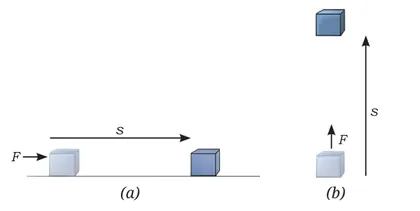
Definition: Work is done when a force applied on a body causes displacement of the body in the direction of the force. It is a scalar quantity.
Mathematical expression (constant force): If a constant force F acts on a body and the body moves through a displacement s, making an angle θ between the force and displacement vectors, then
W = F s cosθ.
Special cases and sign convention:
- If θ = 0° (force parallel to displacement in same direction): W = F s (positive work).
- If θ = 90° (force perpendicular to displacement): W = 0 (no work done by that force).
- If θ = 180° (force opposite to displacement): W = −F s (negative work).
Variable force: If the force varies with position, the work done while the object moves from x1 to x2 is the area under the F(x) vs x curve: W = ∫(x1 to x2) F(x) dx.
Graphical interpretation: For a force-versus-displacement graph, the work done equals the area under the curve between the initial and final displacements. Positive area (above x-axis) gives positive work, negative area (below x-axis) gives negative work.
Units and dimensions: SI unit of work is joule (J). 1 J = 1 N·m. Dimensional formula: [M L^2 T−2].
Important notes:
- Work depends on the component of force along the displacement (F cosθ).
- Forces perpendicular to displacement (e.g., centripetal force in uniform circular motion) do no work and do not change kinetic energy.
- Work can be positive, negative or zero.
Quick example (numeric): A force of 10 N is applied at 30° to the horizontal and moves an object 5 m horizontally. Work = 10 × 5 × cos30° = 50 × 0.866 = 43.3 J.
- Pushing a wall: You apply a force but there is no displacement → work = 0 J.
- Lifting a book vertically up by height h: Applied force (upwards) does positive work; if lifted at constant speed, work by you = m g h.
- Work done by gravity when lifting the book up by h: gravity (downwards) does negative work = −m g h.
- Carrying a bag horizontally at constant height: The vertical force (your lift) is perpendicular to horizontal displacement → work done by that vertical force = 0 J.
- Pulling a suitcase with a rope at an angle: Only the horizontal component F cosθ does work in producing horizontal displacement.
- Friction opposing motion on a rough surface: friction does negative work (removes mechanical energy) equal to −(friction force) × (displacement).
- Work (constant force): W = F s cosθ
- If force is parallel to displacement (θ = 0): W = F s
- If force is perpendicular to displacement (θ = 90°): W = 0
- Work by gravity when object lowered/raised by height h: W_gravity = −m g h (for upward displacement), work by applied upward force = +m g h (at constant speed)
- Variable force: W = ∫(x1 to x2) F(x) dx
- SI unit: 1 joule (J) = 1 newton metre (N·m); Dimensional formula: [M L^2 T^−2]
Energy
What is Energy?
Energy is the capacity of a body or system to do work. Whenever a body can produce change or cause motion it possesses energy. Energy is a scalar quantity. The SI unit of energy is the joule (J). One joule = one newton-meter (1 J = 1 N·m).
Forms of Energy
Energy appears in many forms: kinetic energy (energy of motion), potential energy (stored energy due to position or configuration), thermal (heat), chemical, electrical, light (radiant), sound and nuclear energy. In mechanics we mainly deal with kinetic and potential energy.
Kinetic Energy (KE)
A body of mass m moving with speed v has kinetic energy given by KE = 1/2 m v^2. KE depends on mass and the square of speed. (SI unit: J)
Gravitational Potential Energy (GPE)
A body of mass m at height h above a chosen reference level has gravitational potential energy PE = m g h, where g is the acceleration due to gravity (≈ 9.8 m/s^2 near Earth's surface). PE depends on mass and height.
Work and Energy Relationship
Work is the process of energy transfer. For a constant force F acting through displacement s at angle θ to the direction of motion, the work done is W = F s cos θ. The work done by net force on a body changes its kinetic energy (Work–Energy Theorem): W_net = ΔKE = KE_final − KE_initial.
Conservation of Mechanical Energy
If only conservative forces (like gravity) act, mechanical energy (KE + PE) remains constant: KE_initial + PE_initial = KE_final + PE_final. In the presence of non-conservative forces (friction, air resistance), mechanical energy is not conserved; some mechanical energy is converted to other forms (e.g., heat).
Power
Power is the rate at which work is done or energy is transferred: P = W / t. SI unit is watt (W), where 1 W = 1 J/s. Electrical energy is often measured in kilowatt-hours (kWh): 1 kWh = 3.6 × 10^6 J.
Key ideas to remember
- Energy can be transformed from one form to another but total energy is conserved in an isolated system.
- Kinetic energy depends on v^2, so doubling speed quadruples KE.
- Potential energy depends on choice of reference level for height.
- Lifting a book: When you lift a book of mass m by height h, you do work W = m g h and increase its gravitational potential energy by m g h.
- A ball rolling down an incline: Gravitational potential energy converts into kinetic energy; at the bottom PE_loss = KE_gain (neglecting friction).
- Car brakes: A moving car's kinetic energy is transformed into thermal energy in the brakes and sound when stopping.
- Hydroelectric power: Water stored at height (potential energy) flows down (kinetic energy) and turns turbines to produce electrical energy.
- Battery-powered torch: Chemical energy in the battery converts to electrical energy and then to light and heat in the bulb.
- SI unit of energy: joule (J); 1 J = 1 N·m
- Work (constant force): W = F·s·cos(θ)
- Kinetic energy: KE = 1/2 m v^2
- Gravitational potential energy: PE = m g h
- Work–Energy theorem: W_net = ΔKE = KE_final − KE_initial
- Conservation of mechanical energy (no non-conservative forces): KE_initial + PE_initial = KE_final + PE_final
Kinetic Energy
What is kinetic energy?
Kinetic energy is the energy possessed by an object because of its motion. Any moving object — a running child, a flowing river, a flying ball — has kinetic energy.
Formula
For a body of mass m moving with speed v, the kinetic energy (K or KE) is given by
KE = 1/2 m v2.
SI unit: joule (J). 1 J = 1 kg·m2·s−2.
Derivation (using work done)
If a net force F acts on a body of mass m and displaces it by s, the work done by the force is W = F·s. Using Newton's second law (F = ma) and the kinematic relation vf2 − vi2 = 2as, we get:
- W = F s = m a s
- Using vf2 − vi2 = 2 a s, we get W = (1/2) m (vf2 − vi2)
- Therefore W = ΔKE = KEfinal − KEinitial. If vi = 0, KE = (1/2) m v2.
Key points to remember
- KE is a scalar quantity (no direction).
- KE ≥ 0 for any object; KE = 0 when the object is at rest relative to the chosen frame.
- KE depends on mass and the square of speed: doubling mass doubles KE; doubling speed increases KE by four times.
- Kinetic energy is frame dependent: an object may have different KE measured from different reference frames.
- Work–energy theorem: net work done on a body = change in its kinetic energy.
Energy transformations
Kinetic energy often appears by conversion from other forms: gravitational potential energy → kinetic energy (falling object), chemical energy → kinetic energy (car engine), kinetic energy → thermal energy (brakes).
- A 2 kg ball thrown at 5 m/s: KE = 1/2 × 2 × 5² = 25 J.
- A car of mass 1000 kg moving at 20 m/s: KE = 1/2 × 1000 × 20² = 400,000 J (converted to heat when brakes are applied).
- A cyclist pedaling faster: if speed doubles, kinetic energy increases fourfold, so much more effort is needed to double speed.
- Wind turning a turbine: moving air with mass has kinetic energy that the turbine converts to electrical energy.
- A stone dropped from a height: gravitational potential energy converts into kinetic energy as it falls (ignoring air resistance).
- A bullet: small mass but very high speed gives large kinetic energy, which is why bullets can do a lot of damage.
- KE = (1/2) m v^2
- ΔKE = KE_final − KE_initial = (1/2) m (v_f^2 − v_i^2)
- Work–energy theorem: W_net = ΔKE
- SI unit: 1 J = 1 kg·m^2·s^−2
Potential Energy
What is Potential Energy?
Potential energy (PE) is the energy possessed by an object because of its position or configuration. It is stored energy that can be converted into other forms (for example, kinetic energy) when conditions change.
Types of Potential Energy relevant for Class 9
- Gravitational potential energy (near Earth's surface): Energy due to an object's height above a chosen reference level. If an object of mass m is raised by height h, the increase in its gravitational potential energy is U = mgh (where g is acceleration due to gravity ≈ 9.8 m/s²).
- Elastic potential energy: Energy stored in a stretched or compressed spring or elastic object. For a spring that obeys Hooke's law (force F = kx), the elastic potential energy stored when displaced by x is U = 1/2 k x².
- Chemical potential energy: Energy stored in chemical bonds (e.g., food, fuels, batteries). This is released or absorbed in chemical reactions.
Why mgh? (Short derivation)
To lift a mass m steadily upward through height h against gravity we do work W = force × distance = mg × h. This work goes into increasing the object’s gravitational potential energy, so ΔU = mgh.
Reference level and sign
Potential energy depends on the chosen zero (reference) level. Only changes in potential energy are physically meaningful. For gravitational PE near Earth we often set U = 0 at ground level, but any reference is allowed.
Conservation of Mechanical Energy (simple statement)
In absence of non-conservative forces (like friction), the total mechanical energy E = KE + PE remains constant. As PE decreases, KE increases and vice versa (example: a falling object converts gravitational PE to kinetic energy).
Units and dimensions
Unit of potential energy is the joule (J). 1 J = 1 N·m. Dimension: [M L² T⁻²].
Important notes for Class 9
- Potential energy is stored energy due to position/configuration.
- Only changes in potential energy matter for work and energy conversion.
- Gravitational PE near Earth is linear in height (mgh); elastic PE is quadratic in displacement (1/2 k x²).
- A book kept on a table has gravitational potential energy relative to the floor; if it falls it converts PE to kinetic energy.
- Water stored at the top of a dam has gravitational potential energy which can be converted to electricity via turbines.
- A compressed spring in a toy car stores elastic potential energy; releasing it propels the car.
- A drawn bow stores elastic potential energy; when released, it converts to kinetic energy of the arrow.
- Food and fuel store chemical potential energy; when oxidized, this energy is released as heat and work.
- A roller coaster at the top of a hill has high gravitational potential energy which converts to kinetic energy down the slope.
- Gravitational potential energy (near Earth's surface): U = m g h (U in joules, m in kg, g ≈ 9.8 m/s², h in m)
- Change in gravitational potential energy: ΔU = m g Δh
- Elastic potential energy (spring obeying Hooke's law): U = 1/2 k x² (k is spring constant, x is displacement)
- Work done against gravity = increase in potential energy: W = ΔU
- Total mechanical energy (no friction): E_total = Kinetic energy + Potential energy = KE + PE
Work–Energy Theorem
Statement: The net work done on an object by all forces acting on it is equal to the change in its kinetic energy.
Meaning: If an object of mass m has initial speed u and final speed v after some displacement, then the total (net) work W_net done on it satisfies W_net = K_final - K_initial, where kinetic energy K = 1/2 m v2.
Derivation (brief): Take motion along the line of action of the net force. By Newton's second law, F_net = m a. A small amount of work done when the object moves a small displacement ds is dW = F_net · ds. Using a = dv/dt and ds = v dt, dW = m a v dt = m v dv. Integrating from initial speed u to final speed v gives
W_net = ∫uv m v dv = 1/2 m v2 - 1/2 m u2 = ΔK.
Important points:
- W_net means the algebraic sum of work done by all forces (positive for forces that increase speed, negative for forces that decrease speed).
- If W_net = 0 then the speed does not change and kinetic energy remains constant.
- The theorem assumes constant mass and applies to the net force (vector sum). For non-collinear cases use vector dot product F · ds and integrate along the path.
- The work–energy theorem is consistent with conservation of mechanical energy: when only conservative forces act, work is converted between kinetic and potential energy; non-conservative forces (like friction) do work that changes the total mechanical energy.
- Pushing a trolley: When you push a trolley and it speeds up, the net work done by your push (minus any friction) equals the increase in the trolley's kinetic energy.
- Braking a car: The brakes do negative work on the car (remove kinetic energy). The net work done by friction with the road reduces the car's kinetic energy, bringing it to rest.
- Dropping a ball: As a ball falls, gravity does positive work and the ball's kinetic energy increases. If air resistance is significant, the net work (gravity minus air resistance) equals the change in kinetic energy.
- Lifting a book at constant speed: If you lift a book slowly at constant speed, the net work on the book is zero (your upward pull cancels gravity), so its kinetic energy does not change; however, you do positive work against gravity which is stored as gravitational potential energy.
- Work by a constant force: W = F s cosθ (θ is angle between force and displacement)
- Work (general): W = ∫ F · ds (line integral along the path)
- Work–Energy Theorem: W_net = ΔK = 1/2 m (v^2 - u^2)
- Kinetic energy: K = 1/2 m v^2
- Infinitesimal form: dW = F · ds = m v dv
Conservation of Mechanical Energy
What is mechanical energy? Mechanical energy of a system is the sum of its kinetic energy (energy of motion) and potential energy (energy due to position). For common Class 9 problems, KE = 1/2 m v² and gravitational PE = m g h.
Statement (Conservation of Mechanical Energy): If only conservative forces (like gravity or ideal spring force) do work on a system and non-conservative forces (like friction or air resistance) are absent or negligible, the total mechanical energy remains constant. In other words, the sum of kinetic and potential energies at any two instants is equal:
KE₁ + PE₁ = KE₂ + PE₂
Simple reasoning / derivation (qualitative): When an object falls under gravity, its potential energy decreases and that lost potential energy appears as increased kinetic energy. If no energy is lost to heat or sound, the loss in PE exactly equals the gain in KE, so the total stays the same.
Example relation from energy conservation: For an object of mass m released from rest at height h₁ and reaching height h₂ with speed v,
m g h₁ + 0 = m g h₂ + 1/2 m v²
so 1/2 m v² = m g (h₁ − h₂). If released from rest and h₂ = 0, v = sqrt(2 g h₁).
When mechanical energy is not conserved: If friction or air resistance is present, mechanical energy decreases; some mechanical energy is transformed into thermal energy, sound, etc. In that case, work done by non-conservative forces = change in mechanical energy (W_nc = Δ(KE + PE)).
Including elastic potential: For systems with springs, elastic potential energy U_s = 1/2 k x² is included in total mechanical energy: KE + m g h + 1/2 k x² = constant (when no non-conservative forces act).
- Pendulum (ideal, no air resistance): At the highest point KE is minimum and PE is maximum; at the lowest point KE is maximum and PE is minimum. Total mechanical energy stays constant.
- Free fall: A ball dropped from height converts its gravitational PE to KE; neglecting air resistance, m g h = 1/2 m v².
- Roller coaster (ignoring friction): At the top the coaster has high PE and low KE; as it descends PE converts to KE allowing it to speed up; total mechanical energy is constant.
- Mass on a spring (ideal spring, no damping): Energy oscillates between KE and elastic potential (1/2 k x²); total mechanical energy remains constant.
- A sliding block on a frictionless incline: Loss in gravitational PE equals gain in KE at the bottom.
- Real life with friction (not conserved): A sliding sled slows down because some mechanical energy is converted into heat due to friction.
- Kinetic energy: KE = 1/2 m v²
- Gravitational potential energy (near Earth's surface): PE = m g h
- Elastic potential energy (spring): U_s = 1/2 k x²
- Conservation (no non-conservative work): KE₁ + PE₁ = KE₂ + PE₂
- Velocity from energy (fall from rest): v = sqrt(2 g (h₁ − h₂))
- Work by non-conservative forces: W_nc = Δ(KE + PE) (so if W_nc = 0, mechanical energy is conserved)
Power
Definition: Power is the rate at which work is done or the rate at which energy is transferred. It tells how fast work is being done.
Average power over a time interval Δt is given by P = W / Δt, where W is the work done in that interval. The SI unit of power is the watt (W): 1 W = 1 J/s. Another common unit is horsepower (hp): 1 hp ≈ 746 W.
Instantaneous power: If work changes continuously, instantaneous power is the time derivative of work: P = dW/dt. Using dW = F · ds for a small displacement ds under force F, dividing by dt gives the important relation for a moving object:
P = F · v (dot product). In scalar form, when force and velocity are along the same line, P = F v. If force and velocity are perpendicular, P = 0 (force does no work on the object at that instant). A negative power means the force is taking energy out of the system (opposes motion).
Useful forms: when lifting a mass m through height h in time t, work W = m g h and average power P = m g h / t. When a constant force F moves an object at constant speed v, P = F v.
- A person lifts a 10 kg bucket (weight ≈ 98 N) by 2 m in 4 s. Work = m g h = 10×9.8×2 = 196 J. Average power = 196 / 4 = 49 W.
- An electric bulb rated 60 W converts electrical energy to light and heat at the rate of 60 joules per second.
- A car engine applies a driving force of 2000 N and the car moves at 20 m/s. Mechanical power output ≈ F×v = 2000×20 = 40,000 W (40 kW).
- Climbing stairs: two people climb identical stairs but one takes half the time — the faster climber has twice the average power, since same work in half the time.
- A fan motor doing more work per second (spinning faster or under greater load) delivers more power; its power rating tells energy consumption rate.
- Regenerative braking: the brakes do negative power on the car (they remove kinetic energy), converting it to heat (or electrical energy in regenerative systems).
- Average power: P = W / Δt
- Instantaneous power: P = dW/dt
- Power in translational motion: P = F · v (if force and velocity are collinear: P = F v)
- Work for lifting: W = m g h → P = m g h / t (for lifting in time t)
- Unit conversion: 1 W = 1 J/s, 1 hp ≈ 746 W
Work Done by Different Forces
What is work? Work done by a force on an object is the product of the component of the force along the displacement and the magnitude of that displacement. For a constant force F making an angle θ with the displacement s:
W = F s cosθ
Sign of work:
- W > 0 (positive) when the component of the force is in the same direction as displacement (0 < θ < 90°).
- W = 0 when the force is perpendicular to displacement (θ = 90°) or when there is no displacement.
- W < 0 (negative) when the force has a component opposite the displacement (90° < θ < 180°).
Special cases (common forces):
- Gravitational force (weight): If an object of mass m is moved vertically by height h, the work done by gravity is W = -m g h if the object is lifted up (gravity opposes displacement). If the object moves down by h, gravity does positive work +m g h. Importantly, work done by gravity depends only on vertical displacement (height change), not the path.
- Normal force: Normal is usually perpendicular to the surface. For a displacement along the surface, normal force does zero work because it is perpendicular to displacement.
- Frictional force: Friction opposes motion, so it does negative work. If kinetic friction f_k acts opposite a displacement s along the surface, W_friction = -f_k s.
- Spring force (Hooke's law): For a spring with constant k, force F = -k x (x measured from natural length). Work done by the spring when it is stretched/compressed from x = 0 to x = X is W_spring = 1/2 k X^2 (the spring does negative work on the agent stretching it but positive work on the mass if it is released—sign depends on chosen direction).
- Variable forces: When force varies with position, work is the area under the force–displacement curve: W = ∫ F · ds (from initial to final position).
- Work–energy theorem: The net work done on an object equals its change in kinetic energy: W_net = ΔK = 1/2 m v_f^2 − 1/2 m v_i^2.
Key ideas to remember: Work depends on the component of the force along the displacement, not on the total force. Forces perpendicular to motion (like centripetal or normal on flat motion) do no work. Path independence applies for conservative forces like gravity and spring force (work depends only on initial and final positions), but friction is non-conservative (work depends on the path length).
- Lifting a book vertically by height h: Force by you is upward; displacement is upward. Work done by you = F s cos0 = F h (if F = mg to raise at constant speed, W = m g h). Work done by gravity = -m g h.
- Carrying a bag horizontally at constant height: Your upward force equals weight but displacement is horizontal. Work done by the upward force = F s cos90° = 0 (no work by the upward force). Gravity also does zero work because displacement is perpendicular to weight.
- Pushing a box across a rough floor with friction: If you push with a horizontal force F and kinetic friction f_k opposes motion over distance s, work by you = F s, work by friction = -f_k s (negative), net work = (F - f_k) s.
- Pushing against a wall: No displacement of the wall means s = 0, so work done = 0 even though you apply a large force.
- Stretching a spring from natural length to extension X: Force varies as F = k x; work (area under F–x graph) = 1/2 k X^2 (energy stored in spring).
- Pendulum at lowest point: Tension (centripetal) is perpendicular to instantaneous displacement, so tension does zero work; gravity does positive or negative work depending on motion direction and height change.
- For constant force: W = F s cosθ (θ is angle between force and displacement)
- For variable force: W = ∫(from s_i to s_f) F(s) · ds (area under F vs s curve)
- Work by gravity for vertical displacement h: W_gravity = -m g h (negative when lifting up), magnitude = m g h
- Work by spring (Hooke's law, from 0 to X): W_spring = ∫_0^X k x dx = 1/2 k X^2
- Work done by friction (constant kinetic friction): W_fric = -f_k s
- Work–energy theorem (net work): W_net = ΔK = 1/2 m v_f^2 − 1/2 m v_i^2
Units and Dimensions
What are units and dimensions?
Units are standard measures used to express physical quantities (for example, metre for length, kilogram for mass, second for time). Dimensions describe the physical nature of a quantity in terms of basic physical quantities (for example, the dimension of velocity is length/time).
Base quantities and SI units
The seven SI base quantities commonly used are: length (L) — metre (m), mass (M) — kilogram (kg), time (T) — second (s), electric current — ampere (A), temperature — kelvin (K), amount of substance — mole (mol), luminous intensity — candela (cd). In mechanics we usually work with M, L and T.
Dimensional formula and notation
The dimensional formula of a quantity expresses it as powers of base dimensions M, L, T (and others if needed). We write it as M^a L^b T^c. Example: velocity v = distance/time so Dim(v) = L T-1. The principle of dimensional homogeneity states that all terms in a physical equation must have the same dimensions.
Why dimensional analysis is useful
- Check correctness of formulas (dimensions must match).
- Obtain the form of a relationship up to a dimensionless constant.
- Convert units and derive units of derived quantities.
Limitations: it cannot give numerical dimensionless constants, signs, or dimensionless functions (like trigonometric or exponential dependence).
Common derived quantities (dimension & SI unit)
- Displacement/Length: Dim = L ; unit = m
- Time: Dim = T ; unit = s
- Velocity: Dim = L T-1 ; unit = m s-1
- Acceleration: Dim = L T-2 ; unit = m s-2
- Force: Dim = M L T-2 ; unit = newton (N) = kg m s-2
- Work / Energy: Dim = M L2 T-2 ; unit = joule (J) = N m = kg m2 s-2
- Power: Dim = M L2 T-3 ; unit = watt (W) = J s-1
- Pressure: Dim = M L-1 T-2 ; unit = pascal (Pa) = N m-2
How to find dimensional formula (example)
Given W = F × s. Dim(F) = M L T-2, Dim(s) = L. So Dim(W) = (M L T-2) (L) = M L2 T-2.
- Lifting a 2 kg textbook vertically by 0.5 m: Work = m g h gives units J (kg·m^2·s^-2).
- Pushing a trolley: For constant force, work done is proportional to displacement (W = F·s).
- A 60 W bulb converts 60 joules of electrical energy to light/heat every second (power concept).
- Car tyre pressure: a pressure gauge reads pascals (Pa); pressure = force/area so Dim = M L^-1 T^-2.
- Checking formula plausibility: If someone suggests E = mv, dimensional check fails since E (M L^2 T^-2) ≠ m v (M L T^-1).
- Force: F = m a ; Unit: N (kg·m·s^-2) ; Dim: M L T^-2
- Work/Energy: W = F × s ; Unit: J (kg·m^2·s^-2) ; Dim: M L^2 T^-2
- Kinetic energy: KE = 1/2 m v^2 ; Dim: M L^2 T^-2
- Potential energy: PE = m g h ; Dim: M L^2 T^-2
- Power: P = W / t ; Unit: W (J·s^-1) ; Dim: M L^2 T^-3
- Momentum: p = m v ; Dim: M L T^-1
Applications and Numerical Problems
Overview
Applications and Numerical Problems in Work and Energy cover how work and energy concepts are used to analyse real situations and solve quantitative questions. Main ideas used are: work (scalar product of force and displacement), kinetic energy, potential energy (gravitational and elastic), work–energy theorem, conservation of mechanical energy (when non‑conservative forces are absent), and power.
Key ideas and problem strategy
- Identify forces doing work and the path of motion. Choose sign convention (usually displacement direction positive).
- If force is constant and along displacement: W = F d cosθ. If force varies: W = area under F vs x curve or W = ∫F dx.
- Use work–energy theorem: net work by all forces = change in kinetic energy, W_net = ΔK = 1/2 m(v_f^2 − v_i^2).
- Use conservation of mechanical energy when only conservative forces (gravity, spring) act: K_i + U_i = K_f + U_f. If non‑conservative forces (friction) do work, include W_nc: K_i + U_i + W_nc = K_f + U_f.
- For springs: potential energy U_s = 1/2 k x^2. Work done by spring when stretched/compressed: W_spring = −ΔU_s = −(1/2 k x_f^2 − 1/2 k x_i^2).
- Power: average P = W/Δt. Instantaneous P = F·v.
Sample numerical problems (solved)
- Constant force along displacement
Problem: A horizontal force of 10 N pulls a box 5 m along the same direction. Work done?
Solution: W = F d = 10 × 5 = 50 J. - Lifting against gravity (constant speed)
Problem: A 5 kg weight is lifted vertically by 2.0 m at constant speed. Find work done by (a) gravity, (b) the person doing the lifting. Use g = 9.8 m/s2.
Solution: Change in gravitational potential ΔU = m g h = 5 × 9.8 × 2 = 98 J. Work done by gravity = −98 J (gravity acts downward while displacement is upward). Work done by person = +98 J (to raise at constant speed net work on mass is zero, so applied force equals weight). - Work–energy theorem
Problem: A car of mass 1000 kg speeds up from 10 m/s to 20 m/s. Net work done on car?
Solution: ΔK = 1/2 m(v_f^2 − v_i^2) = 0.5 × 1000 × (400 − 100) = 0.5 × 1000 × 300 = 150000 J = 1.5 × 10^5 J. - Spring energy
Problem: A spring with k = 200 N/m is compressed by 0.10 m. Energy stored?
Solution: U = 1/2 k x^2 = 0.5 × 200 × (0.10)^2 = 0.5 × 200 × 0.01 = 1.0 J. - Inclined plane with friction (using energy)
Problem: A 2 kg block is pushed up a rough plane to height 1.5 m. If friction does 12 J of work (negative), how much work must the push supply to raise it at constant speed?
Solution: Required increase in potential = m g h = 2 × 9.8 × 1.5 = 29.4 J. Work by friction = −12 J. Net work needed to change energy = ΔU + work_friction = 29.4 + 12 = 41.4 J. So applied force must do +41.4 J.
Tips for numerical problems
- Draw free‑body diagram and energy bar (K and U) before calculations.
- Check whether to use work formula directly, work–energy theorem, or energy conservation — energy methods often simplify problems with variable forces or pathways.
- Use area under F vs x graph for variable forces: area = work.
- Watch signs: work done by conservative field decreases its potential (work by gravity is negative when object is raised).
- Lifting water from a well: the person does work equal to the increase in gravitational potential energy of the water (mgh).
- Compressing a spring in a toy: the work done is stored as elastic potential energy (1/2 k x^2) which later converts to kinetic energy when released.
- A pendulum: energy oscillates between kinetic energy at lowest point and gravitational potential energy at highest points; mechanical energy is conserved (neglecting air resistance).
- Braking a bicycle: friction does negative work and removes kinetic energy, converting it to thermal energy.
- Roller coaster: at the highest point potential energy is maximal, which converts to kinetic energy as it descends; design uses conservation of energy to predict speeds.
- Electric fan or bulb: chemical/electrical energy is converted to mechanical work or heat; power ratings tell energy per unit time.
- Work by constant force: W = F d cosθ
- Work by variable force: W = ∫ F(x) dx (area under F–x graph)
- Kinetic energy: K = 1/2 m v^2
- Gravitational potential energy (near Earth): U_g = m g h
- Elastic (spring) potential energy: U_s = 1/2 k x^2
- Work–energy theorem: W_net = ΔK = 1/2 m (v_f^2 − v_i^2)
Key Concepts
- Work
- Product of the component of force along displacement and the displacement: W = F·s·cosθ. Work is a scalar and can be positive, negative or zero.
- Energy
- Capacity of a body or system to do work. Energy is a scalar and exists in various forms (kinetic, potential, thermal, etc.).
- Kinetic Energy
- Energy possessed by a body due to its motion: KE = 1/2 m v², where m is mass and v is speed.
- Potential Energy
- Energy stored in a body due to its position or configuration relative to a reference point.
- Gravitational Potential Energy
- Potential energy due to an object's position in a gravitational field: U = mgh (for near-Earth surfaces), where h is height above reference.
- Elastic Potential Energy
- Energy stored in an elastic object when it is stretched or compressed: U = 1/2 k x² for a spring (k = spring constant, x = displacement).
- Mechanical Energy
- Sum of kinetic and potential energies of a system: Mechanical energy = KE + PE.
- Law of Conservation of Energy
- In an isolated system, total energy remains constant; energy can be transformed from one form to another but not created or destroyed.
- Power
- Rate at which work is done or energy is transferred: P = W/t (average) or P = dW/dt (instantaneous).
- Joule
- SI unit of work and energy: 1 joule (J) = 1 newton · metre (1 N·m).
- Watt
- SI unit of power: 1 watt (W) = 1 joule per second (1 J/s).
- Force
- An interaction that changes or tends to change the state of motion of an object; a vector quantity measured in newtons (N).
- Displacement
- Vector quantity that represents change in position of an object: straight-line distance from initial to final point with direction.
- Scalar
- Physical quantity described only by magnitude, without direction.
- Vector
- Physical quantity having both magnitude and direction.
- Work Done by a Constant Force
- When force is constant, work = magnitude of force × displacement × cosθ, where θ is angle between force and displacement.
- Work Done by a Variable Force
- Work is the area under the force–displacement curve and is given by the integral W = ∫ F·dx between initial and final positions.
- Conservative Force
- A force for which work done is path-independent and depends only on initial and final positions; associated with potential energy (e.g., gravity, elastic force).
- Non-conservative Force
- A force for which work done depends on the path taken; it typically dissipates mechanical energy as heat (e.g., friction, air resistance).
- Work–Energy Theorem
- Net work done on an object equals the change in its kinetic energy: W_net = ΔKE = 1/2 m(v_f² − v_i²).
End-of-Chapter Trial Paper & Test Questions
Topic-wise questions to test your understanding of every concept in this chapter.
-
A force of 10 N moves an object 5 m in the direction of the force. How much work is done? / 10 N का बल किसी वस्तु को बल की दिशा में 5 m तक विस्थापित करता है। कितना कार्य होता है? (a) 2 J (b) 50 J (c) 15 J (d) 0.5 J
Show answer
(b) 50 J / (b) 50 J — W = F × s × cos0° = 10 × 5 × 1 = 50 J. When force and displacement are in the same direction, θ = 0° and cosθ = 1. / W = F × s × cos0° = 10 × 5 × 1 = 50 J। जब बल और विस्थापन एक ही दिशा में हों, θ = 0° और cosθ = 1 होता है।
-
A car of mass 1000 kg increases its speed from 10 m/s to 20 m/s. What is the net work done on the car? / 1000 kg द्रव्यमान की एक कार की चाल 10 m/s से बढ़कर 20 m/s हो जाती है। कार पर किया गया कुल कार्य क्या है? (a) 100,000 J (b) 50,000 J (c) 150,000 J (d) 200,000 J
Show answer
(c) 150,000 J / (c) 150,000 J — By the work–energy theorem: W = ½m(v²–u²) = ½ × 1000 × (400–100) = ½ × 1000 × 300 = 150,000 J. / कार्य-ऊर्जा प्रमेय से: W = ½m(v²–u²) = ½ × 1000 × (400–100) = 1,50,000 J।
-
Work done by a force is zero when the angle between force and displacement is ____. / बल और विस्थापन के बीच का कोण ____ होने पर बल द्वारा किया गया कार्य शून्य होता है।
Show answer
90° — When force is perpendicular to displacement, W = Fs cos90° = 0. For example, the normal force on a horizontal surface does no work as the object moves horizontally. / 90° — जब बल विस्थापन के लंबवत हो, W = Fs cos90° = 0। उदाहरण के लिए, क्षैतिज गति में लंब प्रतिक्रिया बल कोई कार्य नहीं करता।
-
True or False: Potential energy depends on the choice of reference level, but changes in potential energy do not. / सत्य या असत्य: स्थितिज ऊर्जा संदर्भ स्तर के चुनाव पर निर्भर करती है, लेकिन स्थितिज ऊर्जा में परिवर्तन नहीं।
Show answer
True / सत्य — The absolute value of potential energy depends on the reference level chosen, but the change ΔU = mgh is independent of the reference because only the height difference h matters. / स्थितिज ऊर्जा का निरपेक्ष मान संदर्भ स्तर पर निर्भर करता है, लेकिन परिवर्तन ΔU = mgh संदर्भ से स्वतंत्र है क्योंकि केवल ऊँचाई का अंतर h मायने रखता है।
-
State the work–energy theorem. / कार्य-ऊर्जा प्रमेय बताइए।
Show answer
The work–energy theorem states that the net work done on an object equals the change in its kinetic energy: W_net = ΔKE = ½mv² – ½mu². / कार्य-ऊर्जा प्रमेय के अनुसार किसी वस्तु पर किया गया कुल कार्य उसकी गतिज ऊर्जा में परिवर्तन के बराबर होता है: W_net = ΔKE = ½mv² – ½mu²। It is derived from Newton's second law and the kinematic equations. / यह न्यूटन के दूसरे नियम और गतिक समीकरणों से व्युत्पन्न होता है।
-
A spring with spring constant k = 200 N/m is compressed by 0.10 m. What is the elastic potential energy stored? / k = 200 N/m वाली एक स्प्रिंग को 0.10 m संपीडित किया जाता है। संचित लोचदार स्थितिज ऊर्जा क्या है? (a) 2 J (b) 20 J (c) 1 J (d) 10 J
Show answer
(c) 1 J / (c) 1 J — U = ½kx² = ½ × 200 × (0.10)² = ½ × 200 × 0.01 = 1 J. The elastic potential energy is stored as deformation in the spring. / U = ½kx² = ½ × 200 × (0.10)² = ½ × 200 × 0.01 = 1 J। लोचदार स्थितिज ऊर्जा स्प्रिंग में विरूपण के रूप में संचित होती है।
-
A motor lifts a 50 kg load through 10 m in 5 s. Calculate the power of the motor (g = 10 m/s²). / एक मोटर 50 kg भार को 5 s में 10 m तक उठाती है। मोटर की शक्ति की गणना कीजिए (g = 10 m/s²)।
Show answer
Power = 1000 W / शक्ति = 1000 W — Work done W = mgh = 50 × 10 × 10 = 5000 J. Power P = W/t = 5000/5 = 1000 W (1 kW). / किया गया कार्य W = mgh = 50 × 10 × 10 = 5000 J। शक्ति P = W/t = 5000/5 = 1000 W (1 kW)।
-
Explain the law of conservation of mechanical energy with the example of a freely falling ball. / मुक्त रूप से गिरती गेंद के उदाहरण से यांत्रिक ऊर्जा संरक्षण का नियम समझाइए।
Show answer
When a ball falls freely from height h (no air resistance), its gravitational PE decreases while its KE increases. At any point, PE + KE = constant = mgh (total mechanical energy). At the top: KE = 0, PE = mgh. Just before hitting ground: KE = mgh, PE = 0. Total energy remains conserved. / जब गेंद ऊँचाई h से मुक्त रूप से गिरती है (वायु प्रतिरोध नहीं), उसकी स्थितिज ऊर्जा घटती है जबकि गतिज ऊर्जा बढ़ती है। किसी भी बिंदु पर PE + KE = स्थिरांक = mgh। शीर्ष पर KE = 0, PE = mgh। जमीन से टकराने से पहले KE = mgh, PE = 0। कुल ऊर्जा संरक्षित रहती है।
Related Laws & Principles
Explore allFoundational laws & principles behind this chapter. Each one opens a full page — what it says, why it matters, five practice questions and the mistakes to avoid.