Overview
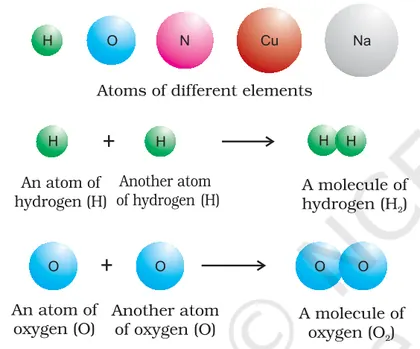
This chapter 'Some Basic Concepts of Chemistry' introduces the fundamental ideas and numerical tools that form the foundation of chemical study. It explains how chemists describe matter (atoms, molecules, ions), presents the classical laws of chemical combination (conservation of mass, constant proportions, multiple proportions), and gives an account of Dalton's atomic theory and its limitations. The chapter develops quantitative concepts: relative atomic and molecular masses, the mole and Avogadro's number (6.022×10^23), molar mass, percentage composition, empirical and molecular formulas, and formula units for ionic compounds. It also teaches stoichiometry — using balanced chemical equations to calculate amounts of reactants and products, including limiting reagent and yield concepts. Overall the chapter equips students to move from a qualitative understanding of chemical change to precise quantitative calculations required in problem solving and laboratory work.
Learning Objectives
- Define mole, Avogadro's number and molar mass, and relate them to number of particles and mass of a substance
- Explain the laws of chemical combination (law of conservation of mass, law of definite proportions, law of multiple proportions) with an example for each
- State Dalton's atomic theory and discuss its main limitations relevant to modern chemistry
- Distinguish between atom, molecule and formula unit, and determine atomic, molecular and formula masses
- Calculate empirical and molecular formulas from percent composition and experimental elemental analysis data
- Calculate mass, number of moles, number of particles and volumes of gases (at STP or given conditions) using the mole concept and Avogadro's law
- Apply stoichiometry to balance chemical equations and perform quantitative calculations for reactants and products
- Identify the limiting reagent in a reaction and calculate theoretical yield, actual yield and percent yield
Topics in this chapter
11 topics · tap a topic title to jump straight to it.
Nature and Classification of Matter
What is Matter?
Matter is anything that has mass and occupies space. Everything around us — air, water, rocks, living beings — is made of matter. Matter is composed of particles (atoms, molecules, ions) and exhibits measurable physical and chemical properties.
Properties of Matter
- Physical properties: observable without changing identity (mass, volume, density, melting/boiling point, color, conductivity).
- Chemical properties: describe reactivity and composition change (combustibility, acidity, oxidation).
States of Matter (Particle View)
- Solid: definite shape & volume; particles closely packed in fixed positions; very low kinetic energy.
- Liquid: definite volume, shape of container; particles close but can move/flow; moderate kinetic energy.
- Gas: no definite shape or volume; particles far apart and move freely; high kinetic energy.
Particle diagrams are useful: tightly packed ordered dots for solids, close but disordered dots for liquids, and widely spaced fast-moving dots for gases.
Classification of Matter
Broadly matter is classified by composition into pure substances and mixtures:
- Pure substances: fixed composition and constant properties. Two types:
- Elements: simplest form of matter, cannot be broken down chemically (e.g., O, Fe, He). Composed of one type of atom.
- Compounds: two or more elements chemically combined in fixed proportion (e.g., H2O, CO2, NaCl). Properties differ from constituent elements.
- Mixtures: physical combination of two or more substances where components retain their identity. Composition may vary. Two main types:
- Homogeneous mixtures (solutions): uniform composition at molecular level (e.g., salt solution, air).
- Heterogeneous mixtures: non-uniform composition (e.g., sand + water, soil, granite).
Mixtures by Particle Size
- True solutions: solute particles < 1 nm; do not scatter light (e.g., sugar in water).
- Colloids: particle size 1–1000 nm; show Tyndall effect (e.g., milk, fog, gels).
- Suspensions: particles > 1000 nm; settle on standing (e.g., muddy water).
Physical vs Chemical Changes
- Physical change: change in state or appearance without changing composition (melting, freezing, dissolving).
- Chemical change: results in new substances with different composition and properties (rusting, combustion, digestion).
Important Laws & Concepts
- Law of Conservation of Mass: mass is neither created nor destroyed in a chemical reaction.
- Law of Definite (Constant) Proportions: a compound always contains the same elements in the same mass ratio (e.g., water is always ~88.89% O and 11.11% H by mass).
- Dalton’s atomic idea (basic): matter is made of indivisible atoms; atoms of an element are identical in mass and properties (historical; modern atomic theory refines this).
Separation Techniques (for mixtures)
Select method based on differences in physical properties:
- Filtration — particle size (solid from liquid).
- Distillation — boiling point (separate liquids or purify solvent).
- Evaporation/Crystallization — volatility/solubility (obtain solute solids).
- Chromatography — polarity/adsorption (separate components of a mixture).
- Centrifugation — density (separate colloids/suspensions).
- Magnetic separation — magnetic property (remove iron filings).
- Sublimation — ability to sublime (separate iodine or ammonium chloride from non‑subliming solids).
Summary
Matter is categorized by physical state and composition: elements and compounds (pure substances) vs mixtures (homogeneous or heterogeneous). Understanding particle nature, physical and chemical properties, and appropriate separation techniques is fundamental to chemistry and to explaining many real-life phenomena.
- Air — homogeneous mixture (major components: N2, O2, Ar, CO2) used for breathing and combustion.
- Salt solution — homogeneous solution of NaCl in water; can be separated by evaporation/crystallization.
- Seawater — complex mixture containing salts, dissolved gases, and suspended particles; desalination by distillation or reverse osmosis.
- Milk — colloidal system (emulsion) showing Tyndall effect; proteins and fats dispersed in water.
- Granite — heterogeneous mixture of minerals (quartz, feldspar, mica).
- Alloy (e.g., brass) — homogeneous mixture of metals with enhanced mechanical properties.
- Density: ρ = mass / volume (ρ = m / V). Units: kg·m⁻³ or g·cm⁻³.
- Number of moles: n = mass / molar mass (n = m / M).
- Molarity (concentration): M = n(solute) / V(solution in L).
- Mass from density: mass = density × volume (m = ρ × V).
- Percent by mass of element in compound: % = (mass of element in 1 mol of compound / molar mass of compound) × 100.
- Law of Conservation of Mass (conceptual): Total mass of reactants = Total mass of products.
Laws of Chemical Combination
Overview
"Laws of Chemical Combination" are empirical rules derived from experiments that describe how elements combine to form chemical compounds. They form the basis of stoichiometry and the atomic theory.
1. Law of Conservation of Mass (Lavoisier)
Statement: In a chemical reaction mass is neither created nor destroyed; the total mass of reactants equals the total mass of products (for a closed system).
Consequence: Mass balance in chemical equations and stoichiometric calculations.
Limitation: In nuclear reactions mass may change because of mass–energy equivalence (E = mc2).
2. Law of Definite Proportions (Proust) — Law of Constant Composition
Statement: A given chemical compound always contains its constituent elements in a fixed definite proportion by mass, independent of its source or the method of preparation.
Example implication: Pure water always has 8 g O for every 1 g H (approximately 88.81% O and 11.19% H by mass).
3. Law of Multiple Proportions (Dalton)
Statement: When two elements A and B form more than one compound, the masses of B that combine with a fixed mass of A are in the ratio of small whole numbers. This was one of the key observations supporting the idea of atoms combining in simple whole-number ratios.
Connection with Atomic and Molecular Formulae
These laws allow calculation of empirical formulas from mass (or percent) composition. If the molecular (molar) mass is known, the molecular formula can be obtained by comparing molecular mass with empirical formula mass.
Important notes
- These laws assume chemically pure substances and classical chemical reactions.
- Isotopic variations change average atomic masses but not the fixed mass ratios in a pure compound sample of fixed isotopic composition.
- For gases, Gay-Lussac's law of gaseous volumes (simple whole-number volume ratios at same T and P) is an extension when molecules behave ideally.
Worked numerical example (empirical → molecular)
Sample: A compound is 40.00% C, 6.71% H, 53.29% O by mass. Assume 100 g sample → 40.00 g C, 6.71 g H, 53.29 g O. Convert to moles: C: 40.00/12.01 ≈ 3.33 mol; H: 6.71/1.008 ≈ 6.66 mol; O: 53.29/16.00 ≈ 3.33 mol. Divide by smallest (3.33): C:1, H:2, O:1 → empirical formula CH2O. If molar mass is 180 g·mol⁻¹ then n = 180/(12.01+2×1.008+16.00) ≈ 6 → molecular formula C6H12O6 (glucose).
- Conservation of mass: In a closed beaker, 2.00 g of hydrogen reacts with 16.00 g of oxygen to give 18.00 g of water (2.00 + 16.00 = 18.00 g).
- Definite proportions: Any pure sample of water has ~11.19% hydrogen and ~88.81% oxygen by mass (H:O = 1:8 by mass).
- Multiple proportions: Carbon monoxide (CO) and carbon dioxide (CO2). 1 g of carbon combines with 1.33 g O in CO and with 2.66 g O in CO2 — the ratio 1.33:2.66 = 1:2 is a simple whole number.
- Real-life: Baking (stoichiometry) — fixed proportions of ingredients (chemically active) affect the final product; industrial synthesis uses mass balance to scale reactions.
- Analytical chemistry: Elemental analysis uses the law of definite proportions to determine empirical formulas from percent composition.
- Law of conservation (mass balance): Σ mass(reactants) = Σ mass(products)
- Percent composition (by mass) of element X = (mass of X in compound / mass of compound) × 100%
- Moles: n = mass (m) / molar mass (M)
- Empirical formula determination: convert % → grams → moles → divide by smallest → obtain simplest whole-number ratio
- Molecular formula relation: Molecular formula = (empirical formula) × n, where n = (molar mass of compound) / (empirical formula mass)
- Law of multiple proportions (qualitative): For fixed mass of element A, masses of B in different compounds are in ratios of small whole numbers (e.g., mB1 : mB2 = 1 : 2)
Dalton's Atomic Theory
Definition: Dalton's Atomic Theory (early 19th century) is a set of postulates proposed by John Dalton to explain the laws of chemical combination — the law of conservation of mass, the law of definite proportions and the law of multiple proportions — by introducing the concept of atoms.
Dalton's main postulates:
- All matter is made of very small, indivisible particles called atoms.
- Atoms of a given element are identical in mass and chemical properties; atoms of different elements differ in mass and properties.
- Compounds are formed when atoms of different elements combine in simple whole-number ratios (e.g., 1:1, 2:1).
- Chemical reactions are rearrangements of atoms; atoms are neither created nor destroyed in a chemical change.
- Each element has atoms with a characteristic mass; relative atomic masses can be used to compare elements.
How Dalton's theory explains basic chemical laws:
- Law of Conservation of Mass: During a chemical reaction atoms are rearranged but not created or destroyed, so total mass remains constant.
- Law of Definite Proportions: A compound always has the same relative number and kinds of atoms, so its mass composition is constant.
- Law of Multiple Proportions: If two elements form more than one compound, the masses of one element that combine with a fixed mass of the other are in ratios of small whole numbers — a direct consequence of atoms combining in simple whole-number ratios.
Significance: Dalton's theory provided the first simple, logical model to understand chemical combination and quantitative relations in reactions. It laid the foundation for atomic weights, stoichiometry and modern chemistry.
Limitations & later modifications (brief): Dalton assumed atoms were indivisible and that all atoms of an element are identical. Both are now known to be incomplete: atoms have subatomic particles (electrons, protons, neutrons), isotopes exist (atoms of same element with different masses), and nuclear reactions can change atoms. Modern atomic theory retains the idea of elements consisting of atoms and compounds formed from atoms in fixed ratios, but updates atomic structure and isotopes.
- Formation of water: Hydrogen and oxygen combine in a 2:1 atom ratio to form H2O. By mass ~1 g of H combines with ~8 g of O (law of definite proportions).
- Carbon monoxide and carbon dioxide: For a fixed 12 g of carbon, oxygen masses that combine are 16 g (CO) and 32 g (CO2) — the ratio 16:32 = 1:2 illustrates the law of multiple proportions.
- Formation of sodium chloride (NaCl): Sodium and chlorine always combine in a 1:1 atom ratio to form table salt, giving a fixed mass composition.
- Chemical equation interpretation: 2H2 + O2 → 2H2O shows atoms are conserved and simply rearranged (Dalton's rearrangement idea).
- Law of definite proportions (qualitative): In a compound, the mass ratio of elements is constant.
- Law of multiple proportions (example): For fixed mass of C (12 g), masses of O combining = 16 g (CO) and 32 g (CO2). Ratio = 16:32 = 1:2 (small whole number ratio).
- Stoichiometric atomic ratio (water): 2 H atoms : 1 O atom → H2O (molar ratio 2:1).
- Mass ratio in water: 2 × (atomic mass of H = 1) : (atomic mass of O = 16) → 2 : 16 → 1 : 8 (1 g H combines with 8 g O approximately).
Atomic and Molecular Masses
What is atomic mass? Atomic mass of an isotope is the mass of a single atom of that isotope expressed in atomic mass units (u). 1 u (also called 1 amu or Dalton) is defined as 1/12 of the mass of one atom of carbon-12. On the periodic table the value given for an element is the relative atomic mass (Ar), which is a weighted average of masses of all naturally occurring isotopes of that element.
Isotopes and average atomic mass — Many elements exist as isotopes (same Z, different A). Because natural samples contain a mixture, the atomic mass listed in the table is the abundance-weighted average:
Ar = Σ (fi × Ai)
where fi is the fractional abundance of isotope i (fi = percent abundance / 100) and Ai is the mass number (or isotope mass in u). Example: chlorine has two main isotopes 35Cl (mass ≈ 35 u, ~75% abundance) and 37Cl (mass ≈ 37 u, ~25% abundance). So Ar(Cl) ≈ 0.75×35 + 0.25×37 = 35.5 u.
Atomic mass unit and molar mass — The atomic mass unit links atomic-scale masses to laboratory-scale amounts: 1 u = 1 g mol⁻¹. Thus the numerical value of a relative atomic mass (in u) equals the molar mass in g mol⁻¹. For example, Ar(H) ≈ 1.008 u so 1 mole of hydrogen atoms has a mass ≈ 1.008 g.
Molecular mass and formula mass — Molecular mass (or relative molecular mass, Mr) of a covalent molecule is the sum of the relative atomic masses of all atoms in the molecule. For ionic substances we use the term formula mass (sum of Ar values for the empirical formula). Units are u for single molecules and g mol⁻¹ for molar mass.
Mr (or formula mass) = Σ Ar(elements in molecule/formula). Example: H2O: Mr = 2×Ar(H) + Ar(O) ≈ 2×1.008 + 16.00 = 18.016 u, so molar mass = 18.016 g mol⁻¹.
Practical points:
- The periodic table values are average atomic masses (weighted by natural abundance).
- For calculations with moles, always use g mol⁻¹ for molar mass; for single-particle masses use u.
- Percent composition by mass of an element in a compound = (mass contribution of element / molecular/formula mass) × 100%.
Worked summary examples included below. These show how to compute weighted atomic masses, molecular masses, and percent composition for simple compounds.
- Calculating average atomic mass of chlorine: 35Cl (75%) and 37Cl (25%) → Ar = 0.75×35 + 0.25×37 = 35.5 u.
- Molecular mass of water: H2O → Mr = 2×1.008 + 16.00 = 18.016 u; molar mass = 18.016 g mol⁻¹.
- Formula mass of sodium chloride: NaCl → Mr = Ar(Na) + Ar(Cl) ≈ 22.99 + 35.45 = 58.44 u; molar mass = 58.44 g mol⁻¹.
- Percent composition of CO2: Mr = 12.01 + 2×16.00 = 44.01 u; %C = (12.01/44.01)×100 ≈ 27.29%, %O = (32.00/44.01)×100 ≈ 72.71%.
- Using molar mass in real life: To prepare 0.5 mol of NaCl you need mass = 0.5 × 58.44 g = 29.22 g.
- 1 u = 1/12 mass of one atom of 12C ≈ 1.660539×10^-27 kg
- Ar (average atomic mass) = Σ (fi × Ai) where fi = fractional abundance of isotope i
- Mr (molecular mass) = Σ Ar (for all atoms in the molecule)
- Molar mass (g mol⁻¹) = numerical value of Ar or Mr in u (e.g., Ar in u = g mol⁻¹)
- Percent composition of element X = (nX × Ar(X) / Mr(compound)) × 100%, where nX is number of X atoms in formula
Mole Concept and Avogadro's Number
Definition of mole: A mole is the amount of substance that contains as many elementary entities (atoms, molecules, ions, electrons, etc.) as there are atoms in 12 g of carbon‑12. It is a convenient counting unit in chemistry, analogous to a dozen (12) but much larger.
Avogadro's number (Avogadro constant): The Avogadro constant, symbol N_A, is the number of specified particles in one mole. Its exact value (since the 2019 redefinition of SI units) is N_A = 6.02214076 × 10²³ mol−1. Thus 1 mole of any substance contains 6.02214076 × 10²³ elementary entities.
Why mole is useful: Chemical reactions occur by collisions between particles. Masses measured in grams can be converted to numbers of particles by using molar mass and Avogadro's number, allowing quantitative stoichiometry: the mole links the microscopic world (atoms, molecules) to the macroscopic world (grams, litres).
Molar mass: The molar mass M (in g mol−1) of a substance equals the relative molecular/atomic mass expressed in grams. Example: atomic mass of C = 12 u → molar mass of C = 12 g mol−1; molecular mass of H2O ≈ 18 u → molar mass ≈ 18 g mol−1.
Common useful facts:
- 1 mole of an ideal gas at STP (0 °C, 1 atm) occupies 22.4 L (molar volume).
- For solids and liquids, the mass of 1 mole = molar mass in grams (e.g., 1 mol of H2O = 18 g ≈ 18 mL).
Basic relations (useful for conversions):
- Number of moles n = N / N_A, where N = number of particles and N_A = Avogadro constant.
- n = m / M, where m = mass (g) and M = molar mass (g mol−1).
- m = n × M.
- N = n × N_A.
- For gases (ideal): V = n × V_m (at given T and P). At STP V_m = 22.4 L mol−1.
Practical significance / stoichiometry: Chemical equations give mole ratios of reactants and products. By converting measured masses to moles, you can predict amounts of product or limiting reactant. Example: 2 H2 + O2 → 2 H2O means 2 mol H2 combine with 1 mol O2 to give 2 mol H2O.
Visualizing Avogadro's number: 6.02 × 10²³ is enormous — one mole of coins, grains of sand, or drops of water vastly exceeds everyday counts. This large constant makes it feasible to work with laboratory masses while accounting for astronomical numbers of particles.
- Example 1 — Convert mass to number of molecules: 36 g of water. M(H2O) = 18 g mol^-1. n = m/M = 36/18 = 2 mol. Number of molecules N = n × N_A = 2 × 6.022×10^23 = 1.2044×10^24 molecules.
- Example 2 — How many moles are in 3.011×10^23 atoms of helium? n = N / N_A = 3.011×10^23 / 6.022×10^23 = 0.5 mol.
- Example 3 — Mass from number of atoms: Given 3.011×10^23 atoms of gold (Au, M ≈ 197 g mol^-1). n = 0.5 mol, so mass m = n × M = 0.5 × 197 = 98.5 g.
- Example 4 — Gas volume at STP: How many litres does 0.25 mol of an ideal gas occupy at STP? V = n × 22.4 L mol^-1 = 0.25 × 22.4 = 5.6 L.
- Avogadro constant: N_A = 6.02214076 × 10^23 mol^-1 (exact)
- Number of moles from particles: n = N / N_A
- Number of particles: N = n × N_A
- Moles from mass: n = m / M (m in g, M in g mol^-1)
- Mass from moles: m = n × M
- Ideal gas (at fixed T and P): V = n × V_m (V_m = 22.4 L mol^-1 at STP)
Stoichiometry and Chemical Calculations
Overview
Stoichiometry is the quantitative study of reactants and products in chemical reactions. Using balanced chemical equations and the mole concept, stoichiometry lets you calculate how much of a substance is consumed or produced.
Core ideas
- Mole concept: A mole (n) is a counting unit: 1 mole = 6.022 × 10²³ particles (Avogadro's number, NA).
- Molar mass (M): Mass of 1 mole of a substance in g mol−1. Numerical value equals formula mass in atomic mass units (u).
- Balanced chemical equation: Coefficients give mole ratios of reactants and products. These ratios are the heart of stoichiometric calculations.
Step-by-step method for stoichiometric problems
- Write and balance the chemical equation.
- Convert given amounts (mass, volume of gas, concentration, % composition) to moles.
- Use mole ratios from the balanced equation to find moles of desired substance.
- Convert moles back to requested units (mass, volume, number of particles, concentration).
Special topics
- Gases: At STP (273 K, 1 atm), 1 mole of an ideal gas occupies 22.4 L. For other conditions use PV = nRT.
- Limiting reagent: The reactant that is completely consumed first limits the amount of product formed. Determine by comparing the mole ratios of reactants available vs required.
- Percent yield: Real reactions may give less product than theoretical. Percent yield = (actual yield / theoretical yield) × 100%.
- Empirical and molecular formula: From mass or percentage composition, convert % → grams → moles, divide by smallest mole to get empirical formula. Molecular formula = empirical formula × (Molecular mass / empirical mass).
Common units and conversions
- Mass ↔ moles: n = mass (g) / M (g mol−1).
- Gas volume ↔ moles: n = V (L) / Vm (L mol−1), where Vm = 22.4 L mol−1 at STP.
- Concentration (molarity): M = moles of solute / volume of solution (L).
Problem-solving tips
- Always balance the chemical equation first.
- Keep track of units; cancel units stepwise.
- For limiting reagent problems, compute theoretical product from each reactant and choose the smaller result.
- Round only the final answer to avoid cumulative rounding errors.
- Combustion of methane (CH4 + 2 O2 → CO2 + 2 H2O): How many grams of CO2 are produced when 16 g of CH4 burns completely? Solution: M(CH4)=16 g mol−1 → n(CH4)=16/16=1 mol. From eqn, 1 mol CH4 → 1 mol CO2. M(CO2)=44 g mol−1 → mass CO2 = 1 × 44 = 44 g.
- Formation of water (2 H2 + O2 → 2 H2O): If 4 g H2 reacts with excess O2, how many grams of H2O form? M(H2)=2 g mol−1 → n(H2)=4/2=2 mol. From eqn, 2 mol H2 → 2 mol H2O. M(H2O)=18 g mol−1 → mass = 2 × 18 = 36 g.
- Limiting reagent: 10 g H2 reacts with 80 g O2 (reaction: 2 H2 + O2 → 2 H2O). Determine limiting reagent and mass of water produced. n(H2)=10/2=5 mol; n(O2)=80/32=2.5 mol. Required O2 for 5 mol H2 is (5/2)=2.5 mol → exactly matches, so neither in excess; water moles = 5 mol; mass H2O = 5×18 = 90 g.
- Empirical formula from composition: A compound contains 40% C, 6.7% H and 53.3% O by mass. Assume 100 g sample → 40 g C (40/12=3.333 mol), 6.7 g H (6.7/1=6.7 mol), 53.3 g O (53.3/16=3.331 mol). Divide by smallest (~3.331): C ≈1.001, H≈2.01, O≈1.00 → empirical formula CH2O (glucose family).
- Gas volume at STP: How many litres of O2 (STP) are needed to react with 2 mol CH4? Reaction CH4 + 2 O2 → CO2 + 2 H2O. Need 2 mol O2 per mol CH4 → 4 mol O2 required. At STP V = n × 22.4 L = 4 × 22.4 = 89.6 L O2.
- Percent yield: Theoretical yield of product is 50 g, but actual obtained is 42 g. Percent yield = (42/50) × 100% = 84%.
- n (moles) = mass (g) / M (g mol−1)
- n (gases) = V (L) / V_m (L mol−1); V_m = 22.4 L mol−1 at STP
- PV = nRT (ideal gas equation)
- Molarity (M) = moles of solute / volume of solution (L)
- Particles = n × N_A (N_A = 6.022 × 10^23 mol−1)
- Mole ratios: n_A / n_B = coefficient_A / coefficient_B (from balanced equation)
Percent Composition, Empirical and Molecular Formulae
Overview
Percent composition, empirical formula and molecular formula are ways to express the composition of a chemical compound by mass and by simplest ratio of atoms.
Percent composition (mass percent)
Percent composition of an element in a compound = (mass of that element in one mole of the compound / molar mass of the compound) × 100%
Example formula (general):
% Element X = (n_X × A_r(X) / M_r(compound)) × 100%
How to calculate percent composition from formula (steps)
- Calculate the molar mass (M_r) of the compound by summing atomic masses.
- Multiply the atomic mass of each element by its stoichiometric coefficient (n_X) to get the mass of that element per mole of compound.
- Divide each element mass by M_r and multiply by 100%.
Empirical formula
The empirical formula is the simplest whole-number ratio of atoms of each element in a compound. It does not show the actual number of atoms in a molecule if the molecule is multiple of that simplest ratio.
How to determine empirical formula from percent composition (or mass percentages)
- Assume 100 g of compound so that % → grams directly.
- Convert grams of each element to moles: moles = mass / atomic mass.
- Divide all mole values by the smallest mole value to get relative ratios.
- If necessary, multiply all ratios by a small integer (2, 3, 4...) to obtain whole numbers.
- Write the empirical formula using those whole-number ratios as subscripts.
Molecular formula
The molecular formula is the actual number of atoms of each element in a molecule. It is an integer multiple of the empirical formula.
Relation between molecular and empirical formula
If empirical formula mass = M_emp and molar mass (experimental) = M_mol, then n = M_mol / M_emp (n is an integer). Molecular formula = (empirical formula) × n.
Worked example 1 — percent composition from formula
For H2O: M_r = 2×1.008 + 16.00 = 18.016 g mol−1.
%H = (2×1.008 / 18.016)×100% ≈ 11.19% ; %O = (16.00 / 18.016)×100% ≈ 88.81%.
Worked example 2 — empirical then molecular formula from percent composition
Given: 40.00% C, 6.71% H, 53.29% O. Assume 100 g sample → 40.00 g C, 6.71 g H, 53.29 g O.
Moles: C = 40.00/12.01 ≈ 3.33; H = 6.71/1.008 ≈ 6.66; O = 53.29/16.00 ≈ 3.33.
Divide by smallest (3.33): C:1, H:2, O:1 → empirical formula = CH2O.
If experimentally M_mol = 180 g mol−1, M_emp(CH2O) = 12.01 + 2×1.008 + 16.00 ≈ 30.03. n = 180 / 30.03 ≈ 6 → molecular formula = C6H12O6 (glucose).
Practical notes and common cautions
- Round ratios only after checking they are very close to whole numbers (±0.05 or so). If a ratio is about 1.5, multiply all by 2; if ~1.33 or 1.67, multiply by 3, etc.
- Always use correct atomic masses and keep enough significant figures until the final step.
- Empirical formula may be identical to molecular formula for simplest molecules (e.g., H2O, CH4).
Real-life applications
- Pharmaceuticals: determining composition and formula of drug molecules from elemental analysis.
- Food chemistry: nutritional labeling uses percent composition (e.g., percent fat, protein), and chemists find empirical formulas of organic nutrients.
- Materials science: identifying stoichiometry in metal oxides or alloys (e.g., FeO vs Fe2O3).
- Environmental analysis: combustion analysis of pollutants to deduce composition.
Summary box (quick reference)
- % composition = (mass of element per mole / molar mass of compound) × 100%
- Empirical formula: convert % → grams → moles → divide by smallest → whole-number ratio
- Molecular formula = (empirical formula) × n, where n = M_molar / M_empirical
- Percent composition: For CO2 (C=12.01, O=16.00). M_r = 12.01 + 2×16.00 = 44.01 g mol−1. %C = (12.01/44.01)×100% ≈ 27.29%, %O = (32.00/44.01)×100% ≈ 72.71%.
- Empirical formula from percent: 52.14% C, 34.73% O, 13.13% H → assume 100 g → C:52.14 g (4.34 mol), O:34.73 g (2.17 mol), H:13.13 g (13.02 mol); divide by smallest (2.17) → C:2.00, O:1.00, H:6.00 → empirical formula C2OH6 (i.e., C2H6O).
- Molecular formula: If empirical formula is CH2 (M_emp = 14.03) and measured molar mass is 28.06, then n = 28.06/14.03 = 2, molecular formula = C2H4.
- % Element X = (mass of X in 1 mol of compound / molar mass of compound) × 100%
- moles = mass (g) / atomic mass (g mol−1)
- empirical formula steps: % → grams (assume 100 g) → moles → divide by smallest → multiply to get whole numbers
- n = M_molecular / M_empirical ; molecular formula = empirical formula × n
Equivalent Mass and Concept of Equivalents
Basic idea
An equivalent (eq) is the amount of a substance that will combine with or displace 1.008 g of hydrogen, 8.0 g of oxygen or 35.5 g of chlorine (or that will furnish or consume one mole of electrons in a redox change). Equivalent mass (E) of a substance is the mass (in grams) that supplies or reacts with one equivalent.
Definition and formula
Equivalent mass (E) = (molar mass or molecular mass) / (n-factor).
Where n-factor (or valence factor) depends on the chemical role of the substance in the reaction.
How to find n-factor
- For acids: n-factor = number of H+ ions the acid can donate (basicity). Example: H2SO4 → basicity = 2.
- For bases: n-factor = number of OH− ions the base can furnish (acidimetry). Example: H2SO4 neutralized by 2 OH− per molecule.
- For salts: n-factor = total positive or negative charge contributed by one formula unit. Example: Na2SO4 → n-factor = 2 (from 2 Na+), CaCl2 → n-factor = 2 (from Ca2+).
- For redox reactions: n-factor = total number of electrons gained or lost per formula unit in the redox change (change in oxidation number × number of species undergoing change).
Common special cases
- Monoprotic acid (HCl): n = 1 → E = M/1 = molar mass.
- Diprotic acid (H2SO4): n = 2 → E = M/2.
- Triprotic acid (H3PO4): n = 3 → E = M/3.
- Oxidizing agent KMnO4 in acidic medium: MnO4− → Mn2+ involves 5 e−, so n = 5 → E = M/5.
Relation to moles and normality
- Number of equivalents (eq) = mass (g) / equivalent mass (g per eq).
- Number of equivalents = normality (N) × volume (L).
- Normality (N) = molarity (M) × n-factor.
Why equivalents matter (applications)
- Used in titrations and analytical work (normal solutions simplify stoichiometry when reacting H+ with OH− or electron transfer occurs).
- Water softening and hardness determination (meq L−1, milliequivalents used to express ionic concentrations).
- Electrochemistry and battery capacity (charge transferred relates to equivalents of electrons).
Worked concept summary
To handle any problem: (1) find the chemical role (acid/base/salt/redox), (2) determine n-factor, (3) compute E = M / n, then use equivalents = mass / E or N = equivalents / volume.
- Equivalent mass of H2SO4: molar mass = 98.08 g mol−1, basicity = 2 → E = 98.08 / 2 = 49.04 g per equivalent.
- Equivalent mass of H3PO4: molar mass ≈ 97.99 g mol−1, basicity = 3 → E ≈ 97.99 / 3 ≈ 32.66 g per equivalent.
- Equivalent mass of NaOH: molar mass = 40.00 g mol−1, n-factor = 1 → E = 40.00 g per equivalent.
- KMnO4 in acidic medium: molar mass ≈ 158.04 g mol−1, n-factor = 5 (MnO4− → Mn2+) → E ≈ 158.04 / 5 ≈ 31.61 g per equivalent.
- Titration example (practical): If 49.04 g of H2SO4 is completely neutralized, it represents 1 equivalent; 0.1 N H2SO4 means 0.1 equivalents per litre (i.e., 0.1 × 49.04 = 4.904 g H2SO4 per litre).
- Real-life: Antacid tablets specify neutralizing capacity in milliequivalents (meq) — showing how many millimoles of H+ can be neutralized.
- Equivalent mass, E = (molar mass) / (n-factor)
- n-factor (acid) = number of H+ ions the acid can donate
- n-factor (base) = number of OH− ions the base can furnish
- n-factor (salt) = total positive or negative charge of the formula unit
- n-factor (redox) = number of electrons lost or gained per formula unit
- Number of equivalents (eq) = mass (g) / E (g per eq)
Concentration Terms and Interconversion
Overview: Concentration terms quantify how much solute is present in a given amount of solution or solvent. Different terms are used depending on the property of interest (volume, mass, amount of substance) and the context (laboratory chemistry, industrial solutions, environmental measurements).
Common concentration terms (definitions & units)
- Molarity (M): moles of solute per litre of solution. Units: mol L-1. M = nsolute / Vsolution (L).
- Molality (m): moles of solute per kilogram of solvent. Units: mol kg-1. m = nsolute / mass of solvent (kg).
- Normality (N): equivalents of solute per litre of solution. Units: eq L-1. N = equivalents / V (L) = M × (equivalents per mole).
- Mole fraction (x): ratio of moles of a component to total moles in the mixture. Dimensionless. xA = nA / (nA + nB + ...).
- Mass percent (w/w %): (mass of solute / mass of solution) × 100%.
- Volume percent (v/v %): (volume of solute / volume of solution) × 100% (used for miscible liquids).
- Mass/volume percent (w/v %): (mass of solute in g / volume of solution in mL) × 100% (common in biology: e.g., 5 g per 100 mL = 5% w/v).
- ppm (parts per million): mass fraction × 106; often mg solute per L for aqueous solutions (approx.).
- ppb (parts per billion): mass fraction × 109.
When to use which term:
- Use molarity for reactions in solution and stoichiometry where volume is convenient (titrations, most lab work).
- Use molality for colligative property calculations (boiling-point elevation, freezing-point depression) because molality is independent of temperature.
- Use normality for titration problems when reaction depends on equivalents (acids/bases, redox).
- Use ppm/ppb for trace contaminants (pollutants, heavy metals, parts of a million/billion).
Interconversion principles:
- Interconversions often require density (ρ) of the solution and molar mass (Mr) of solute. Many conversions are simplest by imagining 1 L (1000 mL) of solution or 100 g of solution as a basis.
- Example common strategy: assume 1 L of solution. If M is given, moles solute = M × 1 L, mass solute = M × Mr (g). Total mass of 1 L solution = 1000 × ρ (g) where ρ is in g mL-1 (or g cm-3); mass of solvent = 1000ρ − mass solute.
Important derived conversion formulas (see 'Formulas' section for a compact list):
- Molarity ⇄ Molality (using density ρ in g mL-1, Mr in g mol-1):
m = (M × 1000) / (1000ρ − M × Mr)
- This follows by taking 1 L of solution: moles solute = M, mass solute = M·Mr g, mass solvent = 1000ρ − M·Mr g (convert to kg in denominator).
Notes on approximations:
- For very dilute aqueous solutions (ρ ≈ 1.00 g mL-1 and solute mass small), molarity ≈ molality.
- ppm (when expressed as mg L-1 for dilute aqueous solutions) can be converted to molarity by: M (mol L-1) = ppm × 10-3 / Mr.
Practical tips:
- Always check which basis is used (per L of solution, per kg solvent, per 100 g solution) and the density if converting between volume- and mass-based units.
- Use molality for temperature-dependent colligative property problems; use molarity for stoichiometry and volumetric analysis (titrations).
- Convert 10% (w/w) NaCl solution (density = 1.07 g mL^-1) to molarity. Work: For 100 g solution, NaCl mass = 10 g; moles = 10 / 58.44 = 0.1711 mol. Volume of 100 g solution = 100 / 1.07 = 93.46 mL = 0.09346 L. M = 0.1711 / 0.09346 = 1.83 M.
- Convert a 1 M aqueous solution of glucose (M_r = 180 g mol^-1, density ≈ 1.00 g mL^-1) to molality. Using formula m = (M × 1000)/(1000ρ − M × M_r) => m = (1 × 1000)/(1000 × 1.00 − 1 × 180) = 1000 / 820 = 1.22 mol kg^-1.
- ppm example: Drinking water has 5 ppm of lead (approx. 5 mg L^-1). Molarity of Pb (M_r ≈ 207 g mol^-1) ≈ (5 × 10^-3 g L^-1) / 207 g mol^-1 = 2.42 × 10^-5 mol L^-1.
- Normality in acid-base titration: 0.1 M H2SO4 has N = M × equivalents = 0.1 × 2 = 0.2 N for reactions where two protons are donated per mole of H2SO4.
- Molarity: M = n_solute (mol) / V_solution (L)
- Molality: m = n_solute (mol) / mass_solvent (kg)
- Normality: N = equivalents of solute / V_solution (L) = M × (equivalents per mole)
- Mole fraction: x_i = n_i / Σ n_j
- Mass percent (w/w %): w/w % = (mass_solute / mass_solution) × 100
- Volume percent (v/v %): v/v % = (volume_solute / volume_solution) × 100
Valency and Oxidation State (Basic Concepts)
Valency (Combining Capacity)
Valency of an element is the combining capacity of its atoms — i.e., the number of hydrogen atoms (or monovalent atoms/groups) one atom of the element can combine with or displace. It is a non‑signed number (always positive or zero) and often equals the number of electrons lost, gained or shared to achieve a stable electronic configuration.
- Simple rule: valency = number of electrons an atom loses, gains or shares to attain a noble gas configuration.
- For many main‑group elements two commonly useful values are: maximum valency = number of valence electrons; or valency by gaining = 8 − (number of valence electrons) (octet approach).
Oxidation State / Oxidation Number
Oxidation state (oxidation number) of an atom in a compound is the hypothetical charge it would have if all bonds were completely ionic. Oxidation states can be positive, negative or zero and are used to track electron transfer in redox reactions.
- Oxidation state is an assigned value (may be fractional in some species) and obeys a set of standard rules.
Key rules to assign oxidation numbers
- Elemental form (H2, O2, N2, P4, S8, metals): oxidation state = 0.
- Monatomic ion: oxidation state = ion charge (e.g., Na+ = +1, Cl− = −1).
- Oxygen is usually −2 (exceptions: peroxides O2^2− → −1; OF2 where O = +2).
- Hydrogen is usually +1 when bonded to nonmetals and −1 when bonded to metals (metal hydrides like NaH).
- Fluorine is always −1 in compounds; other halogens are usually −1 unless bonded to oxygen or more electronegative halogens.
- The sum of oxidation numbers in a neutral compound = 0; in a polyatomic ion = ion charge.
Difference between Valency and Oxidation State
- Valency is the combining capacity (unsigned), while oxidation state is a formal charge (signed) used to indicate electron transfer.
- Valency is usually a small integer (1–7 for most elements); oxidation states can be several values (especially for transition metals) and vary between compounds.
How to calculate oxidation state of an atom (general method)
- Write equation: x + (sum of oxidation states of other atoms) = overall charge of molecule/ion. Solve for x (oxidation state of the atom of interest).
Worked examples (short)
- H2O: Let O = x. 2(+1) + x = 0 ⇒ x = −2 (H = +1, O = −2). Valency of O in water = 2 (it combines with two H).
- CO2: Let C = x. x + 2(−2) = 0 ⇒ x = +4 (C oxidation state +4). Valency of C here is 4 (forms 4 bonds).
- Fe2O3: Let Fe = x. 2x + 3(−2) = 0 ⇒ 2x −6 = 0 ⇒ x = +3 (Fe in Fe2O3 has oxidation state +3). Valency of Fe is commonly 3 in this oxide.
- KMnO4: K(+1) + Mn(x) + 4(−2) = 0 ⇒ +1 + x −8 = 0 ⇒ x = +7 (Mn is +7). Valency of Mn in permanganate is often described by the number of bonds/shared electrons but oxidation state is +7.
Why these concepts matter
- Valency helps predict formulas of simple compounds (e.g., Na (1) + Cl (1) → NaCl; Al (3) + O (2) → Al2O3).
- Oxidation numbers are essential for identifying oxidations and reductions in redox reactions, balancing redox equations, and understanding electron flow in electrochemistry and biological systems.
Limitations & notes
- Valency is a simplified idea — for many elements (especially transition metals) bonding is complex and valency alone doesn't fully describe bonding behaviour.
- Oxidation states are formal constructs; they help bookkeeping of electrons but do not always represent actual charges on atoms in covalent molecules.
- Formation of water: H2 + 1/2 O2 → H2O. Valency: H = 1, O = 2. Oxidation states: H from 0 to +1 (oxidised), O from 0 to −2 (reduced).
- Rusting of iron: 4Fe + 3O2 → 2Fe2O3. Fe goes from 0 to +3 (oxidation), O from 0 to −2 (reduction).
- Combustion of methane: CH4 + 2O2 → CO2 + 2H2O. Carbon: oxidation state −4 in CH4 to +4 in CO2 (change of 8 electrons per C atom overall).
- Sodium chloride formation: Na (valency 1) + Cl (valency 1) → NaCl. Oxidation states: Na 0 → +1, Cl 0 → −1.
- Bleaching with KMnO4 in acidic medium: Mn in KMnO4 is +7 and is reduced to Mn2+ (+2) while the substrate is oxidised — shows variable oxidation state of Mn.
- Metal hydride (e.g., NaH): H has oxidation state −1 (hydride), demonstrating hydrogen can be −1 when bonded to metals.
- Sum rule: Σ(oxidation states of all atoms) = overall charge of species (0 for neutral compounds).
- Oxidation state of atom X in molecule/ion: x + Σ(oxn of other atoms) = overall charge; solve for x.
- Valency (simple octet approach for main‑group elements) ≈ number of electrons gained or lost = min(number of valence electrons, 8 − number of valence electrons).
- Element in elemental form: oxidation state = 0.
- Monatomic ion: oxidation state = ionic charge (e.g., Fe2+ → +2).
- Oxygen usually: O = −2 (exceptions: peroxides O2^2− → each O = −1; in OF2, O = +2).
Measurement, Accuracy and Significant Figures (Practical Calculations)
Overview
Measurement is the quantitative comparison of a physical quantity with a standard unit. In chemistry, accurate and precise measurements are essential for reliable experimental results. Two related but different ideas are:
- Accuracy: how close a measured value is to the true or accepted value.
- Precision: how reproducible repeated measurements are (how close the measurements are to each other).
Errors in measurement
- Systematic errors: reproducible, directional errors (e.g., a miscalibrated balance). They affect accuracy and can often be corrected.
- Random errors: unpredictable variations (e.g., reading a meniscus slightly differently each time). They affect precision and are treated statistically (mean, standard deviation).
Significant figures (sig figs)
Significant figures indicate the certainty of a reported measurement. Rules commonly used:
- All non-zero digits are significant (e.g., 123 → 3 sf).
- Zeros between non-zero digits are significant (e.g., 1002 → 4 sf).
- Leading zeros are not significant (e.g., 0.0025 → 2 sf).
- Trailing zeros in a number with a decimal point are significant (e.g., 2.300 → 4 sf).
- Trailing zeros in a whole number without an indicated decimal are ambiguous; use scientific notation to show sig figs (e.g., 2300 could be 2, 3 or 4 sf; write 2.30e3 for 3 sf).
- Exact numbers (counted items, defined constants) have infinite significant figures.
Rules for calculations
- Addition and subtraction: The result should be reported to the same number of decimal places as the quantity with the fewest decimal places. (Align decimal points first.)
- Multiplication and division: The result should have the same number of significant figures as the factor with the fewest significant figures.
- Rounding: If the first dropped digit > 5, round up. If < 5, round down. If exactly 5, follow the chosen convention (CBSE typically uses round-up) or round to even for minimal bias.
Uncertainty and error propagation (practical calculations)
- Absolute uncertainty (Δx): an estimate of the possible deviation of the measured value x from the true value (e.g., 12.3 ± 0.1 g).
- Relative (fractional) uncertainty: Δx / x. Often expressed as percent uncertainty = (Δx / x) × 100%.
- Addition/subtraction of independent uncertainties: combine absolute uncertainties by square root of sum of squares (RSS): ΔR = sqrt((Δa)^2 + (Δb)^2 + ...). This assumes random independent errors.
- Multiplication/division: combine relative uncertainties by RSS of relative uncertainties (or for approximation, add relative uncertainties): (ΔR / R) = sqrt((Δa/a)^2 + (Δb/b)^2 + ...). For simple rules often used in lab work, relative uncertainties are added when errors are small.
- Powers: For R = a^n, relative uncertainty (ΔR / R) = |n| × (Δa / a).
Best practice for reporting results
- Report the measured value with uncertainty: value ± uncertainty (both rounded so the uncertainty has 1 significant figure, sometimes 2 if leading digit is 1).
- Match the decimal place of the value to the decimal place of the uncertainty.
- Use scientific notation to clarify significant figures for very large or very small numbers.
Why this matters in chemistry
Preparing solutions, titrations, stoichiometric calculations, and determining properties (molar mass, concentration) all require understanding of sig figs and error propagation so that reported results are meaningful and comparable.
- Addition/subtraction sig figs: 12.11 + 0.3 + 1.234 = 13.644 → least decimal places = 1 (from 0.3) → report 13.6.
- Multiplication/division sig figs: 4.56 × 1.4 = 6.384 → least sig figs = 2 (from 1.4) → report 6.4.
- Absolute and percent error: Measured mass = 63.50 g, true mass = 63.546 g. Absolute error = |63.50 − 63.546| = 0.046 g. Percent error = (0.046 / 63.546) × 100% = 0.0724% ≈ 0.072%.
- Uncertainty propagation (addition): Mass1 = 5.00 ± 0.02 g, Mass2 = 3.0 ± 0.1 g. Sum = 8.00 g. Combined uncertainty Δ = sqrt(0.02^2 + 0.1^2) = sqrt(0.0004 + 0.01) = sqrt(0.0104) = 0.102 g. Round uncertainty to 0.1 g → report 8.0 ± 0.1 g.
- Uncertainty propagation (multiplication): V = 2.00 ± 0.02 L, c = 0.100 ± 0.002 mol/L → n = cV. Relative uncertainties: ΔV/V = 0.02/2.00 = 0.01 (1%), Δc/c = 0.002/0.100 = 0.02 (2%). Relative uncertainty in n ≈ sqrt(0.01^2 + 0.02^2) ≈ 0.02236 (2.24%). If n = 0.200 mol, Δn ≈ 0.200 × 0.02236 = 0.0045 mol → report n = 0.200 ± 0.005 mol (rounded).
- Percent error = (|experimental − true| / true) × 100%
- Absolute uncertainty for sum/difference (independent errors): ΔR = sqrt((Δa)^2 + (Δb)^2 + ...)
- Relative uncertainty for product/quotient: (ΔR / R) = sqrt((Δa/a)^2 + (Δb/b)^2 + ...)
- Uncertainty for powers: If R = a^n, then (ΔR / R) = |n| × (Δa / a)
- Convert between absolute and percent uncertainty: percent uncertainty = (Δx / x) × 100%
Key Concepts
- Matter
- Anything that has mass and occupies space.
- Pure substance
- A form of matter with constant composition and distinct properties; either an element or a compound.
- Element
- A substance that cannot be broken down into simpler substances by chemical means and is made of one kind of atom.
- Compound
- A substance formed when two or more elements chemically combine in fixed proportions.
- Mixture
- A physical combination of two or more substances where each retains its identity; composition can vary.
- Atom
- The smallest unit of an element that retains the chemical identity of that element.
- Molecule
- A neutral group of two or more atoms chemically bonded together representing the smallest unit of a compound.
- Ion
- An atom or group of atoms that carries a net electric charge due to loss or gain of electrons.
- Relative atomic mass (Ar)
- The weighted mean mass of atoms of an element compared to 1/12th the mass of a carbon-12 atom (no units).
- Relative molecular (or formula) mass (Mr)
- Sum of the relative atomic masses of atoms in a molecule or formula unit (dimensionless).
- Mole
- The amount of substance containing exactly Avogadro's number of entities (atoms, molecules, ions, etc.).
- Avogadro's number
- The number of constituent entities in one mole of a substance: 6.02214076×10^23.
- Molar mass
- Mass of one mole of a substance expressed in grams per mole (g·mol⁻¹), numerically equal to Mr.
- Empirical formula
- The simplest whole-number ratio of atoms of each element in a compound.
- Molecular formula
- The actual number of each type of atom in a molecule, which is a whole-number multiple of the empirical formula.
- Percentage composition
- Mass percent of each element present in a compound, found from the masses of elements in a formula.
- Stoichiometry
- Quantitative study of reactants and products in chemical reactions using balanced chemical equations.
- Limiting reagent
- Reactant that is completely consumed first in a reaction, limiting the amount of product formed.
- Law of definite proportions (constant composition)
- A given chemical compound always contains the same proportion by mass of its constituent elements.
- Law of multiple proportions
- When two elements form more than one compound, the masses of one element that combine with a fixed mass of the other are in small whole-number ratios.
End-of-Chapter Trial Paper & Test Questions
Topic-wise questions to test your understanding of every concept in this chapter.
-
State the law of multiple proportions and illustrate it with CO and CO₂. / गुणित अनुपात का नियम बताइए और इसे CO तथा CO₂ से समझाइए।
Show answer
When two elements form more than one compound, the masses of one element combining with a fixed mass of the other are in small whole-number ratios; with 1 g carbon, oxygen is 1.33 g in CO and 2.66 g in CO₂, a ratio of 1:2. / जब दो तत्व एक से अधिक यौगिक बनाते हैं, तो एक तत्व की निश्चित मात्रा से संयोग करने वाले दूसरे तत्व के द्रव्यमान छोटे पूर्ण संख्या अनुपात में होते हैं; 1 g कार्बन के साथ CO में ऑक्सीजन 1.33 g और CO₂ में 2.66 g होती है, अनुपात 1:2।
-
State two limitations of Dalton's atomic theory. / डाल्टन के परमाणु सिद्धांत की दो सीमाएँ बताइए।
Show answer
Dalton assumed atoms are indivisible, but they contain electrons, protons and neutrons; he assumed all atoms of an element are identical, yet isotopes have different masses. / डाल्टन ने माना कि परमाणु अविभाज्य हैं, परंतु उनमें इलेक्ट्रॉन, प्रोटॉन और न्यूट्रॉन होते हैं; उन्होंने माना कि किसी तत्व के सभी परमाणु समान हैं, फिर भी समस्थानिकों के द्रव्यमान भिन्न होते हैं।
-
Define mole and state the value of Avogadro's number. / मोल को परिभाषित कीजिए और आवोगाद्रो संख्या का मान बताइए।
Show answer
A mole is the amount of substance containing as many elementary entities as there are atoms in 12 g of carbon-12; Avogadro's number is 6.022×10²³ per mole. / मोल पदार्थ की वह मात्रा है जिसमें उतनी ही मूल इकाइयाँ होती हैं जितने कार्बन-12 के 12 g में परमाणु होते हैं; आवोगाद्रो संख्या 6.022×10²³ प्रति मोल है।
-
Calculate the number of molecules in 36 g of water. / 36 g जल में अणुओं की संख्या निकालिए।
Show answer
n = m/M = 36/18 = 2 mol; N = n × Nₐ = 2 × 6.022×10²³ = 1.2044×10²⁴ molecules. / n = m/M = 36/18 = 2 मोल; N = n × Nₐ = 2 × 6.022×10²³ = 1.2044×10²⁴ अणु।
-
A compound contains 40.00% C, 6.71% H and 53.29% O and has molar mass 180 g mol⁻¹. Find its molecular formula. / एक यौगिक में 40.00% C, 6.71% H और 53.29% O है तथा मोलर द्रव्यमान 180 g mol⁻¹ है। इसका आण्विक सूत्र निकालिए।
Show answer
Moles: C=3.33, H=6.66, O=3.33; dividing by 3.33 gives empirical formula CH₂O (mass 30); n = 180/30 = 6, so molecular formula is C₆H₁₂O₆. / मोल: C=3.33, H=6.66, O=3.33; 3.33 से भाग देने पर मूलानुपाती सूत्र CH₂O (द्रव्यमान 30); n = 180/30 = 6, अतः आण्विक सूत्र C₆H₁₂O₆ है।
-
In the reaction 2H₂ + O₂ → 2H₂O, 10 g H₂ reacts with 80 g O₂. Identify the limiting reagent and mass of water formed. / अभिक्रिया 2H₂ + O₂ → 2H₂O में 10 g H₂ की 80 g O₂ से अभिक्रिया होती है। सीमांत अभिकर्मक और बने जल का द्रव्यमान बताइए।
Show answer
n(H₂)=5 mol, n(O₂)=2.5 mol; H₂ needs 2.5 mol O₂, which is exactly available, so neither is in excess; water = 5 mol × 18 = 90 g. / n(H₂)=5 मोल, n(O₂)=2.5 मोल; H₂ को 2.5 मोल O₂ चाहिए जो ठीक उपलब्ध है, अतः कोई अधिकता में नहीं; जल = 5 मोल × 18 = 90 g।
-
Calculate the equivalent mass of H₂SO₄ and explain the role of the n-factor. / H₂SO₄ का तुल्यांकी द्रव्यमान निकालिए और n-गुणक की भूमिका समझाइए।
Show answer
For H₂SO₄ the n-factor (basicity) is 2; equivalent mass = molar mass/n-factor = 98.08/2 = 49.04 g per equivalent, the mass furnishing one mole of replaceable H⁺. / H₂SO₄ के लिए n-गुणक (क्षारकता) 2 है; तुल्यांकी द्रव्यमान = मोलर द्रव्यमान/n-गुणक = 98.08/2 = 49.04 g प्रति तुल्यांक, जो एक मोल विस्थापनीय H⁺ देने वाला द्रव्यमान है।
-
Why is molality preferred over molarity for colligative property calculations? / अणुसंख्य गुणों की गणना के लिए मोललता को मोलरता पर वरीयता क्यों दी जाती है?
Show answer
Molality is defined per kilogram of solvent (mass based), so it is independent of temperature, whereas molarity depends on solution volume which changes with temperature. / मोललता विलायक के प्रति किलोग्राम (द्रव्यमान आधारित) परिभाषित होती है, अतः यह ताप से स्वतंत्र है, जबकि मोलरता विलयन के आयतन पर निर्भर करती है जो ताप के साथ बदलता है।
Related Laws & Principles
Explore allFoundational laws & principles behind this chapter. Each one opens a full page — what it says, why it matters, five practice questions and the mistakes to avoid.