Overview
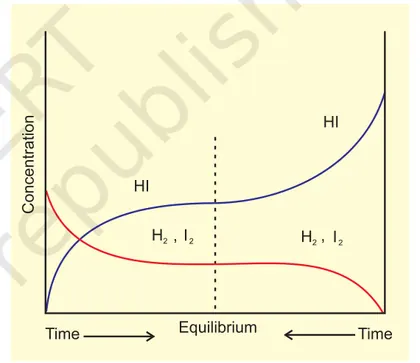
Introduction: This chapter develops the concept of chemical equilibrium — a state in which the macroscopic properties of a reversible chemical system remain constant because the forward and reverse processes occur at equal rates. Emphasis is on the dynamic nature of equilibrium, how it is established, and how to quantify it. Importance: Understanding equilibrium is central to predicting the direction and extent of chemical reactions in laboratory and industrial processes (e.g., Haber process), environmental systems, and biological contexts. It provides the basis for problem solving in quantitative chemistry and for controlling reactions by changing conditions. Key themes: definition of reversible reactions and dynamic equilibrium; law of chemical equilibrium and formation of equilibrium constants (Kc and Kp); relationship between Kp and Kc; reaction quotient (Q) and using Q vs K to predict the direction of change; heterogeneous vs homogeneous equilibria; Le Chatelier's principle and the effect of concentration, pressure, temperature and catalysts; basic calculations including ICE tables and degree of dissociation. What the student will learn: students will be able to write and…
Learning Objectives
- Define dynamic chemical equilibrium and state its main characteristics
- State and apply the law of mass action to write equilibrium expressions for given reactions
- Derive the expression for the equilibrium constant Kc for a balanced chemical reaction and state its units where applicable
- Calculate Kc from equilibrium concentrations for gaseous and aqueous reactions
- Relate Kp and Kc and calculate one from the other using Kp = Kc(RT)Δn
- Formulate equilibrium expressions for homogeneous and heterogeneous systems, omitting pure solids and liquids
- Calculate the reaction quotient Q and use Q versus K to predict the spontaneous direction of the reaction
- Predict and justify shifts in equilibrium on changing concentration, pressure/volume and temperature using Le Chatelier’s principle and solve related numerical problems
Topics in this chapter
30 topics · tap a topic title to jump straight to it.
Introduction and basic concepts
What is chemical equilibrium?
Chemical equilibrium occurs in a reversible reaction when the rates of the forward and reverse reactions become equal, so the macroscopic properties (concentrations, pressure, colour) remain constant with time. Equilibrium is dynamic: reactions continue but with no net change.
Reversible reactions and closed system
Only reversible reactions (A ⇌ B) can reach equilibrium. Equilibrium must be established in a closed system (no matter exchange with surroundings); otherwise, concentrations do not remain constant.
Homogeneous and heterogeneous equilibria
A homogeneous equilibrium has all species in the same phase (e.g. gases). A heterogeneous equilibrium has species in different phases (e.g. solid + gas).
Writing the equilibrium constant
For a general reaction: aA + bB ⇌ cC + dD, the equilibrium constant in terms of molar concentrations (Kc) is
Kc = [C]^c [D]^d / ([A]^a [B]^b)
Pure solids and pure liquids are omitted from the expression. For gaseous systems you can write the equilibrium constant in terms of partial pressures (Kp):
Kp = (P_C)^c (P_D)^d / ((P_A)^a (P_B)^b)
Relation between Kp and Kc
Kp and Kc are related by the gas constant and temperature:
Kp = Kc (RT)^{Δn}
where Δn = (moles of gaseous products) − (moles of gaseous reactants), R = 0.08314 L·bar·mol⁻¹·K⁻¹ (or 0.08206 L·atm·mol⁻¹·K⁻¹ depending on pressure units), and T is in kelvin.
Reaction quotient Q
At any moment, we can form the reaction quotient Q (same algebraic form as K but using instantaneous concentrations or partial pressures). Comparison of Q to K predicts direction:
Q < K: reaction proceeds forward (to produce more products).
Q = K: system is at equilibrium.
Q > K: reaction proceeds in reverse (to produce more reactants).
Dependence of equilibrium
Equilibrium position (value of K) depends only on temperature. Concentration, pressure and catalysts change the position of equilibrium (i.e., shift the composition) but do not change K (except temperature). Le Chatelier's principle gives a qualitative prediction of the direction of shift when a system is disturbed: the system shifts to counteract the change.
Example: N2O4 ⇌ 2NO2 (g)
If initial N2O4 is added, forward reaction increases NO2 until rates equal. Increase in pressure (by decreasing volume) shifts equilibrium toward fewer gas moles (N2O4) and vice versa. Increasing temperature for an endothermic forward reaction shifts equilibrium to products.
Degree of dissociation (α)
For dissociation AB ⇌ A + B with initial concentration c of AB and degree of dissociation α, at equilibrium: [AB] = c(1−α), [A] = cα, [B] = cα. Then
Kc = [A][B]/[AB] = (cα)(cα)/(c(1−α)) = c α^2/(1−α)
For a weak monobasic acid HA ⇌ H+ + A− with initial concentration c and small α, Ka ≈ c α^2. Hence α ≈ √(Ka/c) when α ≪ 1.
Key points to remember
- Equilibrium is dynamic and reached only in closed systems for reversible reactions.
- K (Kc or Kp) is constant at a given temperature and tells about the composition at equilibrium: large K ⇒ products favored; small K ⇒ reactants favored.
- Use Q vs K to predict the direction of spontaneous change.
- Le Chatelier's principle predicts the qualitative shift on changing concentration, pressure, or temperature.
- N2O4 (g) ⇌ 2 NO2 (g): colour change between colourless N2O4 and brown NO2 demonstrates dynamic equilibrium in a closed vessel.
- Haber process: N2 (g) + 3 H2 (g) ⇌ 2 NH3 (g) — industrial equilibrium where pressure, temperature and catalyst are optimized for maximum NH3 yield.
- Esterification: CH3COOH + C2H5OH ⇌ CH3COOC2H5 + H2O — an equilibrium in solution; adding water shifts equilibrium left.
- Weak acid dissociation: CH3COOH ⇌ H+ + CH3COO− — small Ka, partial dissociation; α ≈ √(Ka/c) for dilute solutions.
- Carbonated drinks: CO2 (aq) ⇌ CO2 (g) — opening a bottle reduces pressure, shifting equilibrium to produce more gas (bubbling).
- For aA + bB ⇌ cC + dD: Kc = [C]^c [D]^d / ([A]^a [B]^b) (omit pure solids/liquids)
- Kp = (P_C)^c (P_D)^d / ((P_A)^a (P_B)^b)
- \[Kp = Kc (RT)^{Δn}\]\[where Δn = (gas moles products) − (gas moles reactants)\]
- Reaction quotient Q has same form as K (use instantaneous values). Compare Q with K to predict direction.
- Degree of dissociation for AB ⇌ A + B: Kc = c α^2 / (1 − α)
- Weak acid (HA) dissociation: Ka = [H+][A−]/[HA]; if α ≪ 1 then α ≈ √(Ka / c)
Introduction to Equilibrium
What is Chemical Equilibrium?
A chemical equilibrium is reached in a closed system when the rates of the forward and reverse reactions become equal so that the concentrations (or partial pressures) of reactants and products remain constant with time. Equilibrium is dynamic: microscopic processes continue, but there is no net change in composition.
Reversible reactions and example equation
Many reactions are reversible and are written with a double arrow, e.g. N2(g) + 3 H2(g) ⇌ 2 NH3(g). In a closed vessel, after some time the rate of formation of NH3 equals the rate of its decomposition back to N2 and H2, and the system attains equilibrium.
Characteristics of equilibrium
- Dynamic balance: rate_forward = rate_reverse.
- Macroscopic properties (concentration, pressure, colour) remain constant at equilibrium.
- Equilibrium position depends on temperature, concentrations/pressures, but the equilibrium constant (at a given temperature) is fixed for a particular reaction.
- Heterogeneous equilibrium: pure solids and pure liquids do not appear in the equilibrium expression.
Equilibrium expressions
For a general reaction aA + bB ⇌ cC + dD the equilibrium constant in terms of concentration is written as:
Kc = [C]^c [D]^d / ([A]^a [B]^b).
For gases, the partial pressure form is Kp, and the two are related by Kp = Kc (RT)^{Δn}, where Δn = (c + d) − (a + b).
Reaction quotient and direction
The reaction quotient Q has the same form as K but with instantaneous concentrations/pressures. Comparing Q with K tells the direction the reaction will proceed: if Q < K, forward reaction proceeds; if Q > K, reverse reaction proceeds; if Q = K, the system is at equilibrium.
Why only temperature changes K?
K depends on the standard free energy change (ΔG°) and therefore on temperature. Changing concentration or pressure shifts the equilibrium position (Le Chatelier’s principle) but does not change K at a given temperature.
Physical equilibria
Equilibrium concepts also apply to physical processes such as liquid ↔ vapour (evaporation = condensation) and saturated solution (dissolution = crystallization).
- Haber process: N2(g) + 3 H2(g) ⇌ 2 NH3(g) — industrial example where equilibrium limits ammonia yield; changing pressure, temperature, and using catalyst affect the position.
- Esterification: CH3COOH + C2H5OH ⇌ CH3COOC2H5 + H2O — an equilibrium between acid + alcohol and ester + water; removal of water shifts equilibrium to ester.
- Physical equilibrium: liquid water ↔ water vapour in a closed container — evaporation rate equals condensation rate at equilibrium.
- Saturated salt solution: NaCl(s) ⇌ Na+(aq) + Cl−(aq) — dynamic exchange between dissolved ions and undissolved solid; concentration of ions remains constant at saturation.
- General equilibrium expression: Kc = [C]^c [D]^d / ([A]^a [B]^b) for aA + bB ⇌ cC + dD
- Kp for gases: Kp = (P_C)^c (P_D)^d / ((P_A)^a (P_B)^b)
- \[Relation between Kp and Kc: Kp = Kc (RT)^{Δn}\]\[where Δn = (c + d) − (a + b) and R = 0.08206 L·atm·K−1·mol−1\]
- Reaction quotient: Q = [C]^c [D]^d / ([A]^a [B]^b) (use current concentrations/pressures to compare with K)
- Equilibrium (rate condition): rate_forward = rate_reverse
Homogeneous and heterogeneous equilibria
Equilibrium — brief recap
A chemical equilibrium is reached in a reversible reaction when the rate of the forward reaction equals the rate of the reverse reaction. At equilibrium the macroscopic properties (concentration, pressure, colour) remain constant though reactions continue microscopically (dynamic equilibrium).
Homogeneous equilibrium
When all reactants and products are present in the same phase (all gases or all liquids/solutions), the equilibrium is called homogeneous. Example reactions: gas-phase Haber process: N2(g) + 3H2(g) ⇌ 2NH3(g), or acid dissociation in aqueous phase: CH3COOH(aq) ⇌ CH3COO−(aq) + H+(aq).
Heterogeneous equilibrium
When reactants and products are in different phases (solid + gas, liquid + gas, or solid + liquid + gas), the equilibrium is heterogeneous. Typical examples: decomposition of calcium carbonate: CaCO3(s) ⇌ CaO(s) + CO2(g), and the reaction between a metal oxide and gas: Fe3O4(s) + 4CO(g) ⇌ 3Fe(s) + 4CO2(g).
How equilibrium constants are written
For homogeneous equilibria, the equilibrium constant in terms of concentration (Kc) is expressed using molar concentrations of all species (raised to their stoichiometric coefficients):
Kc = [products]coeff / [reactants]coeff.
For heterogeneous equilibria, concentrations (or partial pressures) of pure solids and pure liquids are omitted from the equilibrium expression because their activity is essentially constant (taken as 1). Only species whose amounts/pressures/concentrations can change (usually gases and solutes) appear.
Examples of equilibrium expressions
1) Homogeneous gas equilibrium (Haber):
Kp = (PNH3)2 / (PN2)(PH2)3 (use partial pressures for gases).
2) Heterogeneous equilibrium (CaCO3):
CaCO3(s) ⇌ CaO(s) + CO2(g) ⇒ Kp = PCO2 (pure solids not included).
Relation between Kp and Kc
For reactions involving gases, Kp and Kc are related by:
Kp = Kc(RT)Δn, where Δn = (moles of gaseous products) − (moles of gaseous reactants), R is the gas constant and T is temperature in kelvin.
Important points
- Pure solids and pure liquids are omitted from equilibrium constant expressions (their activity ≈ 1).
- Equilibrium constants are temperature-dependent but independent of initial concentrations or pressure (for a given T).
- The same reaction can be treated as homogeneous or heterogeneous depending on phases present.
Practical implications / real-life contexts
Heterogeneous equilibria are common in industrial processes (e.g., calcination, metallurgy) and natural systems (soil–gas interactions). Homogeneous equilibria are central to solution chemistry (acid–base equilibria) and gas-phase industrial reactions (Haber process).
- Homogeneous: Haber process — N2(g) + 3H2(g) ⇌ 2NH3(g). Equilibrium expression (Kp): (PNH3)^2 / (PN2)(PH2)^3.
- Homogeneous (aqueous): Acetic acid dissociation — CH3COOH(aq) ⇌ CH3COO−(aq) + H+(aq). Kc = [CH3COO−][H+]/[CH3COOH].
- Heterogeneous: Thermal decomposition of calcium carbonate — CaCO3(s) ⇌ CaO(s) + CO2(g). Kp = PCO2 (solids omitted).
- Heterogeneous (gas-solid reduction): Fe3O4(s) + 4CO(g) ⇌ 3Fe(s) + 4CO2(g). Equilibrium depends on gas partial pressures; solids not in K expression.
- General Kc (homogeneous): Kc = [C]^c [D]^d / ([A]^a [B]^b) for aA + bB ⇌ cC + dD
- Exclude pure solids/liquids: for a reaction involving solids (s) or pure liquids (l), their activities ≈ 1 and they do not appear in K expression
- \[Kp–Kc relation: Kp = Kc (RT)^{Δn}\]\[where Δn = moles of gaseous products − moles of gaseous reactants\]
- \[For heterogeneous example CaCO3(s) ⇌ CaO(s) + CO2(g): Kp = P_{CO2}\]\[equivalently Kc = [CO2] (if concentration used)\]
- Activity approximation: a_i ≈ [i]/c° for solutes, a_i ≈ P_i/P° for gases; for pure solid/liquid a_i = 1
Types of Equilibrium
What is equilibrium? In chemistry, equilibrium is the state of a reversible process where the macroscopic properties remain constant because the forward and reverse processes occur at equal rates. Most chemical equilibria are dynamic (microscopically active though macroscopically unchanged).
Main types of equilibrium
- Physical (phase) equilibrium — equilibrium between different physical states (phases) of the same substance. Example: liquid ⇌ vapor in a closed container at a fixed temperature (saturated vapor pressure), or solid ⇌ liquid at the melting point. At equilibrium the rate of evaporation equals the rate of condensation.
- Chemical equilibrium — equilibrium in a reversible chemical reaction where concentrations of reactants and products remain constant. Example: N2(g) + 3H2(g) ⇌ 2NH3(g) (Haber process). Chemical equilibrium is dynamic: forward and reverse reaction rates are equal.
- Homogeneous vs heterogeneous equilibrium — homogeneous: all reactants and products are in the same phase (e.g., N2O4(g) ⇌ 2NO2(g)); heterogeneous: reactants/products are in different phases (e.g., CaCO3(s) ⇌ CaO(s) + CO2(g)). In heterogeneous equilibria the activities of pure solids and pure liquids are taken as unity and are omitted when writing equilibrium constants.
- Ionic (solution) equilibria — equilibria involving ions in solution, such as acid–base dissociation (HA ⇌ H+ + A−), salt hydrolysis, solubility equilibria and complexation. These are usually homogeneous equilibria in the aqueous phase.
- Dynamic vs static equilibrium — in chemistry, equilibria are generally dynamic (continuous microscopic activity). Static equilibrium (no microscopic movement) is uncommon for chemical processes; the term is more used in mechanics.
Important practical notes: For gas-phase equilibria you can express equilibrium in terms of concentrations (Kc) or partial pressures (Kp). For heterogeneous equilibria, omit pure solids/liquids from the equilibrium expression. Temperature changes can shift equilibria (Le Chatelier’s principle); pressure and concentration changes also affect equilibria involving gases or species in solution.
- Liquid–vapor equilibrium: H2O(l) ⇌ H2O(g) in a closed flask at constant temperature — vapor pressure is constant at equilibrium.
- Dimerisation equilibrium: N2O4(g) ⇌ 2 NO2(g) — colour change (pale ⇌ brown) with temperature shows shifting equilibrium.
- Haber process (chemical equilibrium): N2(g) + 3 H2(g) ⇌ 2 NH3(g) — industrial example where yield depends on equilibrium and conditions.
- Esterification (reversible chemical equilibrium): CH3COOH + C2H5OH ⇌ CH3COOC2H5 + H2O — yield controlled by equilibrium; removal of water shifts equilibrium toward product.
- Solubility equilibrium (heterogeneous/ionic): CaCO3(s) ⇌ CaO(s) + CO2(g) or CaSO4(s) ⇌ Ca2+ + SO42− (in saturated solution) — Ksp governs maximum solubility.
- General equilibrium expression (for a reaction aA + bB ⇌ cC + dD): Kc = [C]^c [D]^d / ([A]^a [B]^b)
- Gas-phase equilibrium (in terms of partial pressures): Kp = (PC)^c (PD)^d / ((PA)^a (PB)^b)
- \[Relation between Kp and Kc: Kp = Kc (RT)^{Δn}\]\[where Δn = (moles of gaseous products) − (moles of gaseous reactants)\]
- Reaction quotient (to predict direction): Qc = [C]^c [D]^d / ([A]^a [B]^b); if Qc < Kc reaction proceeds forward, if Qc > Kc proceeds backward, if Qc = Kc system is at equilibrium.
- Heterogeneous equilibria: omit pure solids/liquids from K expression (their activity ≈ 1). Example: for CaCO3(s) ⇌ CaO(s) + CO2(g), Kp = PCO2
- Solubility product (for MX ⇌ M+ + X−): Ksp = [M+][X−] (for a salt with stoichiometry adjust exponents accordingly)
Law of chemical equilibrium (Law of mass action)
Introduction
The law of chemical equilibrium, or the law of mass action (formulated by Guldberg and Waage), states that for a reversible chemical reaction in a closed system at constant temperature the rate of the forward reaction equals the rate of the backward reaction at equilibrium. For the general homogeneous reaction
aA + bB ⇌ cC + dD
if the forward and backward reactions are elementary, their rates depend on reactant concentrations raised to the power of their stoichiometric coefficients. At equilibrium:
rate_forward = rate_backward
Let rate_forward = k_f [A]^a [B]^b and rate_backward = k_r [C]^c [D]^d. Equating them gives
k_f [A]^a [B]^b = k_r [C]^c [D]^d
Rearranging gives the equilibrium constant expression (K):
K_c = [C]^c [D]^d / [A]^a [B]^b = k_f / k_r
Key points
- Equilibrium is dynamic: molecules continue to react, but macroscopic concentrations remain constant because forward and reverse rates are equal.
- K (equilibrium constant) is temperature dependent but independent of initial concentrations and pressure (except through temperature and for K_p/K_c relations).
- For heterogeneous equilibria, concentrations of pure solids and pure liquids are taken as unity and are omitted from the K expression.
- K_c uses molar concentrations; K_p uses partial pressures for gases. They are related by K_p = K_c (RT)^{Δn}, where Δn = (moles gas products) − (moles gas reactants).
- Magnitude of K: if K ≫ 1, products are favored at equilibrium; if K ≪ 1, reactants are favored; if K ≈ 1, appreciable amounts of both are present.
Thermodynamic link
Standard Gibbs free energy change is related to K by: ΔG° = −RT ln K. Thus K reflects the thermodynamic driving force at a given temperature.
Limitations & activity
The law in the simple concentration form strictly applies using activities rather than concentrations. For dilute solutions and ideal gases activities ≈ concentrations/standard concentration or partial pressure/standard pressure, so concentration expressions are used in practice.
Summary
The law of mass action gives a quantitative relationship between concentrations (or pressures) of species at equilibrium and connects kinetics (k_f, k_r) with thermodynamics (K, ΔG°).
- Formation of ammonia (Haber process): N2(g) + 3H2(g) ⇌ 2NH3(g). Equilibrium expression: K_p = (P_NH3)^2 / (P_N2 (P_H2)^3). Increasing pressure favors formation of ammonia (fewer gas moles).
- Dimerisation of nitrogen dioxide: 2NO2(g) ⇌ N2O4(g). Visible example: brown NO2 ⇌ colorless N2O4; equilibrium shifts with temperature (more NO2 at higher T).
- Esterification (heterogeneous liquid equilibrium): CH3COOH + C2H5OH ⇌ CH3COOC2H5 + H2O. Equilibrium constant K_c = [ester][H2O] / [acid][alcohol]; adding excess reactant or removing product shifts equilibrium.
- Decomposition of calcium carbonate (heterogeneous): CaCO3(s) ⇌ CaO(s) + CO2(g). Pure solids omitted from K; equilibrium depends on CO2 pressure (P_CO2) and temperature.
- For aA + bB ⇌ cC + dD: K_c = [C]^c [D]^d / [A]^a [B]^b
- For gases: K_p = (P_C)^c (P_D)^d / (P_A)^a (P_B)^b
- \[Relation: K_p = K_c (R T)^{Δn}\]\[where Δn = (c + d) - (a + b) (gaseous moles)\]
- K = k_f / k_r (ratio of forward and reverse rate constants for an elementary reversible reaction)
- Reaction quotient: Q = [C]^c [D]^d / [A]^a [B]^b; compare Q with K to predict direction: Q < K (forward), Q > K (reverse), Q = K (equilibrium)
- Thermodynamics: ΔG° = −RT ln K (R = 8.314 J mol⁻¹ K⁻¹)
Law of Mass Action
Definition: The Law of Mass Action (Guldberg and Waage) states that the rate of a chemical reaction at any instant is directly proportional to the product of the active masses (concentrations or partial pressures) of the reactants, each raised to a power equal to its stoichiometric coefficient (for an elementary reaction). At equilibrium, the rate of the forward reaction equals the rate of the reverse reaction, giving an equilibrium constant expression.
Mathematical statement (for an elementary reaction): For aA + bB ⇌ cC + dD,
rate_forward = k_f [A]^a [B]^b
rate_reverse = k_r [C]^c [D]^d
At equilibrium, rate_forward = rate_reverse, therefore
k_f [A]^a[B]^b = k_r [C]^c[D]^d ⟹ K_c = [C]^c[D]^d / [A]^a[B]^b = k_f / k_r
Activities vs concentrations: The rigorous form uses activities (a_i) rather than concentrations: K = Π a_products^(coeff) / Π a_reactants^(coeff). For ideal dilute solutions, activities ≈ concentrations; for gases, activities ≈ partial pressures (P_i/P°).
Relation between Kp and Kc: For gaseous reactions, K_p = K_c (R T)^{Δn}, where Δn = (c + d) − (a + b) and R is the gas constant, T temperature in K.
Significance: The law links kinetics and equilibrium (K = k_f/k_r) and provides the standard equilibrium-constant expressions used to predict composition at equilibrium. It also underpins derived concepts such as reaction quotient Q and Le Chatelier's principle (how equilibria respond to changes).
Limitations & important notes:
- Exponents in the rate law equal stoichiometric coefficients only for elementary reactions (single-step). For complex mechanisms, rate laws must be determined experimentally.
- Use activities (not raw concentrations) for accurate thermodynamic K in non-ideal systems.
- Equilibrium constant depends only on temperature (not on pressure or concentration); K = k_f/k_r and k_f, k_r are temperature dependent.
- Haber process: N2(g) + 3H2(g) ⇌ 2NH3(g). Equilibrium constant Kc = [NH3]^2 / ([N2][H2]^3). Changing concentration/pressure shifts equilibrium according to Le Chatelier's principle; K is temperature-dependent.
- Dissociation of hydrogen iodide (elementary approximation): 2HI ⇌ H2 + I2. If elementary, rate_forward ∝ [HI]^2 and Kc = [H2][I2]/[HI]^2.
- Solubility product: AgCl(s) ⇌ Ag+ + Cl−. Ksp = [Ag+][Cl−] (activity of pure solid omitted). Determines solubility and precipitation.
- Esterification (acid-catalysed, reversible): CH3COOH + C2H5OH ⇌ CH3COOC2H5 + H2O. Kc = [ester][H2O]/([acid][alcohol]); reaction often requires catalysts and may not be elementary.
- For aA + bB ⇌ cC + dD (elementary): rate_forward = k_f [A]^a [B]^b, rate_reverse = k_r [C]^c [D]^d
- Equilibrium constant (concentrations): K_c = [C]^c [D]^d / ([A]^a [B]^b)
- Equilibrium constant (partial pressures): K_p = (P_C^c P_D^d) / (P_A^a P_B^b)
- \[Relation: K_p = K_c (R T)^{Δn}\]\[where Δn = (c + d) − (a + b)\]
- Kinetic link: K = k_f / k_r
- Reaction quotient: Q = (instantaneous product term) / (instantaneous reactant term). If Q < K → forward favored; Q > K → reverse favored.
Equilibrium Constant Expressions
Definition
At chemical equilibrium, for a general reversible reaction aA + bB ⇌ cC + dD the equilibrium constant (law of mass action) is defined as a ratio of products to reactants each raised to the power of their stoichiometric coefficients:
Kc = [C]c[D]d / ([A]a[B]b)
Here [X] denotes the molar concentration of species X at equilibrium. This expression applies to homogeneous equilibria (all species in the same phase).
Kp (equilibrium constant in terms of partial pressures)
For gaseous reactions the equilibrium constant can be written using partial pressures:
Kp = (PCc PDd)/(PAa PBb)
Relation between Kp and Kc
Using ideal‑gas behaviour (Pi=niRT/V or Pi=[i]RT) you obtain:
Kp = Kc (RT)Δn, where Δn = (c + d) − (a + b)
Heterogeneous equilibria
Pure solids and pure liquids have essentially constant concentrations and are omitted from the equilibrium expression. Example: for CaCO3(s) ⇌ CaO(s) + CO2(g), Kp (or Kc) involves only PCO2 (or [CO2]).
Reaction quotient Q
Q has the same mathematical form as K but uses instantaneous (not necessarily equilibrium) concentrations or pressures. Comparison of Q with K predicts the direction of net reaction:
If Q < K → forward reaction favored (proceed to products)
If Q > K → reverse reaction favored (proceed to reactants)
If Q = K → system at equilibrium
Temperature dependence
K depends only on temperature. The van't Hoff relation links K at two temperatures:
ln(K2/K1) = −ΔH°/R (1/T2 − 1/T1)
Units and dimensionless form
Formally equilibrium constants should be written using activities (dimensionless). In school problems concentrations or pressures are used directly and K is often reported without units. For rigorous work use activity-based K.
How to write an equilibrium-constant expression (stepwise)
- Write the balanced chemical equation.
- Include only species whose concentrations/pressures change (omit pure solids/liquids).
- For Kc use equilibrium molar concentrations [ ]. For Kp use partial pressures Pi.
- Raise each term to the power of its stoichiometric coefficient and form products of products over products of reactants.
Notes for problem solving
To compute K from initial and equilibrium data often you set up an ICE table (Initial, Change, Equilibrium) and solve for unknown equilibrium concentrations/pressures, then substitute into the K expression.
- Haber process (industrial): N2(g) + 3H2(g) ⇌ 2NH3(g). Kc = [NH3]^2 / ([N2][H2]^3). The value of K (and temperature, pressure) determines yield of NH3.
- Nitrogen dioxide dimerisation: 2NO2(g) ⇌ N2O4(g). Kc = [N2O4]/[NO2]^2. Visible colour change (brown NO2 ⇌ colourless N2O4) illustrates shift in equilibrium with temperature.
- Esterification (heterogeneous liquid equilibrium): CH3COOH(aq) + C2H5OH(l) ⇌ CH3COOC2H5(aq) + H2O(l). Pure liquids (ethanol, water) often omitted from K expression depending on concentration conventions.
- Autoionisation of water: H2O(l) ⇌ H+(aq) + OH−(aq). Kw = [H+][OH−] (important for pH). Kw changes with temperature (example of K dependent on T).
- Gas-phase example illustrating Kp–Kc relation: For reaction CO(g) + 1/2 O2(g) ⇌ CO2(g), Δn = 1 − (1 + 0.5) = −0.5; Kp = Kc (RT)^{−0.5}.
- General (concentrations): Kc = [C]^c [D]^d / ([A]^a [B]^b) for aA + bB ⇌ cC + dD
- General (pressures): Kp = (P_C^c P_D^d) / (P_A^a P_B^b)
- \[Kp and Kc relation: Kp = Kc (RT)^{Δn}\]\[where Δn = Σ(stoich. gas products) − Σ(stoich. gas reactants)\]
- Reaction quotient: Q (same form as K but with non-equilibrium values); compare Q and K to judge direction
- Van't Hoff equation: ln(K2/K1) = −ΔH°/R (1/T2 − 1/T1) (temperature dependence of K)
- Partial pressure from mole fraction: P_i = x_i · P_total (useful when converting between Kp and composition)
Equilibrium constant Kc
Definition: For a chemical reaction at equilibrium, the equilibrium constant Kc is a number that expresses the ratio of the product concentrations to reactant concentrations (each raised to the power of its stoichiometric coefficient) when the system is at equilibrium. It is a measure of the extent to which a reaction proceeds under a given temperature.
General expression: For the reaction aA + bB ⇌ cC + dD (all species in the same phase, usually aqueous),
Kc = [C]^c [D]^d / ([A]^a [B]^b)
Here [X] means the molar concentration of species X at equilibrium. Kc is written from balanced stoichiometry: changing the stoichiometric coefficients changes the powers in Kc. If the reaction is reversed, Kc becomes 1/(original Kc); if the equation is multiplied by n, Kc is raised to the power n.
Reaction quotient (Qc): Qc has the same form as Kc but uses instantaneous concentrations (not necessarily at equilibrium). Comparison of Qc with Kc predicts the direction of spontaneous shift: Qc < Kc (forward reaction proceeds), Qc > Kc (reverse proceeds), Qc = Kc (equilibrium).
Heterogeneous equilibria: Pure solids and pure liquids do not appear in the Kc expression because their concentrations (activity) are effectively constant. Example: CaCO3(s) ⇌ CaO(s) + CO2(g) gives Kc = [CO2].
Dependence and properties:
- Kc depends only on temperature. Changing temperature changes Kc.
- Changing concentrations or pressure shifts the equilibrium position but does not change Kc (except as a result of a temperature change).
- Catalysts do not change Kc; they only help reach equilibrium faster.
- Kc is often treated as dimensionless (using activities); when quoted using concentrations it may appear to have units depending on Δn, but modern convention reports it as dimensionless.
Relation to Kp (gaseous equilibria): For reactions involving gases, Kp (in terms of partial pressures) relates to Kc by Kp = Kc(RT)^(Δn), where Δn = moles of gaseous products − moles of gaseous reactants, R is gas constant and T is temperature in kelvin.
Temperature dependence (Van 't Hoff): The Van 't Hoff equation links K at two temperatures to the standard enthalpy change: ln(K2/K1) = −ΔH°/R (1/T2 − 1/T1). This shows how Kc changes with temperature depending on whether the reaction is endothermic or exothermic.
Interpretation of magnitude: Large Kc (≫1) means products are favored at equilibrium; small Kc (≪1) means reactants are favored; Kc ≈ 1 means significant amounts of both are present.
- Haber process: N2(g) + 3H2(g) ⇌ 2NH3(g). Kc (or Kp) determines how much NH3 is produced at a given temperature and pressure; changing T shifts equilibrium according to Le Chatelier's principle.
- Esterification (reversible): CH3COOH + C2H5OH ⇌ CH3COOC2H5 + H2O. Kc tells how far esterification proceeds; removal of water shifts equilibrium to products.
- Acetic acid dissociation in water: CH3COOH ⇌ H+ + CH3COO−. Here Kc (commonly written Ka) is the acid dissociation constant used to calculate pH of weak acids.
- Iron(III) thiocyanate color equilibrium: Fe3+ + SCN− ⇌ FeSCN2+. The intensity of red color at equilibrium is used to determine Kc experimentally (colorimetric methods).
- Decomposition of limestone (heterogeneous example): CaCO3(s) ⇌ CaO(s) + CO2(g). Kc reduces to [CO2] (only gas appears), so equilibrium pressure of CO2 over the solid is fixed at given temperature.
- For aA + bB ⇌ cC + dD: Kc = [C]^c [D]^d / ([A]^a [B]^b)
- Reaction quotient: Qc = [C]^c [D]^d / ([A]^a [B]^b) (use instantaneous concentrations)
- \[Kp = Kc (RT)^{Δn}\]\[where Δn = (moles of gaseous products − moles of gaseous reactants)\]
- If reaction reversed: K'_c = 1 / Kc; if equation multiplied by n: K'_c = (Kc)^n
- Van 't Hoff: ln(K2/K1) = −ΔH°/R (1/T2 − 1/T1)
Equilibrium constant Kp and relation to Kc
Definition (Kp): For a gaseous equilibrium aA(g) + bB(g) ⇌ cC(g) + dD(g), the equilibrium constant in terms of partial pressures (Kp) is
Kp = (PC)c (PD)d / [(PA)a (PB)b]
Definition (Kc): The equilibrium constant in terms of molar concentrations is
Kc = [C]c [D]d / ([A]a [B]b)
Relation between pressures and concentrations: For ideal gases, partial pressure Pi and concentration [i] (mol L−1) are related by the ideal‑gas law
Pi = [i] R T
Derivation of Kp in terms of Kc (substitute P = [ ]RT into Kp):
Kp = ([C]RT)c ([D]RT)d / ([A]RT)a ([B]RT)b
Collect concentration terms and RT terms:
Kp = ([C]c [D]d / [A]a [B]b) · (RT)(c+d)−(a+b)
So
Kp = Kc (RT)Δn
where Δn = (c + d) − (a + b) = change in moles of gas between products and reactants.
Important consequences:
- If Δn = 0, then Kp = Kc (numerically equal).
- Kp and Kc are temperature dependent (they change with temperature) but for a given temperature they are constants independent of total pressure. The equilibrium partial pressures/concentrations do depend on pressure but the constants do not.
- Units: Kp may carry units that depend on Δn. Strict thermodynamic practice uses dimensionless forms (pressures divided by standard pressure or fugacities), but for CBSE problems we often keep units explicitly.
- The reaction quotient Q has the analogous relation Qp = Qc (RT)Δn and comparing Qp to Kp predicts the direction of shift.
Temperature and Le Châtelier: Because K depends on temperature (van't Hoff relation), increasing temperature favors endothermic direction (K changes accordingly). Pressure changes shift the position of equilibrium for heterogeneous gas reactions according to Le Châtelier, but do not change Kp at constant T.
Practical note: Use R = 0.08206 L·atm·K−1·mol−1 when pressures are in atm and concentrations in mol·L−1. Ensure consistent units when calculating Kp from Kc.
- Haber process for ammonia: N2(g) + 3H2(g) ⇌ 2NH3(g). Here Δn = 2 − (1+3) = −2, so Kp = Kc (RT)^{−2} = Kc / (RT)^2. Increasing pressure favors production of NH3 (fewer gas moles).
- Dinitrogen tetroxide equilibrium (color change): N2O4(g) ⇌ 2NO2(g). Δn = 2 − 1 = +1, so Kp = Kc (RT)^{+1}. Raising temperature shifts equilibrium toward NO2 (endothermic dissociation), increasing its partial pressure and changing the brown color intensity.
- Contact process (SO2 oxidation): 2SO2(g) + O2(g) ⇌ 2SO3(g). Δn = 2 − (2+1) = −1, so Kp = Kc / (RT). Industrially, higher pressure favors SO3 formation (fewer gas moles), but catalyst and temperature choices are trade-offs.
- Kp = (P_C)^c (P_D)^d / [(P_A)^a (P_B)^b]
- Kc = [C]^c [D]^d / ([A]^a [B]^b)
- P_i = [i] R T (ideal gases)
- \[Kp = Kc (R T)^{Δn}\]\[where Δn = (c+d) − (a+b)\]
- If Δn = 0, then Kp = Kc
- \[Qp = Qc (R T)^{Δn} (relation for reaction quotient)\]
Relation between Kp and Kc
Definitions: For a homogeneous gaseous equilibrium aA + bB ⇌ cC + dD,
Kc = ([C]^c [D]^d)/([A]^a [B]^b) where concentrations [ ] are in mol L-1.
Kp = (p_C^c p_D^d)/(p_A^a p_B^b) where p_i are partial pressures (usually in atm).
Derivation using the ideal gas law: for ideal gases p_i = [i]RT. Substitute into Kp:
Kp = ( ([C]RT)^c ([D]RT)^d / ([A]RT)^a ([B]RT)^b )
Simplify the powers of RT:
Kp = Kc (RT)^{(c+d)-(a+b)}
Define Δn = (moles of gaseous products) − (moles of gaseous reactants) = (c + d) − (a + b). Thus
Kp = Kc (RT)^{Δn}
Important notes:
- Δn counts only gaseous species. Pure solids and liquids do not appear in Kp or Kc expressions and do not change Δn.
- If Δn = 0, then Kp = Kc (common case), i.e., Kp and Kc have the same numerical value at a given temperature.
- Both Kp and Kc depend on temperature. The relation contains an explicit T term, so converting between Kc and Kp requires the temperature (in K) and the gas constant R in consistent units (commonly R = 0.082057 L·atm·mol-1·K-1).
- Thermodynamically, equilibrium constants are dimensionless when referred to standard states; in practice for CBSE problems Kc and Kp are often given with units and used numerically with the above relation.
When to use: Use this relation whenever you need to convert Kc to Kp or vice versa for equilibria involving gases and you know the temperature.
- Haber process: N2(g) + 3H2(g) ⇌ 2NH3(g). Here Δn = 2 − 4 = −2. So Kp = Kc (RT)^{−2}. If Kc is known at a temperature, compute Kp by multiplying by (RT)^{−2}.
- Dimerisation of nitrogen dioxide: 2NO2(g) ⇌ N2O4(g). Δn = 1 − 2 = −1, so Kp = Kc (RT)^{−1}. At higher temperature NO2 (brown) is favored (K decreases); at higher pressure N2O4 (colorless) is favored — the relation helps convert between concentration and pressure forms.
- Dissociation of phosphorus pentachloride: PCl5(g) ⇌ PCl3(g) + Cl2(g). Δn = 2 − 1 = +1, so Kp = Kc (RT)^{+1}. If you measure concentrations but need equilibrium partial pressures, use this formula.
- Numerical conversion example: For a reaction with Δn = −1, Kc = 4.0 at 298 K. Using R = 0.082057 L·atm·mol⁻¹·K⁻¹, Kp = 4.0 × (0.082057 × 298)^{−1} ≈ 4.0 / 24.45 ≈ 0.1636 (in atm-based units).
- For aA + bB ⇌ cC + dD: Kc = ([C]^c [D]^d)/([A]^a [B]^b)
- Kp = (p_C^c p_D^d)/(p_A^a p_B^b)
- Ideal gas relation: p_i = [i] RT
- \[Relation between Kp and Kc: Kp = Kc (RT)^{Δn}\]\[where Δn = (c + d) − (a + b)\]
- Special case: If Δn = 0 then Kp = Kc
- Use consistent units for R (e.g., R = 0.082057 L·atm·mol⁻¹·K⁻¹ if pressures in atm and volumes in L)
Reaction Quotient (Q) and Direction of Reaction
What is the Reaction Quotient (Q)?
For a general reversible reaction aA + bB ⇌ cC + dD, the reaction quotient Q measures the current ratio of product to reactant activities (or concentrations/partial pressures) in the same algebraic form as the equilibrium constant K:
Qc = [C]c[D]d / ([A]a[B]b) (using concentrations)
Qp = (PCcPDd) / (PAaPBb) (using partial pressures)
Q is calculated from the instantaneous concentrations or pressures — it tells you where the system is now compared with the equilibrium position.
Comparison of Q and K (direction of spontaneous change)
- If Q < K: the reaction will proceed in the forward direction (toward products) to reach equilibrium. More reactants → products.
- If Q = K: the system is at equilibrium; no net change.
- If Q > K: the reaction will proceed in the reverse direction (toward reactants) to reach equilibrium.
The reason: the Gibbs free energy change for a non-equilibrium composition is ΔG = ΔG° + RT ln Q. At equilibrium ΔG = 0 and Q = K. If Q < K then ln Q < ln K so ΔG < 0 (forward spontaneous). If Q > K then ΔG > 0 (reverse spontaneous).
Relation between Kp and Kc
If gases are involved, Kp and Kc are related by the change in mole number of gas, Δn = (c + d) − (a + b):
Kp = Kc(RT)Δn
Practical notes for Class 11 level
- Use concentrations for Qc and partial pressures for Qp.
- Strictly, K and Q are defined with activities (dimensionless). In most problems you may substitute concentrations (in mol L−1) or pressures (in bar/atm) consistently.
- Q changes with time as the reaction proceeds; K is constant at a given temperature.
- Example 1 (numerical): For N2(g) + 3H2(g) ⇌ 2NH3(g) at a certain temperature suppose Kc = 0.5. If initially [N2] = 0.50 M, [H2] = 1.50 M and [NH3] = 0.10 M, then Qc = [NH3]^2 / ([N2][H2]^3) = (0.10)^2 / (0.50 × 1.50^3) ≈ 0.0059. Since Qc (0.0059) < Kc (0.5), the reaction will shift forward (to the right) producing more NH3 until Q = K.
- Example 2 (qualitative): N2O4(g) ⇌ 2NO2(g). If a closed container initially contains more NO2 than the equilibrium composition, Q > K and some NO2 will combine to form N2O4 (reaction shifts left) until equilibrium is reached. This equilibrium is visible as a colour change (brown NO2 ⇌ colourless N2O4).
- Example 3 (pressure effect): For a gas-phase equilibrium where Δn < 0 (fewer gas moles in products), increasing total pressure (or decreasing volume) raises the partial pressures; the system responds by shifting toward side with fewer moles. You can predict the direction using Q and Kp together with the relation Kp = Kc(RT)^Δn.
- General reaction: aA + bB ⇌ cC + dD
- Reaction quotient (concentrations): Qc = [C]^c [D]^d / ([A]^a [B]^b)
- Reaction quotient (pressures): Qp = (P_C^c P_D^d) / (P_A^a P_B^b)
- Compare Q and K: if Q < K → proceeds forward; Q = K → at equilibrium; Q > K → proceeds in reverse
- \[Relation Kp and Kc: Kp = Kc (R T)^{Δn}\]\[where Δn = (c + d) − (a + b)\]
- Gibbs energy relation: ΔG = ΔG° + R T ln Q (ΔG = 0 at equilibrium → Q = K)
Writing equilibrium expressions and conventions
What is an equilibrium expression?
For a chemical reaction at equilibrium, the equilibrium constant (K) is written as the ratio of the activities of products to reactants, each raised to the power of its stoichiometric coefficient:
K = Π (a_products)^{ν} / Π (a_reactants)^{ν}
In common school practice this is approximated using concentrations ([ ]) for solutes (Kc) or partial pressures (P) for gases (Kp), with these important conventions:
- Use stoichiometric exponents: Each concentration or pressure term is raised to the power equal to the species' coefficient in the balanced equation.
- Exclude pure solids and pure liquids: Their activities are effectively constant and are omitted from the K expression (they are incorporated into K).
- State symbols: Always indicate states (g, aq, s, l). Only include (aq) and (g) species explicitly in Kc or Kp formulas.
- Reverse and scaled reactions: For the reverse reaction K_rev = 1/K_fwd. If the balanced equation is multiplied by n, the new K = (K_original)^n. If two reactions are added, the overall K = product of the individual Ks.
- Activities vs concentrations/pressures: The rigorous form uses dimensionless activities (a = [C]/C° or P/P°). In practice Kc is written with molar concentrations and Kp with pressures; remember that strictly K is temperature dependent and dimensionless when using activities referenced to standard states.
- Reaction quotient Q: Q has the same form as K but uses instantaneous concentrations/pressures. Compare Q and K to predict net reaction direction (Q < K forward, Q > K reverse, Q = K at equilibrium).
Relation between Kp and Kc:
Kp = Kc (R T)^{Δn}
where Δn = (sum of stoichiometric coefficients of gaseous products) − (sum of coefficients of gaseous reactants), R is the gas constant (0.08206 L·atm·K−1·mol−1 if P in atm and concentrations in mol·L−1), and T is temperature in K.
Practical notes for students: Always write the balanced chemical equation first, identify phases, decide whether to use Kc or Kp, omit pure solids/liquids, and put stoichiometric coefficients as exponents. Remember K depends on temperature but not on starting concentrations.
- N2(g) + 3H2(g) ⇌ 2NH3(g) → Kc = [NH3]^2 / ([N2][H2]^3); Kp = (P_NH3)^2 / (P_N2 (P_H2)^3). Here Δn = 2 − (1+3) = −2, so Kp = Kc (RT)^{-2}.
- CaCO3(s) ⇌ CaO(s) + CO2(g) → Kp = P_CO2. (Pure solids CaCO3 and CaO are omitted from the expression.)
- CH3COOH(aq) ⇌ H+(aq) + CH3COO-(aq) → Ka = [H+][CH3COO-] / [CH3COOH]. (Acid dissociation constant as an equilibrium expression.)
- 2NO2(g) ⇌ N2O4(g) → Kc = [N2O4] / [NO2]^2. For the reverse reaction N2O4 ⇌ 2NO2, K_rev = 1/Kc.
- If a reaction A ⇌ B has K = K1, then for 2A ⇌ 2B the equilibrium constant K' = (K1)^2. If you add reactions R1 and R2 with constants K1 and K2, the overall K = K1 × K2.
- \[General (activities): K = Π (a_i)^{ν_i} (products over reactants)\]
- \[Kc (concentrations): Kc = Π [products]^{ν} / Π [reactants]^{ν} (omit pure solids/liquids)\]
- \[Kp (partial pressures): Kp = Π (P_products)^{ν} / Π (P_reactants)^{ν}\]
- \[Relation: Kp = Kc (R T)^{Δn}\]\[where Δn = Σν_gas(products) − Σν_gas(reactants)\]
- Reaction quotient: Q has same form as K but uses instantaneous [ ] or P; compare Q and K to predict direction
- Reverse reaction: K_rev = 1 / K_fwd
Manipulation of Equilibrium Constants
Basic idea: The equilibrium constant (K) for a chemical reaction is a number (at a given temperature) that relates the activities (often approximated by concentrations or partial pressures) of products and reactants at equilibrium. K is characteristic of the reaction and the temperature.
General expression (for a reaction aA + bB ⇌ cC + dD):
K_c = [C]^c [D]^d / ([A]^a [B]^b) (using molar concentrations)
K_p = (P_C)^c (P_D)^d / ((P_A)^a (P_B)^b) (using partial pressures)
Rules for manipulation:
- Reversing a reaction: If the given reaction is reversed, the equilibrium constant becomes the reciprocal. If original K = K, for reversed reaction K' = 1/K.
- Multiplying coefficients (scaling a reaction): If every stoichiometric coefficient is multiplied by a factor n, the new constant is K' = K^n.
- Adding reactions: When two or more reactions are added to give an overall reaction, the overall equilibrium constant is the product of the equilibrium constants of the individual reactions (K_total = K1 × K2 × ...).
- Combining the above: Use reciprocals and powers appropriately when reactions are reversed or scaled before adding.
- K_p and K_c relation: K_p = K_c (R T)^{Δn_gas}, where Δn_gas = (moles gaseous products) - (moles gaseous reactants), R is the gas constant (0.08314 L·bar·K⁻¹·mol⁻¹ or 0.08206 L·atm·K⁻¹·mol⁻¹ depending on units) and T is absolute temperature.
- Heterogeneous equilibria: Pure solids and pure liquids do not appear in the equilibrium-constant expression (their activity ≈ 1). Only gases and solutes in solution are included.
Temperature dependence (Van't Hoff): The value of K varies with temperature. The Van't Hoff equation in differential form is
ln(K2/K1) = -ΔH°/R (1/T2 - 1/T1)
where ΔH° is standard enthalpy change of the reaction. This shows K increases with T for endothermic reactions (ΔH° > 0) and decreases with T for exothermic reactions (ΔH° < 0).
Reaction quotient Q: Q is calculated like K but for non‑equilibrium concentrations/pressures. Comparison of Q and K predicts the direction the system will shift: Q < K → proceeds forward; Q > K → proceeds backward; Q = K → at equilibrium.
Practical tips: When manipulating reactions algebraically, always track whether you reversed or scaled a reaction and apply reciprocal or power rules to its K before multiplying to get the net K.
- If for A + B ⇌ C the equilibrium constant K_c = 4.0, then for the reverse reaction C ⇌ A + B, K_c = 1/4 = 0.25. If the reaction is doubled (2A + 2B ⇌ 2C), new K_c = (4.0)^2 = 16.0.
- Combine reactions: (i) A ⇌ B with K1, (ii) B ⇌ C with K2. Overall A ⇌ C has K = K1 × K2.
- K_p and K_c example: For N2(g) + 3H2(g) ⇌ 2NH3(g), Δn_gas = 2 - (1+3) = -2. So K_p = K_c (R T)^{-2} = K_c / (R T)^2.
- Van't Hoff example: If K1 is known at T1 and ΔH° is known, you can find K2 at T2 using ln(K2/K1) = -ΔH°/R (1/T2 - 1/T1).
- General K_c: K_c = [C]^c [D]^d / ([A]^a [B]^b) for aA + bB ⇌ cC + dD
- Reverse reaction: K_rev = 1 / K_forward
- Scaled reaction (factor n): K_scaled = (K_original)^n
- Combine reactions: K_overall = K1 × K2 × ...
- \[K_p and K_c relation: K_p = K_c (R T)^{Δn_gas}\]\[where Δn_gas = moles(gas products) − moles(gas reactants)\]
- Van't Hoff (temperature dependence): ln(K2/K1) = −ΔH°/R (1/T2 − 1/T1)
Reaction quotient (Q)
Definition: The reaction quotient Q is a number that has the same algebraic form as the equilibrium constant K but is calculated with the instantaneous (not necessarily equilibrium) concentrations or partial pressures of reactants and products. Q tells us how far the system is from equilibrium and in which direction the reaction will proceed to reach equilibrium.
General expression (for the reaction aA + bB ⇌ cC + dD):
Qc = [C]^c [D]^d / ([A]^a [B]^b) (using concentrations in mol L⁻¹)
Similarly, for gases using partial pressures:
Qp = (P_C)^c (P_D)^d / ((P_A)^a (P_B)^b)
Key points:
- Q has the same mathematical form as K (Kc or Kp) but is evaluated at any moment, not necessarily at equilibrium.
- Compare Q with the equilibrium constant K to predict the direction of spontaneous shift:
- If Q < K, the forward reaction (reactants → products) is favored; system shifts right.
- If Q = K, the system is at equilibrium; no net shift.
- If Q > K, the reverse reaction (products → reactants) is favored; system shifts left.
- For heterogeneous equilibria (solids or pure liquids present), the activities of pure solids and pure liquids are constant and omitted from the Q expression. Only gaseous and aqueous species appear.
- Strictly speaking Q and K are calculated from activities and are dimensionless; in class problems concentrations or partial pressures are usually used directly.
Thermodynamic relation:
ΔG = ΔG° + RT ln Q. At equilibrium ΔG = 0 and Q = K, so ΔG° = −RT ln K. The sign of ΔG tells the spontaneous direction and is directly related to how Q compares with K.
Practical interpretation: Q is a snapshot. If you know the current concentrations (or pressures), compute Q and compare with the appropriate K to know which way the reaction must move to reach equilibrium. Le Chatelier's principle describes how changes in concentration, pressure or temperature change Q (and K if T changes) and thus the position of equilibrium.
- Numerical (gases): For N2(g) + 3H2(g) ⇌ 2NH3(g). If P(N2)=1.0 atm, P(H2)=3.0 atm, P(NH3)=0.10 atm then Qp = (0.10)^2 / (1.0 * 3.0^3) = 0.01 / 27 = 3.70×10^-4. If Kp at that temperature = 5.0×10^-2, then Qp < Kp, so the reaction will proceed forward (to the right) to form more NH3.
- Heterogeneous equilibrium (solid present): CaCO3(s) ⇌ CaO(s) + CO2(g). The solids are omitted, so Qp = PCO2. If PCO2 = 0.20 atm but Kp = 0.10 atm at that temperature, Qp > Kp, so the reverse reaction (formation of CaCO3) is favored and decomposition is suppressed.
- Biological example (qualitative): CO2/H2CO3 equilibrium in blood. If CO2 partial pressure falls (hyperventilation), Q for CO2-containing equilibria decreases and the equilibria shift to produce CO2 from H2CO3, altering pH. This is a practical case where Q changes and the system shifts to restore balance.
- For aA + bB ⇌ cC + dD: Qc = [C]^c [D]^d / ([A]^a [B]^b)
- For gases: Qp = (P_C)^c (P_D)^d / ((P_A)^a (P_B)^b)
- Relationship to K: If Q < K ▶ shift right; Q = K ▶ equilibrium; Q > K ▶ shift left
- Thermodynamic relation: ΔG = ΔG° + RT ln Q (so at equilibrium Q = K and ΔG = 0)
- \[Kp and Kc relation: Kp = Kc (RT)^{Δn} where Δn = (c + d) − (a + b)\]
Calculations using equilibrium constants
Overview
Calculations using equilibrium constants involve using the equilibrium expression (Kc, Kp, Kx, Ka, etc.) to relate concentrations or partial pressures of reactants and products at equilibrium. The usual steps are: write the balanced equation, write the equilibrium-constant expression, set up an ICE (Initial–Change–Equilibrium) table, substitute equilibrium expressions into the constant, and solve for the unknown(s).
Key ideas
- For a general reaction aA + bB ⇌ cC + dD,
Kc = [C]c[D]d / ([A]a[B]b)
- For gaseous reactions in terms of partial pressures, Kp = (PCcPDd)/ (PAaPBb).
- Relation between Kp and Kc:
Kp = Kc(RT)Δn, where Δn = (c + d) − (a + b), R = 0.08206 L·atm·K−1·mol−1, and T is in kelvin.
- Heterogeneous equilibria: concentrations of pure solids and pure liquids are omitted from the equilibrium expression.
- Reaction quotient Q has the same form as K. If Q < K, reaction proceeds forward; if Q > K, reaction goes backward; if Q = K, system is at equilibrium.
ICE-table method (step-by-step)
- Write balanced equation and K expression.
- List initial concentrations/pressures (I).
- Express changes using a variable (x) according to stoichiometry (C).
- Write equilibrium concentrations/pressures in terms of x (E).
- Substitute E into the K expression and solve the resulting algebraic equation for x.
- Check approximations (if any) and compute final concentrations/pressures.
Quadratic and approximation
Often substitution leads to a quadratic (or higher) equation. If K is very small or very large such that x is much smaller than initial concentration I, you can use the approximation x << I and neglect x in denominators. A common check: if x/I < 5% the approximation is acceptable.
Worked example 1 — (dimerisation) 2NO2 ⇌ N2O4
Given: initial [NO2] = 0.100 M, [N2O4] = 0, Kc = 0.25 at the temperature.
Let x = [N2O4] formed at equilibrium. Then [NO2] = 0.100 − 2x.
Kc = [N2O4] / [NO2]2 = x / (0.100 − 2x)2 = 0.25.
Solving: x = 0.25(0.100 − 2x)2 → gives quadratic. Solving the quadratic yields x ≈ 0.0025 M.
Equilibrium concentrations: [N2O4] ≈ 0.0025 M, [NO2] ≈ 0.095 M.
Worked example 2 — relation Kp and Kc (Haber reaction)
For N2 + 3H2 ⇌ 2NH3, given Kc = 6.0×10⁻⁵ at T = 500 K. Find Kp.
Here Δn = (2) − (1 + 3) = −2. Use Kp = Kc(RT)Δn = Kc/(RT)2.
R = 0.08206 L·atm·K−1·mol−1, so RT = 0.08206 × 500 = 41.03. Then (RT)2 ≈ 1683.5.
Kp = 6.0×10⁻⁵/1683.5 ≈ 3.6×10⁻⁸.
Checks and tips
- For the reverse reaction, Kreverse = 1 / Kforward.
- If you multiply a reaction by n, the new K = (Kold)n. If you add reactions, multiply their K values.
- When using partial pressures expressed via mole fraction yi and total pressure Ptot: Pi = yiPtot. Then Kp may be written in terms of mole fractions and Ptot as needed.
Real-life relevance
Calculations with equilibrium constants are essential in industrial chemistry (e.g., optimizing conditions for the Haber process for ammonia synthesis), environmental chemistry (CO2 equilibria, acid–base equilibria in natural waters), and chemical engineering (design of reactors where yields depend on equilibrium position).
- Example 1 (ICE method): 2NO2 ⇌ N2O4, initial [NO2] = 0.100 M, Kc = 0.25. Let x = [N2O4] formed. Kc = x/(0.100 − 2x)^2 → solve quadratic → x ≈ 0.0025 M, so [N2O4] = 0.0025 M and [NO2] = 0.095 M at equilibrium.
- Example 2 (Kp and Kc relation): N2 + 3H2 ⇌ 2NH3, Kc = 6.0×10^−5 at 500 K. Δn = −2, RT = 0.08206×500 = 41.03, (RT)^2 = 1683.5. Kp = Kc/(RT)^2 = 6.0×10^−5/1683.5 ≈ 3.6×10^−8.
- Example 3 (quadratic approximation): For A ⇌ 2B, initial [A] = 1.00 M, Kc = 1.0×10^−3. Let x = extent dissociated: Kc = [B]^2/[A] = (2x)^2/(1.00 − x) ≈ 4x^2 (if x << 1). Solve 4x^2 = 1.0×10^−3 → x ≈ 0.016, check x/1.00 = 1.6% (<5%), approximation valid.
- For aA + bB ⇌ cC + dD: Kc = [C]^c [D]^d / ([A]^a [B]^b)
- Kp = P_C^c P_D^d / (P_A^a P_B^b) (partial pressures in atm)
- \[Kp = Kc (RT)^{Δn}\]\[where Δn = (c+d) − (a+b)\]\[R = 0.08206 L·atm·K^{−1}·mol^{−1}\]
- Q has same form as K; compare Q and K to predict direction: Q < K → forward, Q > K → backward
- For reverse reaction: K_reverse = 1 / K_forward
- If reaction multiplied by n: K_new = (K_old)^n
Units and Dimensionality of K
What is K? For a general homogeneous reaction aA + bB ⇌ cC + dD the equilibrium constant in concentration form is
Kc = [C]c[D]d / ([A]a[B]b)
Here square brackets denote molar concentration (mol L−1). Define Δn = (c + d) − (a + b) (the change in number of moles of gas or species whose concentrations are used).
Units of Kc
- If Δn = 0, the powers of concentration cancel and Kc is dimensionless (no net units).
- If Δn ≠ 0, Kc carries units derived from (mol L−1)Δn. In other words:
[Kc] = (mol L−1)Δn = molΔn L−Δn.
Units of Kp
- When the equilibrium constant is written in terms of partial pressures (Kp), its units are (pressure unit)Δn (for example atmΔn or PaΔn).
- The relation between Kp and Kc for ideal gases is
Kp = Kc (RT)Δn
where R is the gas constant and T the absolute temperature. This relation shows how units shift consistently: (pressure)Δn = (concentration × RT)Δn.
Role of activities and dimensionless K
Strict thermodynamics uses activities (dimensionless) instead of concentrations/pressures. Activities are concentrations (or pressures) divided by standard states (c° = 1 mol L−1, p° = 1 bar). Using activities makes the equilibrium constant truly dimensionless:
K = Π (a_products)ν / Π (a_reactants)ν
In practice textbooks and problems often report Kc or Kp with apparent units for clarity; remember the rigorous K (from thermodynamics) is dimensionless.
Heterogeneous equilibria
Pure solids and pure liquids are assigned activity = 1 and do not appear explicitly in K expressions. Thus Δn should count only the species whose concentrations or pressures appear (usually gases and solutes).
Summary
- Compute Δn = (sum of stoichiometric coefficients of products appearing in K) − (sum for reactants).
- Units of Kc = (mol L−1)Δn; units of Kp = (pressure unit)Δn.
- Prefer reporting K as dimensionless using activities (divide by standard concentration/pressure).
- H2(g) + I2(g) ⇌ 2HI(g): Δn = 2 − (1 + 1) = 0 ⇒ Kc is dimensionless (units cancel).
- N2(g) + 3H2(g) ⇌ 2NH3(g): Δn = 2 − 4 = −2 ⇒ [Kc] = (mol L⁻¹)^(−2) = L² mol⁻². (Often written as L² mol⁻².)
- CaCO3(s) ⇌ CaO(s) + CO2(g): solids omitted ⇒ only CO2(g) appears. Δn = 1 ⇒ Kp = p_{CO2} (units of pressure); Kc = [CO2] (mol L⁻¹).
- Converting to dimensionless form: for a reaction with Kc_app calculated from concentrations, K_dimensionless = Kc_app × (c°)^{−Δn} where c° = 1 mol L⁻¹ (this removes apparent units).
- General: Kc = [C]^c [D]^d / ([A]^a [B]^b)
- Δn = (c + d) − (a + b)
- \[Units: [Kc] = (mol L^−1)^{Δn} = mol^{Δn} L^{−Δn}\]
- \[Kp = Kc (RT)^{Δn}\]
- \[Activity form (dimensionless): K = Π(a_products)^{ν} / Π(a_reactants)^{ν}\]\[with a_i = (concentration or pressure)/(standard state)\]
Degree of dissociation (α) and relation with equilibrium constant
Definition: Degree of dissociation (α) is the fraction of the original molecules that dissociate at equilibrium. If n0 is the initial moles of a substance and n dissociate, α = n/n0. It is dimensionless and 0 ≤ α ≤ 1.
Simple molecular dissociation (A B ⇌ A + B): Consider a substance AB of initial molar concentration c that dissociates as AB ⇌ A + B. If fraction α dissociates, at equilibrium:
- [AB] = c(1 − α)
- [A] = [B] = cα
The equilibrium constant Kc is
Kc = [A][B] / [AB] = (cα)(cα) / (c(1 − α)) = c α² / (1 − α).
This gives a quadratic relation for α:
c α² + Kc α − Kc = 0,
so the positive root is
α = [−Kc + sqrt(Kc² + 4 c Kc)] / (2 c) = [sqrt(Kc(Kc + 4c)) − Kc] / (2c).
Useful approximation: If dissociation is small (α ≪ 1) so that (1 − α) ≈ 1, then Kc ≈ c α² and
α ≈ sqrt(Kc / c).
Electrolyte dissociation (Ostwald's dilution law): For a weak acid/base HA ⇌ H+ + A− with initial concentration c and acid dissociation constant Ka, identical algebra gives Ka = c α² / (1 − α). For dilute solutions (α ≪ 1), α ≈ sqrt(Ka / c). This relation is called Ostwald's dilution law in its approximate form.
Gaseous dissociation and Kp: For N2O4(g) ⇌ 2 NO2(g), if initial pressure of N2O4 is P0 and fraction α dissociates, total moles change and partial pressures at total pressure P are:
- p(N2O4) = P (1 − α) / (1 + α)
- p(NO2) = P (2α) / (1 + α)
The equilibrium constant in pressure terms is
Kp = p(NO2)² / p(N2O4) = P · 4 α² / (1 − α²)
From this, α can be solved; for example, increasing total pressure P shifts equilibrium toward N2O4 (lower α) in accordance with Le Chatelier's principle because dissociation increases the number of moles of gas.
Relation between Kp and Kc: Kp = Kc (RT)^{Δn}, where Δn = moles of gaseous products − moles of gaseous reactants. Use this to convert between Kc-based α formulae and Kp-based ones when gases are involved.
Practical notes:
- α increases when equilibrium constant (extent of dissociation) increases (e.g., with temperature if dissociation is endothermic).
- For electrolytes, conductivity measurements give α experimentally via α = Λ / Λ∞, where Λ is molar conductivity at given dilution and Λ∞ is limiting molar conductivity.
- Dissociation of acetic acid: CH3COOH ⇌ H+ + CH3COO−. For c = 0.10 M and Ka = 1.8×10⁻⁵, α ≈ sqrt(Ka/c) ≈ sqrt(1.8×10⁻⁵ / 0.10) ≈ 0.0134 (≈ 1.34%).
- Gas-phase example: N2O4(g) ⇌ 2 NO2(g). If total pressure is increased, the equilibrium shifts to N2O4 (α decreases). Using Kp = 4P α²/(1−α²) one can solve for α at a given Kp and P.
- Thermal dissociation: PCl5(g) ⇌ PCl3(g) + Cl2(g). The degree of dissociation of PCl5 depends on temperature and total pressure and can be found from Kp and initial pressure.
- Degree of dissociation: α = (amount dissociated) / (initial amount)
- For AB ⇌ A + B with initial concentration c: Kc = c α² / (1 − α)
- Exact solution for α: α = [sqrt(Kc(Kc + 4c)) − Kc] / (2 c)
- Approximate (α ≪ 1): α ≈ sqrt(Kc / c)
- Ostwald (weak acid HA ⇌ H+ + A−): Ka = c α² / (1 − α) → α ≈ sqrt(Ka / c) for dilute solutions
- For N2O4 ⇌ 2 NO2 with total pressure P: Kp = 4 P α² / (1 − α²)
Heterogeneous Equilibria: Concentration and Pressure Terms
What is a heterogeneous equilibrium? A heterogeneous equilibrium involves reactants and products in two or more different phases (solid, liquid, gas). Examples: a solid in equilibrium with its vapor, a solid reacting with a gas, or a gas dissolved in a liquid in equilibrium with the gas phase.
Equilibrium expressions — which species appear? In equilibrium constant expressions (Kc or Kp) only species whose concentrations or partial pressures change with the extent of reaction are included. Pure solids and pure liquids have essentially constant concentrations (their densities do not change appreciably), so their activity is taken as unity and they are omitted from the mathematical expression of the equilibrium constant. Gaseous and dissolved species are included.
Kc and Kp for heterogeneous equilibria:
- Kc uses molar concentrations [ ] (mol L-1) for solutes and may be written for gaseous species if expressed in concentration units.
- Kp uses partial pressures (p, usually in bar or atm) for gaseous species.
- For a heterogeneous reaction the equilibrium constant includes only gaseous and aqueous species; pure solids/liquids are omitted because their activity = 1.
General example and rule — for reaction aA(s) + bB(g) ⇌ cC(g) + dD(l):
- Kc = [C]^c / [B]^b (D and A omitted if pure liquid/solid)
- Kp = (p_C)^c / (p_B)^b (only gaseous partial pressures appear)
Relation between Kp and Kc: For reactions involving gases, Kp is related to Kc by the formula Kp = Kc (RT)^{Δn}, where Δn = (sum of moles of gaseous products) - (sum of moles of gaseous reactants), R is the gas constant and T is temperature in kelvin. Δn counts only gaseous species.
Why solids/liquids omitted? The thermodynamic activity of a pure solid or pure liquid in its standard state is defined as 1. Since their 'concentration' does not change during the reaction (as long as some amount of each pure phase is present), including them would multiply the equilibrium expression by 1 and is unnecessary.
Le Chatelier and pressure effects: Changes in total pressure (or volume) affect equilibria only when the number of moles of gas changes (Δn ≠ 0). If Δn = 0, changing pressure does not shift the equilibrium. In heterogeneous systems pressure changes affect only the gaseous side of the equilibrium.
Activity note (brief): More generally, equilibrium constants are expressed in terms of activities. For ideal gases activity ≈ p/p°, and for dilute solutions activity ≈ [C]/C°. For pure solids and liquids activity = 1.
- Decomposition of calcium carbonate: CaCO3(s) ⇌ CaO(s) + CO2(g). Equilibrium expression: Kp = p(CO2). The equilibrium partial pressure of CO2 (p_eq) is fixed at a given temperature and does not depend on how much CaCO3 or CaO is present as long as both solids remain.
- Sublimation of ammonium chloride: NH4Cl(s) ⇌ NH3(g) + HCl(g). Equilibrium expression: Kp = p(NH3) · p(HCl). The solid NH4Cl is not included in the expression.
- Liquid–gas (carbonation): CO2(aq) ⇌ CO2(g). Henry's law links these: p(CO2) = k_H · [CO2(aq)]. The CO2 pressure above a fizzy drink determines the dissolved concentration; opening the bottle lowers p(CO2) and CO2 comes out of solution.
- Water liquid–vapor equilibrium: H2O(l) ⇌ H2O(g). At a given temperature the equilibrium vapor pressure p(H2O) is constant (depends only on T), independent of the amount of liquid present.
- \[General Kc (only include aq or gas species): Kc = [products]^{coefficients} / [reactants]^{coefficients} (omit pure solids and liquids)\]
- \[General Kp (gaseous species only): Kp = (p_{products})^{coefficients} / (p_{reactants})^{coefficients}\]
- \[Relation between Kp and Kc: Kp = Kc · (RT)^{Δn}\]\[where Δn = moles of gaseous products − moles of gaseous reactants\]
- Activity of a pure solid or liquid: a = 1 (so they are omitted from K expressions)
- \[Reaction quotient (gases): Qp = (p_{products})^{coefficients} / (p_{reactants})^{coefficients}\]\[compare Qp with Kp to predict shift\]
Factors Affecting Equilibrium (Le Chatelier's Principle)
Le Chatelier's Principle (qualitative statement): If a dynamic equilibrium is disturbed by changing concentration, pressure, volume or temperature, the system shifts in the direction that tends to reduce that disturbance.
General reaction and equilibrium constant: For a reaction aA + bB ⇌ cC + dD, the equilibrium constant (concentration form) is
Kc = [C]^c [D]^d / ([A]^a [B]^b)
Reaction quotient Q: At any moment, the reaction quotient has the same algebraic form as Kc:
Q = [C]^c [D]^d / ([A]^a [B]^b)
- If
Q < K, reaction proceeds forward (to products). - If
Q > K, reaction proceeds backward (to reactants). - If
Q = K, system is at equilibrium.
How different factors affect equilibrium:
- Change in concentration: Adding a reactant (or removing a product) makes
Q < K, so equilibrium shifts to the right (forms more products). Removing a reactant or adding a product shifts left. This re-establishes K (Kc unchanged at constant temperature). - Change in pressure / volume (gaseous systems): Only changes that alter partial pressures of gaseous species matter. Decreasing volume (increasing total pressure) favors the side with fewer moles of gas; increasing volume favors the side with more moles of gas. If total moles of gas are equal on both sides, pressure/volume changes have no effect on position of equilibrium (K unchanged).
- Adding an inert gas: At constant volume, adding an inert gas does not change partial pressures of reactants/products and has no effect on equilibrium. At constant pressure, adding an inert gas increases volume and can shift equilibrium as a pressure/volume change would.
- Change in temperature: Temperature changes affect the equilibrium constant K. For an exothermic reaction (ΔH < 0), increasing temperature shifts equilibrium to the left (favoring reactants) and decreases K. For an endothermic reaction (ΔH > 0), increasing temperature shifts equilibrium to the right (favoring products) and increases K. Thus temperature is the only factor that changes the numerical value of K.
- Catalyst: A catalyst increases the rates of both forward and reverse reactions equally, so it speeds attainment of equilibrium but does not change the equilibrium position or K.
- Common-ion effect / ionic equilibria: Adding a species that supplies an ion already present in an equilibrium (e.g., adding NaCl to AgCl ⇌ Ag+ + Cl−) shifts the equilibrium to reduce the added ion (here, to the left), lowering solubility. This is an application of Le Chatelier's principle to solubility equilibria.
Thermodynamic connections (quantitative):
ΔG° = −RT ln Kconnects standard free energy change and K. If temperature changes, K changes according to the van't Hoff relation.- van't Hoff (integrated/differential form):
ln(K2/K1) = −ΔH°/R (1/T2 − 1/T1). This shows how K varies with temperature for approximately constant ΔH°. - Kp & Kc relation (gaseous reactions):
Kp = Kc (RT)^{Δn}, whereΔn = (c + d) − (a + b)is change in moles of gas.
Limitations and remarks:
- Le Chatelier's principle predicts direction of shift qualitatively, not rates or exact new concentrations.
- It applies to equilibria in closed systems; changing temperature changes K itself (not merely shifting position).
- Statistical/thermodynamic relations (ΔG, van't Hoff) give quantitative predictions.
- Haber process: N2(g) + 3H2(g) ⇌ 2NH3(g). High pressure favors product (fewer gas moles); lower temperature favors product (exothermic) but slows rate—industrial compromise.
- NO2(g) ⇌ N2O4(g): Increasing pressure favors formation of N2O4 (2 NO2 → N2O4), and temperature increase shifts equilibrium toward NO2 (endothermic dissociation shows color change).
- Esterification: CH3COOH + C2H5OH ⇌ CH3COOC2H5 + H2O. Removing water (product) by distillation shifts equilibrium right, increasing ester yield.
- Common-ion effect: AgCl(s) ⇌ Ag+ + Cl−. Adding NaCl provides Cl−, shifting equilibrium left and decreasing AgCl solubility.
- Adding a catalyst to an equilibrium (e.g., H2 + I2 ⇌ 2HI with Pt catalyst) speeds attainment of equilibrium but does not change K or position.
- General Kc: Kc = [C]^c [D]^d / ([A]^a [B]^b)
- Reaction quotient: Q = [C]^c [D]^d / ([A]^a [B]^b)
- \[Kp–Kc relation: Kp = Kc (RT)^{Δn}\]\[where Δn = (c + d) − (a + b)\]
- van't Hoff (integrated): ln(K2/K1) = −ΔH°/R (1/T2 − 1/T1)
- Gibbs/free energy: ΔG° = −RT ln K
- Direction rule: if Q < K → forward, if Q > K → backward, if Q = K → equilibrium
Le Chatelier's principle
Definition and context
Le Chatelier's principle states that if a dynamic equilibrium is disturbed by changing the conditions (concentration, pressure, volume or temperature), the system shifts in a direction that tends to counteract the disturbance and restore a new equilibrium.
Dynamic equilibrium
For a reversible reaction at equilibrium, e.g. aA + bB ⇌ cC + dD, the forward and reverse rates are equal. Small changes (stresses) move the position of equilibrium but do not stop the reaction from being reversible.
Qualitative explanations of common stresses
- Change in concentration: Adding a reactant drives the equilibrium toward products to consume the added reactant; removing a product drives it toward products, etc. (Q vs K idea: if Q < K the forward reaction proceeds; if Q > K the reverse proceeds.)
- Change in pressure/volume (for gases): Increasing pressure (or decreasing volume) shifts equilibrium toward the side with fewer moles of gas; decreasing pressure shifts toward the side with more moles of gas. (Only applies when total gas moles differ on two sides.)
- Change in temperature: Treated as adding or removing heat. For an exothermic forward reaction (ΔH < 0), increasing temperature shifts equilibrium toward reactants (reverse); for an endothermic forward reaction (ΔH > 0), increasing temperature shifts toward products. Importantly, temperature changes change the equilibrium constant K.
- Catalyst: A catalyst speeds up both forward and reverse reactions equally, so equilibrium is reached faster but the position of equilibrium (value of K and concentrations at equilibrium) is unchanged.
Why K generally does not change
Concentration or pressure changes shift the position of equilibrium but do not change the equilibrium constant K (except when temperature changes). K depends only on temperature (and standard state definitions).
Thermodynamic connections
K is related to Gibbs free energy: ΔG° = −RT ln K. Temperature dependence of K is given by the van't Hoff relation: ln(K2/K1) = −ΔH°/R (1/T2 − 1/T1).
Important practical implications
Le Chatelier's principle is used to optimize industrial processes (e.g., Haber process), control yields in chemical synthesis (removing product to drive reaction), and to understand buffering and biological equilibria (e.g., CO2/HCO3− balance in blood).
- Haber process: N2(g) + 3H2(g) ⇌ 2NH3(g), ΔH = −92 kJ mol−1. Increasing pressure shifts equilibrium to the right (fewer gas moles → more NH3). Increasing temperature shifts it left (exothermic forward reaction favored by low temperature).
- Esterification: CH3COOH + C2H5OH ⇌ CH3COOC2H5 + H2O. Removing water (e.g., by drying agent) shifts equilibrium to the right, increasing ester yield.
- Iron(III)–thiocyanate equilibrium: Fe3+ + SCN− ⇌ FeSCN2+. Adding SCN− shifts the deep-red complex formation to the right (observed as increased color intensity).
- Decomposition of calcium carbonate: CaCO3(s) ⇌ CaO(s) + CO2(g). Increasing pressure of CO2 shifts equilibrium left (favours CaCO3), increasing temperature shifts equilibrium right (endothermic decomposition).
- Industrial synthesis example: To maximize NH3 in Haber, use high pressure (favor product) and moderate temperature combined with an iron catalyst to speed attainment of equilibrium.
- General equilibrium expression: Kc = [C]^c [D]^d / ([A]^a [B]^b) for aA + bB ⇌ cC + dD
- \[Kp relation to Kc: Kp = Kc (RT)^{Δn}\]\[where Δn = (c + d) − (a + b) (gas mole difference)\]
- Reaction quotient Q has same form as K; if Q < K forward reaction proceeds, if Q > K reverse proceeds, if Q = K system is at equilibrium
- Van't Hoff equation (temperature dependence): ln(K2/K1) = −ΔH°/R (1/T2 − 1/T1)
- Free energy relation: ΔG° = −RT ln K (R = gas constant, T in K)
Effect of pressure and volume
Summary: For a gaseous equilibrium, changing the pressure or volume (at constant temperature) can shift the position of equilibrium. Le Chatelier's principle predicts the direction: an increase in pressure (or decrease in volume) favours the side with fewer moles of gas; a decrease in pressure (or increase in volume) favours the side with more moles of gas. If the total number of moles of gas is the same on both sides, changing pressure/volume does not affect the equilibrium position.
Why this happens (short explanation): For a general reaction aA(g) + bB(g) ⇌ cC(g) + dD(g), define Δn = (c + d) - (a + b), the change in moles of gas. The equilibrium constant in terms of pressure Kp is related to Kc by:
- Kp = Kc (RT)^{Δn} (so Kp depends on Δn and temperature, but not on pressure).
When volume is decreased (total pressure increases), partial pressures of all gases increase. Because the reaction quotient Qp = (P_C^c P_D^d)/(P_A^a P_B^b) changes, the system shifts to reduce the change — i.e., toward the side with fewer gas molecules if pressure is increased (Δn < 0 is favoured) and toward the side with more gas molecules if pressure is decreased (Δn > 0 is favoured). If Δn = 0, Qp does not change with pressure/volume and the position of equilibrium is unaffected.
Special case — addition of an inert gas:
- At constant volume: adding an inert gas (e.g., N2, Ar) raises total pressure but does not change the partial pressures of reacting species (their mole fractions remain the same). Therefore the equilibrium position is not affected.
- At constant pressure: adding an inert gas forces the system to expand (volume increases) so partial pressures of reactants/products decrease. The equilibrium shifts as if volume were increased: toward the side with more gas moles.
Heterogeneous equilibria: Reactions involving solids or pure liquids (e.g., CaCO3(s) ⇌ CaO(s) + CO2(g)) are not significantly affected by pressure/volume changes except through the partial pressure of the gas component (e.g., CO2). Solids and liquids do not appear in Kp/Kc expressions and their amounts/volumes are effectively constant.
Important conceptual points:
- Changing pressure/volume moves the position of equilibrium only when gaseous mole numbers differ between sides (Δn ≠ 0).
- Kp (at fixed temperature) is constant and does not change when you change pressure or volume — only temperature changes Kp.
- Le Chatelier's principle predicts the direction of shift but does not give the new concentrations quantitatively — use equilibrium expressions to calculate new values.
- Haber process: N2(g) + 3H2(g) ⇌ 2NH3(g), Δn = 2 - 4 = -2. Increasing pressure (decreasing volume) shifts equilibrium toward NH3 (fewer gas moles). Industrially, high pressure is used to increase ammonia yield.
- Dimerization of NO2: N2O4(g) ⇌ 2NO2(g), Δn = 2 - 1 = +1. Increasing pressure shifts equilibrium toward N2O4 (colourless), decreasing pressure shifts toward NO2 (brown). This is visible as a colour change with pressure.
- Contact process: 2SO2(g) + O2(g) ⇌ 2SO3(g), Δn = -1. Increasing pressure favours SO3 formation. Because equilibrium improvement with pressure is small, moderate pressures are used industrially along with catalysts.
- Decomposition of CaCO3(s): CaCO3(s) ⇌ CaO(s) + CO2(g). Only the CO2 partial pressure matters; changing external pressure has little effect on solid amounts. Equilibrium is controlled by CO2 pressure and temperature.
- General gas-phase reaction: aA(g) + bB(g) ⇌ cC(g) + dD(g). Define Δn = (c + d) - (a + b).
- \[Kp = Kc (RT)^{Δn} (R = gas constant\]\[T = temperature in K)\]
- Partial pressure: p_i = x_i · P_total (x_i = mole fraction)
- Reaction quotient (pressure form): Qp = (P_C^c · P_D^d) / (P_A^a · P_B^b)
- Le Chatelier rule (pressure/volume): - Decrease volume (↑ pressure): equilibrium shifts to side with smaller number of gas moles (if Δn < 0). - Increase volume (↓ pressure): equilibrium shifts to side with larger number of gas moles (if Δn > 0). - If Δn = 0: no shift with pressure/volume change.
- Effect of inert gas: - At constant volume: no change in equilibrium (partial pressures of reactive gases unchanged). - At constant pressure: behaves like increasing volume (partial pressures of reactants/products drop), shifting toward side with more gas moles.
Temperature Dependence of K
Concept: The equilibrium constant K for a chemical reaction depends on temperature. Temperature changes shift the position of equilibrium and change the numerical value of K according to the reaction enthalpy (ΔH°).
Thermodynamic relations: Standard free energy and K are related by ΔG° = −RT ln K. Combining ΔG° = ΔH° − TΔS° with this gives
ln K = −ΔH°/(RT) + ΔS°/R
where R is the gas constant (8.314 J mol⁻¹ K⁻¹), T is absolute temperature (K), ΔH° and ΔS° are standard enthalpy and entropy changes.
van't Hoff equation (differential form):
d(ln K)/dT = ΔH°/(R T²)
This shows how ln K changes with temperature. If ΔH° is assumed constant over the temperature range, we can integrate:
Integrated van't Hoff equation:
ln(K₂/K₁) = (ΔH°/R) (1/T₁ − 1/T₂)
Equivalent form: ln(K₂/K₁) = −(ΔH°/R) (1/T₂ − 1/T₁).
Sign interpretation (Le Chatelier's principle consistent):
- If reaction is exothermic (ΔH° < 0): increasing T decreases K (equilibrium shifts toward reactants).
- If reaction is endothermic (ΔH° > 0): increasing T increases K (equilibrium shifts toward products).
Graphical form: From ln K = −ΔH°/(RT) + ΔS°/R, a plot of ln K versus 1/T is a straight line with slope = −ΔH°/R and intercept = ΔS°/R. This is commonly used to determine ΔH° and ΔS° experimentally.
Practical notes:
- In industrial processes (e.g., Haber synthesis of NH₃), temperature is chosen as a compromise between favorable K (low T for exothermic reactions) and sufficient reaction rate (higher T for faster kinetics).
- If ΔH° varies with T (nonconstant heat capacity), corrections using ΔC_p (Kirchhoff's law) are needed for accurate predictions.
- For gas-phase equilibria, Kp and Kc are related by Kp = Kc(RT)^Δn; temperature affects both Kc and Kp via Kc's temperature dependence and the explicit T in (RT)^Δn.
- Haber process: N2(g) + 3H2(g) ⇌ 2NH3(g). Reaction is exothermic (ΔH° < 0). Increasing temperature decreases K (equilibrium shifts left), so industrial operation uses moderate temperature and high pressure plus a catalyst.
- Dimerization of NO2: 2NO2(g) ⇌ N2O4(g). The dimerization is exothermic. At higher temperatures equilibrium favors NO2 (K for dimer formation decreases). You can observe color change (brown NO2 ⇌ colorless N2O4) with temperature.
- Thermal decomposition of calcium carbonate: CaCO3(s) ⇌ CaO(s) + CO2(g). This reaction is endothermic (ΔH° > 0). Increasing temperature increases K, favoring decomposition (used in lime production).
- ΔG° = −RT ln K
- ln K = −ΔH°/(RT) + ΔS°/R
- Differential van't Hoff: d(ln K)/dT = ΔH°/(R T²)
- Integrated van't Hoff (ΔH° ≈ constant): ln(K₂/K₁) = (ΔH°/R) (1/T₁ − 1/T₂) = −(ΔH°/R) (1/T₂ − 1/T₁)
- Relation for gas equilibria: Kp = Kc (RT)^(Δn) (Δn = Σ stoich. coeff. gas products − Σ stoich. coeff. gas reactants)
- Use R = 8.314 J mol⁻¹ K⁻¹; ΔH° should be in J mol⁻¹ when using R
Degree/Extent of Dissociation and Equilibrium
Definition: Degree or extent of dissociation (alpha, α) is the fraction of the original molecules that dissociate into ions or fragments at equilibrium. If x out of n0 molecules dissociate, α = x/n0. 0 ≤ α ≤ 1.
Simple dissociation (molecular): Consider a reversible reaction AB ⇌ A + B. If initial concentration of AB is c and fraction dissociated is α, then at equilibrium:
- [AB] = c(1 - α)
- [A] = cα
- [B] = cα
The equilibrium constant Kc is
Kc = [A][B] / [AB] = (cα)(cα) / (c(1 - α)) = c α^2 / (1 - α).
Rearranging gives Ostwald-type relation for a 1:1 dissociation:
α^2 /(1 - α) = Kc / c
Solving for α:
α = sqrt( Kc / (c + Kc) ).
When α << 1 (weak dissociation), α ≈ sqrt( Kc / c ).
Weak acid dissociation (HA ⇌ H+ + A-): If initial concentration = c and degree = α, then
- [HA] = c(1 - α), [H+] = cα, [A-] = cα
- Ka = [H+][A-] / [HA] = c α^2 / (1 - α)
So α = sqrt( Ka / (c + Ka) ) and approximately α ≈ sqrt( Ka/c ) when α << 1 (Ostwald's dilution law).
Electrolyte dissociation and conductivity: For a weak electrolyte, molar conductivity at concentration c is Λ = α Λ0, where Λ0 is molar conductivity at infinite dilution. Combining with Ka expression gives Ostwald form in terms of conductivities:
Ka = c Λ^2 / (Λ0 (Λ0 - Λ)).
Gaseous dissociation (example: A2 ⇌ 2A). Start with pure A2 at initial pressure p. If fraction α dissociates, equilibrium partial pressures are:
- P_A2 = p(1 - α)
- P_A = 2 p α
For Kp = (P_A)^2 / P_A2, we get
Kp = 4 p α^2 / (1 - α) => α^2 /(1 - α) = Kp / (4 p).
Solved approximately for small α: α ≈ sqrt( Kp / (4 p) ).
Factors affecting degree of dissociation:
- Concentration/dilution: For weak electrolytes/weak acids, α increases on dilution (because denominator c decreases, Ostwald law).
- Pressure (gases): For reactions that produce more moles of gas (e.g., A2 ⇌ 2A), increasing pressure shifts equilibrium toward fewer moles (less dissociation); α decreases with increasing external pressure.
- Temperature: If dissociation is endothermic, increasing temperature increases α (Le Chatelier). If exothermic, increasing temperature decreases α.
- Nature of substance: Strong electrolytes/strong acids/bases are almost fully dissociated (α ≈ 1); weak ones have small α.
Use in calculations: Knowing K (Kc, Ka or Kp) and initial concentration (or initial pressure) allows solution for α via the relations above. For small α, approximations (neglecting 1 - α ≈ 1) simplify algebra; always check the validity of approximations (e.g., α < 0.05).
Practical importance: Degree of dissociation determines acidity/basicity (pH), conductivity of electrolyte solutions, colour and composition of equilibria in gases (e.g., NO2/N2O4), industrial equilibrium yields (Haber process considerations), and many temperature-dependent phenomena in chemistry and engineering.
- Acetic acid in water: CH3COOH ⇌ H+ + CH3COO-. For initial concentration c and Ka = 1.8×10^-5, α = sqrt(Ka/(c+Ka)). At c = 0.1 M, α ≈ sqrt(1.8×10^-5 / 0.100018) ≈ 0.0134 (≈1.34%).
- Dinitrogen tetroxide dissociation: N2O4 ⇌ 2 NO2. The brown color intensity increases with temperature because dissociation (endothermic) increases α. Equilibrium relation: Kp = (P_NO2)^2 / P_N2O4 = 4 p α^2 /(1 - α) if starting with pure N2O4 at pressure p.
- Weak electrolyte conductance: A weak acid with molar conductivity Λ at concentration c has Λ = α Λ0. Using Ka = c α^2 /(1 - α) gives Ka = c Λ^2 /(Λ0 (Λ0 - Λ)), allowing experimental determination of Ka from conductivity data.
- Ammonia in water: NH3 + H2O ⇌ NH4+ + OH-. This is a weak base; its degree of ionization α determines the pH of dilute ammonia solutions and increases on dilution.
- Industrial relevance: In the Haber process, dissociation of NH3 (reverse reaction) is affected by temperature and pressure. High pressure favors NH3 formation (less dissociation), while high temperature favors dissociation.
- Definition: α = fraction dissociated = (moles dissociated) / (initial moles)
- AB ⇌ A + B: Kc = c α^2 / (1 - α)
- α = sqrt( Kc / (c + Kc) ) ; for α << 1, α ≈ sqrt( Kc / c )
- Weak acid HA ⇌ H+ + A-: Ka = c α^2 / (1 - α) ; α = sqrt( Ka / (c + Ka) )
- Conductivity: Λ = α Λ0 => Ka = c Λ^2 / (Λ0 (Λ0 - Λ))
- Gaseous A2 ⇌ 2A (initial pressure p): Kp = 4 p α^2 / (1 - α) => α^2 / (1 - α) = Kp / (4 p)
Effect of temperature and thermodynamic connection
Overview
Temperature is a key factor that affects chemical equilibrium. According to Le Chatelier's principle, if temperature is changed, the equilibrium shifts to oppose that change: raising temperature favors the endothermic direction, lowering temperature favors the exothermic direction. The quantitative thermodynamic connection is provided by Gibbs free energy and the Van't Hoff equation, which relate the equilibrium constant (K) to temperature (T) and the reaction enthalpy (ΔH°).
Thermodynamic relations
- Standard Gibbs free energy and equilibrium constant: ΔG° = -RT ln K. This connects the thermodynamic favorability to K.
- Gibbs free energy and entropy/enthalpy: ΔG° = ΔH° - TΔS°. Combining with ΔG° = -RT ln K gives a direct link between K, ΔH° and ΔS°.
Van't Hoff equation (differential and integrated forms)
Differential (Van't Hoff):
(d ln K) / (dT) = ΔH° / (R T^2)
Integrated (assuming ΔH° ≈ constant over the temperature range):
ln(K2 / K1) = -ΔH° / R (1/T2 - 1/T1)
Interpretation: if ΔH° > 0 (endothermic), d(ln K)/dT > 0 so K increases with T. If ΔH° < 0 (exothermic), K decreases as T increases.
Practical implications and interplay of ΔH° and ΔS°
- If ΔH° < 0 (exothermic): increasing temperature reduces K and shifts equilibrium toward reactants; decreasing temperature increases K and favors products.
- If ΔH° > 0 (endothermic): increasing temperature increases K and shifts equilibrium toward products.
- Because ΔG° = ΔH° - TΔS°, when ΔH° and ΔS° have the same sign the temperature can switch the spontaneity (and thereby K). For example, if ΔH° > 0 and ΔS° > 0, reaction may become spontaneous only above a certain T.
Assumptions and limitations
- The integrated Van't Hoff equation assumes ΔH° is approximately constant over the temperature range used. For large ranges, ΔH° may vary and the approximation may fail.
- Temperature also affects kinetics (reaction rates). A higher temperature can increase rate even if it thermodynamically disfavors product formation (common industrial trade-off).
How to use these relations
- Use ΔG° = -RT ln K to compute K from thermodynamic data (or vice versa).
- Use the integrated Van't Hoff form to estimate how much K will change between two temperatures if ΔH° is known.
Short derivation outline of Van't Hoff (for reference): Start from ΔG° = -RT ln K and ΔG° = ΔH° - TΔS°. Differentiate ΔG° = -RT ln K with respect to T and combine with d(ΔG°)/dT = -ΔS° to obtain (d ln K)/(dT) = ΔH°/(RT^2). Integrate to get ln(K2/K1) = -ΔH°/R (1/T2 - 1/T1).
- Haber process: N2(g) + 3H2(g) ⇌ 2NH3(g). Reaction is exothermic (ΔH° < 0). Increasing temperature decreases the equilibrium constant (lower ammonia yield) but increases the rate. Industrial conditions use moderately high temperature and high pressure with a catalyst to optimize yield and rate.
- Dinitrogen tetroxide dissociation: N2O4(g) ⇌ 2 NO2(g). The forward (dissociation) is endothermic. Increase in temperature shifts equilibrium to the right, producing more brown NO2 — visible as a color change.
- Thermal decomposition of calcium carbonate: CaCO3(s) ⇌ CaO(s) + CO2(g). Decomposition is endothermic, so higher temperatures favor CaO + CO2 (used in lime kilns).
- Ammonium nitrate dissolution in water (endothermic): NH4NO3(s) ⇌ NH4+(aq) + NO3-(aq). Dissolution absorbs heat (cold packs). Increasing temperature generally increases solubility for such endothermic dissolutions, shifting equilibrium toward dissolved ions.
- ΔG° = -RT ln K
- ΔG° = ΔH° - TΔS°
- (d ln K) / (dT) = ΔH° / (R T^2) (Van't Hoff differential form)
- ln(K2 / K1) = -ΔH° / R (1/T2 - 1/T1) (Van't Hoff integrated form, ΔH° ≈ const)
- ΔG = ΔG° + RT ln Q (relation with reaction quotient Q)
Effect of catalyst
Definition: A catalyst is a substance that increases the rate of a chemical reaction without itself being consumed. It provides an alternative reaction pathway with a lower activation energy.
What a catalyst does:
- Speeds up both the forward and reverse reactions by providing an alternative mechanism with lower activation energy (Ea).
- Does not change the thermodynamic properties of the reaction: the standard Gibbs free energy change (ΔG°) and the equilibrium constant (K) remain unchanged.
- Allows the system to reach equilibrium faster but does not change the position of equilibrium (i.e., equilibrium concentrations or partial pressures remain the same).
Why equilibrium position is unchanged: The equilibrium constant for a reaction A ⇌ B is related to the rate constants of the forward (kf) and reverse (kr) elementary steps by K = kf/kr. A catalyst increases both kf and kr by providing new pathways, but it does so in a way that preserves the ratio kf/kr (because ΔG° between reactants and products is unchanged). Therefore K remains constant.
Molecular/energy picture: On a potential-energy vs reaction-coordinate diagram a catalyst lowers the activation energy peaks for both forward and reverse processes. The energy difference between reactants and products (ΔG) is the same with or without catalyst, so the relative heights of reactants and products do not change—only the barrier heights change.
Practical consequences: Catalysts are essential in industry and biology to make reactions occur at useful rates and temperatures (e.g., enzymes in metabolism, heterogeneous catalysts in chemical plants). They reduce energy use and increase throughput, but never change the final equilibrium composition predicted by thermodynamics.
- Decomposition of hydrogen peroxide: H2O2 → H2O + 1/2 O2. Catalyzed by MnO2 (heterogeneous) or catalase (enzyme). Catalyst speeds decomposition but final amounts determined by equilibrium conditions remain unchanged.
- Haber process (N2 + 3H2 ⇌ 2NH3): iron-based catalyst increases rate of reaching equilibrium, enabling industrial ammonia manufacture at practical rates, but K depends on temperature and pressure, not on catalyst.
- Automobile catalytic converter (Pt, Pd, Rh): speeds oxidation of CO to CO2 and reduction of NOx, removing pollutants faster; catalysts do not change equilibrium product set, only the rate at which pollutants are converted.
- Contact process for SO2 oxidation (2SO2 + O2 ⇌ 2SO3): V2O5 catalyst accelerates approach to equilibrium so SO3 is produced efficiently at lower temperatures than without catalyst.
- Hydrogenation of vegetable oils using Ni or Pd catalysts: increases rate of H2 addition to C=C bonds; catalyst determines rate and selectivity, not the thermodynamic final state.
- \[Equilibrium constant (general): K = [products]^{coefficients} / [reactants]^{coefficients}\]
- Relation between rate constants and equilibrium (elementary step): K = k_f / k_r
- Arrhenius equation: k = A * exp(-E_a / (R*T)), so lowering E_a increases k
- Gibbs free energy and K: ΔG° = -R*T*ln(K) (ΔG° unchanged by catalyst)
- If catalyst lowers activation energies E_a(f) and E_a(r) but ΔG° = E_a(f) - E_a(r) remains the same, then k_f/k_r (and thus K) is unchanged
Relations between K and Degree of Dissociation
What is degree of dissociation (α)?
Degree of dissociation, α, is the fraction of the original substance that dissociates at equilibrium (0 ≤ α ≤ 1). If initial concentration (or pressure) of a substance A is c (or P) and α fraction dissociates, equilibrium amounts are expressed in terms of α.
General idea: The equilibrium constant (Kc or Kp) can be written in terms of α and the initial concentration (or pressure). Solving that relation gives α as a function of K and initial amount. Two important cases are common in Class 11:
- Solution (weak electrolyte) case: For HA ⇌ H+ + A− with initial concentration c and degree α, at equilibrium [HA] = c(1 − α), [H+] = cα, [A−] = cα. So Ka = [H+][A−]/[HA] = (cα)(cα)/[c(1 − α)] = cα^2/(1 − α).
- Gaseous dissociation (mole change) cases:
- For A ⇌ B + C (start with pure A at initial pressure P): at equilibrium pA = P(1 − α)/(1 + α), pB = Pα/(1 + α), pC = Pα/(1 + α). Then Kp = (pB·pC)/pA = P·α^2/(1 − α^2).
- For A ⇌ 2B (start with pure A at initial pressure P): pA = P(1 − α)/(1 + α), pB = 2Pα/(1 + α). Then Kp = pB^2/pA = 4P·α^2/(1 − α^2).
Useful approximations:
For weak electrolytes (α ≪ 1) we approximate (1 − α) ≈ 1, giving Ka ≈ cα^2 ⇒ α ≈ √(Ka/c). This shows α increases on dilution (smaller c) — a standard experimental observation.
Exact algebraic relation (solution case HA ⇌ H+ + A−):
Ka = cα^2/(1 − α) → rearranged to the quadratic cα^2 + Ka·α − Ka = 0. The physically meaningful root is
α = [−Ka + √(Ka^2 + 4cKa)]/(2c).
Exact relations for the gas cases (starting with pure A at initial pressure P):
- A ⇌ B + C: Kp = P·α^2/(1 − α^2) → α^2 = Kp/(P + Kp) → α = √(Kp/(P + Kp)).
- A ⇌ 2B: Kp = 4P·α^2/(1 − α^2) → α^2 = Kp/(4P + Kp) → α = √(Kp/(4P + Kp)).
Physical implications and trends:
- For a given Ka (intrinsic property), α increases when c decreases (dilution favours dissociation) — explains why weak acids dissociate more on dilution.
- For gaseous dissociation producing more moles (e.g., A ⇌ 2B), increasing pressure shifts equilibrium toward reactant (Le Châtelier): α decreases with rising initial pressure P.
- If K is large (stronger tendency to dissociate), α approaches 1; if K is very small, α ≪ 1.
Measurement link: For electrolytes, molar conductivity at concentration c, Λm, is related to α: Λm = α·Λm° (Λm° = molar conductivity at infinite dilution). Thus α = Λm/Λm° can be used experimentally to get K (via Ka formula above).
- N2O4(g) ⇌ 2NO2(g): A classical gas equilibrium. Degree of dissociation α of N2O4 increases on dilution (lower initial pressure); color change (pale to brown) with temperature/pressure is a visible indicator.
- PCl5(g) ⇌ PCl3(g) + Cl2(g): α depends on total pressure; increasing pressure shifts to PCl5 (lower α). Used in experiments on pressure dependence of equilibria.
- CH3COOH(aq) ⇌ H+ + CH3COO−: Weak acid in water. Ka = cα^2/(1 − α). For typical concentrations α ≪ 1 so α ≈ √(Ka/c), explaining increased dissociation on dilution.
- NH4Cl(s) ⇌ NH3(g) + HCl(g) (in a closed vessel): extent of dissociation depends on temperature and partial pressures — illustrates pressure/volume effects for gaseous equilibria.
- For solution (HA ⇌ H+ + A−): Ka = c·α^2/(1 − α)
- Approximation for weak electrolytes (α ≪ 1): α ≈ √(Ka/c)
- Exact solution for α (HA case): α = [−Ka + √(Ka^2 + 4c·Ka)]/(2c)
- For gas A ⇌ B + C starting with pure A at initial pressure P: Kp = P·α^2/(1 − α^2) and α = √(Kp/(P + Kp))
- For gas A ⇌ 2B starting with pure A at initial pressure P: Kp = 4P·α^2/(1 − α^2) and α = √(Kp/(4P + Kp))
- Conductivity relation (electrolytes): Λm = α·Λm° ⇒ α = Λm / Λm°
Applications and industrial examples
Chemical equilibrium principles (Kc, Kp, Q, Le Chatelier's principle, effect of temperature/pressure/catalyst) are widely used in industry to maximize product yield, choose operating conditions and design reactors. Industrial practice balances thermodynamics (what equilibrium composition favours) and kinetics (how fast equilibrium is reached). Typical strategies to improve yield are: change temperature or pressure, use excess of one reactant, remove product continuously, or use a catalyst to speed up the approach to equilibrium (a catalyst does not change the equilibrium constant).
Key industrial ideas illustrated by equilibrium theory:
- For exothermic reactions, lowering temperature shifts equilibrium toward products; for endothermic, raising temperature favors products (Le Chatelier).
- Increasing pressure favors the side with fewer moles of gas (if Δn ≠ 0), used in high‑pressure processes like the Haber process.
- Removing a product (or adding a reactant) shifts equilibrium to produce more product — used in esterification where water is removed, or in gas-phase syntheses where product is condensed out.
- Catalysts increase reaction rates so processes can be run at less extreme temperatures/pressures while maintaining acceptable throughput; catalysts do not change K.
Common industrial examples demonstrate these principles in practice (Haber, Contact, methanol and ester syntheses). Process design always balances yield (thermodynamics), rate and cost (energy, materials, reactor design).
- Haber process (N2 + 3H2 ⇌ 2NH3): Exothermic. Industrial compromise: high pressure (~150–300 atm) to shift equilibrium to NH3, moderately low temperature to favour formation but use of Fe catalyst to speed reaction. Continuous removal (condensation) of ammonia shifts equilibrium to the right, improving yield.
- Contact process (2SO2 + O2 ⇌ 2SO3): Exothermic. SO3 formation favoured by low temperature and high oxygen partial pressure; V2O5 catalyst used to achieve practical rates. SO3 is absorbed (as oleum) to remove product and push equilibrium right.
- Methanol synthesis (CO + 2H2 ⇌ CH3OH): Exothermic gas-phase synthesis run at moderate-high pressure and with catalysts (Cu/ZnO/Al2O3) to balance kinetics and thermodynamics; product methanol is condensed out to shift equilibrium.
- Esterification (CH3COOH + C2H5OH ⇌ CH3COOC2H5 + H2O): Equilibrium reaction. Industrial methods use excess reactant or continuous removal of water (azeotropic distillation or molecular sieves) to increase ester yield.
- N2O4 ⇌ 2NO2 (dimerization/color change): Demonstrates temperature effect — at higher T more brown NO2; at lower T more colourless N2O4. Useful as a laboratory illustration of equilibrium shifting with temperature.
- Common-ion and solubility equilibria (AgCl ⇌ Ag+ + Cl–): Adding Cl– (e.g., NaCl) reduces AgCl solubility (common-ion effect). Used in controlling precipitation/crystallization processes and in analytical methods.
- For aA + bB ⇌ cC + dD: Kc = [C]^c [D]^d / ([A]^a [B]^b) (at equilibrium, concentrations in mol L^-1)
- Reaction quotient: Q = [C]^c [D]^d / ([A]^a [B]^b) (compare Q with K to predict direction of shift)
- \[Kp = Kc (RT)^{Δn}\]\[where Δn = (moles gas products) − (moles gas reactants) and R = 0.08206 L·atm·K^-1·mol^-1\]
- Gibbs free energy: ΔG° = −RT ln K (gives relation between thermodynamics and equilibrium constant)
- van't Hoff equation (temperature dependence): d(ln K)/dT = ΔH°/(RT^2). Integrated form: ln(K2/K1) = −ΔH°/R (1/T2 − 1/T1). (For exothermic ΔH° < 0, K decreases with increasing T.)
- Le Chatelier (qualitative): If a system at equilibrium is stressed (change in concentration, pressure, temperature), the system shifts to counteract that stress.
Calculations and Problem-Solving Techniques
Overview: Calculations in chemical equilibrium involve using the equilibrium constant (Kc or Kp), the reaction quotient (Q), stoichiometry and algebra (often ICE tables) to find equilibrium concentrations/pressures, percent dissociation, or to predict the direction of reaction. Key ideas: write a balanced equation, form the K expression, set up changes using stoichiometry, substitute into K, solve for the unknowns, and check approximations.
Step-by-step procedure:
- Write the balanced chemical equation: aA + bB ⇌ cC + dD.
- Write the equilibrium expression for Kc (concentrations) or Kp (partial pressures): Kc = [C]^c[D]^d/[A]^a[B]^b.
- Set up an ICE table (Initial, Change, Equilibrium). Represent change by a variable (usually x) using stoichiometric ratios.
- Substitute equilibrium expressions into the K equation to get an equation in x. Solve algebraically (linear or quadratic). If the quadratic is messy and x is small relative to initial concentrations, use the approximation x << initial to simplify.
- Convert between Kc and Kp when gases are involved: Kp = Kc (RT)^{Δn}, where Δn = moles of gaseous products − moles of gaseous reactants.
- Check results: concentrations must be non-negative; verify approximation by ensuring x/initial < 5% (or recalculate exactly if not satisfied).
- Use Q to predict direction: if Q < K, reaction proceeds forward; if Q > K, it proceeds backward; if Q = K, it's at equilibrium.
Special points:
- Heterogeneous equilibria: omit pure solids and pure liquids from K expressions (their activities ≈ 1).
- Percent dissociation/ionization: for A ⇌ products, percent dissociation = (amount dissociated / initial amount) × 100% = (x/initial)×100%.
- Common-ion effect: presence of an ion common to an equilibrium shifts it and reduces dissociation; calculations proceed by including the common-ion initial concentration in the ICE table.
- Temperature dependence: K depends on temperature (Le Chatelier tells qualitative shift when T changes; for numerical change, use thermodynamic relations if available).
ICE table template:
| Initial (M) | Change (M) | Equilibrium (M) | |
| aA | [A]0 | -a x | [A]0 - a x |
| bB | [B]0 | -b x | [B]0 - b x |
| cC | [C]0 | +c x | [C]0 + c x |
| dD | [D]0 | +d x | [D]0 + d x |
Tips for solving:
- Keep units consistent (M for Kc, atm for Kp). Use R = 0.08206 L·atm·K−1·mol−1 when converting Kc ↔ Kp.
- For gas mixtures, partial pressure Pi = yi × Ptotal or Pi = ni RT / V.
- If quadratic arises: ax^2 + bx + c = 0, use x = [-b ± sqrt(b^2 - 4ac)]/(2a). Choose physically meaningful root.
- Always re-evaluate approximations: if x/initial > ~0.05 (5%), solve the full quadratic instead of using the small-x approximation.
- Example 1 — Equilibrium concentrations (quadratic): N2O4(g) ⇌ 2 NO2(g). Initial [N2O4] = 0.100 M, no NO2 initially. Given Kc = 0.050 at the temperature. Let x = amount of N2O4 dissociated: [N2O4] = 0.100 − x, [NO2] = 2x. Kc = [NO2]^2/[N2O4] = (2x)^2/(0.100 − x) = 0.050. Solve 4x^2 = 0.005 − 0.05x → 4x^2 + 0.05x − 0.005 = 0. Positive root x ≈ 0.0297 M. Thus [N2O4]eq ≈ 0.0703 M, [NO2]eq ≈ 0.0593 M.
- Example 2 — Convert Kc to Kp: 2 SO2(g) + O2(g) ⇌ 2 SO3(g). Given Kc = 1.20 at 500 K. Δn = (2) − (2+1) = −1. Kp = Kc (RT)^{Δn} = Kc / (RT) = 1.20 / (0.08206×500) ≈ 1.20 / 41.03 ≈ 0.0293 (unitless).
- Example 3 — Percent dissociation of a weak acid: HA ⇌ H+ + A−. Initial [HA] = 0.100 M, Ka = 1.8×10⁻⁵. Let fraction dissociated = α, so [H+] = cα, [A−] = cα, [HA] = c(1−α). Ka = c α^2 /(1 − α). For small α approximate Ka ≈ c α^2 → α ≈ sqrt(Ka / c) = sqrt(1.8×10⁻⁵ / 0.1) ≈ 0.0134 → percent dissociation ≈ 1.34%. Check: α ≪ 1 so approximation valid.
- Example 4 — Common-ion effect: For CH3COOH ⇌ H+ + CH3COO−, with initial 0.10 M acetic acid and 0.010 M sodium acetate (common ion CH3COO−). Ka = 1.8×10⁻⁵. Let x be dissociation of acid: [H+] = x, [CH3COO−] = 0.010 + x, [HA] = 0.10 − x. Ka = x(0.010 + x)/(0.10 − x). Approximate x ≪ 0.010 so Ka ≈ x×0.010/0.10 → x ≈ Ka×0.10/0.010 = (1.8×10−5)×10 = 1.8×10⁻⁴ M. The common ion greatly reduces dissociation compared to the value without acetate.
- Example 5 — Using Q to predict direction: For A ⇌ B with K = 4.0, if initially [A] = 2.0 M, [B] = 1.0 M, Q = [B]/[A] = 0.5 < K, so reaction proceeds forward (toward products) until equilibrium.
- Equilibrium constant (concentration): Kc = [C]^c [D]^d / ([A]^a [B]^b) for aA + bB ⇌ cC + dD
- Equilibrium constant (pressure): Kp = (P_C)^c (P_D)^d / ((P_A)^a (P_B)^b)
- Reaction quotient: Q (same form as K but using initial or instantaneous values)
- \[Relation between Kp and Kc: Kp = Kc (RT)^{Δn}\]\[where Δn = moles of gaseous products − moles of gaseous reactants and R = 0.08206 L·atm·K−1·mol−1\]
- Partial pressure: P_i = y_i × P_total or P_i = (n_i RT)/V
- Percent dissociation (or ionization): % dissociation = (amount dissociated / initial amount) × 100% = (x / c_initial) × 100
Applications and Examples
Overview: Chemical equilibrium is the state in which the rates of the forward and reverse reactions are equal so that macroscopic properties (concentrations, pressure, color) remain constant. This dynamic balance is quantified by equilibrium constants and is governed qualitatively by Le Chatelier's principle, which predicts how an equilibrium responds to external changes (concentration, pressure, temperature, catalyst).
Why it matters: Understanding equilibrium allows prediction and control of yields in industrial chemical processes, explains behavior of gases and solutions, and underpins biological systems (buffers, respiration). Engineers and chemists shift equilibria to maximize product formation or to maintain safe operating conditions.
Key ideas:
- Equilibrium constant (K): For a general reaction aA + bB ⇌ cC + dD, the equilibrium constant in terms of concentrations (Kc) is Kc = [C]^c [D]^d / ([A]^a [B]^b) (only gases/aqueous species included). Kp is defined analogously for partial pressures.
- Reaction quotient (Q): Q has the same form as K but uses instantaneous concentrations/pressures. Comparing Q and K predicts the direction of net reaction: if Q < K the forward reaction proceeds; if Q > K the reverse proceeds.
- Effect of concentration and pressure: By Le Chatelier's principle, adding reactant (or removing product) shifts equilibrium toward products. For gaseous equilibria, increasing pressure (by decreasing volume) shifts equilibrium toward the side with fewer moles of gas.
- Effect of temperature: Temperature changes alter K. For an exothermic reaction (ΔH < 0) raising temperature decreases K (shifts left); for endothermic (ΔH > 0) raising temperature increases K (shifts right). The van't Hoff relation links ln K to 1/T.
- Effect of catalyst: Catalysts speed up attainment of equilibrium (increase both forward and reverse rates) but do not change K or equilibrium concentrations.
- Common-ion and ionic equilibria: Adding an ion common to a sparingly soluble salt decreases its solubility (common-ion effect). Similar principles control weak acid/base dissociation and buffer action.
Typical applications:
- Industrial synthesis optimization (Haber process for NH3, Contact process for SO3) — conditions (pressure, temperature, catalysts) are chosen to maximize yield while considering kinetics and economics.
- Control of solubility and precipitation in analytical chemistry and water treatment (use of common-ion effect and selective precipitation).
- Biological buffers (blood bicarbonate system CO2 + H2O ⇌ H2CO3 ⇌ H+ + HCO3−) maintain pH by shifting equilibria when acid/base is added.
- Gas solubility in liquids (Henry's law): solubility changes with partial pressure and temperature — relevant for carbonation of drinks, respiration, and decompression sickness.
How to approach equilibrium problems:
- Write a balanced chemical equation and the expression for K (Kc or Kp).
- Use initial concentrations/pressures and an unknown change (x) to write equilibrium values (ICE table).
- Substitute into the K expression and solve for x (approximate quadratic methods may be used when appropriate).
- Check units and whether approximations are valid; interpret the result in chemical terms (shift direction, percent dissociation, yield).
Practical tip: Always check whether the species are gases or in solution to use Kp or Kc. For gas-phase equilibria that involve change in moles of gas, use Kp = Kc (RT)^(Δn), where Δn = moles of gaseous products − moles of gaseous reactants.
- Haber process: N2(g) + 3H2(g) ⇌ 2NH3(g). Industrial conditions (high pressure, moderate temperature, Fe catalyst) shift equilibrium to increase ammonia yield while balancing rate and cost.
- Contact process (SO2 oxidation): 2SO2(g) + O2(g) ⇌ 2SO3(g). Use of V2O5 catalyst and control of temperature/pressure maximizes SO3 formation for H2SO4 production.
- Dimerization: N2O4(g) ⇌ 2NO2(g). Color change (colorless N2O4 ⇌ brown NO2) demonstrates shift with temperature; increasing T shifts right (endothermic dissociation), increasing brown color.
- Esterification: CH3COOH(aq) + C2H5OH(aq) ⇌ CH3COOC2H5(aq) + H2O(l). Adding excess ethanol or removing water shifts equilibrium toward ester formation.
- Solubility and common-ion effect: AgCl(s) ⇌ Ag+(aq) + Cl−(aq). Adding NaCl reduces AgCl solubility by increasing [Cl−], shifting left and causing precipitation.
- Buffer action (blood): CO2 + H2O ⇌ H2CO3 ⇌ H+ + HCO3−. Addition of acid/base is neutralized by shifts in this equilibrium to stabilize pH.
- Equilibrium constant (concentrations): Kc = [C]^c [D]^d / ([A]^a [B]^b) for aA + bB ⇌ cC + dD
- Equilibrium constant (pressures): Kp = (P_C)^c (P_D)^d / ((P_A)^a (P_B)^b)
- \[Relation between Kp and Kc: Kp = Kc (R T)^{Δn}\]\[where Δn = (moles gaseous products − moles gaseous reactants)\]\[R = 0.08206 L·atm·K^−1·mol^−1\]\[T in K\]
- Reaction quotient: Q = [C]^c [D]^d / ([A]^a [B]^b) (use current concentrations); compare Q with K to predict direction
- Degree of dissociation for AB ⇌ A + B (initial concentration c, dissociation α): Kc = (c α^2) / (1 − α)
- Weak acid dissociation (HA ⇌ H+ + A−): Ka = [H+][A−] / [HA]; for very weak acids, [H+] ≈ sqrt(Ka·c) if α ≪ 1
Limitations of law of mass action and role of activities
Law of mass action (brief): For a general reaction aA + bB ⇌ cC + dD the law of mass action (as usually stated in school texts) gives an equilibrium expression in terms of concentrations: Kc = [C]^c [D]^d / ([A]^a [B]^b). For gases it is often written in terms of partial pressures as Kp.
Limitations of the simple concentration/pressure form:
- The simple Kc or Kp expressions are strictly valid only for ideal dilute solutions or ideal gases. Real systems show non‑ideal behaviour at higher concentrations or pressures.
- In ionic solutions (electrolytes), inter‑ionic forces cause the effective reactive 'concentration' to differ from the analytical concentration. Thus use of analytical concentrations can give wrong equilibrium predictions.
- For heterogeneous equilibria involving pure solids or pure liquids the concentrations of those pure phases do not change with extent of reaction; treating them like concentrations is misleading (thermodynamically they are taken as activity = 1).
- The Kc/Kp expressions ignore effects of medium (solvent), ionic strength, and specific interactions (complexation, association) that change the effective reactivity of species.
- The common classroom relation Kp = Kc(RT)^{Δn} assumes ideal gas behaviour (activity of gas = P/po). For real gases this relation fails unless fugacity (not pressure) is used.
Role of activities (correct thermodynamic formulation):
Thermodynamically the equilibrium constant is defined in terms of activities a_i (dimensionless effective concentrations):
K = Π a_i^{ν_i}
where ν_i are stoichiometric coefficients (positive for products, negative for reactants). Activities account for non‑ideality and are defined according to the phase:
- For solutes (standard state = 1 mol L⁻¹): a_i = γ_i · (c_i / c°), where γ_i is the activity coefficient and c° = 1 mol L⁻¹.
- For solvents (standard state often pure solvent): a_solvent ≈ x_solvent · γ_solvent (often ≈ 1 for a pure solvent).
- For gases (standard state = 1 bar or 1 atm depending on convention): a_gas = f_gas / p° = (φ P)/p°, where f is fugacity and φ is the fugacity coefficient. For an ideal gas φ = 1 so a_gas = P/p°.
- For pure solids and pure liquids in heterogeneous equilibria, a = 1 (so they do not appear explicitly in the equilibrium expression).
Practical consequences:
- Measured equilibrium concentrations must often be corrected by activity coefficients to obtain the true thermodynamic constant K (independent of ionic strength and medium).
- In concentrated electrolyte solutions or high pressure gas reactions the predictions made using Kc/Kp without activities can be significantly in error.
- Acid–base equilibria: pKa determined from concentrations differs from thermodynamic pKa unless activities are used. In practice pH measurements are often reported as "operational" pH, and activity corrections are needed for precise thermodynamic analysis.
How activity coefficients are estimated: For dilute ionic solutions the Debye–Hückel limiting law gives an approximate relation for the mean ionic activity coefficient γ±:
log₁₀ γ± = −A |z+ z−| √I
where I is the ionic strength, z+ and z− are ionic charges and A ≈ 0.51 at 25 °C (for water). For higher ionic strengths extended Debye–Hückel or Pitzer models are used.
Summary: The law of mass action must be applied using activities (not raw concentrations or pressures) to obtain thermodynamically correct equilibrium constants. For ideal/very dilute systems activities ≈ concentrations (or pressures) and the simple Kc/Kp forms are good approximations; for non‑ideal systems activity corrections are essential.
- AgCl(s) ⇌ Ag+(aq) + Cl−(aq): The solubility product expression uses activities. In concentrated NaCl solutions the ionic strength increases, reducing the activity coefficients of Ag+ and Cl− and changing the observed solubility compared with the value predicted from simple concentrations.
- CO2 in seawater (CO2 + H2O ⇌ H2CO3 ⇌ H+ + HCO3−): High ionic strength of seawater changes activity coefficients of H+ and carbonate ions; thus carbonate equilibrium and pH predictions require activity corrections (important for ocean acidification studies).
- Haber process at high pressure: Kp = Kc(RT)^{Δn} assumes ideal gases. At high pressures (non‑ideal gas behavior) fugacity must replace pressure, otherwise predicted yields are inaccurate.
- Simple concentration form: Kc = [C]^c [D]^d / ([A]^a [B]^b) (valid ≈ only for ideal/dilute systems)
- \[Thermodynamic form (activities): K = Π a_i^{ν_i} = a_C^c · a_D^d / (a_A^a · a_B^b)\]
- Activity of a solute: a_i = γ_i · (c_i / c°), where c° = 1 mol L⁻¹
- Activity of a gas: a_gas = f_gas / p° = (φ·P)/p°, with fugacity coefficient φ (φ = 1 for ideal gas)
- \[Relation (ideal gas assumption): Kp = Kc (RT)^{Δn}\]\[where Δn = (c + d) − (a + b)\]
- Debye–Hückel limiting law (aqueous, 25 °C): log₁₀ γ± = −0.51 · |z+ z−| · √I, where I = ½ Σ c_i z_i^2 (ionic strength)
Key Concepts
- Chemical equilibrium
- A state in a reversible chemical reaction where the rates of the forward and reverse reactions are equal and concentrations of reactants and products remain constant with time.
- Dynamic equilibrium
- An equilibrium in which microscopic processes continue (both forward and reverse reactions occur) but macroscopic properties remain constant because the rates are equal.
- Reversible reaction
- A reaction that can proceed in both forward and reverse directions under given conditions.
- Irreversible reaction
- A reaction that proceeds essentially to completion in one direction and the reverse reaction is negligible under given conditions.
- Homogeneous equilibrium
- An equilibrium in which all reactants and products are in the same phase (all gases or all in solution).
- Heterogeneous equilibrium
- An equilibrium involving species in more than one phase (solid, liquid, gas).
- Law of mass action
- At equilibrium, the rate of a reaction is proportional to the product of the concentrations of the reactants raised to powers equal to their stoichiometric coefficients; leads to the equilibrium constant expression.
- Equilibrium constant (Kc)
- A dimensionless number expressing the ratio of product concentrations to reactant concentrations (each raised to stoichiometric powers) at equilibrium for reactions in solution or gases using concentrations.
- Equilibrium constant (Kp)
- Equilibrium constant expressed in terms of partial pressures of gaseous species (using pressures in atm or Pa, but Kp is formally dimensionless).
- Reaction quotient (Q)
- An expression like the equilibrium constant but calculated with instantaneous (not necessarily equilibrium) concentrations or partial pressures; used to predict direction of reaction shift.
- Relationship between Kp and Kc
- For a gaseous reaction, Kp = Kc (RT)^{Δn}, where Δn = moles of gaseous products − moles of gaseous reactants and R is gas constant.
- Equilibrium constant expression
- The mathematical formula for K (Kc or Kp) formed by taking product of concentrations or partial pressures of products divided by that of reactants, each raised to stoichiometric coefficients; pure solids and liquids are omitted.
- Degree of dissociation (α)
- The fraction of the initial amount of a substance that dissociates into products at equilibrium; ranges from 0 to 1.
- Le Chatelier's principle
- If a dynamic equilibrium is disturbed by changing concentration, pressure, or temperature, the system shifts in the direction that counteracts the disturbance and re-establishes equilibrium.
- Effect of concentration on equilibrium
- Changing concentration of reactants or products shifts equilibrium to counter the change: adding reactant favors product formation, removing product favors forward reaction.
- Effect of pressure on equilibrium
- For gaseous equilibria, increasing pressure (by reducing volume) favors the side with fewer moles of gas; decreasing pressure favors side with more gas moles.
- Effect of temperature on equilibrium
- Changing temperature shifts equilibrium depending on reaction enthalpy: increasing T favors endothermic direction, decreasing T favors exothermic direction.
- Catalyst (effect on equilibrium)
- A substance that increases rates of both forward and reverse reactions equally, helping the system reach equilibrium faster but not changing equilibrium concentrations or K.
- Haber process
- Industrial synthesis of ammonia from nitrogen and hydrogen (N2 + 3H2 ⇌ 2NH3) conducted at high pressure and moderate temperature with an iron catalyst; an application of chemical equilibrium principles.
- Partial pressure
- The pressure that a gas in a mixture would exert if it alone occupied the whole volume; used in Kp expressions for gaseous equilibria.
End-of-Chapter Trial Paper & Test Questions
Topic-wise questions to test your understanding of every concept in this chapter.
-
Define dynamic chemical equilibrium and state two of its main characteristics. / गतिक रासायनिक साम्य को परिभाषित कीजिए और इसकी दो मुख्य विशेषताएँ लिखिए।
Show answer
Dynamic equilibrium is reached in a closed system when the forward and reverse reaction rates become equal so macroscopic properties stay constant; characteristics include constant concentrations and continued microscopic reaction with no net change. / गतिक साम्य बंद निकाय में तब प्राप्त होता है जब अग्र और प्रतीप अभिक्रिया दरें बराबर हो जाती हैं जिससे स्थूल गुण स्थिर रहते हैं; विशेषताओं में स्थिर सांद्रताएँ और बिना शुद्ध परिवर्तन के सूक्ष्म स्तर पर अभिक्रिया जारी रहना शामिल हैं।
-
Write the Kc expression for N₂(g) + 3H₂(g) ⇌ 2NH₃(g). / N₂(g) + 3H₂(g) ⇌ 2NH₃(g) के लिए Kc व्यंजक लिखिए।
Show answer
Kc = [NH₃]² / ([N₂][H₂]³). / Kc = [NH₃]² / ([N₂][H₂]³)।
-
Derive the relation between Kp and Kc and state when they are numerically equal. / Kp और Kc के बीच संबंध व्युत्पन्न कीजिए और बताइए कि वे संख्यात्मक रूप से कब बराबर होते हैं।
Show answer
Using Pᵢ = [i]RT, Kp = Kc(RT)^Δn where Δn = (moles of gaseous products − moles of gaseous reactants); they are numerically equal when Δn = 0. / Pᵢ = [i]RT का उपयोग करके, Kp = Kc(RT)^Δn जहाँ Δn = (गैसीय उत्पादों के मोल − गैसीय अभिकारकों के मोल); जब Δn = 0 हो तो वे संख्यात्मक रूप से बराबर होते हैं।
-
How is the reaction quotient Q used to predict the direction of a reaction? / अभिक्रिया की दिशा की भविष्यवाणी करने के लिए अभिक्रिया भागफल Q का उपयोग कैसे किया जाता है?
Show answer
If Q < K the reaction proceeds forward, if Q > K it proceeds in reverse, and if Q = K the system is at equilibrium. / यदि Q < K हो तो अभिक्रिया अग्र दिशा में चलती है, यदि Q > K हो तो प्रतीप दिशा में चलती है, और यदि Q = K हो तो निकाय साम्यावस्था में होता है।
-
Why are pure solids and pure liquids omitted from equilibrium constant expressions in heterogeneous equilibria? Illustrate with CaCO₃(s) ⇌ CaO(s) + CO₂(g). / विषमांगी साम्यों में साम्य स्थिरांक व्यंजकों से शुद्ध ठोस और शुद्ध द्रव क्यों हटा दिए जाते हैं? CaCO₃(s) ⇌ CaO(s) + CO₂(g) से स्पष्ट कीजिए।
Show answer
Their activities (effective concentrations) remain constant and are taken as unity, so they do not appear; hence for the given reaction Kp = P(CO₂). / उनकी सक्रियताएँ (प्रभावी सांद्रताएँ) स्थिर रहती हैं और इकाई मानी जाती हैं, इसलिए वे प्रकट नहीं होतीं; अतः दी गई अभिक्रिया के लिए Kp = P(CO₂)।
-
Using Le Chatelier's principle, predict the effect of increasing pressure on N₂(g) + 3H₂(g) ⇌ 2NH₃(g). / ले शातेलिए सिद्धांत का उपयोग करके N₂(g) + 3H₂(g) ⇌ 2NH₃(g) पर दाब बढ़ाने का प्रभाव बताइए।
Show answer
Increasing pressure shifts equilibrium toward the side with fewer gas moles, i.e., toward NH₃ (4 moles → 2 moles), increasing ammonia yield. / दाब बढ़ाने से साम्य कम गैस मोल वाली ओर खिसकता है, अर्थात NH₃ की ओर (4 मोल → 2 मोल), जिससे अमोनिया उत्पादन बढ़ता है।
-
For a weak monobasic acid HA of concentration c with small degree of dissociation α, derive the relation between Ka, c and α. / सांद्रता c वाले दुर्बल एकक्षारकीय अम्ल HA के लिए छोटे वियोजन की मात्रा α के साथ Ka, c और α के बीच संबंध व्युत्पन्न कीजिए।
Show answer
Ka = cα²/(1−α); for small α, Ka ≈ cα², so α ≈ √(Ka/c). / Ka = cα²/(1−α); छोटे α के लिए Ka ≈ cα², अतः α ≈ √(Ka/c)।
-
A catalyst is added to a reaction at equilibrium. Explain its effect on the equilibrium position and on K. / साम्यावस्था में स्थित अभिक्रिया में उत्प्रेरक मिलाया जाता है। साम्य की स्थिति और K पर इसके प्रभाव को समझाइए।
Show answer
A catalyst speeds up both forward and reverse reactions equally, so it helps equilibrium to be reached faster but does not change the equilibrium position or the value of K. / उत्प्रेरक अग्र और प्रतीप दोनों अभिक्रियाओं को समान रूप से तेज़ करता है, इसलिए यह साम्य को तेज़ी से प्राप्त करने में मदद करता है पर साम्य की स्थिति या K के मान को नहीं बदलता।
Related Laws & Principles
Explore allFoundational laws & principles behind this chapter. Each one opens a full page — what it says, why it matters, five practice questions and the mistakes to avoid.