Overview

This chapter introduces Hydrogen — the simplest and most abundant element in the universe (electronic configuration 1s1) — and examines its unique position in the periodic table, physical and chemical behaviour, and wide-ranging applications. Importance: Hydrogen is a fundamental reducing agent, a key raw material for the manufacture of ammonia and methanol, an energy carrier (fuel cells, rocket fuel), and central to concepts such as acids/bases, bonding and isotopes used in nuclear/analytical applications. Key themes covered are: occurrence and isotopes (protium, deuterium, tritium) and their uses; laboratory and industrial methods of preparation and purification (electrolysis, steam reforming, water–gas shift, reactions of acids/metals, coal gasification); physical properties of dihydrogen; chemical reactions (combustion, reactions with oxygen, halogens, nitrogen, metals and non-metals); classification and properties of hydrides (ionic, covalent, metallic/interstitial); hydrogen bonding and its consequences on anomalous properties of water and other compounds; storage and applications (industrial, fuel technology, environmental significance). What the student will learn: how to…
Learning Objectives
- Define the position of hydrogen in the periodic table and state its electronic configuration.
- Explain the isotopes of hydrogen (protium, deuterium, tritium) and distinguish their physical and nuclear properties and uses.
- Describe laboratory and industrial methods for the preparation of hydrogen (with balanced equations), including electrolysis of water and steam reforming.
- Explain the physical properties of hydrogen (molecular structure, bond length, bond energy, density, solubility) and relate them to its behaviour.
- Describe the chemical properties of hydrogen with balanced equations for its reactions with oxygen, halogens, metals, acids and bases.
- Classify hydrides into ionic, covalent and metallic types, give examples and compare their bonding and properties.
- Explain hydrogen bonding and relate it to the anomalous physical properties of water (high boiling point, melting point, specific heat, density anomaly).
- Discuss the preparation, structure, properties, decomposition and common uses of hydrogen peroxide, including laboratory tests.
Topics in this chapter
13 topics · tap a topic title to jump straight to it.
Position of Hydrogen in the Periodic Table

Fig 1.1 — Educational Diagram: Position of Hydrogen in Periodic Table
Position of Hydrogen in the Periodic Table
Key Point: Electronic configuration: 1s1
Introduction: Hydrogen (Z = 1, electronic configuration 1s1) is a unique element. It is a colorless, odourless diatomic gas (H2) under standard conditions and shows properties that resemble both alkali metals (group 1) and halogens (group 17), yet it does not fit perfectly in any single group. For this reason it is usually placed separately at the top of the periodic table.
Electronic structure and basic facts
- Atomic number = 1; electronic configuration = 1s1.
- Common oxidation states: +1 (as in H+ in most covalent compounds) and −1 (as hydride, H− in ionic hydrides); 0 in H2.
Similarities with group 1 (alkali metals)
- Both have one electron in the outermost shell (ns1), so hydrogen can lose its single electron to form H+ (similar to M+ of alkali metals).
- Forms ionic hydrides with very electropositive metals (e.g., NaH, CaH2) where hydrogen behaves as H− (in some contexts these are considered ionic hydrides formed by metals of s-block).
Similarities with group 17 (halogens)
- Like halogens, hydrogen needs one electron to complete the 1s shell, so it can gain an electron to form H− (similar to halide ions X−).
- Hydrogen forms covalent diatomic molecule H2 analogous to Cl2, F2, etc., and reacts with many non-metals to form covalent compounds (e.g., HCl, H2O).
Why hydrogen is placed separately
- Hydrogen shows dual character (metallic and non-metallic) and several behaviors that do not match fully with either group 1 or group 17.
- Physical properties: hydrogen is a light, non-metallic gas (unlike metallic, solid alkali metals).
- Chemical behavior: can form both protonic H+ (like group 1 cations losing an electron) and hydridic H− (like halide-like anions gaining an electron). The combination of these behaviors makes it anomalous.
- Because of its singular nature and placement at the top of the table, many modern periodic tables show H isolated above the table (or sometimes placed above group 1 and group 17 with dotted lines).
Important properties that determine its placement
- Ionisation enthalpy (1st IE) is relatively high (approx. 1312 kJ mol−1), unlike alkali metals which have low IE.
- Electronegativity (Pauling) ≈ 2.20, intermediate between metals and non-metals.
- Forms ionic, covalent and metallic (in extreme conditions) bonds — versatile bonding makes unique placement necessary.
Conclusion: Hydrogen is usually drawn separately because it cannot be unambiguously assigned to any one group. For teaching and classification, it is useful to describe hydrogen as exhibiting both alkali-metal-like and halogen-like behaviour while being fundamentally a non-metallic, diatomic gas.
- Water (H2O): hydrogen covalently bonded to oxygen — essential for life.
- Haber process: H2 + N2 → NH3; hydrogen needed to make ammonia for fertilizers.
- Hydrogenation of vegetable oils: H2 adds across C=C bonds to form saturated fats.
- Metal–acid reaction: 2Al + 6HCl → 2AlCl3 + 3H2 (hydrogen gas evolution like alkali-metal behaviour).
- Formation of ionic hydrides: 2Li + H2 → 2LiH (hydride formation shows metal-like behaviour).
- Heavy water (D2O) using deuterium (2H) in nuclear reactors; tritium (3H) used in fusion research.
- \[Electronic configuration: 1s1\]
- \[Oxidation states: H2 (0)\]\[H+ (+1)\]\[H− (−1)\]
- \[Formation of hydrogen gas from acid + metal: 2Na + 2H2O → 2NaOH + H2↑\]
- \[Formation of hydrogen chloride: H2 + Cl2 → 2HCl\]
- \[Haber process (ammonia synthesis): N2 + 3H2 ⇌ 2NH3\]
- \[Reduction/oxidation half-reactions (acidic medium): 2H+ + 2e− → H2 (reduction)\]\[H2 → 2H+ + 2e− (oxidation)\]
Occurrence of Hydrogen

Fig 1.2 — Educational Diagram: Occurrence & Abundance of Hydrogen
Occurrence of Hydrogen
Key Point: Molecular and common formulas: H2 (hydrogen gas), H2O (water), CH4 (methane), NaH (sodium hydride), CaH2 (calcium hydride).
Overview: Hydrogen is the lightest and most abundant element in the universe. It exists mainly in combined forms on Earth and mostly in free form (as atomic and molecular hydrogen, or as plasma) in stars and the interstellar medium.
In the universe: By mass, hydrogen makes up about three‑quarters of the visible matter of the universe; by number of atoms it is even more dominant. In stars (including the Sun) hydrogen is present as ionized plasma and is the primary fuel for nuclear fusion (hydrogen fusion produces helium and releases energy).
On Earth — general picture: Free diatomic hydrogen (H2) is very rare in the Earth's atmosphere because it is light and escapes to space and because H atoms readily bond with other elements. Most hydrogen on Earth is combined, primarily as:
- Water (H2O) — hydrogen is a constituent of water; each water molecule contains two H atoms, making the hydrosphere the largest reservoir of hydrogen on Earth in combined form.
- Organic compounds — carbohydrates, proteins, lipids and hydrocarbons (e.g., methane CH4) contain large amounts of hydrogen bound to carbon and other elements.
- Minerals and hydrides — certain minerals form hydrogen-containing species or metal hydrides (e.g., NaH, CaH2) occur.
- Acids and salts — hydrogen is present as H+ in acids (HCl, H2SO4) and in salts derived from acids.
Free hydrogen on Earth: Free H2 is found only in trace amounts in the atmosphere (small parts per million) and locally in natural gases (e.g., methane-rich natural gas often contains some H2) and volcanic gases. Microbial activity and industrial processes can produce localized free H2.
Sources and ways hydrogen occurs/appears:
- Water: H is chemically combined as H2O — for every mole of water there are 2 moles of hydrogen atoms.
- Hydrocarbons and organic matter: hydrogen bound to carbon (e.g., CH4, CxHy).
- Hydrides: covalent and ionic hydrides (e.g., H2, NaH, CaH2) where hydrogen is combined with metals or nonmetals.
- Interstellar medium: atomic H and molecular H2 in diffuse clouds; dense molecular clouds are rich in H2 and are star-formation sites.
- Stars: hydrogen exists as plasma undergoing fusion (e.g., proton–proton chain in the Sun) producing helium and energy.
Why hydrogen is usually combined: Hydrogen has a high tendency to form covalent bonds with nonmetals (e.g., O, C, N) and can form ionic hydrides with very electropositive metals; because of these strong bonding tendencies and its low molecular weight (which allows escape to space), free H2 is scarce on Earth.
Typical classroom links: The chapter emphasizes that hydrogen's ubiquitous presence in water and organic matter makes it essential to life and industrial chemistry. Hydrogen's dominant cosmic abundance explains stellar energy generation and cosmic composition.
- Hydrosphere: Water (H2O) — the largest terrestrial reservoir of hydrogen; each water molecule contains two H atoms.
- Hydrocarbons: Methane (CH4) and petroleum products — hydrogen bonded to carbon in fuels.
- Stars: The Sun contains hydrogen as plasma and fuses it to form helium (source of stellar energy).
- Natural gases: Some natural gas fields contain free H2 along with CH4 and other gases.
- Acid–metal reactions: Metals reacting with acids release H2 (e.g., Zn + 2HCl → ZnCl2 + H2) — localized, temporary free hydrogen.
- \[Molecular and common formulas: H2 (hydrogen gas)\]\[H2O (water)\]\[CH4 (methane)\]\[NaH (sodium hydride)\]\[CaH2 (calcium hydride).\]
- \[Acid–metal reaction: Zn + 2HCl → ZnCl2 + H2\]
- \[Acid–active metal example: 2Al + 6HCl → 2AlCl3 + 3H2\]
- \[Electrolysis of water: 2H2O(l) → 2H2(g) + O2(g)\]
- \[Steam reforming (industrial H2 source): CH4 + H2O (steam) → CO + 3H2\]
- \[Water–gas shift reaction: CO + H2O → CO2 + H2\]
Isotopes of Hydrogen

Fig 1.3 — Educational Diagram: Isotopes of Hydrogen (Protium, Deuterium, Tritium)
Isotopes of Hydrogen
Key Point: Nuclear relation: A = Z + N (A = mass number, Z = atomic number, N = number of neutrons). Example: for 2H, A=2, Z=1 ⇒ N=1.
Definition: Isotopes are atoms of the same element (same atomic number Z) having different mass numbers (A) due to different numbers of neutrons. Hydrogen has three important isotopes:
- 1H (protium): Z = 1, A = 1, no neutron. Natural abundance ≈ 99.985%. atomic mass ≈ 1.007825 u.
- 2H (deuterium, D): Z = 1, A = 2, one neutron. Natural abundance ≈ 0.0156% (≈156 ppm). atomic mass ≈ 2.014102 u.
- 3H (tritium, T): Z = 1, A = 3, two neutrons. Radioactive (β− emitter), half-life t1/2 ≈ 12.32 years, atomic mass ≈ 3.016049 u. Occurs in trace amounts naturally and is produced artificially.
Key points:
- All isotopes have identical electronic structure and hence nearly identical chemical properties, but physical properties (mass, melting/boiling points, density) differ.
- Isotopic mass difference causes measurable effects: e.g., vibrational frequencies of X–H bonds, reaction rates (kinetic isotope effect), and physical constants (diffusion rates).
- Tritium is radioactive; its decay follows first-order kinetics (exponential decay).
Average atomic mass of hydrogen (example): using fractional abundances f_i and isotopic masses m_i,
m̄ = Σ f_i m_i
Example rough calculation using protium (99.985% at 1.007825 u) and deuterium (0.015% at 2.014102 u):
m̄ ≈ 0.99985×1.007825 + 0.00015×2.014102 ≈ 1.00794 u (matches standard atomic weight ≈ 1.00794).
Chemical and physical consequences:
- Isotopic (mass) effect: Heavier isotopes have lower zero-point vibrational energy and lower vibrational frequencies. This gives rise to the kinetic isotope effect (KIE): many bond-breaking reactions are slower with D than with H when the bond to H/D is involved in the rate-determining step. Typical primary KIE (k_H/k_D) can be 2–7 for C–H vs C–D bond cleavage at room temperature.
- Physical properties: D2O (heavy water) has higher boiling and melting points and higher density than H2O. This is due to mass-dependent vibrational and translational properties.
- Radioactivity: Tritium decays by β− emission: useful as a tracer but requires radiological controls.
Uses (brief): Deuterium is used in heavy water reactors (D2O moderator), as a nonreactive NMR solvent (D2O or CDCl3), and as an isotopic label for mechanistic studies. Tritium is used for radiolabeling, luminous paints (self-powered lights), and studies of environmental water cycles.
Safety note: Protium and deuterium are chemically safe; tritium is radioactive and handled under radiological safety protocols.
- Heavy water (D2O) used as a neutron moderator in CANDU nuclear reactors — exploits the low neutron absorption of deuterium.
- Deuterium oxide (D2O) and deuterated solvents (e.g., CDCl3) used in NMR spectroscopy to avoid 1H background signals.
- Isotopic labelling with deuterium to trace reaction mechanisms: observing slower reaction rates when H is replaced by D indicates a C–H bond cleavage in the rate-determining step (kinetic isotope effect).
- Tritium used as a radiolabel in biochemical and environmental tracing studies; its β-decay (t1/2 ≈ 12.32 years) allows detection of labeled molecules.
- Natural water cycle studies: measurement of D/H ratios in precipitation and ice cores provides information about paleoclimate and moisture sources.
- \[Nuclear relation: A = Z + N (A = mass number\]\[Z = atomic number\]\[N = number of neutrons)\]\[Example: for 2H\]\[A=2\]\[Z=1 ⇒ N=1.\]
- \[Average (atomic) mass: m̄ = Σ (f_i × m_i) where f_i is fractional abundance and m_i is isotopic mass.\]
- \[Percent abundance: % abundance = (number of atoms of isotope / total number of atoms) × 100.\]
- \[Radioactive decay (first order): N(t) = N0 e^(−λt)\]\[where λ = ln(2) / t1/2\]\[For tritium\]\[t1/2 ≈ 12.32 years.\]
- \[Kinetic isotope effect (primary): KIE = k_H / k_D (typical values for C–H vs C–D bond cleavage ~2–7 at room temperature).\]
Preparation of Hydrogen
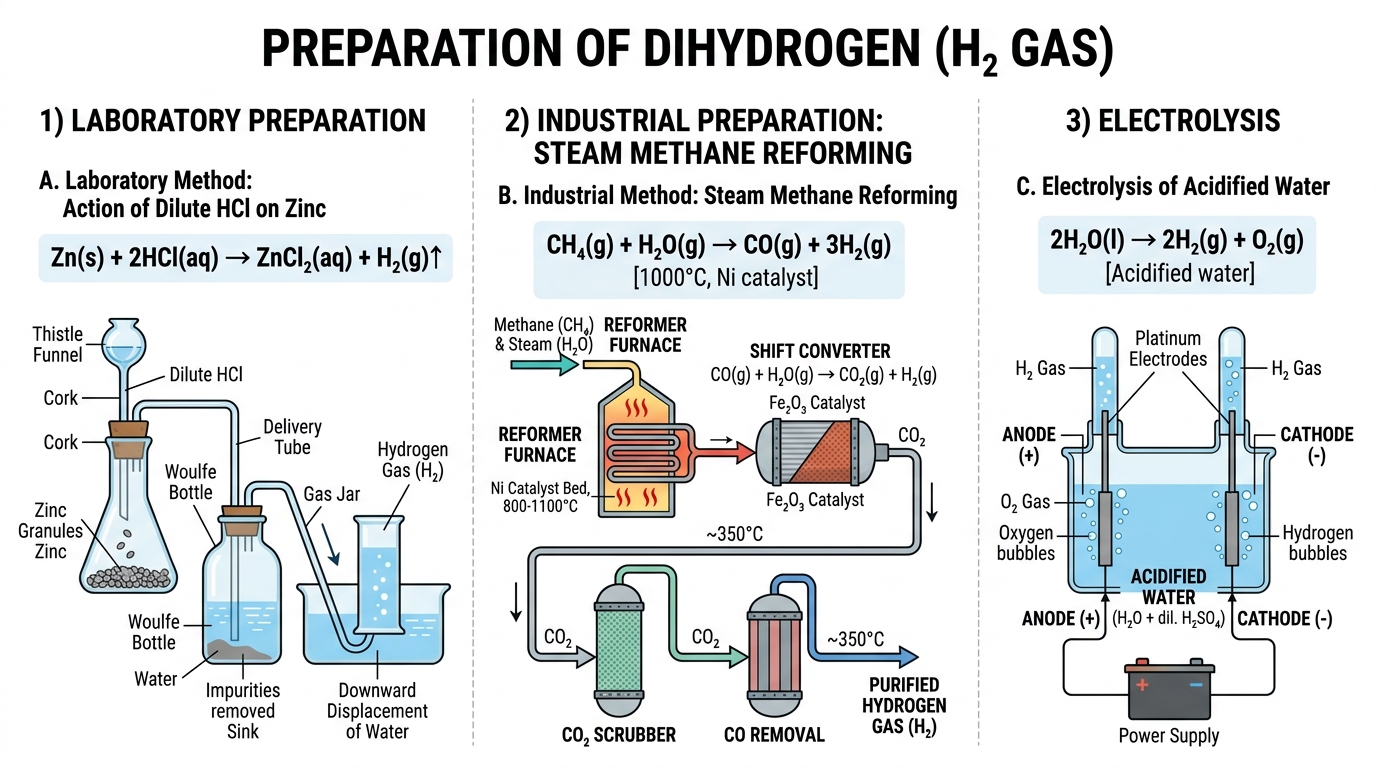
Fig 1.4 — Educational Diagram: Laboratory & Industrial Preparation of Dihydrogen
Preparation of Hydrogen
Key Point: Zn + 2HCl → ZnCl2 + H2
Overview
Hydrogen (H2) is a diatomic, colourless, odourless, highly flammable gas. In Class 11 chemistry, its preparation is studied by laboratory and industrial methods. Key laboratory methods include reaction of metals with dilute acids, reaction of water (or steam) with reactive metals, and electrolysis of water. Major industrial methods include steam reforming of natural gas, coal gasification and electrolysis on a large scale.
Laboratory methods
- Action of dilute acids on metals
Many metals (e.g., Zn, Fe, Mg) react with dilute acids to give hydrogen. This is the common lab method because it is simple and controllable. Example: Zn + 2HCl → ZnCl2 + H2. Use a gas delivery tube and collect H2 by upward displacement of air (H2 is lighter than air) or over water if apparatus permits. - Action of water/steam on metals
Cold water reacts with very reactive metals (alkali metals) to give hydrogen: 2Na + 2H2O → 2NaOH + H2. Steam (high temperature water vapour) reacts with certain metals such as iron, zinc, or aluminium to give hydrogen. Example: 3Fe + 4H2O (g) → Fe3O4 + 4H2 (formation of iron oxide and H2). - Electrolysis of water
Passing electric current through water containing a little acid or alkali decomposes water to hydrogen and oxygen. Overall: 2H2O (l) → 2H2 (g) + O2 (g). Hydrogen is liberated at the cathode and oxygen at the anode. Hydrogen volume is twice that of oxygen. - Other lab methods (special reagents)
Hydrolysis of metal hydrides or borohydrides: e.g., NaBH4 + 2H2O → NaBO2 + 4H2 (used in portable H2 generators). Aluminium reacts with NaOH to produce H2: 2Al + 2NaOH + 6H2O → 2Na[Al(OH)4] + 3H2.
Industrial methods
- Steam reforming of natural gas (principal industrial route)
CH4 + H2O (g) ⇌ CO + 3H2 (endothermic, Ni catalyst, high temperature). Followed by the water–gas shift reaction to convert CO to CO2 and produce more H2: CO + H2O → CO2 + H2. This process gives large-scale H2 used for ammonia synthesis, refining, etc. - Coal gasification (water–gas reaction)
C + H2O (g) → CO + H2 (water–gas reaction). Subsequent shift reaction increases H2 yield. - Electrolytic hydrogen (green hydrogen if electricity is renewable)
Large-scale electrolysers split water to H2 and O2; cost depends on electricity source.
Collection and purification
- Hydrogen is usually collected by upward displacement of air (because H2 is lighter than air). Collection over water is also used when gas is not very soluble.
- Industrial H2 is purified by removal of CO, CO2, H2O and other impurities (pressure swing adsorption, membranes, chemical scrubbing).
Chemical properties relevant to preparation
- H2 is a reducing agent in many metal reduction reactions and also reacts exothermically with oxygen: 2H2 + O2 → 2H2O (combustion/explosion).
- Yield and rate of laboratory H2 generation depend on metal reactivity, acid strength/concentration, temperature and surface area.
Safety notes
Hydrogen is highly flammable and forms explosive mixtures with air (4–75% by volume). Ensure good ventilation, avoid sparks/open flames, and use proper gas-handling equipment.
Summary (when to use which method)
- For school experiments: reaction of Zn or Mg with dilute acid, or electrolysis of water.
- For industrial bulk production: steam reforming of natural gas (most common), coal gasification or large-scale electrolysis (for low-carbon hydrogen).
- Lab: Zn + 2HCl → ZnCl2 + H2. Zinc granules react with dilute HCl to give hydrogen which can be tested with a burning splint (pop sound).
- Reactive metal + water: 2Na + 2H2O → 2NaOH + H2. Sodium reacts violently with water producing hydrogen and heat (sparks/fire).
- Steam on iron (industrial/lab demonstration): 3Fe + 4H2O (g) → Fe3O4 + 4H2. Steam passed over hot iron produces H2 (used in classic lab demonstrations).
- Industrial: Steam reforming of methane: CH4 + H2O → CO + 3H2 (Ni catalyst, high T). Followed by CO + H2O → CO2 + H2 (water–gas shift) to increase H2 yield.
- Electrolysis: 2H2O (l) → 2H2 (g) + O2 (g). In an electrolyser, hydrogen collects at the cathode; volume of H2 is twice the volume of O2 produced.
- \[Zn + 2HCl → ZnCl2 + H2\]
- \[Mg + 2HCl → MgCl2 + H2\]
- \[2Na + 2H2O → 2NaOH + H2\]
- \[2Al + 2NaOH + 6H2O → 2Na[Al(OH)4] + 3H2\]
- \[3Fe + 4H2O (g) → Fe3O4 + 4H2\]
- \[NaBH4 + 2H2O → NaBO2 + 4H2\]
Physical Properties of Hydrogen

Fig 1.5 — Educational Diagram: Physical Properties of Dihydrogen
Physical Properties of Hydrogen
Key Point: Ideal gas law: PV = nRT (P in Pa, V in m^3, n in mol, R = 8.314 J mol^-1 K^-1, T in K).
General description: Hydrogen (H2) is the lightest element and exists as a diatomic, non‑polar gas under normal conditions. It is colourless, odourless and tasteless.
Important physical constants (typical values):
- Molecular mass: 2.016 g mol-1
- Density at STP (273.15 K, 1 atm): ≈ 0.0899 g L-1
- Melting point: 13.99 K (−259.16 °C)
- Boiling point: 20.28 K (−252.87 °C)
- Critical temperature: ≈ 33.19 K (−239.96 °C)
Physical behaviour and observable properties:
- State: Gas at room temperature and pressure; liquefies at very low temperature.
- Low density: Because of its very small molar mass, hydrogen is much lighter than air (air ≈ 1.29 g L-1 at STP).
- High diffusivity and effusion rate: H2 diffuses and effuses faster than heavier gases (explained quantitatively by Graham's law).
- Thermal properties: High thermal conductivity compared with many gases, and high mean molecular speed at a given temperature.
- Solubility: Sparingly soluble in water (practically insoluble for many practical purposes).
- Compressibility / ideal behaviour: At ordinary pressures and temperatures hydrogen approximately follows the ideal gas law PV = nRT; deviations become important near liquefaction/critical point.
Microscopic explanation: At a given temperature hydrogen molecules have higher root‑mean‑square and average speeds than heavier molecules because molecular speed scales as 1/√M (M = molar mass). This leads to fast diffusion and effusion and larger kinetic energy per molecule at a given temperature is given by (3/2)kT per molecule or (3/2)RT per mole.
Practical implications: Very low boiling and melting points mean hydrogen is used as a cryogenic liquid for rocket fuel and for low‑temperature physics; its low density makes it unsuitable for modern balloons because of flammability (helium is used instead); high diffusivity and small size require special leak‑tight storage.
- Historical use in lighter‑than‑air balloons (e.g., 19th century), illustrating hydrogen's low density — later abandoned because of flammability.
- Liquid hydrogen as rocket fuel and coolant in cryogenic systems — demonstrates extremely low boiling point and large latent heat effects.
- Use as a coolant in large generators and turbines where high thermal conductivity of H2 improves heat removal.
- Diffusion demonstrations: hydrogen (or more safely, ammonia vs hydrogen substitutes) diffuses faster than oxygen and nitrogen, illustrating Graham's law.
- \[Ideal gas law: PV = nRT (P in Pa\]\[V in m^3\]\[n in mol\]\[R = 8.314 J mol^-1 K^-1\]\[T in K).\]
- \[Density from ideal gas: ρ = PM/RT (M = molar mass in kg mol^-1)\]\[Example: ρ ≈ (1.013×10^5 Pa × 2.016×10^-3 kg mol^-1)/(8.314×273.15 K) ≈ 0.0899 kg m^-3 (0.0899 g L^-1).\]
- \[Graham's law (rates of effusion/diffusion): rate1 / rate2 = sqrt(M2 / M1)\]\[Hydrogen effuses ≈ sqrt(M_air / M_H2) times faster than air.\]
- \[Root‑mean‑square speed: u_rms = sqrt(3RT / M) (M in kg mol^-1\]\[R = 8.314 J mol^-1 K^-1).\]
- \[Average translational kinetic energy: per mole = (3/2)RT\]\[per molecule = (3/2)kT (k = 1.38×10^-23 J K^-1).\]
- \[Mean speed (Maxwell distribution): u_avg = sqrt(8RT / (πM)).\]
Chemical Properties of Hydrogen
Fig 1.6 — Educational Diagram: Chemical Properties & Reactions of Dihydrogen
Chemical Properties of Hydrogen
Key Point: 2H2 + O2 → 2H2O (combustion; highly exothermic)
Overview
Hydrogen (H2) is a colourless, diatomic gas with unique chemical behaviour. It acts both as a reducing agent and as a reactant forming hydrides. The most common oxidation state is +1 (in compounds with more electronegative elements) and -1 (in metal hydrides).
1. Reaction with oxygen (combustion)
Hydrogen burns in oxygen to form water. This is highly exothermic and can be explosive when a flammable H2–O2 mixture is ignited.
2H2 + O2 → 2H2O (ΔH < 0)
2. Reaction with halogens
Hydrogen reacts with halogens to give hydrogen halides. These reactions are generally exothermic and can be violent (H2 + Cl2 may explode in sunlight).
H2 + Cl2 → 2HCl
3. Reaction with nitrogen (Haber process)
Hydrogen combines with nitrogen under high pressure, high temperature and in presence of an iron catalyst to form ammonia. This is industrially important for fertilizers.
N2 + 3H2 ⇌ 2NH3 (reversible; high pressure, moderate temperature, Fe catalyst)
4. Reaction with non-metals
Examples include formation of hydrogen sulphide and hydrides of other non-metals:
H2 + S → H2S
5. Reaction with acids and salts (displacement)
Many metals react with dilute acids to liberate hydrogen gas (acid acts as H+ source). This is a typical displacement (single‑replacement) reaction.
Zn + 2HCl → ZnCl2 + H2
6. Reaction with water
Active metals react with water to produce hydroxides and H2 (e.g., alkali metals). Most metals do not react with cold water; some react with steam to give metal oxides and hydrogen.
2Na + 2H2O → 2NaOH + H2
Fe + H2O (steam) → FeO + H2
7. Reduction of metal oxides (hydrogen as reducing agent)
Hydrogen reduces many metal oxides to metals; this property is widely used in metallurgy and laboratory preparations.
CuO + H2 → Cu + H2O
Fe2O3 + 3H2 → 2Fe + 3H2O
8. Formation of hydrides
Hydrogen forms three types of hydrides:
- Ionic (saline) hydrides — with very electropositive metals (Group 1 & 2), e.g., NaH, CaH2. Here H has oxidation state −1.
- Covalent hydrides — with p‑block elements: CH4, NH3, HCl. Bonding is covalent; H usually +1.
- Metallic (interstitial) hydrides — with transition metals; H atoms occupy interstices in metal lattices, e.g., PdHx (useful for H2 storage).
9. Acid–base and redox perspective
In aqueous chemistry H2 is produced by reduction of H+; the standard hydrogen electrode (SHE) reaction is used as reference:
2H+ + 2e− ⇌ H2 (E° = 0.00 V)
10. Kinetics and catalysis
Many reactions of H2 (e.g., hydrogenation of unsaturated organic compounds or Haber process) require catalysts (Ni, Pt, Pd, Fe). Catalysts lower activation energy and enable reaction at practical rates and milder conditions.
Safety note
Hydrogen is highly flammable and forms explosive mixtures with air. It is colourless and odourless, so leaks are hard to detect; good ventilation, leak detectors, and proper handling are essential.
Summary
Hydrogen reacts with O2, halogens, N2 (under conditions), acids, and many non‑metals; it forms hydrides and acts as a powerful reducing agent in both laboratory and industrial processes.
- Haber process for ammonia: N2 + 3H2 ⇌ 2NH3 — ammonia is used in fertilizers.
- Hydrogenation of vegetable oils (industrial) — H2 + unsaturated fat (Ni catalyst) → saturated fat (margarine production).
- Laboratory reaction of acid with metal: Zn + 2HCl → ZnCl2 + H2 (collection of H2 gas).
- Reduction of metal oxides: CuO + H2 → Cu + H2O — used in metallurgy/analytical tests.
- Fuel cell electricity generation: H2 + 1/2O2 → H2O (electrochemical conversion in fuel cells powers vehicles like Toyota Mirai).
- \[2H2 + O2 → 2H2O (combustion\]\[highly exothermic)\]
- \[H2 + Cl2 → 2HCl (reaction with halogens)\]
- \[N2 + 3H2 ⇌ 2NH3 (Haber process\]\[high P\]\[Fe catalyst)\]
- \[Zn + 2HCl → ZnCl2 + H2 (acid + metal → H2)\]
- \[2Na + 2H2O → 2NaOH + H2 (alkali metal + water)\]
- \[CuO + H2 → Cu + H2O (reduction of metal oxides)\]
Hydrogen Bonding

Fig 1.7 — Educational Diagram: Intermolecular & Intramolecular Hydrogen Bonding & Ice Lattice
Hydrogen Bonding
Key Point: Generic notation: X–H...Y (X, Y = F, O, or N)
Definition: A hydrogen bond is a special, directional attractive interaction in which a hydrogen atom covalently bonded to a highly electronegative atom (usually F, O or N) is attracted to a lone pair of electrons on another electronegative atom. It is commonly written as X–H...Y where X and Y = F, O or N.
Conditions for hydrogen bonding:
- Hydrogen must be covalently bonded to a small, highly electronegative atom (F, O or N).
- The acceptor atom (Y) must have a lone pair of electrons.
- The interaction is strongest when the X–H...Y angle approaches 180° (linear).
Types:
- Intermolecular hydrogen bonding: between two different molecules (e.g., H2O...H2O, HF chains).
- Intramolecular hydrogen bonding: within the same molecule when donor and acceptor are close (e.g., o-nitrophenol).
Characteristics and effects:
- Directional: strength depends on the X–H...Y angle (near 180° is strongest).
- Moderate bond strength: typically about 5–40 kJ·mol⁻¹ for neutral H-bonds (charged H-bonds may be stronger).
- Shorter X–H...Y distance and greater red shift of X–H stretching frequency in IR spectroscopy indicate stronger H-bonding.
- Huge influence on physical properties: increased boiling and melting points, higher viscosity and surface tension, anomalous properties of water (high boiling point, ice less dense than liquid water).
- Important in biological structure and function: base pairing in DNA, secondary structure of proteins (α-helix, β-sheet).
Why hydrogen bonding matters: Hydrogen bonds explain many common chemical and physical observations — e.g., why water is liquid at room temperature despite its low molar mass, why alcohols have higher boiling points than ethers of similar mass, and why ice floats.
Detection and evidence: Spectroscopic shifts (O–H and N–H stretching bands shift to lower frequency and broaden in IR when H-bonded), changes in NMR chemical shift, X-ray and neutron diffraction showing characteristic geometries and distances.
- Water (H2O): each molecule can form up to four H-bonds in ice (tetrahedral network); explains high boiling point, surface tension, and ice floating (lower density than liquid water).
- Hydrogen fluoride (HF): forms chains via strong H-bonding, accounts for high boiling point compared with other hydrogen halides.
- Ethanol (CH3CH2OH) vs. dimethyl ether (CH3OCH3): ethanol shows hydrogen bonding (higher boiling point) while dimethyl ether does not.
- Carboxylic acids (e.g., acetic acid): form stable intermolecular dimers via two H-bonds in gas and nonpolar solvents.
- DNA base pairing: adenine–thymine pair has two H-bonds; guanine–cytosine pair has three H-bonds—critical for stability and specificity of the double helix.
- Proteins: hydrogen bonds stabilize α-helices and β-sheets between backbone N–H and C=O groups.
- \[Generic notation: X–H...Y (X\]\[Y = F\]\[O\]\[or N)\]
- \[Typical H-bond energy ranges: weak ≈ 5–15 kJ·mol⁻¹\]\[moderate ≈ 15–40 kJ·mol⁻¹ (neutral H-bonds)\]\[charged H-bonds can be > 40 kJ·mol⁻¹.\]
- \[Typical distances: d(H...A) ≈ 1.5–2.5 Å (depends on donor/acceptor)\]\[shorter distance → stronger bond.\]
- \[Geometry condition: X–H...Y angle ≈ 180° gives strongest interaction (directionality).\]
- \[Hydrogen-bonded water in ice: each H2O forms 4 H-bonds → tetrahedral coordination (explains lower density of ice).\]
Hydrides

Fig 1.9 — Educational Diagram: Classification of Hydrides (Ionic, Covalent, Metallic)
Hydrides
Key Point: 2 Na + H2 → 2 NaH (formation of ionic hydride)
What are hydrides?
Hydrides are binary compounds of hydrogen with other elements (of the form E–H). Depending on the element E and the nature of bonding, hydrides are classified into three main types: ionic (salt-like) hydrides, covalent (molecular) hydrides, and metallic (interstitial) hydrides.
Types and characteristics
- Ionic (salt-like) hydrides: Formed by highly electropositive elements (groups 1 and 2). They contain H− (hydride ion). Typical properties: high melting points, crystalline solids, strong reducing agents, react vigorously with water to give H2. Example: NaH, CaH2.
- Covalent (molecular) hydrides: Formed by p-block elements (groups 13–17 and some transition elements). Bonds are covalent; many are gases or volatile liquids. Properties vary widely: e.g., CH4 (non-polar, gas), NH3 (polar, gas), H2O (polar liquid due to H-bonding), HF (very polar, hydrogen bonding). Subclasses include electron-deficient hydrides (e.g., B2H6) and polymeric covalent hydrides (e.g., AlH3).
- Metallic (interstitial) hydrides: Formed by some transition metals and lanthanides/actinides. Hydrogen atoms occupy interstitial sites in metal lattices (non-stoichiometric often). These are typically electrically conductive, have metallic lustre, and are used for reversible hydrogen storage. Examples: PdHx, LaNi5H6, TiH2.
Bond character and periodic trends
Bond character correlates with electronegativity difference (Pauling scale): large difference → ionic hydride; moderate → polar covalent; small → nonpolar covalent. Across a period, hydrides tend to be covalent; down a group, size and bond strength change. Hydrogen bonding (strong in H–F, H–O, H–N) raises boiling points and affects physical properties (e.g., H2O liquid at room temperature).
Acid–base behaviour of hydrides
Hydrides can show protic behaviour (H+ donor), hydridic behaviour (H− donor), or be amphoteric. Examples: H in HCl is protic (acidic), H in NaH is hydridic (basic) and reduces many substances, some hydrides (e.g., AlH3, ZnH2) are amphoteric.
Preparation methods (overview)
- Direct combination: elements combine at suitable conditions (e.g., 2Na + H2 → 2NaH; H2 + 1/2O2 → H2O).
- Reduction/hydrogenation: metal oxides or halides reduced by H2 or by metal hydrides (e.g., formation of borohydrides and complex hydrides).
- Hydrolysis or exchange reactions: e.g., forming boranes or silanes by specific routes (industrial methods vary by compound).
Chemical behaviour and important reactions
- Ionic hydrides react with water to release hydrogen: CaH2 + 2H2O → Ca(OH)2 + 2H2.
- Hydrides act as reducing agents: NaH, LiAlH4, NaBH4 used in organic reductions (LiAlH4 is a strong hydride donor; NaBH4 is milder).
- Combustion and fuel use: H2 + 1/2O2 → H2O (high energy release) — basis for hydrogen fuel; metal hydrides used for reversible H2 storage (M + x/2 H2 ⇄ MHx).
Uses and real-life applications
Hydrides are important in industry, laboratories and technology: hydrogen storage (metal hydrides in fuel cells and NiMH batteries), reducing agents in organic chemistry (LiAlH4, NaBH4), drying agents (CaH2), semiconductor industry (SiH4 for CVD), boranes and silanes in synthesis, H2 as rocket/space fuel and clean fuel.
Tests and safety
Hydrogen gas is identified by the ‘pop’ test (ignite small sample -> pop sound). Many hydrides (especially ionic ones) are strongly reducing and react with water; some hydrides (e.g., B2H6, PH3) are toxic or pyrophoric — handle with care and under appropriate controls.
Summary
Hydrides illustrate a wide range of bonding and properties: from ionic salts (H−) to covalent molecules (H bonded to p-block elements) to metal lattices with interstitial H. Their chemistry underpins key industrial processes (reduction, hydrogen storage, synthesis) and explains many physical trends (boiling points, acidity/basicity) seen in the hydrides of the elements.
- Sodium hydride (NaH): ionic hydride, strong reducing agent; reacts with water to give sodium hydroxide and hydrogen.
- Calcium hydride (CaH2): used as a drying agent for solvents; CaH2 + 2H2O → Ca(OH)2 + 2H2.
- Methane (CH4): covalent hydride of carbon; principal component of natural gas (fuel).
- Ammonia (NH3): covalent hydride of nitrogen; used as fertilizer and industrial feedstock.
- Water (H2O): covalent hydride of oxygen, exhibits extensive hydrogen bonding; essential for life.
- Palladium hydride (PdHx): metallic/interstitial hydride used to study hydrogen absorption and catalysis.
- \[2 Na + H2 → 2 NaH (formation of ionic hydride)\]
- \[Ca + H2 → CaH2 (formation of ionic hydride)\]
- \[NaH + H2O → NaOH + H2 (ionic hydride + water → hydrogen gas)\]
- \[2 H2 + O2 → 2 H2O (combustion of hydrogen)\]
- \[CH4 + 2 O2 → CO2 + 2 H2O (combustion of methane)\]
- \[B2H6 + 6 H2O → 2 B(OH)3 + 6 H2 (hydrolysis of diborane)\]
Water (H2O)

Fig 1.8 — Educational Diagram: Water (H₂O) vs Heavy Water (D₂O) Properties & Reactor Moderator
Water (H2O)
Key Point: Molecular formula: H2O
Overview
Water (H2O) is a simple triatomic molecule essential for life. Each molecule contains two hydrogen atoms covalently bonded to one oxygen atom. Water's unique structure and hydrogen bonding give it anomalous physical and chemical properties important in chemistry, biology and the environment.
Structure and Bonding
The Lewis structure shows O with two bonding pairs and two lone pairs. Oxygen is sp3 hybridized; the VSEPR shape is bent (angular) with a bond angle ≈ 104.5° (reduced from tetrahedral 109.5° because of lone-pair repulsion). The O–H bonds are polar (difference in electronegativity), producing a net dipole moment ≈ 1.85 D. Strong intermolecular hydrogen bonds (between the H of one molecule and lone pairs on O of another) create an extended H-bonded network in liquid and solid water.
Important Physical Properties
- Formula: H2O
- Molar mass: 18.015 g·mol−1
- Density (liquid, 4 °C): 1.000 g·cm−3; maximum density at 4 °C (anomalous expansion on cooling below 4 °C)
- Melting point: 0 °C; Boiling point (1 atm): 100 °C
- Specific heat capacity: 4.18 J·g−1·K−1 (high heat capacity)
- Surface tension (20 °C): ≈ 72.8 mN·m−1
- Dielectric constant (25 °C): ≈ 78.5 (high, promotes solvation of ions)
Chemical Properties
Water undergoes autoionization: 2 H2O ⇌ H3O+ + OH− (commonly written H2O ⇌ H+ + OH−). The ionic product Kw = [H+][OH−] = 1.0×10⁻¹⁴ (at 25 °C), giving pH + pOH = 14. Water is amphoteric: it can act as an acid (donate H+) or as a base (accept H+). It reacts with reactive metals (e.g., 2 Na + 2 H2O → 2 NaOH + H2), and is a reactant in hydrolysis reactions and many redox processes. Combustion of hydrogen produces water: 2 H2 + O2 → 2 H2O. Electrolysis decomposes water to H2 and O2: 2 H2O(l) → 2 H2(g) + O2(g).
Why water is a 'universal solvent'
Because of its polarity and high dielectric constant, water stabilizes and solvates ions strongly via ion–dipole interactions and hydrogen bonds, dissolving many ionic and polar covalent substances. This underlies aqueous chemistry and biochemical reactions.
Role & Consequences of Hydrogen Bonding
- Elevated boiling and melting points compared with similar-sized molecules (e.g., H2S)
- High latent heats (fusion and vaporization) and high heat capacity → temperature buffering in environment and organisms
- Surface tension → droplet formation and capillarity (important in plant water transport)
- Ice is less dense than liquid water → ice floats, insulating aquatic life
- Combustion of hydrogen: 2 H2(g) + O2(g) → 2 H2O(l) (formation of water in rockets and fuel cells produces large amounts of heat and water vapor).
- Electrolysis of water to produce hydrogen fuel: 2 H2O(l) → 2 H2(g) + O2(g) (used in lab and industry for H2 production).
- Capillary action in plants: cohesion (H-bonds between water molecules) and adhesion (H-bonds to xylem walls) enable water transport from roots to leaves.
- Ice floating on lakes: because water is densest at 4 °C, ice (solid water) floats and insulates aquatic ecosystems in winter.
- Water as a solvent: NaCl(s) dissolves to give Na+ and Cl− stabilized by hydration shells (ion–dipole interactions).
- \[Molecular formula: H2O\]
- \[Lewis/structural: H–O–H with two lone pairs on O\]\[bond angle ≈ 104.5°\]
- \[Autoionization: 2 H2O ⇌ H3O+ + OH− (often written H2O ⇌ H+ + OH−)\]
- \[Ionic product: Kw = [H+][OH−] = 1.0 × 10⁻¹⁴ (at 25 °C)\]
- \[pH relation: pH + pOH = 14 (at 25 °C)\]\[pH = −log[H+]\]
- \[Combustion: 2 H2 + O2 → 2 H2O\]\[Electrolysis: 2 H2O → 2 H2 + O2\]
Heavy Water (D2O)
Fig 1.8 — Educational Diagram: Water (H₂O) vs Heavy Water (D₂O) Properties & Reactor Moderator
Heavy Water (D2O)
Key Point: Molar mass: M(D2O) ≈ 2×(2.014) + 15.999 = 20.03 g mol⁻¹
Definition: Heavy water (D2O) is the isotopic form of water in which both hydrogen atoms are the isotope deuterium (2H or D) instead of protium (1H). Chemically it behaves like ordinary water but has different physical, spectroscopic and nuclear properties because deuterium has about twice the mass of protium.
Structure and basic facts:
- Formula: D2O (or 2H2O).
- Molar mass: ≈ 20.03 g mol⁻¹ (vs H2O ≈ 18.02 g mol⁻¹).
- Density (25 °C): ≈ 1.1056 g cm⁻³ (greater than H2O ≈ 0.997 g cm⁻³).
- Melting point: 3.82 °C; Boiling point: 101.42 °C (both slightly higher than H2O).
Why properties differ: The mass difference of deuterium changes the reduced mass of the O–H (O–D) oscillator. Vibrational frequencies ν vary approximately as ν ∝ 1/√μ (μ = reduced mass), so O–D vibrations are lower in frequency than O–H. This leads to different IR spectra, altered zero-point energies and measurable kinetic and equilibrium isotope effects.
Preparation (overview):
- Electrolytic enrichment: preferential electrolysis of H2O leaves D2O enriched in the residual liquid.
- Girdler sulfide (GS) process: a chemical exchange method used industrially to concentrate D2O from natural water.
- Isotope exchange methods: catalytic exchange between H2/D2 and H2O/D2O under suitable conditions.
Chemical and nuclear behavior:
- Chemically similar to H2O; it forms hydrogen-bonded networks but bond strengths and reaction rates can differ due to isotope effects.
- Rapid proton-deuteron exchange means mixing H2O and D2O produces HDO (statistical distribution) quickly: H2O + D2O ⇌ 2 HDO.
- Deuterium has a very low neutron absorption cross-section compared with protium, so D2O is an excellent neutron moderator in nuclear reactors (e.g., CANDU reactors).
Isotope effects and kinetics: Substitution of H by D usually slows reactions that involve breaking or forming X–H bonds (primary kinetic isotope effect). Typical primary kinetic isotope effects (kH/kD) for bond-breaking steps can be up to ~6–7, reflecting the lower zero-point energy and stronger effective bond for O–D compared to O–H.
Biological/toxicological note: Small amounts of D2O are non-toxic, but replacement of a large fraction of body water with D2O disrupts cell division and biochemical reactions. High concentrations (near 100% D2O) are harmful; partial replacement (above ~25–50%) can cause physiological effects in organisms.
Uses:
- Moderator and coolant in heavy-water nuclear reactors (because of low neutron absorption and good moderating properties).
- Solvent and tracer in laboratory studies: NMR (as a deuterated solvent), IR spectroscopy, metabolic/turnover studies using deuterium labeling.
- Neutron scattering and neutron diffraction experiments (deuterium scatters neutrons differently than hydrogen).
Important practical points for Class 11:
- Recognize D2O as chemically water but with altered physical properties due to isotopic mass.
- Understand simple exchange and the concept of kinetic isotope effect qualitatively.
- Know its major application as a neutron moderator in reactors and as a deuterated solvent in spectroscopy.
- Heavy water is used as a moderator in CANDU nuclear reactors because deuterium absorbs neutrons much less readily than protium, allowing efficient chain reactions with natural uranium.
- In NMR spectroscopy, D2O is used as a solvent to avoid the large proton signal from H2O and to provide a deuterium lock signal for the spectrometer.
- In mechanistic chemistry studies, replacing H by D (using D2O or deuterated reagents) reveals whether an X–H bond is broken in the rate‑determining step via observed kinetic isotope effects.
- \[Molar mass: M(D2O) ≈ 2×(2.014) + 15.999 = 20.03 g mol⁻¹\]
- \[Reduced mass (diatomic approximation): μ = m_O × m_H / (m_O + m_H) (used in vibrational frequency calculations)\]
- \[Vibrational frequency relation: ν ∝ 1 / √μ (so ν_OD ≈ ν_OH × √(m_H/m_D) ≈ ν_OH × 1/√2 ≈ 0.707 ν_OH)\]
- \[Typical kinetic isotope effect (qualitative): KIE = k_H / k_D (primary KIE can be up to ~6–7 for H→D substitution)\]
- \[Exchange reaction (illustrative): H2O + D2O ⇌ 2 HDO (rapid proton/deuteron exchange)\]
- \[Hydrogen–deuterium exchange with gas (catalytic): H2O + D2 ⇌ D2O + H2 (requires catalyst/conditions)\]
Hydrogen Peroxide (H2O2)

Fig 1.10 — Educational Diagram: Hydrogen Peroxide (H₂O₂) Open-Book Structure & Storage
Hydrogen Peroxide (H2O2)
Key Point: Molecular formula: H2O2
Definition and basic properties
Hydrogen peroxide (H2O2) is a simple peroxide in which two oxygen atoms are bonded together (O–O) and each oxygen is also bonded to one hydrogen. It is a pale blue liquid in concentrated form, usually available as an aqueous solution. Molar mass = 34.01 g mol-1. It is less stable than water and decomposes to water and oxygen:
2 H2O2 (aq) → 2 H2O (l) + O2 (g) (exothermic)
Structure
H–O–O–H with a single O–O bond. The O–O bond is relatively weak; the H–O–O bond angle ≈ 94–98°. Because of the O–O bond and the nonplanar arrangement the molecule has a skewed (nonlinear) shape. The formal oxidation state of each O is −1.
Preparation
Laboratory method (classical):
- Barium peroxide + dilute sulphuric acid: BaO2 + H2SO4 → H2O2 + BaSO4 (BaSO4 precipitates).
Industrial (major method): Anthraquinone process — hydrogenation of anthraquinone to anthrahydroquinone followed by autoxidation with O2 regenerates the anthraquinone and produces H2O2. Electrochemical routes and direct synthesis from H2 + O2 are also used in some processes.
Chemical behaviour
H2O2 is an important oxidizing agent but can also act as a reducing agent depending on the reactant and the medium.
- As oxidizing agent (acidic medium): 2 I- + H2O2 + 2 H+ → I2 + 2 H2O
- As reducing agent (with strong oxidizer): 2 MnO4- + 5 H2O2 + 6 H+ → 2 Mn2+ + 5 O2 + 8 H2O
Catalysed decomposition
Decomposition of H2O2 to H2O + O2 is catalysed by transition metal ions (Fe2+/Fe3+, MnO2), iodide (I-), and enzymes (catalase). Light, heat and metal surfaces accelerate decomposition. For safety and shelf life, commercial solutions contain stabilizers (e.g. phosphoric acid, sodium stannate, acetanilide) and are stored in dark, cool containers.
Concentration, grades and uses
Common household concentrations are ~3% (w/w). Laboratory and industrial concentrations range from 6% up to >90% (for e.g., propellant-grade). Uses include antiseptic/disinfectant, bleaching (textiles, paper), organic synthesis (oxidation reactions, epoxidation), environmental (wastewater treatment, advanced oxidation), rocket propellant and oxygen source in emergencies (high concentrations), and as a bleaching/cleaning agent in cosmetics and hair dyes (low-moderate concentrations).
Analytical chemistry
H2O2 can be estimated iodometrically: H2O2 + 2 I- + 2 H+ → I2 + 2 H2O (then titrate I2 with thiosulfate) or by redox titration with KMnO4 in acidic medium using the reaction: 2 MnO4- + 5 H2O2 + 6 H+ → 2 Mn2+ + 5 O2 + 8 H2O.
Safety
Concentrated H2O2 is corrosive and a strong oxidizer — it can cause severe burns and may ignite combustible materials. Dilute solutions (3–6%) are commonly safe with normal precautions. Store in original opaque containers away from organics and reducing agents.
- Household antiseptic: 3% H2O2 used to clean minor cuts and as a mouthwash (diluted) — it disinfects by oxidizing cell components and liberating oxygen.
- Bleaching: H2O2 is used to bleach paper and textiles because it oxidizes colored impurities without chlorinated byproducts.
- Laboratory oxidant: Used in organic reactions (e.g., Baeyer–Villiger oxidation, epoxidation in presence of catalysts).
- Catalase reaction in biology: The enzyme catalase decomposes H2O2 rapidly to water and oxygen (observable as bubbling when H2O2 is added to blood or potato).
- Rocketry/propulsion: High-concentration H2O2 (>70%) can be used as monopropellant (decomposed over a catalyst to produce hot steam and O2) or as an oxidizer in bipropellant systems.
- \[Molecular formula: H2O2\]
- \[Decomposition: 2 H2O2 → 2 H2O + O2\]
- \[Oxidizing example (iodide): H2O2 + 2 I- + 2 H+ → I2 + 2 H2O\]
- \[Reducing example (permanganate): 2 MnO4- + 5 H2O2 + 6 H+ → 2 Mn2+ + 5 O2 + 8 H2O\]
- \[Preparation (laboratory): BaO2 + H2SO4 → H2O2 + BaSO4 (s)\]
- \[Molarity from mass%: M = (mass% / 100) × (density in g·L^-1) / (34.01 g·mol^-1) — (use density of the solution for accuracy)\]
Uses of Hydrogen
Fig 1.1 — Educational Diagram: Position of Hydrogen
Uses of Hydrogen
Key Point: Steam reforming (primary industrial production): CH4 + H2O (g) → CO + 3H2
Hydrogen (H2) is the lightest and most reactive element. Its unique properties — highest gravimetric energy density (per kg), strong reducing ability, ability to form water on combustion, and readiness to form covalent and ionic bonds — make it extremely useful across chemical industry, energy, metallurgy and space technology.
Main industrial roles:
- Feedstock for chemical synthesis: H2 is a principal raw material for making ammonia (NH3) via the Haber–Bosch process (fertilisers), methanol (CH3OH), hydrogen chloride (HCl) and many other chemicals.
- Hydrogenation: Addition of H2 across C=C (with catalysts like Ni, Pt) converts unsaturated vegetable oils into saturated or partially saturated fats (margarine manufacture) and is used in fine chemical synthesis.
- Petroleum refining: Hydrocracking and hydrodesulfurization use H2 to break heavy hydrocarbons into lighter fuels and to remove sulfur from fuels.
- Reducing agent in metallurgy: H2 reduces metal oxides to metals (used in laboratory and some industrial reductions) and gives a clean, non-carbonaceous reducing atmosphere when required.
- Energy carrier and fuel: H2 is used as rocket propellant (liquid hydrogen with liquid oxygen), and in fuel cells (direct conversion to electricity), and is proposed as a low-carbon energy vector in a hydrogen economy.
- Other uses: As a coolant (high thermal conductivity, low density) for large electrical generators, in glass and electronics industries for controlled atmospheres, and historically for lifting gas in balloons (now largely replaced by helium for safety reasons).
Production methods (brief): commercial H2 is mainly produced by steam reforming of natural gas, partial oxidation of hydrocarbons, and electrolysis of water (favoured when low-carbon electricity is available). The choice of production route links hydrogen use to carbon emissions — 'green hydrogen' from electrolysis is important for decarbonisation.
Practical considerations: H2 storage and transport are challenging because of low volumetric energy density (needs compression, liquefaction or carriers like ammonia/metal hydrides). Safety (flammability, embrittlement of metals) is important in design.
- Ammonia production (Haber–Bosch): N2 + 3H2 → 2NH3 — ammonia is a major fertiliser feedstock.
- Hydrogenation of vegetable oils to make margarine: R-CH=CH-R' + H2 → R-CH2-CH2-R' (Ni catalyst).
- Methanol synthesis: CO + 2H2 → CH3OH (used as solvent, feedstock, fuel).
- Petroleum refining — hydrocracking/hydrodesulfurization uses H2 to produce cleaner fuels and lighter fractions.
- Fuel cells in vehicles (e.g., Toyota Mirai): 2H2 + O2 → 2H2O, producing electricity with water as the only major product.
- Rocket propulsion: liquid H2 + liquid O2 combust to give high specific impulse (used in upper stages and space shuttles).
- \[Steam reforming (primary industrial production): CH4 + H2O (g) → CO + 3H2\]
- \[Water electrolysis (green H2): 2H2O (l) → 2H2 + O2\]
- \[Haber process (ammonia): N2 + 3H2 → 2NH3\]
- \[Methanol formation: CO + 2H2 → CH3OH\]
- \[Hydrogenation of an alkene: R-CH=CH-R' + H2 → R-CH2-CH2-R' (catalyst: Ni/Pt/Pd)\]
- \[Fuel cell overall reaction: 2H2 + O2 → 2H2O (anode: 2H2 → 4H+ + 4e–\]\[cathode: O2 + 4H+ + 4e– → 2H2O)\]
Storage, Safety and Environmental Aspects
Fig 1.1 — Educational Diagram: Position of Hydrogen
Storage, Safety and Environmental Aspects
Key Point: Combustion (enthalpy per mole): 2 H2(g) + O2(g) → 2 H2O(l) ΔH° ≈ −571.6 kJ (i.e., −285.8 kJ per mol H2)
Overview
Hydrogen (H2) is a high–energy-content fuel by mass (≈142 MJ·kg⁻¹) that can be stored as compressed gas, cryogenic liquid, in chemical or metal hydrides, or as part of liquid organic hydrogen carriers (LOHCs). Each storage route has trade‑offs in energy efficiency, volumetric density, cost and safety.
Common storage methods
- Compressed gas: H2 stored in high‑pressure cylinders (typically 200–700 bar). Advantages: mature technology, fast refuelling. Drawbacks: low volumetric energy density, high pressure requires strong tanks and safety systems.
- Liquid hydrogen (LH2): cryogenic storage at ≈20 K (−253°C). Advantage: higher volumetric density than compressed gas. Drawbacks: energy‑intensive liquefaction, boil‑off losses, requires high insulation.
- Metal hydrides: certain metals/alloys (e.g., MgH2, LaNi5Hx) absorb H2 reversibly. Advantage: safe, low pressure. Drawbacks: added mass (low gravimetric capacity for many alloys), slow kinetics, heat management for release.
- Chemical hydrides / LOHCs: hydrogen chemically bonded in compounds (e.g., NaBH4, methylcyclohexane). Advantage: liquid handling like conventional fuels, good volumetric density. Drawbacks: need chemical processing to release H2 (regeneration costs and energy).
Key safety issues
- Flammability and explosion risk: H2 has a wide flammability range in air (≈4–75% by volume) and a high flame speed. A small leak can form an ignitable mixture.
- Leakage and detection: H2 is colourless, odourless and very diffusive (small molecule). It disperses quickly upwards but is hard to detect without sensors. Hydrogen detectors, adequate ventilation and leak‑tight fittings are essential.
- Embrittlement: H2 can diffuse into and weaken metals (hydrogen embrittlement), causing cracking in steels and welds. Use of compatible materials (austenitic stainless steels, aluminium alloys, special coatings) and design standards is required.
- Pressure and cryogenics: high‑pressure vessels require certified cylinders and pressure‑relief devices. Cryogenic LH2 needs vacuum insulation, boil‑off management and materials that remain ductile at very low temperatures.
- Static electricity and ignition control: ensure grounding/earthing during transfers; eliminate ignition sources in storage/dispensing areas.
Environmental aspects
- Clean use: Direct use of H2 in fuel cells produces only water vapor (H2 + 1/2 O2 → H2O), so tailpipe emissions contain no CO2 or particulates.
- Production footprint matters: Most current H2 is made from fossil fuels (steam methane reforming—SMR) producing CO2 ("grey" hydrogen). Capturing and storing CO2 gives "blue" hydrogen. Electrolysis using renewables gives low‑carbon "green" hydrogen. Life‑cycle GHG emissions therefore vary widely.
- Indirect impacts: H2 leakage to the atmosphere can affect air chemistry (e.g., influence the lifetime of methane and ozone balance) if leakage is significant at scale, so minimizing leaks is important.
- Water and energy use: electrolysis requires significant electricity and water; environmental benefit depends on the source of electricity and water availability.
Operational best practices (summary)
- Use certified cylinders/tanks and pressure‑relief devices; follow standards for materials resistant to embrittlement.
- Provide hydrogen sensors, good ventilation (hydrogen rises), grounding for transfer operations and strict control of ignition sources.
- Design refuelling stations and storage sites to limit leak consequences: safe spacing, automatic shut‑off, emergency venting and personnel training.
- Choose production pathways and supply chains that minimize lifecycle emissions (prefer renewable electricity for electrolysis or SMR+CCS where available).
Summary
Hydrogen can enable near‑zero local emissions when used cleanly, but safe storage and handling are critical because of flammability, leakage and embrittlement risks. The real environmental benefit depends on how the hydrogen is produced and managed throughout its lifecycle.
- Fuel cell vehicles (e.g., Toyota Mirai, Hyundai Nexo) storing H2 in high‑pressure (700 bar) tanks; rapid refuelling but requires leak detection and grounding.
- Space launch vehicles use liquid hydrogen (LH2) as rocket fuel (e.g., SpaceX, NASA) in heavily insulated cryogenic tanks with boil‑off management.
- Forklifts and material‑handling equipment using metal hydride or gaseous H2 for zero‑emission indoor operation with dedicated safety systems.
- Industrial hydrogen produced by steam methane reforming (SMR) at refineries—large CO2 emissions unless CCS is applied (blue H2) versus electrolysis using wind/solar (green H2).
- LOHCs (liquid organic hydrogen carriers) used for safe transport of hydrogen by ship or truck, with hydrogen released at the destination and carrier recycled.
- \[Combustion (enthalpy per mole): 2 H2(g) + O2(g) → 2 H2O(l) ΔH° ≈ −571.6 kJ (i.e., −285.8 kJ per mol H2)\]
- \[Energy per mass: E (MJ·kg⁻¹) = (ΔH° per mol × 1000) / M_molar(H2)\]\[Example: (285.8 kJ·mol⁻¹ × 1000)/(2 g·mol⁻¹) ≈ 142.9 MJ·kg⁻¹\]
- \[Ideal gas (useful for estimating compressed storage): PV = nRT (P in Pa\]\[V in m³\]\[n in mol\]\[R = 8.314 J·mol⁻¹·K⁻¹\]\[T in K)\]
- \[Volumetric energy at STP: E_vol (MJ·m⁻³) ≈ (285.8 kJ·mol⁻¹ × N_mol per m³)/1000 ≈ 12.8 MJ·m⁻³ (since ~44.6 mol·m⁻³ at STP)\]
- \[Key safety numbers: flammability limits ≈ 4%–75% H2 by volume in air\]\[autoignition temperature ≈ 500 °C\]\[liquid H2 density ≈ 0.071 kg·L⁻¹\]\[boiling point ≈ −253 °C.\]
Key Concepts
- Hydrogen
- Lightest element (atomic number 1), diatomic gas in elemental form; highly reactive and a primary reducing agent.
- Dihydrogen (H2)
- Molecular form of hydrogen consisting of two H atoms bonded by a single covalent bond; colorless, odorless gas.
- Atomic hydrogen
- Monatomic, highly reactive hydrogen atoms (H·) formed by dissociation of H2; exist only transiently under special conditions.
- Protium
- Most common isotope of hydrogen (1H), contains one proton and no neutron.
- Deuterium
- Stable hydrogen isotope (2H or D) with one proton and one neutron; used as a tracer and in heavy water.
- Tritium
- Radioactive hydrogen isotope (3H or T) with one proton and two neutrons; emits beta radiation.
- Ortho and Para hydrogen
- Spin isomers of H2: ortho-H2 (parallel nuclear spins, triplet) and para-H2 (antiparallel spins, singlet); differ in energy and heat capacity.
- Hydride
- Compound in which hydrogen is bonded to another element; hydrogen can behave as hydridic (H−), protic (H+), or neutral.
- Ionic hydride
- Hydride formed with highly electropositive metals (usually s-block) where H exists as hydride ion (H−); salt-like and basic.
- Covalent hydride
- Hydride in which hydrogen forms covalent bonds with p-block elements; molecular and often volatile.
- Metallic hydride
- Hydride in which hydrogen is absorbed into the metal lattice, often forming non-stoichiometric compounds; used for hydrogen storage.
- Hydrogen bond
- Strong dipole–dipole interaction between a hydrogen atom covalently bonded to N, O, or F and an electronegative atom on another molecule.
- Electrolysis (of water)
- Decomposition of water into hydrogen and oxygen using an electric current; an important laboratory and industrial method.
- Steam reforming
- Industrial process to produce hydrogen by reacting methane with steam over a catalyst to form CO and H2, followed by shift conversion to CO2 and more H2.
- Water gas
- Mixture of CO and H2 produced by passing steam over red-hot carbon; used as a source of hydrogen after purification.
- Reducing agent
- Substance that donates electrons in a chemical reaction; hydrogen commonly reduces metal oxides to metals.
- Hydrogenation
- Addition of hydrogen across multiple bonds (e.g., C=C) typically using a catalyst; important in organic and industrial chemistry.
- Fuel cell
- Electrochemical device that converts chemical energy of hydrogen and oxygen directly into electricity, water, and heat.
- Proton (H+)
- Hydrogen nucleus after losing its electron; a key species in acid–base chemistry and proton transfer reactions.
- Oxidation state of hydrogen
- Formal charge assigned to hydrogen in compounds: usually +1 with nonmetals and −1 with metals (hydrides); zero in elemental H2.
Practice Questions
-
Why is hydrogen placed separately in the periodic table rather than firmly in Group 1 or Group 17? / हाइड्रोजन को आवर्त सारणी में समूह 1 या समूह 17 में दृढ़ता से रखने के बजाय अलग क्यों रखा जाता है?
Show answer
Hydrogen (1s¹) resembles alkali metals by losing an electron to form H⁺ and halogens by gaining one to form H⁻, but its high ionisation enthalpy and non-metallic gaseous nature fit neither group fully, so it is shown separately. / हाइड्रोजन (1s¹) एक इलेक्ट्रॉन खोकर H⁺ बनाने में क्षार धातुओं से तथा एक प्राप्त कर H⁻ बनाने में हैलोजनों से मिलता है, परंतु इसकी उच्च आयनन एन्थैल्पी और अधात्विक गैसीय प्रकृति किसी भी समूह में पूर्णतः फिट नहीं होती, इसलिए इसे अलग दर्शाया जाता है।
-
Distinguish the three isotopes of hydrogen with respect to neutrons and radioactivity. / न्यूट्रॉन और रेडियोधर्मिता के संदर्भ में हाइड्रोजन के तीन समस्थानिकों में अंतर बताइए।
Show answer
Protium (¹H) has no neutron and is stable; deuterium (²H) has one neutron and is stable; tritium (³H) has two neutrons and is radioactive, decaying by β⁻ emission with a half-life of about 12.32 years. / प्रोटियम (¹H) में कोई न्यूट्रॉन नहीं है और यह स्थिर है; ड्यूटीरियम (²H) में एक न्यूट्रॉन है और स्थिर है; ट्रिटियम (³H) में दो न्यूट्रॉन हैं और यह रेडियोधर्मी है, जो लगभग 12.32 वर्ष की अर्ध-आयु के साथ β⁻ उत्सर्जन द्वारा क्षय होता है।
-
Write balanced equations for the two main steps of industrial hydrogen production from natural gas. / प्राकृतिक गैस से औद्योगिक हाइड्रोजन उत्पादन के दो मुख्य चरणों के संतुलित समीकरण लिखिए।
Show answer
Steam reforming: CH₄ + H₂O → CO + 3H₂ (Ni catalyst, high temperature); then the water-gas shift reaction: CO + H₂O → CO₂ + H₂, which increases the H₂ yield. / भाप सुधारण: CH₄ + H₂O → CO + 3H₂ (Ni उत्प्रेरक, उच्च ताप); फिर जल-गैस विस्थापन अभिक्रिया: CO + H₂O → CO₂ + H₂, जो H₂ उपज बढ़ाती है।
-
Explain why ice floats on liquid water in terms of hydrogen bonding. / हाइड्रोजन आबंधन के संदर्भ में समझाइए कि बर्फ द्रव जल पर क्यों तैरती है।
Show answer
In ice each water molecule forms four hydrogen bonds creating an open tetrahedral network, which makes ice less dense than liquid water, so ice floats. / बर्फ में प्रत्येक जल अणु चार हाइड्रोजन आबंध बनाकर एक खुला चतुष्फलकीय जाल रचता है, जिससे बर्फ द्रव जल की तुलना में कम घनत्व वाली होती है, अतः बर्फ तैरती है।
-
Classify hydrides into three types with one example each. / हाइड्राइडों को तीन प्रकारों में एक-एक उदाहरण सहित वर्गीकृत कीजिए।
Show answer
Ionic (saline) hydrides with electropositive metals, e.g., NaH; covalent (molecular) hydrides with p-block elements, e.g., CH₄; and metallic (interstitial) hydrides with transition metals, e.g., PdHₓ. / विद्युत-धनात्मक धातुओं के साथ आयनिक (लवणीय) हाइड्राइड, जैसे NaH; p-ब्लॉक तत्वों के साथ सहसंयोजी (आण्विक) हाइड्राइड, जैसे CH₄; और संक्रमण धातुओं के साथ धात्विक (अंतराकाशी) हाइड्राइड, जैसे PdHₓ।
-
Calculate the density of hydrogen gas at STP using ρ = PM/RT. / ρ = PM/RT का उपयोग करके STP पर हाइड्रोजन गैस का घनत्व निकालिए।
Show answer
ρ = (1.013×10⁵ Pa × 2.016×10⁻³ kg mol⁻¹) / (8.314 J mol⁻¹K⁻¹ × 273.15 K) ≈ 0.0899 kg m⁻³, i.e. about 0.0899 g L⁻¹, much lighter than air. / ρ = (1.013×10⁵ Pa × 2.016×10⁻³ kg mol⁻¹) / (8.314 J mol⁻¹K⁻¹ × 273.15 K) ≈ 0.0899 kg m⁻³, अर्थात लगभग 0.0899 g L⁻¹, जो वायु से बहुत हल्का है।
-
Why does lithium form a normal oxide while sodium and potassium form peroxide and superoxide on burning, and how does this relate to hydrogen's reactions? / लिथियम जलने पर सामान्य ऑक्साइड क्यों बनाता है जबकि सोडियम और पोटैशियम पेरॉक्साइड व सुपरऑक्साइड बनाते हैं? (हाइड्रोजन के संदर्भ में)
Show answer
Hydrogen reacts with oxygen as 2H₂ + O₂ → 2H₂O (combustion); like hydrogen behaviour, small Li forms only Li₂O, while larger Na and K stabilise larger O₂²⁻/O₂⁻ anions giving Na₂O₂ and KO₂. / हाइड्रोजन ऑक्सीजन से 2H₂ + O₂ → 2H₂O (दहन) के रूप में अभिक्रिया करता है; हाइड्रोजन जैसे व्यवहार में छोटा Li केवल Li₂O बनाता है, जबकि बड़े Na और K बड़े O₂²⁻/O₂⁻ ऋणायनों को स्थिर कर Na₂O₂ व KO₂ देते हैं।
-
Give two properties of heavy water (D₂O) that differ from ordinary water and one of its uses. / भारी जल (D₂O) के दो गुण जो साधारण जल से भिन्न हैं और इसका एक उपयोग बताइए।
Show answer
D₂O has higher density (≈1.1056 g cm⁻³) and higher boiling point (101.42 °C) than H₂O; it is used as a neutron moderator in nuclear reactors. / D₂O का घनत्व (≈1.1056 g cm⁻³) और क्वथनांक (101.42 °C) H₂O से अधिक होता है; इसका उपयोग नाभिकीय रिएक्टरों में न्यूट्रॉन मंदक के रूप में होता है।
Related Laws & Principles
Explore allFoundational laws & principles connected to this chapter — tap to open in the Laws Explorer.