Overview
Introduction: Chapter 'Life Processes' explains the basic biological processes that keep living organisms alive — how they obtain food and energy, transport substances, breathe and respire, and remove wastes. Importance: These processes form the foundation of physiology and ecology; understanding them helps students appreciate how organisms (including humans) function, maintain balance (homeostasis), and interact with the environment, and is essential for health and further study in biology. Key themes: types of nutrition (autotrophic and heterotrophic), photosynthesis and its importance, human digestive system and enzymes, breathing and respiration (aerobic and anaerobic), transport of substances in plants (xylem and phloem) and animals (blood, heart, circulation), and excretion (kidneys, nephron, urine formation) — plus adaptations and interconnections among these processes. What you will learn: identify and describe major organs and steps involved in each life process; write and interpret basic chemical equations (photosynthesis, respiration); compare mechanisms across plants and animals; explain the structure–function relationships (e.g., alveoli, nephrons, stomata); and…
Learning Objectives
- Define autotrophic and heterotrophic nutrition and give one example of each.
- Explain the process of photosynthesis, state its balanced chemical equation, and list factors affecting its rate.
- Describe the structure and functions of the human digestive system and explain digestion and absorption of carbohydrates, proteins and fats.
- Identify and explain nutritional adaptations in unicellular organisms (e.g., amoeba) and in plant leaves.
- Explain aerobic and anaerobic respiration, provide their chemical equations, and give biological examples.
- Describe the structure and functioning of the human respiratory system, including mechanism of breathing and gaseous exchange at the alveoli.
- Distinguish between breathing and cellular respiration, and between external and internal respiration.
- Explain transport of water, minerals and organic solutes in plants (role of xylem and phloem) and describe the mechanism and significance of transpiration including factors that affect its rate.
Topics in this chapter
5 topics · tap a topic title to jump straight to it.
Overview of Life Processes
What are life processes? Life processes are the basic biological activities that living organisms perform to obtain energy and raw materials, maintain internal stability, grow and reproduce. Major life processes taught in Class 10 are: nutrition, respiration, transportation and excretion (plus the related concept of homeostasis).
1. Nutrition
- Autotrophic nutrition: Organisms (mostly plants) make their own food using photosynthesis. Chlorophyll captures light energy to convert CO2 and H2O into glucose and O2.
- Heterotrophic nutrition: Animals and many microbes obtain food from other organisms. Includes ingestion, digestion, absorption and assimilation (e.g., human digestive system).
2. Respiration
- Process of breaking down food to release energy. Can be aerobic (with O2) or anaerobic (without O2).
- Aerobic respiration releases more energy (ATP) and produces CO2 and H2O; anaerobic yields less energy and produces lactic acid (animals) or ethanol + CO2 (yeast).
3. Transportation
- Plants: Xylem transports water and minerals upward; phloem transports food (sugars) both directions.
- Animals (humans): Circulatory system (heart, blood, blood vessels) transports oxygen, nutrients, hormones and wastes.
4. Excretion
- Removal of metabolic wastes to maintain internal chemistry. In humans: kidneys (urine), lungs (CO2), skin (sweat).
- Plants excrete some wastes into leaves, bark or convert to inert compounds.
5. Homeostasis and coordination (brief)
- Keeping internal conditions relatively stable (temperature, pH, water balance). Achieved by feedback systems (nervous and endocrine coordination in animals; stomatal regulation and osmoregulation in plants).
Why this overview matters: These processes are interlinked—nutrition provides raw material, respiration releases energy to drive transport and excretion, and coordination/homeostasis ensures efficient functioning. Understanding them explains how organisms survive, adapt and respond to their environment.
- Photosynthesis in green leaves: plants produce glucose and release oxygen — basis of food chains.
- Human digestion: bread broken down by amylase in mouth, further digested in stomach and small intestine, nutrients absorbed into blood.
- Aerobic respiration in muscles during normal activity; anaerobic respiration (lactic acid formation) during intense exercise causing muscle fatigue.
- Transpiration stream: water uptake by roots and upward movement through xylem driven by transpiration from leaves.
- Excretion: kidneys filtering blood to form urine; dialysis as an artificial replacement when kidneys fail.
- Fermentation by yeast (anaerobic): glucose → ethanol + CO2 used in baking and alcohol production.
- Photosynthesis: 6CO2 + 6H2O → C6H12O6 + 6O2
- Aerobic respiration (balanced): C6H12O6 + 6O2 → 6CO2 + 6H2O + energy (≈ 36–38 ATP per glucose under ideal cellular conditions)
- Anaerobic respiration (animals): C6H12O6 → 2C3H6O3 (lactic acid) + small amount of energy
- Anaerobic fermentation (yeast): C6H12O6 → 2C2H5OH + 2CO2 + small amount of energy
Nutrition
Definition: Nutrition is the process by which organisms obtain food, break it down, absorb the useful products and use them for growth, repair and energy.
Types of Nutrition
- Autotrophic nutrition: Organisms make their own food from simple inorganic substances. Example: green plants and some bacteria. Main type in plants is photosynthesis.
- Heterotrophic nutrition: Organisms obtain food from other organisms. Subtypes:
- Holozoic (ingestion, digestion, absorption, assimilation, egestion) — animals, humans, Amoeba.
- Saprophytic — fungi and some bacteria obtain nutrients from dead organic matter.
- Parasitic — like Cuscuta (dodder) and ticks, feed on living hosts.
- Symbiotic — mutual nutrition as in mycorrhizae or lichens.
Photosynthesis (brief)
Photosynthesis is the process by which green plants convert carbon dioxide and water into glucose and oxygen using light energy, chlorophyll being the main pigment located in chloroplasts (thylakoids/grana and stroma).
Overall equation: 6CO2 + 6H2O → C6H12O6 + 6O2
Two main sequences: light-dependent reactions (require light, produce ATP, NADPH and O2 by splitting water) and light-independent reactions (Calvin cycle, fix CO2 into sugar).
Factors affecting photosynthesis: light intensity, carbon dioxide concentration, temperature, chlorophyll amount, water availability.
Net photosynthesis: gross photosynthesis minus respiration (plants respire too).
Respiration
Respiration is the biochemical process by which organisms break down glucose to release energy (stored as ATP).
- Aerobic respiration (with oxygen): C6H12O6 + 6O2 → 6CO2 + 6H2O + energy (ATP)
- Anaerobic respiration (without oxygen):
- In yeast (alcoholic fermentation): C6H12O6 → 2 C2H5OH + 2 CO2 + energy
- In muscles (lactic acid fermentation): C6H12O6 → 2 C3H6O3 + energy
Nutrition in Humans (Holozoic) — Major steps & organs
- Ingestion: mouth (teeth, tongue). Saliva contains salivary amylase to begin starch digestion.
- Digestion: mechanical (chewing) and chemical. Stomach: acidic medium, pepsin digests proteins. Small intestine: pancreatic enzymes (pancreatic amylase, trypsin, lipase) and intestinal enzymes complete digestion.
- Absorption: occurs mainly in small intestine via villi and microvilli into blood and lymph (fats via lacteals).
- Assimilation: cells use absorbed nutrients for energy, growth and repair.
- Egestion: removal of undigested waste via large intestine and anus.
- Accessory organs: liver (bile for fat emulsification, metabolism), pancreas (digestive enzymes and hormones), gall bladder (stores bile).
Nutrition in Single-celled Organisms
Amoeba shows holozoic nutrition by phagocytosis: it engulfs food forming a food vacuole where enzymes digest the food; digested products diffuse into cytoplasm and undigested material is egested.
Significance of Nutrition
- Provides energy for cellular activities (growth, movement, reproduction).
- Supplies raw materials for repair and synthesis of new molecules.
- Maintains ecological energy flow (photosynthesis forms the base of most food chains).
Mnemonic — Steps of human nutrition: I D A S E (Ingestion, Digestion, Absorption, Assimilation, Egestion).
- Autotrophic: A green plant making its own food by photosynthesis (e.g., a potted spinach plant producing glucose and O2 in sunlight).
- Holozoic: Human digestion — eating a chapati and vegetable, starch starts to break down by salivary amylase, proteins by pepsin, fats emulsified by bile and digested by lipase.
- Saprophytic: Mushrooms and bread mold obtain nutrients from dead organic matter by secreting digestive enzymes externally and absorbing products.
- Parasitic: Cuscuta (dodder) wraps around host plants and draws water and nutrients; tapeworms absorb pre-digested food in a host intestine.
- Anaerobic respiration: Yeast fermentation during bread-making produces CO2 (dough rises) and ethanol; muscle cells produce lactic acid during intense exercise.
- Photosynthesis (overall): 6CO2 + 6H2O → C6H12O6 + 6O2
- Aerobic respiration: C6H12O6 + 6O2 → 6CO2 + 6H2O + energy (ATP)
- Alcoholic fermentation (yeast): C6H12O6 → 2 C2H5OH + 2 CO2 + energy
- Lactic acid fermentation (muscle): C6H12O6 → 2 C3H6O3 + energy
- Net photosynthesis = Gross photosynthesis − Respiration
Respiration
What is respiration?
Respiration is a biochemical process in which organisms break down food (mainly glucose) to release energy for cellular activities. In everyday language, respiration also refers to the physical process of breathing (inhalation and exhalation) that supplies oxygen and removes carbon dioxide.
Types of respiration
- Aerobic respiration: Glucose is completely oxidised in the presence of oxygen. It yields large amounts of energy and produces carbon dioxide and water. Site: mitochondria (in eukaryotes).
- Anaerobic respiration (fermentation): Glucose is partially broken down without oxygen. It yields less energy and produces products such as ethanol and CO2 (in yeast) or lactic acid (in animal muscles).
Steps and processes
- Breathing (Ventilation) – the mechanical movement of air in and out of lungs by contraction and relaxation of diaphragm and intercostal muscles (negative-pressure mechanism in humans).
- External respiration (pulmonary) – exchange of O2 and CO2 between alveolar air and blood in pulmonary capillaries by diffusion across alveolar walls.
- Transport of gases – O2 is mainly transported bound to haemoglobin; CO2 is transported dissolved, as bicarbonate ions and bound to haemoglobin.
- Internal (tissue) respiration – exchange of gases between blood and body cells.
- Cellular respiration – series of intracellular reactions (glycolysis, Krebs cycle, electron transport chain) that oxidise glucose to release ATP.
Key features of respiratory organs (human lungs)
- Large surface area (many alveoli) to increase diffusion.
- Thin respiratory membrane to reduce diffusion distance.
- Rich blood supply to maintain concentration gradients.
Energy yield summary
- Glycolysis (cytosol): net 2 ATP per glucose.
- Krebs cycle + Electron transport chain (mitochondria, aerobic): additional ≈ 34–36 ATP per glucose. Total aerobic yield ≈ 36–38 ATP/glucose (textbook values vary).
- Anaerobic respiration: much lower yield (≈2 ATP/glucose from glycolysis only).
Importance
Respiration provides usable chemical energy (ATP) for processes such as growth, movement, active transport, and biosynthesis. It also helps maintain body temperature in warm-blooded animals and drives metabolic reactions.
Common disorders (brief)
Asthma, bronchitis, emphysema and pneumonia reduce effective ventilation or gas exchange and lower oxygen supply to tissues.
- Baking and brewing: Yeast ferments sugars anaerobically to produce ethanol and carbon dioxide, causing dough to rise and producing alcohol.
- Sprinting: During intense short exercise muscles may switch to anaerobic respiration, producing lactic acid and causing muscle fatigue.
- Breathing faster during exercise: Increased ventilation supplies more O2 and removes more CO2 to meet higher cellular respiration rates.
- Plants at night: Since photosynthesis stops without light, plants still respire and consume O2 while releasing CO2.
- Germinating seeds: Seeds respire rapidly using stored food to provide energy for growth before photosynthesis begins.
- Aerobic respiration (balanced chemical equation): C6H12O6 + 6 O2 → 6 CO2 + 6 H2O + energy (ATP)
- Anaerobic respiration in yeast (ethanol fermentation): C6H12O6 → 2 C2H5OH + 2 CO2 + energy (ATP)
- Anaerobic respiration in muscles (lactic acid): C6H12O6 → 2 C3H6O3 + energy (ATP)
- Approximate ATP yields: Glycolysis ≈ 2 ATP; Total aerobic ≈ 36–38 ATP per glucose; Anaerobic ≈ 2 ATP per glucose
- Respiratory minute volume (useful for experiments): VM = Tidal volume × Respiratory rate (VM in L/min)
- Simple diffusion dependence (Fick’s law idea): Rate ∝ (Surface area × Concentration difference) / Thickness of membrane
Transportation
Overview: Transportation in living organisms is the movement of substances (water, minerals, gases, nutrients, hormones, wastes) within cells, between cells and organs, and through whole organisms to maintain life processes.
1. Cellular level: Transport across cell membranes occurs by diffusion, osmosis and active transport.
- Diffusion — passive movement of molecules from higher to lower concentration until equilibrium is reached (e.g., O2 and CO2 exchange in alveoli).
- Osmosis — diffusion of water across a selectively permeable membrane from region of higher water potential to lower (e.g., plant cells swelling or plasmolysing; potato tuber experiments).
- Active transport — movement of ions/molecules against their concentration gradient using metabolic energy (e.g., uptake of mineral ions by root hair cells).
2. Transport in plants — two major transport tissues: xylem and phloem.
- Xylem conducts water and dissolved minerals from roots to shoots. Mechanisms that help ascent of sap:
- Transpiration pull/cohesion-tension theory: evaporation of water from leaf stomata creates negative pressure (tension) that pulls a continuous column of water up the xylem; cohesion between water molecules & adhesion to xylem walls support the column.
- Root pressure: active uptake of ions in roots can push water upward a small height (visible as guttation).
- Phloem conducts organic solutes (mainly sucrose) from sources (leaves) to sinks (growing tissues, roots, fruits). The pressure-flow (mass flow) hypothesis explains translocation: loading of sucrose at source draws water in, generating high pressure that drives flow toward sink where sucrose is unloaded.
3. Transport in animals (humans) — circulatory system (blood, heart, blood vessels) transports gases, nutrients, hormones and wastes.
- Blood: plasma (fluid) + cellular components (RBCs carry O2 using haemoglobin; WBCs for defense; platelets for clotting).
- Heart and double circulation: Right side pumps deoxygenated blood to lungs (pulmonary circulation); left side pumps oxygenated blood to body (systemic circulation). This separation maintains efficient oxygen delivery.
- Lymphatic system: collects excess tissue fluid (lymph) and returns it to blood, also involved in immunity.
Importance: Efficient transport maintains homeostasis — supplies nutrients and oxygen, removes CO2 and wastes, distributes hormones and heat, and supports growth and repair.
Factors affecting transport: concentration gradient, surface area, membrane permeability, temperature, rate of transpiration, stomatal opening, and metabolic energy for active processes.
- Transpiration in plants: evaporation of water from leaf surfaces creates a pull that helps draw water and minerals from roots to leaves (visible when leaves are transpiring on a sunny day).
- Guttation: water droplets on leaf margins in the early morning caused by root pressure pushing xylem sap out (common in well-watered plants).
- Plasmolysis: plant cells in a concentrated salt/sugar solution lose water by osmosis and the cell membrane pulls away from the wall (demonstrated in onion epidermis experiment).
- Transport of oxygen in blood: RBCs pick up O2 in lungs and deliver it to tissues; CO2 is carried back to lungs for exhalation.
- Translocation of sugars: sucrose produced in leaves is transported via phloem to growing fruits or roots (e.g., maple sap flow in spring).
- Kidney filtration and reabsorption: blood is filtered and useful substances are selectively reabsorbed into circulation, wastes excreted as urine.
- Rate of diffusion (Fick's law, qualitative form): Rate ∝ (Area × Concentration difference) / Distance (Quantitative: Rate = D × A × (C1 − C2) / d, where D = diffusion coefficient, A = area, d = thickness).
- Osmotic pressure (van ’t Hoff relation, basic form): π = cRT (π = osmotic pressure, c = solute molar concentration, R = gas constant, T = temperature in K).
- Flow rate: Q = V / t (Q = volumetric flow, V = volume moved, t = time). Also Q = A × v (A = cross-sectional area, v = velocity).
- Cardiac output (circulatory transport): CO = Stroke Volume × Heart Rate (CO = volume pumped per minute).
- Water potential (plant physiology, qualitative): ψ = ψs + ψp (ψ = total water potential, ψs = solute potential, ψp = pressure potential).
Excretion
Definition: Excretion is the process by which metabolic wastes and excess substances are removed from the body to maintain internal chemical homeostasis (steady internal environment).
Excretion vs Egestion: Excretion removes metabolic wastes (e.g., urea, CO2, salts, excess water). Egestion removes undigested food from the alimentary canal (faeces).
Main human excretory organs:
- Kidneys: Primary excretory organs responsible for removal of nitrogenous wastes (mainly urea), excess salts and water; they also regulate blood volume and ionic balance.
- Lungs: Excrete carbon dioxide and water vapour produced during respiration.
- Skin: Sweat glands excrete water, salts and small amounts of urea — also helps in temperature regulation.
- Liver: Converts toxic ammonia (from amino acid breakdown) into urea; breaks down many harmful substances (detoxification).
Structure of the kidney (brief): Each kidney contains about a million functional units called nephrons. A nephron consists of a Bowman’s capsule surrounding a glomerulus, followed by the proximal tubule, loop of Henle, distal tubule and the collecting duct.
Urine formation — three main steps:
- 1. Filtration (Ultrafiltration): Blood enters the glomerulus under pressure. Small molecules (water, glucose, amino acids, salts, urea) are forced into Bowman’s capsule to form the filtrate; larger molecules (proteins, blood cells) remain in blood.
- 2. Reabsorption: Useful substances (glucose, most salts, amino acids, much of the water) are selectively reabsorbed from the tubules back into blood, mainly in the proximal tubule and collecting duct.
- 3. Secretion: Additional waste ions and molecules (e.g., H+, NH4+, certain drugs) are actively secreted from blood into the tubule. Final adjustments produce urine.
Concentration of urine and osmoregulation: The loop of Henle and collecting duct create and exploit a concentration gradient in the kidney medulla to concentrate urine when the body needs to conserve water. Antidiuretic hormone (ADH) from the pituitary increases water permeability of the collecting duct, reducing urine volume and increasing its concentration.
Importance of excretion: Removal of toxic metabolic wastes (e.g., urea, CO2), maintenance of water and electrolyte balance, regulation of blood volume and pressure, and stabilization of internal pH.
Common disorders & remedial measures:
- Kidney stones: Solid deposits (mainly calcium salts) that can block urine flow and cause pain.
- Urinary tract infections (UTIs): Bacterial infections that affect bladder or kidneys.
- Renal (kidney) failure: Kidneys lose ability to excrete wastes; treatment includes dialysis or kidney transplant.
Summary: Excretion is essential for removing metabolic waste and maintaining homeostasis. In humans, kidneys are central to this process through filtration, selective reabsorption and secretion; lungs, skin and liver also contribute.
- Sweating during exercise removes water and salts and helps cool the body (skin as an excretory organ).
- Exhalation removes carbon dioxide produced in respiration (lungs).
- Urine produced by kidneys removes urea, excess salts and water—e.g., after a high-protein meal, urinary urea increases.
- Patients with kidney failure undergo dialysis: an artificial filtration process that removes wastes and excess salts from the blood.
- Plants release excess water vapour by transpiration; certain wastes are excreted by deposition in leaves, bark, or as resinous substances.
- Renal clearance (general): C = (U × V) / P — where C is clearance (ml/min), U is substance concentration in urine (mg/ml), V is urine flow rate (ml/min), and P is plasma concentration of the substance (mg/ml).
- Urine flow rate: V = Volume of urine collected / Time (e.g., ml per min or L per day).
- Approximate normal values (useful reference): Glomerular Filtration Rate (GFR) ≈ 125 ml/min (healthy adult), Normal urine output ≈ 0.5–1.5 L/day.
Key Concepts
- Nutrition
- Process by which organisms obtain and utilize food for growth, energy and repair.
- Autotrophic nutrition
- Mode of nutrition in which organisms synthesize their own food from inorganic substances using light or chemical energy.
- Heterotrophic nutrition
- Mode of nutrition in which organisms obtain food by consuming other organisms or organic matter.
- Photosynthesis
- Biochemical process in green plants that converts carbon dioxide and water into glucose and oxygen using sunlight and chlorophyll.
- Chlorophyll
- Green pigment in chloroplasts that absorbs light energy for photosynthesis.
- Stomata
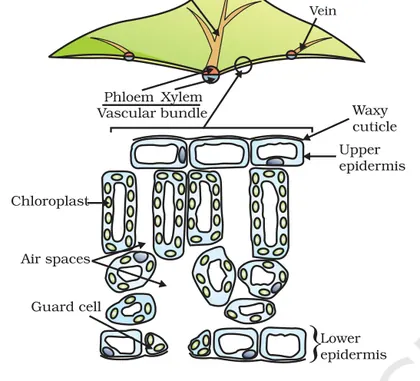
- Small pores on the leaf surface that allow gas exchange (CO2 in, O2 and water vapor out).
- Transpiration
- Loss of water vapor from plant aerial parts, mainly through stomata.
- Respiration
- Process of breaking down food to release energy for cellular activities.
- Aerobic respiration
- Energy-releasing breakdown of food in presence of oxygen, yielding carbon dioxide, water and large ATP amount.
- Anaerobic respiration
- Energy production from food without oxygen, producing less ATP and byproducts like lactic acid or ethanol.
- Digestion
- Mechanical and chemical breakdown of complex food into absorbable molecules.
- Enzyme
- Biological catalyst that speeds up specific chemical reactions in living organisms.
- Absorption
- Uptake of digested nutrients into the bloodstream or lymph from the alimentary canal.
- Circulatory system
- Organ system (heart, blood vessels, blood) that transports substances like gases, nutrients and wastes throughout the body.
- Blood
- Fluid connective tissue carrying oxygen, nutrients, hormones and wastes; contains plasma, red cells, white cells and platelets.
- Xylem
- Plant tissue that conducts water and dissolved minerals upward from roots to shoots and leaves.
- Phloem
- Plant tissue that transports organic nutrients, especially sucrose, from leaves to other parts (translocation).
- Translocation
- Movement of organic solutes (like sugars) through the phloem from source (manufacturing sites) to sink (storage or usage sites).
- Excretion
- Removal of metabolic waste products from an organism to maintain internal chemical balance.
- Kidney
- Paired excretory organs in vertebrates that filter blood, remove wastes, and regulate water and electrolyte balance; functional unit is the nephron.
End-of-Chapter Trial Paper & Test Questions
Topic-wise questions to test your understanding of every concept in this chapter.
-
Distinguish between autotrophic and heterotrophic nutrition, giving one example of each. / स्वपोषी और विषमपोषी पोषण में अंतर बताइए, प्रत्येक का एक उदाहरण दीजिए।
Show answer
In autotrophic nutrition organisms make their own food from inorganic substances using light energy, e.g., green plants by photosynthesis. / स्वपोषी पोषण में जीव प्रकाश ऊर्जा से अकार्बनिक पदार्थों से अपना भोजन बनाते हैं, जैसे हरे पौधे प्रकाश-संश्लेषण द्वारा। In heterotrophic nutrition organisms obtain food from other organisms, e.g., humans (holozoic). / विषमपोषी पोषण में जीव अन्य जीवों से भोजन प्राप्त करते हैं, जैसे मनुष्य (प्राणिसम)।
-
Write the balanced chemical equation for photosynthesis and list two factors affecting its rate. / प्रकाश-संश्लेषण का संतुलित रासायनिक समीकरण लिखिए तथा इसकी दर को प्रभावित करने वाले दो कारक बताइए।
Show answer
6CO2 + 6H2O → C6H12O6 + 6O2 (in presence of sunlight and chlorophyll). / 6CO2 + 6H2O → C6H12O6 + 6O2 (सूर्य के प्रकाश व क्लोरोफिल की उपस्थिति में)। Factors affecting rate: light intensity and carbon dioxide concentration (also temperature, water). / दर को प्रभावित करने वाले कारक: प्रकाश की तीव्रता और कार्बन डाइऑक्साइड की सांद्रता (तापमान, जल भी)।
-
Why does aerobic respiration release more energy than anaerobic respiration? Support with their end products. / वायवीय श्वसन अवायवीय श्वसन की तुलना में अधिक ऊर्जा क्यों मुक्त करता है? उनके अंतिम उत्पादों से समर्थन कीजिए।
Show answer
In aerobic respiration glucose is completely oxidised to CO2 and H2O, releasing about 36-38 ATP. / वायवीय श्वसन में ग्लूकोज पूर्णतः CO2 व H2O में ऑक्सीकृत होता है, जिससे लगभग 36-38 ATP मुक्त होता है। In anaerobic respiration glucose is only partially broken down into lactic acid or ethanol + CO2, releasing only about 2 ATP. / अवायवीय श्वसन में ग्लूकोज केवल आंशिक रूप से लैक्टिक अम्ल या एथेनॉल + CO2 में टूटता है, जिससे केवल लगभग 2 ATP मुक्त होता है।
-
Explain the structural features of alveoli that make them efficient for gaseous exchange. / कूपिकाओं (एल्वियोलाई) की उन संरचनात्मक विशेषताओं को समझाइए जो उन्हें गैसीय विनिमय के लिए कुशल बनाती हैं।
Show answer
Alveoli provide a very large surface area due to their large number, and have extremely thin walls that reduce diffusion distance. / कूपिकाएं अपनी अधिक संख्या के कारण बहुत बड़ा सतह क्षेत्रफल प्रदान करती हैं तथा उनकी दीवारें अत्यंत पतली होती हैं जिससे विसरण दूरी घटती है। They are surrounded by a rich network of blood capillaries that maintains the concentration gradient for fast diffusion. / वे रक्त कोशिकाओं के घने जाल से घिरी होती हैं जो तीव्र विसरण के लिए सांद्रता प्रवणता बनाए रखता है।
-
Differentiate between breathing and cellular respiration. / श्वासोच्छ्वास (breathing) और कोशिकीय श्वसन में अंतर बताइए।
Show answer
Breathing is the mechanical process of taking in air (O2) and giving out air (CO2) by movement of the diaphragm and ribs. / श्वासोच्छ्वास वायु (O2) अंदर लेने और वायु (CO2) बाहर निकालने की यांत्रिक प्रक्रिया है जो डायाफ्राम व पसलियों की गति से होती है। Cellular respiration is the biochemical breakdown of glucose inside cells (mitochondria) to release ATP. / कोशिकीय श्वसन कोशिकाओं (माइटोकॉन्ड्रिया) के अंदर ग्लूकोज का जैव-रासायनिक विघटन है जिससे ATP मुक्त होती है।
-
Explain how water rises to the top of a tall tree, naming the tissue and mechanism involved. / लंबे वृक्ष की चोटी तक जल कैसे पहुँचता है, इसमें शामिल ऊतक व क्रियाविधि का नाम देते हुए समझाइए।
Show answer
Water and minerals rise through the xylem. / जल व खनिज जाइलम के द्वारा ऊपर चढ़ते हैं। The main mechanism is transpiration pull: evaporation of water from leaf stomata creates a tension that pulls a continuous water column upward, aided by cohesion of water molecules; root pressure also contributes. / मुख्य क्रियाविधि वाष्पोत्सर्जन खिंचाव है: पत्ती के रंध्रों से जल के वाष्पन से तनाव उत्पन्न होता है जो जल स्तंभ को ऊपर खींचता है, इसमें जल अणुओं का संसंजन सहायक होता है; मूल दाब भी योगदान देता है।
-
Why is double circulation necessary in humans? / मनुष्यों में दोहरा परिसंचरण क्यों आवश्यक है?
Show answer
In double circulation blood passes through the heart twice in one cycle, keeping oxygenated and deoxygenated blood completely separate. / दोहरे परिसंचरण में रक्त एक चक्र में हृदय से दो बार गुजरता है, जिससे ऑक्सीजनित व विऑक्सीजनित रक्त पूरी तरह अलग रहते हैं। This ensures efficient and high-rate oxygen supply to body tissues, needed by warm-blooded animals to maintain body temperature. / यह शरीर के ऊतकों को कुशल व उच्च दर पर ऑक्सीजन की आपूर्ति सुनिश्चित करता है, जो ऊष्मरक्तीय जंतुओं को शरीर का तापमान बनाए रखने हेतु आवश्यक है।
-
Describe the three main steps of urine formation in a nephron. / नेफ्रॉन में मूत्र निर्माण के तीन मुख्य चरणों का वर्णन कीजिए।
Show answer
1) Filtration: blood is filtered under pressure at the glomerulus into Bowman's capsule, allowing small molecules through while retaining proteins and cells. / 1) निस्यंदन: रक्त ग्लोमेरुलस में दाब के अंतर्गत बोमैन संपुट में छनता है, छोटे अणु निकल जाते हैं जबकि प्रोटीन व कोशिकाएं रुक जाती हैं। 2) Reabsorption: useful substances like glucose, salts and most water are reabsorbed into blood from the tubule. / 2) पुनरवशोषण: ग्लूकोज, लवण व अधिकांश जल जैसे उपयोगी पदार्थ नलिका से रक्त में पुनः अवशोषित होते हैं। 3) Secretion: extra wastes are secreted into the tubule to form final urine. / 3) स्रवण: अतिरिक्त अपशिष्ट नलिका में स्रावित होकर अंतिम मूत्र बनाते हैं।
Related Laws & Principles
Explore allFoundational laws & principles behind this chapter. Each one opens a full page — what it says, why it matters, five practice questions and the mistakes to avoid.