Overview
This chapter introduces acids, bases and salts as fundamental chemical families and explains their behaviour in aqueous solutions. You will learn how to identify acids and bases using indicators, understand the pH scale and how it quantifies acidity/basicity, and study characteristic reactions: acids with metals, carbonates and bases (neutralisation). The chapter also covers formation and classification of salts (normal, acidic, basic; hydrated salts), conductivity of their solutions, and practical applications and environmental implications (antacids, agriculture, cleaning agents, acid rain). Emphasis is on simple laboratory observations and procedures (use of indicators, pH paper/universal indicator, preparation of common salts) and on relating concepts to everyday life and safety.
Learning Objectives
- Define acids, bases and salts and give two examples of each
- Describe characteristic physical properties of acids and bases (taste, feel, electrical conductivity)
- Explain the role of indicators and predict colour changes of litmus, phenolphthalein and methyl orange in acidic and basic media
- Differentiate between strong and weak acids/bases and between concentrated and dilute solutions with examples
- Interpret the pH scale to classify solutions as strongly/weakly acidic, neutral or basic and compare acidity based on pH values
- Write balanced chemical equations for reactions of acids with metals, metal oxides, carbonates and bases (including neutralisation and gas evolution where applicable)
- Apply the concept of neutralisation to solve simple problems and state practical applications (antacids, agriculture, wastewater treatment)
- Perform simple laboratory tests to identify acids, bases and common salts (litmus test, effervescence with carbonates, flame or precipitation tests) following safety precautions
Topics in this chapter
19 topics · tap a topic title to jump straight to it.
Introduction
What are acids and bases?
Acids are substances that increase the concentration of hydrogen ions (H+) when dissolved in water; bases increase the concentration of hydroxide ions (OH−). This is the Arrhenius definition suitable for Class 10. Acids usually taste sour and react with metals to produce hydrogen; bases taste bitter and feel soapy.
Key properties
- Acids: sour taste, turn blue litmus red, conduct electricity in solution, react with metals to give H2 (e.g., HCl + Zn → ZnCl2 + H2).
- Bases (alkalis): bitter and soapy feel, turn red litmus blue, conduct electricity in solution, react with acids to form salt and water (neutralization).
Neutralization and salts
When an acid reacts with a base, the products are usually a salt and water: acid + base → salt + water. This is called neutralization. Example: HCl + NaOH → NaCl + H2O.
Strength vs concentration
‘Strength’ of an acid/base refers to its ability to ionize in water (strong vs weak). ‘Concentration’ refers to how much acid/base is present in a given volume (dilute vs concentrated). A strong acid can be dilute, and a weak acid can be concentrated.
pH — a measure of acidity
The acidity or basicity of a solution is expressed by pH, a logarithmic scale. pH 7 is neutral (pure water). pH < 7 is acidic; pH > 7 is basic (alkaline). The scale commonly used in Class 10 is 0–14 (at 25°C).
Importance and uses
- Acids and bases are everywhere: digestion (stomach HCl), food (vinegar, citrus), cleaning agents (bleach, baking soda), industry (fertilizers, glassmaking), and medicine (antacids).
- They are important in agriculture (soil pH affects plant growth) and the environment (acid rain).
Safety
Many acids and bases are corrosive. Use protective gear (gloves, goggles) and follow safe handling and storage rules.
- Lemon juice (citric acid) — sour taste, pH ~2–3
- Vinegar (acetic acid) — used in cooking and cleaning, pH ~2–3
- Hydrochloric acid (HCl) — present in stomach gastric juice
- Sodium hydroxide (NaOH) — drain cleaners, strong base
- Baking soda (sodium hydrogen carbonate, NaHCO3) — mild base used in baking and antacid
- Calcium hydroxide (slaked lime, Ca(OH)2) — used in agriculture to reduce soil acidity
- pH = -log10[H+]
- pOH = -log10[OH-]
- [H+][OH-] = 1.0 × 10^-14 (at 25°C)
- pH + pOH = 14 (at 25°C)
- Neutralization (general): acid + base → salt + water
- Example reaction: HCl + NaOH → NaCl + H2O
Definitions
Overview: In Class 10 Chemistry (Acids, Bases and Salts) the basic definitions explain what acids, bases and salts are, how they behave in water, how their strength differs from concentration, and how we detect them.
Acid (Arrhenius definition): An acid is a substance that produces hydrogen ions (H+) or hydronium ions (H3O+) when dissolved in water. Example: HCl → H+ + Cl–. Acids taste sour, turn blue litmus red, and conduct electricity in solution.
Base (Arrhenius definition): A base is a substance that produces hydroxide ions (OH–) when dissolved in water. Example: NaOH → Na+ + OH–. Bases taste bitter, feel soapy/slimy, turn red litmus blue, and conduct electricity.
Bronsted–Lowry view (brief): An acid is a proton (H+) donor and a base is a proton acceptor. This definition covers reactions in non-aqueous media as well.
Salt: A salt is an ionic compound formed when an acid reacts with a base (neutralization): acid + base → salt + water. Example: HCl + NaOH → NaCl + H2O. Salts can be neutral, acidic or basic depending on ions present.
Indicator: A substance that changes colour with pH. Natural examples: litmus (red in acid, blue in base), phenolphthalein (colourless in acid, pink in basic solutions).
Strength vs Concentration: Strength refers to extent of ionization/dissociation (strong acids/bases ionize almost completely; weak ones ionize partially). Concentration refers to amount of substance per unit volume (molarity). A dilute strong acid can be less concentrated than a concentrated weak acid but is still a strong acid chemically.
pH concept: pH is a measure of acidity/basicity: pH = −log10[H+]. pH < 7 acidic, pH = 7 neutral (at 25°C), pH > 7 basic. pH is a convenient logarithmic scale for [H+].
Electrical conductivity: Acids, bases and salts in aqueous solution produce ions and thus conduct electricity. Conductivity depends on ion concentration and mobility.
Practical notes: Many everyday substances are acids or bases: citric acid in lemon, acetic acid in vinegar, sodium bicarbonate (baking soda) is mildly basic, household ammonia (NH3 in water) is basic. Neutralization reactions are used in antacids, wastewater treatment, and agriculture (lime to neutralize acidic soil).
- Hydrochloric acid (HCl): Strong acid; present in gastric juice; used in industry to clean metals.
- Sulfuric acid (H2SO4): Strong acid; used in car batteries and fertilizers.
- Acetic acid (CH3COOH): Weak acid; main component of vinegar (gives sour taste).
- Sodium hydroxide (NaOH): Strong base; used in soap making and drain cleaners.
- Calcium hydroxide (Ca(OH)2): Base (lime); used in construction and to neutralize acidic soils.
- Sodium chloride (NaCl): Common salt; product of neutralization between HCl and NaOH.
- pH = -log10[H+]
- pOH = -log10[OH-]
- [H+][OH-] = Kw = 1.0 × 10^-14 (at 25°C)
- pH + pOH = 14 (at 25°C)
- General neutralization: Acid + Base → Salt + H2O
- M1V1 (acid) × equivalents = M2V2 (base) × equivalents; for monoprotic acids/bases often used: M1V1 = M2V2
Common Acids and Bases
Definition (CBSE Class 10): Acids are substances that produce H+ (hydrogen) ions in aqueous solution. Bases are substances that produce OH− (hydroxide) ions in aqueous solution.
Basic properties:
- Acids: sour taste, turn blue litmus red, conduct electricity, react with metals to produce H2, react with bases to form salt and water (neutralisation).
- Bases: bitter taste, slippery feel, turn red litmus blue, conduct electricity, neutralise acids to give salt and water.
Strong vs weak: Strength depends on extent of ionisation (dissociation) in water. Strong acids/bases ionise almost completely (e.g., HCl, NaOH). Weak acids/bases ionise partially (e.g., CH3COOH, NH3).
Common examples with uses & simple dissociation:
- Hydrochloric acid (HCl) — strong acid. Present in stomach (gastric juice); used in labs and industry. Dissociation: HCl → H+ + Cl−.
- Sulfuric acid (H2SO4) — strong diprotic acid. Used in car batteries, fertilizers. Stepwise dissociation: H2SO4 → H+ + HSO4−; HSO4− ⇌ H+ + SO4 2−.
- Nitric acid (HNO3) — strong acid. Used to make fertilizers and explosives.
- Acetic acid (CH3COOH) — weak acid. Main component of vinegar. CH3COOH ⇌ H+ + CH3COO−.
- Carbonic acid (H2CO3) — weak acid in soft drinks (formed by CO2 + H2O).
- Sodium hydroxide (NaOH) — strong base (caustic soda). Used in soap, drain cleaners. NaOH → Na+ + OH−.
- Potassium hydroxide (KOH) — strong base, used in batteries and soaps.
- Calcium hydroxide (Ca(OH)2) — slaked lime, used in construction and to test for CO2 (turns milky).
- Ammonia (NH3) — weak base (in water: NH3 + H2O ⇌ NH4+ + OH−). Used in household cleaners and fertilizers.
- Sodium bicarbonate (NaHCO3) — mild base (baking soda); used as antacid and in baking.
Neutralisation (general): Acid + Base → Salt + Water. Example: HCl + NaOH → NaCl + H2O.
Safety note: Strong acids and bases are corrosive — handle with care, use protective gear.
- Stomach acid: HCl in gastric juice (helps digestion).
- Vinegar: dilute acetic acid (CH3COOH) used in food and cleaning.
- Car batteries: Sulfuric acid (H2SO4) as electrolyte.
- Soaps and drain cleaners: Sodium hydroxide (NaOH).
- Antacids: Magnesium hydroxide (Mg(OH)2) or sodium bicarbonate (NaHCO3) to neutralise excess stomach acid.
- Soft drinks: Carbonic acid (H2CO3) formed by dissolved CO2.
- pH = -log10[H+]
- pOH = -log10[OH-]
- [H+][OH-] = Kw = 1.0 × 10^-14 (at 25°C)
- Neutralisation: Acid + Base → Salt + H2O (e.g., HCl + NaOH → NaCl + H2O)
- Strong acid dissociation (example): HCl → H+ + Cl−
- Weak acid equilibrium (example): CH3COOH ⇌ H+ + CH3COO−
Physical Properties
Physical properties of acids, bases and salts are the observable and measurable characteristics that help distinguish them without changing their chemical identity. In everyday chemistry (CBSE Class 10), the most important physical properties are taste, touch (feel), odour, state/appearance, solubility, electrical conductivity, effect on indicators and pH.
- Taste: Acids have a sour taste (e.g., lemon, vinegar). Bases (alkalis) often taste bitter (but never taste chemicals in the lab!). Salts may be salty, sweet or tasteless depending on composition (e.g., NaCl tastes salty).
- Touch/Feel: Aqueous solutions of bases (alkalis) feel slippery or soapy because they react with fats on skin. Acids are usually corrosive and do not feel slippery.
- Odour: Many acids have a sharp or pungent smell (e.g., acetic acid vinegar). Many salts are odourless. Some bases (e.g., ammonia solution) have a distinctive pungent smell.
- State and Appearance: Most common salts are crystalline solids with high melting points. Strong acids and bases are often available as aqueous solutions; many mineral acids are liquids at room temperature (e.g., HCl solution), while some organic acids (e.g., benzoic acid) are solids.
- Solubility: Many acids, bases and salts dissolve in water to give ionic solutions. Solubility varies by compound (e.g., NaCl is highly soluble; AgCl is insoluble).
- Electrical Conductivity: When dissolved in water (or molten), acids, bases and salts that ionize conduct electricity because mobile ions carry charge. Strong electrolytes (e.g., HCl, NaOH, NaCl) conduct well; weak electrolytes (e.g., CH3COOH) conduct poorly.
- Effect on Indicators and pH: Acids turn blue litmus red and have pH < 7. Bases turn red litmus blue and have pH > 7. Neutral salts/neutral solutions have pH ≈ 7. The pH scale ranges from 0 (very acidic) to 14 (very basic).
Safety note: tastes and touches are mentioned only for conceptual identification — never taste or touch laboratory chemicals.
- Hydrochloric acid (HCl) — strong acid; component of gastric acid in stomach (aqueous HCl).
- Acetic acid (CH3COOH) — weak acid; gives vinegar its sour taste.
- Sodium hydroxide (NaOH) — strong base (caustic soda), used in soap making.
- Calcium hydroxide (Ca(OH)2) — slaked lime; an alkali used in construction and to neutralize acidic soils.
- Sodium chloride (NaCl) — common salt, crystalline solid, soluble in water and conducts electricity in solution.
- Calcium carbonate (CaCO3) — salt found in eggshells and limestone; reacts with acids to give CO2.
- pH = -log10[H+]; pOH = -log10[OH-]; pH + pOH = 14 (at 25°C).
- Ionisation of a strong acid: HCl → H+ + Cl- (complete ionisation in water).
- Ionisation of a strong base: NaOH → Na+ + OH- (complete ionisation in water).
- Neutralisation (acid + base): H+ + OH- → H2O (or HCl + NaOH → NaCl + H2O).
- Acid reaction with metal (example): 2HCl + Zn → ZnCl2 + H2↑.
- Acid reaction with carbonate: 2HCl + CaCO3 → CaCl2 + CO2↑ + H2O.
Chemical Properties of Acids
Definition: Acids are substances that release H+ ions (or H3O+ in water) and show characteristic chemical reactions. In Class 10 context, the main chemical properties of acids arise from the presence of hydrogen ions (H+).
Chemical properties (with observations and typical equations):
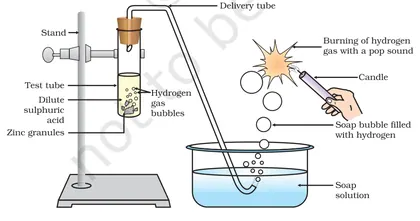
- Reaction with active metals: Acids react with metals that are above hydrogen in the reactivity series to produce a salt and hydrogen gas. Observation: effervescence; test gas with a lighted splint (gives a 'pop').
Example equation: Zn + 2HCl → ZnCl2 + H2↑ - Reaction with metal carbonates and bicarbonates: Acids react with carbonates (CO32–) and bicarbonates (HCO3–) to give a salt, carbon dioxide gas and water. Observation: vigorous effervescence (CO2 evolution).
Example equation: CaCO3 + 2HCl → CaCl2 + CO2↑ + H2O - Reaction with bases (neutralization): Acids neutralize bases (metal hydroxides or oxides) to form a salt and water. These reactions are usually exothermic. Observation: temperature rise; pH moves toward 7 on neutralization.
General equation: Acid + Base → Salt + H2O
Example: HCl + NaOH → NaCl + H2O - Reaction with metal oxides: Metal oxides are basic oxides; acids react with them to form salt and water.
Example: 2HCl + CuO → CuCl2 + H2O - Effect on indicators: Acids change the colour of indicators. Common observations: blue litmus turns red; methyl orange turns red in acidic medium; phenolphthalein is colourless in acid.
This property is used to identify acidic solutions and to follow reactions such as titrations.
Why these reactions occur: In all above reactions the H+ ions from the acid combine with OH– (from bases) or displace hydrogen from metals, or react with carbonate species to form CO2 and H2O. The net chemical change is driven by the transfer of H+ and formation of stable products (salt, water or CO2).
pH and concentration relation (useful concept): pH measures acidity: pH = -log[H+]. Lower pH means higher [H+]. This relation explains why diluting an acid raises its pH (makes it less acidic).
Practical notes: Corrosive acids attack metals, skin and some building materials (e.g., acid rain dissolving limestone). Neutralization (with bases or antacids) is a common method to treat acid spills or excess stomach acid. Indicators and titration curves are used to determine concentration of an acid.
- Antacid tablets neutralize excess HCl in the stomach: HCl + CaCO3 (in antacid) → CaCl2 + CO2 + H2O.
- Vinegar (acetic acid) reacts with baking soda (sodium bicarbonate) to produce fizzing CO2 — kitchen volcano demo: CH3COOH + NaHCO3 → CH3COONa + CO2 + H2O.
- Acid rain (containing H2SO4 or HNO3) reacts with limestone (CaCO3) on buildings/statues: CaCO3 + H2SO4 → CaSO4 + CO2 + H2O (weathering).
- Hydrochloric acid in the lab reacts with zinc to release hydrogen (used as a source of H2 in school experiments): Zn + 2HCl → ZnCl2 + H2↑.
- Titration in laboratories and hospitals: a known concentration of base is used to find the concentration of an acid (and vice versa) by neutralization.
- General (metal): Acid + Metal → Salt + H2 (e.g., Zn + 2HCl → ZnCl2 + H2)
- Carbonates/bicarbonates: Acid + MetalCO3 → Salt + CO2 + H2O (e.g., CaCO3 + 2HCl → CaCl2 + CO2 + H2O)
- Neutralization (base): Acid + Base → Salt + H2O (e.g., HCl + NaOH → NaCl + H2O)
- Metal oxide: Acid + MetalO → Salt + H2O (e.g., 2HCl + CuO → CuCl2 + H2O)
- Organic acid reaction example: CH3COOH + NaHCO3 → CH3COONa + CO2 + H2O
- pH formula: pH = -log[H+]
Chemical Properties of Bases
What is a base? A base is a substance that produces hydroxide ions (OH-) in aqueous solution (Arrhenius definition). Common bases: NaOH, KOH, Ca(OH)2, NH4OH. Bases are bitter, soapy, and feel slippery.
Chemical properties (with brief explanations)
- Action on indicators: Bases turn red litmus blue. Phenolphthalein is colourless in neutral/acidic solution and turns pink in basic solution (pH > ~8.2). Methyl orange is yellow in basic solution.
- Neutralisation with acids: Bases react with acids to form a salt and water. This is an exothermic reaction and the ionic view is H+ + OH- → H2O. Example: NaOH + HCl → NaCl + H2O.
- Reaction with ammonium salts (release of ammonia): Strong bases displace ammonia from ammonium salts. Example: NaOH + NH4Cl → NH3(g) + H2O + NaCl. The released gas has a characteristic pungent smell.
- Precipitation of metal hydroxides from salts: Bases react with solutions of many metal salts to give insoluble metal hydroxides (precipitates). Example: FeCl3 + 3NaOH → Fe(OH)3 (brown ppt) + 3NaCl.
- Reaction with acidic (non-metal) oxides / CO2: Bases react with acidic oxides such as carbon dioxide to form carbonates or bicarbonates. Example: 2NaOH + CO2 → Na2CO3 + H2O.
- Reaction with amphoteric metals/oxides/hydroxides: Some metals and their oxides/hydroxides (Al, Zn, Pb) react with strong bases to give soluble complex ions. Example: Zn(OH)2 + 2NaOH → Na2[Zn(OH)4]. Metallic aluminium reacts with NaOH producing hydrogen: 2Al + 2NaOH + 6H2O → 2Na[Al(OH)4] + 3H2 (g).
- Saponification (reaction with fats/oils): Bases like NaOH hydrolyse fats (triglycerides) to give glycerol and soap (sodium salts of fatty acids). Example (general): fat + 3NaOH → glycerol + 3 RCOONa (soap).
Important observations and uses: Neutralisation is used in medicine (antacids), industry (waste neutralisation), and household (drain cleaners). Reaction with CO2 explains why bases absorb CO2 from air (e.g., NaOH forming carbonate).
Safety note: Strong bases (e.g., NaOH, KOH) are caustic and can burn skin and eyes. Handle with care.
- Neutralisation: NaOH + HCl → NaCl + H2O (used in titrations and waste neutralisation)
- Ammonia liberation: NaOH + NH4Cl → NH3(g) + H2O + NaCl (smell of ammonia when base added to ammonium salts)
- Precipitation: FeCl3 + 3NaOH → Fe(OH)3 (brown precipitate) + 3NaCl (used to test Fe3+ ions)
- Reaction with CO2: 2NaOH + CO2 → Na2CO3 + H2O (bases absorb acidic CO2)
- Saponification: fat + 3NaOH → glycerol + 3 RCOONa (soap manufacture)
- Amphoteric reaction: Zn(OH)2 + 2NaOH → Na2[Zn(OH)4] (solubilisation of amphoteric hydroxides)
- General neutralisation: Acid + Base → Salt + Water
- Ionic neutralisation: H+ + OH- → H2O
- Strong base dissociation (example): NaOH → Na+ + OH-
- Base + CO2: 2NaOH + CO2 → Na2CO3 + H2O
- Ammonium salt + base: NH4Cl + NaOH → NH3 + H2O + NaCl
- Saponification (general): triglyceride + 3NaOH → glycerol + 3 RCOONa
Indicators and Their Behaviour
What is an indicator?
An indicator is a substance that changes colour depending on whether it is in an acidic or basic medium. Indicators are used to detect the presence of acids or bases and to estimate the pH of a solution.
How indicators work (chemical basis)
Most indicators are weak acids or weak bases that exist in equilibrium between two forms with different colours. For a weak acid indicator HIn:
HIn ⇌ H+ + In–
The undissociated form (HIn) has one colour and the dissociated form (In–) another. The position of the equilibrium depends on [H+]: in acidic solution the equilibrium lies to the left (more HIn), in basic solution to the right (more In–). The observed colour is the mixture of the two forms; when one form predominates the corresponding colour is seen.
Quantitative relation (useful idea)
The acid dissociation constant for the indicator (Ka) is
Ka = [H+][In–] / [HIn]
Taking logs and rearranging gives the Henderson–Hasselbalch type relation for the indicator:
pH = pKa + log([In–]/[HIn])
When [In–] = [HIn] (ratio 1:1) the pH = pKa and both colours are equally visible. Practically, a visible colour change occurs roughly when pH = pKa ± 1 (this defines the indicator's transition range).
Types of indicators
- Natural indicators — obtained from plants (e.g., litmus from lichens, red cabbage extract, turmeric).
- Synthetic indicators — prepared in labs (e.g., phenolphthalein, methyl orange, methyl red, universal indicator).
Choosing an indicator
Choose an indicator whose transition range includes the pH at the equivalence point of the reaction you are monitoring. For example, for titrations that have an equivalence pH in the basic region, use phenolphthalein; for acidic-equivalence titrations, use methyl orange.
Common indicators and their approximate transition ranges
- Litmus: ~pH 4.5–8.3 (acid: red; base: blue)
- Methyl orange: ~pH 3.1–4.4 (acid: red; base: yellow)
- Methyl red: ~pH 4.4–6.2 (acid: red; base: yellow)
- Phenolphthalein: ~pH 8.2–10.0 (acid: colourless; base: pink)
- Universal indicator: shows a range of colours across pH 1–14
Behaviour examples (practical notes)
- In titrations the rapid pH change at equivalence is matched with an indicator whose colour change lies within that steep region.
- Natural indicators (e.g., red cabbage) give different colours across a wide pH range and are useful for demonstration or rough pH estimation.
- Indicators are not used to give exact pH values; for precise pH use a pH meter.
Limitations
- Indicator colour depends on concentration and medium; very dilute solutions may not show colours well.
- Some indicators are affected by temperature or redox conditions.
Summary: An indicator changes colour because its acid and base forms have different colours. The equilibrium between these forms depends on pH; using Ka and pKa (Henderson–Hasselbalch) we can predict the pH range over which an indicator will change colour and thus select the appropriate indicator for experiments and practical checks.
- Using litmus paper to test whether a sample is acidic (red) or basic (blue).
- Adding phenolphthalein during a titration of a weak acid with a strong base to detect the end point (solution turns pink in basic region).
- Using methyl orange to detect the end point of titrations where the equivalence pH is acidic (red → yellow).
- Using red cabbage juice as a natural indicator to show a spectrum of colours across acids and bases for classroom demonstrations.
- Testing pool water or soil pH roughly with universal indicator or pH strips to ensure safe/healthy conditions.
- Equilibrium for an acid indicator: HIn ⇌ H+ + In−
- Ka (indicator) = [H+][In−] / [HIn]
- Henderson–Hasselbalch for indicator: pH = pKa + log([In−]/[HIn]) ; colour change visible roughly when pH = pKa ± 1
pH Scale
What is pH? pH is a measure of the acidity or basicity of an aqueous solution. It is defined as the negative base‑10 logarithm of the hydrogen‑ion (H+) concentration: pH = -log10[H+]. The pH scale commonly runs from 0 to 14 at 25°C: values below 7 are acidic, 7 is neutral, and above 7 are basic (alkaline).
Why logarithmic? Because pH uses a logarithm, each unit change in pH corresponds to a tenfold change in H+ concentration. For example, a solution at pH 3 has ten times more H+ than one at pH 4 and 100 times more than one at pH 5.
Key features
- Neutral water (at 25°C): [H+] = [OH-] = 1×10^-7 M so pH = 7.
- Relation with hydroxide ions: pOH = -log[OH-], and at 25°C pH + pOH = 14 because Kw = [H+][OH-] = 1×10^-14.
- Temperature dependence: Kw (and thus the numerical value 14) changes with temperature, so neutral pH is 7 only at 25°C.
- Strong acids/bases: for a strong monoprotic acid (e.g., HCl) that is fully dissociated, [H+] ≈ initial molarity.
- Weak acids/bases: need equilibrium (Ka or Kb) to find [H+] or [OH-]; approximate formulas are used when dissociation is small.
pH in real systems — pH affects biological systems, corrosion, chemical reactions and industrial processes. Living organisms maintain narrow pH ranges (e.g., human blood ≈ 7.35–7.45). Indicators such as litmus, phenolphthalein and methyl orange change colour at characteristic pH ranges and help estimate pH.
Quick practical notes
- To calculate pH of a strong acid: if [H+] = c (M), pH = -log c.
- For a weak acid HA with concentration c and acid constant Ka (assuming x << c): [H+] ≈ sqrt(Ka·c) and pH ≈ -log(sqrt(Ka·c)). Equivalently pH ≈ 1/2 (pKa - log c).
- Buffers resist pH change by containing a weak acid and its conjugate base (or weak base and its conjugate acid).
- Stomach gastric juice (HCl): pH ≈ 1.5–3.5 (strongly acidic)
- Lemon juice: pH ≈ 2.0 (acidic)
- Vinegar (acetic acid): pH ≈ 2.4–3.0
- Pure water (neutral, at 25°C): pH = 7.0
- Human blood: pH ≈ 7.35–7.45 (slightly basic; tightly regulated)
- Milk: pH ≈ 6.5–6.7 (slightly acidic)
- pH = -log10[H+]
- [H+] = 10^-pH
- pOH = -log10[OH-]
- [OH-] = 10^-pOH
- pH + pOH = 14 (at 25°C)
- Kw = [H+][OH-] = 1.0 × 10^-14 (at 25°C)
Strength versus Concentration
Definition — Strength: 'Strength' of an acid or base refers to its ability to ionize (dissociate) in water. A strong acid/base ionizes almost completely (e.g., HCl, NaOH); a weak acid/base ionizes only partially (e.g., CH3COOH, NH3). Strength is an intrinsic chemical property and is quantified by the acid dissociation constant Ka (or base dissociation constant Kb).
Definition — Concentration: 'Concentration' refers to how much acid or base is present in a given volume of solution. Common measures: molarity (c, mol L−1), percent (w/v or w/w), ppm. Concentration is an extrinsic property and can be changed by dilution or mixing.
How they differ: Strength tells how completely molecules ionize; concentration tells how many molecules are present per unit volume. A strong acid can be very dilute (low concentration) but remain 'strong' (still fully ionizes proportionally), and a weak acid can be very concentrated but remain 'weak' (still only partially ionizes).
Effect on [H+] and pH:
- For a strong monoprotic acid at concentration c (mol L−1), [H+] ≈ c and pH = −log10 c.
- For a weak acid HA with dissociation HA ⇌ H+ + A−, Ka = [H+][A−]/[HA]. If initial concentration is c and degree of dissociation is α, then [H+] = cα, [A−] = cα, [HA] ≈ c(1−α).
Relation between degree of dissociation (α), Ka and concentration:
Ka = (cα)(cα)/(c(1−α)) = c α^2/(1−α). For small α (typical of weak acids) 1−α ≈ 1, giving the useful approximation α ≈ sqrt(Ka / c). This shows α increases as c decreases (i.e., dilution increases percent ionization of weak acids).
Key consequence: On dilution, weak acids/bases show increased degree of ionization (α↑) and hence larger fraction of molecules ionized — the solution becomes relatively more conductive and pH shifts more than expected from linear dilution. Strong acids/bases are essentially completely ionized at all ordinary concentrations, so their degree of ionization is independent of concentration; however, the absolute [H+] (and thus pH) still changes with concentration.
Common student confusion: People often confuse 'dilute HCl' (low concentration) with 'weak HCl' (HCl is a strong acid regardless of concentration). Remember: strength = intrinsic ionization tendency; concentration = amount present.
- Concentrated acetic acid (glacial CH3COOH) is still a weak acid — it ionizes only partially. Diluting acetic acid increases its percent ionization (α increases) and raises [H+] relative to what simple dilution would predict.
- 1.0 M HCl (strong acid) has [H+] ≈ 1.0 M and pH ≈ 0. A 0.01 M HCl (dilute) has [H+] ≈ 0.01 M and pH ≈ 2. HCl remains a strong acid at both concentrations (fully ionized).
- Vinegar (~0.8 M acetic acid) tastes acidic but most acetic acid molecules are unionized; when diluted (e.g., in a salad dressing), the fraction ionized increases.
- In lead–acid batteries, sulfuric acid concentration determines the battery charge state — concentration matters for battery operation even though H2SO4 is a strong acid.
- Ka = [H+][A−] / [HA]
- For initial concentration c and degree of dissociation α: [H+] = cα
- Ka = c α^2 / (1 − α) ⇒ for small α, α ≈ √(Ka / c)
- pH = −log10[H+]; pOH = −log10[OH−]
- For strong monoprotic acid: [H+] ≈ c (so pH = −log10 c)
- Percent ionization = α × 100%
Neutralisation Reactions
Definition: A neutralisation reaction is a chemical reaction in which an acid and a base react to form a salt and usually water. In terms of ions, H+ (from the acid) combines with OH- (from the base) to form H2O. Neutralisation reactions are usually exothermic.
General chemical form:
- Acid + Base → Salt + Water
- Ionic (net) equation: H+ (aq) + OH- (aq) → H2O (l)
Details & important points:
- When a strong acid reacts with a strong base (both fully dissociated), the equivalence point (true neutralisation) occurs near pH 7 and about one mole of H+ combines with one mole of OH- to give one mole of water.
- Neutralisation is exothermic. For strong acid + strong base the standard heat of neutralisation is about −57 kJ per mole of water formed.
- Not all neutralisation reactions produce only water and a neutral salt; some acids react with carbonates/bicarbonates to give salt + CO2 + H2O (e.g., NaHCO3 + HCl → NaCl + CO2 + H2O).
- Salts formed can be neutral, acidic, or basic depending on whether the parent acid/base were strong or weak (e.g., NaCl is neutral; NH4Cl is acidic; Na2CO3 is basic).
- Neutralisation is used in titrations to determine unknown concentrations by using an indicator (or pH meter) to find the end point (close to equivalence point). Common indicators: litmus, phenolphthalein, methyl orange. The choice depends on the type of acid/base being titrated.
Connection to titration: During a titration, plot of pH vs volume of titrant gives a characteristic curve. The steepest region corresponds to the equivalence point. For strong acid + strong base the curve is steep and the equivalence pH ≈ 7. For weak acid + strong base the equivalence pH > 7; for strong acid + weak base the equivalence pH < 7.
Practical significance: Neutralisation reactions are used in medicine (antacids), agriculture (lime to neutralise acidic soil), environmental protection (treating acidic industrial effluents, neutralising acid spills), food (baking soda neutralising excess acidity), and household cleaning.
- HCl + NaOH → NaCl + H2O (hydrochloric acid neutralised by sodium hydroxide; common lab example)
- H2SO4 + 2NaOH → Na2SO4 + 2H2O (sulfuric acid neutralised by sodium hydroxide)
- NH4OH + HCl → NH4Cl + H2O (a weak base neutralised by a strong acid producing an acidic salt)
- NaHCO3 + HCl → NaCl + CO2 + H2O (acid + bicarbonate gives salt, carbon dioxide and water; used in antacid action and baking)
- CaO (lime) + 2HCl → CaCl2 + H2O (metal oxide neutralising an acid; applied in treating acidic soils or effluents)
- Maintenance/medical example: Mg(OH)2 or CaCO3 tablets (antacids) neutralise excess stomach acid (HCl) to relieve heartburn
- General: Acid + Base → Salt + Water
- Ionic (net): H+ (aq) + OH- (aq) → H2O (l)
- Example balanced: HCl (aq) + NaOH (aq) → NaCl (aq) + H2O (l)
- Carbonate case: 2HCl + Na2CO3 → 2NaCl + CO2 + H2O
- Heat of neutralisation (strong acid + strong base): ΔH ≈ −57 kJ per mole H2O formed (approximate)
- Salt nature: Strong acid + strong base → neutral salt; Strong acid + weak base → acidic salt; Weak acid + strong base → basic salt
Formation of Salts
What is a salt? A salt is an ionic compound formed when the H+ of an acid is replaced by a metal ion or an ammonium ion (NH4+). Salts are generally formed by neutralisation, displacement or double‑displacement (precipitation) reactions.
Main ways salts are formed
- Neutralisation (acid + base): An acid reacts with a base (metal hydroxide) to give a salt and water. Example: HCl + NaOH → NaCl + H2O. Ionic view: H+ + OH− → H2O.
- Acid + metal: A metal above hydrogen in the reactivity series reacts with an acid to give a salt and hydrogen gas. Example: Zn + 2HCl → ZnCl2 + H2↑.
- Acid + metal oxide: Metal oxides (basic oxides) react with acids to give salt and water. Example: CuO + 2HCl → CuCl2 + H2O.
- Acid + metal carbonate / bicarbonate: Produces salt, carbon dioxide and water. Example: CaCO3 + 2HCl → CaCl2 + CO2↑ + H2O.
- Double displacement / precipitation (salt + salt): Two soluble salts react to form an insoluble salt (precipitate) and another soluble salt. Example: AgNO3 + NaCl → AgCl(s)↓ + NaNO3.
- Acid + ammonium compounds: Acid reacts with ammonium salts to liberate ammonia or form ammonium salts. Example: HCl + NH3 → NH4Cl.
Types of salts (based on neutralisation)
- Normal (neutral) salts: Complete neutralisation; solution pH ≈ 7 (e.g., NaCl).
- Acidic salts: Incomplete neutralisation of a polyprotic acid (e.g., NaHSO4 from partial neutralisation of H2SO4).
- Basic salts: Incomplete neutralisation of polyvalent base or decomposition of hydroxide (e.g., Cu2(OH)3Cl or basic lead carbonate).
pH of salt solutions: The pH of a salt solution depends on the ions produced and their hydrolysis. Examples: NaCl (neutral), NH4Cl (acidic because NH4+ ⇌ NH3 + H+), Na2CO3 (basic because CO32− + H2O ⇌ HCO3− + OH−).
Hydrated salts: Many salts crystallise with water of crystallisation (eg. CuSO4·5H2O, Na2CO3·10H2O). Heating can remove water and change properties.
Everyday relevance: Salts are common in food (NaCl), medicine (NaCl IV fluids; NH4Cl in expectorants), agriculture (NPK fertilizers such as KNO3, NH4NO3), construction (gypsum—CaSO4·2H2O → wall plaster), water treatment (salts in hard water), and household products (washing soda Na2CO3).
- Neutralisation: HCl + NaOH → NaCl + H2O (table salt formed in neutralisation).
- Acid + metal: Mg + 2HCl → MgCl2 + H2↑ (magnesium chloride formed).
- Acid + carbonate: CaCO3 + 2HCl → CaCl2 + CO2↑ + H2O (calcium chloride formed, CO2 effervescence).
- Precipitation (double displacement): AgNO3 + NaCl → AgCl(s)↓ + NaNO3 (silver chloride precipitate).
- Formation of ammonium salt: HCl + NH3 → NH4Cl (used in smelling salts, fertilizers).
- Hydrated salt: CuSO4·5H2O (blue crystals) lose water on heating to give white anhydrous CuSO4.
- General neutralisation: Acid + Base → Salt + Water (HA + BOH → BA + H2O)
- Ionic neutralisation: H+ + OH− → H2O
- Acid + metal: 2HCl + Zn → ZnCl2 + H2
- Acid + carbonate: 2HCl + CaCO3 → CaCl2 + CO2 + H2O
- Acid + metal oxide: 2HCl + CuO → CuCl2 + H2O
- Precipitation (double displacement): AgNO3 + NaCl → AgCl(s) + NaNO3
Laboratory Preparation and Purification of Salts
Overview
A salt is an ionic compound formed when the hydrogen ion of an acid is wholly or partly replaced by a metal or another positive ion. In the laboratory salts are prepared by different chemical reactions (neutralisation, displacement, carbonate reaction and precipitation) and are purified by techniques such as filtration, evaporation, crystallisation and recrystallisation.
Common laboratory methods of preparation
- 1. Neutralisation (acid + base): A soluble salt is made by reacting an acid with a base (metal hydroxide or alkali). The reaction gives salt and water. Example: HCl + NaOH → NaCl + H₂O. To obtain solid crystals, the solution is evaporated until saturated and then allowed to cool so crystals form (crystallisation).
- 2. Acid + Metal Carbonate/Bicarbonate: Acid reacts with a carbonate to give salt, CO₂ and water. Example: 2HCl + Na₂CO₃ → 2NaCl + CO₂ + H₂O. After CO₂ evolution stops, filter if necessary and crystallise the filtrate.
- 3. Acid + Metal: A metal (more reactive than hydrogen) reacts with acid to give a salt and hydrogen gas. Example: 2HCl + Zn → ZnCl₂ + H₂. The resulting solution is evaporated/crystallised to get solid salt.
- 4. Precipitation (double displacement): Mix two soluble salt solutions to produce an insoluble salt that precipitates out. Example: AgNO₃(aq) + NaCl(aq) → AgCl(s) + NaNO₃(aq). The precipitate is collected by filtration, washed and dried.
Purification techniques
- Filtration — separates insoluble impurities or precipitates from liquid. Use gravity filtration (filter paper + funnel) or vacuum filtration (Buchner funnel) for faster drying.
- Washing — the precipitate is washed with cold distilled water to remove soluble impurities (mother liquor).
- Evaporation and Crystallisation — concentrate the solution by gentle heating to approach saturation, then cool to allow crystals to form. Collect crystals by filtration and dry them.
- Recrystallisation — dissolve impure solid in minimum hot solvent, filter hot to remove insoluble impurities (hot filtration), then cool so pure crystals form. This improves purity by exploiting different solubilities.
- Drying — place filtered crystals/precipitate on a watch glass or in a desiccator or oven (low temperature) to remove physically-adsorbed water without decomposing the salt.
- Fractional crystallisation — separates two salts in a mixture using their different solubilities (cooling a concentrated solution so the less-soluble salt crystallises first).
Typical laboratory procedure (example: preparing copper(II) sulfate crystals)
- React copper oxide (CuO) with dilute sulphuric acid until in excess of one reactant is used: CuO + H₂SO₄ → CuSO₄ + H₂O.
- Filter to remove unreacted insoluble CuO.
- Evaporate the filtrate to concentrate; when hot and saturated, allow to cool to form blue crystals of CuSO₄·5H₂O.
- Collect crystals by filtration, wash with small amount of cold water, and dry.
Practical tips & safety
- Use gentle heat to avoid splattering and decomposition. Do not boil to dryness unless the salt is stable on heating.
- Perform reactions producing gases (H₂, CO₂) in a well-ventilated area or under a fume hood.
- Use appropriate personal protective equipment (gloves, goggles, lab coat).
Key terms: mother liquor (the leftover solution after crystallisation), filtrate (liquid passed through filter), residue (solid left on filter), saturation point, recrystallisation, precipitate.
- Preparation of sodium chloride (NaCl) from hydrochloric acid and sodium hydroxide: HCl + NaOH → NaCl + H₂O. Evaporate and crystallise to obtain common salt crystals.
- Preparation of copper(II) sulfate crystals by reacting copper oxide with dilute sulfuric acid, filtering, evaporating and crystallising to obtain blue CuSO₄·5H₂O crystals.
- Making insoluble silver chloride by mixing aqueous silver nitrate and sodium chloride: AgNO₃(aq) + NaCl(aq) → AgCl(s)↓ + NaNO₃(aq). Collect AgCl by filtration, wash and dry.
- Fractional crystallisation to separate a mixture of potassium nitrate (KNO₃) and sodium chloride (NaCl) using the much greater temperature-dependence of KNO₃ solubility (KNO₃ crystallises on cooling from a hot concentrated solution).
- Industrial example: Sea salt (NaCl) is obtained by evaporating seawater in shallow ponds; impurities are removed by settling, filtration and recrystallisation steps.
- General neutralisation: Acid + Base → Salt + Water
- HCl + NaOH → NaCl + H₂O (example neutralisation)
- 2HCl + Na₂CO₃ → 2NaCl + CO₂ + H₂O (acid + carbonate)
- 2HCl + Zn → ZnCl₂ + H₂ (acid + metal → salt + hydrogen)
- AgNO₃ + NaCl → AgCl(s) + NaNO₃ (precipitation reaction)
- Solubility principle used in recrystallisation: solubility increases with temperature for many salts — heat to dissolve, cool to crystallise
Types of Salts
What is a salt?
A salt is an ionic compound formed when an acid reacts with a base (neutralisation) or by replacement of H+ in an acid by a metal or a positive radical. Example: HCl + NaOH → NaCl + H2O.
Classification of salts (Class 10 level)
- Neutral salts: Formed from a strong acid and a strong base. Their aqueous solutions are neutral (pH ≈ 7) because neither ion hydrolyses significantly. Example: NaCl (from HCl + NaOH).
- Acid salts (acidic salts): Formed by partial neutralisation of a polyprotic acid (or when a strong acid reacts with a weak base). They still contain replaceable H+ and give acidic solutions. Examples: NaHCO3 (sodium hydrogen carbonate, from partial neutralisation of H2CO3) and NaHSO4 (from partial neutralisation of H2SO4). Another type is salt from strong acid + weak base: NH4Cl (from HCl + NH3) — solution is acidic because NH4+ hydrolyses to produce H+.
- Basic salts (alkaline salts): Formed by partial neutralisation of a polyhydroxy base or when a weak acid reacts with a strong base. Their solutions are basic because anion hydrolyses to give OH−. Example: NaCH3COO (sodium acetate, from CH3COOH + NaOH) — acetate ion hydrolyses to give OH−.
- Double salts: Crystalline salts that contain two different simple salts in their lattice and show combined properties in the solid state but dissociate into constituent ions in solution. They are formed by mixing solutions of two salts and crystallising. Examples: Mohr's salt FeSO4·(NH4)2SO4·6H2O, Potash alum KAl(SO4)2·12H2O. Note: Double salts are different from complex (coordination) compounds; double salts dissociate into simple ions in solution.
- Normal salts: (sometimes called 'basic/common' salts) — salts in which all replaceable H+ of the acid has been replaced by metal (e.g., NaCl, K2SO4). This term is often used to contrast with acid/basic salts.
Why solutions are acidic or basic — hydrolysis
When salts dissolve, their ions can react (hydrolyse) with water. The tendency to hydrolyse depends on the strengths of the parent acid and base:
- Salt of strong acid + strong base: neither ion hydrolyses → neutral solution (pH ≈ 7).
- Salt of strong acid + weak base: cation hydrolyses (produces H+) → acidic solution (pH < 7). Example: NH4Cl → NH4+ + Cl−; NH4+ + H2O ⇌ NH3 + H+.
- Salt of weak acid + strong base: anion hydrolyses (produces OH−) → basic solution (pH > 7). Example: CH3COONa → CH3COO− + Na+; CH3COO− + H2O ⇌ CH3COOH + OH−.
- Salt of weak acid + weak base: pH depends on relative strengths (pKa and pKb) of the parent acid and base.
Identification (simple tests)
Use litmus: acidic salts turn blue litmus red; basic salts turn red litmus blue; neutral salts do not change litmus. Observe pH with indicator paper or pH meter for precise measurement.
Typical classroom examples and observations
- Add NaHCO3 (baking soda) to water: slightly basic (CO3(2−)/HCO3− hydrolysis).
- Dissolve KAl(SO4)2·12H2O (alum): neutral to slightly acidic depending on hydrolysis of Al3+ ions.
- Mohr's salt forms stable, bright crystals used in volumetric analysis.
Important distinctions
- Acid/basic salt refers to partial neutralisation or hydrolysis behavior in water.
- Double salts exist as unique crystals but dissociate into ions in solution; complex salts (coordination compounds) retain complex ions in solution.
Teaching tip: Use a simple flowchart: start with 'which parent acid/base are strong or weak?' → classify salt (neutral/acidic/basic). Show examples and litmus test results alongside.
- Neutral salt: NaCl — table salt, formed from HCl + NaOH; pH ≈ 7.
- Acid salt: NaHCO3 (sodium hydrogen carbonate) — baking soda; formed by partial neutralisation of H2CO3; mildly basic in water but classified as an acid salt because it contains replaceable H.
- Acidic solution from salt: NH4Cl — formed from HCl + NH3; NH4+ hydrolyses to give acidic solution used in dry cell electrolytes.
- Basic salt: CH3COONa (sodium acetate) — forms basic solution; used in buffer solutions and as a preservative.
- Double salt: KAl(SO4)2·12H2O (potash alum) — used in water purification, deodorants and as an astringent; crystalline solid made from K2SO4 + Al2(SO4)3.
- Double salt (Mohr's salt): FeSO4·(NH4)2SO4·6H2O — used in volumetric analysis because of stability.
- General neutralisation: Acid + Base → Salt + H2O (e.g., HCl + NaOH → NaCl + H2O)
- Acid salt formation (partial neutralisation): H2SO4 + NaOH → NaHSO4 + H2O (1:1 neutralisation of diprotic acid)
- Basic salt formation (example of salt from weak acid + strong base): CH3COOH + NaOH → CH3COONa + H2O
- Hydrolysis (anion of weak acid): A− + H2O ⇌ HA + OH− with Kb = Kw / Ka
- Hydrolysis (cation of weak base): B+ + H2O ⇌ BOH + H+ with Ka' = Kw / Kb (where Kb is base dissociation constant of B)
- Double salt formation (alum): K2SO4 + Al2(SO4)3 + 24 H2O → 2 KAl(SO4)2·12H2O
Hydrated Salts and Water of Crystallization
Definition: Hydrated salts are crystalline ionic compounds that contain a definite number of water molecules chemically bound in their crystal lattice. The water present in the crystal is called the water of crystallization (or crystallization water). A general formula is MxAy·nH2O, where n is the number of water molecules per formula unit.
Nature and properties:
- The number of water molecules (n) is fixed for a particular hydrated salt (e.g., CuSO4·5H2O has n = 5).
- Hydrated salts often have characteristic colours caused or modified by the coordinated water (e.g., blue CuSO4·5H2O; when dehydrated it becomes pale/white).
- On heating, hydrated salts may lose some or all of their water of crystallization (dehydration). Some dehydration reactions are reversible — the anhydrous salt can reabsorb water (rehydration).
- Related phenomena: efflorescence (loss of water to atmosphere), deliquescence (absorb moisture and dissolve), hygroscopicity (absorb moisture but not necessarily dissolve).
How to determine water of crystallization experimentally (typical lab method):
- Weigh a clean, dry crucible with the hydrated salt sample: mass = m1.
- Heat strongly until all water is lost; cool in a desiccator and weigh the crucible with anhydrous salt: mass = m2.
- Mass of water lost = m1 - m2. Mass of anhydrous salt = m2 - mass of empty crucible.
- Convert masses to moles: n(H2O) = mass of water / 18.0 g mol⁻¹; n(salt) = mass of anhydrous salt / M (molar mass of anhydrous part).
- Number of water molecules per formula unit n = n(H2O) / n(salt). Round to nearest whole number.
Sample calculation (CuSO4·nH2O): Suppose a sample of copper(II) sulfate hydrate weighed 2.500 g (including crucible) and after heating the anhydrous salt weighed 1.636 g (same crucible correction already applied). Mass of water lost = 2.500 − 1.636 = 0.864 g. Molar masses: H2O ≈ 18.0 g mol⁻¹; CuSO4 ≈ 159.6 g mol⁻¹.
moles H2O = 0.864 / 18.0 = 0.0480 mol. moles CuSO4 = 1.636 / 159.6 = 0.01025 mol. n ≈ 0.0480 / 0.01025 ≈ 4.69 ≈ 5. So the hydrate is CuSO4·5H2O.
Chemical behaviour (examples of dehydration/rehydration):
- CuSO4·5H2O (blue) → CuSO4 (white/gray) + 5 H2O (g) (on heating)
- CoCl2·6H2O (pink) → CoCl2 (blue) + 6 H2O (g)
- MgSO4·7H2O (Epsom salt) → MgSO4 + 7 H2O
- CaSO4·2H2O (gypsum) heated partially → CaSO4·½H2O (plaster of Paris) + 3/2 H2O
Importance and applications: Hydrated salts are important in drying, manufacture, construction and laboratory work. Examples include washing soda (Na2CO3·10H2O), Epsom salt (MgSO4·7H2O) in medicine, gypsum (CaSO4·2H2O) in plaster, and copper sulfate in agriculture. Some salts are used as humidity indicators (cobalt(II) chloride).
Safety and practical notes: Heating must be controlled — some salts decompose rather than simply lose water; use a desiccator to prevent reabsorption before weighing.
Summary: Water of crystallization is fixed and part of the crystal structure. It can be removed by heating and its quantity determined experimentally by mass loss. Hydrated salts show characteristic physical properties (colour, solubility) that change on dehydration.
- Copper(II) sulfate pentahydrate: CuSO4·5H2O — blue crystals used in laboratories; heating gives white anhydrous CuSO4 and water vapour.
- Epsom salt: MgSO4·7H2O — used as a laxative and bath soak; loses water on heating to give anhydrous MgSO4.
- Washing soda: Na2CO3·10H2O — used in cleaning and water softening; a typical decahydrate.
- Gypsum and plaster of Paris: Gypsum CaSO4·2H2O is heated to make plaster of Paris (CaSO4·½H2O), used in construction and casts.
- Cobalt(II) chloride indicator: CoCl2·6H2O (pink) loses water to become CoCl2 (blue); used as a moisture indicator.
- General: MxAy·nH2O (M = metal cation, A = anion, n = number of H2O per formula unit)
- Dehydration (example): CuSO4·5H2O → CuSO4 + 5 H2O (on heating)
- Gypsum → plaster of Paris (partial dehydration): CaSO4·2H2O (heat) → CaSO4·½H2O + 3/2 H2O
- Determining n from experimental data: n = (moles of H2O lost) / (moles of anhydrous salt)
- Percent water by mass: %H2O = [n × 18.0] / [M(salt) + n × 18.0] × 100
- Mass-loss calculation steps: mass water = mass(hydrated) − mass(anhydrous); moles H2O = mass water / 18.0
Salt Hydrolysis and pH of Salt Solutions
What is salt hydrolysis?
Salt hydrolysis is the reaction of ions from a dissolved salt with water to produce H3O+ or OH−, which changes the pH of the solution. Whether a salt solution is acidic, basic or neutral depends on the strengths of the parent acid and base.
Classification (simple rules)
- Salt of strong acid + strong base → neutral solution (pH ≈ 7). Example: NaCl.
- Salt of strong acid + weak base → acidic solution. Example: NH4Cl (NH4+ hydrolyses to give H3O+).
- Salt of weak acid + strong base → basic solution. Example: CH3COONa (A− hydrolyses to give OH−).
- Salt of weak acid + weak base → pH depends on relative strengths; compare Ka and Kb of the conjugates.
Basic hydrolysis reactions (examples)
- CH3COO− + H2O ⇌ CH3COOH + OH− (gives basic solution)
- NH4+ + H2O ⇌ NH3 + H3O+ (gives acidic solution)
Equilibrium constants and relations
At 25 °C, Kw = [H+][OH−] = 1.0×10⁻¹⁴ and pKw = 14.
- For an anion A− (conjugate base of weak acid HA): Kb (for A−) = Kw/Ka(HA).
- For a cation BH+ (conjugate acid of weak base B): Ka(BH+) = Kw/Kb(B).
Approximate pH formulas (for a salt concentration c, mol L−1)
- Salt of weak acid (A−) from strong base: A− hydrolyses, Kb = Kw/Ka.
[OH−] ≈ √(Kb · c).
pOH ≈ 1/2 (pKb − log c).
pH = 14 − pOH. - Salt of weak base (BH+) from strong acid: BH+ hydrolyses.
[H+] ≈ √(Ka · c) where Ka(BH+) = Kw/Kb.
pH ≈ 1/2 (pKa − log c). - Percent (degree) of hydrolysis for A−: α ≈ √(Kb/c). Percent hydrolysis ≈ 100·α = 100·√(Kb/c). (Derived from Kb = x2/(c − x) ≈ x2/c when x ≪ c.)
- Salt of weak acid + weak base (both conjugates present): if both hydrolyses occur, an approximate result often used for class 10 is pH ≈ 7 + 1/2 (pKa − pKb). Interpretation: if pKa > pKb the solution is basic; if pKa < pKb acidic; if equal ≈ 7.
How the formulas are obtained (short derivation)
For A−: A− + H2O ⇌ HA + OH−, Kb = [HA][OH−]/[A−]. If initial salt conc. = c and x = [OH−] formed, Kb ≈ x2/c ⇒ x ≈ √(Kbc).
Limitations and approximations
These simple formulas assume x ≪ c (small degree of hydrolysis) and temperature 25 °C (Kw = 1×10⁻¹⁴). For very dilute solutions or very strong hydrolysis (large Kb or Ka) you must solve the full equilibrium expressions.
Common observations
- Diluting a basic salt (e.g., CH3COONa) lowers its pH toward 7 (absolute [OH−] decreases), though degree of hydrolysis increases.
- Metal ions with high positive charge (Al3+, Fe3+) hydrolyse appreciably and give acidic solutions.
- NaCl (from HCl + NaOH): neutral solution, pH ≈ 7 because neither Cl⁻ nor Na⁺ hydrolyse significantly.
- NH4Cl (from HCl + NH3): acidic solution. NH4⁺ + H2O ⇌ NH3 + H3O⁺ increases [H⁺]; typical classroom pH ≈ 5–6 for 0.1 M.
- CH3COONa (from CH3COOH + NaOH): basic solution. CH3COO⁻ + H2O ⇌ CH3COOH + OH⁻; [OH⁻] ≈ √(Kb·c) with Kb = Kw/Ka (CH3COOH).
- Na2CO3 (carbonate from weak acid H2CO3 + strong base NaOH): basic because CO3²⁻ hydrolyses to form OH⁻.
- NH4NO3 (from HNO3 + NH3): acidic because NH4⁺ hydrolyses (acidic) while NO3⁻ is neutral.
- Kw = [H+][OH−] = 1.0×10⁻¹⁴ (at 25 °C); pKw = 14
- For A− (conjugate base of weak acid HA): Kb = Kw / Ka
- [OH−] ≈ √(Kb · c) for salt of weak acid; pOH ≈ 1/2 (pKb − log c); pH = 14 − pOH
- For BH+ (conjugate acid of weak base B): Ka(BH+) = Kw / Kb and [H+] ≈ √(Ka · c); pH ≈ 1/2 (pKa − log c)
- Percent hydrolysis (approx): %h ≈ 100 · √(Kb / c) (for A− from a salt of conc. c)
- Weak acid + weak base salt (approx): pH ≈ 7 + 1/2 (pKa − pKb)
Applications and Uses
Acids, bases and salts are widely used in everyday life, industry, agriculture and medicine because of their characteristic chemical behaviours — acidity/basicity, reactivity with metals and carbonates, neutralisation and salt formation. Understanding these applications explains why certain substances are chosen for specific tasks and shows how neutralisation is routinely used to control pH.
Household uses
- Cleaning — basic solutions (e.g., caustic soda, NaOH) dissolve grease and unclog drains; weak acids (vinegar, citric acid) remove limescale and rust.
- Cooking and food preservation — acetic acid (vinegar) and citric acid are food preservatives and flavouring agents; common salt (NaCl) is used for seasoning and preservation.
- Personal care — soaps and detergents are produced using NaOH (saponification); baking soda (NaHCO3) is used in baking and as a mild antacid.
Industrial and manufacturing uses
- Sulfuric acid (H2SO4) is a major industrial chemical used in fertilizer manufacture (superphosphates), petroleum refining, battery acid and chemical synthesis.
- Hydrochloric acid (HCl) is used for pickling steel, removing rust, and in the production of chloride salts.
- Chlor-alkali process produces NaOH, Cl2 and H2; NaOH is used in paper, soap and textile industries.
- Nitric acid (HNO3) is used to make fertilizers and explosives; hydrofluoric acid (HF) etches glass (hazardous).
Agriculture and environment
- Fertilizers are salts containing nitrogen, phosphorus or potassium (e.g., NH4NO3, KCl, Ca(H2PO4)2) that supply nutrients to plants.
- Soil pH correction uses lime (CaO or Ca(OH)2) to neutralise acidic soils; neutralisation reactions are used to treat acidic industrial effluents.
- Bleaching powder (CaOCl2) and chlorine-containing salts are used for disinfection.
Medicine and safety
- Antacids (containing Mg(OH)2, Al(OH)3 or NaHCO3) neutralise excess stomach acid to relieve acidity/heartburn.
- pH control in pharmaceuticals is critical for drug stability and activity; many medicinal salts deliver active ions in safe forms.
Laboratory and analytical uses
- Titration (acid–base titration) is used to determine concentration of acids or bases using indicators or pH meters. The neutralisation point (equivalence point) is a key concept.
- Indicators (litmus, methyl orange, phenolphthalein) are dyes that change colour over specific pH ranges and are used to detect acidity/basicity.
- Electroplating and electrolysis use salt solutions as electrolytes to deposit metals or produce industrial chemicals.
Safety note: Many concentrated acids and bases are corrosive and hazardous. Neutralisation with the appropriate reagent, dilution and use of protective equipment are essential when handling them.
Summary: The characteristic reactions of acids, bases and salts — neutralisation, reaction with metals and carbonates, and ion exchange — make them indispensable across household, industrial, agricultural and medical applications. Practical use often involves controlling pH, choosing suitable salts and applying neutralisation reactions safely.
- Neutralisation in medicine: Mg(OH)2 or NaHCO3 neutralise excess stomach acid to relieve heartburn.
- Household cleaning: Vinegar (acetic acid) removes limescale; NaOH-based drain cleaners remove grease clogs.
- Soap making (saponification): Fat + NaOH → glycerol + soap (salt of fatty acid).
- Fertilizers: Ammonium nitrate (NH4NO3) provides nitrogen to crops; superphosphate provides phosphorus.
- Industrial manufacture: Sulfuric acid (H2SO4) used in acid batteries and production of many chemicals.
- Pickling of metals: HCl removes rust and scale from iron before plating or painting.
- General neutralisation: acid + base → salt + water
- HCl + NaOH → NaCl + H2O
- H2SO4 + 2 NaOH → Na2SO4 + 2 H2O
- Acid + metal → salt + H2 (e.g., 2 HCl + Zn → ZnCl2 + H2)
- Acid + carbonate → salt + CO2 + H2O (e.g., 2 HCl + CaCO3 → CaCl2 + CO2 + H2O)
- pH = -log10[H+]
Environmental and Safety Aspects
The chapter topic "Environmental and Safety Aspects" deals with how acids, bases and salts affect the environment and human safety, and what practical measures are taken to reduce harm. This includes pollution caused by acidic or basic discharges, acid rain, effects on soil and aquatic life, corrosion of buildings, methods of neutralization and treatment of effluents, and laboratory/industrial safety practices.
Environmental effects
- Acid rain: Sulphur dioxide (SO2) and nitrogen oxides (NOx) from burning fossil fuels are converted in the atmosphere into strong acids (SO3 → H2SO4, NO2 → HNO3) and fall as acid rain. Typical reactions: SO2 + 1/2 O2 → SO3; SO3 + H2O → H2SO4. Acid rain lowers pH of lakes and soils causing plant damage, killing aquatic organisms and mobilizing toxic metal ions (e.g., Al3+) in soil.
- Water bodies: Discharge of acidic or alkaline industrial effluents changes pH, harming aquatic flora and fauna. Sudden pH shifts can denature enzymes and disrupt biological processes.
- Soil and agriculture: Acidic soils decrease nutrient availability and increase toxic metal solubility. Farmers often add lime (CaCO3 or Ca(OH)2) to neutralize soil acidity.
- Corrosion and building damage: Acid rain reacts with carbonate rocks (e.g., limestone): H2SO4 + CaCO3 → CaSO4 + CO2 + H2O, causing erosion and structural damage.
- Eutrophication (salts): Excessive nitrates and phosphates (salts) from fertilizers lead to algal blooms, reducing dissolved oxygen and killing aquatic life.
Safety aspects (laboratory, school, industry)
- Storage: Store strong acids and bases separately in labeled, corrosion-resistant containers and cabinets. Keep incompatible chemicals apart.
- PPE and equipment: Use goggles, gloves, lab coat, and face shield when handling corrosives. Have eyewash stations and safety showers accessible.
- Handling & dilution: Always add acid to water (not water to acid) to dilute strong acids—this minimizes heat splashes. Similarly, add concentrated base slowly to water.
- Spill response: For small spills, neutralize acids with a weak base (e.g., sodium bicarbonate) and neutralize bases with a weak acid (e.g., dilute acetic acid) only if trained. Absorb neutralized residue and dispose as instructed. For skin/eye contact, rinse immediately with plenty of water and seek medical attention.
- Waste treatment: Industrial acidic/alkaline effluents are typically neutralized (e.g., with lime Ca(OH)2) and treated to remove harmful ions before discharge. Proper effluent treatment reduces environmental impact.
Practical preventive and remedial measures
- Limit SO2/NOx emissions via scrubbers, catalytic converters and cleaner fuels to reduce acid rain.
- Neutralize acidic soils by liming; monitor soil pH regularly.
- Treat wastewater: neutralization, precipitation of heavy metals, biological treatment for organic pollutants.
- Use buffer solutions where pH must be maintained (e.g., aquaria, industrial processes).
Key takeaways: pH control is central to protecting ecosystems and human health. Safe handling, correct neutralization and proper waste treatment prevent damage from acids, bases and salts.
- Acid rain damaging a limestone statue: H2SO4 + CaCO3 → CaSO4 + CO2 + H2O; the statue surface dissolves over time.
- Neutralization of acidic industrial wastewater with lime: H2SO4 + Ca(OH)2 → CaSO4 + 2 H2O (used to raise pH before discharge).
- Using lime (CaCO3) to reduce soil acidity and improve crop yield — farmers apply agricultural lime to acidic fields.
- Household acid/base hazards: drain cleaners often contain NaOH (caustic) which can cause severe burns; baking soda (NaHCO3) can neutralize small acid spills, but for skin contact, rinse with plenty of water.
- Antacid tablets (e.g., containing Mg(OH)2 or CaCO3) neutralize excess stomach acid: Mg(OH)2 + 2 HCl → MgCl2 + 2 H2O.
- pH = -log10[H+]
- pOH = -log10[OH-]
- [H+][OH-] = Kw = 1.0 × 10^-14 (at 25°C)
- Neutralization (general): acid + base → salt + water (e.g., HCl + NaOH → NaCl + H2O)
- Dilution/neutralization calculations: M1 × V1 = M2 × V2 (used in titrations and preparing solutions)
Tests and Observations
Overview
"Tests and Observations" covers simple qualitative and quantitative procedures used to identify acids, bases and their reactions. Common observations include colour changes with indicators, effervescence with carbonates or metals, slippery feel for bases, and heat release on neutralization.
Indicator tests
Indicators are substances that change colour depending on pH. Typical observations:
- Blue litmus paper turns red in an acid; red litmus turns blue in a base.
- Methyl orange: red in acid, yellow in alkaline medium.
- Phenolphthalein: colourless in acid and neutral, pink/magenta in basic solutions (around pH > 8.2).
Reactions giving characteristic observations
- Acid + metal (e.g., Zn, Mg) → effervescence due to H2 gas. Test H2 with a burning splint (produces a ‘pop’ sound).
- Acid + carbonate/bicarbonate → effervescence of CO2. Confirm CO2 by passing gas through limewater (Ca(OH)2) which turns milky (forms CaCO3).
- Acid + base → neutralization: salt + water; often exothermic (temperature rises). If an indicator is present, it shows endpoint colour change.
- Bases often feel slippery (due to saponification of skin oils) and neutralize acids; they give pink colour with phenolphthalein.
Qualitative observations to note in the laboratory
- Colour of indicator before and after adding sample.
- Effervescence (rate/intensity) and behaviour of gas (test identity).
- Temperature change on mixing acid and base (use thermometer).
- Solubility/precipitate formation (e.g., CaCO3 white precipitate in limewater).
Precautions & interpretation
Indicator colours depend on concentration and type of indicator. Some acids/bases are weak and may give smaller changes. Always perform gas tests safely and use dilute samples when possible.
- Vinegar (acetic acid) + baking soda (sodium bicarbonate) → vigorous effervescence; CO2 produced turns limewater milky. Observation: bubbles and milky limewater.
- Drop of HCl on blue litmus paper → paper turns red. Observation: immediate colour change to red.
- Add phenolphthalein to soap solution (basic) → solution turns pink. Observation: pink colour indicates alkaline pH.
- Neutralization in an antacid test: HCl (stomach acid) + antacid tablet → pH rises; fizzing if tablet contains carbonate. Observation: decrease in acidity, reduced indicator colour for acid.
- Titration of 0.1 M HCl with 0.1 M NaOH using phenolphthalein: pH remains low, then rises sharply at equivalence point (~pH 7), indicator turns pink. Observation: sudden colour change at endpoint.
- Acid + Metal → Salt + Hydrogen gas (e.g., 2HCl + Zn → ZnCl2 + H2↑)
- Acid + Carbonate → Salt + Carbon dioxide + Water (e.g., 2HCl + Na2CO3 → 2NaCl + CO2↑ + H2O)
- Acid + Base → Salt + Water (neutralization) (e.g., HCl + NaOH → NaCl + H2O) — reaction is usually exothermic
- CO2 + Ca(OH)2 → CaCO3 (white precipitate) ↓ (limewater test for CO2)
- Excess CO2 + CaCO3 + H2O → Ca(HCO3)2 (milky → clear on further bubbling)
Important Equations and Reactions
Overview
This topic covers the key chemical reactions and equations from the chapter "Acids, Bases and Salts" (Class 10). Emphasis is on neutralisation, reactions of acids and bases with metals, metal carbonates, metal oxides and ammonium salts, salt hydrolysis, and a few important preparative and real-life reactions.
1. Neutralisation (acid + base)
General: acid + base → salt + water. Neutralisation removes H+ from acid and OH- from base to form H2O.
Examples (balanced):
HCl + NaOH → NaCl + H2O
H2SO4 + 2 NaOH → Na2SO4 + 2 H2O
2. Acids with metals
Acids react with many metals (above hydrogen in activity series) to give a salt and hydrogen gas.
Example:
Zn + 2 HCl → ZnCl2 + H2
3. Acids with metal carbonates / bicarbonates
Acid + carbonate/bicarbonate → salt + CO2 + H2O. This is the evolution of carbon dioxide gas (effervescence).
Examples:
CaCO3 + 2 HCl → CaCl2 + CO2 + H2O
2 NaHCO3 + H2SO4 → Na2SO4 + 2 CO2 + 2 H2O
4. Acids with metal oxides (basic oxides)
Acid + metal oxide → salt + water.
Example:
2 HCl + CuO → CuCl2 + H2O
5. Bases with ammonium salts (release of NH3)
Base + ammonium salt → salt + ammonia + water (ammonia gas is liberated on heating or on strong base addition).
Example:
NH4Cl + NaOH → NaCl + NH3 + H2O
6. Decomposition of bicarbonates on heating
Many bicarbonates decompose on heating giving carbonate, water and CO2.
Example:
2 NaHCO3 (s) → Na2CO3 (s) + H2O (g) + CO2 (g)
7. Saponification (bases react with fats)
Triglyceride (fat/oil) + NaOH → glycerol + sodium salts of fatty acids (soap).
Typical equation (schematic):
Fat + 3 NaOH → Glycerol + 3 RCOONa (soap)
8. Preparation of salts
Methods include neutralisation (acid + base), precipitation (mixing two soluble salts to form insoluble salt), and direct reactions (metal + acid, metal oxide + acid). Example of precipitation:
AgNO3 + NaCl → AgCl (s) + NaNO3
9. Salt hydrolysis (effect of salt on pH)
Salts from strong acid + strong base are neutral (e.g., NaCl). Salts from strong acid + weak base are acidic (e.g., NH4Cl), and salts from weak acid + strong base are basic (e.g., Na2CO3). Hydrolysis reactions:
NH4+ + H2O → NH3 + H3O+ (acidic)
CO32- + H2O → HCO3- + OH- (basic)
10. Important observational reactions
- Lime water test for CO2: CO2 + Ca(OH)2 → CaCO3 (white precipitate)
- Ammonium chloride with NaOH gives pungent NH3 smell and turns red litmus blue.
- Phenolphthalein: colourless in acid, pink in base. Methyl orange: red in acid, yellow in base.
Key concepts to remember
- Stoichiometry: balance H+ and OH- for neutralisation.
- Reaction types: acid + metal, acid + carbonate, acid + oxide, base + ammonium salt, saponification, precipitation.
- Behaviour of salts in water depends on the strength of parent acid/base (hydrolysis).
- Antacid neutralisation: Mg(OH)2 + 2 HCl → MgCl2 + 2 H2O (used to relieve acidity in stomach)
- Baking soda + vinegar: NaHCO3 + CH3COOH → CH3COONa + CO2 + H2O (CO2 causes fizzing in experiments/cleaning)
- Lime water test: CO2 + Ca(OH)2 → CaCO3 (white precipitate) — used to test exhaled CO2
- Soap making (saponification): Fat + 3 NaOH → Glycerol + 3 RCOONa (soap)
- Titration (laboratory neutralisation): HCl + NaOH → NaCl + H2O; volumes and concentrations related by MaVa = MbVb for monoprotic cases
- pH = −log[H+]
- pOH = −log[OH−]
- [H+][OH−] = 1.0 × 10^−14 (at 25 °C)
- pH + pOH = 14 (at 25 °C)
- Dilution / concentration: M1V1 = M2V2
- Titration stoichiometry (general): (Ma × Va) / na = (Mb × Vb) / nb where n = number of H+ or OH− equivalents (for monoprotic acid/base MaVa = MbVb)
Key Concepts
- Acid
- A substance that produces H+ ions (protons) in aqueous solution; tastes sour and turns blue litmus red.
- Base (Alkali)
- A substance that produces OH− ions in aqueous solution; tastes bitter, feels soapy and turns red litmus blue. An alkali is a soluble base.
- Salt
- An ionic compound formed by the neutralization reaction between an acid and a base, often consisting of a cation from the base and an anion from the acid.
- pH
- A numerical scale (0–14) that measures the acidity or alkalinity of a solution; pH = −log10[H+].
- Neutralization
- A chemical reaction in which an acid reacts with a base to form a salt and water, often releasing heat.
- Indicator
- A substance that changes color at certain pH ranges and is used to detect acidity or basicity of a solution.
- Litmus
- A natural dye used as a simple acid–base indicator: turns red in acidic solutions and blue in basic solutions.
- Universal Indicator
- A mixture of indicators that shows a continuous range of colors across the pH scale, giving an approximate pH value.
- Strong Acid
- An acid that ionizes almost completely in aqueous solution, producing a high concentration of H+ ions.
- Weak Acid
- An acid that ionizes only partially in aqueous solution, producing relatively few H+ ions.
- Strong Base
- A base that dissociates almost completely in water to give a high concentration of OH− ions.
- Weak Base
- A base that dissociates only partially in water, producing a limited number of OH− ions.
- Amphoteric Substance
- A substance that can act as either an acid or a base depending on the reacting partner.
- Acidic Oxide
- An oxide that reacts with water to form an acid or reacts with a base to form a salt.
- Basic Oxide
- An oxide that reacts with water to form a base (alkali) or reacts with an acid to form a salt.
- Salt Hydrolysis
- The reaction of a salt with water that produces an acidic or basic solution depending on the parent acid and base strengths.
- Titration (Acid–Base Titration)
- A quantitative technique to determine the concentration of an acid or base by reacting it with a standard solution of known concentration using an indicator.
- Electrolyte
- A substance whose aqueous solution conducts electricity due to the presence of mobile ions.
- Conjugate Acid–Base Pair
- Two species that differ by one proton (H+); the acid can donate an H+ and the base can accept it.
- Degree of Ionization (Dissociation)
- The fraction or percentage of molecules of a substance that ionize (dissociate) in solution; indicates strength of acids/bases.
End-of-Chapter Trial Paper & Test Questions
Topic-wise questions to test your understanding of every concept in this chapter.
-
Define an acid and a base according to the Arrhenius concept. / आरेनियस संकल्पना के अनुसार अम्ल और क्षार को परिभाषित कीजिए।
Show answer
An acid produces hydrogen ions (H⁺) in aqueous solution, while a base produces hydroxide ions (OH⁻) in aqueous solution. / अम्ल जलीय विलयन में हाइड्रोजन आयन (H⁺) देता है, जबकि क्षार जलीय विलयन में हाइड्रॉक्साइड आयन (OH⁻) देता है।
-
State the colour changes of litmus and phenolphthalein in acidic and basic media. / अम्लीय और क्षारीय माध्यम में लिटमस और फिनॉल्फथैलीन के रंग परिवर्तन बताइए।
Show answer
Acid turns blue litmus red and keeps phenolphthalein colourless; base turns red litmus blue and turns phenolphthalein pink. / अम्ल नीले लिटमस को लाल करता है और फिनॉल्फथैलीन को रंगहीन रखता है; क्षार लाल लिटमस को नीला करता है और फिनॉल्फथैलीन को गुलाबी करता है।
-
What does the pH scale measure, and what does each tenfold change in H⁺ concentration represent on it? / pH मापक्रम क्या मापता है, और इस पर H⁺ सांद्रता में प्रत्येक दस गुना परिवर्तन क्या दर्शाता है?
Show answer
It measures acidity/basicity as pH = −log₁₀[H⁺]; since it is logarithmic, a tenfold change in [H⁺] changes the pH by one unit. / यह pH = −log₁₀[H⁺] के रूप में अम्लीयता/क्षारीयता मापता है; लघुगणकीय होने के कारण [H⁺] में दस गुना परिवर्तन pH को एक इकाई बदल देता है।
-
Differentiate between strength and concentration of an acid with an example. / एक उदाहरण सहित अम्ल की प्रबलता और सांद्रता में अंतर कीजिए।
Show answer
Strength refers to the extent of ionisation (HCl is strong, CH3COOH is weak), while concentration refers to amount per unit volume; thus a strong acid like HCl can still be dilute. / प्रबलता आयनन की मात्रा को दर्शाती है (HCl प्रबल, CH3COOH दुर्बल), जबकि सांद्रता प्रति इकाई आयतन मात्रा को दर्शाती है; अतः HCl जैसा प्रबल अम्ल तनु भी हो सकता है।
-
Write the balanced equation for the reaction of zinc with dilute hydrochloric acid and name the gas evolved. / जिंक की तनु हाइड्रोक्लोरिक अम्ल के साथ अभिक्रिया का संतुलित समीकरण लिखिए और निकलने वाली गैस का नाम बताइए।
Show answer
Zn + 2HCl → ZnCl2 + H2↑; the gas evolved is hydrogen, which burns with a 'pop' sound. / Zn + 2HCl → ZnCl2 + H2↑; निकलने वाली गैस हाइड्रोजन है, जो 'पॉप' ध्वनि के साथ जलती है।
-
What is a neutralisation reaction? Write its general equation and the net ionic equation. / उदासीनीकरण अभिक्रिया क्या है? इसका सामान्य समीकरण और शुद्ध आयनिक समीकरण लिखिए।
Show answer
It is the reaction of an acid with a base to give salt and water: Acid + Base → Salt + Water; net ionic equation is H⁺ + OH⁻ → H2O. / यह अम्ल की क्षार के साथ अभिक्रिया है जो लवण और जल देती है: अम्ल + क्षार → लवण + जल; शुद्ध आयनिक समीकरण है H⁺ + OH⁻ → H2O।
-
Why does dilute acid react with a metal carbonate producing effervescence? Write the equation for CaCO3 with HCl. / तनु अम्ल धातु कार्बोनेट के साथ अभिक्रिया कर बुदबुदाहट क्यों उत्पन्न करता है? CaCO3 की HCl के साथ अभिक्रिया का समीकरण लिखिए।
Show answer
The reaction releases carbon dioxide gas, causing effervescence: CaCO3 + 2HCl → CaCl2 + CO2↑ + H2O. / अभिक्रिया कार्बन डाइऑक्साइड गैस मुक्त करती है, जिससे बुदबुदाहट होती है: CaCO3 + 2HCl → CaCl2 + CO2↑ + H2O।
-
Explain why the pH of salt solutions can differ, giving examples of a neutral, an acidic and a basic salt. / समझाइए कि लवण विलयनों का pH भिन्न क्यों हो सकता है, एक उदासीन, एक अम्लीय और एक क्षारीय लवण के उदाहरण देते हुए।
Show answer
The pH depends on the strength of the parent acid and base: NaCl (strong acid + strong base) is neutral, NH4Cl (strong acid + weak base) is acidic, and Na2CO3 (weak acid + strong base) is basic. / pH मूल अम्ल और क्षार की प्रबलता पर निर्भर करता है: NaCl (प्रबल अम्ल + प्रबल क्षार) उदासीन, NH4Cl (प्रबल अम्ल + दुर्बल क्षार) अम्लीय, और Na2CO3 (दुर्बल अम्ल + प्रबल क्षार) क्षारीय होता है।
Related Laws & Principles
Explore allFoundational laws & principles behind this chapter. Each one opens a full page — what it says, why it matters, five practice questions and the mistakes to avoid.