Overview
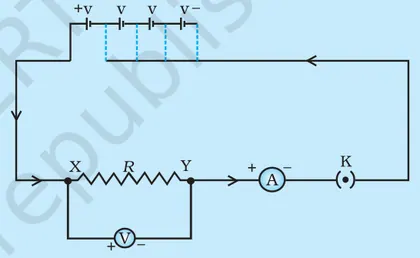
Electricity is one of the most important sources of energy in the modern world. This chapter builds the idea of electric current as the flow of electric charge, defines potential difference as the work done to move charge, and connects them through Ohm's law (V = IR). You will learn what decides the resistance of a conductor, how resistors behave in series and parallel, and how an electric current produces heat (Joule's law) and consumes power. These ideas explain everything from why a bulb glows to why household wiring uses a parallel arrangement.
Learning Objectives
- Define electric current and relate it to charge and time (I = Q/t), and state its SI unit, the ampere.
- Define electric potential difference (V = W/Q) and measure it with a voltmeter connected in parallel.
- State and apply Ohm's law (V = IR) and draw/interpret V–I graphs of ohmic conductors.
- Explain the factors that determine resistance and use R = ρl/A, including the meaning of resistivity.
- Derive and use equivalent resistance for resistors in series (Rs = R1+R2+…) and in parallel (1/Rp = 1/R1+…).
- Apply the heating effect of current (H = I²Rt) and electric power (P = VI = I²R = V²/R), and compute energy in kWh.
Topics in this chapter
8 topics · tap a topic title to jump straight to it.
Electric Current and Circuit
Learn what electric current is, how it's measured, and what a circuit needs to keep it flowing.
What exactly is “flowing” when current flows through a wire?
An electric current is the flow of electric charge. In a metallic conductor the charge carriers are free electrons. By convention, the direction of current is taken as the direction of flow of positive charge — i.e. opposite to the actual electron flow.
If a charge Q flows through a cross-section of a conductor in time t, the current is I = Q / t. The SI unit of current is the ampere (A); 1 A = 1 coulomb per second. Current is measured with an ammeter connected in series in the circuit.
A continuous, closed conducting path is called an electric circuit. Current flows only when the circuit is closed (e.g. a switch is ON); an open circuit carries no current.
A charge of 6 coulombs flows through a wire in 3 seconds. Find the current.
A charge of 10 C flows through a conductor in 5 s. What is the current?
Current is just charge per second — I = Q ÷ t, measured in amperes.
Electric Potential and Potential Difference
Learn what pushes charge around a circuit, and how potential difference is measured.
Why doesn't charge flow on its own, without a battery?
To make charge flow, something must push it. The potential difference between two points is the work done to move a unit charge from one point to the other: V = W / Q. Its SI unit is the volt (V); 1 V = 1 joule per coulomb.
A cell or battery maintains this potential difference and acts as the 'pump' that drives current around the circuit. Potential difference is measured with a voltmeter connected in parallel across the two points.
6 joules of work are done to move 2 coulombs of charge between two points. Find the potential difference.
12 J of work move 4 C of charge between two points. What is the potential difference?
Potential difference is work done per unit charge — V = W ÷ Q, measured in volts.
Ohm's Law
Learn how voltage, current and resistance are related.
What happens to current if you increase the voltage?
Ohm's law states that, at constant temperature, the current through a conductor is directly proportional to the potential difference across its ends: V ∝ I, hence V = I R, where the constant R is the resistance of the conductor.
The SI unit of resistance is the ohm (Ω); 1 Ω = 1 volt per ampere. Conductors that obey Ohm's law are called ohmic, and their V–I graph is a straight line through the origin whose slope equals R. Resistance opposes the flow of current; a rheostat is a variable resistor used to change the current in a circuit.
A 6 V battery is connected across a 3 Ω resistor. Find the current.
At 12 V across the same 3 Ω resistor, what is the current?
For fixed resistance, doubling voltage doubles current.
Factors Affecting Resistance (Resistivity)
Learn the four things that decide how much a conductor resists current.
Why does a long, thin wire heat up more than a short, thick one carrying the same current?
The resistance of a uniform conductor depends on four things:
(i) its length l — R increases with length; (ii) its area of cross-section A — R decreases as A increases (thicker wire, lower resistance); (iii) the material of the conductor; and (iv) its temperature (resistance of metals rises with temperature).
Combining the first three: R = ρ l / A, where ρ (rho) is the resistivity of the material (SI unit Ω·m). Metals like copper and aluminium have very low resistivity, so they are used for wires; alloys like nichrome have high resistivity and a high melting point, so they are used in heating elements of toasters, irons and heaters.
A wire of resistivity 2 × 10⁻⁶ Ω·m, length 1 m and area 1 × 10⁻⁶ m² — find its resistance.
If a wire's length is doubled and its area of cross-section is unchanged, what happens to its resistance?
Resistance grows with length and resistivity, and shrinks as the conductor gets thicker.
Resistors in Series
Learn how resistance and voltage combine when resistors are connected one after another.
If one bulb in a series string of fairy lights fails, why do all the others go out too?
When resistors are joined end to end so that the same current flows through each, they are in series. The total potential difference is shared: V = V₁ + V₂ + V₃.
The equivalent resistance is the sum: Rs = R₁ + R₂ + R₃. The combined resistance is therefore larger than the largest individual resistor. A drawback is that if one component breaks, the whole circuit is broken — which is why home wiring is not done in series.
Three resistors of 2 Ω, 3 Ω and 5 Ω are connected in series. Find the equivalent resistance.
Two resistors of 4 Ω and 6 Ω are connected in series. What is the equivalent resistance?
In series, resistances simply add — and the same current flows through every one of them.
Resistors in Parallel
Learn how resistance and current combine when resistors are connected side by side.
Why does switching off one lamp at home not turn off the others?
When resistors are connected between the same two points so that each has the same potential difference across it, they are in parallel. The main current is shared: I = I₁ + I₂ + I₃.
The equivalent resistance is given by 1/Rp = 1/R₁ + 1/R₂ + 1/R₃, so Rp is smaller than the smallest individual resistor. Household circuits use parallel connections because each appliance gets the full supply voltage (220 V), can be switched on/off independently, and a low total resistance allows a large total current.
Two resistors of 2 Ω and 2 Ω are connected in parallel. Find the equivalent resistance.
Two resistors of 3 Ω and 6 Ω are connected in parallel. What is the equivalent resistance?
In parallel, equivalent resistance is always smaller than the smallest resistor in the group.
Heating Effect of Electric Current (Joule's Law)
Learn how electrical energy turns into heat, and what decides how much heat is produced.
Why does a wire inside a heater glow and get hot, while the thick copper wire feeding it stays cool?
When current flows through a resistor, electrical energy is converted into heat. By Joule's law of heating, the heat produced is H = I² R t — it is proportional to the square of the current, to the resistance, and to the time.
This effect is used in electric heaters, irons, toasters and the filament of incandescent bulbs, and in the electric fuse, a safety device made of a wire with low melting point that melts and breaks the circuit if the current becomes dangerously high.
A current of 2 A flows through a 5 Ω resistor for 10 s. Find the heat produced.
A current of 3 A flows through a 4 Ω resistor for 5 s. How much heat is produced?
Heat produced depends on the square of the current — double the current, quadruple the heat.
Electric Power and Energy
Learn how to calculate electric power, and how electricity bills actually add it up.
Why does a 2000 W heater cost more to run for an hour than a 60 W bulb left on all day?
Electric power is the rate at which electrical energy is consumed: P = V I. Using Ohm's law this is also P = I² R = V² / R. The SI unit of power is the watt (W); 1 W = 1 joule per second.
Electrical energy = power × time. The commercial unit of electrical energy is the kilowatt-hour (kW·h), the '1 unit' on an electricity bill: 1 kW·h = 3.6 × 10⁶ J. For example, a 100 W bulb used for 10 hours consumes 100 × 10 = 1000 W·h = 1 kW·h = 1 unit.
A 100 W bulb is used for 10 hours. Find the energy consumed in kilowatt-hours.
A 2000 W heater runs for 2 hours. How many units (kWh) of electricity does it use?
A 'unit' on your electricity bill is just one kilowatt-hour — power in kilowatts times time in hours.
Key Concepts
- Electric current (I)
- Rate of flow of electric charge, I = Q/t; SI unit ampere (A). Measured with an ammeter in series.
- Electric charge (Q)
- Quantity of electricity; SI unit coulomb (C). Charge of one electron ≈ 1.6 × 10⁻¹⁹ C.
- Potential difference (V)
- Work done per unit charge to move charge between two points, V = W/Q; SI unit volt (V). Measured with a voltmeter in parallel.
- Ohm's law
- At constant temperature, V = IR; current is directly proportional to potential difference.
- Resistance (R)
- Opposition offered by a conductor to current; SI unit ohm (Ω). R = V/I.
- Resistivity (ρ)
- Property of a material: R = ρl/A; SI unit ohm-metre (Ω·m). Low for metals, high for alloys like nichrome.
- Series combination
- Same current through each resistor; equivalent resistance Rs = R₁ + R₂ + R₃ (adds up).
- Parallel combination
- Same potential difference across each resistor; 1/Rp = 1/R₁ + 1/R₂ + 1/R₃ (decreases).
- Joule's law of heating
- Heat produced H = I²Rt; basis of heaters, fuses and bulb filaments.
- Electric power (P)
- Rate of consuming electrical energy, P = VI = I²R = V²/R; SI unit watt (W).
- Kilowatt-hour (kW·h)
- Commercial unit of electrical energy ('1 unit'); 1 kW·h = 3.6 × 10⁶ J.
- Electric fuse
- Safety device of low-melting-point wire that melts and breaks the circuit on excessive current.
End-of-Chapter Trial Paper & Test Questions
Topic-wise questions to test your understanding of every concept in this chapter.
-
State Ohm's law and write its mathematical expression. / ओम का नियम लिखिए तथा इसका गणितीय व्यंजक दीजिए।
Show answer
Ohm's law states that, at constant temperature, the current through a conductor is directly proportional to the potential difference across its ends; mathematically V = IR, where R is the resistance. / ओम का नियम कहता है कि स्थिर ताप पर किसी चालक से प्रवाहित धारा उसके सिरों के बीच विभवांतर के अनुक्रमानुपाती होती है; गणितीय रूप में V = IR, जहाँ R प्रतिरोध है।
-
On what factors does the resistance of a conductor depend? / किसी चालक का प्रतिरोध किन कारकों पर निर्भर करता है?
Show answer
The resistance depends on its length (directly proportional), area of cross-section (inversely proportional), the nature/material of the conductor (resistivity), and temperature. / प्रतिरोध इसकी लंबाई (अनुक्रमानुपाती), अनुप्रस्थ काट क्षेत्रफल (व्युत्क्रमानुपाती), चालक के पदार्थ की प्रकृति (प्रतिरोधकता) तथा ताप पर निर्भर करता है।
-
Why are coils of electric heating devices made of an alloy like nichrome rather than pure metal? / विद्युत तापन युक्तियों की कुंडलियाँ शुद्ध धातु के बजाय नाइक्रोम जैसी मिश्रधातु से क्यों बनाई जाती हैं?
Show answer
Nichrome has high resistivity (producing more heat), does not oxidise readily even at high temperature, and has a high melting point, so it is suitable for heating elements. / नाइक्रोम की प्रतिरोधकता उच्च होती है (अधिक ऊष्मा उत्पन्न करती है), उच्च ताप पर भी शीघ्र ऑक्सीकृत नहीं होती और इसका गलनांक उच्च होता है, अतः यह तापन अवयवों के लिए उपयुक्त है।
-
Compare the resistances of resistors connected in series and in parallel for the same set of resistors. / समान प्रतिरोधकों के समूह के लिए श्रेणी तथा पार्श्व में जुड़े प्रतिरोधों की तुलना कीजिए।
Show answer
In series the equivalent resistance is the sum (Rs = R1 + R2 + ...) and is larger than the greatest individual resistance, while in parallel 1/Rp = 1/R1 + 1/R2 + ... and Rp is smaller than the smallest individual resistance. / श्रेणी में तुल्य प्रतिरोध योग (Rs = R1 + R2 + ...) होता है और सबसे बड़े प्रतिरोध से भी अधिक होता है, जबकि पार्श्व में 1/Rp = 1/R1 + 1/R2 + ... तथा Rp सबसे छोटे प्रतिरोध से भी कम होता है।
-
State Joule's law of heating and name two devices based on it. / जूल का तापन नियम लिखिए तथा इस पर आधारित दो युक्तियों के नाम बताइए।
Show answer
Joule's law states that the heat produced in a resistor is H = I²Rt, i.e., proportional to the square of current, the resistance, and the time; electric iron and electric heater are based on it. / जूल का नियम कहता है कि प्रतिरोधक में उत्पन्न ऊष्मा H = I²Rt होती है, अर्थात् धारा के वर्ग, प्रतिरोध तथा समय के अनुक्रमानुपाती; विद्युत इस्त्री तथा विद्युत हीटर इस पर आधारित हैं।
-
An electric bulb is rated 220 V and 100 W. Calculate the current drawn and its resistance. / एक विद्युत बल्ब 220 V तथा 100 W अंकित है। खींची गई धारा तथा इसका प्रतिरोध ज्ञात कीजिए।
Show answer
Current I = P/V = 100/220 = 0.45 A; resistance R = V²/P = (220)²/100 = 48400/100 = 484 ohm. / धारा I = P/V = 100/220 = 0.45 A; प्रतिरोध R = V²/P = (220)²/100 = 48400/100 = 484 ohm।
-
Why is it preferred to connect electrical appliances in a household in parallel rather than in series? / घरेलू विद्युत उपकरणों को श्रेणी के बजाय पार्श्व में जोड़ना क्यों उपयुक्त है?
Show answer
In parallel each appliance gets the full supply voltage and works independently, and if one fails the others keep working; in series a single break would switch off all appliances and the voltage would be shared. / पार्श्व में प्रत्येक उपकरण को पूरा आपूर्ति वोल्टेज मिलता है और वह स्वतंत्र रूप से कार्य करता है, और एक के खराब होने पर अन्य चलते रहते हैं; श्रेणी में एक स्थान पर टूटने से सभी उपकरण बंद हो जाते और वोल्टेज बँट जाता।
-
Define 1 kilowatt-hour and express it in joules. / 1 किलोवाट-घंटा को परिभाषित कीजिए तथा इसे जूल में व्यक्त कीजिए।
Show answer
One kilowatt-hour is the energy consumed by a device of power 1 kilowatt operating for 1 hour; 1 kWh = 1000 W × 3600 s = 3.6 × 10⁶ J. / एक किलोवाट-घंटा 1 किलोवाट क्षमता की युक्ति द्वारा 1 घंटे में उपभोग की गई ऊर्जा है; 1 kWh = 1000 W × 3600 s = 3.6 × 10⁶ J।
Related Laws & Principles
Explore allFoundational laws & principles behind this chapter. Each one opens a full page — what it says, why it matters, five practice questions and the mistakes to avoid.