Overview
This chapter introduces the external structure and visible modifications of flowering plants (angiosperms). It covers the morphology of the root, stem and leaf; forms and arrangements of leaves; types of inflorescence; detailed parts of a flower and their variations; floral formulas and diagrams; types of fruits and seeds and their adaptive/economic significance. Understanding these external features helps in plant identification, classification, and explains many ecological and agricultural adaptations. Students will learn standard botanical terms, recognize and name common modified organs (roots, stems, leaves), distinguish flower types and inflorescences, interpret floral formulas/diagrams, and identify common fruit and seed types with examples — skills needed for observation, drawing, and basic taxonomic work.
Learning Objectives
- Define morphology of flowering plants and state its scope and importance in botany
- Describe the external morphology and functions of root types, including modified roots (storage, aerial, respiratory, parasitic)
- Explain the structure, functions and common modifications of stems with suitable examples (rhizome, stolon, tuber, cladode, thorn)
- Describe leaf morphology, including venation, phyllotaxy, types and common modifications (tendrils, spines, succulents)
- Differentiate between monocot and dicot plants based on root, stem, leaf and floral characteristics
- Identify and label parts of a typical flower and explain the function of each floral whorl
- Classify inflorescences and give characteristic features and examples of racemose and cymose types
- Draw and label transverse sections and surface views of root, stem, leaf and a typical flower as required in exams
Topics in this chapter
19 topics · tap a topic title to jump straight to it.
Introduction
Definition and scope
Morphology of flowering plants (angiosperms) deals with the external form and structure of plants — their organs, parts and visible modifications. It describes vegetative organs (root, stem, leaf) and reproductive organs (inflorescence, flower, fruit, seed) and the variations that help plants adapt to environments and perform functions.
Vegetative vs reproductive structures
- Vegetative organs – Root: anchorage, absorption, storage. Stem: support, conduction and bearing organs. Leaf: photosynthesis, gas exchange, storage in modified leaves.
- Reproductive organs – Flower: sexual reproduction; composed of four whorls — calyx (sepals), corolla (petals), androecium (stamens), gynoecium (carpels). Inflorescence: arrangement of flowers on the axis. Fruit and seed: protect and disperse the embryo.
Major themes and types
Morphology emphasizes identification of types and modifications: root systems (taproot vs fibrous), stem modifications (rhizome, stolon, tuber, thorn), leaf forms (simple vs compound, venation patterns, phyllotaxy), flower symmetry (actinomorphic vs zygomorphic), sexual condition (unisexual vs bisexual), ovary position (superior vs inferior), and common inflorescence patterns (racemose vs cymose).
Useful concepts for identification
Floral formula and floral diagrams are concise ways to represent a flower’s structure. Phyllotaxy (leaf arrangement) and venation, presence/absence of stipules, and types of placentation are key for distinguishing families and species.
Importance / applications
Morphological knowledge is essential for plant identification, taxonomy, agriculture (recognizing crop varieties and adaptations), horticulture, forestry, and understanding ecological adaptations (e.g., pneumatophores in mangroves, succulent leaves in xerophytes). It also underpins plant breeding and conservation.
How the topic is studied
Observation (field/herbarium), dissection of flowers and organs, drawing labelled diagrams, making floral diagrams and floral formulae, and comparing modifications across species are standard methods.
- Taproot system — Carrot (Daucus carota): main primary root persists and stores food.
- Fibrous root system — Grass species: many similar adventitious roots from stem base.
- Stem modified as rhizome — Ginger (Zingiber officinale): horizontal underground stem for storage and vegetative propagation.
- Stem modified as stolon — Strawberry (Fragaria spp.): horizontal above-ground runner producing new plants.
- Leaf modified as tendril — Pea (Pisum sativum): helps climbing.
- Leaf modified for storage — Onion (Allium cepa): fleshy storage leaves.
- Leaf Area Index (LAI) = Total leaf area of plant canopy / Ground area (useful for comparing foliage density).
- Specific Leaf Area (SLA) = Leaf area / Leaf dry mass (cm²·g⁻¹) — indicates leaf thickness and adaptation.
- Root : Shoot ratio = Dry mass of roots / Dry mass of shoot — used to assess biomass allocation.
- Phyllotactic (divergence) angle ≈ 137.5° (the golden angle) — commonly observed in spiral leaf arrangements.
Habit and Habitat
Habit — Habit describes the general external appearance and growth form of a plant caused by its genetic make-up and influenced by environment. Common habits are herbs, shrubs, trees, climbers and creepers, lianas, succulents, epiphytes and parasites. Habit is a morphological classification used in field identification.
Types of habit (short notes)
- Herb: Non-woody plant with short life-span; may be annual, biennial or perennial (e.g., wheat, mustard, turmeric).
- Shrub: Woody plant with several stems near the ground and shorter than trees (e.g., Hibiscus, Bougainvillea).
- Tree: Tall, woody plant with a single main trunk and well-developed crown (e.g., Mango, Neem, Banyan).
- Climber: Plants that attach to supports by twining stems, tendrils or adventitious roots (e.g., Ipomoea — twiner; Pisum — tendril climber).
- Liana: Woody climber common in forests, large stems (e.g., Calamus/rattan).
- Succulent: Plants with thickened water-storing stems or leaves (e.g., Opuntia, Aloe).
- Epiphyte: Plants growing on other plants (not parasitic), obtaining moisture from air/rain (e.g., many orchids, some ferns).
- Parasite: Depend on other plants for water/nutrients; may be partial or holoparasitic (e.g., Cuscuta, Loranthus).
Habitat — Habitat is the natural environment where a plant species lives and grows. It includes climatic, edaphic (soil), topographic and biotic factors. Habitat determines the adaptive features (morphological and physiological) shown by plants.
Common habitat types and adaptive features
- Xerophytes (dry habitats): e.g., deserts; adaptations — reduced leaves/needles, thick cuticle, sunken stomata, CAM metabolism, water-storing stems (cacti, Opuntia).
- Mesophytes (moderate moisture): no extreme adaptations; broad leaves, well-developed vascular system (many agricultural crops).
- Hydrophytes (aquatic habitats): e.g., ponds, marshes; adaptations — reduced/absent cuticle, large air spaces (aerenchyma), floating leaves (Nymphaea), submerged leaves (Vallisneria).
- Halophytes (saline soils): salt-excreting glands, succulent leaves or salt sequestration (e.g., Salicornia, Avicennia).
- Lithophytes (rocky habitats): grow on rocks with little soil; often have specialized roots and xerophytic features.
- Epiphytes (on other plants): aerial roots, water storage, CAM photosynthesis (many orchids, some bromeliads).
- Parasitic habitats: rely on hosts; haustoria connect to host vascular system (Cuscuta, Orobanche).
Link between habit and habitat: Habit often reflects habitat-driven adaptations — e.g., succulents (habit) dominate xeric habitats (habitat) because stem succulence reduces water loss; climbers (habit) are common in dense forests (habitat) to reach light without investing in a thick trunk.
How to study these topics (practical tips): Observe stem thickness, presence/absence of woody tissue, root types (tap, adventitious), leaf size/shape and surface, presence of aerial roots or pneumatophores, and any special structures (tendrils, spines, storage organs). Relate these observations to the plant’s natural habitat.
- Herb (annual): Triticum aestivum (wheat), Brassica juncea (mustard)
- Herb (perennial): Curcuma longa (turmeric)
- Shrub: Hibiscus rosa-sinensis, Bougainvillea
- Tree: Mangifera indica (mango), Azadirachta indica (neem), Ficus benghalensis (banyan)
- Twining climber: Ipomoea purpurea (morning glory)
- Tendril climber: Pisum sativum (pea), Passiflora
- Leaf Area Index (LAI) = (Total leaf area of plants in ground area) / (Ground area)
- Specific Leaf Area (SLA) = Leaf area / Leaf dry mass
- Surface area to volume ratio (SA/V) = Surface area ÷ Volume (important for exchange rates and desiccation risk)
- Water Use Efficiency (WUE) ≈ Biomass produced / Water transpired
- Approximate transpiration relation: E ≈ g_s × VPD (where E = transpiration rate, g_s = stomatal conductance, VPD = vapor pressure deficit)
Root — External Morphology
Definition and importance
The root is the usually subterranean part of a plant that develops from the radicle of the embryo. It anchors the plant, absorbs water and minerals, stores food, and in some plants performs special functions (support, respiration, parasitism).
Main external parts of a typical root
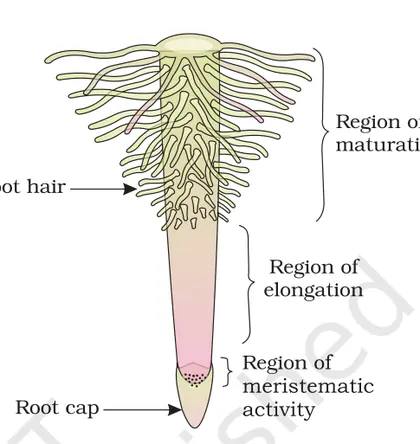
- Root cap (calyptra): A thimble‑shaped protection at the apex that shields the apical meristem and secretes mucilage to lubricate the root through the soil.
- Region of cell division (apical meristem): Just behind the cap; cells here divide to form new root tissues.
- Region of elongation: Cells increase in length and push the root tip forward.
- Region of maturation (root hair zone): Cells differentiate; root hairs develop here and greatly increase the absorbing surface area.
- Root hairs: Unicellular tubular outgrowths of epidermal cells; they are short‑lived but crucial for water and mineral uptake.
- Lateral (secondary) roots: Originate endogenously from the pericycle; they increase the rooting network and absorption surface.
Types of root systems
- Tap root system: Main root persists and produces lateral branches. Typical of dicots (e.g., carrot, radish, mango).
- Fibrous root system: Many similarly sized roots arise from the stem base or radicle, typical of monocots (e.g., wheat, rice, grasses, maize seedlings initially produce fibrous roots).
Adventitious roots
Roots that originate from non‑root tissues (stem or leaf). Examples: prop roots of maize and banyan, adventitious roots in ivy and sweet potato vines.
External modifications of roots (with their adaptive significance)
- Storage roots — swollen for food reserve (carrot/Daucus carota, radish/Raphanus sativus, sweet potato/Ipomoea batatas).
- Prop roots/supporting roots — provide mechanical support to tall/herbaceous plants (maize, sugarcane) and banyan (aerial prop roots that reach soil and thicken).
- Pneumatophores (respiratory roots) — vertical aerial roots with lenticels for gas exchange in waterlogged soils (e.g., Avicennia, Sonneratia).
- Buttress roots — large flaring roots in tropical trees to stabilize shallow soils (some Ficus and tropical trees).
- Contractile roots — pull the plant deeper into the soil (bulbs and some geophytes like dahlia, lily).
- Climbing/aerial roots — help attachment and absorb moisture from air (epiphytic orchids, ivy).
- Parasitic/haustorial roots — penetrate host tissues to obtain water and nutrients (root parasites such as Striga, Orobanche).
Distinguishing root and stem modifications
Some underground organs are modified stems (rhizomes, tubers, bulbs) while others are true roots. Useful differences: roots lack nodes, internodes, and buds; stems have nodes/buds and may bear leaves. Example: sweet potato = modified root (tuberous root); potato = modified stem (stem tuber).
External features important in identification and ecology
Presence/absence of root hairs, nature of branching, presence of adventitious roots, and special modifications are used to identify species and infer ecological strategies (e.g., deep taproots for drought tolerance; shallow fibrous roots for rapid surface uptake).
- Tap root: Carrot (Daucus carota), Radish (Raphanus sativus), Mango (Mangifera indica)
- Fibrous root: Wheat (Triticum aestivum), Rice (Oryza sativa), Grass species
- Prop roots: Maize (Zea mays), Sugarcane (Saccharum officinarum), Banyan (Ficus benghalensis)
- Pneumatophores: Avicennia (mangrove), Sonneratia
- Storage root: Sweet potato (Ipomoea batatas)
- Contractile roots: Dahlia, some bulbous plants
- Cylindrical root surface area (approx.) = 2 × π × r × l (where r = radius, l = length). Useful to estimate absorbing surface of a root segment.
- Root volume (approx.) = π × r^2 × l (r = radius, l = length).
- Specific root length (SRL) = total root length / root dry mass (units: m · g^−1). Higher SRL → finer roots for soil exploration.
- Root:shoot ratio = root dry mass / shoot dry mass (dimensionless). Used to assess allocation of biomass between belowground and aboveground parts.
- Relative growth rate of root length = (ln L2 − ln L1) / (t2 − t1) where L1 and L2 are lengths at times t1 and t2.
Root — Modifications and Special Types
Introduction
The root is the part of a plant that normally grows downward into the soil, anchoring the plant and absorbing water and minerals. In many plants roots become modified to perform special functions such as storage, support, respiration, absorption, and parasitism. These structural changes are called root modifications or special types of roots.
Major categories of root modifications and their adaptive significance
- Storage roots — Roots that become swollen to store food (carbohydrates) and water. Subtypes include:
- Fusiform: spindle-shaped, thicker in middle (e.g., carrot, Daucus carota). Stores food and water.
- Napiform: very swollen near top, abruptly tapering (e.g., radish, Raphanus sativus).
- Tuberous/Beet-type: uniformly swollen fleshy root (e.g., beet, Beta vulgaris; sweet potato, Ipomoea batatas — note: potato is a stem tuber, not a root).
- Conical and other shapes (e.g., turnip/hypocotylic storage in some species).
- Support and anchorage roots
- Prop or stilt roots: arise from stem nodes above ground to support plants (e.g., maize/zea mays, banyan/Ficus benghalensis, sugarcane).
- Buttress roots: large, flaring surface roots for support in shallow tropical soils (e.g., Ceiba, many tropical trees).
- Respiratory roots (pneumatophores) — vertical, spongy roots that protrude above waterlogged soil to obtain oxygen (e.g., Avicennia, Sonneratia). They have lenticels and internal air spaces (aerenchyma).
- Aerial and climbing roots
- Aerial roots: roots exposed to air, often with velamen for moisture absorption (e.g., epiphytic orchids).
- Clinging roots: adventitious roots that cling to walls, rocks, or tree bark (e.g., ivy Hedera).
- Haustorial roots (parasitic): penetrate host tissues and absorb nutrients (e.g., Cuscuta, Orobanche).
- Absorbing and symbiotic roots
- Nodulated roots: bear root nodules housing nitrogen-fixing bacteria (e.g., legumes like pea, soybean — Rhizobium).
- Mycorrhizal associations: fungal symbiosis increases nutrient uptake (widespread among vascular plants).
- Contractile roots — roots that shorten to pull the plant (bulbs, corms, and tubers) deeper into the soil (e.g., Lilium, some bulbs like gladiolus, dahlia corms). They have transverse plates of storage tissues that contract.
- Adventitious roots — roots that arise from non-root organs (stem or leaf) and perform varied functions (e.g., prop roots of banyan, adventitious roots in sweet potato vines). They are important in vegetative propagation and wound repair.
- Special aquatic modifications — in hydrophytes root systems may be reduced or modified mainly for anchorage (e.g., Pistia has adventitious roots; some free-floating plants have no roots).
Structure and anatomy notes (brief)
Many modified roots show common anatomical features: enlarged cortex for storage, well-developed parenchyma with starch, aerenchyma in respiring roots (pneumatophores), thickened periderm in tuberous roots. Nodules show specialized infection zones with symbiotic bacteria.
How to identify a root modification in the field
- Location of origin (root vs stem): storage roots originate from primary root axis; tubers and swollen stems originate from stem tissue and bear nodes/buds.
- Presence of nodes/scale leaves or axillary buds (stem origin) vs absence (root origin).
- External shape and internal tissue (storage parenchyma, vascular cylinder pattern).
Summary
Root modifications enable plants to survive and reproduce under diverse environmental conditions — from storing food and water, anchoring and supporting large structures, to breathing in waterlogged soils and parasitizing other plants. Recognizing these types and their functions is important in plant morphology and ecology.
- Fusiform (storage): Carrot — Daucus carota
- Napiform (storage): Radish — Raphanus sativus
- Tuberous root (storage): Sweet potato — Ipomoea batatas; Beetroot — Beta vulgaris
- Prop/stilt roots (support): Banyan — Ficus benghalensis; Maize — Zea mays
- Buttress roots (support): Kapok/Ceiba species, many tropical rainforest trees
- Pneumatophores (respiration): Avicennia (mangrove)
- Root:Shoot ratio = Total root dry mass / Total shoot dry mass (dimensionless) — compares allocation of biomass
- Specific Root Length (SRL) = Root length (m) / Root dry mass (g) — indicates fineness and exploratory capacity
- Root surface area (cylindrical approximation) = π × diameter × length
- Root volume (cylindrical approximation) = π × (diameter/2)^2 × length
- Root growth rate = (Final root length − Initial root length) / Time (e.g., cm/day)
Stem — External Morphology
Definition: The stem is the aerial axis of a plant that bears leaves, buds, flowers and fruits. It connects roots and leaves and performs support, conduction, storage and often photosynthesis.
Major external features
- Node: Point on the stem where leaf, bud or branch is attached. Example: joints on pea stem.
- Internode: Region between two consecutive nodes. Example: long internodes in sugarcane and bamboo.
- Buds: Undeveloped shoots found in axils (axillary buds) or at stem tip (terminal bud). Buds may be vegetative or floral; bud scale scars on woody stems indicate previous season growth.
- Leaf scar and bundle scars: On fallen-leaf woody stems the area where the leaf was attached (leaf scar) contains bundle scars marking vascular strand ends. Example: visible on twigs of many deciduous trees.
- Lenticels: Small porous raised spots on bark for gas exchange in woody stems. Example: pear and apple stems, potato tuber also shows lenticel-like spots.
- Bud scale and node ridge: In temperate woody plants repeated growth leaves a ring of bud-scale scars producing a growth-ring on the stem.
- Phyllotaxy (leaf arrangement):
- Alternate (one leaf per node): mango, mustard.
- Opposite (two leaves per node): guava, Calotropis.
- Whorled (three or more leaves per node): Nerium (oleander), Alstonia.
- Spiral/decussate variations exist; spiral phyllotaxy often follows Fibonacci arrangement.
- Surface features & growth habit: stems may be herbaceous or woody; growth habit includes erect (sunflower), climbing (ivy, grapevine), twining (Cucurbita), scandent and succulent (cactus).
Distinguishing stem from root and leaf (external): nodes and internodes, buds and leaves present on stem but absent on roots; leaves are lateral and have a petiole and blade whereas stem bears nodes, buds and axillary branches.
Modifications of stem (external forms and functions) — stems are often modified for storage, support, reproduction and protection. Major modified stems with examples:
- Rhizome (horizontal underground): Ginger, turmeric — storage and vegetative propagation.
- Tuber (swollen underground stem): Potato — carbohydrate storage and vegetative propagation (has eyes = buds).
- Bulb: Onion, garlic — short stem with fleshy leaves for storage and perennation.
- Corm: Gladiolus, Crocus — compact swollen stem for storage (thin leaves).
- Stolon/Runner (above-ground horizontal): Strawberry (runner) — produces new plants at nodes.
- Sucker and Offset: Banana (sucker), Pistia (offset) — vegetative propagation.
- Cladode/Phylloclade (flattened photosynthetic stem): Opuntia (cactus pads), Ruscus, Asparagus — perform photosynthesis when leaves are reduced.
- Tendril (modified stem/shoot): Grapevine, Cayratia — for climbing and support.
- Thorn (modified branch/stem): Bougainvillea, Citrus — protection against herbivores.
- Succulent stem: Cactus, Aloe — water storage and photosynthesis.
Functions of stem (external and related): support leaves/flowers, conduction of water/minerals and food, storage of food and water, vegetative propagation, perennation and protection (thorns), photosynthesis (green stems), and aeration in some aquatic/wetland stems.
Important practical notes for students: when observing stems, always note node-internode pattern, presence/position/type of buds, leaf scars and bundle scars in woody twigs, lenticels, and any visible modifications (e.g., runners, tubers). Label a diagram showing node, internode, axillary bud, terminal bud, leaf scar and lenticel.
- Sugarcane & bamboo: long internodes supporting tall culms; nodes visible as joints.
- Potato: underground tuber — swollen stem storing starch and bearing 'eyes' (buds) for vegetative propagation.
- Ginger and turmeric: rhizomes — horizontal underground stems for storage and new shoot formation.
- Onion and garlic: bulbs — short stem surrounded by fleshy storage leaves.
- Strawberry: runners (stolons) — horizontal stems that form new plantlets at nodes.
- Opuntia (cactus pads): cladodes/phylloclades — flattened photosynthetic stems.
- Golden angle (common in spiral phyllotaxy): angle ≈ 360° × (1 - 1/φ) ≈ 137.5°, where φ (phi) ≈ 1.618 (golden ratio).
- Stem growth rate (average): growth rate = (final length - initial length) / time (units: cm/day or mm/week).
- Cylinder (approximation for stem geometry): lateral surface area = 2πrh; volume = πr²h (r = stem radius, h = stem length).
Stem — Modifications
Introduction: The stem is the axis of a plant bearing nodes, internodes, leaves and buds. Stems frequently get modified from the typical upright axis to perform special functions such as storage, support, protection, vegetative propagation and photosynthesis. These structural changes are called stem modifications.
Basic unit: A repeated unit of stem construction is the phytomer = node + internode + leaf + axillary bud. Modifications involve alteration of one or more of these parts.
Functional classification and common types:
- For storage (food/water):
- Tuber: Enlarged, fleshy, underground stem storing starch; bears eyes (axillary buds). Example: potato (Solanum tuberosum).
- Rhizome: Horizontal underground stem with nodes and internodes; helps perennation and vegetative spread. Example: ginger (Zingiber officinale), turmeric.
- Corm: Short, vertical, swollen underground stem with tunic of dead leaves; has basal plate and buds. Example: Gladiolus, Crocus.
- Bulb: Modified stem with fleshy storage leaves attached to a small stem (basal plate). Two types: tunicate (onion) and scaly (Lily). Example: onion, tulip.
- Succulent stems: Thickened stems that store water (also photosynthetic). Example: cactus (Opuntia), some Euphorbia.
- For vegetative propagation and spread:
- Stolon or runner: Horizontal above-ground stem that produces new plants at nodes. Example: strawberry (Fragaria).
- Sucker: A shoot from underground portions of stem that can form a new plant. Example: Chrysanthemum, banana (suckers produce new plants).
- Offset: Short lateral branch that forms a new plant (common in cacti and some succulents).
- For climbing and support:
- Tendrils (stem-derived): Slender coiling shoots used for support (e.g., Vitis — grapevine tendrils are modified stems).
- Cladode / Phylloclade: Flattened, leaf-like stems that carry out photosynthesis. Phylloclades are larger with several nodes/internodes (e.g., Asparagus? phylloclades in some species), cladodes are small leaf-like stems (e.g., Ruscus). Many cacti have flattened stem segments (Opuntia) acting as photosynthetic organs.
- For protection:
- Thorns: Hard, pointed woody branches or stems. Example: bougainvillea, Citrus (sharp branches are stem modifications).
- Spines: In some plants stems or parts become sharp for defense (note: cactus spines are modified leaves, while some sharp structures are stem-derived).
- Other specialized forms:
- Cladophylls/Phylloclades for photosynthesis: e.g., Ruscus, Asparagus (small green stem-like structures).
- Bulbils: Aerial buds forming small plantlets on aerial parts of stem (e.g., Agave, Dioscorea — yam bulbils in some species).
How to recognize a modified stem (key characters):
- Presence of nodes and internodes and buds/eyes indicates stem origin (e.g., potato eyes are nodes).
- Leaves or leaf bases present on a structure (e.g., bulb has fleshy leaves) point to stem or leaf origin depending on structure.
- Storage roots (sweet potato) lack nodes/internodes and buds — helps distinguish root tubers from stem tubers.
Adaptive significance: Stem modifications allow survival under adverse conditions (perennation), vegetative propagation and rapid colonisation, storage of reserve food or water, mechanical support for climbing species and protection against herbivory.
Important distinctions (stem vs root modifications):
- Stem tuber (potato) has eyes (buds) and nodes; root tuber (sweet potato) does not.
- Bulb and corm are stem-derived with modified leaves/scale leaves; storage roots (taproots) are purely root tissue.
Summary: Recognising stem modifications relies on identifying nodal structure, buds and the pattern of leaves. Each modification represents an evolutionary response to habitat and life-history strategy (storage, protection, propagation, photosynthesis or climbing).
- Potato (Solanum tuberosum) — tuber: underground storage stem with eyes (buds); edible.
- Ginger (Zingiber officinale) — rhizome: horizontal underground stem used as spice and medicine.
- Onion (Allium cepa) — bulb: underground stem with fleshy storage leaves; edible.
- Gladiolus — corm: swollen basal stem for storage and perennation.
- Strawberry (Fragaria) — stolon/runner: horizontal above-ground stem for vegetative propagation.
- Bougainvillea, Citrus — thorn: modified stem for protection.
- Phytomer (basic stem unit) = node + internode + leaf + axillary bud
- Typical phyllotaxy spiral fractions (common in stems/leaves) often follow Fibonacci fractions (e.g., 2/5, 3/8) — useful when discussing leaf arrangement on stems
- Identification rule: presence of nodes + buds -> stem origin (e.g., tuber with eyes = stem tuber); absence of nodes/buds -> root origin
Leaf — External Morphology
Definition and general role
A leaf is a lateral, usually flattened lateral appendage of stem borne at the node. It is the primary photosynthetic organ of most plants and also performs gas exchange, transpiration and storage in some cases.
Principal external parts of a typical leaf
- Leaf base – the part that connects leaf to stem; may bear stipules.
- Petiole – stalk that attaches lamina to stem (absent in sessile leaves).
- Lamina (leaf blade) – expanded portion; contains veins and margin.
- Midrib and veins – midrib is the main central vein; lateral veins form venation pattern.
- Stipules – paired appendages at the base of petiole (may be leaf-like, glandular, or modified).
Classification by complexity
Simple leaf: lamina single (e.g., mango). Compound leaf: lamina divided into discrete leaflets. Types of compound leaves: pinnate (leaflets along an axis — neem), bipinnate (each leaflet further pinnate — gulmohar), palmate (leaflets radiate from a point).
Leaf arrangement (phyllotaxy)
Arrangement of leaves on stem: alternate (one leaf per node — Hibiscus, Mango), opposite (two leaves per node — Guava, Calotropis), whorled (three or more leaves per node — Nerium, Alstonia). Phyllotaxy determines light capture and spacing.
Venation
Two major kinds: parallel venation (veins run parallel along the length — typical of monocots like grasses, maize) and reticulate/reticulated venation (network of veins — typical of dicots like mango, neem). Venation type relates to vascular organization and mechanical support.
Shapes, apices and bases
Lamina shapes: linear, lanceolate, ovate, orbicular, cordate, spatulate, etc. Apex: acute, obtuse, acuminate, mucronate. Base: rounded, cordate, cuneate, truncate. Margin types: entire (smooth), serrate (toothed like rose), crenate, lobed (oak).
Modifications of leaf
Leaves are frequently modified to perform special functions. Common modifications with examples:
- Tendrils (Pea) — climbing support
- Spines (Cactus, Bougainvillea) — protection and reduced transpiration
- Phyllodes/Cladodes (Acacia phyllodes; Opuntia pads are modified stems but some plants have phyllodes) — flattened petiole or stem assuming photosynthesis
- Storage leaves (Onion scales) — storage of water/nutrients
- Succulent leaves (Aloe) — water storage
- Insectivorous leaves (Venus flytrap, Nepenthes pitchers) — obtaining nutrients from insects
- Bracts (Bougainvillea, Poinsettia) — attract pollinators
Stomata and epidermal features
Stomata are pores on epidermis surrounded by guard cells; important for gas exchange and transpiration. Distribution may be epistomatic (upper), hypostomatic (lower) or amphistomatic (both surfaces). Stomatal type (anomalous shapes, subsidiary cells) is diagnostic in taxonomy.
Functional significance
Leaves are optimized for light capture (broad lamina, arrangement), gaseous exchange (stomata), water management (cuticle, stomatal distribution, modifications), mechanical support and special tasks (storage, defense, climbing, nutrient acquisition).
Measurement & observational notes for students
Typical classroom observations: note petiole presence/absence, measure leaf length and breadth, examine margin and apex, observe venation pattern with hand lens, count stomata under microscope (impression method), identify any modifications. Use correct botanical terms when recording.
- Simple leaf: Mango (Mangifera indica) — broad lamina, reticulate venation.
- Pinnately compound leaf: Neem (Azadirachta indica) — leaflets arranged along a rachis.
- Bipinnate leaf: Gulmohar/Flame tree (Delonix regia) — leaflets appear twice-compound.
- Parallel venation: Grass (Poaceae) and maize — veins run parallel from base to tip.
- Opposite phyllotaxy: Guava (Psidium guajava); Alternate phyllotaxy: Hibiscus; Whorled phyllotaxy: Nerium/Alstonia.
- Leaf modification — Tendril: Pea; Spine: Cactus; Storage leaf: Onion; Insectivorous leaf: Nepenthes (pitcher plant).
- Leaf area approximations: rectangle ≈ length × breadth; ellipse ≈ π × (length/2) × (breadth/2) = (π/4) × length × breadth (useful for oval leaves).
- Leaf Area Index (LAI) = (Total leaf area of canopy) / (Ground area occupied) — dimensionless; used in crop and ecology studies.
- Specific Leaf Area (SLA) = Leaf area (cm²) / Leaf dry mass (g) — indicates leaf thickness and growth strategy.
- Stomatal frequency = Number of stomata in given area / Area (e.g., stomata per mm²).
- Stomatal Index (SI) = [S / (E + S)] × 100, where S = number of stomata per unit area and E = number of epidermal cells in same area.
Leaf — Modifications and Special Leaves
Introduction
A leaf is a lateral, usually flattened plant organ, primarily adapted for photosynthesis, gas exchange and transpiration. Typical external parts are lamina (blade), midrib and veins, petiole and leaf base; many leaves bear stipules. Leaves show a wide range of structural modifications when plants adapt to different environments or life-strategies. These modifications alter shape, size or function and are called leaf modifications or special leaves.
Why do leaves get modified?
- To reduce water loss in xeric conditions (xerophytic adaptations).
- To provide mechanical support (tendrils).
- To protect the plant from herbivores (spines, tough scales).
- To store water or food (succulent or storage leaves, bulb scales).
- To capture and digest insects (insectivorous leaves) when soil nutrients are poor.
- To aid reproduction (vegetative propagation by leaf buds, bracts that attract pollinators).
Major types of leaf modifications (with structure and function)
- Tendrils — Leaves or leaf-parts (lamina, leaflet or petiole) become thin, coiling structures for climbing and support. Example: Pea (Pisum sativum) leaflets become tendrils; Bixa and Vitis have modified tendrils.
- Spines — Leaves or parts of leaves are modified into hard, pointed structures to protect against herbivory and to reduce transpiration by lowering surface area. Example: Cactus (Opuntia, Cylindropuntia) where leaves form spines; Bougainvillea also has spines.
- Phyllode — Petiole becomes flattened and leaf-like, taking over photosynthetic function while the true lamina is reduced or absent. Example: Acacia (Australian species) — helps reduce water loss and overheating.
- Storage leaves / Succulent leaves — Leaves become fleshy and store water or food. Example: Onion (bulb scales are modified leaves for food storage), Aloe, Kalanchoe and many succulents store water in leaves.
- Bulb scale: onion, garlic — leaves modified into scales arranged as bulb for food storage and perennation.
- Window leaves (fenestration) — Thick, often translucent leaf-tips allow light to reach photosynthetic tissues below ground level; common in plants that grow mostly buried. Example: Fenestraria, Lithops, some Haworthia.
- Bracts — Leaves modified to be showy or colored to attract pollinators or protect inflorescences. Example: Bougainvillea (colored bracts), Poinsettia (Euphorbia pulcherrima).
- Insectivorous (Carnivorous) leaves — Leaves modified to capture and digest insects to supplement mineral nutrients.
- Pitcher leaves: Nepenthes, Sarracenia — form pitfall traps filled with digestive fluid.
- Sundew (Drosera): sticky glandular leaves that trap insects.
- Venus flytrap (Dionaea muscipula): snap-trap leaves that close rapidly.
- Bladderworts (Utricularia): suction traps on modified leaves.
- Reproductive leaves (vegetative propagation) — Leaves that form plantlets on margins or buds that can drop off and grow into new plants. Example: Bryophyllum (Kalanchoe) produces plantlets along leaf margins.
- Hydrophyte leaf modifications — Leaves adapted to aquatic habitats:
- Floating leaves (broad, with stomata on upper surface): Nymphaea (water lily).
- Submerged leaves (narrow, dissected, ribbon-like to reduce resistance): Vallisneria, Hydrilla.
- Heterophylly: different leaf forms on the same plant depending on submersion (e.g., Ranunculus).
- Xerophytic leaf adaptations — Features to conserve water:
- Reduced leaf area or conversion to spines.
- Thickened cuticle and epidermis, sunken stomata, multiple epidermis layers, dense trichomes (hairs).
- Leaf rolling or folding to reduce exposed area (e.g., grasses like Ammophila or Marram).
- Cataphylls and scale leaves — Reduced, non-photosynthetic protective leaves around buds and underground storage organs. Example: scale leaves on bulbs (Allium, Tulipa) and bud scales.
How to recognize a modified leaf?
- Look for characteristic leaf tissues (vascular bundles, vein traces) — a true leaf-modification will show leaf vascular supply.
- Distinguish modified petiole (phyllode) from modified stem (phylloclade or cladode) which will have leaf trace patterns typical of stems and axillary buds.
Functional trade-offs and ecological significance
Leaf modifications reflect evolutionary trade-offs: e.g., spines reduce photosynthetic area but increase survivorship in arid/herbivore-rich habitats; insectivorous leaves invest energy to capture prey to obtain scarce nutrients (N, P) in boggy soils. Understanding these modifications links anatomy, physiology and ecology.
Teaching/Revision tips
- Use labelled diagrams showing each modification (tendril, spine, pitcher, bulb scale, bract, window leaf).
- Compare cross-sections of xerophytic, mesophytic and hydrophytic leaves to see structural differences (cuticle thickness, mesophyll organization, stomatal position).
- Memorize a few representative examples and their functions (CBSE often asks for named examples).
- Tendrils: Pea (Pisum sativum) leaflets become tendrils for support.
- Spines: Cactus (Opuntia) leaves reduced to spines — protection and reduced transpiration.
- Phyllode: Australian Acacia species — petiole becomes leaf-like and photosynthetic.
- Bulb scales (storage leaves): Onion (Allium cepa) — fleshy scales store food.
- Succulent leaves: Aloe, Kalanchoe — water storage in leaves.
- Window leaves: Fenestraria and Lithops — translucent 'windows' allow light to internal tissues.
- Overall photosynthesis (summary): 6 CO2 + 6 H2O → C6H12O6 + 6 O2
- Net photosynthesis = Gross photosynthesis − Respiration
- Simplified transpiration relation (empirical): E ≈ g_s × VPD, where E = transpiration rate, g_s = stomatal conductance, VPD = vapour pressure deficit (air−leaf)
- Surface area to volume ratio (SA:V) (for a cube of side L): SA = 6L^2, Volume = L^3 → SA:V = 6/L (illustrates that reducing leaf area reduces exposed surface relative to volume)
Inflorescence — Concepts and Types
Definition
Inflorescence is the arrangement or group of flowers on a flowering plant (angiosperm). It is the flowering part of a shoot including the peduncle (main stalk), rachis (extension of peduncle), pedicels (stalks of individual flowers) and associated bracts/bracteoles.
Key terms
- Peduncle: main stalk of an entire inflorescence.
- Rachis: axis bearing flowers or secondary branches.
- Pedicel: stalk of an individual flower.
- Bract/Bracteole: modified leaf(s) associated with the inflorescence or flower.
- Sessile: flower without a pedicel (attached directly to axis).
- Determinate vs Indeterminate: whether the terminal bud ends in a flower (determinate) or continues growth (indeterminate).
Classification (basic)
Inflorescences are broadly classified by the fate of the growing point into two main types:
1. Racemose (Indeterminate)
The main axis continues to grow and does not terminate in a flower. Younger flowers are at the apex and older ones at the base (acropetal maturation). Characteristic feature: indefinite apical growth.
Common racemose types (with features):
- Raceme: elongated axis with pedicellate flowers (e.g., mustard, Brassica).
- Spike: like raceme but flowers sessile (e.g., wheat, barley).
- Corymb: lower pedicels longer so flowers form a flat-topped cluster (e.g., Achillea).
- Panicle: branched raceme; compound and loose (e.g., rice, Oryza).
- Umbel: several pedicels arise from a common point (simple umbel) — e.g., Allium (onion); compound umbel — Apiaceae like carrot, coriander.
- Head/Capitulum: very short axis bearing many sessile florets on a common receptacle, often subtended by an involucre of bracts (e.g., sunflower, Helianthus; Chrysanthemum).
- Spadix: thick fleshy axis with small flowers, usually subtended by a spathe (e.g., Arum, Colocasia, Zantedeschia).
- Catkin (ament): pendulous spike-like, often unisexual and ephemeral (e.g., Salix, Populus).
2. Cymose (Determinate)
The main axis ends in a flower (terminal flower), so growth is limited. Older flowers are at the apex and younger ones are produced later on lateral branches (basipetal maturation). Subtypes depend on how lateral branches develop:
Major cymose patterns:
- Simple cyme (dichasium): a terminal flower with two lateral flowers (e.g., many Jasminum species).
- Monochasium: single lateral branch develops repeatedly — if it coils on one side it is helicoid (e.g., some species in Boraginaceae); if alternating sides it is scorpioid.
- Compound cymes: repeated branching of dichasial or monochasial units forming complex cymes.
Mixed and special types
Some inflorescences combine racemose and cymose features: thyrse (main axis racemose, lateral units cymose) — e.g., bougainvillea; cyathium — a special cup-like pseudanthium in Euphorbia; hypanthodium — fig (Ficus) with many flowers inside a hollow receptacle.
Biological significance
Inflorescence types influence pollination efficiency, seed dispersal, resource allocation and flowering sequence (which affects reproductive success). For example, a capitulum aggregates many small flowers to appear as a single large floral unit attractive to pollinators.
How to identify
Key observations: position of flowers (axillary or terminal), presence/absence of pedicels (sessile vs pedicellate), branching pattern, whether the terminal bud develops into a flower (determinate) or continues to grow (indeterminate), presence of specialized bracts or spathes.
- Raceme: Mustard (Brassica), Radish (Raphanus) — elongated axis with pedicellate flowers.
- Spike: Wheat (Triticum), Barley (Hordeum) — sessile flowers on an unbranched axis.
- Panicle: Rice (Oryza), Oats (Avena) — branched raceme (compound inflorescence).
- Corymb: Achillea (yarrow) — pedicels of lower flowers longer producing a flat-topped head.
- Umbel / Compound umbel: Onion (Allium) — simple umbel; Carrot (Daucus), Coriander (Coriandrum) — compound umbels (Apiaceae).
- Capitulum (Head): Sunflower (Helianthus), Chrysanthemum — many sessile florets on common receptacle with involucre.
- General notation (conceptual): Indeterminate (racemose) — apical meristem continues to grow (acropetal flowering; younger flowers near apex). Determinate (cymose) — apical meristem ends in a flower (basipetal flowering; younger flowers produced later on side branches).
- Simple shorthand used in identification: R = racemose (indeterminate), C = cymose (determinate). Example: Mustard = R (raceme); Jasmine = C (dichasial cyme).
- Inflorescence structural formula (illustrative, not a numeric equation): Peduncle + Rachis + Σ(pedicels × flowers) — shows the hierarchy: main stalk supports axis which bears pedicels, each with a flower.
- Floral sequence rule: In racemose: flowering sequence base → apex (older ↓ younger ↑). In cymose: flowering sequence apex → base (terminal flower first).
Flower — General Structure
Definition: A flower is a modified shoot specialized for sexual reproduction in angiosperms. It typically bears four concentric whorls of floral leaves — calyx, corolla, androecium and gynoecium — on a thalamus (receptacle).
Main parts (with functions):
- Pedicel: stalk that attaches the flower to the stem; may bear an articulation (abscission zone).
- Receptacle (thalamus): expanded tip of pedicel where floral organs are inserted.
- Perianth: non-reproductive outer envelope. If differentiated into calyx (sepals) and corolla (petals) the perianth is dichlamydeous; if not differentiated (monochlamydeous) its units are tepals.
- Calyx (sepals): usually green, protect the bud.
- Corolla (petals): often colourful, attract pollinators; may be free (polypetalous) or fused (sympetalous).
- Androecium (stamens): male whorl. Each stamen = filament + anther (two thecae). Microsporangia in anthers produce pollen (microspores).
- Gynoecium (pistil/carpel): female whorl. A carpel has stigma (pollen-receptive), style (conduit) and ovary (encloses ovules). Carpels may be free (apocarpous) or fused (syncarpous); ovary position may be superior, half-inferior (perigynous) or inferior (epigynous).
Microstructure of ovule: Ovule has integuments (one or two), micropyle (opening), chalaza, and nucellus which encloses the embryo sac (megagametophyte). After fertilization, ovule becomes the seed and ovary becomes the fruit.
Important morphological concepts:
- Completeness: Complete flowers have all 4 whorls; incomplete flowers lack one or more whorls (e.g., grasses lack conspicuous corolla).
- Bisexual (perfect) vs unisexual (imperfect): both stamens and pistil present vs only one sex organ.
- Symmetry: Actinomorphic (radial) — e.g., Hibiscus; Zygomorphic (bilateral) — e.g., Pea, Orchid.
- Aestivation (arrangement of petals/sepals in bud): valvate, imbricate, twisted, vexillary (papilionaceous). Example: vexillary in pea.
- Adnation and connation: Connation = fusion of similar parts (e.g., fused petals in Petunia). Adnation = fusion of dissimilar whorls (e.g., stamens adnate to corolla in many Solanaceae).
- Placentation (ovule attachment inside ovary): marginal (pea), axile (tomato, China rose), parietal (mustard), free-central (Dianthus), basal (sunflower).
- Flower types by ovary position: Hypogynous (superior ovary — e.g., mustard, brinjal), perigynous (ovary surrounded by hypanthium — e.g., rose), epigynous (inferior ovary — e.g., cucumber, guava).
Functional summary: Flowers present structures for pollination (petals, scent, nectar, pollen), ensure gamete production (anther and embryo sac), and after pollination and fertilization transform into fruits and seeds for dispersal.
How to study visually (recommended diagrams): show a labelled longitudinal section (L.S.) of a typical bisexual flower, a floral formula and corresponding floral diagram, cross-section of an ovary showing placentation types, and a drawing of an inflorescence (capitulum) for composite flowers.
- Hibiscus (China rose): complete, actinomorphic, bisexual; stamens fused into a staminal column (epipetalous-like arrangement) and gynoecium syncarpous with axile placentation.
- Pea (Pisum sativum): papilionaceous corolla, zygomorphic, marginal placentation; vexillary aestivation; example of marital importance in Mendel's work.
- Mustard (Brassica): cruciform corolla, actinomorphic, tetradynamous stamens (4 long + 2 short), parietal placentation; hypogynous (superior ovary).
- Lilium (Lily): monocot with undifferentiated perianth (tepals), many free stamens, superior ovary.
- Sunflower (Helianthus): an inflorescence (capitulum) made of many small florets — ray florets (sterile or female) and disc florets (bisexual), basal placentation in each floret’s ovary.
- Dianthus (Carnation): free-central placentation; typical example used for showing free-central ovule attachment.
- Notation guide (common symbols): K = calyx (sepals), C = corolla (petals), A = androecium (stamens), G = gynoecium (carpels); numbers in parentheses indicate fusion; underbar/overbar convention often shows ovary position (G̲ for inferior, Ḡ for superior) and symmetry symbols ↑ (radial) or ↓ (bilateral).
- Hibiscus (China rose) floral formula (common form): K5 C5 A∞ G(5) — bisexual, actinomorphic, superior ovary (syncarpous gynoecium of 5 carpels).
- Pea (Papilionaceous flower) floral formula: ↓ K(5) C(5) A(10) G(1) — zygomorphic (↓ indicates bilateral symmetry), vexillary aestivation, marginal placentation.
- Mustard (Brassica) floral formula: K4 C4 A2+4 G(2) — cruciform corolla, tetradynamous stamens (2 short + 4 long), superior ovary, parietal placentation.
Flower — Types and Symmetry
Overview
A flower is the reproductive shoot of angiosperms. Flowers are classified by presence/absence of whorls, sex, ovary position, fusion of parts and symmetry. Understanding these types helps identify plants and predict pollination mechanisms.
Basic terms
- Complete: has all four floral whorls — calyx (sepals), corolla (petals), androecium (stamens), gynoecium (carpels). Example: mustard.
- Incomplete: missing one or more whorls. Example: grasses (no petals).
- Perfect (bisexual): both androecium and gynoecium present. Example: Hibiscus.
- Imperfect (unisexual): only stamens or only carpels present. Example: cucumber (separate male and female flowers).
- Monoecious: male and female flowers on same plant (e.g., Cucurbita). Dioecious: male and female flowers on separate plants (e.g., papaya).
- Apocarpous: carpels free (e.g., Ranunculus). Syncarpous: carpels fused (e.g., Hibiscus, mustard).
Classification by ovary position
- Hypogynous (superior ovary): other floral parts arise below the ovary. Flower is usually called hypogynous. Examples: mustard, Hibiscus, pea.
- Perigynous (half-inferior/intermediate): floral parts fused to form a cup (hypanthium) around the ovary; ovary appears central. Example commonly cited: rose.
- Epigynous (inferior ovary): other parts arise above the ovary (ovary embedded). Examples: sunflower, cucumber, guava, apple.
Classification by fusion of parts
- Polysepalous / Gamosepalous — sepals free or fused.
- Polypetalous / Sympetalous — petals free (e.g., Ranunculus) or fused (e.g., Petunia).
- Stamens — may be free or fused to each other or to petals (epipetalous). Example: staminal column in Malvaceae (Hibiscus).
Symmetry of flowers (shape & symmetry)
- Actinomorphic (radial symmetry): can be divided into two equal halves through multiple planes passing through the centre. Also called regular. Examples: mustard, Hibiscus, many lily family flowers. Symbol often: ✳
- Zygomorphic (bilateral symmetry): can be divided into equal halves by only one plane. Also called irregular. Examples: pea (Fabaceae), orchid, snapdragon.
- Asymmetric: no plane gives mirror-image halves. Example: Canna.
Floral formula — concise symbolic description
A floral formula encodes number and fusion of floral parts using symbols: K (calyx), C (corolla), A (androecium), G (gynoecium); brackets ( ) for fused parts, + for free groups, ∞ for many, ↓ or ✳ for symmetry, and an overbar/underscore convention for superior/inferior ovary (see examples and notes below).
Why symmetry matters
Symmetry correlates with pollination: actinomorphic flowers often attract a variety of pollinators (generalized), whereas zygomorphic flowers often have specialized pollinators and precise pollen transfer mechanisms.
How to identify quickly
- Look for presence/absence of petals → complete vs incomplete.
- Check if both stamens and carpels present → bisexual vs unisexual.
- Observe where sepals/petals attach relative to ovary to decide hypogynous/perigynous/epigynous.
- Fold the flower (or trace) to test planes of symmetry.
Note on notation conventions: Different textbooks show superior/inferior ovary with lines above or below G. In the formulas below we state ovary position explicitly to avoid ambiguity.
- Hibiscus (China rose): complete, bisexual, actinomorphic, syncarpous, hypogynous (ovary superior); floral formula: ✳ K5 C5 A(∞ in staminal column) G(5) [superior].
- Mustard (Brassica): complete, bisexual, actinomorphic, syncarpous; floral formula: ✳ K4 C4 A2+4 G(2) [superior].
- Pea (Pisum sativum): complete, bisexual, zygomorphic, papilionaceous (legume family), syncarpous; floral formula: ↓ K(5) C(5) A(9)+1 G(1) [superior].
- Sunflower (Helianthus): inflorescence = capitulum of Asteraceae. Ray florets zygomorphic (sterile/♀), disc florets actinomorphic (bisexual); ovary of florets inferior (epigynous).
- Cucumber (Cucurbita/Cucumis): unisexual flowers, monoecious; female flowers pistillate with inferior ovary (epigynous), males staminate without gynoecium.
- Orchid: typically zygomorphic, bisexual, ovary inferior (epigynous), specialized fused structures (gynostemium).
- Floral formula notation (key): K = calyx (sepals), C = corolla (petals), A = androecium (stamens), G = gynoecium (carpels). Brackets ( ) = fused whorl, + = free groups, ∞ = many; ↓ = zygomorphic, ✳ = actinomorphic. State ovary position explicitly (superior = hypogynous, half-inferior = perigynous, inferior = epigynous).
- Hibiscus: ✳ K5 C5 A(∞ staminal column) G(5) — ovary superior (hypogynous).
- Mustard (Brassica): ✳ K4 C4 A2+4 G(2) — ovary superior (hypogynous).
- Pea (Pisum): ↓ K(5) C(5) A(9)+1 G(1) — ovary superior (hypogynous).
- Sunflower (disk floret, Asteraceae): ✳ K(5) C(5) A(5) G(2) — ovary inferior (epigynous); note: head = many florets (capitulum).
- Cucumber (female flower): ✳ K5 C5 A0 G(3) — ovary inferior (epigynous) (unisexual pistillate flower).
Aestivation
Definition: Aestivation (also spelled aestivation) is the arrangement of sepals or petals (perianth parts) in a floral bud relative to one another before the flower opens. It is analogous to vernation (leaf arrangement in a bud) but applies to floral leaves (petals/sepals).
Why it matters: Aestivation is an important morphological character used in plant identification and classification. The pattern influences protection of inner floral parts in the bud and may affect the way a flower opens.
General points to observe:
- Look at a transverse section of the floral bud or gently tease the petals/sepals to see how margins overlap or meet.
- Count the number of parts (n) and note which margins are inner (overlapping) or outer (overlapped).
Main types of aestivation (with brief descriptions):
- Valvate: Margins of adjacent parts meet edge to edge without overlapping (like doors meeting). No part overlaps another. Example families/flowers often show plain, non-overlapping calyx or corolla in bud.
- Twisted (contorted or convolute): Each part overlaps the next in a regular direction (clockwise or anticlockwise). One margin of each member is inside and the other is outside (e.g., petal A overlaps B, B overlaps C, etc.).
- Imbricate: Parts overlap irregularly; some parts have both margins overlapped, some both margins overlapping, and others overlapped on one side. This is a general overlapping pattern (not a uniform direction).
- Vexillary (papilionaceous): A special form of imbricate aestivation seen in pea/bean family (Fabaceae, papilionoid flowers). One large anterior petal (standard/banner) is outermost, two lateral petals (wings) overlap the two inner keel petals, forming a distinct arrangement: standard (outer) > wings > keel (innermost).
- Quincuncial: Typical for five parts (n = 5). Two parts are completely external, two are completely internal, and the fifth has one margin external and one margin internal (partly overlapping on one side and overlapped on the other).
How to distinguish similar types:
- Valvate: look for no overlaps (edges meet).
- Twisted: consistent one-sided overlap around the circle.
- Imbricate vs. quincuncial: both involve overlaps, but quincuncial has a specific pattern for five parts (2 external + 2 internal + 1 partially overlapping).
Significance:
- Protection: proper covering of inner parts in bud.
- Developmental constraint: reflects growth sequence and organ initiation order.
- Taxonomic value: useful character in keys and classification (e.g., vexillary in many Fabaceae).
Practical tip for students: To study aestivation, collect young buds, observe under a hand lens, or carefully cut a transverse section through the bud apex. Sketch the arrangement and label outer/inner margins to determine the type.
- Valvate: Calotropis (commonly cited in textbooks) and Bombax (silk cotton) show valvate calyx/corolla in buds.
- Twisted/Contorted: Many members of Malvaceae (e.g., Hibiscus) display twisted aestivation of petals.
- Imbricate: Common in many dicots with overlapping petals/sepals; e.g., some members of Rosaceae and Malvaceae show imbricate arrangements.
- Vexillary (papilionaceous): Pea (Pisum sativum), beans and other Fabaceae (papilionoid flowers) — characteristic banner, wings and keel arrangement.
- Quincuncial: Typical in many five-parted flowers (textbook examples include some Ranunculaceae and other families where 5-petaled buds follow the quincuncial pattern).
- No numerical/mathematical formulas apply to aestivation; it is descriptive. Use identification rules instead.
- Rule for quincuncial (n = 5): 2 external + 2 internal + 1 partially overlapping = quincuncial pattern.
- Rule for twisted/contorted: for each successive petal P(i), P(i) overlaps P(i+1) in the same rotational direction around the bud.
- Checklist formula for identification: Count parts (n) → observe overlap pattern (none / one-directional / irregular / banner-wings-keel) → match to valvate / twisted / imbricate / vexillary / quincuncial.
Placentation and Ovule
Overview
Placentation is the arrangement of ovules inside the ovary. An ovule (megasporangium) is the structure that develops into a seed after fertilization. Understanding placentation and ovule structure is essential for identifying flowers, understanding pollination/fertilization and seed formation.
Placentation — types and features
Placentation is named according to where ovules attach inside the ovary. Common types:
- Marginal: Ovules in a single row along the suture of a unilocular ovary formed from a fused carpel (typical of legumes). Example: pea, bean.
- Axile: Ovules on a central column in a multilocular ovary; septa divide the ovary. Example: tomato, lemon.
- Parietal: Ovules on the inner wall of a unilocular ovary (placentae on the ovary wall), often with false septa. Example: mustard (Brassica), Cucurbitaceae members.
- Free-central: Ovules on a central column not connected to the ovary walls (no septa). Example: Dianthus (carnation).
- Basal: A single ovule arises at the base of the ovary. Example: sunflower (Asteraceae).
- Superficial: Ovules on surface of a multilocular ovary formed by proliferation of nucellar tissue; seen in some aquatic plants. Example: Nymphaea (water lily).
Ovule — structure and parts (outer to inner)
- Funiculus — stalk attaching ovule to placenta; bears a scar (hilum) on the ovule.
- Raphe — ridge produced when the ovule is anatropous and funiculus is fused along the back.
- Integuments — one or two protective layers (bitegmic = two; unitegmic = one) that leave a small opening, the micropyle.
- Micropyle — small opening through which pollen tube enters the embryo sac.
- Nucellus — megasporangium that houses the megaspore mother cell (MMC) and provides nutrition.
- Chalaza — base of ovule where nucellus, integuments and funiculus meet; supplies nutrients.
- Embryo sac (megagametophyte) — female gametophyte inside the nucellus; typical angiosperm type (Polygonum) is 8-nucleate and 7-celled.
Types of ovules by orientation
- Anatropous — ovule inverted so micropyle lies near funiculus (most common in angiosperms).
- Orthotropous (straight) — straight ovule with micropyle, chalaza and funiculus in one line.
- Campylotropous — curved ovule; nucellus curved causing partially folded embryo sac.
- Amphitropous — intermediate; the embryo sac is bent so micropyle is near funiculus but not fully inverted.
Megagametophyte (Polygonum type) — summary of development
MMC (megaspore mother cell) undergoes meiosis → 4 megaspores (linear) → 3 degenerate, 1 functional megaspore → functional megaspore undergoes three mitotic divisions without cytokinesis → 8 free nuclei → nuclei arrange and form 7 cells: egg apparatus (one egg + two synergids) at micropylar end, three antipodal cells at chalazal end, and one central cell with two polar nuclei (haploid nuclei fused later or at fertilization behave as a binucleate central cell).
Fertilization — double fertilization
A pollen tube enters through the micropyle and releases two male gametes: one fuses with the egg → zygote (embryo); the other fuses with the two polar nuclei → primary endosperm nucleus (triploid) → endosperm (nutritive tissue).
Key identification tips
To identify placentation on dissecting a flower: make a longitudinal section of ovary and note the position of ovules relative to locules and ovary wall. Observing ovule orientation and number of integuments helps in family/genus identification.
Practical relevance
Placentation influences seed arrangement, fruit anatomy and commercial traits such as seed number per fruit (important in crop breeding). Ovule number and positioning affect seed dispersal and fruit development.
- Marginal placentation: Pea (Pisum sativum), Bean (Phaseolus) — ovules in a single row along suture.
- Axile placentation: Tomato (Solanum lycopersicum), Lemon (Citrus) — ovules on central column in multilocular ovary.
- Parietal placentation: Mustard (Brassica), Cucumber (Cucumis) — ovules on ovary wall.
- Free-central placentation: Dianthus (carnation) — ovules on a central column without septa.
- Basal placentation: Sunflower (Helianthus) — single ovule at base of the ovary.
- Superficial placentation: Water lily (Nymphaea) — ovules on expanded placental tissue.
- Total ovules = number of locules × average ovules per locule (when uniform across locules)
- Seed set percentage = (number of seeds formed ÷ number of ovules) × 100
- Fruit set percentage = (number of fruits formed ÷ number of flowers pollinated) × 100
Floral Formula and Floral Diagram
What they are
Floral formula and floral diagram are compact ways to represent the structure of a flower. A floral formula uses standard symbols and numbers to summarise the number, fusion and arrangement of floral parts (calyx, corolla, androecium, gynoecium) and other features (symmetry, sexuality, ovary position). A floral diagram is a scaled, labelled, circular drawing that shows the actual spatial arrangement of the parts in concentric whorls.
Key symbols and conventions (used here)
- K = calyx (sepals); C = corolla (petals); P = perianth (when sepals and petals similar); A = androecium (stamens); G = gynoecium (carpels).
- Numbers (K5, C4, A6, G(2)) show the number of parts. Parentheses around a number — e.g. K(5) or G(3) — indicate connation (fusion among parts of that whorl).
- Groups or unequal whorls are written with +, e.g. A2+4 means stamens arranged as a group of 2 and a group of 4 (tetradynamous stamens in Brassicaceae).
- Fusion between different whorls (adnation), e.g. epipetalous stamens, is usually noted in words or by writing A(5) attached to C; some notations join symbols with a hyphen (C–A).
- Symmetry: radial (actinomorphic) often shown as ✳ or ‘*’; bilateral (zygomorphic) shown as ↑.
- Sex: bisexual (hermaphrodite) indicated by ⚥; unisexual by ♂ or ♀. Often the word “bisexual” is used instead of a symbol.
- Ovary position: a horizontal line under G (G̲) denotes a superior ovary (hypogynous flower). A line above G (̄G) denotes an inferior ovary (epigynous). Perigynous is often described in words.
How to read/write a floral formula (stepwise)
- State symmetry and sexuality (e.g. ✳, ↑, ⚥).
- Write perianth: K (sepals) and C (petals) or P (perianth) with numbers; use parentheses if fused.
- Write androecium A with number; if stamens are grouped or unequal, use +; use parentheses for connation.
- Write gynoecium G with number; put parentheses if carpels are fused; show ovary position by a line under/over G.
Floral diagram basics
A floral diagram is drawn as concentric rings (outer ring = calyx, then corolla, stamens, carpels). Each part’s number is represented by equally spaced symbols (lobes, petals, triangles for stamens, etc.). Fusion is drawn by joining adjacent symbols. Orientation: in diagrams the floral axis or dorsal/ventral side is indicated for bilateral flowers (e.g., pea).
Why they are useful
They summarise complex floral morphology in a form easy to compare across species, useful for identification, systematics and teaching.
Common classroom examples (short descriptions below will be in examples list)
- Brassica (mustard): actinomorphic, bisexual, hypogynous, K4 C4 A2+4 G(2)
- Pisum sativum (pea): zygomorphic (papilionaceous), bisexual, hypogynous, K(5) C(5) A(9)+1 G(1)
- Hibiscus rosa‑sinensis: actinomorphic, bisexual, hypogynous, K5 C5 A(∞ – staminal column) G(5)
- Lilium (lily): actinomorphic, bisexual, perianth P6 (3+3 tepals), A6 G(3)
Tips for drawing a floral diagram
- Use concentric circles for whorls (outermost = calyx).
- Place sepals/petals as lobes; show stamens as small circles/triangles; show carpels in centre with cross‑section if necessary.
- Indicate fusion by joining the shapes; show ovary position by drawing receptacle shape (cup for inferior ovary).
- Mark dorsal/ventral side for zygomorphic flowers and label all parts; use colour coding for clarity (e.g., green sepals, red petals, yellow stamens, blue carpels).
Note: Different texts use slightly different notational conventions (e.g., whether parentheses mean fusion or whether numbers alone mean free parts). The conventions used above match common CBSE/NCERT style: parentheses = connation, underline/overline to show ovary position, + to show unequal/groups of parts.
- Brassica (mustard) — Features: actinomorphic, bisexual, hypogynous. Floral formula: ✳ K4 C4 A2+4 G(2) (G underlined to show superior ovary). Explanation: 4 free sepals, 4 free petals, 6 stamens arranged as 2 short + 4 long (tetradynamous), syncarpous gynoecium of 2 fused carpels.
- Pisum sativum (pea) — Features: zygomorphic (papilionaceous), bisexual, hypogynous. Floral formula: ↑ K(5) C5 A(9)+1 G(1) (G underlined). Explanation: calyx of 5 fused sepals, corolla of 5 distinct petals arranged as banner + wings + keel, stamens diadelphous (9 fused + 1 free), single superior carpel.
- Hibiscus rosa‑sinensis — Features: actinomorphic, bisexual, hypogynous. Floral formula: ✳ K5 C5 A(∞) G(5) (G underlined). Explanation: 5 sepals, 5 petals, numerous stamens fused into a staminal column (connate filaments), gynoecium of 5 fused carpels.
- Lilium (lily) — Features: actinomorphic, bisexual, perianth with similar segments. Floral formula: ✳ P6 A6 G(3) (G underlined). Explanation: perianth of 6 tepals (3+3 similar segments), 6 free stamens, 3 fused carpels forming syncarpous gynoecium.
- Legend (compact): K = calyx, C = corolla, P = perianth, A = androecium, G = gynoecium; number = number of parts; parentheses ( ) = fusion within whorl; + = groups/unequal parts; underline G (G̲) = superior ovary (hypogynous); overline G (̄G) = inferior ovary (epigynous); ✳ = actinomorphic (radial); ↑ = zygomorphic (bilateral); ⚥ = bisexual.
- General patterns: Free whorls: K5 C5 A5 G(5) — If all are free. Connate whorl: K(5) means 5 fused sepals. Tetradynamous stamens: A2+4. Diadelphous stamens: A(9)+1 (9 fused + 1 free). Numerous stamens: A∞ or A(numerous).
- Classroom examples (compact): Brassica: ✳ K4 C4 A2+4 G(2)̲ ; Pea: ↑ K(5) C5 A(9)+1 G(1)̲ ; Hibiscus: ✳ K5 C5 A(∞) G(5)̲ ; Lilium: ✳ P6 A6 G(3)̲
Fruit — Definition and Types
Definition: A fruit is a mature ovary of a flower together with its contents (seeds) and any accessory parts when present. In some cases, parts other than the ovary (receptacle, floral tube) contribute to the fruit; such fruits are called accessory or false fruits.
Origin and basic structure: Fruits develop from the ovary after fertilization. The ovary wall transforms into the pericarp, which usually differentiates into three layers:
- Exocarp (outer layer, skin)
- Mesocarp (middle layer, often fleshy)
- Endocarp (inner layer, often hard around the seed)
Functional roles: Protect seeds, aid in seed dispersal (by wind, water, animals), and sometimes provide food to dispersers.
Classification of fruits (overview): Based on origin and nature, fruits are classified as:
- Simple fruits — develop from a single ovary of one flower. These are further divided into:
- Fleshy simple fruits — pericarp becomes soft and succulent. Examples and subtypes:
- Berry: entire pericarp fleshy (tomato, grape, banana).
- Drupe (stone fruit): outer fleshy part with a hard, stony endocarp enclosing the seed (mango, peach, cherry, coconut = fibrous drupe).
- Pome (accessory simple fruit): edible part largely from receptacle; ovary forms the core (apple, pear).
- Specialized berries: Pepo (gourds — pumpkin, cucumber) and Hesperidium (citrus — orange, lemon).
- Dry simple fruits — pericarp dry at maturity. Two behavioural groups:
- Dehiscent (split open to release seeds): follicle (e.g., Calotropis), legume/ pod (pea, gram), capsule (okra, cotton, poppy).
- Indehiscent (do not split): achene (sunflower), caryopsis/grain (wheat, maize, rice), samara (maple), nut (acorn, walnut).
- Fleshy simple fruits — pericarp becomes soft and succulent. Examples and subtypes:
- Aggregate fruits — develop from many free carpels of a single flower; each carpel forms a small fruitlet that together forms the aggregate fruit (raspberry and blackberry — aggregate of drupelets; strawberry is an aggregate accessory fruit where tiny achenes are on a fleshy receptacle).
- Multiple (collective) fruits — develop from the ovaries of many flowers (inflorescence) that fuse to form a single mass (fig/syconium, mulberry, pineapple).
- Accessory (false) fruits — include tissues other than the ovary as the edible/major part (strawberry: edible part = swollen receptacle; apple: fleshy part mostly from receptacle and floral tube).
Key distinguishing features (practical tips):
- Look at the pericarp: fleshy versus dry.
- Check how seeds are released: does the fruit split (dehiscent) or not (indehiscent)?
- Identify origin: single ovary (simple), many ovaries of one flower (aggregate), many flowers (multiple).
Examples of common fruits and their types (short list): tomato (berry, simple fleshy), mango (drupe, simple fleshy), apple (pome, accessory simple fleshy), pea (legume, simple dry dehiscent), sunflower (achene, simple dry indehiscent), strawberry (accessory aggregate), fig (multiple, syconium).
- Tomato — simple fleshy fruit (berry)
- Mango — simple fleshy fruit (drupe)
- Apple — accessory simple fleshy fruit (pome; fleshy part largely from receptacle)
- Pea — simple dry dehiscent fruit (legume/pod)
- Sunflower seed — simple dry indehiscent fruit (achene)
- Strawberry — accessory aggregate fruit (fleshy receptacle bearing achenes)
- Fruit = Mature ovary ± accessory parts (receptacle, floral tube) + seeds
- Pericarp = Exocarp + Mesocarp + Endocarp
- Classification (simple view): Fruit → Simple | Aggregate | Multiple | Accessory
Seed — Structure and Types
Definition and origin: A seed is a mature ovule containing an embryo and stored food, covered by a seed coat. Seeds develop after fertilisation and function in protection, dispersal and nourishment of the young plant until it can photosynthesise.
Basic structure of a seed (typical organisation):
- Seed coat (formed from integuments): outer part protecting the seed. It has two layers in many seeds: outer testa and inner tegmen.
- Micropyle: small pore in the seed coat present at the site of pollen tube entry; important in water uptake during germination.
- Hilum: the scar marking the point of attachment of the seed to the funicle (seed stalk).
- Embryo: the young plant. Main parts are:
- Radicle — embryonic root (gives primary root).
- Plumule — embryonic shoot containing epicotyl (young shoot tip) and plumular leaves.
- Cotyledons — seed leaves that may store food and/or absorb endosperm.
- Endosperm (nutritive tissue): formed by triple fusion (3n). It may be persistent at maturity (albuminous/endospermic seeds) or largely consumed by cotyledons (exalbuminous/non-endospermic seeds).
Dicot (typical) seed structure — example: pea, bean
- Two large cotyledons that store food. The embryo is enclosed by a thin seed coat. Endosperm is usually consumed during seed development (exalbuminous).
Monocot seed structure — example: maize, rice, coconut
- Single cotyledon (scutellum in grasses) that absorbs food from persistent endosperm. Specialized coverings: coleoptile (protects plumule) and coleorhiza (protects radicle) in many monocots. Coconut is a large monocot seed with abundant endosperm (solid copra and liquid coconut water).
Classification of seeds (important types):
- By number of cotyledons: monocotyledonous (one cotyledon) and dicotyledonous (two cotyledons).
- By presence of endosperm at maturity:
- Albuminous (endospermic): endosperm persists as food reserve (e.g., wheat, maize, coconut).
- Exalbuminous (non-endospermic): endosperm used up during embryo development; cotyledons store food (e.g., pea, gram, bean).
- By orientation of embryo (based on curvature and position): orthotropous (straight), anatropous (inverted), campylotropous (curved), hemitropous (partly inverted). These describe spatial orientation of embryo relative to funicle and micropyle and are useful in seed morphology studies.
- Other practical distinctions: fleshy vs dry seeds (e.g., coconut = fleshy/large endosperm; castor, sunflower = dry).
Functional notes:
- Micropyle acts as the water entry point for imbibition at germination and can also allow gas exchange.
- Seed coat protects against mechanical damage and pathogens; dormancy mechanisms are often associated with coat impermeability or physiological blocks.
- Stored reserves (starch, proteins, oils) support germination until the seedling becomes autotrophic.
Practical/CBSE relevance: Know labelled diagrams of a typical dicot seed (pea/gram) and a monocot grain (maize/wheat/rice), differences between albuminous and exalbuminous seeds, and the roles of micropyle, hilum, testa/tegmen, radicle, plumule and cotyledons.
- Pea (Pisum sativum) — dicot, exalbuminous: two cotyledons store food; endosperm used up during development.
- Bean (Phaseolus) — similar to pea; used in classic germination studies.
- Gram (Cicer arietinum) — dicot, commonly used to study embryo structure.
- Maize (Zea mays) — monocot, albuminous: large persistent endosperm, scutellum (cotyledon), coleoptile and coleorhiza present.
- Wheat and rice — monocot grains with starchy endosperm used as human food (albuminous).
- Coconut — a large monocot seed with extensive solid and liquid endosperm; the 'meat' (copra) is persistent endosperm.
- Germination percentage (%) = (Number of seeds germinated / Total number of seeds sown) × 100
- Seed moisture content (%) = [(Fresh weight − Dry weight) / Fresh weight] × 100
- Vigour index = Germination (%) × Mean seedling length (cm)
Phyllotaxy, Venation and Stipules (Details)
Overview
This topic covers three related aspects of leaf morphology in flowering plants: how leaves are arranged on the stem (phyllotaxy), how veins are arranged in a leaf blade (venation), and the presence and types of stipules at the leaf base.
1. Phyllotaxy (leaf arrangement)
Definition: Phyllotaxy is the arrangement of leaves on a stem. It affects light capture, gas exchange and packing of leaves around the stem.
Major types (with meaning):
- Alternate (spiral) — one leaf per node, leaves arranged alternately up the stem; often described as spiral phyllotaxy when the leaves follow a helical path around the stem (e.g., Mango).
- Opposite — a pair of leaves at each node, directly opposite one another (e.g., Calotropis, Lamiaceae members like mint/ocimum).
- Whorled — three or more leaves arise from the same node in a ring or whorl (e.g., Nerium/oleander, Alstonia).
Spiral phyllotaxy and phyllotactic fraction
Many plants have a regular spiral pattern described by a fraction m/n (commonly written as p/q in some texts). The fraction indicates the fraction of a full turn between successive leaves and the count relationship between turns and leaves. Practically, after m turns of the spiral you meet the leaf that is n positions above the starting leaf.
Divergence angle (α) is the angle between the position of one leaf and the next, measured around the stem. Using the phyllotactic fraction m/n (m turns per n leaves):
α = (m/n) × 360°
Common phyllotactic fractions: 1/2 (180°), 1/3 (120°), 2/5 (144°), 3/8 (135°), 5/13 (~138.46°). As successive fractions often use Fibonacci numbers, the divergence angle approaches the golden angle (~137.5°) which gives very efficient packing.
2. Venation (vein pattern in leaves)
Definition: Venation is the pattern of veins (vascular bundles) in the leaf blade; veins provide mechanical support and transport water, nutrients and photosynthates.
Two broad categories:
- Parallel venation — veins run side-by-side from the base to the tip of the leaf; typical of monocots. Examples: grasses (wheat, maize), banana, coconut.
- Reticulate (netted) venation — veins form a branching network; typical of dicots. Two main subtypes:
- Pinnate (feather-like) — one main midrib with lateral branches (e.g., mango, rose, neem).
- Palmate (radiating) — several main veins radiate from a single point at the base (e.g., castor, grape, palmate maples).
Terminology in venation: primary vein (midrib), secondary veins (branches), tertiary veins, veinlets and areoles (small areal spaces bounded by veinlets in a netted leaf).
Functional significance: Parallel venation is efficient for long, strap-like leaves of monocots; reticulate venation provides redundancy and support in broad dicot leaves, aiding transport, mechanical strength and limiting spread of damage.
3. Stipules
Definition: Stipules are paired appendages at the base of the petiole (leaf stalk). They vary greatly in form and function.
Types (form and examples):
- Foliose (leaf-like) — green and leaf-like; e.g., many legumes such as Pisum (pea).
- Setaceous (bristle-like) — reduced to bristles.
- Spiny — modified into spines (protective role).
- Glandular — bearing glands.
- Caducous — fall off early (shed soon after emergence).
- Persistent — remain attached for long time.
- Interpetiolar — two stipules from adjacent nodes fuse between petiole bases (typical of Rubiaceae, e.g., Cinchona/Ixora).
- Intrapetiolar — stipules located between the petiole and stem, often appearing as one pair (common in Myrtaceae—e.g., Eucalyptus/Syzygium).
- Ochreate — stipules fused into a sheath (ocrea) around the stem, e.g., Polygonaceae (Polygonum).
Significance: Protection of young buds, photosynthetic role (if leaf-like), modification into spines for defence, or formation of sheathing structures (ocrea) that protect nodes.
Summary of relationships and practical points
- Monocots typically: parallel venation, often alternate/spiral phyllotaxy (many grasses have alternate leaves in a two-ranked arrangement).
- Dicots typically: reticulate venation (pinnate or palmate), and varied phyllotaxy (alternate, opposite, whorled).
- Phyllotactic fractions using Fibonacci numbers give efficient packing and light interception; divergence angles near the golden angle (~137.5°) avoid leaf overlap.
For students: draw clear labelled diagrams — cross-section of a stem with a helical arrangement (showing divergence angle), leaf blade with pinnate and palmate venation, and representative stipule types (foliose, ochreate, interpetiolar, intrapetiolar).
- Phyllotaxy: Mango (Mangifera indica) – alternate/spiral phyllotaxy; Nerium (oleander) – whorled; Calotropis – opposite.
- Venation: Maize and banana – parallel venation (monocots); Mango and neem (Azadirachta indica) – pinnate reticulate venation (dicots); Castor (Ricinus communis) – palmate venation.
- Stipules: Pea (Pisum sativum) – large foliose stipules; Polygonum (knotweed) – ochreate stipules (sheathing ocrea); Cinchona/Ixora (Rubiaceae) – interpetiolar stipules; Eucalyptus/Syzygium (Myrtaceae) – intrapetiolar stipules.
- Divergence angle (α) from phyllotactic fraction m/n: α = (m / n) × 360° (e.g., for 2/5, α = 2/5 × 360° = 144°).
- Common phyllotactic fractions: 1/2 (180°), 1/3 (120°), 2/5 (144°), 3/8 (135°), 5/13 (~138.46°).
- Golden angle relation: as phyllotactic fractions use consecutive Fibonacci numbers, α approaches the golden angle ≈ 137.5°, which can be written as α_golden = 360° × (1 − 1/φ), where φ = (1 + √5) / 2 ≈ 1.618.
Terminology, Identification and Practical Skills
Overview
This topic introduces the technical terms used to describe morphology of flowering plants, the methods used to identify plants in the field and laboratory, and the basic practical skills students must master (dissection, microscopy, specimen preparation and recording observations).
Key terminology (short definitions)
- Root, stem, leaf — basic plant organs.
- Phyllotaxy — leaf arrangement on stem (alternate, opposite, whorled).
- Venation — pattern of veins in a leaf (reticulate, parallel).
- Leaf types — simple vs compound (pinnate, palmate); petiole, lamina, stipules.
- Inflorescence — arrangement of flowers on axis (raceme, spike, panicle, umbel, capitulum).
- Flower parts — perianth (calyx + corolla), petals, sepals, tepals (when not differentiated), androecium (stamens: anther + filament), gynoecium (carpel(s): ovary + style + stigma).
- Symmetry — actinomorphic (radial) vs zygomorphic (bilateral).
- Placentation — arrangement of ovules in ovary (axile, parietal, marginal, free-central, basal).
- Fruit types and modifications — simple, aggregate, multiple; modified stems (rhizome, tuber, bulb) and modified leaves (tendrils, spines).
Identification principles
- Observe habit (tree, shrub, herb, climber), leaf arrangement, leaf shape, margin, venation and presence/absence of stipules.
- Examine flowers: floral formula/diagram, symmetry, number and fusion of floral parts, ovary position (superior/inferior), type of inflorescence.
- Use dichotomous keys: answer paired contrasting statements to narrow identity.
- Use field notes and photographs (habit, bark, flowers, fruits, habitat) and compare with floras/plant identification guides/herbaria.
Practical skills (stepwise highlights)
- Dissection of a flower: remove sepals & petals, separate stamens and carpels, note fusion (connation vs adnation), draw labelled diagrams from both longitudinal and transverse sections.
- Preparing temporary mounts: epidermal peel/squash for stomata or pollen; use stains (iodine, glycerine, safranin) and cover slip properly; observe under low and high power.
- Microscope calibration and measurement: calibrate eyepiece using a stage micrometer; calculate total magnification = ocular × objective; find actual size = observed size / total magnification.
- Making a herbarium specimen: collect representative specimen, press between newspapers, dry, mount on sheet with label (name, locality, date, collector, habit, habitat, description) and a voucher number.
- Counting stomatal density: count stomata in known area under microscope; stomatal density = number of stomata ÷ area (mm²).
- Recording and drawing: make clear, proportionate labelled drawings, include magnification and scale bar, write observational notes (colour, scent, texture, habitat).
- Safety and ethics: obtain permission for collection, avoid protected species, follow safe use of sharp instruments and stains.
How terminology supports identification
Using precise terms (e.g., actinomorphic, axile placentation, bilobed stigma) lets you match observations to descriptions in keys and floras. Floral formulae and diagrams summarise floral structure compactly for comparison.
- Hibiscus: actinomorphic, epicalyx present, superior ovary — used to teach floral parts and superior ovary.
- Pea (Pisum sativum): papilionaceous (zygomorphic) flower typical of Fabaceae — shows fusion and specialized corolla.
- Mustard (Brassica): cruciform corolla, tetradynamous stamens, superior ovary — example for Brassicaceae characters.
- Sunflower (Helianthus): capitulum (head) inflorescence with composite flowers (Asteraceae) — good for discussing inflorescence and fruit (achene).
- Tulip/Lilium: perianth with undifferentiated tepals (monocot character), parallel venation.
- Neem (Azadirachta indica): pinnate compound leaves, alternate phyllotaxy — useful for leaf-type identification.
- Total magnification (compound microscope) = Eyepiece power × Objective power (e.g., 10× × 40× = 400×).
- Actual size of specimen = Measured image size (under microscope) ÷ Total magnification.
- Field of view (approx.) at high power = (FOV at low power) × (Magnification_low ÷ Magnification_high).
- Stomatal density = Number of stomata counted ÷ Area observed (stomata per mm²).
- Leaf area by grid method = Number of full grid squares covered × area per square + estimated area of partial squares.
Economic and Ecological Importance
Overview: Flowering plants (angiosperms) have major economic and ecological roles. Their morphological parts—roots, stems, leaves, flowers, fruits and seeds—provide food, raw materials, medicines and ecosystem services that sustain life and human economies.
Economic importance (by plant part):
- Roots: Storage roots (potato, sweet potato), spices and medicines (ginger, turmeric), industrial raw materials (cassava/tapioca). Roots also produce compounds of commercial value (e.g., ginseng).
- Stems: Woody stems give timber (teak, mahogany), bamboo and cane for construction and crafts; succulent stems store water (cactus); sugarcane stems provide sugar and biofuel; cuttings used in horticulture.
- Leaves: Edible leaves (spinach, lettuce), beverage leaves (tea), spices and flavorings (mint), fibres (silk-like in some cases), and raw materials for fodder and mulching.
- Flowers: Ornamental trade (roses, marigolds), spices (cloves), source of nectar for honey (beekeeping), and used in perfumery and cosmetics.
- Fruits & Seeds: Major food sources (mango, apple, cereals from seeds), oils (soybean, groundnut, coconut), condiments (pepper), and propagation (seeds for agriculture). Many seeds are traded as commodities.
Other economic roles: Plants supply raw materials for paper, rubber, dyes, tannins, pharmaceuticals (e.g., quinine, digitalis), biofuels, and fibres (cotton, jute, flax). They underpin agriculture, forestry, horticulture and fisheries (through aquatic vegetation).
Ecological importance:
- Primary production & oxygen supply: Through photosynthesis plants convert solar energy into biomass, forming the base of food chains and releasing O2.
- Carbon sequestration: Vegetation stores carbon in biomass and soils, mitigating atmospheric CO2 and climate change.
- Soil conservation & formation: Roots bind soil, prevent erosion (e.g., grasses on slopes, mangrove roots stabilising coastlines) and aid humus formation via leaf litter decomposition.
- Water cycle regulation: Transpiration contributes to atmospheric humidity and local rainfall; vegetation influences infiltration and groundwater recharge.
- Habitat & biodiversity support: Plants provide food, shelter and breeding sites for animals, fungi and microorganisms; floral morphology co-evolves with pollinators, maintaining ecosystem complexity.
- Pollination & seed dispersal: Flower structure aids specific pollinators (insects, birds, bats), while fruits and seed adaptations (wind, water, animals) enable colonisation and genetic exchange.
- Succession & ecosystem stability: Pioneer plants prepare substrates for later communities; plant diversity increases ecosystem resilience.
Link between morphology and function: Morphological traits are adaptive and underlie these roles. Examples: deep taproots access groundwater and stabilise soil; broad leaves maximize light capture and transpiration; showy corollas and nectar guides attract pollinators; fleshy fruits encourage animal dispersal.
Conservation & sustainable use: Preserving plant diversity and managing morphological resources (timber harvesting limits, seed banks, agroforestry, medicinal plant cultivation) are crucial for long-term economic benefits and ecosystem services.
- Roots: Potato (storage root as staple food), Carrot (taproot vegetable), Cassava (starch source), Turmeric (medicinal and spice).
- Stems: Teak and bamboo (timber and construction), Sugarcane (sugar and biofuel), Cork oak bark/stem harvesting for cork.
- Leaves: Tea leaves (Camellia sinensis) for beverages, Spinach (leafy vegetable), Neem leaves (traditional medicine, insecticidal properties).
- Flowers: Rose and chrysanthemum (floriculture), Clove (spice - dried flower bud), Bee-pollinated fruit crops (apple, almond).
- Fruits & seeds: Mango and coconut (food and oil), Groundnut & soybean (edible oils and protein), Coconut (seed dispersal by water).
- Ecological example: Mangroves (specialised aerial roots) stabilise coastlines, reduce erosion and provide nursery habitats for fish.
- Photosynthesis (overall balanced equation): 6 CO2 + 6 H2O + light energy → C6H12O6 + 6 O2
- Cellular respiration: C6H12O6 + 6 O2 → 6 CO2 + 6 H2O + energy (ATP)
- Net Primary Productivity (NPP): NPP = GPP − R (where GPP = Gross Primary Productivity; R = plant respiration)
- Leaf Area Index (LAI): LAI = (Total leaf area of canopy) / (Ground area beneath canopy) — useful to estimate photosynthetic capacity and transpiration.
Key Concepts
- Root
- The subterranean plant organ that anchors the plant, absorbs water and minerals, and stores food; usually lacks nodes and leaves.
- Tap root
- A root system with a single main primary root that grows vertically downward with lateral branches (typical of many dicots).
- Fibrous root
- A root system composed of many thin, branched roots of similar size arising from the stem or base of the plant (common in monocots).
- Adventitious root
- Roots that arise from organs other than the radicle — e.g., from stem, leaf or old woody roots.
- Root hair
- Fine tubular outgrowths of root epidermal cells that increase surface area for absorption of water and minerals.
- Stem
- The aerial or subterranean axis of a plant bearing nodes, internodes, leaves, buds and sometimes flowers; conducts water, nutrients and supports plant parts.
- Node
- A point on the stem where a leaf, bud or branch originates.
- Internode
- The stem segment between two successive nodes.
- Leaf
- A lateral, typically flattened plant organ specialized for photosynthesis and gas exchange, usually with a blade and sometimes a petiole.
- Petiole
- The stalk that attaches the leaf blade (lamina) to the stem; may be absent (sessile leaves).
- Venation
- The pattern of veins (vascular bundles) in the leaf blade; mainly reticulate (net-like) in dicots and parallel in monocots.
- Phyllotaxy
- The arrangement of leaves on the stem (e.g., alternate, opposite, or whorled).
- Inflorescence
- The arrangement and pattern of a group of flowers on a floral axis (peduncle); types include raceme, spike, panicle, capitulum, etc.
- Flower
- The reproductive shoot of angiosperms bearing floral parts (sepals, petals, stamens, carpels) that facilitate sexual reproduction and seed formation.
- Peduncle
- The stalk of a single flower or of an entire inflorescence; the stalk of an individual flower in an inflorescence is called a pedicel.
- Calyx
- The outermost whorl of a flower, composed of sepals that usually protect the developing bud.
- Corolla
- The whorl of petals, usually colorful, that attracts pollinators and may protect reproductive organs.
- Androecium
- The male reproductive whorl of a flower made up of stamens; each stamen typically has an anther and a filament.
- Gynoecium
- The female reproductive whorl of a flower composed of one or more carpels (pistil) containing ovary, style and stigma.
- Placentation
- The arrangement of ovules (and their attachment) within the ovary; common types include axile, parietal, marginal, and free-central.
End-of-Chapter Trial Paper & Test Questions
Topic-wise questions to test your understanding of every concept in this chapter.
-
Differentiate between a stem tuber and a tuberous root, using potato and sweet potato as examples. / आलू तथा शकरकंद के उदाहरण से तना कंद एवं कंदिल जड़ में अंतर बताएं।
Show answer
A stem tuber such as potato is a modified underground stem that bears nodes (eyes/buds) and internodes, while a tuberous root such as sweet potato is a modified root that lacks nodes, internodes and buds. / आलू जैसा तना कंद एक रूपांतरित भूमिगत तना है जिसमें पर्व (आँखें/कलिकाएँ) तथा पर्वसंधियाँ होती हैं, जबकि शकरकंद जैसी कंदिल जड़ एक रूपांतरित जड़ है जिसमें पर्व, पर्वसंधियाँ तथा कलिकाएँ नहीं होतीं।
-
How are pneumatophores adapted to the habitat of mangrove plants? / न्यूमेटोफोर मैंग्रोव पादपों के आवास के अनुसार किस प्रकार अनुकूलित होते हैं?
Show answer
Pneumatophores are vertical aerial roots that grow upward out of waterlogged, oxygen-poor soil and bear lenticels and aerenchyma, enabling gas exchange and oxygen supply to the underground roots, e.g., in Avicennia and Sonneratia. / न्यूमेटोफोर ऊर्ध्वाधर वायवीय जड़ें हैं जो जलमग्न, ऑक्सीजन-रहित मृदा से ऊपर की ओर बढ़ती हैं तथा वातरंध्र व वायूतक धारण करती हैं, जिससे गैस विनिमय तथा भूमिगत जड़ों को ऑक्सीजन की आपूर्ति होती है, जैसे Avicennia तथा Sonneratia में।
-
Distinguish racemose from cymose inflorescence on the basis of the growth of the main axis. / मुख्य अक्ष की वृद्धि के आधार पर असीमाक्ष तथा ससीमाक्ष पुष्पक्रम में अंतर बताएं।
Show answer
In a racemose (indeterminate) inflorescence the main axis continues to grow and flowers open in acropetal order (oldest at base, youngest at tip), e.g. mustard; in a cymose (determinate) inflorescence the main axis ends in a flower so growth is limited and flowers open in basipetal order (oldest at tip). / असीमाक्ष (अनिश्चित) पुष्पक्रम में मुख्य अक्ष बढ़ता रहता है तथा पुष्प अग्रिमविकासी क्रम में खिलते हैं (सबसे पुराना आधार पर, सबसे नया शीर्ष पर), जैसे सरसों; ससीमाक्ष (निश्चित) पुष्पक्रम में मुख्य अक्ष एक पुष्प में समाप्त होता है अतः वृद्धि सीमित होती है तथा पुष्प तलाभिसारी क्रम में खिलते हैं (सबसे पुराना शीर्ष पर)।
-
Write the floral formula of Hibiscus rosa-sinensis and interpret what it tells you about the flower. / Hibiscus rosa-sinensis का पुष्प सूत्र लिखें और बताएं कि यह पुष्प के बारे में क्या दर्शाता है।
Show answer
The floral formula is K5 C5 A(∞) G(5): it shows five sepals, five petals, an indefinite number of stamens that are united, and a gynoecium of five fused carpels with a superior ovary, with the flower being actinomorphic. / पुष्प सूत्र K5 C5 A(∞) G(5) है: यह पाँच बाह्यदल, पाँच दल, अनिश्चित संख्या में संयुक्त पुंकेसर, तथा पाँच संयुक्त अंडपों वाले जायांग को ऊर्ध्ववर्ती अंडाशय सहित दर्शाता है, और पुष्प त्रिज्यासममित होता है।
-
Compare parallel and reticulate venation and state the plant group typically associated with each. / समानांतर तथा जालिकावत् शिराविन्यास की तुलना करें और प्रत्येक से सामान्यतः संबंधित पादप समूह बताएं।
Show answer
Parallel venation has veins running parallel along the lamina and is typical of monocots like maize and grasses, whereas reticulate venation forms a network of veins and is typical of dicots like mango and neem. / समानांतर शिराविन्यास में शिराएँ पर्ण फलक के साथ समानांतर चलती हैं तथा यह मक्का व घास जैसे एकबीजपत्री में सामान्य है, जबकि जालिकावत् शिराविन्यास में शिराओं का जाल बनता है तथा यह आम व नीम जैसे द्विबीजपत्री में सामान्य है।
-
Why is the petiole of an Acacia phyllode considered a leaf modification and not a stem modification? / Acacia पर्णवृंत (फिलोड) को तना रूपांतर न मानकर पत्ती रूपांतर क्यों माना जाता है?
Show answer
A phyllode is a flattened, photosynthetic petiole derived from leaf tissue and shows the vascular supply typical of a leaf, whereas a stem modification (phylloclade/cladode) bears nodes, internodes and axillary buds. / फिलोड एक चपटा, प्रकाश संश्लेषी पर्णवृंत है जो पत्ती ऊतक से व्युत्पन्न होता है तथा पत्ती की विशिष्ट संवहन आपूर्ति दर्शाता है, जबकि तना रूपांतर (पर्णकाय स्तंभ/क्लैडोड) में पर्व, पर्वसंधियाँ तथा कक्षस्थ कलिकाएँ होती हैं।
-
Give two morphological adaptations of xerophytic leaves that reduce water loss. / जल हानि कम करने वाले मरुद्भिद पत्तियों के दो आकारिकीय अनुकूलन बताएं।
Show answer
Xerophytic leaves reduce water loss by having a thick cuticle and sunken stomata, and by reducing leaf surface area, often being modified into spines as in cactus. / मरुद्भिद पत्तियाँ मोटी उपत्वचा तथा धँसे हुए रंध्रों द्वारा, और पर्ण सतह क्षेत्रफल को घटाकर जल हानि कम करती हैं, जो प्रायः कैक्टस की भाँति काँटों में रूपांतरित हो जाती हैं।
-
Name and define the four whorls of a typical flower in their correct order from outside to inside. / एक प्रारूपिक पुष्प के चार चक्रों के नाम बाहर से भीतर की ओर सही क्रम में बताएं तथा परिभाषित करें।
Show answer
From outside inward the whorls are calyx (sepals that protect the bud), corolla (petals that attract pollinators), androecium (stamens that produce pollen) and gynoecium (carpels containing ovary, style and stigma). / बाहर से भीतर की ओर चक्र हैं—बाह्यदलपुंज (बाह्यदल जो कलिका की रक्षा करते हैं), दलपुंज (दल जो परागणकों को आकर्षित करते हैं), पुमंग (पुंकेसर जो पराग बनाते हैं) तथा जायांग (अंडप जिनमें अंडाशय, वर्तिका व वर्तिकाग्र होते हैं)।
Related Laws & Principles
Explore allFoundational laws & principles behind this chapter. Each one opens a full page — what it says, why it matters, five practice questions and the mistakes to avoid.