Overview
This chapter introduces the thermal properties of matter — how materials respond to changes in temperature and how heat is transferred. It covers thermal expansion of solids, liquids and gases; temperature, heat, internal energy; specific and latent heats; and modes of heat transfer (conduction, convection, radiation) including Newton's law of cooling. The topic is important for understanding everyday phenomena (thermostats, gaps in bridges, engine cooling), laboratory calorimetry and engineering design (insulation, heat exchangers). Students will learn core definitions, derive and use key relations (e.g. ΔL = αLΔT, Q = mcΔT, Q = mL, Fourier's law), carry out simple experiments and calculations, and apply concepts to solve numerical and conceptual problems.
Learning Objectives
- Define temperature and differentiate between heat and temperature with examples.
- Explain the molecular interpretation of temperature and relate internal energy to molecular kinetic energy for an ideal gas.
- Define coefficient of linear, area and volume expansion and derive the relation between them (β ≈ 3α).
- Calculate change in length, area and volume of solids and liquids using ΔL = αLΔT, ΔA ≈ 2αAΔT and ΔV ≈ βVΔT in numerical problems.
- Explain apparent and true expansion of a liquid in a heated container and calculate true expansion from experimental data.
- Apply thermal expansion principles to solve problems involving expansion of holes, gaps in rails, and bimetallic strips.
- Derive and apply Q = mcΔT for specific heat capacity and solve calorimetry problems including mixing and heat lost to surroundings.
- Define latent heat of fusion and vaporization and calculate heat required for phase changes using Q = mL.
Topics in this chapter
18 topics · tap a topic title to jump straight to it.
Heat and Temperature
Overview: Heat and temperature are central concepts in Thermal Properties of Matter. Temperature is a measure of the average kinetic energy (or degree of hotness) of particles in a body. Heat is energy transferred between systems due to a temperature difference.
Temperature (T): A scalar quantity that indicates how hot or cold a body is. SI unit: kelvin (K). Related to average microscopic kinetic energy: for an ideal monatomic gas, <KE> = (3/2)k_B T per particle (k_B = Boltzmann constant). Temperature scales: Celsius (°C), Kelvin (K), Fahrenheit (°F). Conversion: T(K) = T(°C) + 273.15.
Heat (Q): Energy in transit due to temperature difference. Heat is not a property of a body (it depends on process). SI unit: joule (J). Heat can increase internal energy and/or do work on surroundings.
Key distinctions (Heat vs Temperature):
- Temperature measures average kinetic energy; heat is energy transfer.
- Temperature is an intrinsic property; heat depends on a process (flow).
- Two bodies at same temperature exchange no net heat (thermal equilibrium).
Thermal equilibrium and Zeroth Law: If A is in thermal equilibrium with B, and B with C, then A is in equilibrium with C. This allows definition of temperature and use of thermometers.
Internal energy (U): Sum of microscopic kinetic and potential energies of particles. For an ideal monatomic gas, U = (3/2) nRT. Change in internal energy (first law): ΔU = Q - W, where W is work done by the system.
Specific heat and Heat capacity: Heat capacity (C) is amount of heat required to raise temperature of a body by 1 K: C = dQ/dT. Specific heat (c) is heat capacity per unit mass: c = (1/m)(dQ/dT). For processes at constant volume or pressure, use molar/ specific heat at constant volume (C_v) or constant pressure (C_p). For ideal gases: C_p - C_v = R (molar values).
Latent heat: Heat absorbed or released during a phase change at constant temperature. Q = mL, where L is latent heat (fusion, vaporization).
Modes of heat transfer:
- Conduction: transfer through direct contact. Fourier’s law: dQ/dt = -k A (dT/dx) (k = thermal conductivity).
- Convection: transfer by bulk motion of fluid. Newton's law of cooling (empirical): rate ∝ (T - T_env); dT/dt = -k(T - T_env) or heat flux ≈ h A (T - T_env).
- Radiation: emission of electromagnetic waves. Stefan–Boltzmann law: P = εσA T^4 (ε = emissivity, σ = Stefan–Boltzmann constant).
Calorimetry: Experimental branch to measure heat capacities and latent heats. Principle: conservation of energy—heat lost by hot bodies = heat gained by cold bodies (neglecting losses).
Practical notes and examples: Heating water on a stove (Q = mcΔT), melting ice at 0°C (latent heat), thermal expansion of solids with temperature rise (important in engineering), thermometer reading and body fever detection, cooling of hot coffee (Newton’s law), refrigerators and heat engines (use transfer of heat for work).
Summary: Temperature quantifies thermal state; heat quantifies energy transfer due to temperature difference. Understanding heat, temperature, specific/latent heat, and modes of transfer is essential for solving calorimetry problems and analyzing thermal processes.
- Heating 1 kg of water from 20°C to 100°C: use Q = mcΔT with c(water) ≈ 4180 J·kg⁻¹·K⁻¹.
- Melting 0.5 kg of ice at 0°C: Q = mL_f, where L_f (fusion of ice) ≈ 3.34 × 10^5 J·kg⁻¹.
- Cooling of a hot cup of coffee: temperature vs time follows an exponential approach to room temperature (Newton's law of cooling).
- Thermal expansion of railway tracks: rails are laid with gaps to accommodate length increase on heating.
- Thermometer types: mercury-in-glass (expansion of liquid), thermocouple (Seebeck effect), RTD (resistance changes with temperature).
- Temperature conversion: T(K) = T(°C) + 273.15
- Average translational KE (monatomic ideal gas): ⟨KE⟩ = (3/2) k_B T
- Internal energy (ideal monatomic gas): U = (3/2) nRT
- First law of thermodynamics: ΔU = Q - W
- Heat for temperature change: Q = m c ΔT
- Heat for phase change (latent heat): Q = m L
Thermal Equilibrium and Zeroth Law
Thermal equilibrium is the state in which two or more bodies in thermal contact exchange no net heat energy; their macroscopic temperatures are equal and there is no further spontaneous heat flow between them. Thermal contact means they can exchange energy (typically as heat) through a common boundary.
Zeroth law of thermodynamics states: If two systems A and B are each in thermal equilibrium with a third system C, then A and B are in thermal equilibrium with each other. Symbolically, if T(A) = T(C) and T(B) = T(C), then T(A) = T(B). The law establishes temperature as a fundamental, transitive property that can be used to compare thermal states and to define thermometers.
Key concepts and consequences:
- Temperature is the property that is equal for systems in thermal equilibrium; it is a measurable scalar that indicates the direction of spontaneous heat flow (from higher T to lower T).
- At thermal equilibrium the net heat flow between systems is zero. In other words, dQ/dt = 0 (no net rate of heat transfer).
- The Zeroth law justifies the use of a thermometer: a thermometer (system C) brought into thermal contact with any system A will come to the same temperature as A, allowing temperature measurement.
- For isolated systems, thermal equilibrium corresponds to a maximum of total entropy; this gives a statistical justification: ∂S_total/∂E_A = ∂S_total/∂E_B implies 1/T_A = 1/T_B and hence T_A = T_B.
How equilibrium is reached: When two objects at different temperatures are put in thermal contact, heat flows from the hotter to the colder object. Over time, the temperatures change until they become equal. The rate at which temperature approaches equilibrium often follows Newton's law of cooling for convective heat transfer, giving an exponential approach to the environment temperature in many practical cases.
- Thermometer measuring body temperature: The thermometer (C) is placed in contact with the body (A). After a short time they come to the same temperature; by the Zeroth law that reading also represents the body’s temperature relative to other systems (B).
- Mixing hot and cold water in an isolated container: Two water masses at different temperatures reach a final common temperature. If no heat is lost to surroundings, m1 c (T1 - T_f) = m2 c (T_f - T2).
- A metal spoon in hot tea: Heat flows from the tea to the spoon until both reach the same temperature; if the spoon is then touched to a colder surface it will transfer heat there.
- Room heater and air: A heater increases air temperature until heat input equals heat losses to walls and windows; when input equals losses, air temperature becomes steady (thermal equilibrium with surroundings in the steady sense).
- Cold drink in a warm room: The drink warms while the room cools negligibly; the drink approaches room temperature following an exponential curve (Newton’s cooling approximation).
- Zeroth law (statement): If T(A) = T(C) and T(B) = T(C) then T(A) = T(B).
- No net heat flow at equilibrium: Q̇_net = 0 (or dQ/dt = 0).
- Heat balance for two bodies (no heat loss to surroundings): m1 c1 (T_f - T1) + m2 c2 (T_f - T2) = 0 → T_f = (m1 c1 T1 + m2 c2 T2) / (m1 c1 + m2 c2).
- \[Newton’s law of cooling (approx.) for a body exchanging heat with an environment of temperature T_env: dT/dt = -k (T - T_env)\]\[solution: T(t) = T_env + [T(0) - T_env] e^{-k t}.\]
- Statistical relation (advanced note): At equilibrium ∂S_total/∂E_A = ∂S_total/∂E_B ⇒ 1/T_A = 1/T_B ⇒ T_A = T_B.
Measurement of Temperature and Thermometers
What is temperature? Temperature is a measure of the hotness or coldness of a body related to the average kinetic energy of its molecules. Two bodies in thermal equilibrium have the same temperature.
Zeroth law of thermodynamics: If A is in thermal equilibrium with B, and B is in thermal equilibrium with C, then A is in thermal equilibrium with C. This law justifies the use of thermometers (it lets us assign a number to temperature).
Thermometric property and thermometer: A thermometric property X is any physical quantity of a substance that changes predictably with temperature (example: length of a mercury column, pressure of gas at constant volume, electrical resistance). A thermometer uses such a property and a chosen scale to measure temperature.
Fixed points and temperature scales:
- Fixed points are reproducible temperatures used to define scales: common ones are the ice point (pure water at 1 atm, 0 °C) and steam point (pure water vapor at 1 atm, 100 °C).
- Celsius (centigrade) scale: 0 °C and 100 °C are defined as above.
- Kelvin (absolute) scale: T(K) = t(°C) + 273.15. Zero of Kelvin scale (0 K) is absolute zero.
- Fahrenheit: t(°F) = (9/5)t(°C) + 32.
Properties of a good thermometer:
- Well-defined and reproducible thermometric property.
- High sensitivity (large change in property per unit temperature).
- Linearity (property varies linearly with temperature over range) or known calibration curve.
- Small thermal mass and fast response time.
- Wide useful range and stability (no hysteresis).
Common types of thermometers (principles & brief notes):
- Liquid-in-glass (mercury or alcohol): volume expansion of liquid raises the column. Simple, fairly linear over a moderate range. Not used for very low temperatures (mercury freezes) or where mercury toxicity is a concern.
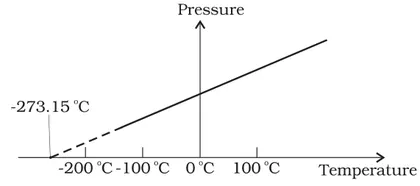
- Constant-volume gas thermometer: at constant volume, gas pressure p ∝ absolute temperature T (Kelvin). Very accurate and used as a laboratory standard. Relation: T = T0 (p/p0) at constant V.
- Thermocouple: two different metals joined produce a thermoelectric emf proportional to temperature difference (Seebeck effect). Robust, wide range, used in furnaces and engines. E ≈ S ΔT for small ranges (S: Seebeck coefficient).
- Resistance thermometer (RTD): electrical resistance of a metal (usually platinum) increases approximately linearly with temperature. R = R0[1 + α (T − T0)]. Precise and stable for industrial calibration.
- Thermistor: semiconductor whose resistance falls rapidly with temperature. High sensitivity over limited range; used in digital thermometers and sensors.
- Bimetallic strip: two metals with different expansion coefficients bend with temperature; used in thermostats and mechanical thermometers.
- Infrared (pyrometer): measures thermal radiation emitted by a body; useful for non-contact measurement (e.g., moving objects, human forehead thermometers).
Calibration and linearity: A thermometer must be calibrated by relating its property X to known fixed-point temperatures (e.g., ice and steam points). If X varies linearly with temperature, one calibration straight line suffices; otherwise a calibration curve or table is needed.
Errors and limits:
- Systematic errors: poor calibration, non-linearity, self-heating (electrical sensors), heat losses.
- Random errors: fluctuations, sensor noise. Response time and thermal contact affect readings.
Practical notes: For clinical use, digital thermometers (thermistor or RTD based) are common because of safety and speed. Industrial processes often use thermocouples or RTDs depending on required range and accuracy.
- Clinical digital thermometer: uses a thermistor or semiconductor sensor for fast, accurate body-temperature measurement (non-mercury and safe).
- Lab mercury-in-glass thermometer (historical): glass capillary with mercury column; length of column proportional to temperature over a limited range.
- Constant-volume gas thermometer: laboratory standard—measures pressure at fixed volume and uses p ∝ T (Kelvin) to find temperature precisely.
- Thermocouple in an oven or furnace: junction of two dissimilar metals produces an emf proportional to temperature difference; suitable for very high temperatures.
- RTD (platinum) for industrial process control: R = R0[1 + α(T − T0)] gives accurate, repeatable readings over a moderate temperature range.
- Infrared pyrometer for non-contact measurement: measures emitted radiation to estimate surface temperature (used in food, metallurgy, medical screening).
- Celsius ↔ Kelvin: T(K) = t(°C) + 273.15
- Celsius ↔ Fahrenheit: t(°F) = (9/5) t(°C) + 32 ; t(°C) = (5/9)[t(°F) − 32]
- Ideal gas (constant volume) thermometer: p ∝ T (in K) → T = T0 (p/p0) at constant V
- Ideal gas general: pV = nRT → T = pV / (nR)
- Resistance thermometer (approx.): R = R0[1 + α (T − T0)] where α is temperature coefficient of resistance
- Thermistor (approx., empirical): R = R0 e^(B/T) (B is material constant; T in Kelvin)
Thermal Expansion of Solids
Definition: Thermal expansion of solids is the increase in linear dimensions, area or volume of a solid when its temperature is raised. It occurs because atomic vibrations increase with temperature and, owing to the anharmonicity of interatomic potential, the average separation between atoms increases.
Linear expansion: For a rod of initial length L0, when its temperature changes by ΔT, the change in length ΔL is given (for small ΔT) by
ΔL = α L0 ΔT
Here α is the coefficient of linear expansion (units: K-1). Physically α = (1/L)(dL/dT) (for infinitesimal changes).
Area and volume expansion (isotropic solids): If the linear coefficient is α, then for small temperature change ΔT
- Change in area: ΔA = 2 α A0 ΔT
- Change in volume: ΔV = 3 α V0 ΔT
So the coefficient of volume expansion β (sometimes written γ) is β = 3 α for isotropic solids.
Exact (integral) form: If α varies with temperature, dL/dT = α(T) L, so
L(T) = L0 exp(∫T0T α(T') dT')
For approximately constant &alpha:, L(T) ≈ L0(1 + αΔT).
Thermal stress (constrained expansion): If a body that tends to expand is prevented from doing so, it develops thermal stress. For a rod rigidly clamped at both ends, the induced stress is approximately
σ = Y α ΔT
where Y is Young's modulus. The corresponding thermal strain = αΔT.
Physical origin: The interatomic potential is not symmetric; with increasing thermal vibrations the average atomic separation increases, giving macroscopic expansion. Some materials have very small or even negative α over certain temperature ranges (e.g., Invar alloy has very low α).
Important remarks: For large ΔT higher order terms may be relevant. Coefficients differ for different materials and depend weakly on temperature. Expansion is anisotropic in crystals with low symmetry.
- Railway tracks: small gaps left between rails to allow for thermal expansion; without gaps rails can buckle ('sun kinks').
- Bimetallic strip in thermostats: two metals with different α bend on heating and operate switches.
- Bridges and highways: expansion joints provided to accommodate expansion and prevent structural damage.
- Fitting metal lids on glass jars: heating the metal lid expands it and makes it easier to remove.
- Precision instruments and engineering: temperature control needed because dimensional changes affect accuracy.
- Invar use in clocks and precision mounts: very low α minimizes dimensional changes with temperature.
- ΔL = α L<sub>0</sub> ΔT
- α = (1/L) (dL/dT)
- L(T) = L<sub>0</sub> exp(∫<sub>T0</sub><sup>T</sup> α(T') dT') (exact)
- For constant &alpha:: L(T) ≈ L<sub>0</sub>(1 + αΔT)
- ΔA = 2 α A<sub>0</sub> ΔT
- ΔV = 3 α V<sub>0</sub> ΔT
Area and Volume Expansion
Overview
When the temperature of a solid is raised, its dimensions increase. For isotropic (same in all directions) solids the change in length, area and volume are related by coefficients of linear, area and volume expansion. These describe how a physical quantity changes per unit original quantity per unit temperature rise.
Linear expansion (recap)
If a rod of initial length L0 is heated by ΔT, its length becomes L = L0(1 + αΔT). Here α is the coefficient of linear expansion (units K−1 or °C−1).
Area expansion — derivation
Consider a square plate with side L0 and area A0 = L0². After heating by ΔT each side becomes L = L0(1 + αΔT). New area:
A = L² = L0²(1 + αΔT)² = A0[1 + 2αΔT + (αΔT)²].
For typical materials αΔT ≪ 1, so the (αΔT)² term is negligible and we get the approximate relation
ΔA = A − A0 ≈ 2α A0 ΔT.
Thus the coefficient of area expansion ≈ 2α. Exactly, A = A0(1 + αΔT)² so the fractional change is (1 + αΔT)² − 1.
Volume expansion — derivation
For a cube of edge L0 and volume V0 = L0³, after heating:
V = L³ = L0³(1 + αΔT)³ = V0[1 + 3αΔT + 3(αΔT)² + (αΔT)³].
Neglecting higher-order small terms,
ΔV ≈ 3α V0 ΔT.
So the coefficient of volume expansion β ≈ 3α. Exactly, fractional change is (1 + αΔT)³ − 1.
Notes and special points
- Units: α, β are in K−1 (or °C−1); β ≈ 3α for isotropic solids.
- For anisotropic materials (different expansion along axes) area/volume changes add the relevant linear coefficients; e.g., for a rectangle with αx, αy, ΔA/A ≈ (αx + αy)ΔT.
- For large ΔT or materials with large α one should use exact expressions: A = A0(1 + αΔT)², V = V0(1 + αΔT)³.
- If thermal expansion is prevented (constrained), it produces thermal stress. For a rod fully constrained in length, induced stress σ ≈ EαΔT (E = Young's modulus).
Typical magnitudes
For metals α is typically of order 10−5 K−1; for glass it is much smaller, and for polymers it can be larger and more temperature-dependent.
- Railway tracks: rails have small gaps at joints to allow expansion. If gaps are too small, rails can buckle in hot weather.
- Expansion joints in bridges and buildings: allow decks and structures to expand/contract without damage.
- Bimetallic strip in thermostats: two metals with different α bend on heating due to unequal expansions, driving a switch.
- Jar lids: heating the metal lid (or immersing in hot water) expands it more than the glass jar, loosening the lid.
- Mercury/Alcohol thermometer: liquid volume expansion inside a capillary tube produces a measurable rise in height.
- Concrete pavements: control joints are cut to accommodate area/volume expansion and prevent cracking.
- Linear: ΔL = α L₀ ΔT
- Area (approx): ΔA ≈ 2α A₀ ΔT
- Area (exact): A = A₀(1 + α ΔT)² → ΔA/A₀ = (1 + αΔT)² − 1
- Volume (approx): ΔV ≈ 3α V₀ ΔT
- Volume (exact): V = V₀(1 + α ΔT)³ → ΔV/V₀ = (1 + αΔT)³ − 1
- Relation: β ≈ 3α (β = coefficient of volume expansion)
Relation between Expansion Coefficients
Definition: Thermal expansion coefficients measure fractional change of dimensions per unit temperature rise.
Linear expansion coefficient (α): α = (1/L)(dL/dT) ≈ ΔL/(L ΔT). It gives fractional change in length.
Area expansion coefficient (β): β = (1/A)(dA/dT) ≈ ΔA/(A ΔT). It gives fractional change in area.
Volume expansion coefficient (γ): γ = (1/V)(dV/dT) ≈ ΔV/(V ΔT). It gives fractional change in volume.
Derivation and relations (isotropic solid):
Consider a cuboid with initial sides l, w, h. After temperature rise ΔT each side becomes l(1+αΔT), w(1+αΔT), h(1+αΔT) (assuming same α in all directions).
New area of one face (l×w): A' = l w (1+αΔT)^2 = A[1 + 2αΔT + (αΔT)^2]. Therefore
β = (ΔA)/(A ΔT) = [A' - A]/(A ΔT) = 2α + α^2 ΔT. For small ΔT (neglect α^2ΔT) we get β ≈ 2α.
New volume: V' = l w h (1+αΔT)^3 = V[1 + 3αΔT + 3(αΔT)^2 + (αΔT)^3]. Hence
γ = (ΔV)/(V ΔT) = 3α + 3α^2 ΔT + α^3 ΔT^2. For small ΔT we get γ ≈ 3α.
General (possibly anisotropic) case: If linear coefficients along three orthogonal directions are αx, αy, αz, then
β = αx + αy (for area in the xy-plane),
γ = αx + αy + αz (for volume). For isotropic materials αx = αy = αz = α, so β = 2α and γ = 3α.
Approximate relations used commonly:
ΔL ≈ α L ΔT,
ΔA ≈ β A ΔT ≈ 2α A ΔT,
ΔV ≈ γ V ΔT ≈ 3α V ΔT.
Notes: The approximations β ≈ 2α and γ ≈ 3α are valid when αΔT << 1. For large temperature changes or materials with large α, keep higher-order terms or use exact expressions above. Liquids and glasses are usually treated isotropically for volume expansion, but solids can be anisotropic (different α along different crystal axes).
- Railway tracks: gaps are left to allow for linear expansion (ΔL = αLΔT) so tracks do not buckle in summer.
- Bimetallic strips in thermostats: two metals with different α bend on heating because their linear expansions differ.
- Stuck jar lids: metal lids expand more than glass jars (different α), making lids easier to open after hot water is poured.
- Mercury thermometer: volume expansion of mercury (γ_mercury) combined with glass expansion determines the apparent rise of mercury in the capillary.
- Overhead power lines sag in summer: wires lengthen (linear expansion) and hang lower between supports.
- Concrete bridges and pavements: expansion joints accommodate thermal expansion (area and linear effects).
- α = (1/L)(dL/dT) ≈ ΔL/(L ΔT)
- β = (1/A)(dA/dT) ≈ ΔA/(A ΔT)
- γ = (1/V)(dV/dT) ≈ ΔV/(V ΔT)
- For isotropic solids: β ≈ 2α, γ ≈ 3α
- Exact (from finite change): β = [ (1+αΔT)^2 - 1 ] / ΔT = 2α + α^2 ΔT
- Exact (from finite change): γ = [ (1+αΔT)^3 - 1 ] / ΔT = 3α + 3α^2 ΔT + α^3 ΔT^2
Anomalous Expansion of Water
Definition: The anomalous expansion of water is the unusual behaviour that water contracts on heating between 0 °C and 4 °C (i.e., its volume decreases and density increases with temperature in that range). Water attains its maximum density at 4 °C. Above 4 °C it behaves normally and expands on heating; below 0 °C it becomes ice with a much larger, open structure.
Molecular explanation: Water molecules form hydrogen bonds that favour an open tetrahedral arrangement (as in ice). Near 0 °C many molecules are arranged in this open structure, giving a relatively large volume. As the temperature rises to 4 °C, some of these open structures collapse and molecules pack more closely, so volume decreases and density increases. Above 4 °C, thermal motion dominates and the usual thermal expansion (increase of volume with temperature) takes over.
Key consequences:
- Ice is less dense than liquid water and floats — lakes and rivers freeze from the top downward, insulating aquatic life below.
- Seasonal convection in lakes: water at 4 °C sinks, helping mixing and oxygenation.
- Practical effects on engineering (pipes, reservoirs) and on biological habitats in cold climates.
When linear expansion formulas fail: The simple linear expansion relation (ΔV = V0 β ΔT) still applies as a definition, but here the volume expansion coefficient β becomes negative between 0 and 4 °C. Thus one must use measured β(T) or density data rather than assume a constant positive β.
Experimental observation: The anomalous behaviour is commonly demonstrated using a dilatometer (a flask with a narrow capillary). By cooling/heating water and recording the liquid level in the capillary versus temperature, one observes the level fall as temperature increases from 0 to 4 °C (volume decreases) and then rise for T > 4 °C.
- Ice floats on water because the open crystal structure of ice makes it less dense than liquid water; this is why lakes freeze from the top and fishes survive beneath the ice layer.
- In winter, surface water cooling to 4 °C sinks and helps mix the lake. Further cooling below 4 °C makes surface water lighter and it stays on top, leading to ice formation at the surface.
- Pipes and containers may still burst from freezing because water expands when it becomes ice (volume of ice > volume of liquid water at just-above-freezing temperatures).
- Design of thermal systems and cold-storage tanks accounts for the negative volume expansion between 0 and 4 °C when accurate volume/density control is needed.
- Coefficient of volume expansion: β(T) = (1/V)(dV/dT). For water, β < 0 for 0 °C < T < 4 °C and β > 0 for T > 4 °C.
- Approximate volume change (for small ΔT where β can be taken as average): ΔV ≈ V0 · β · ΔT. (Note: use measured β(T) near the anomalous region.)
- Relation between density and volume: ρ = m/V ⇒ (1/ρ)(dρ/dT) = −β. Thus density increases when β is negative.
- Linear thermal expansion (solids): ΔL = α L ΔT and for isotropic solids β ≈ 3α. This relation is not generally used for liquids but is shown for comparison.
Applications of Thermal Expansion
Thermal expansion is the change in size (length, area or volume) of materials when their temperature changes. The phenomenon is quantified by coefficients of linear (α), area and volume expansion (β, γ). Practical applications either use expansion intentionally (to produce motion or fit parts) or must allow for it (to prevent damage). Key ideas:
- Controlled use: Devices that convert temperature change into mechanical motion (e.g., bimetallic strips in thermostats) exploit different expansions of two metals.
- Allowing for expansion: Large structures such as railway tracks and bridges include gaps or expansion joints to avoid buckling or fracture when parts expand.
- Thermal fitting (shrink/heat fit): Components are intentionally heated/cooled so their size changes to create tight assemblies (e.g., fitting a metal ring onto a shaft).
- Measurement: Liquid-in-glass thermometers use the volume expansion of liquids (mercury/alcohol) to measure temperature changes.
- Stress due to restraint: When thermal expansion is prevented, large stresses develop (thermal stress), which must be accounted for in design.
Each application is based on the basic expansion formulas (linear, area, volume) and on the behavior of materials when they are free to expand or are constrained. Designers either provide freedom (gaps, joints, flexible hangers) or use the expansion to perform useful work (thermostats, shrink fits).
- Bimetallic strip in thermostats and electric irons — two metals with different α bonded together bend on heating and operate switches.
- Liquid-in-glass thermometers (mercury or alcohol) — volume expansion of liquid rises in a capillary to indicate temperature.
- Railway tracks — expansion gaps are left between rails to prevent buckling; fishplates and rail gaps account for ΔL = αLΔT.
- Bridges and buildings — expansion joints and supports allow for thermal movements; bearings and sliders accommodate displacement.
- Overhead power lines — wires sag more at higher temperatures; tension and hangers are designed for worst-case expansion.
- Shrink/heat fitting — heating a metal ring to expand it, fitting onto a shaft, and letting it cool to make a tight interference fit.
- Linear expansion: ΔL = α L₀ ΔT, so L(T) = L₀(1 + α ΔT).
- Area expansion (approx): ΔA ≈ 2α A₀ ΔT (β ≈ 2α).
- Volume expansion: ΔV = γ V₀ ΔT (for isotropic solids/liquids γ ≈ 3α).
- Thermal strain: ε_th = ΔL / L₀ = α ΔT.
- Thermal stress (if expansion is fully prevented): σ = E α ΔT, where E is Young's modulus.
- Resulting force when restrained: F = σ A = E α ΔT · A (A is cross-sectional area).
Heat Capacity and Specific Heat
Definitions: Heat capacity (C) of a body is the amount of heat required to raise its temperature by 1 K (or 1 °C). It is an extensive property. Specific heat (specific heat capacity, c) is the heat required to raise the temperature of unit mass of a substance by 1 K (or 1 °C). It is an intensive property.
Symbols and SI units: C (J K-1), c (J kg-1 K-1), temperature change ΔT in K (or °C).
Basic relations: If a heat Q is supplied and the body temperature changes by ΔT, then for small temperature changes (or assuming c constant over the range):
Q = C ΔT = mc ΔT
So C = mc and c = C/m. More generally, when C depends on T, Q = ∫ C(T) dT.
Molar heat capacity: Heat capacity per mole, C_m = C/n (n = number of moles). For a substance with molar mass M, C_m = M c. SI unit: J mol-1 K-1.
Gases (important relations): For ideal gases one distinguishes heat capacity at constant volume (C_V or c_v per unit mass) and at constant pressure (C_P or c_p per unit mass). Per mole: C_p - C_v = R (universal gas constant). Per unit mass: c_p - c_v = R_specific = R/M.
Experimental measurement (method of mixtures / calorimetry): Using a calorimeter (with heat capacity C_cal), when a hot body (mass m_h, heat capacity c_h) at temperature T_h is put into cold water (mass m_w, specific heat c_w) at T_w, final equilibrium temperature T_f satisfies:
m_h c_h (T_h - T_f) = m_w c_w (T_f - T_w) + C_cal (T_f - T_w)
One can rearrange this to determine an unknown c_h or the calorimeter's heat capacity. The water-equivalent of a calorimeter is W = C_cal / c_water.
Conceptual notes: - Heat capacity is extensive (depends on amount of substance); specific and molar heat capacities are intensive. - For most solids and liquids mechanical work during heating is negligible so Cp ≈ Cv; for gases the difference is significant. - Some substances have temperature-dependent specific heats; for many solids at room temperature c is roughly constant (Dulong–Petit law: molar heat capacity of many solid metals ≈ 3R ≈ 25 J mol-1 K-1).
Physical meaning: A large specific heat means the substance requires more heat to change its temperature (has higher thermal inertia). This explains why water warms/cools slowly compared to metals or sand.
- Heating 1 kg of water requires much more heat than heating 1 kg of iron for the same temperature rise (water: c ≈ 4186 J kg^-1 K^-1, iron: c ≈ 450 J kg^-1 K^-1).
- Coastal climate moderation: large heat capacity of oceans keeps coastal regions’ temperature variations smaller than inland areas.
- Cooking pans: metal with low c heats quickly but also transfers heat quickly; pots with thick bottoms (higher heat capacity) give more even cooking.
- Wooden vs metal spoon in hot tea: wooden spoon (low thermal conductivity and moderate c) stays cooler to touch than metal spoon.
- Thermal mass in buildings: materials with high specific heat (concrete, water barrels) store heat during day and release it at night, reducing temperature swings.
- Heat capacity: C = dQ/dT (J K^-1)
- Relation for finite change (constant c): Q = C ΔT = m c ΔT
- Specific heat: c = C / m (J kg^-1 K^-1)
- Molar heat capacity: C_m = C / n = M c (J mol^-1 K^-1), where M is molar mass
- For ideal gases (per mole): C_p - C_v = R (≈ 8.314 J mol^-1 K^-1)
- Method of mixtures / calorimetry: m_h c_h (T_h - T_f) = m_w c_w (T_f - T_w) + C_cal (T_f - T_w)
Calorimetry
Definition: Calorimetry is the experimental study of heat transfer between bodies and the measurement of heat changes accompanying physical and chemical processes. A calorimeter is the device used to measure heat exchanged.
Basic ideas: Heat (Q) is energy transferred due to temperature difference. Temperature (T) is a measure of the average kinetic energy of particles. In calorimetry we use the principle of conservation of energy: heat lost by hot parts = heat gained by cold parts (if no heat is lost to surroundings).
Key quantities:
- Specific heat capacity (c): amount of heat required to raise 1 kg of a substance by 1 K (SI unit: J kg⁻¹ K⁻¹). For water c ≈ 4186 J kg⁻¹ K⁻¹ (≈ 4.18 J g⁻¹ K⁻¹).
- Latent heat (L): heat absorbed or released during a phase change at constant temperature (J kg⁻¹). Examples: latent heat of fusion (melting) Lf, latent heat of vaporization (boiling) Lv.
- Heat capacity (C): heat required to raise temperature of an object by 1 K (C = mc for a homogeneous body).
Principle of calorimetry (method of mixtures): If a hot object (mass m1, specific heat c1, initial temperature T1) is placed in a colder fluid (mass m2, specific heat c2, initial temperature T2) inside a calorimeter (heat capacity Ccal), the final equilibrium temperature Tf satisfies energy balance:
heat lost = heat gained, i.e.
m1 c1 (T1 − Tf) = m2 c2 (Tf − T2) + Ccal (Tf − Tcal)
Often Ccal is combined with the water term as an effective water equivalent. In ideal (no loss) cases ΣQ = 0. For phase changes include latent heat terms: Q = mL for melting/boiling.
Experimental notes & assumptions: Assume thermal equilibrium is reached, negligible heat exchange with surroundings (or correct for it), include heat capacity of thermometer/calorimeter if significant, and use consistent units (K or °C increments are equivalent for ΔT).
- Determining specific heat of a metal: A heated metal block is dropped into water in a calorimeter; measure final temperature to compute c_metal using energy balance.
- Measuring latent heat of fusion of ice: Melting a known mass of ice in warm water and using temperature change to find Lf (accounting for warming melted ice from 0°C to final temperature).
- Bomb calorimeter for calorific value of fuel: Fuel is burned in a sealed bomb; the heat raises the water temperature and the calorimeter reading gives energy per mass of fuel.
- Everyday: A hot cup of coffee cools as heat is transferred to surrounding air and to the mug (calorimetry idea explains why lids reduce cooling).
- Metallurgy: Measuring heat released/absorbed in phase transformations during alloy processing uses calorimetric principles.
- Heat for temperature change: Q = m c ΔT
- Heat for phase change (latent heat): Q = m L
- Energy conservation (no external loss): ΣQ = 0 (heat lost = heat gained)
- Two-body mixing (no calorimeter): m1 c1 (T1 − Tf) = m2 c2 (Tf − T2)
- Including calorimeter heat capacity Ccal: m_hot c_hot (T_hot − Tf) = m_water c_water (Tf − T_water) + Ccal (Tf − T_calorimeter)
- Finding specific heat of metal from experiment: c_m = [(m_w c_w + Ccal)(Tf − T_w)] / [m_m (T_m − Tf)]
Latent Heat
Definition: Latent heat is the amount of heat energy absorbed or released by a substance during a phase change (solid↔liquid or liquid↔gas) at constant temperature and pressure, without any change in temperature of the substance.
When heat is supplied during a phase change, it changes the internal energy (mainly the potential energy associated with intermolecular forces) rather than the kinetic energy of molecules, so the measured temperature remains constant while the phase change proceeds.
Types:
- Latent heat of fusion (L_f): heat required per unit mass to change a solid into a liquid at its melting point (or released when liquid freezes).
- Latent heat of vaporization (L_v): heat required per unit mass to change a liquid into a gas at its boiling point (or released when gas condenses).
- Latent heat of sublimation (L_s): heat required per unit mass to change a solid directly into a gas (L_s = L_f + L_v for a substance undergoing solid→liquid→gas).
Physical explanation: During melting or boiling the energy supplied is used to overcome intermolecular attractions and increase the potential energy of the system. Since average molecular kinetic energy (and thus temperature) does not change during the phase transition, the temperature remains constant until the entire sample has changed phase.
Dependence: Latent heat values depend on the substance and on pressure (especially for boiling). For most substances L_v > L_f because converting liquid to gas requires breaking more intermolecular bonds than solid→liquid.
- Melting of ice at 0°C: ice absorbs latent heat of fusion to become water while temperature remains 0°C.
- Boiling of water at 100°C: water absorbs latent heat of vaporization to become steam; temperature stays at 100°C (at 1 atm).
- Steam burns: steam at 100°C carries large latent heat of vaporization; when it condenses on skin it releases that energy, causing severe burns.
- Sweating and cooling: evaporation of sweat from skin consumes latent heat of vaporization, cooling the body.
- Dry ice (solid CO2) sublimation: dry ice turns directly to gas, absorbing latent heat of sublimation and producing cooling.
- Q = m L (heat required for mass m to undergo a phase change), where L is specific latent heat (unit: J/kg)
- L = Q / m (specific latent heat equals heat per unit mass)
- Units: L in J/kg (often expressed in kJ/kg). Example: for water L_f ≈ 3.34×10^5 J/kg, L_v ≈ 2.26×10^6 J/kg at 1 atm
- For a fraction f of mass changing phase: Q = m f L (useful for partial melting/boiling)
- Molar latent heat (when given per mole): Q = n L_m (L_m in J/mol); relation L_m = M × L_specific where M is molar mass
- Latent heat of sublimation: L_s = L_f + L_v (for a two-step path solid→liquid→gas)
Internal Energy (Qualitative)
What is internal energy?
Internal energy (U) of a system is the total microscopic energy contained in it — the sum of kinetic energies of all molecules/atoms (translational, rotational, vibrational) and the potential energies arising from intermolecular forces and chemical bonds. It is a property of the state of the system and is extensive (depends on amount of substance).
Microscopic picture (qualitative)
• Kinetic part: motion of particles. Faster motion (higher average speed) → larger kinetic energy → higher internal energy.
• Potential part: interactions between particles. When particles move apart (e.g. melting/evaporation) the potential energy typically increases even if temperature does not change.
Dependence on temperature and state
• For an ideal gas, internal energy depends only on temperature (not on volume or pressure). Increasing T increases particle kinetic energy and hence U.
• For liquids and solids, U depends on temperature and also on molecular arrangement; during phase changes temperature can stay constant while U changes (energy goes into changing potential energy — latent heat).
Changes in internal energy
You cannot measure the absolute value of U directly; only changes ΔU are meaningful. According to the first law of thermodynamics (qualitatively), the change in internal energy equals energy added as heat minus work done by the system. Heat input can increase kinetic energy (raise temperature) or increase potential energy (cause phase change).
Key qualitative examples:
• Heating a gas in a closed container: particles move faster → U increases.
• Melting ice at 0°C: temperature stays ~constant while energy increases the potential energy (separating molecules) → U increases.
• Compressing a gas rapidly (adiabatically): work done on gas increases kinetic energy → temperature and U increase.
Important conceptual points
• Internal energy is a state function: ΔU depends only on initial and final states, not the path.
• For an ideal gas, isothermal processes (constant T) imply ΔU ≈ 0.
• The choice of zero of internal energy is arbitrary; only changes are physically measurable.
- Heating air in a piston: When heat is supplied, the air’s molecules move faster so internal energy increases; if the piston is allowed to expand, part of the heat becomes work and ΔU is the remainder.
- Melting ice at 0°C: Despite constant temperature, energy supplied increases intermolecular potential energy—internal energy increases (latent heat of fusion).
- Boiling water at 100°C: Energy input goes into breaking intermolecular attractions (increase in potential energy) so U increases while temperature stays constant during the phase change.
- Rapid compression of a bicycle pump: Work done on the trapped air raises its temperature — internal energy increases (felt as warming of the pump).
- Evaporation cooling (sweating): Liquid molecules with higher kinetic energy escape; the remaining liquid has lower average kinetic energy → internal energy of the liquid decreases and it cools.
- Heating a metal rod: Increase in vibrational motion of atoms (kinetic) and slight change in bond stretch (potential) increase the rod’s internal energy.
- Total internal energy (microscopic form): U = Σ (kinetic energy of particles) + Σ (potential energy of interactions)
- First law (change in internal energy): ΔU = Q − W (Q = heat added to system, W = work done by system)
- Ideal gas (n moles, constant composition): U = n C_v T (for ideal gas internal energy depends only on temperature)
- Monatomic ideal gas (per mole): U = (3/2) n R T (or per mole U_m = (3/2) R T)
- General degrees of freedom (qualitative): U ∝ (f/2) n R T, where f is degrees of freedom (translational, rotational, vibrational — vibrational contributes at higher T)
Heat Transfer — Conduction
What is conduction? Conduction is the mode of heat transfer within a body or between bodies in direct physical contact, due to temperature differences. Heat flows from the hotter region to the colder region by microscopic collisions and energy exchange between particles (in solids mainly by lattice vibrations—phonons—and, in metals, also by free electrons).
Macroscopic description (Fourier's law). In one dimension, the rate of heat transfer (heat current) through an area A with a temperature gradient dT/dx is given by Fourier's law: q_x = dQ/dt = -k A (dT/dx). The negative sign indicates heat flows from high to low temperature. The constant k is the thermal conductivity of the material (units: W·m⁻¹·K⁻¹).
Steady vs transient conduction. In steady-state conduction the temperature at each point does not change with time; the temperature profile is time-independent and the heat current is constant. In transient (non‑steady) conduction the temperature changes with time and is described by the heat diffusion equation: ∂T/∂t = α ∇²T, where α = k/(ρ c) is thermal diffusivity, ρ is density and c is specific heat.
Common geometries and useful results. For a plane slab of thickness L with faces at temperatures T1 and T2 (steady state, uniform k): Q/t = k A (T1 - T2)/L. For composite media (layers in series) thermal resistances add: R_total = Σ(L_i/(k_i A)). For cylindrical and spherical shells there are analogous forms (see formulas list).
Important points. Heat conduction is most effective in metals (high k) because free electrons carry energy. Insulators (like wood, air, vacuum) have low k. Thermal contact resistance at interfaces can reduce heat flow. The idea of thermal resistance and conductance (G = kA/L) is useful for solving practical problems.
- A metal spoon becoming hot when left in a bowl of hot soup (heat conducted from soup through the spoon to the handle).
- Cooking: heat conducted through a pan bottom from the flame to the food; different materials (copper, aluminum, steel) give different heating rates due to different k.
- Thermos flask: vacuum (and low‑k materials) reduce conduction to keep beverages hot or cold.
- Insulation in buildings: walls with low‑k materials reduce heat loss in winter and heat gain in summer.
- Heat sink on electronics: conduction from chip to sink fins, then convection from fins to air.
- Thermal bridge in composite walls: temperature profile has slope changes at interfaces between materials with different thermal conductivities.
- Fourier's law (one dimension): dQ/dt = -k A (dT/dx)
- Steady heat flow through a plane slab: Q/t = k A (T1 - T2) / L
- Thermal resistance of a slab: R = L / (k A); Q/t = (T1 - T2) / R
- Composite layers in series: R_total = Σ (L_i / (k_i A)), Q/t = (T_hot - T_cold) / R_total
- Cylindrical shell (length L, inner radius r1, outer r2): Q/t = 2π k L (T1 - T2) / ln(r2/r1)
- Spherical shell (inner r1, outer r2): Q/t = 4π k (T1 - T2) / (1/r1 - 1/r2)
Heat Transfer — Convection
What is convection? Convection is the mode of heat transfer that occurs in fluids (liquids and gases) due to bulk motion of the fluid. Heat is carried from one place to another by the movement of warmer and cooler portions of the fluid.
How it works (mechanism): When a part of a fluid is heated, its temperature increases, its density usually decreases and it becomes buoyant. The warmer (lighter) fluid rises while the cooler (denser) fluid moves down to replace it. This continuous motion sets up convection currents that transfer heat. In forced convection, an external agent (fan, pump) causes the fluid motion; in natural (free) convection, fluid motion is caused by buoyancy differences due to temperature gradients.
Boundary layer and heat exchange: Near a solid surface, a thin layer of fluid (the boundary layer) develops where velocity and temperature change from the surface values to the free-stream values. The thickness and properties of this layer strongly influence the rate of convective heat transfer.
Comparison with other modes: Unlike conduction (heat transfer through direct molecular contact without bulk motion) and radiation (energy transfer by electromagnetic waves), convection requires a moving fluid and combines bulk transport with conduction inside the fluid.
- Boiling water: hot water at the bottom rises and cooler water descends, creating visible convection currents.
- Room heating by a radiator: warm air from the radiator rises, cool air moves down to be heated (natural convection).
- Using a fan or pump to speed cooling of an electronic component (forced convection).
- Sea breeze and land breeze: differential heating of land and sea creates convective air currents.
- Convection oven: hot air is circulated by a fan to cook food more uniformly (forced convection).
- Mantle convection in Earth: slow convection in the mantle drives plate tectonics (geophysical example).
- Newton's law of cooling (rate of heat transfer by convection): Q̇ = h A (Ts − T∞), where Q̇ is heat transfer rate (W), h is convective heat transfer coefficient (W·m⁻²·K⁻¹), A is surface area (m²), Ts is surface temperature (K or °C), and T∞ is fluid temperature away from the surface.
- Cooling (exponential) for lumped system (when Biot number Bi = hLc/k ≪ 1): (Ts(t) − T∞) = (Ts(0) − T∞) e^(−(hA/(ρVc_p)) t), where ρ is density, V volume, c_p specific heat, and Lc characteristic length.
- Reynolds number (flow regime): Re = ρ v L / μ (dimensionless), indicates laminar or turbulent flow.
- Prandtl number (fluid property): Pr = c_p μ / k (dimensionless), ratio of momentum to thermal diffusivity.
- Nusselt number (measure of convective heat transfer): Nu = h L / k (dimensionless), relates convective to conductive heat transfer across a length L.
- Correlation for laminar flow over a flat plate (local Nusselt): Nu_x = 0.332 Re_x^(1/2) Pr^(1/3) (valid for laminar boundary layer).
Heat Transfer — Radiation
What is thermal radiation?
Thermal radiation is the transfer of heat in the form of electromagnetic waves (mainly infrared) emitted by all bodies because of the thermal motion of their charged particles. Radiation does not require any material medium and can occur through vacuum (for example, Sun to Earth).
Key characteristics
- No medium required — can travel through vacuum.
- All bodies emit and absorb radiation; the amount and spectral distribution depend on temperature and surface properties.
- Directionality, wavelength distribution and intensity depend on temperature; hotter bodies emit shorter-wavelength, higher-intensity radiation.
Black body and grey/real bodies
A black body is an idealized object that absorbs all incident radiation (absorptivity α = 1) and emits the maximum possible radiation for a given temperature. Real bodies are grey bodies with emissivity 0 < ε < 1 (ε = 1 for a perfect black body).
Emissivity and absorptivity
Emissivity (ε) is the ratio of radiation emitted by a body to that emitted by a black body at the same temperature. Absorptivity (α) is the fraction of incident radiation absorbed. For an object in thermal equilibrium and for each wavelength, Kirchhoff's law states ε(λ,T) = α(λ,T). For opaque surfaces (no transmission), α + ρ = 1 where ρ is reflectivity.
Stefan–Boltzmann law
The total power per unit area emitted by a black body is proportional to the fourth power of its absolute temperature:
P/A = σ T^4
For a real surface with emissivity ε, the emitted power per unit area is εσT^4.
Net radiative exchange with surroundings
If an object of area A and emissivity ε at temperature T is inside a large surrounding at temperature T_s, the net radiative power lost (or gained) by the object is approximately:
P_net = ε σ A (T^4 - T_s^4)
Spectral distribution (qualitative)
A black body emits radiation over a continuous spectrum. As T increases, the peak wavelength shifts to shorter values (objects glow from red to white). Wien's displacement law gives the peak wavelength.
Practical points
- Shiny surfaces (low emissivity) radiate and absorb less than dark/matte surfaces (high emissivity) — e.g., a shiny kettle cools slower by radiation than a black-painted one.
- Radiation is dominant when conduction and convection are small (vacuum, large temperature differences, high temperatures).
- Greenhouse effect: the atmosphere is more transparent to visible solar radiation than to outgoing terrestrial infrared, causing warming—an application of radiative transfer principles.
- Sun warming the Earth through vacuum: solar radiation transfers energy without a medium.
- A metal spoon in hot soup: the spoon’s handle may heat by conduction, but the glowing hot metal emits visible and infrared radiation (you see it glow at high temperature).
- Black-painted and shiny surfaces under the same lamp: the black surface becomes hotter because it absorbs and emits more (higher emissivity).
- Thermal imaging (infrared cameras): detectors sense emitted IR radiation and form temperature maps of objects.
- Radiative cooling at night: clear-sky objects lose heat by radiation to the cold upper atmosphere/space and can become colder than air temperature.
- Stefan–Boltzmann law (black body): P/A = σ T^4, where σ = 5.670374419×10^-8 W·m^-2·K^-4
- Real surface (emissivity ε): P_emit = ε σ A T^4
- Net radiative power between object and surroundings: P_net = ε σ A (T^4 - T_s^4)
- Kirchhoff's law (per wavelength): ε(λ,T) = α(λ,T) — emissivity equals absorptivity at thermal equilibrium
- Energy balance for opaque surface: α + ρ = 1 (α = absorptivity, ρ = reflectivity)
- Wien's displacement law (peak wavelength, advanced): λ_max T = b, where b ≈ 2.898×10^-3 m·K
Newton's Law of Cooling
Statement: Newton's law of cooling states that the rate of change of temperature of a body is proportional to the difference between its temperature and the temperature of the surrounding medium, provided the temperature difference is not too large and the body is approximately uniform in temperature.
Mathematical form: Let T(t) be the temperature of the object at time t and T_e be the ambient (surrounding) temperature. Define the temperature difference θ(t)=T(t)−T_e. Then
dT/dt = −k (T − T_e) or dθ/dt = −k θ,
where k (>0) is the cooling constant (s−1) that depends on the object and the environment.
Solution (derivation sketch): Solve dθ/dt = −k θ by separation of variables:
θ(t) = θ(0) e^{−k t} ⇒ T(t) = T_e + (T_0 − T_e) e^{−k t},
where T_0 is the initial temperature at t = 0. The temperature approaches T_e exponentially as t → ∞.
Relation to heat transfer properties: For the lumped-capacitance model (object of uniform temperature), k = hA/(m c), where h is the convective heat-transfer coefficient, A is surface area, m is mass, and c is specific heat. This model is valid when the Biot number Bi = h L_c / k_material << 1 (usually Bi < 0.1).
Important derived quantities: time constant τ = 1/k (time for θ to fall to 1/e of initial value). ‘‘Half-time’’ for the temperature difference t_{1/2} = (ln 2)/k (time for θ to reduce to half).
How to determine k from measurements: If temperatures T_1 and T_2 are recorded at times t_1 and t_2, then
k = (1/(t_2 − t_1)) ln[(T_1 − T_e)/(T_2 − T_e)].
Assumptions and limitations: constant ambient temperature, object nearly uniform in temperature (lumped model), linear dependence of heat flux on temperature difference (valid when convection dominates and ΔT is not too large). For large ΔT, radiative heat transfer (proportional to T^4) becomes significant and the simple law fails. Also k may vary with time if flow conditions or properties change.
Applications (brief): cooling of hot drinks, temperature decay of heated metal pieces, cooling of electronic components, and approximate forensic estimation of time of death (using body cooling).
- A cup of tea at 80°C placed in a room at 25°C cools. If the cooling constant k is 0.05 s−1, then T(t) = 25 + 55 e^{−0.05 t} (t in seconds).
- A heated metal block (mass m, specific heat c) with surface area A in air: k = h A/(m c). Changing the surface area or adding insulation changes k and hence the cooling rate.
- Forensic example: If a body fell from 37°C to 30°C in a room at 20°C and the cooling constant k is known, use T(t)=T_e+(T_0−T_e)e^{−k t} to estimate the time since death (assuming validity of the model).
- Electronics: A heated chip on a board cools towards ambient temperature; designers use the time constant τ = 1/k to estimate how quickly it returns to safe temperature after a thermal transient.
- Differential form: dT/dt = −k (T − T_e)
- \[Temperature vs time: T(t) = T_e + (T_0 − T_e) e^{−k t}\]
- \[Temperature difference decay: θ(t) = θ_0 e^{−k t}\]\[where θ = T − T_e\]
- Cooling constant in lumped model: k = h A/(m c)
- Time constant: τ = 1/k
- \[Half-time of temperature difference: t_{1/2} = (ln 2)/k\]
Problems and Numerical Techniques
Overview
In the chapter Thermal Properties of Matter, many questions require setting up and solving numerical problems that combine concepts: heat, temperature change, phase change, thermal expansion, and heat transfer. Solving these reliably needs both the right formulas and sound numerical techniques (unit consistency, approximations, error checking).
Typical problem types
- Calorimetry and mixing problems (use conservation of energy: heat lost = heat gained).
- Heating with phase change (include latent heat terms where temperature remains constant).
- Linear and volume expansion problems (find change in length/volume, combined expansions).
- Steady-state conduction (use Fourier's law, series/parallel thermal resistance).
- Cooling and heating dynamics (Newton's law of cooling, exponential approach to ambient temperature).
- Thermal stress in constrained objects (use elastic modulus and thermal strain).
Problem-solving strategy
- Read carefully and list knowns and unknowns with units.
- Decide physics principle (energy conservation, expansion relation, heat conduction, etc.).
- Write down corresponding formula(s) and substitute known values. For multi-stage problems (heating then melting then heating) write energy balance for each stage and sum Q.
- Pay attention to sign convention (heat gained positive, lost negative) and to whether temperatures are absolute (Kelvin) when needed (e.g., radiation) or relative (Celsius for ΔT).
- Solve algebraically, check units, estimate magnitude, and state answer with appropriate significant figures and units.
Numerical techniques and tips
- Unit consistency: convert masses to kg, lengths to m, temperatures to °C or K consistently (ΔT is same in °C and K).
- Significant figures: keep 3 significant figures during calculation and round final answer appropriately.
- Dimensional check: ensure both sides of equation have same dimensions.
- Approximation: use β ≈ 3α for volume expansion of isotropic solids; neglect small terms (e.g., product of two small expansions) when justified.
- Composite conduction: treat layers as thermal resistances in series: R = L/(kA); total heat flow = ΔT / sum(R).
- Linearize for small changes: when ΔT is small, use linear relations for expansion and ignore higher-order terms.
- Graphical and iterative methods: plot temperature vs time to find cooling constant or use least-squares for best-fit; for transcendental equations use simple iteration or numerical root-finding (Newton–Raphson) if needed.
- Error propagation: when result depends on measured quantities, estimate fractional uncertainties by combining relative errors (for multiplication/division) and absolute errors (for addition/subtraction).
Worked-logic templates
- Calorimetry: m1 c1 (Tfinal - T1) + m2 c2 (Tfinal - T2) + ... = 0 (include latent heat terms mL where phase change occurs).
- Expansion: ΔL = αL0ΔT, ΔV = βV0ΔT (β ≈ 3α for solids), effective expansion for composite objects found by combining contributions.
- Conduction steady-state: dQ/dt = kA(ΔT)/L. For layers: dQ/dt = ΔT / [L1/(k1A) + L2/(k2A) + ...].
Using these structured steps and numerical techniques will make solving Class 11 thermal problems systematic and reliable.
- Real-life: Rail tracks have expansion gaps because ΔL = αLΔT; without gaps, rails buckle on hot days.
- Real-life: Bimetallic strips in thermostats bend on heating because two metals have different α; used to switch circuits.
- Numerical problem 1 (calorimetry): 200 g of water at 20 °C is mixed with 100 g of water at 80 °C. Find final temperature (assume no heat loss, c_water = 4186 J·kg⁻¹·K⁻¹). Solution idea: m1c(Tf - T1) + m2c(Tf - T2) = 0 → Tf = (m1T1 + m2T2)/(m1 + m2) = (0.2×20 + 0.1×80)/0.3 = 40 °C.
- Numerical problem 2 (latent heat + heating): 0.5 kg of ice at 0 °C is added to 1.0 kg of water at 30 °C. Does all ice melt? Use L_f(ice) = 334000 J·kg⁻¹. Compute heat available from water: Q = mwater c ΔT = 1×4186×30 = 1.256×10^5 J. Heat to melt ice: 0.5×334000 = 1.67×10^5 J → not enough, so final state is mixture of ice+water at 0 °C.
- Numerical problem 3 (linear expansion): A 2.0 m steel rail (α = 1.2×10⁻⁵ K⁻¹) is heated by 40 K. Find ΔL = αLΔT = 1.2×10⁻⁵×2.0×40 = 9.6×10⁻³ m ≈ 9.6 mm.
- Numerical problem 4 (steady conduction): A wall of area 10 m² has two layers: 0.1 m of brick (k = 0.7 W·m⁻¹·K⁻¹) and 0.05 m of insulation (k = 0.04 W·m⁻¹·K⁻¹). Temperature difference across wall is 20 K. Heat flow rate = ΔT / [L1/(k1A)+L2/(k2A)]. Compute R_total = 0.1/(0.7×10) + 0.05/(0.04×10) = 0.0142857 + 0.125 = 0.1392857 K·W⁻¹. dQ/dt = 20 / 0.1392857 ≈ 143.6 W.
- Heat to change temperature: Q = mcΔT
- Heat for phase change: Q = mL (L = latent heat of fusion or vaporization)
- Linear expansion: ΔL = α L0 ΔT
- Volume expansion: ΔV = β V0 ΔT (β ≈ 3α for solids)
- Steady conduction (Fourier's law): dQ/dt = k A (ΔT)/L
- Thermal resistance of layer: R = L/(kA); series: R_total = Σ L_i/(k_i A)
Units, Dimensions and Important Constants
Overview
This topic gives the units and dimensional formulas of physical quantities used in thermal physics (temperature, heat, specific heat, thermal conductivity, coefficients of expansion, etc.) and lists important constants used in Class 11 thermal physics and kinetic theory.
Base SI units and fundamental dimensions
SI base units relevant here: metre (m) for length, kilogram (kg) for mass, second (s) for time, kelvin (K) for thermodynamic temperature, mole (mol) for amount of substance. Standard dimension symbols used below: M (mass), L (length), T (time), Θ (thermodynamic temperature), N (amount of substance, sometimes written as mol).
Common thermal quantities — definitions, SI units and dimensions
- Temperature (T): SI unit kelvin (K). Dimension: Θ.
- Heat (thermal energy) Q or ΔE: SI unit joule (J = kg·m²·s⁻²). Dimension: M L² T⁻².
- Heat capacity (C): amount of heat required to raise temperature by 1 K. Unit: J·K⁻¹. Dimension: M L² T⁻² Θ⁻¹.
- Specific heat capacity (c): heat per unit mass per K; unit: J·kg⁻¹·K⁻¹. Dimension: L² T⁻² Θ⁻¹.
- Latent heat (L, specific latent heat): energy per unit mass for phase change; unit: J·kg⁻¹. Dimension: L² T⁻².
- Coefficient of linear expansion (α): fractional change in length per K; unit: K⁻¹. Dimension: Θ⁻¹.
- Coefficient of area expansion (β) ≈ 2α, coefficient of volume expansion (γ) ≈ 3α: unit K⁻¹, dimension Θ⁻¹.
- Thermal conductivity (k): rate of heat conduction per unit area per unit temp. gradient; unit: W·m⁻¹·K⁻¹ (J·s⁻¹·m⁻¹·K⁻¹). Dimension: M L T⁻³ Θ⁻¹.
- Emissivity (ε): dimensionless (0–1).
Why dimensions matter
Dimensional formulas check equation consistency and help derive relations (up to dimensionless constants). For example, the dimension of specific heat c must make Q = mcΔT dimensionally correct.
Important relations (explained below)
- Heat required to change temperature: Q = m c ΔT
- Latent heat for phase change: Q = m L
- Linear thermal expansion: ΔL = α L ΔT
- Area and volume expansion: ΔA = β A ΔT (β ≈ 2α), ΔV = γ V ΔT (γ ≈ 3α)
- Steady conduction (one-dimensional): Q/t = (k A ΔT)/L
- Newton’s law of cooling (convective): dT/dt ∝ −(T − T_env)
- Stefan–Boltzmann law (radiation): Power radiated = ε σ A T⁴ (net exchange uses T⁴ − T_env⁴)
Practical notes
Always use absolute temperature (K) in formulas involving thermal energy (e.g., Stefan–Boltzmann, kinetic theory). For linear expansion and coefficients, ΔT in K or °C is fine because sizes of degree are equal; convert Celsius to Kelvin when needed for absolute relationships.
Important constants (values in SI units)
- Boltzmann constant, k_B = 1.380649×10⁻²³ J·K⁻¹ (dimension: M L² T⁻² Θ⁻¹). Used in kinetic theory: average kinetic energy per molecule = (3/2) k_B T.
- Universal gas constant, R = 8.314462618 J·mol⁻¹·K⁻¹ (dimension: M L² T⁻² N⁻¹ Θ⁻¹). PV = nRT.
- Avogadro’s number, N_A = 6.02214076×10²³ mol⁻¹ (dimension: N⁻¹ or mol⁻¹). Links per-molecule and per-mole quantities: R = N_A k_B.
- Stefan–Boltzmann constant, σ = 5.670374419×10⁻⁸ W·m⁻²·K⁻⁴ (dimension: M T⁻³ Θ⁻⁴). Used for blackbody radiation.
- Specific heat of water (approx.): c_water ≈ 4186 J·kg⁻¹·K⁻¹.
- Latent heat of fusion of ice: L_f ≈ 3.34×10⁵ J·kg⁻¹; latent heat of vaporization of water: L_v ≈ 2.26×10⁶ J·kg⁻¹.
- Typical thermal conductivities (approx.): copper ≈ 400 W·m⁻¹·K⁻¹, air ≈ 0.025 W·m⁻¹·K⁻¹, glass ≈ 1 W·m⁻¹·K⁻¹.
Dimension formulas (summary)
- Heat Q: [Q] = M L² T⁻²
- Specific heat c: [c] = L² T⁻² Θ⁻¹
- Heat capacity C: [C] = M L² T⁻² Θ⁻¹
- Latent heat (specific) L: [L] = L² T⁻²
- Linear expansion α: [α] = Θ⁻¹
- Thermal conductivity k: [k] = M L T⁻³ Θ⁻¹
- Stefan–Boltzmann σ: [σ] = M T⁻³ Θ⁻⁴
How to use these in problem solving
1) Check units/dimensions on both sides of an equation. 2) Use Q = mcΔT and Q = mL for calorimetry. 3) For conduction problems, use Q/t = kAΔT/L. 4) For radiative heat transfer at high temperatures, use σT⁴ relations. 5) Use k_B and N_A to move between molecular and molar descriptions (e.g., average kinetic energy per molecule vs per mole).
- Thermal expansion of a bridge: Gaps (expansion joints) are left because ΔL = α L ΔT can lead to metre-scale length changes for long steel spans when temperature changes tens of °C.
- Thermostat (bimetallic strip): Two metals with different α are bonded; differential expansion bends the strip to break/make an electrical contact and control temperature.
- Heating water in a kettle: Use Q = m c ΔT. For 1 kg water from 20°C to 100°C, Q ≈ 1×4186×80 ≈ 3.35×10^5 J (roughly equal to latent heat of fusion of ice).
- Insulation: Materials with low thermal conductivity (air, foam) reduce heat loss because Q/t = k A ΔT / L is small when k is small.
- Blackbody radiation (stove element or the Sun): Radiated power ∝ T⁴ (Stefan–Boltzmann law). A small increase in T leads to a large increase in radiative power.
- Q = m c ΔT (heat to change temperature)
- Q = m L (latent heat for phase change)
- ΔL = α L ΔT (linear expansion)
- ΔA = β A ΔT, with β ≈ 2α (area expansion)
- ΔV = γ V ΔT, with γ ≈ 3α (volume expansion)
- Rate of conduction: dQ/dt = (k A (T1 − T2))/L (steady, 1D)
Key Concepts
- Heat
- Energy transferred between bodies or systems due to a temperature difference.
- Temperature
- A measure of the average kinetic energy of the particles in a substance; determines direction of heat flow.
- Thermal equilibrium
- A state in which two or more bodies in contact exchange no net heat energy; they have the same temperature.
- Specific heat capacity
- Amount of heat required to raise the temperature of 1 kg of a substance by 1 K (or 1°C).
- Heat capacity
- Amount of heat required to raise the temperature of a given object or amount of substance by 1 K.
- Calorimetry
- Experimental technique to measure heat changes during physical or chemical processes using a calorimeter.
- Latent heat
- Heat absorbed or released by a substance during a phase change at constant temperature without changing temperature.
- Latent heat of fusion
- Heat required per unit mass to change a substance from solid to liquid at its melting point without temperature change.
- Latent heat of vaporization
- Heat required per unit mass to change a substance from liquid to gas at its boiling point without temperature change.
- Thermal expansion
- Increase in dimensions of a material when its temperature rises due to increased average separation between particles.
- Coefficient of linear expansion
- Fractional increase in length per unit temperature rise for a solid (α), defined by ΔL = α L ΔT.
- Coefficient of area expansion
- Fractional increase in area per unit temperature rise for a surface (approximately 2α for isotropic solids).
- Coefficient of volume (cubical) expansion
- Fractional increase in volume per unit temperature rise for a material (β), defined by ΔV = β V ΔT.
- Relation between expansion coefficients
- For isotropic solids and liquids, the coefficient of volume expansion β is approximately three times the linear coefficient α (β ≈ 3α).
- Anomalous expansion of water
- Unusual behaviour of water where it expands on cooling below 4°C, reaching maximum density at 4°C instead of continuously contracting.
- Thermal conductivity
- Material property (k) that quantifies the rate at which heat is conducted through a material per unit area per unit temperature gradient.
- Conduction
- Mode of heat transfer through a medium or between bodies in direct contact via microscopic collisions and transfer of kinetic energy.
- Convection
- Heat transfer in fluids (liquids or gases) by the bulk motion of the fluid caused by density differences from temperature variations.
- Radiation
- Transfer of heat energy through electromagnetic waves that does not require a material medium.
- Newton's law of cooling
- The rate of temperature change of a body is proportional to the difference between its temperature and the ambient temperature (for small temperature differences).
End-of-Chapter Trial Paper & Test Questions
Topic-wise questions to test your understanding of every concept in this chapter.
-
Distinguish between heat and temperature. / ऊष्मा और ताप में अंतर कीजिए।
Show answer
Temperature is a measure of the average kinetic energy of the particles of a body and is an intrinsic property, whereas heat is energy in transit between systems due to a temperature difference and depends on the process. / ताप किसी पिंड के कणों की औसत गतिज ऊर्जा का माप है और यह एक आंतरिक गुण है, जबकि ऊष्मा ताप अंतर के कारण निकायों के बीच संचरित ऊर्जा है और प्रक्रम पर निर्भर करती है।
-
State the Zeroth law of thermodynamics and explain its significance. / ऊष्मागतिकी का शून्यवाँ नियम बताइए और इसका महत्त्व समझाइए।
Show answer
If two systems A and B are each in thermal equilibrium with a third system C, then A and B are in thermal equilibrium with each other. This establishes temperature as a well-defined property and justifies the use of thermometers. / यदि दो निकाय A और B किसी तीसरे निकाय C के साथ ऊष्मीय साम्य में हैं, तो A और B आपस में भी ऊष्मीय साम्य में होते हैं। यह ताप को एक सुपरिभाषित गुण के रूप में स्थापित करता है और थर्मामीटर के उपयोग को न्यायसंगत बनाता है।
-
Derive the relation β ≈ 3α between the volume and linear expansion coefficients of an isotropic solid. / समदैशिक ठोस के लिए आयतन और रैखिक प्रसार गुणांकों के बीच संबंध β ≈ 3α व्युत्पन्न कीजिए।
Show answer
For a cube of edge L₀, V = L₀³(1+αΔT)³ = V₀[1 + 3αΔT + 3(αΔT)² + (αΔT)³]. Since αΔT ≪ 1, higher-order terms are negligible, so ΔV ≈ 3αV₀ΔT, giving β ≈ 3α. / किनारे L₀ वाले घन के लिए V = L₀³(1+αΔT)³ = V₀[1 + 3αΔT + 3(αΔT)² + (αΔT)³]। चूँकि αΔT ≪ 1, उच्च घात के पद नगण्य हैं, अतः ΔV ≈ 3αV₀ΔT, जिससे β ≈ 3α।
-
Explain the anomalous expansion of water and one consequence of it for aquatic life. / जल के असामान्य प्रसार को समझाइए और जलीय जीवन के लिए इसका एक परिणाम बताइए।
Show answer
Between 0 °C and 4 °C water contracts on heating, attaining maximum density at 4 °C, so β is negative in this range. Because ice is less dense than water it floats, and lakes freeze from the top down, insulating water below and allowing aquatic life to survive. / 0 °C और 4 °C के बीच जल गर्म करने पर सिकुड़ता है और 4 °C पर अधिकतम घनत्व प्राप्त करता है, अतः इस परास में β ऋणात्मक होता है। चूँकि बर्फ जल से कम घनी होती है यह तैरती है, और झीलें ऊपर से नीचे की ओर जमती हैं, जिससे नीचे का जल रोधित रहता है और जलीय जीव जीवित रहते हैं।
-
Calculate the heat required to convert 0.5 kg of ice at 0 °C completely into water at 0 °C (L_f = 3.34 × 10⁵ J/kg). / 0 °C पर 0.5 kg बर्फ को पूर्णतः 0 °C पर जल में बदलने के लिए आवश्यक ऊष्मा परिकलित कीजिए (L_f = 3.34 × 10⁵ J/kg)।
Show answer
Q = mL_f = 0.5 × 3.34 × 10⁵ = 1.67 × 10⁵ J. The temperature stays at 0 °C since the heat supplies latent heat of fusion only. / Q = mL_f = 0.5 × 3.34 × 10⁵ = 1.67 × 10⁵ J। ताप 0 °C पर ही रहता है क्योंकि ऊष्मा केवल गलन की गुप्त ऊष्मा प्रदान करती है।
-
Why does steam at 100 °C cause more severe burns than water at 100 °C? / 100 °C की भाप 100 °C के जल की तुलना में अधिक गंभीर जलन क्यों उत्पन्न करती है?
Show answer
When steam condenses on the skin it releases its large latent heat of vaporization (≈ 2.26 × 10⁶ J/kg) in addition to the heat given out on cooling, so it delivers much more energy than water at the same temperature. / जब भाप त्वचा पर संघनित होती है तो यह शीतलन में दी गई ऊष्मा के अतिरिक्त अपनी बड़ी वाष्पन की गुप्त ऊष्मा (≈ 2.26 × 10⁶ J/kg) भी मुक्त करती है, अतः समान ताप के जल की तुलना में यह कहीं अधिक ऊर्जा प्रदान करती है।
-
Why does water moderate the climate of coastal regions? / जल तटीय क्षेत्रों की जलवायु को संतुलित क्यों रखता है?
Show answer
Water has a high specific heat capacity (≈ 4186 J/kg·K), so it absorbs and releases large amounts of heat with only small temperature changes, reducing temperature swings in coastal regions compared to inland areas. / जल की विशिष्ट ऊष्मा धारिता उच्च होती है (≈ 4186 J/kg·K), अतः यह बहुत कम ताप परिवर्तन के साथ बड़ी मात्रा में ऊष्मा अवशोषित और मुक्त करता है, जिससे अंतःस्थलीय क्षेत्रों की तुलना में तटीय क्षेत्रों में ताप के उतार-चढ़ाव कम होते हैं।
-
State Fourier's law of heat conduction and identify the role of thermal conductivity. / ऊष्मा चालन का फूरियर नियम बताइए और तापीय चालकता की भूमिका बताइए।
Show answer
Fourier's law states dQ/dt = −kA(dT/dx), where the rate of heat conduction is proportional to the area A and temperature gradient dT/dx. The constant k is the thermal conductivity; a larger k means the material conducts heat more readily. / फूरियर नियम के अनुसार dQ/dt = −kA(dT/dx), जहाँ ऊष्मा चालन की दर क्षेत्रफल A और ताप प्रवणता dT/dx के समानुपाती होती है। स्थिरांक k तापीय चालकता है; बड़ा k अर्थात पदार्थ ऊष्मा को अधिक सरलता से चालित करता है।
Related Laws & Principles
Explore allFoundational laws & principles behind this chapter. Each one opens a full page — what it says, why it matters, five practice questions and the mistakes to avoid.