Overview
This chapter develops the microscopic (molecular) picture of gases and uses it to explain macroscopic gas behaviour. Starting from clear assumptions (large number of molecules, random motion, elastic collisions, negligible intermolecular forces except during collisions), students derive pressure as momentum transfer and obtain PV = (1/3) N m <v^2>. The kinetic interpretation of temperature shows that the average translational kinetic energy per molecule is (1/2) m <v^2> = (3/2) kT. The chapter introduces the Maxwell speed distribution and the three characteristic speeds: most probable, mean and root-mean-square (v_mp, v_avg, v_rms) with their formulae. It covers degrees of freedom and the equipartition theorem to find internal energy U = (f/2) nRT and the molar specific heats (Cv = f/2 · R, Cp = Cv + R), with specific results for monoatomic gases (Cv = 3/2 R). Transport concepts such as mean free path (λ = 1/(√2 π d^2 n) or λ = kT/(√2 π d^2 p)) and collision frequency are discussed. The chapter highlights the assumptions and limitations of the kinetic model and trains students in derivations, numerical computations and interpretation of molecular-level explanations for pressure,…
Learning Objectives
- Define an ideal gas and state the ideal gas equation PV = nRT and its microscopic form PV = NkT
- Derive the expression for pressure of an ideal gas from molecular collisions and obtain P = (1/3)ρv_rms^2
- Explain the concepts of root-mean-square, mean and most probable speeds and derive their formulas from the Maxwell–Boltzmann distribution
- Apply v_rms = sqrt(3kT/m) and related relations to calculate molecular speeds at a given temperature
- State and apply the equipartition theorem to obtain average kinetic energy per molecule and internal energy U = (f/2) nRT
- Derive the relations Cp − Cv = R and γ = Cp/Cv in terms of degrees of freedom and use them to compute specific heats
- Explain the kinetic interpretation of temperature by relating temperature to average translational kinetic energy (e.g., (3/2)kT)
- Interpret the Maxwell–Boltzmann speed distribution to determine the fraction of molecules within a given speed range
Topics in this chapter
12 topics · tap a topic title to jump straight to it.
Introduction and Basic Assumptions
What is Kinetic Theory?
Kinetic theory of gases gives a microscopic explanation of the macroscopic properties of gases (pressure, temperature, etc.) by modelling a gas as a large number of small particles (molecules) in constant, random motion. It connects molecular motion with thermodynamic quantities and explains gas laws (e.g., ideal gas law).
Purpose: To explain pressure, temperature and other properties of an ideal gas in terms of molecular motion and statistical averages.
Basic assumptions (ideal gas model)
- Number of molecules is very large: The gas contains a very large number of identical molecules (so statistical treatment is meaningful).
- Point-like molecules: The molecules are treated as point particles whose own volume is negligible compared to the volume of the container.
- No long-range intermolecular forces: Except during collisions, molecules exert no forces on each other (no attraction or repulsion).
- Elastic collisions: Collisions between molecules and between molecules and the walls are perfectly elastic (total kinetic energy conserved in collisions).
- Random motion: Molecules move in random directions with a distribution of speeds and obey Newton's laws between collisions.
- Time between collisions large compared to collision duration: Motion is free (straight-line) between brief collisions.
- Identical masses: All molecules (for a pure gas) have the same mass m.
Consequences / Physical ideas
- Pressure on walls: Pressure arises from innumerable collisions of molecules with container walls; average momentum transfer per collision times collision rate gives pressure.
- Temperature and kinetic energy: Absolute temperature T is a measure of average translational kinetic energy of molecules. Higher T → higher average kinetic energy → higher molecular speeds.
- Ideal gas law from microscopic view: Using the assumptions and averaging over directions one obtains pV = (1/3) Nm <v^2> and, with the thermodynamic relation, pV = Nk_B T.
When assumptions fail: At high pressure or low temperature molecular sizes and intermolecular forces become important (real gases). Then ideal-gas assumptions break down and corrections (e.g., van der Waals equation) are needed. Also gases with internal degrees of freedom (rotational, vibrational) store energy not only in translational motion.
Notation used: N = total number of molecules, V = volume, n = number of moles, m = mass of one molecule, M = molar mass (kg mol-1), k_B = Boltzmann constant, R = universal gas constant, <v^2> = mean square speed, v_rms = sqrt(<v^2>).
- Pressure in a closed container: Molecules striking the walls transfer momentum; more frequent or harder impacts (higher speed) produce greater pressure.
- Heating a gas in a cylinder: Raising temperature increases average molecular speeds, increasing pressure if volume is fixed (explains Gay-Lussac/Charles behaviour).
- Diffusion of perfume: Random molecular motion causes perfume molecules to spread through air (assumption of random motion and many collisions).
- Brownian motion: Visible motion of pollen grains suspended in a fluid produced by collisions with molecules supports existence of molecular motion.
- Where model fails — liquefaction at low temperature: Intermolecular attractions become important and the ideal assumptions break down, leading to condensation.
- Number density: n (lowercase) = N/V = p / (k_B T)
- Pressure from molecular motion: p = (1/3) (N/V) m <v^2>
- Root-mean-square speed: v_rms = sqrt(<v^2>) = sqrt(3 k_B T / m) = sqrt(3 R T / M)
- Average translational kinetic energy per molecule: <E_kin> = (1/2) m <v^2> = (3/2) k_B T
- Ideal gas law (microscopic and macroscopic forms): p V = N k_B T = n R T
- Most probable speed: v_mp = sqrt(2 k_B T / m) (from Maxwell distribution)
Equation of State for Ideal Gases
What it states (macroscopic form)
The equation of state for an ideal gas relates pressure (P), volume (V), temperature (T) and the amount of gas (n): PV = nRT. Here R is the universal gas constant (R = 8.314 J·mol-1·K-1). For N molecules the form is PV = NkT, where k is the Boltzmann constant (k = 1.38×10⁻²³ J·K-1) and N = nNA.
Derivation from kinetic theory (brief)
Consider N identical molecules of mass m in a container of volume V. For motion in three dimensions, using the average of the squared velocity components, kinetic theory yields the pressure produced by molecular collisions as:P = (1/3) (N/V) m <v^2>, where <v^2> is the mean square speed (average of v2 over all molecules). The microscopic definition of temperature gives the relation between kinetic energy and temperature:(1/2) m <v^2> = (3/2) kT. Substituting <v^2> into the pressure expression gives PV = NkT, which for N = nNA becomes PV = nRT.
Physical meaning and consequences
- Temperature is a measure of the average translational kinetic energy of molecules: average kinetic energy per molecule = (3/2)kT.
- Internal energy of a monatomic ideal gas (only translational degrees of freedom) is U = (3/2) nRT (depends only on T).
- From the equation of state follow the gas laws: Boyle’s law (PV = constant at fixed T), Charles’s law (V ∝ T at fixed P), Gay-Lussac’s law (P ∝ T at fixed V).
Assumptions behind the ideal gas equation
1) Molecules are point particles (negligible volume). 2) No intermolecular forces except elastic collisions. 3) Collisions with walls and between molecules are perfectly elastic. 4) Large number of particles and classical (non-quantum) behavior. These assumptions hold well at low pressure and high temperature; deviations occur for real gases near high pressure/low temperature (condensation).
Corrections for real gases
Real gases are described by corrected equations like Van der Waals: (P + a(n/V)^2)(V - nb) = nRT, where a and b account for intermolecular attractions and finite molecular size.
- Hot-air balloon: Heating air increases T → increases average molecular kinetic energy → pressure/volume change enables buoyancy (practical use of PV and V ∝ T at nearly constant pressure).
- Car tire pressure rises on a hot day: At nearly constant volume, P ∝ T causes higher pressure when temperature increases.
- Gas thermometer: Uses pressure (or volume) change of an ideal (or nearly ideal) gas to measure temperature because P or V varies linearly with T.
- Syringe with trapped air: Compressing the piston (decreasing V) increases pressure at constant temperature (Boyle’s law) or increases temperature if compression is rapid (work → internal energy).
- Scuba tanks and cylinders: Filling and storage conditions use PV = nRT to relate amount of gas, pressure and temperature for safe handling.
- PV = nRT (macroscopic ideal gas equation; n in moles)
- PV = NkT (microscopic form; N = number of molecules, k = Boltzmann constant)
- k = R / N_A (k = 1.38×10^-23 J·K^-1, R = 8.314 J·mol^-1·K^-1, N_A = 6.022×10^23 mol^-1)
- P = (1/3) (N/V) m <v^2> (pressure from molecular collisions)
- <v^2> = 3kT / m, so v_rms = sqrt(<v^2>) = sqrt(3kT/m)
- Average kinetic energy per molecule = (1/2) m <v^2> = (3/2) kT
Molecular Explanation of Pressure
What is pressure at molecular level?
Macroscopic pressure of a gas on the walls of its container arises from countless microscopic impacts of moving gas molecules. Each time a molecule collides elastically with the wall it transfers momentum to the wall. The average rate of momentum transfer per unit area is the pressure.
Derivation (cube of side L)
- Consider N identical molecules (mass m) enclosed in a cube of side L (volume V = L3). Take the x-axis perpendicular to one wall.
- For a molecule with x-component of velocity v_x, an elastic collision with the wall reverses this component, so the change in momentum is Δp_x = 2 m v_x.
- The time between successive collisions of this molecule with the same wall is Δt = 2L / |v_x|. So average force exerted by this molecule on that wall is F = Δp_x / Δt = (2 m v_x) / (2L / |v_x|) = m v_x^2 / L.
- Total force on the wall from all N molecules is F_total = (m / L) Σ v_{x,i}^2 (sum over all molecules).
- Pressure p = F_total / Area = F_total / L^2 = (m / V) Σ v_{x,i}^2.
- Assuming isotropy of molecular motion, average kinetic energy is equally shared among components: Σ v_{x,i}^2 = (1/3) Σ v_i^2. Therefore
Key result:
p = (1/3) (N m / V) <v^2> = (1/3) ρ <v^2>, where <v^2> is the mean square speed and ρ = mass density = N m / V.
Relation to temperature and kinetic energy
Define root-mean-square speed v_rms = <v^2>^{1/2}. The average translational kinetic energy per molecule is (1/2) m <v^2>. Statistical mechanics/kinetic theory gives
(1/2) m <v^2> = (3/2) k_B T,
so combining with p = (1/3) (N m / V) <v^2> leads to the ideal gas law
pV = N k_B T = n R T.
Assumptions used
- Gas consists of a large number of identical point-like molecules.
- Molecules move randomly and isotropically; no preferred direction.
- Collisions with the walls and between molecules are perfectly elastic.
- Intermolecular forces are negligible except during collisions (ideal gas approximation).
Physical picture
Higher molecular speeds or greater molecular density (more molecules per unit volume) increase the average momentum transfer per unit time and thus increase pressure. Heating a gas raises molecular speeds and therefore pressure if volume is held fixed.
- Air in a car tyre: pumping air increases the number of molecules (N) and/or their average energy, raising pressure so the tyre becomes firm.
- Hot air balloon: heating the air increases molecular speeds (higher T), so pressure at given volume relates to higher internal energy; combined with lower density the balloon rises.
- Breathing: diaphragm changes lung volume, altering collision frequency of air molecules with lung walls; decreasing volume at same temperature raises pressure and forces air out.
- Aerosol spray: compressed gas in a can has high pressure because molecules are confined in a small volume; when released they expand and perform work.
- Barometer: mercury column height balances atmospheric pressure produced by molecular impacts on the liquid surface.
- Volume of cube: V = L^3
- Impulse per collision (normal to wall): Δp = 2 m v_x
- Time between successive collisions with same wall: Δt = 2 L / |v_x|
- Average force by one molecule on wall: F = m v_x^2 / L
- \[Pressure from N molecules: p = (m / V) Σ v_{x,i}^2\]
- Using isotropy: p = (1/3) (N m / V) <v^2>
Kinetic Interpretation of Temperature
Basic idea: Temperature is a measure of the average random kinetic energy of the microscopic particles (atoms or molecules) in a substance. In kinetic theory of gases, macroscopic temperature is directly related to the translational motion of gas particles: higher temperature means higher average random speeds.
Derivation (ideal monoatomic gas):
- From kinetic theory (by considering momentum transfer on walls) pressure p of a gas of N molecules (each of mass m) in volume V is given by: pV = (1/3) N m <v^2>, where <v^2> is the mean square speed.
- From thermodynamics, for an ideal gas pV = NkT, where k is Boltzmann constant and T is absolute temperature.
- Equating the two expressions: NkT = (1/3) N m <v^2> → kT = (1/3) m <v^2>.
- Rewriting gives the kinetic interpretation: (1/2) m <v^2> = (3/2) kT. Thus the average translational kinetic energy per particle = (3/2) kT.
Consequences and remarks:
- Total translational kinetic energy of N particles: K_total = (3/2) N k T. Per mole: K_total = (3/2) n R T (n = number of moles).
- RMS speed: v_rms = sqrt(<v^2>) = sqrt(3kT/m) = sqrt(3RT/M), where M is molar mass.
- Equipartition theorem: each independent quadratic degree of freedom contributes (1/2) kT to the average energy per particle. For a monatomic gas only 3 translational degrees exist, giving (3/2) kT. Diatomic and polyatomic gases have additional rotational (and at higher T, vibrational) contributions.
- Temperature refers to random microscopic motion only; bulk macroscopic motion (e.g., whole gas flowing) does not raise temperature unless randomized (thermalized).
- Absolute zero (T = 0 K) corresponds, in the classical picture, to zero average kinetic energy. Quantum mechanics modifies the behavior at very low temperatures (zero-point energy, frozen degrees of freedom).
- Limitations: relations above assume ideal gas behavior, classical equipartition (valid when kT is large compared to energy level spacing). At low T or for strongly interacting/condensed systems, quantum/statistical corrections are needed.
How a thermometer works (brief): A thermometer equilibrates thermally with its surroundings. Energy exchange changes microscopic kinetic energies inside the thermometer material (e.g., liquid expands, resistance changes), and that macroscopic change is calibrated to give temperature.
- Heating a fixed-volume gas in a rigid container: as T increases, average molecular speeds increase; pressure rises because faster molecules strike the walls more frequently and with larger impulses.
- A hot gas escapes from a container and produces faster-moving molecules that carry away energy — this is why steam can scald more than warm air.
- Evaporation: molecules with speeds above a threshold escape from the liquid surface. Higher temperature increases the fraction of high-speed molecules, increasing evaporation rate.
- Thermometer mercury (or alcohol) rises when placed in a warmer environment because the increased molecular kinetic energy of the thermometer material causes thermal expansion.
- Brownian motion: visible jitter of microscopic particles in a fluid is caused by collisions with rapidly moving molecules; increasing temperature increases the intensity of this motion.
- pV = (1/3) N m <v^2> (kinetic-theory expression for pressure)
- pV = N k T (ideal gas law in particle form)
- (1/2) m <v^2> = (3/2) k T (average translational kinetic energy per particle)
- Total translational kinetic energy: K_total = (3/2) N k T = (3/2) n R T
- v_rms = sqrt(<v^2>) = sqrt(3 k T / m) = sqrt(3 R T / M) (root-mean-square speed)
- Equipartition: average energy per quadratic degree of freedom = (1/2) k T
Velocity and Speed Distributions
Overview: In the kinetic theory of gases, the motion of molecules in a gas is described statistically. Each molecule has a velocity vector (with components vx, vy, vz) and a speed v = |v⃗|. The distributions tell us the probability of finding molecules with particular velocity components or speeds.
Velocity components (one-dimensional): The distribution of any single velocity component (e.g. vx) is a Gaussian (normal) centered at 0 because motion is equally probable in ± directions:
f(vx) = √[m/(2πkT)] · exp[−m vx2/(2kT)]
This function is symmetric about vx = 0 and normalized so ∫−∞∞ f(vx) dvx = 1. The width (variance) increases with temperature T and decreases with particle mass m.
Speed distribution (Maxwell–Boltzmann): Speed is the magnitude of velocity; its distribution in 3D is the Maxwell speed distribution:
f(v) = 4π · v2 · (m / 2πkT)3/2 · exp[−m v2/(2kT)], v ≥ 0
Here f(v) dv is the probability that a molecule has speed between v and v + dv. The factor v2 arises from the volume element in 3D velocity space (more states at higher v) and the exp(−mv2/2kT) factor gives the Boltzmann weight.
Characteristic speeds:
- Most probable speed (peak of f): vmp = sqrt(2kT / m)
- Average (mean) speed: <v> = sqrt(8kT / πm)
- Root-mean-square speed: vrms = sqrt(3kT / m)
These satisfy vmp < <v> < vrms. The mean kinetic energy per molecule is (1/2)m vrms2 = (3/2) kT.
Dependence on T and m: Increasing temperature broadens the distributions and shifts them to higher speeds; heavier particles (larger m) have narrower distributions and lower characteristic speeds at the same T.
Normalization and moments (quick): ∫0∞ f(v) dv = 1. Moments (e.g. <vn>) can be obtained by integrating vn f(v) dv; the common ones above give vmp, <v>, vrms.
Physical meaning: The distributions quantify how speeds are shared among particles. Even in a single gas sample at fixed T, molecules have a wide range of speeds — some much faster than the average (long tail of distribution).
- Diffusion and mixing: lighter gas molecules (smaller m) diffuse faster because their speed distribution is shifted to higher values.
- Effusion and Graham's law: rate of effusion ∝ <v>, so lighter gases escape faster through small holes.
- Smell spreading: molecules with a range of speeds carry odor; faster molecules reach a receptor earlier, producing quick initial detection.
- Temperature change: heating a gas increases the mean and rms speeds — e.g., hot air rises because faster molecules exert greater momentum transfer.
- Isotope separation: small differences in mass produce slightly different speed distributions; methods like gaseous diffusion exploit this.
- Vacuum/gas-beam experiments: Maxwellian vs non-Maxwellian beams — characterizing the speed distribution is essential for designing detectors and experiments.
- One-component (velocity) distribution: f(v_x) = sqrt(m / (2π k T)) · exp[ − m v_x^2 / (2 k T) ]
- Maxwell speed distribution: f(v) = 4π v^2 (m / 2π k T)^(3/2) · exp[ − m v^2 / (2 k T) ], for v ≥ 0
- Most probable speed: v_mp = sqrt(2 k T / m)
- Mean speed: ⟨v⟩ = sqrt(8 k T / (π m))
- Root-mean-square speed: v_rms = sqrt(3 k T / m)
- Mean kinetic energy: (1/2) m v_rms^2 = (3/2) k T
Characteristic Speeds
What are characteristic speeds? For a gas described by the Maxwell–Boltzmann velocity distribution, three characteristic speeds are commonly used to summarise the distribution of molecular speeds: the most probable speed (v_mp), the mean (average) speed (v_avg), and the root-mean-square speed (v_rms). They give different measures of a typical molecular speed and are useful in kinetic theory calculations.
Maxwell–Boltzmann speed distribution (3D):
f(v) = 4π (m / 2πkT)^{3/2} v^2 e^{−mv^2/(2kT)}, where v is speed, m is mass of one molecule, k is Boltzmann constant and T is absolute temperature.
Definitions and brief derivations (outline):
- Most probable speed v_mp: the speed where f(v) is maximum. Set df/dv = 0 → v_mp = √(2kT/m).
- Mean (average) speed v_avg: v_avg = ∫_0^∞ v f(v) dv = √(8kT / πm).
- Root-mean-square speed v_rms: v_rms = √(⟨v^2⟩) with ⟨v^2⟩ = ∫_0^∞ v^2 f(v) dv = √(3kT/m).
Using molar quantities (m = M / N_A and k = R / N_A) these can be written with the molar mass M (in kg mol^{-1}) and the gas constant R:
- v_mp = √(2RT / M)
- v_avg = √(8RT / πM)
- v_rms = √(3RT / M)
Order and numeric ratios: v_mp < v_avg < v_rms. Their ratios (relative to v_mp) are: v_avg / v_mp = 2 / √π ≈ 1.128, and v_rms / v_mp = √(3/2) ≈ 1.225. So the three speeds are close but distinct.
Physical meaning and relations:
- v_mp gives the most likely speed of a molecule in the ensemble.
- v_avg is the arithmetic mean of speeds — relevant for processes depending linearly on speed (e.g., mean collision frequency per molecule ∝ v_avg).
- v_rms is directly related to kinetic energy: (1/2) m v_rms^2 = (3/2) kT, so v_rms is useful when connecting macroscopic temperature to microscopic kinetic energy.
Assumptions and applicability: These formulas assume an ideal classical gas obeying Maxwell–Boltzmann statistics (low density, not quantum-degenerate). At very low temperatures or very high densities quantum effects modify the distribution.
Quick numeric example: For nitrogen (M ≈ 0.028 kg mol^{-1}) at T = 300 K: v_mp ≈ √(2RT/M) ≈ 457 m s^{-1}, v_avg ≈ 511 m s^{-1}, v_rms ≈ 517 m s^{-1} (values rounded).
- Effusion rates (Graham’s law): lighter gases effuse faster because their characteristic speeds are higher; effusion rate ∝ v_avg approximately.
- Doppler broadening in spectroscopy: distribution of molecular speeds (v_rms) causes spectral line broadening proportional to typical molecular speeds.
- Temperature dependence of diffusion/mixing: higher T → higher characteristic speeds → faster molecular mixing.
- Comparing gases: at the same temperature hydrogen molecules move much faster than oxygen molecules because v ∝ 1/√(mass).
- Connection to kinetic energy: v_rms sets average kinetic energy per molecule via (1/2) m v_rms^2 = (3/2) kT.
- \[Maxwell speed distribution: f(v) = 4π (m / 2πkT)^{3/2} v^2 e^{−mv^2/(2kT)}\]
- Most probable speed: v_mp = √(2kT / m) = √(2RT / M)
- Mean (average) speed: v_avg = √(8kT / πm) = √(8RT / πM)
- Root-mean-square speed: v_rms = √(3kT / m) = √(3RT / M)
- Relation to kinetic energy: (1/2) m v_rms^2 = (3/2) kT
- Ordering and ratios: v_mp < v_avg < v_rms, v_avg / v_mp = 2 / √π ≈ 1.128, v_rms / v_mp = √(3/2) ≈ 1.225
Degrees of Freedom and Equipartition Theorem
Degrees of Freedom (DoF) — Definition: Degrees of freedom of a molecule are the independent coordinates in which its atoms can store energy (kinetic or potential). For a system of N atoms, total available mechanical degrees = 3N (three coordinates per atom).
Classification of DoF:
- Translational: motion of the whole molecule in x, y, z (3 DoF for any molecule).
- Rotational: rotation about axes through centre of mass. Linear molecules: 2 rotational DoF; Nonlinear molecules: 3 rotational DoF.
- Vibrational: internal vibrations of atoms. Number of vibrational modes = 3N − 5 for linear molecules and 3N − 6 for nonlinear molecules. Each vibrational mode has both kinetic and potential parts (counts as 2 quadratic degrees when classically active).
Examples of counting: Monoatomic gas (He, Ar): N=1, total DoF = 3 (all translational). Diatomic rigid molecule (O2, N2) at moderate T: translational 3 + rotational 2 = 5 active DoF; vibrational modes often frozen at low T. Nonlinear triatomic (H2O): 3N=9 so 3 translational + 3 rotational + (9 − 6) = 3 vibrational modes.
Equipartition Theorem — Statement: In classical statistical mechanics, each independent quadratic term in the energy (Hamiltonian) contributes an average energy of (1/2)kT per molecule (or (1/2)RT per mole) in thermal equilibrium at temperature T. Here k is the Boltzmann constant and R is the gas constant.
Consequences for Ideal Gases: If a molecule has f active quadratic degrees of freedom, average energy per molecule = (f/2) kT, and per mole = (f/2) RT. For n moles, internal energy U = n (f/2) RT.
Heat capacities: Molar heat capacity at constant volume: CV,m = (dU/dT)V = (f/2) R. Molar heat capacity at constant pressure: CP,m = CV,m + R = (f+2)/2 R.
Typical classical predictions: - Monoatomic gas (f=3): CV,m = 3/2 R. - Diatomic gas (rigid, ignoring vibrations, f=5): CV,m = 5/2 R. - Diatomic at very high T when vibration active (f=7): CV,m = 7/2 R.
Limitations and Quantum Corrections: Equipartition is classical. Quantum mechanics shows that a mode is excited only if kT is comparable to or larger than the energy spacing of that mode (e.g. vibrational quantum hν). At low T many vibrational (and sometimes rotational) modes are "frozen out," so measured heat capacities are lower than classical values. This explains temperature dependence of specific heats and why Dulong–Petit (classical) fails at low T for solids.
Relation to kinetic theory and pressure: For monoatomic ideal gas, average translational kinetic energy per molecule = (3/2) kT and PV = (2/3) N <KE> = NkT, recovering ideal gas law PV = NkT = nRT.
Summary: Degrees of freedom tell how energy can be partitioned among motions. Equipartition assigns (1/2)kT energy to each quadratic degree at equilibrium, giving simple formulae for internal energy and heat capacities, but quantum effects can restrict applicability at low temperatures or for high-frequency modes.
- Monoatomic gas (He, Ar): Only 3 translational DoF → average energy per mole U = (3/2)RT, so C_V = 3/2 R ≈ 12.5 J·mol⁻¹·K⁻¹.
- Diatomic gas (N₂, O₂) at room temperature: Rotational modes active but vibrational frozen → f = 5 so C_V ≈ 5/2 R ≈ 20.8 J·mol⁻¹·K⁻¹.
- Diatomic gas at very high temperature: Vibrational mode becomes active → f = 7 so C_V ≈ 7/2 R ≈ 29.1 J·mol⁻¹·K⁻¹.
- Water molecule (H₂O, nonlinear triatomic): 3 translational + 3 rotational + 3 vibrational (vibrations may be partially quantum-frozen at low T).
- Specific heat of solids: Dulong–Petit law (classical equipartition) predicts C_V ≈ 3R per mole of atoms; observed deviations at low T are explained by quantum theory (Debye model).
- Total mechanical degrees for N-atom molecule: f_total = 3N
- Translational DoF = 3 (always)
- Rotational DoF = 2 for linear molecules, 3 for nonlinear molecules
- Vibrational modes = 3N − 5 (linear) or 3N − 6 (nonlinear); each vibrational mode contributes 2 quadratic DoF (kinetic + potential)
- Equipartition (per molecule): average energy per quadratic DoF = (1/2) kT
- Energy per molecule with f active DoF: ⟨ε⟩ = (f/2) kT
Internal Energy of Ideal Gases
Definition: Internal energy (U) of an ideal gas is the total microscopic energy of its molecules. For an ideal gas (no intermolecular potential), this energy is entirely kinetic: translational, and where applicable, rotational and vibrational energies of the molecules.
Key idea: For ideal gases the internal energy depends only on temperature, not on pressure or volume. This follows from the kinetic theory and the equipartition theorem.
Monoatomic ideal gas (e.g., He, Ne):
Each molecule has only 3 translational degrees of freedom. From kinetic theory the average kinetic energy per molecule is (3/2)kT, where k is Boltzmann's constant. For N molecules,
U = N × (3/2) kT = (3/2) NkT.
Converting to moles (N = nN_A and kN_A = R) gives
U = (3/2) nRT.
General case — degrees of freedom (f):
By the equipartition theorem, each quadratic degree of freedom contributes (1/2)kT per molecule. If a molecule has f active degrees of freedom,
average energy per molecule = (f/2) kT,
total internal energy = U = N (f/2) kT = n (f/2) RT.
Examples: f = 3 for monoatomic, f = 5 for diatomic (translational + two rotational) at ordinary temperatures, f increases when vibrational modes are excited at higher T.
Relation with heat capacity:
For ideal gases, U is a function of temperature only, so ΔU = n C_v ΔT, where C_v is molar specific heat at constant volume. From equipartition,
C_v = (f/2) R.
Implications & limitations:
- Internal energy change depends only on temperature: if temperature is constant, ΔU = 0 even if P or V change.
- Real gases deviate from ideal behaviour at high pressure / low temperature because of intermolecular potential energy, so internal energy then includes potential contributions and depends on volume too.
- At low temperatures some degrees of freedom (especially vibrational) may be ‘‘frozen out’’ quantum mechanically, so classical equipartition predictions fail.
Short derivation (monoatomic):
Average translational kinetic energy per molecule = (1/2) m v_rms^2 = (3/2) kT. Multiply by N molecules: U = (3/2) NkT = (3/2) nRT.
- Heating a fixed mass of helium in a rigid container: temperature rise ΔT increases internal energy by ΔU = (3/2) nR ΔT; pressure rises but U depends only on T.
- Inflating a hot-air balloon: air temperature increase raises internal energy of the contained gas, causing density to drop and lift to occur (internal energy change ∝ ΔT).
- Compressed air in a bicycle pump heats up due to compression; part of the work goes into increasing internal energy (temperature) of the gas.
- Comparison: For same temperature rise, monatomic gases (He) and diatomic gases (N2) store different amounts of internal energy per mole: U = (3/2)RT for He vs U = (5/2)RT for N2 (at ordinary T).
- Average energy per molecule (f degrees): ε_avg = (f/2) k T
- Internal energy (N molecules): U = N (f/2) k T
- Internal energy (n moles): U = n (f/2) R T
- Monoatomic (f=3): U = (3/2) n R T = (3/2) N k T
- Diatomic at ordinary T (f=5): U = (5/2) n R T
- Change in internal energy: ΔU = n C_v ΔT, with C_v = (f/2) R
Specific Heats and Ratio of Specific Heats
Specific heat is the heat required to raise the temperature of a unit amount (mass or amount of substance) of a substance by 1 K. For gases we commonly use:
- Cv (specific heat at constant volume): heat required per mole (or per kg) to raise temperature by 1 K at constant volume.
- Cp (specific heat at constant pressure): heat required per mole (or per kg) to raise temperature by 1 K at constant pressure.
For an ideal gas, at constant volume all heat supplied increases internal energy U, so dQv = dU and Cv = (1/n)(dU/dT) (molar basis). At constant pressure dQp = dH where H is enthalpy, so Cp = (1/n)(dH/dT).
Kinetic theory / Equipartition theorem: each quadratic degree of freedom (d.o.f.) of a molecule contributes (1/2)kT per molecule to its average energy (or (1/2)RT per mole). If a molecule has f active quadratic degrees of freedom, its molar internal energy is U_m = (f/2) RT. Hence the molar specific heat at constant volume is Cv,m = (dU_m/dT) = (f/2) R. Using H = U + pV = U + RT (per mole), Cp,m = Cv,m + R = (f+2)/2 * R.
Ratio of specific heats (gamma) is defined as γ = Cp/Cv. For an ideal gas γ = Cp,m / Cv,m = (f+2)/f. γ is important in adiabatic processes and acoustics.
Internal energy and enthalpy (molar): U_m = (f/2) RT, H_m = U_m + RT = ((f+2)/2) RT. For n moles: U = n (f/2) RT.
Useful consequences (ideal gas): - Cp,m − Cv,m = R - For adiabatic (reversible, ideal gas): PV^γ = constant, TV^{γ−1} = constant, and T^γ P^{1−γ} = constant. - Speed of sound in an ideal gas: v = sqrt(γ R T / M), where M is molar mass.
Physical meaning & temperature dependence: f is the number of active degrees of freedom. Typical values: - Monatomic gases (He, Ne, Ar): f = 3 → Cv,m = 3/2 R, Cp,m = 5/2 R, γ = 5/3 ≈ 1.67. - Diatomic gases at room temperature (N2, O2): translational + rotational active → f = 5 → Cv,m = 5/2 R, Cp,m = 7/2 R, γ = 7/5 = 1.4. - At higher temperatures vibrational modes activate increasing f and changing Cv and γ. Real gases deviate from these ideal values and specific heats vary with temperature.
Practical notes: Use molar values (Cv,m, Cp,m) when working with moles; use mass-specific values (c_v, c_p) when working with kilograms: c_v = Cv,m / M and c_p = Cp,m / M, where M is molar mass.
- Sound speed in air (approx): Using γ = 1.4, R = 8.314 J·mol⁻¹·K⁻¹, T = 293 K, M_air ≈ 0.02897 kg·mol⁻¹ → v = sqrt(γ R T / M) ≈ 343 m·s⁻¹.
- Helium (monatomic): f = 3 → Cv,m = 3/2 R ≈ 12.47 J·mol⁻¹·K⁻¹, Cp,m = 5/2 R ≈ 20.78 J·mol⁻¹·K⁻¹, γ ≈ 1.667. These values explain stronger temperature change under adiabatic compression compared with diatomic gases.
- Adiabatic compression in an engine cylinder: For air (γ ≈ 1.4), PV^γ = constant. A higher γ means a larger temperature rise for the same compression ratio; this affects engine efficiency and knocking.
- Temperature dependence: Diatomic gas at very low T behaves like monatomic (rotational modes frozen) so Cv,m ~ 3/2 R; as temperature rises, rotational then vibrational modes activate and Cv,m increases in steps (not continuous for idealised equipartition).
- Definition (molar): Cv,m = (1/n) (dQ/dT)_V = (dU_m/dT), Cp,m = (1/n) (dQ/dT)_P = (dH_m/dT)
- Internal energy (molar): U_m = (f/2) RT
- Cv,m = (f/2) R
- Cp,m = Cv,m + R = (f+2)/2 · R
- Ratio of specific heats: γ = Cp,m / Cv,m = (f+2)/f
- Relation: Cp,m − Cv,m = R
Mean Free Path and Collision Frequency
Definition: The mean free path (λ) of a gas molecule is the average distance it travels between successive collisions with other molecules. The collision frequency (z) is the average number of collisions a molecule suffers per unit time.
Assumptions (Kinetic theory): gas is dilute; molecules are hard spheres of diameter d; only binary collisions matter; distribution of molecular speeds is Maxwellian; intermolecular forces are negligible except during collisions.
Derivation (sketch): Consider one molecule moving in a sea of other molecules with number density n (number per unit volume). In time in which it travels a distance λ it sweeps a cylinder of volume σ·λ, where σ is the effective collision cross-section. For identical hard spheres σ = πd². The average number of target centers in this volume is n·σ·λ. To account for the fact that all molecules move (so relative motion increases collision rate), a factor √2 appears when using statistical relative speeds. Setting the average number of collisions in the distance λ equal to 1 gives:
λ = 1 / (√2 · n · σ).
Using the ideal-gas relation n = p/(k_B·T) (k_B = Boltzmann constant) we get a useful engineering form:
λ = k_B·T / (√2 · π · d² · p).
Collision frequency: The mean speed of molecules (average of speed, not rms) is v̄ = √(8k_B·T / πm). The average collision frequency per molecule (collisions per second) is
z = v̄ / λ = √2 · n · σ · v̄.
Equivalently, the mean time between collisions (mean free time) is τ = 1 / z = λ / v̄.
Collision rate per unit volume: The number of collisions occurring per unit volume per unit time (counting every collision once) is
R = (1/2) · n² · σ · <v_rel> = (1/2) · n² · σ · √2 · v̄ = (n² · σ · v̄) / √2.
Dependence on p and T: At constant temperature, λ ∝ 1/p (inverse of pressure). At constant pressure, λ ∝ T; v̄ ∝ √T, so z = v̄/λ ∝ 1/√T (decreases slowly with increasing T if p fixed). If number density n is fixed (e.g., sealed container), λ is independent of T and z ∝ √T.
Typical scale: For air at STP (T ≈ 300 K, p ≈ 1 atm) and molecular diameter of order 3×10⁻¹⁰ m, λ is of order 10⁻⁷ m (tens of nanometres). In high vacuum λ can grow to centimeters, meters or more depending on pressure.
Physical significance: Mean free path separates microscopic (collision-dominated) and macroscopic (continuum) behavior. When characteristic macroscopic length L ≫ λ, continuum (hydrodynamic) assumptions hold; when L ~ λ or smaller, free-molecular or rarified-gas effects dominate (important in vacuum technology, spacecraft upper-atmosphere drag, micro/nano flow).
- Air at sea level (STP): with molecular diameter ~3×10⁻¹⁰ m, λ ≈ 10⁻7 m (tens of nm).
- High vacuum chamber: at 10⁻6 Torr the mean free path of gas molecules can be meters — important for electron microscopes and vacuum coating so electrons/particles travel without collisions.
- Upper atmosphere: as density falls with altitude, λ rises from nanometres near sea level to centimetres/metres at high altitudes — explaining why spacecraft experience rarefied-gas dynamics.
- Smell diffusion: odor molecules undergo many collisions (λ very small) so diffusion is slow and governed by many collisions; in very thin gases (low pressure) molecules travel longer distances between collisions.
- Microfluidic channels / MEMS: when channel size becomes comparable to λ, continuum fluid equations fail and slip/rarefaction effects appear.
- Mean free path: λ = 1 / (√2 · n · σ)
- Collision cross-section (hard spheres): σ = π · d²
- Using ideal gas: n = p / (k_B · T) ⇒ λ = k_B · T / (√2 · π · d² · p)
- Mean (average) speed: v̄ = √(8 k_B · T / (π m))
- Collision frequency (per molecule): z = v̄ / λ = √2 · n · σ · v̄
- Mean free time: τ = 1 / z = λ / v̄
Deviations from Ideal Behaviour and Limitations
Overview
Ideal-gas behaviour (PV = nRT) is based on simplified assumptions of the kinetic theory: point-like molecules, no intermolecular forces, perfectly elastic collisions, large number of molecules, and classical motion. Real gases deviate from ideal behaviour when these assumptions are not valid — typically at high pressures and low temperatures. Two main physical causes of deviation are:
- Finite molecular size (excluded volume): molecules occupy space, so the free volume available for motion is less than the container volume.
- Intermolecular forces (attraction and repulsion): attractive forces reduce the momentum transfer to the walls (lower pressure) at moderate distances; repulsive forces dominate at very short distances (higher pressure than ideal).
Consequences
- At low pressure and/or high temperature the two effects are small and gases approximately follow ideal-gas law.
- At moderate pressures attractive forces make measured pressure smaller than ideal prediction (compressibility factor Z < 1). At very high pressures repulsive volume effects dominate and Z > 1.
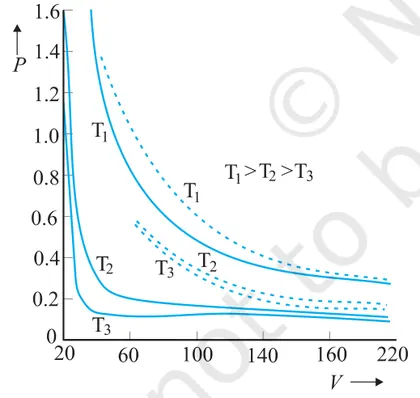
- Below a certain temperature (critical region) real-gas isotherms deviate strongly and show liquefaction; ideal-gas law cannot describe phase change.
Van der Waals equation (simple correction)
Van der Waals introduced two corrections: subtract an excluded volume nb from V, and add an internal pressure correction a(n/V)^2 to P. The equation (for n moles) is
(P + a n^2 / V^2)(V - n b) = n R T
Per mole (using molar volume Vm = V/n):
(P + a / Vm^2)(Vm - b) = R T
This equation qualitatively explains liquefaction and critical behaviour (S-shaped isotherms below Tc). It also gives expressions for critical constants (from inflection point):
- Tc = 8 a / (27 b R)
- Pc = a / (27 b^2)
- Vc = 3 b
Compressibility factor
Z = PV / (n R T) (or Z = P Vm / (R T)). For an ideal gas Z = 1. For real gases Z varies with P and T:
- Z < 1 : attractive forces dominate (gas is more compressible than ideal).
- Z > 1 : repulsive/volume effects dominate (less compressible).
For van der Waals, the second virial coefficient B(T) (in virial expansion PV = RT(1 + B/Vm + ...)) is B(T) = b - a/(R T). Setting B(TB) = 0 gives the Boyle temperature TB = a / (R b) — near TB a gas behaves ideally over a wide range of pressures.
Limitations of the kinetic theory / ideal-gas model
- Does not include intermolecular forces (so cannot predict liquefaction, condensation, or attractive effects).
- Assumes point particles (ignores finite molecular volume), so fails at high densities.
- Classical treatment breaks down at very low temperatures or for very light particles — quantum effects become important.
- Ignores internal degrees of freedom (rotation, vibration) that store energy in polyatomic molecules; simple kinetic theory applies best to monatomic gases.
- Cannot handle chemical reactions, dissociation, or ionization occurring at high T or in plasmas.
Practical importance
Understanding deviations is essential for accurate design and analysis of compressors, high-pressure gas cylinders, refrigeration and liquefaction processes, and when predicting real behaviour of gases near condensation. Engineers use corrected equations of state (van der Waals, Redlich–Kwong, Soave–Redlich–Kwong, Peng–Robinson, or virial expansions) chosen for the application and range of conditions.
- Carbon dioxide in a high-pressure cylinder: at high pressures CO2 deviates a lot from ideal gas and can liquefy — ideal gas law underestimates density.
- Liquefaction of gases (e.g., ammonia, propane) during refrigeration: attractive forces allow gas to condense below critical temperature — impossible to predict with ideal law.
- Compressibility corrections in natural gas pipeline design: engineers use Z-factor tables (Z = PV/RT) not Z = 1 to size pipes and compressors.
- Scuba diving tanks and breathing-gas mixtures: at high filling pressures real-gas corrections change the amount of gas stored compared to ideal-gas estimate.
- Isotherms of nitrogen: near and below the critical temperature, measured P–V isotherms show inflection and flat portions (phase change) that the ideal model cannot reproduce.
- Ideal gas: PV = nRT
- Van der Waals (n moles): (P + a n^2 / V^2)(V - n b) = n R T
- Van der Waals (per mole): (P + a / Vm^2)(Vm - b) = R T
- Compressibility factor: Z = PV / (n R T) = P Vm / (R T)
- Second virial coefficient (vdW): B(T) = b - a / (R T)
- Boyle temperature (vdW): T_B = a / (R b)
Applications and Problem-Solving Topics
Overview: Kinetic theory connects macroscopic gas properties (P, V, T) with microscopic motion of molecules. It provides formulas for pressure, speeds (most probable, mean, rms), energy per molecule, mean free path, collision frequency, effusion/diffusion and explains specific heats via equipartition. This section emphasizes applying those results to solve typical Class 11 problems.
Key ideas and derivations (concise):
- Pressure from molecular motion: P = (1/3)(N/V)m<v^2>. Using m<v^2>/2 = (3/2)kT gives ideal gas law PV = NkT.
- Energy and temperature: Average kinetic energy per molecule = (3/2)kT. Temperature is a measure of average translational kinetic energy.
- Speed measures: Maxwell distribution of speeds f(v) gives three useful speeds: most probable v_mp, mean v_avg and root-mean-square v_rms. They satisfy v_mp < v_avg < v_rms.
- Mean free path and collisions: Mean free path λ = 1/(√2 n π d^2) = kT/(√2 π d^2 P). Collision frequency (per molecule) z = √2 n σ v̄, where σ = π d^2 and v̄ is mean speed.
- Effusion and Graham's law: Effusion rate ∝ v̄ ∝ 1/√M, so Rate1/Rate2 = √(M2/M1).
- Equipartition and specific heats: Each quadratic degree of freedom carries (1/2)kT per molecule. For f degrees of freedom, molar CV = (f/2)R and CP = CV + R. For monoatomic gas f=3 → CV,m = 3/2 R; diatomic (at ordinary T, translational+rotational) f=5 → CV,m ≈ 5/2 R.
Problem-solving strategy:
- Always convert mass units: molar mass M (g mol−1) → kg mol−1 by dividing by 1000 when using R in J mol−1 K−1.
- Use N = n·NA and k = R/NA when switching between molecule-level and mole-level formulae.
- Temperature must be in kelvin; pressure in Pa for SI. For mean free path use pressure in Pa and molecular diameter in m.
- Decide if the problem uses molecule mass m or molar mass M and pick v formulas accordingly: v_rms = √(3kT/m) = √(3RT/M).
- For distribution problems, use Maxwell f(v). For fractions above/below a speed, integrate f(v) or use standard ratios/approximations; many textbook problems ask for qualitative comparisons or use known ratios v_mp:v_mean:v_rms.
- When pressure or density changes, remember λ ∝ 1/P and collision frequency ∝ P (at fixed T).
Common question types: compute v_rms/v_mean/v_mp at given T; fraction of molecules above a speed; mean free path at given P and T; collision frequency; compare effusion rates; find heat capacities from degrees of freedom; relate macroscopic PV work to microscopic energy change.
- Calculate v_rms of helium at 300 K: use v_rms = sqrt(3RT/M) with M(He) = 4 g/mol = 0.004 kg/mol.
- Mean free path at 1 atm and 300 K for gas with molecular diameter 3x10^-10 m: λ = kT/(√2 π d^2 P).
- Compare effusion rates of H2 and O2 at same T: Rate_H2/Rate_O2 = sqrt(M_O2/M_H2) = sqrt(32/2) = 4.
- Using equipartition, find molar internal energy of a diatomic gas (no vibration) at 400 K: U_molar = (5/2) RT.
- Fraction of molecules with speed greater than 2 v_mp (qualitative): use Maxwell tail — the fraction is small; approximate by integrating f(v) or use tables.
- Show that heating at constant volume increases pressure if number of molecules fixed: increased T → increased <v^2> → larger P via P = (1/3)(N/V)m<v^2>.
- Ideal gas: PV = nRT = NkT
- Pressure (kinetic theory): P = (1/3)(N/V) m ⟨v^2⟩
- Average kinetic energy per molecule: (1/2) m ⟨v^2⟩ = (3/2) kT
- v_rms = sqrt(⟨v^2⟩) = sqrt(3kT/m) = sqrt(3RT/M)
- v_mp (most probable) = sqrt(2kT/m) = sqrt(2RT/M)
- v_mean = ⟨v⟩ = sqrt(8kT/(π m)) = sqrt(8RT/(π M))
Key Concepts
- Kinetic theory of gases
- A model that explains macroscopic gas properties by treating gas as a large number of small particles in constant random motion and interacting through elastic collisions.
- Ideal gas
- A hypothetical gas whose molecules have negligible size, no intermolecular forces, and obey elastic collisions so that PV = nRT holds exactly.
- Molecule
- The smallest particle of a substance that retains its chemical identity; in kinetic theory a particle that moves and collides to produce gas properties.
- Elastic collision
- A collision in which kinetic energy (and momentum) is conserved; assumed for molecule–molecule and molecule–wall collisions in ideal gas theory.
- Mean free path
- The average distance a molecule travels between successive collisions; often denoted λ and given by λ = 1/(√2 n σ) for hard-sphere molecules.
- Collision cross-section
- An effective area σ that quantifies the likelihood of collision between two molecules, typically σ = πd^2 for hard spheres of diameter d.
- Collision frequency
- Average number of collisions a molecule makes per unit time; related to mean free path and average speed by ν = v̅/λ.
- Maxwell–Boltzmann distribution
- Probability distribution of molecular speeds in an ideal gas at equilibrium, giving the fraction of molecules having a given speed.
- Most probable speed
- The speed at which the Maxwell–Boltzmann speed distribution is maximum; v_mp = sqrt(2kT/m) for molecules of mass m.
- Average (mean) speed
- The arithmetic mean of molecular speeds from the Maxwell–Boltzmann distribution; v̅ = sqrt(8kT/πm).
- Root mean square (rms) speed
- Square root of the average of squared speeds; v_rms = sqrt(3kT/m) and relates directly to kinetic energy per molecule.
- Degrees of freedom
- Independent ways in which a molecule can store energy (translational, rotational, vibrational); denoted f and used in equipartition.
- Equipartition theorem
- Each quadratic degree of freedom contributes (1/2)kT to the average energy per molecule in thermal equilibrium.
- Internal energy
- Total microscopic kinetic (and, if applicable, potential) energy of gas molecules; for an ideal monatomic gas U = (3/2) nRT.
- Pressure (kinetic theory expression)
- Pressure arises from molecular impacts on container walls; for ideal gas p = (1/3) n m v_rms^2 where n is number density and m molecular mass.
- Boltzmann constant (k)
- Fundamental constant relating average kinetic energy per particle to temperature; k ≈ 1.380649×10^-23 J/K.
- Universal gas constant (R)
- Molar form of Boltzmann constant, R = NA·k ≈ 8.314 J/(mol·K), appears in PV = nRT and energy formulas per mole.
- Molar mass
- Mass of one mole of a substance (M), used to relate molecular mass m to molar quantities: m = M/NA.
- Avogadro's number (NA)
- Number of particles in one mole of substance, NA ≈ 6.02214076×10^23 mol^-1.
- Brownian motion
- Random jittery motion of microscopic particles suspended in a fluid, caused by unequal molecular impacts; experimental evidence for molecular theory.
End-of-Chapter Trial Paper & Test Questions
Topic-wise questions to test your understanding of every concept in this chapter.
-
State any three basic assumptions of the kinetic theory of an ideal gas. / आदर्श गैस की गति सिद्धांत की कोई तीन मूल मान्यताएँ लिखिए।
Show answer
(1) The gas contains a very large number of identical molecules treated as point particles of negligible volume. (2) There are no intermolecular forces except during collisions. (3) Collisions of molecules with each other and with the walls are perfectly elastic. / (1) गैस में बहुत बड़ी संख्या में समान अणु होते हैं जिन्हें नगण्य आयतन वाले बिंदु कण माना जाता है। (2) टक्करों के दौरान को छोड़कर अंतराण्विक बल नहीं होते। (3) अणुओं की आपस में तथा दीवारों से टक्करें पूर्णतः प्रत्यास्थ होती हैं।
-
Derive the expression P = (1/3)ρ⟨v²⟩ for the pressure of an ideal gas. / आदर्श गैस के दाब के लिए व्यंजक P = (1/3)ρ⟨v²⟩ व्युत्पन्न कीजिए।
Show answer
For a molecule with x-velocity vₓ in a cube of side L, the momentum change per wall collision is 2mvₓ and the time between collisions is 2L/vₓ, giving force mvₓ²/L. Summing over all N molecules and using isotropy ⟨vₓ²⟩ = (1/3)⟨v²⟩, the pressure P = F/L² = (1/3)(Nm/V)⟨v²⟩ = (1/3)ρ⟨v²⟩. / L भुजा के घन में x-वेग vₓ वाले अणु के लिए प्रति टक्कर संवेग परिवर्तन 2mvₓ तथा टक्करों के बीच समय 2L/vₓ होता है, जिससे बल mvₓ²/L मिलता है। सभी N अणुओं पर योग करके तथा समदैशिकता ⟨vₓ²⟩ = (1/3)⟨v²⟩ का उपयोग करके दाब P = F/L² = (1/3)(Nm/V)⟨v²⟩ = (1/3)ρ⟨v²⟩ प्राप्त होता है।
-
Show that the average translational kinetic energy of a gas molecule depends only on temperature, and write its value. / दर्शाइए कि किसी गैस अणु की औसत स्थानांतरीय गतिज ऊर्जा केवल ताप पर निर्भर करती है, तथा इसका मान लिखिए।
Show answer
Equating PV = (1/3)Nm⟨v²⟩ with PV = NkT gives (1/2)m⟨v²⟩ = (3/2)kT, so the average translational KE per molecule is (3/2)kT, which depends only on absolute temperature T and not on the type of gas. / PV = (1/3)Nm⟨v²⟩ को PV = NkT के बराबर रखने पर (1/2)m⟨v²⟩ = (3/2)kT प्राप्त होता है, अतः प्रति अणु औसत स्थानांतरीय गतिज ऊर्जा (3/2)kT है जो केवल परम ताप T पर निर्भर करती है, गैस के प्रकार पर नहीं।
-
Calculate the rms speed of a nitrogen molecule (M = 0.028 kg/mol) at 300 K. (R = 8.314 J/mol·K) / 300 K पर नाइट्रोजन अणु (M = 0.028 kg/mol) की वर्ग-माध्य-मूल चाल ज्ञात कीजिए। (R = 8.314 J/mol·K)
Show answer
v_rms = √(3RT/M) = √(3 × 8.314 × 300 / 0.028) = √(267300) ≈ 517 m/s. / v_rms = √(3RT/M) = √(3 × 8.314 × 300 / 0.028) = √(267300) ≈ 517 m/s।
-
Using the equipartition theorem, find Cv, Cp and γ for a diatomic gas at room temperature. / ऊर्जा समविभाजन प्रमेय का उपयोग करके कमरे के ताप पर द्विपरमाणुक गैस के लिए Cv, Cp तथा γ ज्ञात कीजिए।
Show answer
A diatomic gas has f = 5 active degrees of freedom (3 translational + 2 rotational), so Cv = (5/2)R, Cp = Cv + R = (7/2)R, and γ = Cp/Cv = 7/5 = 1.4. / द्विपरमाणुक गैस की f = 5 सक्रिय स्वातंत्र्य कोटियाँ होती हैं (3 स्थानांतरीय + 2 घूर्णी), अतः Cv = (5/2)R, Cp = Cv + R = (7/2)R, तथा γ = Cp/Cv = 7/5 = 1.4।
-
Arrange v_mp, v_avg and v_rms in increasing order and give their ratios. / v_mp, v_avg तथा v_rms को बढ़ते क्रम में लिखिए तथा उनके अनुपात दीजिए।
Show answer
v_mp < v_avg < v_rms, where v_mp = √(2kT/m), v_avg = √(8kT/πm), v_rms = √(3kT/m); the ratios are v_avg/v_mp = 2/√π ≈ 1.128 and v_rms/v_mp = √(3/2) ≈ 1.225. / v_mp < v_avg < v_rms, जहाँ v_mp = √(2kT/m), v_avg = √(8kT/πm), v_rms = √(3kT/m); अनुपात v_avg/v_mp = 2/√π ≈ 1.128 तथा v_rms/v_mp = √(3/2) ≈ 1.225 हैं।
-
How does the mean free path of gas molecules depend on pressure and temperature? / गैस अणुओं का माध्य मुक्त पथ दाब तथा ताप पर किस प्रकार निर्भर करता है?
Show answer
Since λ = kT/(√2 πd²p), at constant temperature λ ∝ 1/p (decreases with pressure), and at constant pressure λ ∝ T (increases with temperature). / चूँकि λ = kT/(√2 πd²p), अचर ताप पर λ ∝ 1/p (दाब के साथ घटता है), तथा अचर दाब पर λ ∝ T (ताप के साथ बढ़ता है)।
-
Why do real gases deviate from ideal behaviour at high pressure and low temperature? / उच्च दाब तथा निम्न ताप पर वास्तविक गैसें आदर्श व्यवहार से क्यों विचलित हो जाती हैं?
Show answer
At high pressure the finite molecular size (excluded volume) becomes significant, and at low temperature intermolecular attractive forces become important; both effects are neglected in the ideal gas model, so PV = nRT no longer holds and corrections like the van der Waals equation are needed. / उच्च दाब पर अणुओं का परिमित आकार (वर्जित आयतन) महत्वपूर्ण हो जाता है, तथा निम्न ताप पर अंतराण्विक आकर्षण बल महत्वपूर्ण हो जाते हैं; आदर्श गैस मॉडल में दोनों प्रभाव उपेक्षित होते हैं, अतः PV = nRT लागू नहीं होता और वान डर वाल्स समीकरण जैसे संशोधन आवश्यक होते हैं।
Related Laws & Principles
Explore allFoundational laws & principles behind this chapter. Each one opens a full page — what it says, why it matters, five practice questions and the mistakes to avoid.