Overview
Introduction: Gravitation is the fundamental force of attraction between masses. This chapter develops Newton's Universal Law of Gravitation and applies it to planetary motion, free-fall near Earth, satellites and energy considerations. It introduces gravitational field and potential as tools to describe how masses influence space around them. Importance: Understanding gravitation explains everyday phenomena (weight, tides), the motion of planets and satellites, and underpins space technology (satellite orbits, launch speeds). It trains students in inverse-square laws, vector fields, energy methods and quantitative problem solving essential for higher studies in physics and engineering. Key themes: Newton's law of gravitation; comparison of mass and weight; acceleration due to gravity (g) and its variation with altitude/depth; gravitational field and potential (scalar vs vector), superposition principle; gravitational potential energy; escape velocity and orbital velocity; Kepler's laws and their connection to Newtonian gravitation; satellite motion (geostationary, orbit periods) and the two-body problem basics. What the student will learn: How to state and use Newton's law to…
Learning Objectives
- Define Newton's law of universal gravitation and state the value and significance of the universal gravitational constant G.
- Derive the expression for the gravitational force between two point masses and apply it to solve numerical problems involving distances and masses.
- Distinguish between mass and weight and calculate weight on the surface of the Earth and at different altitudes using g.
- Explain the concept of gravitational field (intensity) as force per unit mass and calculate the field due to a point mass and a spherical shell.
- Define gravitational potential and distinguish it from gravitational potential energy; compute potential due to a point mass and for a spherical mass distribution.
- Derive the expression for acceleration due to gravity g on the Earth's surface and analyze its variation with altitude and with depth below the Earth's surface.
- Apply the principle of superposition to determine the resultant gravitational field and potential for systems of discrete masses.
- Derive and calculate the escape velocity from a planet and apply the result to solve related numerical problems.
Topics in this chapter
14 topics · tap a topic title to jump straight to it.
Kepler's Laws of Planetary Motion
Overview: Kepler's laws describe the motions of planets (and other bodies) around the Sun based on observations. They apply to two-body gravitational systems and are a foundation for celestial mechanics.
1. Kepler's First Law (Law of Ellipses): The orbit of every planet is an ellipse with the Sun at one focus.
Ellipse equation (Cartesian): x2/a2 + y2/b2 = 1, where a = semimajor axis, b = semiminor axis. Eccentricity e = c/a where c is the focal distance; b2 = a2(1 - e2). Perihelion and aphelion are the closest and farthest points from the Sun.
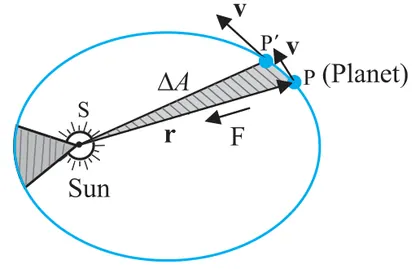
2. Kepler's Second Law (Law of Areas): A line joining a planet and the Sun sweeps out equal areas in equal times.
Mathematically: dA/dt = constant. This implies conservation of angular momentum for the planet: L = m r2 dθ/dt = constant, so r2 dθ/dt = const. Consequence: planets move faster at perihelion and slower at aphelion.
3. Kepler's Third Law (Law of Periods): The square of the orbital period T of a planet is proportional to the cube of the semimajor axis a of its orbit.
Proportional form: T2 ∝ a3. For a two-body system (star mass M and planet mass m) the exact relation from Newtonian gravity is:
T2 = (4π2/(G (M + m))) a3.
For M >> m (planet around the Sun), this simplifies to T2 = (4π2/GM) a3.
Connection with Newton's Law: Using F = G M m / r2 and centripetal approximation for circular orbits (m v2/r = G M m / r2) and v = 2πr/T leads directly to T2 = (4π2/GM) r3, which is Kepler's third law (with r = a for circular motion).
Key consequences & limitations: Kepler's laws describe ideal two-body motion. For systems with more bodies, perturbations alter orbits slightly. Kepler's laws are exact in Newtonian gravity for two-body motion and are generalized in celestial mechanics (orbital elements, perturbation theory) and relativistic corrections (e.g., Mercury's perihelion precession).
Practical importance: orbit prediction, satellite design (orbital elements use Keplerian parameters), mission planning (Hohmann transfers), and measuring masses of stars/planets from orbital periods and semimajor axes.
- Earth orbiting the Sun: a ≈ 1 AU, T = 1 year — demonstrates T<sup>2</sup> ∝ a<sup>3</sup>.
- Halley’s Comet: highly eccentric elliptical orbit — moves much faster near perihelion than at aphelion (illustrates 2nd law).
- Artificial satellites: low Earth orbit (LEO) and geostationary orbit — using T = 2π√(r<sup>3</sup>/GM) to find orbital periods.
- Binary stars: each star orbits the common center of mass; Kepler's third law (with M+m) yields stellar masses.
- Hohmann transfer for space missions: uses elliptical transfer orbit between two circular orbits (application of Keplerian orbits).
- Detection of exoplanets: orbital period and semimajor axis from transit/RV data allow estimation of host star mass or planet mass (with additional info).
- Ellipse: x^2/a^2 + y^2/b^2 = 1
- Eccentricity: e = c/a, and b^2 = a^2(1 - e^2)
- Area law (2nd): dA/dt = constant ⇒ r^2 (dθ/dt) = constant
- Angular momentum: L = m r^2 (dθ/dt) = constant
- Kepler III (exact two-body): T^2 = (4π^2/(G (M + m))) a^3
- Kepler III (M >> m): T^2 = (4π^2/GM) a^3
Newton's Universal Law of Gravitation
Statement: Every particle of matter in the universe attracts every other particle with a force which is directly proportional to the product of their masses and inversely proportional to the square of the distance between their centres. In scalar form: F = G m1 m2 / r^2, directed along the line joining the two masses.
Vector form: F_{12} = -G (m1 m2 / r^2) r̂_{12}, where r̂_{12} is the unit vector from mass 1 to mass 2. The minus sign shows the force is attractive.
Universal gravitational constant: G = 6.67430 × 10^{-11} N·m^2/kg^2 (measured by the Cavendish experiment).
Important derived quantities: gravitational field (or acceleration due to gravity) at distance r from a mass M is g(r) = GM / r^2 (vector g points toward M). Gravitational potential (per unit mass) is V(r) = -GM / r and gravitational potential energy of masses M and m is U(r) = -GMm / r.
Key features:
- Universal: applies to all masses anywhere in the universe.
- Always attractive.
- Long-range and follows an inverse-square law (intensity falls as 1/r^2).
- Superposition principle: total gravitational force on a mass is the vector sum of forces from all other masses.
Applications and consequences: explains planetary orbits and Kepler's laws (for circular orbits equating centripetal force to gravity gives orbital speed v = sqrt(GM/r) and period T satisfies T^2 = (4π^2/GM) r^3), escape velocity v_{esc} = sqrt(2GM / R), tides (differential gravity of Moon and Sun), behaviour of satellites, variation of weight with altitude, and allows determination of Earth’s mass and density from G and g.
Limitations: Newton's law is extremely accurate for most everyday and astronomical problems but is replaced by General Relativity when very strong gravitational fields, high precision or relativistic speeds are involved.
- An apple falling from a tree: attraction between apple and Earth causes free fall (near Earth's surface acceleration ≈ 9.8 m/s^2).
- Moon orbiting Earth: gravitational force provides the centripetal force that keeps the Moon in orbit.
- Artificial satellites: orbital speed and altitude determined by GM and r (geostationary orbit has specific period and altitude).
- Tides: difference in gravitational pull of the Moon (and Sun) on near and far sides of Earth causes ocean tides.
- Cavendish experiment: measured the tiny gravitational attraction between lead spheres to determine G and hence Earth's mass.
- Escape of spacecraft: escape velocity formula v_{esc} = sqrt(2GM/R) gives speed needed to escape a planet's gravity.
- Newton's law (magnitude): F = G m1 m2 / r^2
- \[Newton's law (vector): F_{12} = -G (m1 m2 / r^2) r̂_{12}\]
- Gravitational field (acceleration): g(r) = GM / r^2 (vector g toward the mass M)
- Gravitational potential: V(r) = -GM / r
- Gravitational potential energy: U(r) = -GMm / r
- Weight near Earth's surface: W = mg, with g ≈ GM_E / R_E^2
Gravitational Force between Extended Bodies
Gravitational force between extended bodies is obtained by applying Newton's law of gravitation to every mass element and using superposition (integration). For point masses Newton's law is F = G m1 m2 / r2. For extended bodies we sum (integrate) the contributions of all infinitesimal elements dm of the two bodies.
General expression (vector form): If body 1 has mass distribution ρ1(r1) and body 2 has ρ2(r2), the gravitational force on body 2 by body 1 is
F = G ∬V1,V2 (ρ1(r1) ρ2(r2) (r2 − r1) / |r2 − r1|3) dV1 dV2
This double volume integral is often simplified using symmetry.
Shell theorem (useful results for spherical symmetry):
- A spherically symmetric shell of mass attracts a particle outside as if all mass were concentrated at the center (force ∝ 1/r2 for r > R).
- Inside a thin spherical shell (r < R) the net gravitational force is zero.
- For a uniform solid sphere of total mass M and radius R: for r ≥ R the field is identical to a point mass, g(r) = GM/r2; for r ≤ R the field varies linearly with r, g(r) = GMr/R3 (i.e. F ∝ r).
Practical approach: If the separation between two extended bodies is large compared with their sizes and they are approximately spherically symmetric, treat each as a point mass at its center of mass. If not, set up and evaluate the necessary integrals or use numerical methods.
Important physical consequences:
- Weight variation with depth inside Earth: roughly linear decrease of g with depth (ignoring density variations).
- Spherical shells/hollow planets produce zero gravity inside (thought experiments and engineering implications for cavities).
- Gravitational interaction of non-spherical objects (rod, disk, ring) requires integration and gives characteristic field patterns (e.g., field on the axis of a ring).
- Earth–Moon attraction: Treat Earth and Moon as point masses located at their centers when separation >> radii; use F = G M_earth M_moon / r^2 to find orbital force.
- Weight variation inside Earth: For a uniform Earth, gravitational acceleration at depth r from centre is g(r) = G M r / R^3, so g decreases linearly to zero at the centre.
- Gravitational field of a thin spherical shell: A particle inside a hollow shell experiences zero net force; outside it feels the shell's mass concentrated at the center.
- Attraction of a thin rod on a point mass: Compute F by integrating dF = G dm / r^2 along the rod (common exercise for non-spherical bodies).
- Axis of a ring/disk: On the axis of a ring of mass M and radius a at distance x from centre, field = G M x / (x^2 + a^2)^(3/2); used in modeling disk galaxies and rings.
- Newton’s law (point masses): F = G m1 m2 / r^2
- Vector double integral for extended bodies: F = G ∬ (ρ1(r1) ρ2(r2) (r2 − r1) / |r2 − r1|^3) dV1 dV2
- Shell theorem (outside a sphere): g(r) = GM / r^2 for r ≥ R
- Inside thin spherical shell: g(r) = 0 for r ≤ R
- Inside a uniform solid sphere (r ≤ R): g(r) = G M r / R^3
- Gravitational potential inside a uniform solid sphere: φ(r) = −GM/(2R^3) (3R^2 − r^2) (reference: φ(∞)=0)
Gravitational Field (Intensity)
Definition: The gravitational field (or gravitational field intensity) at a point in space is defined as the gravitational force experienced by a unit test mass placed at that point. If a mass m experiences a gravitational force F, the field intensity g is
g = F / m (direction: toward the attracting mass). Units: N kg⁻¹ (same as m s⁻²).
Gravitational field of a point mass: For a point mass M located at the origin, Newton's law of gravitation gives the magnitude
g(r) = GM / r²,
directed radially inward. Vector form: g = - GM r̂ / r², where r̂ is the unit vector from the source mass to the field point. G is the universal gravitational constant.
Field near Earth's surface: Treating Earth as a sphere of mass M_E and radius R_E, at the surface
g = GM_E / R_E² ≈ 9.8 m s⁻².
For small heights h above the surface (h << R_E),
g(h) = GM_E / (R_E + h)² ≈ g(1 - 2h / R_E) (first-order approximation).
Superposition: Gravitational fields from multiple masses add vectorially. For discrete masses M_i at positions r_i,
g_total(r) = Σ (-G M_i (r - r_i) / |r - r_i|³).
Special results for spherically symmetric mass distributions (important CBSE results):
- Outside a spherically symmetric mass distribution (radius R), the field is the same as if all mass were concentrated at the center: g = GM / r² for r ≥ R.
- Inside a thin spherical shell of mass, the gravitational field is zero everywhere inside the shell.
- Inside a uniform solid sphere of total mass M and radius R, at distance r from center (r ≤ R): g(r) = G M r / R³. Thus g increases linearly with r inside and reaches maximum at the surface, then falls as 1/r² outside.
Relation with gravitational potential V: The gravitational field is the negative gradient of the gravitational potential V: g = -∇V. For a point mass V(r) = -GM / r, so g = -dV/dr = GM / r² (directed inward).
Direction and sign: Gravitational field intensity is a vector that points toward masses (attractive). When using scalar magnitude g we usually quote a positive number and state the inward direction explicitly.
Properties (summary):
- Vector quantity, units N kg⁻¹ or m s⁻².
- Obeys superposition.
- For spherically symmetric mass: outside behaves as point mass; inside a shell field = 0; inside solid sphere g ∝ r.
- Determines weight: weight W = m g (local g).
- Variation of weight with altitude: A person’s weight decreases slightly at high altitudes because g(h) = GM/(R+h)^2 is smaller than at the surface. For h much smaller than Earth’s radius, g ≈ g0(1 - 2h/R).
- Satellites in orbit: A satellite at radius r experiences centripetal acceleration provided by gravitational field g = GM/r^2. For circular orbit speed v = √(GM/r).
- Inside a hollow spherical shell: A small mass placed anywhere inside a thin hollow spherical shell experiences zero gravitational force (g = 0). This explains why a cavity inside a uniform spherical planet would be weightless.
- Cavendish-type measurements: The gravitational field from known masses is used to measure G by observing tiny forces on a test mass and relating them to g = F/m.
- Tides: Tidal forces arise from the variation (gradient) of Earth's gravitational field due to the Moon and Sun; differences in g across Earth's diameter produce tidal bulges.
- Definition: g = F / m (N kg⁻¹ or m s⁻²)
- Point mass (magnitude): g(r) = G M / r²
- Point mass (vector): g(r) = - G M r̂ / r²
- Near Earth's surface: g = G M_E / R_E² ≈ 9.8 m s⁻²
- At height h above surface: g(h) = G M_E / (R_E + h)² ≈ g (1 - 2h / R_E) for h ≪ R_E
- Inside uniform solid sphere (r ≤ R): g(r) = G M r / R³ (directed toward center)
Gravitational Potential
Definition: Gravitational potential (V) at a point in a gravitational field is the work done by an external agent per unit mass in bringing a small test mass from infinity (where potential is taken as zero) to that point, without acceleration. It is a scalar quantity.
Mathematical meaning:
- For a point mass M at distance r, V(r) = -GM/r. (Convention: V(∞) = 0.)
- Gravitational potential energy (U) of a mass m placed at that point: U = mV = -GmM/r.
- For a system of point masses: V = -G Σ (mi/ri), where ri is distance from the i-th mass to the point.
Relation to gravitational field:
- The gravitational field (vector) g is the negative gradient of potential: g = -∇V. For radial symmetry, g(r) = -dV/dr (directed inward).
- Because V is scalar, potentials from different sources add algebraically (superposition), which simplifies calculations.
Special cases for spherical mass distributions (total mass M, radius R):
- Outside (r ≥ R): V(r) = -GM/r (same as point mass located at centre).
- Hollow thin spherical shell: inside (r < R) potential is constant: V = -GM/R. The field inside is zero.
- Uniform solid sphere: for r ≤ R, V(r) = -G M (3R^2 - r^2) / (2 R^3). At centre V(0) = -3GM/(2R); at surface r = R gives -GM/R.
Properties and insights:
- V is always negative (for attractive gravity with zero at infinity) for isolated masses; its magnitude increases as you move closer.
- Equipotential surfaces are surfaces of constant V; the gravitational field is always perpendicular to these surfaces. No work is done by gravity when moving along an equipotential.
- Potential difference ΔV between two points is the work done per unit mass in moving between them: ΔV = V(B) - V(A) = -∫_A^B g·dr.
Why negative? Because gravitational force is attractive, bringing a mass from infinity to a finite r releases energy (work is done by the field), so potential (work done by external agent) is negative relative to zero at infinity.
- Launching a rocket: escape velocity v_esc = sqrt(2GM/R) comes from equating kinetic energy to the magnitude of gravitational potential energy to reach infinity (V(∞)=0).
- Low-Earth satellites: orbital speed v = sqrt(GM/r) follows from balance of centripetal force and gravitational attraction; potential determines the total mechanical energy (E = K + U).
- Interior of a hollow spherical shell: a mass placed anywhere inside experiences zero gravitational field although the potential is constant (useful model for hollow planets or shells).
- Tidal effects: differences in Earth's gravitational potential due to Moon lead to tidal bulges—tides are caused by spatial variations (gradients) of potential rather than its absolute value.
- Near-Earth approximation: for heights h much smaller than Earth's radius, V ≈ -GM/R + gh, so the change in potential per unit mass between heights is approximately gh (used in everyday gravitational potential energy mgh).
- Definition: V = (work done by external agent to bring unit mass from ∞ to point) (scalar).
- Point mass: V(r) = -G M / r
- Potential energy of mass m at r: U = m V = -G m M / r
- System of point masses: V = -G Σ (mi / ri)
- Relation to field: g = -∇V ; for radial case g(r) = -dV/dr = -GM/r^2 (directed inward for a point mass)
- Hollow spherical shell: V(r) = -GM/R for r ≤ R (field g = 0 inside)
Gravitational Potential Energy
Definition: Gravitational potential energy (GPE) of a system of two masses is the energy associated with their relative position in a gravitational field. For a test mass m in the gravitational field of a mass M, the gravitational potential energy at distance r (measured from the centre of M) is defined with the zero of potential energy at infinity:
U(r) = -G M m / r.
Why the negative sign? The negative sign indicates that bound configurations (finite r) have less energy than the separated state (r → ∞, U = 0). Work must be done against gravity to move the masses apart to infinity.
Relation to work and conservative force: Gravity is a conservative force, so the change in gravitational potential energy when moving from r1 to r2 is the negative of the work done by the gravitational force:
ΔU = U(r2) − U(r1) = − ∫_{r1}^{r2} F · dr.
For radial motion under gravity (magnitude of force F = GMm/r^2 directed inward), the work done by gravity when moving from r1 to r2 is W_by = GMm(1/r2 − 1/r1), and hence U(r) = −GMm/r satisfies ΔU = −W_by.
Approximation near Earth's surface: If the mass m is at height h above Earth of radius R (h << R), expand U(R + h) to get
U(R + h) ≈ −GMm/R + m g h
Because the constant term −GMm/R is the same for all heights measured from the surface, changes in GPE near the surface are given by the familiar expression
ΔU ≈ m g h.
Key physical points:
- The zero of gravitational potential energy is chosen by convention (commonly U = 0 at r = ∞). Only differences in U are physically measurable.
- GPE is negative for bound two-body systems when zero is set at infinity.
- The spatial derivative of U gives the force: F_r = −dU/dr. For U = −GMm/r, this yields the inverse-square law magnitude GMm/r^2 directed inward.
- Units: joule (J).
- Lifting a book a height h above a table: the increase in GPE is ΔU = m g h.
- A satellite raised from low Earth orbit to a higher orbit: use ΔU = −GMm(1/r2 − 1/r1) (not mgh when heights are comparable to Earth's radius).
- Hydroelectric dam: water stored at height h has GPE ≈ m g h; converting to electrical energy when released.
- Escape of a rocket: to escape Earth from radius R you need kinetic energy equal to the loss of GPE, giving escape speed v = √(2GM/R).
- Binding energy of a planet or star: total (negative) GPE of the self-gravitating body gives the energy required to disperse it to infinity.
- General two-body: U(r) = − G M m / r (zero at r → ∞)
- Gravitational potential (per unit mass): φ(r) = U/m = − G M / r
- Relation: U = m φ
- Work by gravity moving r1 → r2: W_by = G M m (1/r2 − 1/r1)
- \[Change in potential energy: ΔU = − ∫_{r1}^{r2} F · dr\]
- Near Earth's surface (h << R): ΔU ≈ m g h (and U(R + h) ≈ −GMm/R + m g h)
Acceleration due to Gravity (g) near Earth
What is g?
Acceleration due to gravity (g) at a point near Earth is the acceleration that a small test mass would experience solely due to Earth's gravitational pull. Its SI unit is m/s². Near the Earth's surface the average value is g ≈ 9.8 m/s².
Origin (Newton’s law)
From Newton's law of gravitation, the gravitational force on a mass m due to Earth of mass M and centre-to-point distance r is F = G M m / r². The acceleration (force per unit mass) is therefore
g(r) = G M / r².
At the Earth's surface (r = R), g = G M / R². Using M ≈ 5.972×10²⁴ kg, R ≈ 6.371×10⁶ m and G ≈ 6.674×10⁻¹¹ N·m²/kg² gives g ≈ 9.8 m/s².
Variation with height (h above surface)
At altitude h above Earth’s surface the distance is r = R + h, so
g(h) = G M / (R + h)² = g₀ (R²/(R + h)²).
For small heights (h << R) a binomial approximation gives
g(h) ≈ g₀ (1 − 2h/R).
Variation with depth (d below surface)
If Earth is approximated as a uniform sphere, the gravitational acceleration at depth d (distance r = R − d from centre) comes only from the mass enclosed within radius r, giving
g(d) = g₀ (1 − d/R).
Thus g decreases approximately linearly with depth and goes to zero at the centre (d = R).
Effect of Earth’s rotation and latitude
Because Earth rotates, there is a centrifugal acceleration that reduces the effective gravity. Its vertical component at latitude φ is ω² R cos²φ, so the effective gravity is approximately
g_eff(φ) = g(φ) − ω² R cos²φ,
where ω ≈ 7.2921×10⁻5 rad/s. This makes g slightly smaller at the equator (~9.780 m/s²) than at the poles (~9.832 m/s²).
Measurement
g can be measured by timing free fall (s = ½ g t²), by a simple pendulum (T = 2π √(L/g)), or by gravimeters which detect tiny changes in g.
Important distinctions
g is the gravitational field (acceleration) near Earth. It depends on location (height, depth, latitude) and not on the test mass. It should not be confused with G (universal gravitational constant) or with weight W = m g (which depends on the test mass m).
- Free fall: An object dropped from rest from height 20 m takes t = sqrt(2h/g) ≈ sqrt(40/9.8) ≈ 2.02 s to reach the ground.
- Pendulum: A simple pendulum of length 1 m has period T = 2π sqrt(L/g) ≈ 2.01 s; measuring T and L gives g = 4π² L / T².
- Altitude effect: At h = 400 km (approx. ISS orbit) g(h) ≈ g₀ (R/(R + 400000))² ≈ 8.7 m/s², so gravity is weaker but still substantial.
- Latitude effect: Due to rotation, g at the equator is about 9.780 m/s² while at the poles it is about 9.832 m/s²; the difference comes mainly from centrifugal reduction and Earth’s oblateness.
- Depth effect: In a deep mine 3 km down, approximate g ≈ g₀ (1 − d/R) ≈ 9.8 × (1 − 3000/6.371×10⁶) ≈ 9.795 m/s² (a very small decrease).
- Newton’s law (general): g(r) = G M / r²
- At surface: g₀ = G M / R²
- At height h: g(h) = G M / (R + h)² = g₀ (R²/(R + h)²)
- Small-height approximation: g(h) ≈ g₀ (1 − 2h/R) for h << R
- At depth d (uniform Earth approximation): g(d) = g₀ (1 − d/R)
- Weight: W = m g (apparent weight varies if frame accelerates)
Variation of g with Altitude and Depth
Overview
Gravitational acceleration g at a point near Earth depends on the distance from Earth's centre. As you go up (altitude) g decreases because you are farther from the mass producing the field. As you go down into Earth (depth) the effective g is due only to the mass enclosed within that radius, so g decreases toward the centre and becomes zero at the centre (for a spherically symmetric Earth).
Derivation for altitude (above surface)
Let Earth's mass = M and radius = R. At the surface g = GM/R2. At height h above surface (distance from centre = R + h):
g(h) = G M / (R + h)2 = g × (R/(R + h))2.
For small heights h << R, use binomial expansion:
g(h) ≈ g × (1 - 2h/R). (first-order approximation)
Derivation for depth (below surface)
Assume Earth is spherically symmetric. By Gauss's law for gravity (or Newton's shell theorem), only the mass inside radius r contributes to g at distance r from centre. Let depth d be measured below surface so r = R - d.
If density is uniform, M_r = M × (r3/R3). Then
g(r) = G M_r / r2 = G M r / R3 = g × (r/R) = g × (1 - d/R).
Thus, for a uniform Earth g decreases linearly with depth and becomes zero at the centre (d = R).
More general form
If density varies with radius ρ(r), the gravitational acceleration at radius r is
g(r) = (G / r2) × ∫0r 4π r'2 ρ(r') dr'.
Real Earth is not uniform: inner regions are denser, so g actually increases slightly below the surface to a maximum at some depth (~about 3000 km), then decreases to zero at the centre.
Notes and limitations
- Binomial approximation g(h) ≈ g(1 - 2h/R) is valid only for h << R.
- Uniform density assumption is idealized. Real Earth’s density increases with depth.
- Measured apparent gravity at a point also depends on Earth's rotation (centrifugal effect) and latitude; effective g = gravitational g minus centrifugal component (≈ ω2 R cos2φ).
Physical consequences
- At mountain tops you weigh slightly less than at sea level; in deep mines you weigh slightly less than at the surface (for a uniform Earth) but the real effect depends on internal density.
- Satellites in low Earth orbit still experience significant g (not zero); they are in free fall, producing weightlessness for occupants.
- At Earth's centre gravitational acceleration is zero (net gravitational forces cancel).
- Weight on a mountain (e.g., Mt. Everest ~8.85 km): g decreases by about 2h/R ≈ 0.28%, so weight is slightly less than at sea level.
- Low Earth Orbit (ISS ~400 km): g ≈ g (R/(R+h))^2 ≈ 8.7 m/s^2 — astronauts feel microgravity because they are in free fall, not because g is zero.
- Geostationary orbit (h ≈ 35,786 km): g falls to a few tenths of 1 m/s^2 (orbit maintained by centripetal conditions, not because gravity vanished).
- Deep mine (d = 3 km) under uniform Earth model: g ≈ g (1 - d/R) ≈ g (1 - 0.00047) — a tiny decrease in weight.
- At Earth's centre (d = R): g = 0 (net gravitational force cancels).
- g(surface) = G M / R^2
- g at height h: g(h) = G M / (R + h)^2 = g × (R/(R + h))^2
- Binomial (h << R): g(h) ≈ g (1 - 2h/R)
- g at depth d (uniform density): g(d) = g × (1 - d/R) where d is depth below surface
- \[General inside Earth: g(r) = (G / r^2) × ∫_{0}^{r} 4π r'^2 ρ(r') dr' (r = distance from centre)\]
- Effective gravity including Earth's rotation (latitude φ): g_eff ≈ g - ω^2 R cos^2 φ (ω = 2π / day)
Apparent Weight, Weightlessness and Accelerating Frames
Apparent weight (reading on a scale) is the normal reaction force N that a supporting surface exerts on a body. It is what a weighing scale measures, and need not equal the gravitational force mg. Apparent weight depends on the acceleration of the body (or the frame) relative to an inertial frame.
Basic idea and free-body analysis: For a body of mass m in a noninertial (accelerating) frame or attached to an accelerating support, draw forces: weight mg (down) and normal reaction N (up). Using Newton’s 2nd law in an inertial frame (taking upward as positive):
N − mg = m a ⇒ N = m(g + a)
Here a is the acceleration of the body (upward positive). Special cases:
- At rest or uniform velocity (a = 0): N = mg (true weight = apparent weight).
- Accelerating upward (a > 0): N = m(g + a) → apparent weight increases.
- Accelerating downward (a > 0 downward, i.e. a negative in upward sign convention): N = m(g − |a|) → apparent weight decreases.
- Free fall (a = g downward): N = 0 → weightlessness (scale reads zero).
Weightlessness: Occurs when the support does not exert a normal force (N = 0). That happens in free fall or in orbit when the centripetal acceleration of the body equals gravitational acceleration (objects are in continuous free fall around Earth). Important: gravity is not zero in orbit; the support force is zero, so occupants feel weightless.
Accelerating (non-inertial) frames and pseudo (inertial) forces: When working entirely inside a noninertial frame that accelerates with acceleration a_frame, introduce a pseudo force F_pseudo = −m a_frame acting on each mass, opposite to the frame acceleration. Then static balance in the accelerating frame gives:
N + (−m a_frame) − m g = 0 ⇒ N = m(g + a_frame) (signs depend on chosen axis)
Using consistent sign conventions this yields the same expressions as above. The pseudo force idea helps analyze more complex accelerating systems (e.g., accelerating vehicles, rotating frames).
Rotating frames and centrifugal effect: In a frame rotating with angular speed ω, an additional outward (centrifugal) pseudo acceleration ω²r acts on a mass at radius r (radially outward). The effective gravity (vector sum of real gravity and centrifugal acceleration) determines apparent weight. For a horizontal rotating platform the apparent normal force may increase or decrease depending on orientation of g and centrifugal acceleration.
Key physical points:
- Scale reading = normal reaction N = apparent weight, not necessarily mg.
- Weightlessness means N = 0, not absence of gravity.
- Pseudo forces must be used when applying Newton’s laws inside accelerating frames.
- Apparent weight can be changed deliberately (elevators, rockets, centrifuges) or happen naturally (free fall, orbit).
- Person in an elevator: stationary or moving at constant velocity → scale reads mg; elevator accelerating upward with acceleration a → scale reads m(g + a); accelerating downward with acceleration a → scale reads m(g − a); free fall (cable broken, a = g) → scale reads 0 (weightlessness).
- Astronauts in orbit: both astronaut and spacecraft fall around Earth; scale reading (support force) is zero so astronauts experience weightlessness although gravity ≈ 90% of surface value at low Earth orbit.
- Accelerating car: when the car accelerates forward, apparent weight shifts backward on the seats (pseudo force acts opposite acceleration), felt as a backward push against the seat.
- Roller coaster loop: at top of a vertical loop, apparent weight is reduced: N = m(g − v^2/R). If v^2/R = g, N = 0 and riders feel weightless at the top.
- Rotating space station: centrifugal acceleration ω^2 r provides a normal force on the floor; to simulate 1 g at radius r, choose ω = sqrt(g/r) (e.g., r = 100 m ⇒ ω ≈ 0.313 rad/s ≈ 3.0 rpm).
- Actual weight (gravitational force): W = mg
- Newton’s second law (vertical): N − mg = m a ⇒ Apparent weight (scale reading): N = m(g + a) (take upward as positive)
- Common sign-case forms: elevator accelerating up (magnitude a upward): N = m(g + a); elevator accelerating down (magnitude a downward): N = m(g − a)
- Free fall (a = g downward): N = 0 (weightlessness)
- Pseudo (inertial) force in a frame accelerating with a_frame: F_pseudo = −m a_frame (apply opposite to frame acceleration)
- Centrifugal (rotating frame) outward acceleration: a_cent = ω^2 r; effective gravity vector = g + ω^2 r (vector sum); for simulated g: ω = sqrt(g/r)
Motion under Gravity: Orbits and Circular Motion
Overview
Motion under gravity for bodies in space (planets, moons, satellites) is governed by the gravitational force which provides the required centripetal force for circular orbits and determines orbital parameters for more general (elliptical) motion. Key ideas: gravity supplies centripetal acceleration, orbital speed depends on central mass and orbital radius, period follows Kepler's third law, and escape velocity sets the threshold to leave a bound orbit.
Gravitational force as centripetal force
For a small mass m orbiting a large mass M at distance r (center to center), Newton's law of gravitation gives the inward force F = GMm/r2. If the orbit is circular with speed v, centripetal force required is m v2/r. Equating them:
- GMm/r2 = m v2/r
Thus, the circular orbital speed is v = sqrt(GM/r). Note that v is independent of the orbiting mass m.
Orbital period
The time to complete one revolution (period T) for a circular orbit of radius r is T = 2πr/v. Using v = sqrt(GM/r) gives Kepler's third-law form:
- T = 2π sqrt(r3 / GM)
This shows T ∝ r3/2 for orbits around the same central mass.
Energy of a circular orbit
Total mechanical energy (kinetic + potential) of mass m in a circular orbit:
- Kinetic energy: K = 1/2 m v2 = GMm/(2r)
- Gravitational potential energy: U = - GMm/r
- Total energy: E = K + U = - GMm/(2r) (negative for bound orbits)
Escape velocity
Escape velocity from distance r is found from energy conservation (set final total energy → 0):
- v_esc = sqrt(2GM/r)
Variation of g with altitude
Acceleration due to gravity at distance r from Earth's center is g(r) = GM/r2. For height h above Earth's surface (r = R + h):
- g(h) = g_0 (R / (R + h))2, where g_0 is surface gravity and R is Earth's radius.
Elliptical orbits and Kepler's laws (brief)
General orbits under inverse-square gravity are conic sections. For bound motion, orbits are ellipses with the central mass at one focus. Kepler's laws summarize the motion: (1) Planets move in ellipses; (2) Equal areas are swept in equal times (angular momentum conservation); (3) T2 ∝ a3 (a = semi-major axis).
Apparent weightlessness
Objects in orbit (e.g., astronauts) experience apparent weightlessness because they are in continuous free fall around Earth — gravity acts but produces centripetal acceleration instead of normal force.
Important notes
- Orbital speed decreases with increasing radius (v ∝ 1/√r).
- Geostationary orbit: a circular orbit in Earth's equatorial plane with period 24 h; altitude ≈ 35,786 km above Earth’s surface. Satellite mass does not enter v or T formulas (when M ≫ m).
- International Space Station (ISS): Low Earth Orbit ~400 km altitude; orbital speed ≈ 7.7–7.8 km/s and period ≈ 92 minutes. Astronauts feel weightless because ISS and crew are in free fall.
- Geostationary satellite: orbit at radius where T = 24 h (≈ 42,164 km from Earth's center), altitude ≈ 35,786 km. Appears fixed above one longitude because its orbital period matches Earth's rotation and it lies over the equator.
- Moon around Earth: approximately circular orbit with orbital speed ≈ 1.02 km/s and period ≈ 27.3 days (sidereal).
- Escape velocity from Earth’s surface: ≈ 11.2 km/s. An object launched at ≥ this speed (neglecting atmosphere and rotation) can escape Earth’s gravity.
- Gravitational force: F = G M m / r^2
- Centripetal requirement: F_c = m v^2 / r
- Circular orbital speed: v = sqrt( G M / r )
- Orbital period (circular): T = 2π sqrt( r^3 / (G M) )
- Kinetic energy (orbit): K = (1/2) m v^2 = G M m / (2 r)
- Potential energy: U = - G M m / r
Orbital Period and Kepler's Third Law (from Newtonian Gravitation)
Definition: The orbital period (T) is the time a body takes to complete one full orbit about another body. Kepler's third law (empirical) states that for planets orbiting the Sun, the square of the orbital period is proportional to the cube of the semi-major axis: T^2 \propto a^3. Newtonian gravitation provides the physical basis and the exact constant of proportionality.
Derivation for circular orbits (Newtonian):
For a small mass m orbiting a large mass M at radius r (circular orbit):
Centripetal force = Gravitational force
m v^2 / r = G M m / r^2
=> v = sqrt(G M / r)
Orbital period T = circumference / speed = 2 π r / v
=> T = 2 π r / sqrt(G M / r) = 2 π sqrt(r^3 / (G M))
Kepler's third law (Newtonian form):
T^2 = (4 π^2 / (G (M + m))) a^3
Here a is the semi-major axis of the relative orbit. For M >> m (e.g., planet around Sun, satellite around Earth) this simplifies to
T^2 = (4 π^2 / (G M)) a^3,which shows T^2 ∝ a^3 (Kepler's law) with the proportionality constant 4 π^2/(G M).
Elliptical orbits: The same relation holds if r (circular radius) is replaced by the semi-major axis a of the ellipse. The period depends only on a (and central mass), not on eccentricity.
Physical meaning and assumptions:
- Assumes inverse-square gravity and two-body motion (point masses or spherically symmetric masses).
- Neglects perturbations from other bodies, atmospheric drag, relativity (important only for very precise cases).
- Shows why more distant objects have much longer periods (T ∝ a^{3/2}).
Using the law: Given a and M, you can compute T. Conversely, measuring T and a for two orbiting objects lets you find the total mass M + m (useful in astronomy to find star masses from binary orbits).
- Earth–Sun: Using a = 1 AU = 1.496 × 10^11 m and M_sun = 1.989 × 10^30 kg, T = 2π sqrt(a^3/(G M_sun)) ≈ 3.156 × 10^7 s ≈ 1 year.
- Geostationary satellite: For T = 24 h = 86400 s around Earth (M_earth = 5.972 × 10^24 kg), r = (G M_earth T^2 / 4π^2)^{1/3} ≈ 4.216 × 10^7 m. Altitude ≈ r − R_earth ≈ 35786 km above Earth's surface.
- Moon around Earth: a ≈ 3.84 × 10^8 m and M_earth ≈ 5.972 × 10^24 kg gives T ≈ 27.3 days (sidereal month), consistent with observation.
- Binary stars / exoplanets: Measure orbital period T and semi-major axis a from observations; use T^2 = 4π^2 a^3 / (G (M1+M2)) to determine total mass (M1+M2).
- Gravitational force: F = G m1 m2 / r^2
- Circular orbital speed: v = sqrt(G M / r) (for m << M)
- Orbital period (circular): T = 2π sqrt(r^3 / (G M))
- Newtonian Kepler's third law (general two-body): T^2 = 4π^2 a^3 / (G (M + m))
- Kepler's original proportionality: T^2 ∝ a^3 (constant depends on central mass)
Escape Velocity and Minimum Energy for Escape
Definition: Escape velocity is the minimum speed that an object must have at the surface (or at a given distance) of a gravitating body so that it can move away indefinitely and reach infinity with zero remaining speed, i.e., just escape the gravitational field without further propulsion.
Derivation (energy conservation): Take gravitational potential energy U = -GMm/r (zero at r → ∞). For a mass m at radius r = R with initial speed v, total energy is E = (1/2)mv^2 - GMm/R. To just escape, the final speed at infinity is zero, so final total energy = 0. Thus
(1/2)mv_esc^2 - GMm/R = 0
Solving gives v_esc = sqrt(2GM/R). Important points:
- Escape velocity is independent of the mass m of the escaping object.
- For escape from altitude h above the surface, use radius r = R + h: v_esc = sqrt(2GM/(R+h)).
- Using surface gravity g = GM/R^2, v_esc can also be written v_esc = sqrt(2gR).
Minimum energy required: The minimum kinetic energy required (at the starting point) for escape equals the magnitude of the gravitational potential energy at that point. From the energy equation,
E_min = (1/2) m v_esc^2 = GMm/R = m g R.
This is the least amount of kinetic energy that must be supplied (ignoring atmosphere, drag, and rotation effects). If the object has more energy than this, it will escape with some residual speed; if less, it will remain bound and follow a closed or elliptical orbit or fall back.
Relationship with orbital speed: Circular orbital speed at the surface (idealized) is v_orb = sqrt(GM/R). Therefore v_esc = sqrt(2) v_orb (escape speed is √2 times the circular speed).
Physical remarks: - In presence of an atmosphere, drag increases required energy. - Planetary rotation helps if the launch is eastward at the equator (reduces required rocket delta-v). - If total energy > 0, the trajectory is unbound (parabolic for exactly zero total energy, hyperbolic for positive energy).
- Escape velocity from Earth surface: v_esc = √(2GM_earth/R_earth) ≈ 11.2 km/s. The minimum energy per kg is E_min ≈ gR ≈ 9.8 × 6.37×10^6 ≈ 6.25×10^7 J/kg.
- Escape velocity from Moon: ≈ 2.38 km/s (much smaller due to lower mass and smaller radius).
- Spacecraft such as Voyager achieved escape from the Sun–Earth system by reaching speeds greater than the local escape velocity using launch energy plus gravity assists.
- A rocket launched eastward from the equator needs slightly less fuel because Earth's rotational speed (~0.46 km/s) adds to its initial velocity.
- Gravitational potential energy (relative to infinity): U(r) = -GMm/r
- Escape velocity from radius r: v_esc = sqrt(2GM/r)
- Escape velocity from surface (r = R): v_esc = sqrt(2GM/R) = sqrt(2gR)
- Minimum kinetic energy required (at r): E_min = (1/2) m v_esc^2 = GMm/r = m g r (for r = R, m g R)
- Circular orbital speed at r: v_orb = sqrt(GM/r) → v_esc = sqrt(2) v_orb
Work, Energy and Conservation in Gravitational Field
Overview: The gravitational field produced by a mass M exerts a central force on another mass m. This force is conservative, so work done by gravity depends only on initial and final positions (not path) and mechanical energy (kinetic + potential) is conserved when only gravity does work.
Gravitational force (point mass): Two point masses M and m attract each other with
F(r) = G M m / r2 directed toward M (radial). In vector form F = -G M m / r2 r̂.
Work done by gravity: If the mass m moves quasi-statically from r = r1 to r = r2 (radial motion), the work done by the gravitational force is
W = ∫(r1→r2) F · dr = -G M m (1/r2 - 1/r1) = G M m (1/r1 - 1/r2).
Note sign: gravity does positive work when the object moves closer (r2 < r1) and negative work when moving away.
Gravitational potential energy (GPE): Choose zero of potential energy at infinity. The potential energy of m at distance r from M is
U(r) = - G M m / r.
Change in potential energy from r1 to r2 is ΔU = U(r2) - U(r1) = -G M m (1/r2 - 1/r1). This gives W = -ΔU (work done by gravity equals negative change in potential energy).
Gravitational potential (per unit mass): Φ(r) = U/m = - G M / r. The field (acceleration) is g = -∇Φ, whose magnitude is g(r) = G M / r2.
Near Earth's surface (approximation): For heights h small compared with Earth's radius R, expand U(R+h) ≈ -GMm/(R+h) ≈ -GMm/R + mgh, so only changes matter and we commonly use
ΔU ≈ m g Δh,
and take U = mgh (with appropriate zero reference) for practical problems.
Conservation of mechanical energy: If only gravity does work (no non-conservative forces), total mechanical energy E is conserved:
E = K + U = 1/2 m v2 + U(r) = constant.
So as U decreases (object moves inward), kinetic energy K increases so that E stays fixed. For a free-falling object from rest at r1 to r2: 1/2 m v2 = U(r1) - U(r2) = G M m (1/r2 - 1/r1).
Special results:
- Escape velocity from surface r = R: set final kinetic + potential at infinity to zero: 1/2 m v_e2 - G M m / R = 0 ⇒ v_e = sqrt(2 G M / R). For Earth v_e ≈ 11.2 km/s.
- Circular orbital speed at radius r: centripetal requirement gives m v2/r = G M m / r2 ⇒ v = sqrt(G M / r).
- Total mechanical energy of a circular orbit: E = - 1/2 G M m / r (negative, bound orbit). Kinetic energy equals half the magnitude of potential energy: K = + 1/2 G M m / r, U = - G M m / r.
Sign conventions and intuition: Gravitational potential energy is negative (with zero at infinity). Moving an object out (increasing r) increases U (less negative) and gravity does negative work; moving it in decreases U (more negative) and gravity does positive work. In closed loop motion under gravity only, net work = 0.
How to solve problems:
- Decide whether to use exact expressions U = -GMm/r or near-surface approximation mgh.
- Use energy conservation: K_i + U_i = K_f + U_f to find speeds or heights.
- For work, evaluate W = ∫ F·dr or use W = -ΔU.
- A stone dropped from height h near Earth: using mgh = 1/2 m v^2 gives v = sqrt(2 g h) ignoring air resistance.
- Escape velocity: to escape Earth's gravity from surface R, required speed v_e = sqrt(2 G M_earth / R_earth) ≈ 11.2 km/s.
- Satellite in circular orbit at altitude h: orbital speed v = sqrt(G M_earth / (R_earth + h)).
- Hydroelectric dam: water at height has gravitational potential energy U = m g h; when released it converts to kinetic energy to drive turbines.
- Pendulum (small amplitude): gravitational potential converts to kinetic at the lowest point; total energy conserved (neglecting friction).
- Gravitational force: F = G M m / r^2 (attractive, directed toward M).
- Work by gravity (r1 → r2): W = ∫(r1→r2) F · dr = G M m (1/r1 - 1/r2).
- Potential energy (zero at infinity): U(r) = - G M m / r.
- Change in potential energy: ΔU = U(r2) - U(r1) = - G M m (1/r2 - 1/r1).
- Near Earth's surface: U ≈ m g h and ΔU = m g Δh.
- Mechanical energy conservation: E = K + U = 1/2 m v^2 + U(r) = constant.
Superposition and Multi-body Gravitational Systems
Principle: Gravitational interactions obey the superposition principle: the net gravitational field or potential at any point due to several masses is the algebraic (vector for field/force, scalar for potential) sum of the contributions from each mass, calculated as if the others were absent.
Gravitational field and force (N bodies): For a test mass m at position r, the net gravitational force is F_net = m g_net where
- g_net(r) = sum_{i=1}^{N} g_i(r) = -G sum_{i=1}^{N} M_i (r - r_i)/|r - r_i|^3.
- Equivalently, F_net = -G m sum_{i=1}^{N} M_i (r - r_i)/|r - r_i|^3.
Gravitational potential (scalar): The total potential at r is the sum of the individual potentials:
- Φ(r) = sum_{i=1}^{N} Φ_i(r) = -G sum_{i=1}^{N} M_i / |r - r_i|.
- Potential energy of test mass m: U(r) = m Φ(r) = -G m sum_{i=1}^{N} M_i / |r - r_i|.
Multi-body consequences and uses: Because forces add vectorially, you can compute the net pull on a body from multiple planets, stars, or particles by adding contributions. In many problems (e.g., orbital motion of two bodies), it is convenient to reduce the problem to the motion of the centre of mass (CM) plus relative motion. For an isolated system, the CM moves as if the total mass were concentrated at that point under external forces:
- R_CM = (1 / M_tot) sum_i m_i r_i, where M_tot = sum_i m_i.
Simple two-body line problem — equilibrium point between two masses: For two fixed masses M1 and M2 separated by distance d on a line, the point along the line between them where a test mass feels zero net gravitational force satisfies
- GM1/x^2 = GM2/(d - x)^2, giving x = d / (1 + sqrt(M2/M1)), measured from M1 toward M2.
Stability note: A point where net force is zero may be stable or unstable. For two masses the midpoint between equal masses is an equilibrium along the line, but in full 3D it is generally a saddle point (unstable to transverse displacements).
Astrophysical applications: superposition explains tidal forces (difference in gravitational pull across a body), spacecraft station-keeping at Lagrange points (special equilibrium points in the rotating two-body frame), and calculating net gravity in multi-planet systems and galactic dynamics.
- Earth–Moon–satellite: the satellite feels gravitational forces from both Earth and Moon. Treat each contribution separately and add vectorially to get net force and acceleration.
- Tides on Earth: tidal forces arise from the difference (gradient) of the Moon's gravitational field across Earth's diameter — calculated by superposing the Moon's and Earth's fields and taking differences.
- Point between two equal masses: a small mass placed exactly at midpoint experiences zero net gravitational force (contributions cancel), but it sits in a potential well—transverse displacements are unstable in 3D.
- Spacecraft at Sun–Earth L1: the gravitational pulls from Sun and Earth plus centrifugal effect in rotating frame produce an equilibrium region where spacecraft can ‘hover’ with little fuel use.
- Center-of-mass motion: two-body planet–star system can be reduced to motion of CM and relative motion using superposition and CM definition.
- \[g_net(r) = sum_{i=1}^{N} g_i(r) = -G sum_{i=1}^{N} M_i (r - r_i)/|r - r_i|^3\]
- \[F_net = m g_net = -G m sum_{i=1}^{N} M_i (r - r_i)/|r - r_i|^3\]
- \[Φ(r) = sum_{i=1}^{N} Φ_i(r) = -G sum_{i=1}^{N} M_i / |r - r_i|\]
- \[U(r) = m Φ(r) = -G m sum_{i=1}^{N} M_i / |r - r_i|\]
- \[Center of mass: R_CM = (1 / M_tot) sum_{i} m_i r_i\]\[where M_tot = sum_i m_i\]
- Equilibrium between two masses M1 and M2 separated by d (point measured from M1): x = d / (1 + sqrt(M2/M1)), satisfying GM1/x^2 = GM2/(d - x)^2
Key Concepts
- Gravitation
- Mutual attractive force between any two masses in the universe; always attractive and acts along the line joining their centres.
- Newton's law of universal gravitation
- Every two point masses m1 and m2 separated by distance r attract each other with magnitude F = G·m1·m2 / r^2, where G is the universal gravitational constant.
- Gravitational constant (G)
- Universal constant in Newton's law of gravitation; G = 6.674 × 10^-11 N·m^2·kg^-2 (approx.).
- Mass (gravitational and inertial)
- Measure of amount of matter (inertial mass resists acceleration) and source of gravitational attraction (gravitational mass). In practice they are equal (equivalence principle).
- Weight
- Gravitational force exerted on a mass by a planet: W = m·g (vector directed toward the centre of the planet).
- Free fall
- Motion of a body under the influence of gravity alone, with negligible air resistance.
- Acceleration due to gravity (g)
- Acceleration experienced by a freely falling body near a planet's surface; g = GM / R^2 for a spherical planet of mass M and radius R.
- Variation of g with altitude and depth
- g decreases with altitude: g(h) = g0·(R/(R+h))^2. Inside a uniform sphere at depth d, g decreases linearly: g(d) = g0·(1 - d/R).
- Gravitational field (field intensity)
- Gravitational force per unit mass at a point: g⃗ = F⃗ / m_test; for a point mass M, g = GM / r^2 directed toward the mass.
- Gravitational potential
- Work done per unit mass in bringing a test mass from infinity to a point in the field: V = -GM / r (negative, with zero at infinity).
- Gravitational potential energy
- Energy associated with two masses due to their positions: U = -G·m1·m2 / r (zero at infinite separation).
- Escape velocity
- Minimum speed required to move from the surface of a body to infinity with zero residual speed, v_esc = sqrt(2GM / R).
- Orbital (circular) velocity
- Speed needed for a small body to move in a circular orbit of radius r around mass M: v = sqrt(GM / r).
- Satellite
- A body that revolves around a larger body due to gravitational attraction; natural (e.g., Moon) or artificial (man-made).
- Geostationary orbit
- Equatorial circular orbit where a satellite has orbital period equal to Earth's rotation (24 h), appearing fixed over one longitude (radius ≈ R + 35,786 km).
- Kepler's First Law (Law of Orbits)
- Planets move in elliptical orbits with the Sun at one focus.
- Kepler's Second Law (Law of Areas)
- A line joining a planet and the Sun sweeps equal areas in equal times; orbital speed varies — faster at perihelion, slower at aphelion.
- Kepler's Third Law (Law of Periods)
- Square of orbital period T of a planet is proportional to cube of semi-major axis a of its orbit: T^2 ∝ a^3 (for same central mass).
- Shell theorem
- For a uniform spherical shell: (1) Outside the shell, gravitational effect is as if all mass were concentrated at centre. (2) Inside a hollow shell, net gravitational field is zero.
- Centre of mass
- Point representing average position of mass distribution; motion of a system under external forces is equivalent to that of the centre of mass.
End-of-Chapter Trial Paper & Test Questions
Topic-wise questions to test your understanding of every concept in this chapter.
-
State Newton's universal law of gravitation and write its scalar form. / न्यूटन के सार्वत्रिक गुरुत्वाकर्षण नियम को बताइए और इसका अदिश रूप लिखिए।
Show answer
Every particle attracts every other particle with a force directly proportional to the product of their masses and inversely proportional to the square of the distance between them: F = G m₁m₂/r². / प्रत्येक कण हर दूसरे कण को एक बल से आकर्षित करता है जो उनके द्रव्यमानों के गुणनफल के समानुपाती और उनके बीच की दूरी के वर्ग के व्युत्क्रमानुपाती होता है: F = G m₁m₂/r²।
-
State Kepler's second law and explain why a planet moves faster at perihelion than at aphelion. / केप्लर का द्वितीय नियम बताइए और समझाइए कि कोई ग्रह उपसौर पर अपसौर की तुलना में तेज़ क्यों चलता है।
Show answer
Kepler's second law states that the line joining a planet to the Sun sweeps equal areas in equal times (dA/dt = constant). Since angular momentum L = mr²(dθ/dt) is conserved, a smaller r at perihelion requires a larger angular speed, so the planet moves faster. / केप्लर का द्वितीय नियम कहता है कि ग्रह को सूर्य से जोड़ने वाली रेखा समान समय में समान क्षेत्रफल प्रसर्पित करती है (dA/dt = स्थिर)। चूँकि कोणीय संवेग L = mr²(dθ/dt) संरक्षित है, उपसौर पर छोटा r बड़ी कोणीय चाल की माँग करता है, अतः ग्रह तेज़ चलता है।
-
Derive the expression for the escape velocity from the surface of a planet of mass M and radius R. / द्रव्यमान M और त्रिज्या R के किसी ग्रह की सतह से पलायन वेग का व्यंजक व्युत्पन्न कीजिए।
Show answer
By energy conservation, the kinetic energy must equal the magnitude of gravitational potential energy: ½mv² = GMm/R, giving v_esc = √(2GM/R). / ऊर्जा संरक्षण से, गतिज ऊर्जा गुरुत्वीय स्थितिज ऊर्जा के परिमाण के बराबर होनी चाहिए: ½mv² = GMm/R, जिससे v_esc = √(2GM/R)।
-
How does acceleration due to gravity g vary with depth d below Earth's surface (uniform Earth)? What is g at the centre? / एकसमान पृथ्वी के लिए पृथ्वी की सतह से गहराई d पर गुरुत्वीय त्वरण g कैसे बदलता है? केंद्र पर g कितना है?
Show answer
For a uniform Earth, g(d) = g₀(1 − d/R), so g decreases linearly with depth. At the centre (d = R), g = 0. / एकसमान पृथ्वी के लिए, g(d) = g₀(1 − d/R), अतः g गहराई के साथ रैखिक रूप से घटता है। केंद्र पर (d = R), g = 0।
-
Distinguish between gravitational potential and gravitational potential energy, stating their formulas for a point mass. / गुरुत्वीय विभव और गुरुत्वीय स्थितिज ऊर्जा में अंतर बताइए, बिंदु द्रव्यमान के लिए उनके सूत्र देते हुए।
Show answer
Gravitational potential V = −GM/r is the work done per unit mass to bring a test mass from infinity (a scalar property of the field), whereas gravitational potential energy U = −GMm/r is the energy of a mass m at that point (U = mV). / गुरुत्वीय विभव V = −GM/r अनंत से इकाई द्रव्यमान लाने में किया गया कार्य है (क्षेत्र का अदिश गुण), जबकि गुरुत्वीय स्थितिज ऊर्जा U = −GMm/r उस बिंदु पर द्रव्यमान m की ऊर्जा है (U = mV)।
-
A satellite orbits Earth in a circular orbit of radius r. Show that its orbital speed is independent of its own mass. / एक उपग्रह त्रिज्या r की वृत्तीय कक्षा में पृथ्वी की परिक्रमा करता है। दिखाइए कि इसकी कक्षीय चाल इसके अपने द्रव्यमान से स्वतंत्र है।
Show answer
Equating gravitational force to centripetal force: GMm/r² = mv²/r, the mass m cancels, giving v = √(GM/r), which depends only on M and r, not on the satellite's mass. / गुरुत्वीय बल को अभिकेंद्र बल के बराबर रखने पर: GMm/r² = mv²/r, द्रव्यमान m निरस्त हो जाता है, जिससे v = √(GM/r) मिलता है, जो केवल M और r पर निर्भर करता है, उपग्रह के द्रव्यमान पर नहीं।
-
Explain why astronauts in an orbiting spacecraft feel weightless even though gravity is significant at that altitude. / समझाइए कि परिक्रमा करते अंतरिक्षयान में अंतरिक्ष यात्री भारहीनता का अनुभव क्यों करते हैं जबकि उस ऊँचाई पर गुरुत्व पर्याप्त होता है।
Show answer
Both the spacecraft and the astronauts are in continuous free fall around Earth, so the support (normal) force is zero (N = 0); weightlessness means absence of normal force, not absence of gravity. / अंतरिक्षयान और यात्री दोनों पृथ्वी के चारों ओर निरंतर मुक्त पतन में होते हैं, अतः अवलंब (अभिलंब) बल शून्य होता है (N = 0); भारहीनता का अर्थ अभिलंब बल का अभाव है, गुरुत्व का अभाव नहीं।
-
Using the shell theorem, state the gravitational field inside a thin uniform spherical shell and just outside it. / कोश प्रमेय का उपयोग करते हुए, एक पतले एकसमान गोलीय कोश के अंदर और ठीक बाहर गुरुत्वीय क्षेत्र बताइए।
Show answer
Inside a thin spherical shell the net gravitational field is zero everywhere; outside (r ≥ R) the shell behaves as if all its mass were concentrated at the centre, giving g = GM/r². / पतले गोलीय कोश के अंदर हर जगह नेट गुरुत्वीय क्षेत्र शून्य होता है; बाहर (r ≥ R) कोश ऐसा व्यवहार करता है मानो उसका संपूर्ण द्रव्यमान केंद्र पर संकेंद्रित हो, जिससे g = GM/r² मिलता है।
Related Laws & Principles
Explore allFoundational laws & principles behind this chapter. Each one opens a full page — what it says, why it matters, five practice questions and the mistakes to avoid.