Overview
Introduction: "Laws of Motion" is a foundational chapter in Class 11 Physics (Physics – Part I) that introduces the basic principles governing how forces affect the motion of bodies. It builds on kinematics and defines the concepts of force, mass, inertia and introduces Newton's three laws as the central framework for dynamics. Importance: Mastery of this chapter is crucial because Newton's laws form the basis for most mechanics problems — from everyday phenomena (friction, collisions, motion of vehicles) to advanced topics (momentum conservation, dynamics of systems). Key themes: inertia and mass, types of forces (contact and field), Newton's first, second and third laws with their mathematical formulations, linear momentum and impulse, conservation of linear momentum for isolated systems, collisions (elastic and inelastic), friction (static and kinetic), and problem-solving using free-body diagrams and system analysis. What you will learn: precise definitions of mass and force; how to apply Newton's laws to single particles and interacting systems; how impulse changes momentum; derivation and use of conservation of linear momentum; classification and analysis of collisions; the…
Learning Objectives
- Define inertia, mass and weight and state their SI units and physical significance
- State Newton's three laws of motion and identify inertial and non-inertial frames of reference
- Explain the concept of force, net force and free-body diagram representation for particles
- Derive the relation between force, mass and acceleration for constant mass systems (F = ma)
- Apply Newton's laws to solve problems involving connected bodies and pulleys
- Calculate frictional forces, distinguish between static and kinetic friction, and use limiting friction in equilibrium problems
- Define linear momentum and impulse and derive the impulse–momentum theorem
- Apply conservation of linear momentum to solve collisions in one and two dimensions, distinguishing elastic and inelastic collisions
Topics in this chapter
14 topics · tap a topic title to jump straight to it.
Introduction and basic concepts
Overview
"Laws of Motion" begins with basic concepts needed to understand how forces change motion. Core ideas: force, mass, inertia, momentum, and system. A force is a push or pull that tends to change the state of motion of a body. Motion is described by position, velocity and acceleration, and forces are vectors (they have magnitude and direction).
Inertia and Mass
Inertia is the property of a body that resists any change in its state of motion. Mass is a quantitative measure of inertia: larger mass → greater resistance to acceleration. Mass is a scalar and is measured in kilograms (kg).
Types of Forces
Common forces encountered in problems: gravitational (weight), normal, friction (static and kinetic), tension, applied/contact forces, and non-contact forces (like electrostatic and gravitational). Distinguish contact forces (require physical contact) from non-contact (act at a distance).
Net Force and Equilibrium
The net force on a body is the vector sum of all forces acting on it. If the net force is zero the body is in translational equilibrium: either at rest or moving with constant velocity (no acceleration).
Newton's Laws — qualitative summary
- First law (Inertia): If net force = 0, velocity is constant.
- Second law: Net force causes acceleration; acceleration is proportional to net force and inversely proportional to mass.
- Third law: Forces occur in action–reaction pairs: if A exerts a force on B, B exerts an equal and opposite force on A.
Momentum and Impulse
Linear momentum p = m v. Impulse is the change in momentum and equals the time integral (or product for constant force) of force: J = Δp = ∫F dt ≈ FΔt. This links force and duration to changes in motion.
Free-Body Diagrams and Problem Strategy
To solve motion problems: (1) identify the system, (2) draw a free-body diagram showing all forces, (3) write vector sum of forces = ma (Newton's second law), (4) solve for unknowns and check units and limiting behavior.
Units and Vector Nature
SI units: force in newton (N), where 1 N = 1 kg·m/s²; mass in kg; acceleration in m/s²; momentum in kg·m/s. Treat forces as vectors — resolve into components (usually horizontal and vertical) and apply Newton's laws separately in each direction.
- A book resting on a table: normal force balances weight, net force = 0 (equilibrium).
- Pushing a stalled car: you apply a force; if net force ≠ 0 the car accelerates — larger mass means smaller acceleration for the same force (F = ma).
- Seatbelt during sudden braking: impulse reduces change in passenger momentum by increasing interaction time, lowering force on the body.
- Sliding a box: static friction prevents motion up to a maximum (fs ≤ μsN); once moving kinetic friction (fk = μkN) opposes motion at (nearly) constant value.
- Astronaut in space applying a force to a tool: action–reaction pair causes spacecraft to recoil (third law) because there is no external contact to absorb momentum.
- Newton's 2nd law: F_net = m a
- Weight: W = m g (g ≈ 9.8 m/s² near Earth's surface)
- Momentum: p = m v
- Impulse: J = Δp = ∫ F dt ≈ F Δt (for constant F)
- Static friction: f_s ≤ μ_s N (maximum value)
- Kinetic friction: f_k = μ_k N
Inertia and mass
Inertia is the property of a body that makes it resist any change in its state of rest or uniform motion in a straight line. This concept is expressed by Newton's First Law (the law of inertia): a body remains at rest or continues to move with constant velocity unless acted upon by a net external force.
Inertia has three common aspects:
- Inertia of rest – tendency to remain at rest.
- Inertia of motion – tendency to continue moving.
- Inertia of direction – tendency to maintain the current direction of motion.
Mass is the quantitative measure of inertia. It tells how strongly an object resists acceleration when a force is applied. Mass (m) is a scalar quantity; its SI unit is kilogram (kg). The larger the mass, the greater the inertia.
Relationship with Newton's Second Law: when a net force F acts on a body of mass m, it produces acceleration a according to F = ma. Rearranged, a = F/m shows that for the same applied force, larger mass gives smaller acceleration — this is the quantitative statement that mass measures inertia.
Mass vs Weight: mass is an intrinsic property (measured in kg); weight is the gravitational force on the mass, W = mg, and depends on the acceleration due to gravity g (varies with location).
Inertial mass (measured by F and a) and gravitational mass (appearing in gravitational force) are experimentally equal to high precision — a key empirical fact used in physics.
Common demonstrations: tablecloth trick (objects on table remain nearly at rest while cloth is pulled), passengers lurch forward when a bus stops (inertia of motion), and heavier objects are harder to start or stop than lighter ones (inertia ∝ mass).
- Seatbelt in a car: when the car stops suddenly, passengers tend to lunge forward because their bodies continue in motion; the seatbelt applies a force to change that motion.
- Tablecloth trick: a quick pull of the cloth removes it while objects on top remain approximately in place due to inertia of rest.
- Pushing a cart: pushing an empty trolley accelerates it more than a loaded trolley under the same force (a = F/m).
- Stopping a heavy truck vs a small car: the truck has greater inertia (larger mass), so it needs a larger braking force or longer distance to stop.
- Astronaut pushing off the space-station: in microgravity there is no weight but mass (inertia) still resists changes in motion.
- Newton's second law: F = m a
- Acceleration for given force: a = F / m
- Mass from measured force and acceleration: m = F / a
- Weight (gravitational force): W = m g
- Qualitative relation: Inertia ∝ mass (greater mass ⇒ greater inertia)
- SI unit of mass: 1 kilogram (kg)
Newton's First Law of Motion (Law of Inertia)
Statement: Newton's First Law (Law of Inertia) — An object continues in its state of rest, or of uniform motion in a straight line, unless acted upon by a net external force.
Meaning and detailed explanation:
- Inertia is the property of a body that resists any change in its state of motion (rest or uniform straight-line motion). The greater the mass of a body, the greater its inertia.
- The law identifies a special class of reference frames called inertial frames: frames in which a free particle (no net external force) moves with constant velocity. If you observe acceleration without any applied force, you are in a non-inertial frame.
- Mathematically, if the net external force ΣF = 0 on a particle of mass m, then acceleration a = 0 and the velocity v is constant. This is a special case of Newton's Second Law (F = ma).
- Consequences: equilibrium (static or dynamic) occurs when ΣF = 0. Conservation of linear momentum for an isolated system follows because if ΣF_ext = 0, the total momentum p = Σ m v is constant in time.
Key points:
- Mass is a quantitative measure of inertia: larger mass → larger resistance to change in motion.
- The law defines the behavior of objects when no unbalanced force acts; it does not explain the cause of motion.
- Valid only in inertial frames — accelerating elevators or rotating frames require fictitious forces to apply similar reasoning.
Simple demonstrations and thought experiments:
- Book on a table stays at rest until a net horizontal force is applied.
- A puck on a frictionless ice surface keeps moving in a straight line at constant speed once pushed.
- Pulling a tablecloth quickly from under dishes: dishes tend to remain at rest (inertia) so they don’t move much if the cloth is removed rapidly.
Practical importance: It lets us identify when forces are present (e.g., a change in velocity signals a net force), and it provides the conceptual foundation for dynamics and for introducing Newton's Second Law and conservation laws.
- A book lying on a table remains at rest until someone applies a force to move it.
- Passengers lurch forward in a bus that suddenly stops — their bodies tend to remain in motion (inertia).
- A puck slides almost forever on a nearly frictionless ice rink after one push (approximate uniform motion).
- Pulling a tablecloth quickly from under plates — plates tend to stay at rest, so they are less disturbed.
- Objects in space (satellites) continue in uniform motion unless acted on by gravitational or other forces.
- Statement in force form (special case): ΣF = 0 ⇒ a = 0 ⇒ v = constant
- Relation to second law: ΣF = ma, so ΣF = 0 ⇒ a = 0
- Momentum constant when no external force: ΣF_ext = 0 ⇒ dp/dt = 0 ⇒ p = constant (p = mv)
- Inertia quantified by mass: larger m ⇒ greater resistance to change in motion
Newton's Second Law of Motion
Statement: In an inertial frame, the net external force acting on a body is equal to the time rate of change of its linear momentum: F_net = dp/dt. For constant mass this reduces to the familiar form F_net = m a, where F_net and a are vectors.
Meaning and implications:
- Force causes change in motion: a nonzero net force produces acceleration (change of velocity).
- Proportionality: for a given mass, acceleration is directly proportional to the net force: a ∝ F_net.
- Mass dependence: for a given net force, acceleration is inversely proportional to mass: a = F_net / m.
- Vector nature: directions matter — the direction of acceleration is the direction of the net force.
- Valid only in inertial frames (frames not accelerating). In non-inertial frames fictitious forces must be introduced.
Derivation (brief): Momentum p = m v. In full generality, F_net = dp/dt = m dv/dt + v dm/dt. For systems with constant mass (typical rigid-body problems in Class 11) dm/dt = 0, so dp/dt = m (dv/dt) = m a, giving F_net = m a.
Interpretation in problem solving: Draw a free-body diagram, sum all external forces (vector sum) to get F_net, then use F_net = m a to find acceleration, or use dp/dt for problems with changing mass or when impulse is considered.
Related concepts: Impulse J = ∫F dt = Δp, conservation of momentum (when net external force = 0), and work-energy connections when force acts over a distance.
- Pushing a shopping cart: If you push harder (greater F) the cart accelerates more; for the same push, an empty cart (smaller m) accelerates more than a loaded cart (larger m).
- Car acceleration: The engine produces force at the wheels; a more powerful force or lower mass yields larger acceleration (a = F_net/m).
- Seat belt in a car crash: A sudden large external force (from the seat belt) produces a rapid change in passenger momentum; impulse and large force over short time reduce displacement but not necessarily reduce peak force unless time is increased.
- Kicking a ball: The foot applies a force for a short time → impulse changes the ball's momentum. For the same force and contact time, a heavier ball gets less acceleration.
- Rocket thrust (variable-mass case): The rocket expels mass (dm/dt ≠ 0) so external thrust must be treated using F_ext = dp/dt; this is why the simple F = ma form must be generalized for variable-mass systems.
- General form: F_net = dp/dt (vector).
- Constant mass: F_net = m a (vector).
- Component form: ΣF_x = m a_x, ΣF_y = m a_y, ΣF_z = m a_z.
- \[Impulse: J = ∫_{t1}^{t2} F dt = Δp.\]
- Units: 1 newton (N) = 1 kg·m/s^2.
- Variable mass: F_ext = m (dv/dt) + v_rel (dm/dt) (use carefully; derive from dp/dt with sign conventions).
Momentum and Impulse
Momentum is the product of the mass and velocity of a body: p = mv. It is a vector (same direction as velocity). SI unit: kg·m/s. Momentum measures how hard it is to stop a moving object.
Impulse is the effect of a force acting over a short time. For a force F(t) acting on a body during time interval t1 to t2, the impulse J is
J = \int_{t1}^{t2} F(t)\,dt.
The impulse–momentum theorem states that impulse equals change in momentum:
J = \Delta p = p_{final} - p_{initial}.
Using Newton’s second law in its general form: F_{net} = dp/dt. For constant mass this reduces to F_{net} = m a.
Conservation of Momentum: For an isolated system (no external net force), total linear momentum is conserved: \Sigma p_{initial} = \Sigma p_{final}. For a system of particles the total momentum equals the total mass times the velocity of the center of mass: P_{total} = M V_{cm}.
Collisions: In collisions between bodies, momentum is always conserved (if external forces negligible). Collisions are classified as:
- Elastic: both momentum and kinetic energy conserved.
- Inelastic: momentum conserved, kinetic energy not conserved (some lost as heat, deformation).
- Perfectly inelastic (completely inelastic): colliding bodies stick together after impact.
For one-dimensional two-body collision, conservation of momentum gives: m1 u1 + m2 u2 = m1 v1 + m2 v2. The coefficient of restitution e is defined as the ratio of relative speed of separation to relative speed of approach: e = (v2 - v1)/(u1 - u2) (signs chosen consistently). e = 1 for perfectly elastic, 0 for perfectly inelastic.
Practical idea: Increasing the time of impact (e.g., airbags, padded surfaces) reduces the average force because for the same impulse J = \Delta p the average force F_{avg} = J/\Delta t is smaller when \Delta t is larger.
- Car airbags: increase collision time, reducing peak force on passengers and thus injury.
- Catching a ball with bent elbows: increases stopping time so the force on the hand is reduced.
- Recoil of a gun or balloon propulsion: conservation of momentum causes backward motion when mass is expelled forward.
- Pool (billiard) balls: nearly elastic collisions where momentum (and approximately kinetic energy) is transferred between balls.
- Vehicles colliding and sticking together (inelastic collision): total momentum conserved but kinetic energy lost as deformation and heat.
- Momentum: p = m v (vector), unit kg·m/s
- \[Impulse: J = ∫_{t1}^{t2} F(t) dt\]
- Impulse–momentum theorem: J = Δp = p_f - p_i
- Newton (general): F_net = dp/dt
- Average force: F_avg = J / Δt
- Conservation of linear momentum (isolated system): Σ p_initial = Σ p_final
Newton's Third Law of Motion
Statement: For every action there is an equal and opposite reaction. More precisely: if body A exerts a force F on body B, then body B simultaneously exerts a force −F on body A.
Vector form: F_AB = −F_BA. These forces have the same magnitude, opposite direction and act on different bodies along the same line of action.
Key points and consequences:
- Action and reaction act on different bodies, so they do not cancel each other out on the same body.
- Action–reaction pairs are of the same nature (both contact forces or both field forces).
- In an isolated system of particles the internal action–reaction pairs cancel pairwise, which leads to conservation of momentum (total momentum remains constant).
- If only two bodies interact (and no external forces), m1 a1 = −m2 a2, so accelerations are inversely proportional to masses.
Relation to momentum: Using impulse-momentum theorem, ∫F_AB dt = −∫F_BA dt, so the impulses (change of momentum) on the two bodies are equal and opposite; hence total momentum of the isolated system is conserved.
Common misconceptions: The action–reaction forces do not cancel because they act on different bodies. Also, the phrase "equal and opposite" refers to force vectors, not to displacements or energies.
Experimental demonstrations: Examples include recoil of a gun, launching of a rocket (expelled gases push rocket forward), pushing off a boat to reach the shore, and collisions where two carts exert equal and opposite forces during contact.
- Walking: your foot pushes the ground backwards (action); the ground pushes your foot forward (reaction) propelling you.
- Rocket propulsion: hot gases are expelled backward (action); the rocket is pushed forward (reaction).
- Recoil of a gun: the bullet is pushed forward (action); the gun is pushed backward (reaction).
- Swimming: swimmer pushes water backward (action); water pushes swimmer forward (reaction).
- Bouncing ball: ball exerts a force on floor during impact (action); floor exerts equal and opposite force on ball (reaction), causing rebound.
- Book on a table: book exerts downward force on table due to gravity (action); table exerts upward normal force on book (reaction).
- Vector form: F_AB = −F_BA
- Impulse (action) = ∫ F_AB dt, Impulse (reaction) = ∫ F_BA dt = −∫ F_AB dt
- Impulse–momentum theorem: ∫ F dt = Δp
- Conservation of momentum (isolated system): Σ p_initial = Σ p_final
- Two-body accelerations (no external forces): m1 a1 = − m2 a2
- Thrust (for rocket) = rate of change of momentum of exhaust = ṁ · v_exhaust (approximately)
Conservation of Linear Momentum
Definition. The total linear momentum of an isolated system (one on which net external force is zero) remains constant in time. In symbols: if F_ext = 0, then dP_total/dt = 0 ⇒ P_total = constant.
Why it holds (derivation for two particles). For two interacting particles, Newton's second law gives dp1/dt = F_12 + F1_ext and dp2/dt = F_21 + F2_ext. By Newton's third law F_12 = −F_21, so internal forces cancel: d(p1 + p2)/dt = F1_ext + F2_ext. If external forces sum to zero, d(p1 + p2)/dt = 0, hence p1 + p2 = constant. This generalizes to any number of particles.
Impulse–momentum theorem. The change in momentum of a body equals the impulse delivered: J = ∫ F dt = Δp. During short collisions external impulses may be negligible, so momentum of the colliding bodies is conserved.
Applications to collisions (1D). For two bodies of masses m1, m2 with initial velocities u1, u2 and final velocities v1, v2, momentum conservation gives m1 u1 + m2 u2 = m1 v1 + m2 v2 (vector form or component-wise). Special cases:
- Perfectly inelastic (stick together): v = (m1 u1 + m2 u2)/(m1 + m2).
- Perfectly elastic: both momentum and kinetic energy conserved; for head‑on collisions the final velocities are v1 = ((m1 - m2)/(m1 + m2)) u1 + (2 m2/(m1 + m2)) u2, and v2 = (2 m1/(m1 + m2)) u1 + ((m2 - m1)/(m1 + m2)) u2.
Relation to centre of mass. Total momentum P_total = M V_cm, where M = Σ m_i and V_cm is the velocity of the centre of mass. If no external force acts, V_cm is constant and the centre of mass moves with uniform velocity.
Important conditions. Conservation holds for an isolated system or when the net external impulse during the interaction is negligible (typical approximation for short collisions). Momentum is a vector — conservation must hold component-wise.
Physical intuition. Momentum conservation is a mathematical statement of Newton's third law: when two bodies push on each other, equal and opposite changes in their momenta leave the total unchanged. It governs everything from billiard-ball collisions to rocket motion (consider rocket + expelled fuel as the system).
- Two colliding billiard balls: total momentum before collision equals total after; directions and magnitudes change but vector sum remains same.
- Recoil of a gun when a bullet is fired: the momentum of the bullet and the gun (with opposite signs) sum to zero if the system is initially at rest.
- A person on ice pushing off another person: both move in opposite directions so that total momentum remains zero.
- Inelastic car crash: two cars may stick together and travel with a common velocity given by (m1 u1 + m2 u2)/(m1 + m2).
- Explosion of a stationary firework shell into fragments: vector sum of fragment momenta is zero (if no external impulse).
- Rocket propulsion: momentum conserved for rocket + expelled fuel; rocket gains forward momentum as fuel exhausts backward (external forces ignored for short times).
- Linear momentum: p = m v (vector).
- Total momentum: P_total = Σ p_i = M V_cm.
- Conservation condition: if ΣF_ext = 0 then P_before = P_after (vectorially).
- Two-body momentum conservation (1D): m1 u1 + m2 u2 = m1 v1 + m2 v2.
- Perfectly inelastic (stick): v_common = (m1 u1 + m2 u2) / (m1 + m2).
- Perfectly elastic (1D head-on) final velocities: v1 = ((m1 - m2)/(m1 + m2)) u1 + (2 m2/(m1 + m2)) u2, v2 = (2 m1/(m1 + m2)) u1 + ((m2 - m1)/(m1 + m2)) u2.
Collisions and Impact
Collision is an event in which two bodies exert forces on each other for a short time resulting in change of their velocities. In Class 11 (Laws of Motion) we study one-dimensional (head-on) collisions and key quantities: momentum, impulse, kinetic energy, and the coefficient of restitution.
Conservation of linear momentum: For two interacting bodies in an isolated system (no external net impulse), total linear momentum before collision equals total linear momentum after collision.
Impulse: During collision a large internal force acts for a short time. The impulse J is the integral of force over contact time and equals the change in momentum of a body: J = m(v - u). The average force can be written F_avg = J / Δt.
Coefficient of restitution (e): A measure of elasticity of collision defined (for one-dimensional case) as the ratio of relative speed of separation to relative speed of approach: e = (relative speed after collision)/(relative speed before collision) = (v2 - v1)/(u1 - u2). 0 ≤ e ≤ 1: e = 1 perfectly elastic (no kinetic energy lost), 0 < e < 1 partially inelastic, e = 0 perfectly inelastic (bodies stick together).
Solving two-body head-on collisions (m1, m2; initial velocities u1, u2; final velocities v1, v2): Use 1) conservation of momentum: m1 u1 + m2 u2 = m1 v1 + m2 v2, and 2) restitution: v2 - v1 = e (u1 - u2). From these you get
v1 = [m1 u1 + m2 u2 - m2 e (u1 - u2)] / (m1 + m2), v2 = [m1 u1 + m2 u2 + m1 e (u1 - u2)] / (m1 + m2).
Special cases: - Elastic (e = 1): v1 = [(m1 - m2) u1 + 2 m2 u2] / (m1 + m2), v2 = [2 m1 u1 + (m2 - m1) u2] / (m1 + m2). - Perfectly inelastic (e = 0): bodies stick and move with common velocity v = (m1 u1 + m2 u2) / (m1 + m2).
Energy loss: Kinetic energy is not conserved for e < 1. The kinetic energy loss during collision is ΔK = (1/2) (m1 m2/(m1 + m2)) (1 - e^2) (u1 - u2)^2, where ΔK = K_before - K_after (positive when some energy is lost).
Center of mass (COM) frame: Velocity of COM Vcm = (m1 u1 + m2 u2)/(m1 + m2). In the COM frame initial velocities are u1' = u1 - Vcm, u2' = u2 - Vcm, and after collision v1' = - e u1', v2' = - e u2' (for one-dimensional collisions). This shows speeds are reduced by factor e and directions reverse in COM frame.
Important remarks: - Momentum is always conserved in isolated collisions; kinetic energy is conserved only for elastic collisions. - Sign conventions matter: the restitution formula uses relative velocities with consistent direction signs. - Real collisions also involve deformation and sound/heat; e quantifies how “bouncy” the collision is.
- Billiard balls colliding: approximate elastic collision (e close to 1). Useful to calculate post-collision velocities on a pool table.
- A car crash: largely inelastic collision. Use momentum conservation to find combined velocity after impact; considerable kinetic energy converted to deformation and heat.
- A bouncing ball (superball): partially elastic; measure rebound height to determine e (e = sqrt(h_rebound / h_drop) for vertical drop onto hard surface).
- Newton's cradle: demonstration of nearly elastic collisions and momentum transfer between identical masses.
- Two ice-skaters pushing off each other: momentum conservation gives recoil velocities in opposite directions.
- Conservation of momentum (two bodies): m1 u1 + m2 u2 = m1 v1 + m2 v2
- Coefficient of restitution: e = (v2 - v1) / (u1 - u2) (one-dimensional, consistent sign convention)
- Final velocities (head-on, general e): v1 = [m1 u1 + m2 u2 - m2 e (u1 - u2)] / (m1 + m2), v2 = [m1 u1 + m2 u2 + m1 e (u1 - u2)] / (m1 + m2)
- Elastic case (e = 1): v1 = [(m1 - m2) u1 + 2 m2 u2] / (m1 + m2), v2 = [2 m1 u1 + (m2 - m1) u2] / (m1 + m2)
- Perfectly inelastic (e = 0, stick together): v = (m1 u1 + m2 u2) / (m1 + m2)
- Impulse: J = m (v - u) and average force F_avg = J / Δt
Friction
Definition: Friction is the resistive force that acts tangentially between two surfaces in contact and opposes relative motion (or the tendency to move) of the surfaces.
Types:
- Static friction (f_s): Acts when surfaces tend to move but remain at rest relative to each other. It adjusts up to a maximum value to prevent motion.
- Kinetic (sliding) friction (f_k): Acts when surfaces slide relative to each other; usually smaller than limiting static friction.
- Rolling friction (rolling resistance): Small resistive torque when a body rolls because of deformation of surfaces.
- Fluid friction (viscous): Resistance when an object moves through a fluid (liquid or gas).
Empirical laws (Amontons' laws):
- Friction is approximately proportional to the normal reaction: f ∝ N.
- Friction is (approximately) independent of contact area for a given pair of surfaces and normal force.
- Limiting static friction is greater than kinetic friction: μ_s > μ_k.
Microscopic origin: Real surfaces have asperities (microscopic bumps). Contact occurs at asperity tips producing adhesion and interlocking; deformation and breaking of these contacts consume mechanical energy and produce heat.
Direction and nature: Friction acts tangent to the surface and opposite to (or opposing) the relative motion or impending motion. It is a non-conservative force: work done by friction depends on the path and converts mechanical energy into thermal energy.
Common applications and consequences: Friction enables walking, driving (tyres on road), and braking; it causes wear, heating and energy loss in machines. Lubrication reduces friction by introducing a fluid layer between surfaces.
- Rubbing hands together to generate heat (static + kinetic friction).
- A block on a horizontal table: increasing pull until it just starts to move (limiting static friction), then sliding with kinetic friction.
- Car tyres providing traction: static friction prevents slipping during acceleration and braking; skidding uses kinetic friction (less effective).
- Walking: static friction between shoe and ground provides the necessary horizontal force to push the body forward.
- Brakes: friction between brake pads and wheel converts kinetic energy to heat and slows the vehicle.
- A rolling wheel (bicycle): rolling friction (resistance) is much smaller than sliding friction — reason bikes are efficient.
- Limiting static friction: f_s(max) = μ_s N
- Static friction (inequality): f_s ≤ μ_s N (adjusts up to the limit)
- Kinetic (sliding) friction: f_k = μ_k N
- Typically μ_s > μ_k
- Net acceleration for a block being pulled horizontally: a = (F_applied - f)/m, where f is frictional force
- Work done by friction (path d): W = -f d (energy dissipated as heat)
Free-body Diagrams and Applications of Newton's Laws
Overview
Free-body diagrams (FBDs) are vector drawings that show all forces acting on a single object. They are the primary tool for applying Newton's laws to solve mechanics problems. Use FBDs to set up the vector equations ΣF = ma (Newton's second law) and Στ = Iα when rotations are involved.
Steps to draw a correct Free-body Diagram
- Isolate the body: imagine the object alone, separated from surroundings.
- Represent all contact and non-contact forces by arrows from the object's center or point of contact. Label each force (W or mg, N, T, f, F_applied, R, etc.).
- Choose convenient axes (often one axis parallel to an inclined plane and the other perpendicular). Resolve forces into components along these axes.
- Indicate known directions of motion or acceleration. If direction unknown, assume and solve; sign will tell actual direction.
- Write Newton's second law for each axis: ΣF_x = m a_x, ΣF_y = m a_y. Solve for unknowns.
Common forces to include
- Weight (W or mg): force due to gravity acting at the center of mass, vertically downward.
- Normal force (N): contact force perpendicular to the surface.
- Tension (T): pull in a string, assumed along the string direction.
- Friction (f): tangential contact force opposing relative motion. Static friction f_s ≤ μ_s N; kinetic friction f_k = μ_k N opposite the direction of motion.
- Applied force (F): any external push or pull.
- Air resistance or drag: often velocity dependent; neglected in ideal problems unless specified.
Using Newton's laws with FBDs
- First law (inertia): If ΣF = 0 then a = 0 (object at rest or moving with constant velocity). Useful for equilibrium problems.
- Second law: ΣF = m a. Apply separately along chosen axes after resolving forces. This gives equations to solve for a, T, N, f, etc.
- Third law: Forces come in action–reaction pairs (e.g., block pushes table downward with mg, table pushes block upward with N). Action and reaction act on different bodies and are equal in magnitude and opposite in direction.
Problem-solving strategies
- Always draw FBD before writing equations.
- Pick axes to simplify (parallel/perpendicular to plane or to acceleration).
- Use ΣF = m a separately in each axis; if no acceleration in an axis, set ΣF = 0 to find reaction forces.
- For systems (connected masses, pulleys), draw FBD for each body and relate accelerations and tensions via constraints.
Example setups often covered: block on a horizontal surface with friction, block on an inclined plane, Atwood (two masses connected over a pulley), elevator problems (apparent weight), and blocks connected on horizontal/ inclined surfaces.
Short derivation examples shown in words
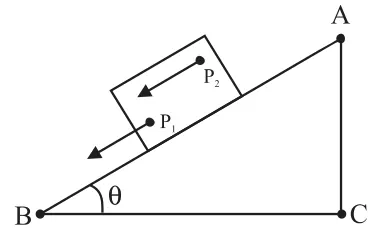
- Block on incline (angle θ), mass m, no friction: FBD shows mg downward split into components mg sinθ (down the plane) and mg cosθ (into plane). Equation along plane: m a = mg sinθ, so a = g sinθ.
- Block on incline with kinetic friction μ_k: friction = μ_k N = μ_k mg cosθ acting up the plane if block slides down. Then m a = mg sinθ - μ_k mg cosθ → a = g(sinθ - μ_k cosθ).
- Atwood machine (m1 and m2, m1 > m2): Draw FBD for each mass: m1g - T = m1 a; T - m2 g = m2 a. Solve to get a = (m1 - m2)g/(m1 + m2) and T = 2 m1 m2 g/(m1 + m2) (or solve for T from one equation).
Common mistakes to avoid: forgetting to include friction or normal force, mixing forces on different bodies, applying action–reaction forces to the same body, choosing poor axes that complicate algebra.
Conclusion
Mastery of free-body diagrams plus Newton's laws allows systematic solution of many mechanics problems. Practice drawing FBDs, resolving components, and writing ΣF = m a equations for each axis and each body in a system.
- Block on horizontal surface with applied force F: FBD includes applied force F (right), friction f (left), weight mg (down), normal N (up). Equations: Σx = F - f = m a; Σy = N - mg = 0 → N = mg. If moving, f = μ_k N.
- Block on an inclined plane (angle θ) with no friction: FBD has mg down, N perpendicular, acceleration down plane a = g sinθ. Components: mg sinθ (parallel), mg cosθ (perpendicular).
- Block on an inclined plane with kinetic friction μ_k: a = g (sinθ - μ_k cosθ) when sliding down. If sinθ ≤ μ_s cosθ it stays at rest (static friction can balance).
- Atwood machine (two masses m1 and m2 on pulley): Acceleration a = (m1 - m2) g / (m1 + m2). Use separate FBDs for each mass and connect by same magnitude of acceleration and tension.
- Elevator accelerating upward with acceleration a: scale reading (apparent weight) = m (g + a). If elevator accelerates down with a, reading = m (g - a). Use FBD with normal up and weight down and ΣF = m a.
- Newton's second law: ΣF = m a
- Weight: W = mg
- Normal force (flat surface, no vertical acceleration): N = mg
- Friction (static): f_s ≤ μ_s N (maximum static friction)
- Friction (kinetic): f_k = μ_k N (opposes motion)
- Components on incline: parallel = mg sinθ, perpendicular = mg cosθ
Systems of Particles and Internal Forces
What is a system of particles?
A system of particles is any collection of material points (particles) considered together as one object. Each particle experiences forces from other particles in the system (internal forces) and from agents outside the system (external forces).
Centre of mass (CM)
The position vector of the centre of mass R_cm of N particles (m_i at r_i) is
R_cm = (Σ m_i r_i) / M, where M = Σ m_i.
The velocity and acceleration of the CM are
V_cm = (Σ m_i v_i) / M, A_cm = (Σ m_i a_i) / M.
Newton's second law for a system (resultant external force)
For each particle: m_i a_i = Σ_j F_ij + F_i^ext, where F_ij are internal forces on i from j and F_i^ext are external forces on i. Summing over all particles gives
Σ m_i a_i = Σ_i Σ_j F_ij + Σ F_i^ext.
Internal forces come in action–reaction pairs (Newton's third law). For central forces F_ij = −F_ji so Σ_i Σ_j F_ij = 0. Therefore
M A_cm = Σ F_i^ext = F_ext (net external force).
Thus the centre of mass moves as if the whole mass M were concentrated at CM and acted on by the net external force.
Momentum and its conservation
Total linear momentum P of the system is
P = Σ m_i v_i = M V_cm.
Differentiate: dP/dt = M A_cm = F_ext. If net external force is zero, dP/dt = 0 and total momentum is conserved. This underlies collisions, explosions, and recoil phenomena.
Impulse
Change of total momentum equals impulse of net external force:
ΔP = ∫ F_ext dt.
Kinetic energy: CM and internal motion
Total kinetic energy K_total can be split into motion of CM plus motion about CM:
K_total = (1/2) M V_cm^2 + Σ (1/2) m_i v_i,rel^2,
where v_i,rel = v_i − V_cm. The first term is kinetic energy of CM motion; the second is internal (relative) kinetic energy.
Physical meaning and consequences
- Internal forces cannot change the total momentum of an isolated system; they only redistribute momentum among particles.
- Net external force controls the motion of the CM (not necessarily each part of the system).
- In collisions or explosions, analyze using CM frame and conservation of momentum when external impulse is negligible.
Limitations/notes
Newton's third-law cancellation of internal forces assumes the internal forces are equal and opposite (true for central forces) and no external fields break pair symmetry; variable-mass systems (rockets) require careful bookkeeping of mass flow and application of momentum conservation.
- Recoil of a rifle: When a bullet is fired forward, the gun (system component) recoils backward. Internal forces between bullet and gun cannot change the total momentum, so the gun+bullet system's momentum remains zero (if initially zero) — the gun recoils to conserve momentum.
- Explosion of a stationary shell: A shell at rest explodes into fragments. Sum of momenta of all fragments is zero (if external force/impulse is negligible).
- Person walking in a stationary boat: Internal forces (person pushing the boat) make the person move forward and the boat backward, but the centre of mass of person+boat system remains fixed (if no external horizontal force).
- Inelastic collision (bullet embedding in block): If no external impulse acts, total momentum before and after collision is conserved. Use M V_cm = Σ m_i v_i to find final velocity.
- Billiard-ball collisions: Total momentum of colliding balls (system) is conserved in absence of external impulses; kinetic energy may not be conserved (inelastic case).
- Rocket motion (variable-mass note): A rocket expels mass; treating a fixed-mass system doesn't apply directly — one must apply momentum conservation to the combined system of rocket + expelled fuel during each small mass ejection.
- R_cm = (Σ m_i r_i) / M, where M = Σ m_i
- V_cm = (Σ m_i v_i) / M
- A_cm = (Σ m_i a_i) / M
- P_total = Σ m_i v_i = M V_cm
- M A_cm = Σ F_i^ext (Net external force on the system)
- dP_total/dt = F_ext
Non-inertial Frames and Pseudo (Fictitious) Forces
Definition: A non-inertial frame is a reference frame that is accelerating (translationally and/or rotationally) with respect to an inertial frame. In such frames Newton's 2nd law does not hold in its simple form unless extra, apparent forces — called pseudo or fictitious forces — are introduced.
Why pseudo forces? If you analyze motion from a frame that itself accelerates, objects that are free (no real force in that direction) appear to accelerate. To restore Newton's law in the accelerating frame, we add a pseudo force on each mass equal to minus mass times the acceleration of the frame (or other kinematic acceleration terms for rotating frames).
Translationally accelerating frame (simple case):
- Let A_frame be the acceleration of the non-inertial frame relative to an inertial frame. For a particle of mass m, the pseudo force is
F_pseudo = - m A_frame - Then in the non-inertial frame Newton's 2nd law becomes
m a' = ΣF_real + F_pseudo where a' is acceleration measured in the accelerating frame and ΣF_real are real forces (gravity, normal, friction, etc.).
Example derivation (elevator): If the elevator accelerates upward with acceleration a, then a_frame = +a (up). For a mass at rest in the elevator (a' = 0):
- Real forces: Normal N (up), weight mg (down).
- Pseudo force: F_pseudo = -m a (down).
- 0 = N - mg - m a ⇒ N = m(g + a). This is the apparent weight.
Rotating frames — additional pseudo forces: For a frame rotating with angular velocity ω (and possibly changing ω), the acceleration relation between inertial and rotating-frame quantities introduces three extra kinematic acceleration terms. For a particle at position r' with velocity v' measured in the rotating frame, the inertial acceleration a_inertial is
a_inertial = a' + 2 (ω × v') + ω × (ω × r') + (dω/dt × r') + A_frame
Rewriting Newton's law in the rotating (non-inertial) frame gives the pseudo forces (negative of the kinematic accelerations times m):
- Centrifugal force: F_cf = -m [ω × (ω × r')] (in practice this equals +m ω² r_radial outward).
- Coriolis force: F_cor = -2 m (ω × v') (causes deflection of moving objects in rotating frames).
- Euler force: F_E = -m (dω/dt × r') (appears if rotation rate changes).
- Plus the translational pseudo: -m A_frame, if the rotating frame also translates.
How to apply in problems: 1) Choose the non-inertial frame and find its acceleration(s). 2) Draw real forces on the body. 3) Add pseudo forces (equal to −m times the appropriate kinematic accelerations) acting on the body. 4) Apply m a' = ΣF_real + ΣF_pseudo and solve (for bodies at rest in the non-inertial frame, a'=0).
Physical meaning / real-life intuition: Pseudo forces are not caused by physical interactions; they are artifacts of observing from an accelerating frame. They allow you to use Newton's laws within that frame. For rotating frames, centrifugal force behaves like a radially outward push, while Coriolis force causes sideways deflection of moving objects.
- Passenger in an accelerating car: when the car accelerates forward, a pseudo force m a acts backward in the car-frame, so passengers feel pushed into the seatback; when the car brakes, they lurch forward.
- Elevator (lift): elevator accelerating upward with acceleration a gives apparent weight N = m(g + a); if accelerating downward with a, N = m(g - a).
- Spinning turntable: a small object placed on a rotating disk experiences centrifugal pseudo force m ω² r directed outward from the axis; if friction cannot supply this, the object slides off.
- Merry-go-round / rotating Earth: moving objects or air masses are deflected by the Coriolis force (−2m ω × v'), which explains trade wind patterns and cyclones.
- Projectile on a rotating platform: path appears curved to an observer on the platform due to Coriolis and centrifugal pseudo forces; in inertial frame the path is straight (or follows real forces only).
- F_pseudo (translational) = - m A_frame
- m a' = ΣF_real + F_pseudo (Newton's 2nd law in accelerating frame)
- Apparent weight in elevator: N = m(g + a) for acceleration upward (a measured upward); N = m(g - a) for acceleration downward
- Relation of accelerations (rotating frame): a_inertial = a' + 2 (ω × v') + ω × (ω × r') + (dω/dt × r') + A_frame
- Centrifugal pseudo force: F_cf = - m [ω × (ω × r')] (magnitude for uniform ω: F_cf = m ω² r, radially outward)
- Coriolis pseudo force: F_cor = - 2 m (ω × v')
Equilibrium and Conditions of Equilibrium
Introduction
Equilibrium describes a state in which a particle or a rigid body remains at rest or moves with constant velocity because no net effect (translation or rotation) acts to change its motion. In mechanics we distinguish equilibrium of a particle and a rigid body:
- Particle: All forces acting on it add vectorially to zero, so acceleration is zero.
- Rigid body: Both net force and net torque (moment) on the body must be zero so it has no linear acceleration and no angular acceleration.
Conditions of equilibrium (general)
For a rigid body in equilibrium the following must hold simultaneously:
- 1. Translational equilibrium: The vector sum of all external forces is zero: ΣF = 0. In components (2D): ΣFx = 0 and ΣFy = 0.
- 2. Rotational equilibrium: The sum of all moments (torques) about any chosen point is zero: Στ = 0. (If ΣF = 0, it is sufficient to require Στ = 0 about any one point; if ΣF ≠ 0, Στ depends on the point chosen.)
Torque (moment)
The torque produced by a force F about a point is given by the vector cross product τ = r × F. Its magnitude is τ = r F sinθ, where r is the perpendicular distance from the point to the line of action of the force and θ is the angle between r and F. For a simple pair of equal and opposite forces (a couple) separated by perpendicular distance d, the moment is τ = F d and is independent of the choice of origin.
Types of equilibrium for a rigid body
- Stable equilibrium: After a small displacement the body experiences restoring forces/torques that bring it back to equilibrium. Graphically, potential energy U has a local minimum: dU/dx = 0 and d2U/dx2 > 0.
- Unstable equilibrium: A small displacement leads to forces/torques that move the body further away. U has a local maximum: d2U/dx2 < 0.
- Neutral equilibrium: A small displacement neither restores nor moves it further; U is flat (d2U/dx2 = 0).
Stability criterion using center of gravity and base of support
A rigid body supported on a surface is stable if the vertical line through its center of gravity (center of mass) falls inside its base of support. If the line passes outside the base, the body tips (unstable).
Practical notes and sign conventions
Choose a consistent sign convention for moments (clockwise negative/positive). When writing Στ = 0 take care to use perpendicular lever arm distances. For 2D problems you normally take moments about one convenient point to eliminate unknown forces whose lines of action pass through that point.
- A book resting on a horizontal table: weight (mg) downward is balanced by normal force upward, ΣF = 0; no net torque, rigid-body equilibrium.
- Seesaw balanced with equal torques: two children at different distances can balance if F1 × d1 = F2 × d2 (Στ = 0 and ΣF = 0).
- A ladder leaning against a wall: equilibrium requires balancing horizontal and vertical reaction forces and torques about a point (usually the foot) to solve for friction and normal reactions.
- A hanging picture on a nail: tension in the hanging wire and its geometry determine torque; the picture is in equilibrium when net torque about the nail is zero.
- A pencil standing on its tip (unstable): tiny perturbation moves the center of mass outside the base → tips over (unstable equilibrium).
- Mobile (hanging balancing toy): several masses balance about pivot points so that torques about each pivot sum to zero (Στ = 0 for each pivot).
- Translational equilibrium (vector): ΣF = 0
- Component form (2D): ΣFx = 0 and ΣFy = 0
- Rotational equilibrium: Στ = 0 (sum of moments about any point is zero)
- Torque by a force: τ = r × F (magnitude τ = r F sinθ)
- Moment of a couple: τ_couple = F × d (force times perpendicular separation)
- Stability (potential energy): At equilibrium dU/dx = 0; stable if d2U/dx2 > 0, unstable if d2U/dx2 < 0, neutral if d2U/dx2 = 0
Experimental verification and problem-solving techniques
Overview
"Experimental verification and problem-solving techniques" in the Laws of Motion means (1) how to design and perform simple experiments to verify Newton's laws and frictional laws, and (2) the systematic methods used to solve mechanics problems reliably.
Experimental verification — key experiments and what they show
- Verification of Newton's Second Law (a ∝ F, a ∝ 1/m): Use a dynamics trolley on a low-friction track attached to hanging masses (Atwood-like setup) or apply known forces with calibrated weights/springs. Measure acceleration for different applied forces and masses; plots of a vs F (at fixed m) and a vs 1/m (at fixed F) should be linear through the origin.
- Atwood machine: Two masses m1 and m2 over a pulley verify a = (m1−m2)g/(m1+m2). Measure acceleration and compare with theoretical value.
- Verification of friction laws: Use a block on a horizontal surface: gradually increase horizontal pull until motion starts to get static friction μs from f_max = μsN. For kinetic friction, pull at constant speed and measure force to find μk via f_k = μk N. Alternatively use an inclined plane to find the angle θ where block just slides: μs = tanθ.
- Third law demonstration: Use two spring balances attached to each other—each shows equal and opposite forces. Colliding carts with force sensors also show equal-and-opposite interaction forces.
- Impulse and momentum: Use carts on a track with a force sensor or collision bumper to measure force vs time. Area under F–t curve gives impulse J = Δp; compare with measured change in momentum.
Typical measurements and error sources
- Measure time using photogates or motion sensors for accurate acceleration.
- Reduce friction and pulley friction or correct for them in calculations.
- Account for mass of string/pulley if significant.
Problem-solving techniques — stepwise method
- Read and sketch: Draw the physical situation and label all given quantities and unknowns.
- Choose system and free-body diagrams (FBD): Draw FBDs for each body (or the combined system). Show all forces: gravity, normal, tension, applied forces, friction, and pseudo-forces if using a non-inertial frame.
- Pick axes: Choose convenient axes (parallel and perpendicular to surfaces or along motion) and sign convention.
- Write equations: Apply ΣF = ma along each axis. For rotational problems (if any) include torques. Use kinematic relations only after writing dynamics equations when necessary.
- Include constraints: For connected bodies, relate accelerations (e.g., same magnitude, or a = rα for pulley constraints). For limiting friction use f ≤ μsN and check if static friction requirement exceeds μsN.
- Solve algebraically: Solve the set of equations for unknowns, keeping units consistent.
- Check special cases and dimensions: Verify limiting behaviour (e.g., m→0, F→0) and check units/dimensions and signs. Compare with intuition (e.g., heavier mass → smaller acceleration for same force).
Tips and common pitfalls
- Always draw FBDs even for simple problems.
- Distinguish carefully between static and kinetic friction.
- When applying Newton's laws to systems, internal forces cancel; use external forces for the system equation.
- In collisions, use conservation of momentum (if no external impulse) and energy only if elastic.
- For non-inertial frames include pseudo (inertial) forces on each mass: F_pseudo = −ma_frame.
- Atwood machine: m1 = 0.6 kg, m2 = 0.4 kg. Acceleration a = (m1−m2)g/(m1+m2) = (0.2*9.8)/1.0 = 1.96 m/s^2. Tension T on lighter mass = m2(g+a) = 0.4*(9.8+1.96) = 4.704 N.
- Block on horizontal surface: mass 2 kg, pull until it moves; if f_max measured = 6 N and N = mg = 19.6 N, static friction coefficient μs = 6/19.6 ≈ 0.306.
- Collision of two carts on frictionless track: m1=0.5 kg, v1=1.2 m/s, m2=0.3 kg, v2=0. Find v_final (perfectly inelastic): v = (m1 v1 + m2 v2)/(m1+m2) = (0.6)/(0.8) = 0.75 m/s.
- Newton's second law: ΣF = ma
- Newton's first law: If ΣF = 0, velocity is constant (equilibrium if v = 0).
- Newton's third law: For every action there is an equal and opposite reaction: F12 = −F21
- Friction: static f_s ≤ μ_s N, kinetic f_k = μ_k N (direction opposite velocity)
- Atwood machine acceleration: a = (m1 − m2) g / (m1 + m2)
- Tension in Atwood: T = (2 m1 m2 g) / (m1 + m2) * 1/(m1+m2) (use derived T = m1(g − a) = m2(g + a) as appropriate)
Key Concepts
- Force
- A vector quantity that tends to change the state of motion of an object; measured in newtons (N).
- Mass
- A scalar measure of the amount of matter in a body and its resistance to acceleration (inertia); measured in kilograms (kg).
- Inertia
- The tendency of an object to resist changes in its state of motion; proportional to its mass.
- Newton's First Law (Law of Inertia)
- A body remains at rest or in uniform motion in a straight line unless acted upon by a net external force.
- Newton's Second Law
- The net external force on a body equals the rate of change of its linear momentum; for constant mass, F = ma.
- Newton's Third Law
- For every action force there is an equal and opposite reaction force; forces always occur in pairs on different bodies.
- Net Force (Resultant Force)
- The vector sum of all forces acting on a body; determines the body's acceleration.
- Linear Momentum
- The product of an object's mass and velocity, p = mv; a vector quantity conserved in isolated systems.
- Impulse
- The change in momentum produced by a force acting for a time interval; J = ∫F dt, or J = FΔt for constant force.
- Conservation of Momentum
- In the absence of external forces, the total linear momentum of a system remains constant.
- Frictional Force
- A contact force that opposes relative motion (or impending motion) between two surfaces in contact.
- Static Friction
- The frictional force that resists the initiation of relative motion between surfaces, up to a maximum (limiting) value.
- Kinetic (Sliding) Friction
- The frictional force acting between surfaces in relative motion; typically smaller than limiting static friction.
- Limiting Friction
- The maximum static frictional force just before motion begins; fs(max) = μsN.
- Coefficient of Friction
- A dimensionless constant (μ) that characterizes the roughness between two surfaces; μs for static, μk for kinetic.
- Normal Reaction (Normal Force)
- The contact force exerted by a surface perpendicular to the surface, balancing components of weight or other perpendicular forces.
- Tension
- The pulling force transmitted along a string, rope or cable; in an ideal massless string under equilibrium, tension is same throughout.
- Equilibrium (Mechanical Equilibrium)
- A state where the net force on a body is zero, so the body's velocity is constant (either at rest or uniform motion).
- Inertial Frame of Reference
- A frame of reference in which Newton's laws hold without modification; it moves with constant velocity relative to absolute space.
- Pseudo Force (Fictitious Force)
- An apparent force introduced in a non-inertial (accelerating) frame to apply Newton's laws; equals -m times the frame's acceleration.
End-of-Chapter Trial Paper & Test Questions
Topic-wise questions to test your understanding of every concept in this chapter.
-
Distinguish between mass and weight, stating their SI units. / द्रव्यमान तथा भार में अंतर बताइए तथा उनके SI मात्रक लिखिए।
Show answer
Mass is the quantitative measure of inertia, a scalar intrinsic property measured in kilograms (kg); weight is the gravitational force on the mass, W = mg, a vector measured in newtons (N) that varies with location. / द्रव्यमान जड़त्व का परिमाणात्मक माप है, एक अदिश आंतरिक गुण जिसे किलोग्राम (kg) में मापा जाता है; भार द्रव्यमान पर लगने वाला गुरुत्वीय बल है, W = mg, एक सदिश जिसे न्यूटन (N) में मापा जाता है तथा जो स्थान के साथ बदलता है।
-
State Newton's second law in its general form and show how F = ma follows from it for constant mass. / न्यूटन के द्वितीय नियम को इसके सामान्य रूप में लिखिए तथा दर्शाइए कि अचर द्रव्यमान के लिए इससे F = ma किस प्रकार प्राप्त होता है।
Show answer
The general form is F_net = dp/dt where p = mv. For constant mass, dp/dt = m(dv/dt) + v(dm/dt) = m(dv/dt) since dm/dt = 0, giving F_net = ma. / सामान्य रूप F_net = dp/dt है जहाँ p = mv। अचर द्रव्यमान के लिए dp/dt = m(dv/dt) + v(dm/dt) = m(dv/dt), क्योंकि dm/dt = 0, अतः F_net = ma प्राप्त होता है।
-
Explain how a seatbelt and airbag reduce injury during a car crash using the concept of impulse. / आवेग की संकल्पना का उपयोग करके समझाइए कि कार दुर्घटना के दौरान सीटबेल्ट तथा एयरबैग चोट को कैसे कम करते हैं।
Show answer
For a given change in momentum, impulse J = Δp = F_avg·Δt is fixed, so increasing the collision time Δt reduces the average force F_avg = J/Δt; airbags and seatbelts increase the stopping time and thus lower the force on the passenger. / दिए गए संवेग परिवर्तन के लिए आवेग J = Δp = F_avg·Δt नियत रहता है, अतः टक्कर का समय Δt बढ़ाने पर औसत बल F_avg = J/Δt घट जाता है; एयरबैग तथा सीटबेल्ट रुकने का समय बढ़ाते हैं और इस प्रकार यात्री पर बल कम करते हैं।
-
Why do action and reaction forces, though equal and opposite, not cancel each other? / क्रिया तथा प्रतिक्रिया बल बराबर तथा विपरीत होते हुए भी एक-दूसरे को निरस्त क्यों नहीं करते?
Show answer
Action and reaction forces act on two different bodies, not on the same body, so they cannot be added together to give zero net force on a single object; cancellation requires forces acting on the same body. / क्रिया तथा प्रतिक्रिया बल दो भिन्न पिंडों पर लगते हैं, एक ही पिंड पर नहीं, अतः इन्हें जोड़कर किसी एक वस्तु पर शून्य परिणामी बल नहीं प्राप्त होता; निरस्तीकरण के लिए बलों का एक ही पिंड पर लगना आवश्यक है।
-
Two masses m₁ = 5 kg and m₂ = 3 kg are connected over a frictionless pulley (Atwood machine). Find the acceleration. (g = 10 m/s²) / दो द्रव्यमान m₁ = 5 kg तथा m₂ = 3 kg एक घर्षणरहित घिरनी (एटवुड मशीन) पर जुड़े हैं। त्वरण ज्ञात कीजिए। (g = 10 m/s²)
Show answer
a = (m₁ − m₂)g/(m₁ + m₂) = (5 − 3)(10)/(5 + 3) = 20/8 = 2.5 m/s². / a = (m₁ − m₂)g/(m₁ + m₂) = (5 − 3)(10)/(5 + 3) = 20/8 = 2.5 m/s²।
-
Why is limiting static friction greater than kinetic friction, and what is its practical consequence? / सीमांत स्थैतिक घर्षण गतिज घर्षण से अधिक क्यों होता है, तथा इसका व्यावहारिक परिणाम क्या है?
Show answer
Because μs > μk, the maximum static friction f_s(max) = μsN exceeds kinetic friction f_k = μkN; consequently a larger force is needed to start motion than to keep an object moving, and a body, once it just begins to slide, tends to accelerate. / चूँकि μs > μk, अधिकतम स्थैतिक घर्षण f_s(max) = μsN गतिज घर्षण f_k = μkN से अधिक होता है; फलस्वरूप वस्तु को गति में लाने के लिए उसे गतिशील रखने की तुलना में अधिक बल चाहिए, तथा वस्तु जैसे ही फिसलना शुरू करती है, त्वरित होने लगती है।
-
A 2 kg body moving at 4 m/s collides head-on and sticks to a stationary 2 kg body. Find their common velocity. / 4 m/s से गतिशील 2 kg का पिंड एक स्थिर 2 kg के पिंड से सीधी टक्कर करके चिपक जाता है। उनका सामान्य वेग ज्ञात कीजिए।
Show answer
By conservation of momentum (perfectly inelastic): v = (m₁u₁ + m₂u₂)/(m₁ + m₂) = (2×4 + 2×0)/(2+2) = 8/4 = 2 m/s. / संवेग संरक्षण (पूर्णतः अप्रत्यास्थ) से: v = (m₁u₁ + m₂u₂)/(m₁ + m₂) = (2×4 + 2×0)/(2+2) = 8/4 = 2 m/s।
-
What is a pseudo force? Find the apparent weight of a person of mass m in a lift accelerating upward with acceleration a. / छद्म बल क्या है? ऊपर की ओर त्वरण a से त्वरित लिफ्ट में m द्रव्यमान के व्यक्ति का आभासी भार ज्ञात कीजिए।
Show answer
A pseudo (fictitious) force is an apparent force −mA_frame introduced in a non-inertial frame to apply Newton's laws. In an upward-accelerating lift, N − mg = ma, so the apparent weight N = m(g + a). / छद्म (काल्पनिक) बल एक आभासी बल −mA_frame है जिसे अजड़त्वीय निर्देश तंत्र में न्यूटन के नियम लागू करने हेतु जोड़ा जाता है। ऊपर की ओर त्वरित लिफ्ट में N − mg = ma, अतः आभासी भार N = m(g + a) होता है।
Related Laws & Principles
Explore allFoundational laws & principles behind this chapter. Each one opens a full page — what it says, why it matters, five practice questions and the mistakes to avoid.