Overview
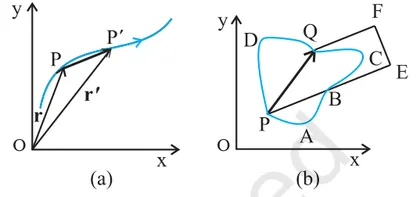
This chapter introduces motion in two dimensions, extending one-dimensional kinematics to vectors and planar trajectories. It emphasizes vector representation (magnitude and direction), vector algebra (addition, resolution into components, unit vectors), and differentiation/integration of vector quantities to obtain velocity and acceleration. Key physical situations studied are projectile motion, relative motion in a plane, and uniform circular motion; each illustrates the independence of orthogonal components and the use of kinematic equations in 2D. Importance: mastering this chapter builds the mathematical and conceptual tools needed for analyzing real-world motion (ballistics, satellite/vehicle motion, rotational systems) and is foundational for dynamics, electromagnetism, and engineering. Students will learn to represent and manipulate vectors, derive and use 2D kinematic equations, analyze projectile trajectories, solve relative-motion problems, understand centripetal acceleration and angular kinematics, interpret motion graphs in two dimensions, and apply these ideas to solve numerical and conceptual CBSE-level problems.
Learning Objectives
- Define scalar and vector quantities and give examples relevant to motion in a plane
- Distinguish between distance and displacement for two-dimensional motion
- Describe vector addition and subtraction using graphical (triangle and parallelogram) and analytical methods
- Resolve a vector into rectangular components and reconstruct the resultant from its components
- Apply kinematic equations in two dimensions to analyze projectile motion problems (time of flight, range, maximum height)
- Derive expressions for time of flight, maximum height and range for a projectile launched from level ground
- Calculate the trajectory equation of a projectile and determine the launch angle for maximum range
- Explain uniform circular motion and relate angular speed, linear speed and centripetal acceleration
Topics in this chapter
14 topics · tap a topic title to jump straight to it.
Introduction and Scalars vs Vectors
Introduction (Motion in a plane)
Motion in a plane (two‑dimensional motion) describes the change of position of a particle on a flat surface. The particle's position is specified by a position vector r = xi + yj (in Cartesian coordinates), where x and y are coordinates measured from an origin and i, j are unit vectors along x and y axes respectively. The path traced by the particle in the xy‑plane is called its trajectory.
Displacement and Distance
Distance is the total length of the path traveled (scalar, always positive). Displacement is the straight‑line vector from initial to final position: Δr = r_final − r_initial. Displacement has magnitude and direction.
Scalars vs Vectors
A scalar is a physical quantity described by magnitude only (e.g., mass, temperature, speed, time). A vector requires magnitude and direction (e.g., displacement, velocity, acceleration, force). Important vector properties: equality (same magnitude and direction), addition, subtraction and multiplication by scalars.
Vector representation and components
A vector A in the plane can be written as A = A_x i + A_y j. Its magnitude is |A| = sqrt(A_x^2 + A_y^2). The direction (angle with x‑axis) θ satisfies tan θ = A_y / A_x. To find components: A_x = |A| cos θ, A_y = |A| sin θ. A unit vector along A is â = A/|A|.
Vector addition
Vectors add according to the triangle or parallelogram law. If A and B are two vectors, the resultant R = A + B. In components: R_x = A_x + B_x, R_y = A_y + B_y, and |R| = sqrt(R_x^2 + R_y^2). Subtraction: A − B = A + (−B) (reverse direction of B).
Speed and Velocity
Speed (scalar) = total distance / time; average velocity (vector) = total displacement / time: v_avg = Δr / Δt. Instantaneous velocity is the derivative v = dr/dt; instantaneous speed is |v|. In plane motion the x and y components of velocity are v_x = dx/dt, v_y = dy/dt — motion in two dimensions splits into two independent one‑dimensional motions.
Why vectors matter
Many physical quantities (displacement, velocity, acceleration) depend on direction. Vector methods let us resolve problems into components, add contributions from different directions, and handle relative motion in a clear way.
- Walking: If you walk 3 km east then 4 km north, distance = 7 km (scalar) but displacement = 5 km northeast (vector) — computed using Pythagoras.
- Car motion: The speedometer shows speed (scalar). If the car reverses direction at same speed the velocity (vector) changes sign.
- Boat crossing a river: Boat velocity relative to water and river current (vector addition) determine the resultant path and landing point.
- Airplane and wind: Pilot must set heading so that the vector sum of airplane velocity (relative to air) and wind velocity gives the desired ground track.
- Projectile path: Trajectory in the xy‑plane can be obtained by combining independent x (constant velocity) and y (accelerated) components.
- Position vector: r = xi + yj
- Displacement: Δr = r_final − r_initial
- Vector components: A = A_x i + A_y j
- Magnitude: |A| = sqrt(A_x^2 + A_y^2)
- Direction: tan θ = A_y / A_x ; A_x = |A| cos θ ; A_y = |A| sin θ
- Resultant components: R_x = A_x + B_x ; R_y = A_y + B_y
Vector Representation and Basic Operations
Vectors vs Scalars: Scalars are quantities described by magnitude only (e.g., temperature, mass). Vectors have both magnitude and direction (e.g., displacement, velocity, force). A vector is usually depicted as an arrow: length ∝ magnitude, arrowhead gives direction.
Representation and Components: A vector A in 2D can be written in component form as A = A_x i + A_y j. In 3D: A = A_x i + A_y j + A_z k, where i, j, k are unit vectors along x, y, z axes. Magnitude: |A| = sqrt(A_x^2 + A_y^2 (+ A_z^2)). Direction angle(s): θ = arctan(A_y / A_x) (choose correct quadrant).
Unit Vector: Unit vector in the direction of A: â = A / |A|. Unit vectors have magnitude 1 and indicate direction.
Resolution of a Vector: Any vector can be resolved into orthogonal components. For a vector of magnitude A making angle θ with +x axis: A_x = A cosθ, A_y = A sinθ. This is used to convert between magnitude-angle form and component form.
Vector Addition and Subtraction: Addition: triangle, parallelogram or polygon rules. If A and B are vectors, resultant R = A + B. In components: R_x = A_x + B_x, R_y = A_y + B_y (and R_z for 3D). Subtraction: A - B = A + (−B) (reverse direction of B and add). Properties: A + B = B + A (commutative), A + (B + C) = (A + B) + C (associative).
Multiplication by a Scalar: For scalar k and vector A, kA has magnitude |k||A| and direction same as A if k>0, opposite if k<0. Distributive laws hold: k(A + B) = kA + kB.
Dot (Scalar) Product: A · B = |A||B| cosθ, where θ is the angle between A and B. In components: A · B = A_xB_x + A_yB_y (+ A_zB_z). The dot product is a scalar and gives projection information: component of A along B = (A · B)/|B|.
Cross (Vector) Product: A × B is a vector perpendicular to the plane of A and B with magnitude |A||B| sinθ and direction given by the right-hand rule. It is anti-commutative: A × B = −(B × A). In component form (using determinant): A × B = (A_yB_z − A_zB_y) i + (A_zB_x − A_xB_z) j + (A_xB_y − A_yB_x) k.
Position and Displacement Vectors: Position vector r locates a point: r = x i + y j (+ z k). Displacement between two points r_1 and r_2: Δr = r_2 − r_1 (a vector). Path length (distance) is not the same as displacement (vector).
Key Properties (summary): Equality of vectors requires same magnitude and direction. Vector algebra follows linear rules: addition commutative/associative, scalar multiplication distributive, dot product is bilinear and scalar, cross product is bilinear and anti-commutative.
- Displacement of a car: A car moves 3 km east then 4 km north. Resultant displacement = 3i + 4j km; magnitude = 5 km (3-4-5 triangle).
- Boat crossing a river: Boat velocity relative to water v_bw and current velocity v_w (to the east). Actual velocity relative to ground v_bg = v_bw + v_w (vector addition) — used to find drift and resultant speed.
- Two forces on an object: Force F1 at 30° and F2 at 120°. Resultant obtained by resolving each into components and adding: R_x = F1_x + F2_x, R_y = F1_y + F2_y.
- Relative velocity: If rain falls vertically at speed v_r and a person walks horizontally at v_p, the rain’s velocity relative to the person is v_r - v_p (vector subtraction) — used to find apparent direction of rain.
- Projection example: Component of velocity v = 10 m/s along a direction B is (v·B)/|B|; useful for work: work = F·s when force and displacement are at angle.
- |A| = sqrt(A_x^2 + A_y^2 (+ A_z^2))
- A = A_x i + A_y j (+ A_z k)
- A_x = |A| cosθ, A_y = |A| sinθ
- Unit vector: â = A / |A|
- Resultant (components): R_x = ΣA_x, R_y = ΣA_y
- Displacement: Δr = r_2 − r_1
Components, Resolution and Unit Vectors
Introduction
In two- or three-dimensional motion, any vector (displacement, velocity, acceleration, force) can be described by its components along mutually perpendicular axes. Resolution of a vector means splitting it into two or more component vectors whose vector sum equals the original vector. Unit vectors are vectors of length one that give direction.
Components and Resolution (Orthogonal axes)
For a vector V in the xy-plane that makes angle θ with the +x-axis, the rectangular (orthogonal) components are found by forming a right triangle:
- Vx = V cos θ (component along x-axis)
- Vy = V sin θ (component along y-axis)
The vector can be written in component form using unit vectors i and j:
V = Vx i + Vy j
Magnitude and direction from components:
- |V| = sqrt(Vx2 + Vy2)
- θ = arctan(Vy/Vx) (take care of the quadrant)
Negative components
Sign of a component indicates direction: e.g., Vx < 0 means the x-component points toward negative x direction.
Vector addition using components
To add vectors A and B, add corresponding components:
A + B = (Ax + Bx) i + (Ay + By) j. This is the simplest way to perform vector addition in coordinate form.
Unit Vectors
Unit vectors have magnitude 1 and indicate direction. Standard unit vectors in Cartesian coordinates are i (along +x), j (along +y) and k (along +z). Any vector R can be written as R = Rx i + Ry j + Rz k. The unit vector along R is û = R / |R|.
Projection on an arbitrary direction
The scalar projection (component) of V along a unit vector û is V·û (dot product). The vector projection is (V·û) û. This allows resolution along non-orthogonal or rotated axes.
Important properties
- Components are independent: motion along x does not affect motion along y (useful in projectile motion).
- Resolution is unique only when axes are fixed (especially orthogonal axes give simple formulas).
- Unit vectors are dimensionless and used to express direction; multiplying a unit vector by a scalar gives a vector with that magnitude in the given direction.
Summary
Resolution into components + unit vectors provide a systematic way to represent, add, and manipulate vectors in mechanics problems, simplifying analysis of motion and forces.
- Projectile motion: initial speed u at angle θ is resolved into u_x = u cosθ (horizontal, constant) and u_y = u sinθ (vertical, affected by gravity).
- Inclined plane: weight mg is resolved into components parallel (mg sinα) and perpendicular (mg cosα) to the plane to find normal force and acceleration down the slope.
- Boat crossing a river: boat velocity relative to water combined with river current yields resultant velocity. Resolve current and boat velocities into components to find net displacement.
- Wind effect on an airplane: a plane's airspeed vector plus wind velocity vector are resolved into components to find ground speed and track (navigation).
- V_x = V cosθ, V_y = V sinθ (for a vector V at angle θ from +x axis)
- |V| = sqrt(V_x^2 + V_y^2)
- θ = arctan(V_y / V_x) (adjust for quadrant)
- V = V_x i + V_y j (+ V_z k in 3D)
- Unit vector along V: û = V / |V|
- Scalar projection of V on unit vector û: V·û
Position and Displacement Vectors
Position vector: The position vector of a particle (often denoted by r) is a vector drawn from a fixed origin O to the particle's instantaneous location P in a coordinate system. It gives both the location of the particle and the direction from the origin. In two dimensions, if the coordinates of P are (x, y), the position vector is written as:
r = xi + yj.
The magnitude (distance from origin) is |r| = sqrt(x2 + y2) and its direction (angle with x-axis) is θ = arctan(y/x) (with quadrant checks).
Displacement vector: The displacement vector Δr between two events (or instants) is the vector change in position. If the position at time t1 is r1 and at time t2 is r2, then
Δr = r2 − r1.
In components, if r1 = x1i + y1j and r2 = x2i + y2j, then
Δr = (x2 − x1)i + (y2 − y1)j = Δxi + Δyj,
and its magnitude |Δr| = sqrt((Δx)2 + (Δy)2).
Key distinctions:
- Position is measured from a chosen origin; displacement is the change in position between two points in time.
- Both position and displacement are vectors (have magnitude and direction). Distance (path length) is a scalar and is generally ≥ |Δr|; equality holds only for straight-line motion between the two points.
- Displacement depends only on initial and final positions — it is independent of the path taken.
Vector operations and unit vectors: The unit vector along r is r̂ = r/|r|. Position and displacement vectors add/subtract using usual vector rules (graphical or component-wise).
Time dependence: If the particle's position varies with time, write r(t). The displacement over time interval Δt = t2 − t1 is Δr = r(t2) − r(t1). Instantaneous velocity is v = dr/dt (vector), introduced naturally from the position vector.
- Walking from home (point A) to a shop (point B) along a curved path: the displacement is the straight vector from A to B, while the distance is the total length walked.
- A car that starts at coordinates (0,0), moves to (4 km, 3 km): position vector r = 4i + 3j (km), displacement from origin is this vector and its magnitude is 5 km (3-4-5 triangle).
- An airplane flies around a holding pattern and returns to the same point: net displacement is zero even though the distance flown is large.
- A swimmer swims across a river from point P to Q downstream: displacement is the direct vector PQ, useful for navigation and GPS corrections.
- Using GPS, your device reports your current position vector relative to a mapped origin; route planning computes displacements between waypoints.
- Position vector (2D): r = x i + y j
- Magnitude of position: |r| = sqrt(x^2 + y^2)
- Direction angle: θ = arctan(y/x) (use correct quadrant)
- Displacement: Δr = r2 − r1 = Δx i + Δy j
- Magnitude of displacement: |Δr| = sqrt((Δx)^2 + (Δy)^2)
- Unit vector along r: r̂ = r / |r|
Scalar (Dot) Product and Projection
Overview: The scalar (dot) product is an operation that takes two vectors and returns a single number (scalar). It quantifies how much one vector goes in the direction of another. Projection uses this idea to find the component of one vector along the direction of another.
Geometric definition: For two vectors a and b with angle θ between them, the dot product is
a · b = |a| |b| cosθ.
This gives a scalar; its sign tells whether vectors point generally in the same (positive), opposite (negative) or perpendicular (zero) directions.
Algebraic (component) definition: If a = (a_x, a_y) and b = (b_x, b_y) in 2‑D (or include z components in 3‑D), a · b = a_x b_x + a_y b_y ( + a_z b_z). This formula is used for calculations in coordinate form.
Scalar projection (component): The scalar projection (also called component) of a on b is the signed length of a along the direction of b: comp_b(a) = |a| cosθ = (a · b) / |b|. It is positive when a has a component in the direction of b, negative if opposite, zero if perpendicular.
Vector projection: The vector projection of a onto b (the actual vector along b) is proj_b(a) = ((a · b) / |b|^2) b. This yields a vector parallel to b whose magnitude equals the scalar projection.
Key properties (for vectors a, b, c and scalar k):
- a · b = b · a (commutative)
- (ka) · b = k(a · b)
- a · (b + c) = a · b + a · c (distributive)
- a · a = |a|^2
- a · b = 0 ⇔ a ⟂ b (orthogonality)
Physical meaning and use:
- Work: If a constant force F acts and an object is displaced by s, the work done W = F · s = |F||s|cosθ (θ is angle between force and displacement). Only the component of force along the displacement does work.
- Component of velocity along a direction (useful on inclines or along roads): use scalar projection to find how fast you move along that direction.
- Computer graphics and lighting: brightness depends on the dot product of surface normal and light direction (cosine law).
How to compute:
- If vectors are given in components, use a_x b_x + a_y b_y (+ a_z b_z).
- If magnitudes and angle given, use |a||b|cosθ.
- To get projection length of a on b: (a · b)/|b|. To get projection vector: ((a · b)/|b|^2) b.
Quick example (conceptual): A force of 10 N acts at 30° to the horizontal while an object is displaced 5 m horizontally. Work = F · s = (10 N)(5 m)cos30° = 50 × (√3/2) ≈ 43.3 J.
Summary: The dot product connects geometry (angle) and algebra (components); projection extracts the part of one vector along another and is found directly from the dot product.
- Work done by a force at an angle: A force F = 10 N applied at 30° to the horizontal moves an object 5 m horizontally. Work W = F·s = 10 × 5 × cos30° ≈ 43.3 J.
- Wind component along runway: If wind vector v = (8, 3) m/s and runway direction unit vector u = (0.6, 0.8), the headwind/tailwind speed = v·u = 8×0.6 + 3×0.8 = 4.8 + 2.4 = 7.2 m/s.
- Projection of velocity on incline: A car velocity v = (12, 0) m/s on flat, incline direction b has unit vector (cosθ, sinθ); component along incline = v·b = 12 cosθ.
- Lighting in graphics: Light intensity on a surface ∝ n·l, where n is surface normal and l is light direction (both unit vectors). If angle = 60°, intensity ∝ cos60° = 0.5.
- a · b = |a| |b| cosθ
- a · b = a_x b_x + a_y b_y ( + a_z b_z)
- cosθ = (a · b) / (|a| |b|)
- Scalar projection of a on b: comp_b(a) = (a · b) / |b| = |a| cosθ
- Vector projection of a on b: proj_b(a) = ((a · b) / |b|^2) b
- Work: W = F · s = |F||s| cosθ
Velocity in Two Dimensions
Introduction: Velocity in two dimensions describes how fast and in what direction a particle moves on a plane. Position is a vector r = x i + y j. Motion in a plane is treated by resolving vectors into orthogonal components (usually x and y) which evolve independently (if forces separate similarly).
Displacement and Average Velocity: For a time interval Δt the displacement is Δr = r(t + Δt) − r(t). The average velocity is a vector: v_avg = Δr / Δt. Its direction is the direction of the net displacement.
Instantaneous Velocity: The instantaneous velocity is the time derivative of position: v(t) = dr/dt = v_x(t) i + v_y(t) j, where v_x = dx/dt and v_y = dy/dt. The speed is the magnitude: v = |v| = sqrt(v_x^2 + v_y^2). The direction (measured from +x) is θ = arctan(v_y / v_x) (take quadrant into account).
Component Independence: In many problems (e.g., projectile motion under uniform gravity), x- and y-components are independent: x-motion may be uniform (no acceleration) while y-motion may be uniformly accelerated. This allows solving two 1D problems and recombining their vector results.
Relative Velocity: Velocity is frame-dependent. The velocity of A relative to B is v_{A/B} = v_A − v_B. This is used for problems like a boat in a flowing river or an airplane in wind.
Geometric picture: Instantaneous velocity is tangent to the trajectory. For circular motion the velocity vector rotates while its magnitude may be constant (uniform circular motion) — the tip of the velocity vectors plotted head-to-tail traces a curve called a hodograph.
- Projectile: A ball thrown at initial speed u and angle θ. Components: v_x = u cosθ (constant), v_y = u sinθ − g t. The trajectory y(x) is parabolic.
- Car on a curved road: The car's instantaneous velocity vector is tangent to its path; speed and direction may both change.
- Riverboat crossing: Boat's velocity relative to water plus current (wind) gives resultant velocity relative to shore; use vector addition to find drift and crossing time.
- Airplane with wind: Ground velocity = airspeed vector + wind velocity vector; used to compute required heading to maintain a desired track.
- Uniform circular motion: Speed constant but velocity changes direction; v = ω R and v is always tangent to the circle.
- Satellite orbits (approx.): Instantaneous velocity is tangent to orbit; components change continuously, magnitude relates to orbital speed.
- Position vector: r = x i + y j
- Displacement: Δr = r(t+Δt) − r(t)
- Average velocity: v_avg = Δr / Δt
- Instantaneous velocity: v(t) = dr/dt = v_x i + v_y j
- Components: v_x = dx/dt, v_y = dy/dt
- Speed (magnitude): v = sqrt(v_x^2 + v_y^2)
Acceleration in Two Dimensions
Definition: In two dimensions, acceleration is the rate of change of the velocity vector with time. If the position vector is r(t) = x(t) i + y(t) j, then the velocity v = dr/dt and the acceleration a = dv/dt = d^2r/dt^2.
Component form: Acceleration is naturally expressed in components: a = a_x i + a_y j where a_x = d^2x/dt^2 and a_y = d^2y/dt^2. The magnitude and direction are
- Magnitude: a = sqrt(a_x^2 + a_y^2)
- Direction (angle with x-axis): tan(theta) = a_y / a_x
Vector relation with position and speed: a = dv/dt = d^2r/dt^2. This means acceleration can change the speed (magnitude of v) and/or the direction of v.
Tangential and normal (centripetal) components: For motion along a curved path it is useful to decompose a into two orthogonal components:
- a_t (tangential) = dv/dt — the component of acceleration along the instantaneous velocity direction, responsible for change in speed.
- a_n (normal) = v^2 / R — the component perpendicular to velocity (toward center of curvature), responsible for change in direction. R is the radius of curvature of the path.
So a = a_t t_hat + a_n n_hat and |a| = sqrt(a_t^2 + a_n^2). In uniform circular motion a_t = 0 and a_n = v^2/R (directed to the centre).
Special case — projectile motion: For a projectile near Earth (neglecting air resistance) acceleration is constant and vertical: a = 0 i + (−g) j where g ≈ 9.8 m/s^2. Hence a_x = 0 (horizontal velocity constant) and a_y = −g (vertical velocity changes uniformly).
Interpretation: In two dimensions acceleration describes how both components of velocity change. A nonzero a_x changes horizontal speed; a nonzero a_y changes vertical speed. A vector a not parallel to v produces curvature by changing direction.
How to solve problems: 1) Write r(t) or v(t) in components. 2) Differentiate components to get a_x and a_y. 3) If asked, compute magnitude and angle, or decompose into tangential/normal using v and its derivative.
- Car turning on a curved road: centripetal acceleration (a_n = v^2/R) points toward the curve center; braking or accelerating adds tangential acceleration a_t = dv/dt.
- Projectile motion (stone thrown): acceleration is constant downward (0, −g). Horizontal velocity remains constant while vertical velocity changes linearly with time.
- A satellite in circular orbit: acceleration is centripetal and of magnitude v^2/r (or GM/r^2) directed toward Earth center.
- A ball swung on a string: speed may be constant (pure centripetal acceleration) or changing (both tangential and normal components present).
- Car on a banked curve: normal and frictional forces produce the required centripetal acceleration; tangential component changes speed if throttle/brakes act.
- r(t) = x(t) i + y(t) j
- v(t) = dr/dt = v_x i + v_y j, where v_x = dx/dt, v_y = dy/dt
- a(t) = dv/dt = d^2r/dt^2 = a_x i + a_y j, where a_x = d^2x/dt^2, a_y = d^2y/dt^2
- Magnitude: a = sqrt(a_x^2 + a_y^2)
- Direction: tan(theta) = a_y / a_x
- Tangential component: a_t = dv/dt
Kinematic Equations in Vector Form
What it describes: Kinematic equations in vector form give the position, velocity and acceleration of a particle moving in a plane while keeping track of both magnitude and direction. They are especially useful when acceleration is constant (uniform acceleration) and when motion is treated as two independent component motions (usually x and y).
Definitions and relations (vector form):
- Position vector r(t) = x(t) i + y(t) j.
- Velocity vector v(t) = dr/dt.
- Acceleration vector a(t) = dv/dt = d^2r/dt^2.
For constant acceleration a (a is a constant vector):
- Integrating a = dv/dt gives v(t) = v0 + a t. (vector equation)
- Integrating v = dr/dt gives r(t) = r0 + v0 t + (1/2) a t2. (vector equation)
- Using dot product one gets v·dv/dt = a·v ⇒ v2 = v02 + 2 a·(r − r0). This is the vector form of the v² relation.
Component form (useful in a plane):
- x(t) = x0 + v0x t + (1/2) ax t2, vx(t) = v0x + ax t
- y(t) = y0 + v0y t + (1/2) ay t2, vy(t) = v0y + ay t
Key points to remember: (1) For constant a, motion in x and y are independent and can be solved separately. (2) The vector v is tangent to the trajectory; acceleration may have tangential (change speed) and normal (change direction) components. (3) If acceleration direction changes (e.g., circular motion), use instantaneous vectors and decompose a into atangential and anormal. (4) For non-constant a(t), use v(t)=v0+∫a(t) dt and r(t)=r0+∫v(t) dt.
- Projectile motion: A ball thrown at angle θ with initial speed v0. Use r(t)=r0+v0 t + (1/2) a t^2 with a = −g j to get x(t) and y(t); eliminate t to obtain the parabolic trajectory y(x).
- Car accelerating on a straight road: Treat motion as 1D vector along road. With constant engine acceleration a, v(t)=v0+at and x(t)=x0+v0 t + ½ a t^2 give speed and position vs time.
- Boat crossing a river (relative velocity): Velocity of boat relative to water v_b and velocity of river v_r add as vectors: v_ground = v_b + v_r. Use components to find resultant path and time to cross.
- Uniform circular motion (direction-changing acceleration): Position r(t) rotates; velocity v is tangent, acceleration a is normal (centripetal) and equals v^2/R toward center. Vector form emphasizes direction change even if speed is constant.
- r(t) = r0 + v0 t + (1/2) a t^2 (vector form, constant acceleration)
- v(t) = v0 + a t (vector form)
- a = dv/dt , v = dr/dt
- v·dv/dt = a·v ⇒ v^2 = v0^2 + 2 a·(r − r0) (dot-product form)
- Component forms: x(t)=x0+v0x t + ½ ax t^2, y(t)=y0+v0y t + ½ ay t^2
- Component velocities: v_x(t)=v0x+ax t, v_y(t)=v0y+ay t
Projectile Motion
What is a projectile? A projectile is any object that, after an initial launch, moves only under the influence of gravity (neglecting air resistance). Projectile motion is the two-dimensional motion of such an object under constant acceleration g directed vertically downward.
Key idea — independence of motions: Projectile motion can be treated as two independent motions: (1) uniform motion in the horizontal direction with constant velocity, and (2) uniformly accelerated motion in the vertical direction with acceleration −g.
Initial conditions and components: If a projectile is launched from origin with initial speed u at angle θ above horizontal, resolve initial velocity into components: u_x = u cosθ (constant), u_y = u sinθ (initial vertical component).
Equations of motion (vector form):
x(t) = u cosθ · t
y(t) = u sinθ · t − (1/2) g t^2
v_x(t) = u cosθ
v_y(t) = u sinθ − g t
Trajectory (eliminate t):
y(x) = x tanθ − (g x^2) / (2 u^2 cos^2θ)
This is a parabola opening downward.
Important derived results (for landing at same vertical level from which it was launched):
- Time of flight (total time in air): T = 2 u sinθ / g
- Maximum height (highest y reached): H_max = (u^2 sin^2θ) / (2 g)
- Horizontal range (horizontal distance covered): R = (u^2 sin 2θ) / g
Remarks and properties:
- Trajectory is symmetric: the ascent and descent times about the peak are equal.
- Horizontal velocity is constant; vertical velocity changes linearly with time (v_y = u sinθ − g t).
- Range is maximum when sin 2θ = 1 → 2θ = 90° → θ = 45° (for level launch and landing).
- Two different angles θ and (90° − θ) give the same range for a given speed u (complementary angles).
- All formulas above assume uniform gravity, negligible air resistance, and a flat horizontal landing plane.
Velocity at any time: The instantaneous speed is the magnitude of velocity vector:
v(t) = sqrt[(u cosθ)^2 + (u sinθ − g t)^2]
θ_v(t) = arctan[(u sinθ − g t) / (u cosθ)]  (angle of velocity with horizontal)
Extensions (brief): If launch and landing heights differ, solve y(t) = y_final to get the flight time(s) and then x = u cosθ · t to get range. Air resistance, wind, or non-uniform g require more advanced treatment.
Typical derivations (outline): For T use y(T)=0 → u sinθ T − 1/2 g T^2 = 0 → T( u sinθ − 1/2 g T) = 0 → T = 2 u sinθ/g. For R use R = u cosθ · T → R = u cosθ · (2 u sinθ/g) = u^2 sin2θ/g.
- A ball thrown at an angle — e.g., tossing a ball to a friend: the ball follows a parabolic path.
- Kicking a football (soccer) to clear defenders — choosing the angle and speed determines range and height.
- Water from a garden hose or fountain — streams form parabolic trajectories (neglecting air drag).
- Projectile in sports: javelin throw, shot put, high jump approach trajectories (idealized).
- Artillery and cannon shells (simplified) — classic application in aiming and maximum range.
- Sprinkler jets and water fountains used to illustrate different launch angles producing different ranges.
- Horizontal position: x(t) = u cosθ · t
- Vertical position: y(t) = u sinθ · t − (1/2) g t^2
- Horizontal velocity: v_x = u cosθ (constant)
- Vertical velocity: v_y(t) = u sinθ − g t
- Trajectory (y vs x): y = x tanθ − (g x^2) / (2 u^2 cos^2θ)
- Time of flight (same level): T = 2 u sinθ / g
Motion on Inclined Planes (2D projection variants)
Overview
Motion on an inclined plane in 2D covers two related situations: (A) an object moving (or sliding) on the plane under gravity (useful for resolving g into components), and (B) projectile motion where the trajectory is relative to an inclined plane (projectile launched from or toward a slope). For CBSE Class 11 the important concept is choosing convenient axes (usually one axis along the plane and the other perpendicular), resolving velocity and acceleration into those axes, and using kinematic equations to get range, time of flight and velocity components.
Key idea — axis rotation
If the incline makes an angle β with the horizontal, it is often easiest to rotate axes so x' is along the plane (up the slope) and y' is perpendicular to it (out of the plane). Gravity g (vertically downward) then has components along these axes:
- Along the plane (down slope): a_x' = −g sinβ
- Perpendicular to the plane (into plane): a_y' = −g cosβ
Projectile launched from the plane
Suppose a projectile is launched from the plane with speed u at an angle φ above the plane (so the angle with horizontal is α = φ + β). Initial components in the rotated axes are u_x' = u cosφ, u_y' = u sinφ. Using kinematic equations:
- y'(t) = u sinφ · t − (1/2) g cosβ · t²
- x'(t) = u cosφ · t − (1/2) g sinβ · t²
For launch from the plane, the projectile returns to the plane when y'(t) = 0 (nonzero t), giving time of flight t = 2u sinφ / (g cosβ). Plugging into x'(t) gives the range along the plane.
Range along the plane (measured along slope)
If the same launch is described by α measured from horizontal, the range s (distance along the plane from launch point to impact on the plane) is:
s = (2 u² cosα · sin(α − β)) / (g cos²β)
Equivalently, in terms of φ (angle above the plane):
s = (2 u² cos(φ + β) · sinφ) / (g cos²β)
Time of flight (when launched from plane)t = 2 u sinφ / (g cosβ)
Maximum range on an inclined plane
For fixed speed u and incline β, s is maximized when the launch angle α (w.r.t horizontal) satisfies
α_max = 45° + β/2
Substituting gives maximum range along the plane
s_max = (u² / (g cos²β)) · (1 − sinβ)
Alternate viewpoint (intersection method)
Treat projectile in standard horizontal/vertical coordinates: x = u cosα t, y = u sinα t − (1/2) g t². The inclined plane (through origin) has equation y = x tanβ. Equate y and x tanβ, solve for t (nonzero root), then compute distance along plane s = x / cosβ. This yields the same range formula above.
Important practical notes
- When launching uphill (α close to β), sin(α − β) becomes small and range short; launching too steep reduces horizontal component.
- If launching from a height above or below the plane (not at plane origin), include the plane offset in the intersection equation and solve the quadratic for t.
- For block or object constrained to move on the incline (no projectile), you only need the scalar components of acceleration: along-plane acceleration = g sinβ (downwards if no other forces).
- A ball is thrown from the top of a hill (incline β) with speed u at angle φ above the surface; find time of flight and range along the hill using t = 2u sinφ/(g cosβ) and s = (2u² cos(φ+β) sinφ)/(g cos²β).
- Maximizing range: For a given speed u from a slope of angle β, the launch angle (with horizontal) for maximum slope-range is α_max = 45° + β/2 (so measured above horizontal).
- A car on an inclined road: decompose gravity into g sinβ along the road (causing tendency to roll down) and g cosβ normal to road (affecting normal reaction).
- A water jet hitting a sloped roof: treat the jet as a projectile and compute where along the slope it lands by solving y = x tanβ intersection.
- Gravity components with incline angle β: a_parallel = −g sinβ (down plane), a_perp = −g cosβ (into plane).
- Rotation relation: if launch angle from horizontal is α and from plane is φ, then α = φ + β.
- Equations in rotated axes (x' along plane, y' perpendicular): x'(t) = u cosφ · t − (1/2) g sinβ · t², y'(t) = u sinφ · t − (1/2) g cosβ · t².
- Time of flight (launch from plane): t = 2 u sinφ / (g cosβ).
- Range along the plane (launch from plane): s = (2 u² cosα · sin(α − β)) / (g cos²β) = (2 u² cos(φ + β) · sinφ) / (g cos²β).
- Maximum-range angle (w.r.t horizontal): α_max = 45° + β/2.
Uniform Circular Motion
Definition: Uniform circular motion (UCM) is motion of a particle along a circular path with constant speed. Although the speed is constant, the velocity is not constant because its direction continuously changes.
Key features:
- Path: a circle of fixed radius r.
- Speed v: constant in magnitude.
- Velocity v⃗ : always tangent to the circle (perpendicular to the radius at each point).
- Acceleration a⃗ : directed toward the centre of the circle (centripetal), with constant magnitude but continuously changing direction.
- Angular speed ω: constant (rate of change of angular position θ).
Position, velocity and acceleration (parametric form):
Choose origin at centre and let r be the radius. For constant angular speed ω, the angular position is θ(t)=ωt+θ₀ and the position vector is
r⃗(t)=r(cosωt, sinωt).
Velocity: v⃗ (t)=d r⃗/dt = r(−ω sinωt, ω cosωt) = ω×r⃗ (magnitude v=ωr, direction tangent).
Acceleration: a⃗ (t)=d v⃗/dt = r(−ω² cosωt, −ω² sinωt) = −ω² r⃗ (directed radially inward). Its magnitude a_c = ω² r = v²/r.
Derivation (sketch) of centripetal acceleration: For a small angular change Δθ, the change in velocity |Δv| ≈ vΔθ (because velocity vector rotates by Δθ). Then average acceleration ≈ |Δv|/Δt = v(Δθ/Δt) = vω. Since ω = v/r, a = v²/r.
Physical points:
- Centripetal acceleration requires a net inward force F_c = m a_c (provided by tension, gravity component, friction, normal force, etc.).
- No work is done by centripetal force (force is perpendicular to instantaneous displacement), so kinetic energy and speed remain constant.
- In a rotating (non-inertial) frame a fictitious outward 'centrifugal' force m v²/r can be introduced to explain apparent effects.
- A car moving at constant speed along a circular track (friction provides the centripetal force).
- A satellite in a circular orbit around Earth (gravitational force acts as centripetal force).
- A stone tied to a string and whirled in a horizontal circle (tension in the string provides centripetal force).
- A Ferris wheel rotating at constant angular speed (passengers move in UCM).
- Centrifuge in a laboratory spinning samples (apparent centrifugal effect separates substances).
- Tip of a clock's second hand (moves with nearly uniform circular motion).
- Linear/angular relationship: s = r θ
- Linear speed: v = ω r
- Angular speed: ω = dθ/dt (constant in UCM)
- Period: T = 2π/ω
- Frequency: f = 1/T = ω/(2π)
- Centripetal acceleration (magnitude): a_c = v²/r = ω² r
Relative Motion in Two Dimensions
What it is
Relative motion in two dimensions studies how the position, velocity and acceleration of one object appear when observed from another moving object, using vector subtraction. Observations depend on the chosen reference frame (observer). For two observers A and B, the position of A relative to B is r_{A/B} = r_A - r_B. Differentiating with respect to time gives relative velocity and acceleration.
Key vector relations
- Relative position: r_{A/B}(t) = r_A(t) - r_B(t)
- Relative velocity: v_{A/B} = v_A - v_B
- Relative acceleration: a_{A/B} = a_A - a_B
Galilean transformation
If frame B moves with constant velocity V relative to an inertial frame S, then coordinates transform as r_S = r_B + r_{S/B}. For constant V the time derivatives are simple differences of velocities. (Rotating frames are not covered here.)
Component method
Resolve vectors into x and y components and subtract components: v_{A/B,x} = v_{A,x} - v_{B,x}, v_{A/B,y} = v_{A,y} - v_{B,y}. Then |v_{A/B}| = sqrt((v_{A/B,x})^2 + (v_{A/B,y})^2).
Magnitude formula (using law of cosines)
If the speeds v_A and v_B make angle θ between them, then |v_{A/B}| = sqrt(v_A^2 + v_B^2 - 2 v_A v_B cos θ).
Solving strategy (stepwise)
- Choose a reference frame (often ground or one of the objects).
- Draw vector diagram of velocities; label magnitudes and angles.
- Resolve into components or form velocity triangle.
- Compute relative components: subtract corresponding components.
- Find magnitude and direction of relative vector if needed.
Important notes
- If the reference frame moves with constant velocity (inertial shift), accelerations are identical in both frames (a_A = a_{A/B} + a_B).
- Relative motion is purely vector subtraction; order matters (v_{A/B} = v_A - v_B, not vice versa).
- For problems like crossing a river or an airplane in wind, use component subtraction to find ground velocity and drift.
- Boat crossing a river: boat speed relative to water v_{B/W} and water speed v_{W/G} (fluid relative to ground). Ground velocity of boat v_{B/G} = v_{B/W} + v_{W/G}. Use components to find downstream drift and effective speed across.
- Airplane in wind: if plane's airspeed is v_plane (relative to air) and wind velocity is v_wind (relative to ground), the ground velocity is v_ground = v_plane + v_wind. Pilot must point into the wind to maintain a desired ground track.
- Person walking inside a moving train: if the train moves at 60 km/h and a person walks forward at 5 km/h relative to the train, the person’s speed relative to ground is 65 km/h (vector addition along same line). If walking sideways on the train, use components to find resultant ground velocity.
- Rain streaks observed from a moving car: raindrop velocity relative to ground v_r and car velocity v_c. Relative velocity of rain seen by driver v_{r/c} = v_r - v_c; angle of streaks gives direction and magnitude of relative velocity.
- Two cars in different directions: to find how fast car A is moving away from car B, compute v_{A/B} = v_A - v_B and take its magnitude; direction tells the instantaneous separation direction.
- \[r_{A/B}(t) = r_A(t) - r_B(t)\]
- \[v_{A/B}(t) = dr_{A/B}/dt = v_A(t) - v_B(t)\]
- \[a_{A/B}(t) = d^2 r_{A/B}/dt^2 = a_A(t) - a_B(t)\]
- \[Componentwise: v_{A/B,x} = v_{A,x} - v_{B,x}\]\[v_{A/B,y} = v_{A,y} - v_{B,y}\]
- \[Magnitude: |v_{A/B}| = sqrt((v_{A/B,x})^2 + (v_{A/B,y})^2)\]
- \[If angle between v_A and v_B is θ: |v_{A/B}| = sqrt(v_A^2 + v_B^2 - 2 v_A v_B cos θ)\]
Graphical Analysis of Plane Motion
Overview: Graphical analysis of plane motion studies how position, velocity and acceleration of a particle moving in a plane (two dimensions) are represented and interpreted using graphs. Plane motion is treated component-wise: break vectors into x- and y-components, draw separate time-graphs for each component, and reconstruct vector behaviour from those component graphs.
Vectors and components: Represent the position vector r = xi + yj as an arrow from origin to point (x,y). Its x- and y-projections are the component vectors. Graphical vector addition uses tip-to-tail or parallelogram rules.
From graphs to kinematics:
- x(t), y(t) (position vs time): slope at a time = instantaneous velocity component (dx/dt or dy/dt). Area under these curves is not commonly used; rather, integration of velocity components gives position change.
- vx(t), vy(t) (velocity components vs time): slope = acceleration component (dvx/dt or dvy/dt). Area under vx(t) between t1 and t2 = Δx; area under vy(t) = Δy.
- a_x(t), a_y(t) (acceleration components vs time): area under acceleration curve = change in corresponding velocity component.
- Speed |v|(t): magnitude of velocity; equals sqrt(vx2 + vy2). Its graph often differs from component graphs; its slope is not simply component acceleration.
Parametric and trajectory plots: Many plane motions are parametric: x = x(t), y = y(t). Eliminating t yields trajectory y(x) (e.g., a parabola for projectile motion). The shape of y vs x gives the path; tangent to the path gives direction of velocity vector.
Special cases:
- Projectile motion (no air resistance): x(t) = v0 cosθ · t (linear), y(t) = v0 sinθ · t − (1/2) g t2 (parabolic). So vx = constant, vy = v0 sinθ − g t (linear).
- Uniform circular motion (in plane): x(t) = R cos(ωt), y(t) = R sin(ωt). x and y vary sinusoidally; vx and vy are also sinusoidal and shifted in phase by 90°; acceleration components are −Rω2 cos(ωt) and −Rω2 sin(ωt).
How to analyze a given plane-motion graph:
- Separate motion into x and y components and draw/inspect their individual graphs.
- Find instantaneous component velocities from slopes of x(t) and y(t).
- Find component accelerations from slopes of vx(t) or by differentiating vx, vy.
- Compute displacement in each direction from area under vx(t) and vy(t) curves (or integrate analytically).
- Get vector magnitude and direction: |v| = sqrt(vx2+vy2), angle φ = arctan(vy/vx).
Practical tips for graphs: Use parametric plotting (x vs t and y vs t) and trajectory plotting (y vs x). Always mark axes, scales, and sign conventions (up/down, right/left). When reading instantaneous values on curves, draw a tangent; slope of tangent gives the instantaneous rate.
- Throwing a ball: analyze x(t) and y(t) separately. x(t) is linear if horizontal speed is constant; y(t) is parabolic due to gravity.
- Boat crossing a river: velocity of boat relative to water + velocity of current gives resultant path (graph vx and vy to find drift and crossing time).
- Drone flying with constant speed while changing heading: trajectory in the plane can be plotted; vx(t) and vy(t) show how components change with steering.
- Ferris wheel (uniform circular motion): x(t) and y(t) are sinusoidal; speed is constant, acceleration points toward centre (centripetal).
- Football free kick: trajectory y(x) is a parabola; range, max height and flight time can be read from component graphs.
- Position vector: r = x i + y j
- Velocity vector: v = dr/dt = vx i + vy j ; where vx = dx/dt, vy = dy/dt
- Acceleration vector: a = dv/dt = ax i + ay j ; where ax = dvx/dt, ay = dvy/dt
- Speed: |v| = sqrt(vx^2 + vy^2)
- \[Displacement components from area: Δx = ∫_{t1}^{t2} vx(t) dt , Δy = ∫_{t1}^{t2} vy(t) dt\]
- Projectile (no air resistance): x(t) = v0 cosθ · t , y(t) = v0 sinθ · t − (1/2) g t^2
Problem-Solving Strategies and Applications
Overview: Problem-solving in motion in a plane reduces two-dimensional motion to one-dimensional component problems using vectors. Treat position, velocity and acceleration as vectors, pick convenient axes, resolve vectors into components, apply kinematic equations separately in x- and y-directions, and combine results.
Step-by-step strategy:
- Read the problem carefully and identify what is given and what is required.
- Draw a clear diagram showing the path (trajectory), initial and final points, and all vectors (u, v, a, r). Mark angles and choose axes (usually x horizontal, y vertical).
- Resolve initial velocity and acceleration into components: u = u_x i + u_y j, a = a_x i + a_y j.
- Write kinematic equations for each component (x and y) independently, since for constant acceleration components evolve independently.
- Use symmetry, eliminate the time variable when needed (e.g., to get trajectory y(x)), and check limiting cases (θ = 0, small/large u) to validate answers.
- Consider alternate approaches: energy methods (when heights/speeds matter), centripetal/rotational relations (for circular motion), or relative velocity (moving frames).
- Always check units and signs, and sketch the motion and vector directions to ensure consistency.
Key ideas to apply:
- Independent-component treatment: motion in x and y governed by the same one-dimensional formulas.
- Eliminate time by solving one component for t and substituting into the other to obtain trajectory equations.
- Use geometry or symmetry to find maxima, ranges, and times of flight for projectiles.
- For curved motion, velocity is tangent to the path and acceleration has tangential (change of speed) and normal/centripetal (change of direction) components.
Common pitfalls: forgetting to resolve vectors, mixing signs for acceleration (take g = +9.8 m/s^2 downward or use -g in y-equations), using equations valid only for constant acceleration, and ignoring horizontal vs vertical independence.
- Projectile: A ball thrown with speed u at angle θ. Resolve u into u_x = u cosθ and u_y = u sinθ, use x = u_x t and y = u_y t − ½ g t^2 to get trajectory y(x) = x tanθ − (g x^2)/(2 u^2 cos^2θ). Time of flight T = 2 u sinθ / g, maximum height H = u^2 sin^2θ /(2 g), range R = u^2 sin2θ / g.
- Horizontal launch: A stone projected horizontally from height h with speed u. Horizontal motion: x = u t. Vertical motion: y = h − ½ g t^2. Find time to hit ground t = sqrt(2h/g) and range x = u sqrt(2h/g).
- Motion on incline (plane): Break gravity into components along/normal to plane: g_parallel = g sinα, g_perp = g cosα. Use s = u t + ½ (−g sinα) t^2 along the plane.
- Uniform circular motion: A point moves with speed v on a circle of radius r. Centripetal acceleration a_c = v^2 / r directed radially inward. Use v = ω r to connect angular and linear quantities.
- Relative motion: A swimmer aiming across a river with velocity relative to water u and river speed v_r. Resolve velocities and use vector addition to find resultant drift and time to cross.
- Vector kinematics (constant acceleration): r = r_0 + v_0 t + (1/2) a t^2
- Components: x = x_0 + u_x t + (1/2) a_x t^2, y = y_0 + u_y t + (1/2) a_y t^2
- Velocity components: v_x = u_x + a_x t, v_y = u_y + a_y t
- Eliminating time (trajectory): y(x) = x tanθ − (g x^2)/(2 u^2 cos^2θ) for projectile launched at speed u and angle θ
- Time of flight (projectile, landing at same level): T = 2 u sinθ / g
- Maximum height: H = u^2 sin^2θ / (2 g)
Key Concepts
- Scalar
- A physical quantity that has magnitude only and no direction.
- Vector
- A physical quantity that has both magnitude and direction and is represented by an arrow or ordered components.
- Position vector
- A vector that specifies the location of a point relative to an origin in a chosen coordinate system.
- Displacement
- The vector change in position of a particle; it depends only on initial and final positions.
- Distance
- The total path length traveled by a particle; a scalar and always nonnegative.
- Speed
- The rate of change of distance with time; a scalar (average speed = total distance / total time).
- Velocity
- The rate of change of position (displacement) with time; a vector (v = dr/dt).
- Average velocity
- Total displacement divided by the total time interval (Δr/Δt).
- Instantaneous velocity
- The velocity of a particle at a specific instant, given by the time derivative of position.
- Acceleration
- The rate of change of velocity with time; a vector (a = dv/dt).
- Average acceleration
- Change in velocity divided by the time interval over which the change occurs (Δv/Δt).
- Instantaneous acceleration
- The acceleration of a particle at a particular instant, equal to the time derivative of velocity.
- Trajectory
- The path followed by a particle as it moves through space in the plane.
- Projectile motion
- Motion of an object under gravity (neglecting air resistance), typically in two dimensions with constant vertical acceleration -g.
- Range (projectile)
- The horizontal distance traveled by a projectile between launch and landing on the same level.
- Time of flight
- Total time a projectile remains in the air until it returns to its initial vertical level.
- Maximum height
- The greatest vertical displacement reached by a projectile above its launch level.
- Uniform circular motion
- Motion in a circle at constant speed; direction of velocity changes continuously though magnitude stays constant.
- Centripetal acceleration
- Acceleration directed toward the center of the circle in circular motion; magnitude a_c = v²/r or ω²r.
- Relative velocity
- Velocity of one object as observed from another moving object; v_rel = v_B - v_A.
End-of-Chapter Trial Paper & Test Questions
Topic-wise questions to test your understanding of every concept in this chapter.
-
Resolve a vector A of magnitude A making angle θ with the x-axis into rectangular components and give its magnitude in terms of the components. / x-अक्ष से कोण θ बनाने वाले परिमाण A के सदिश A को आयताकार घटकों में वियोजित कीजिए और घटकों के पदों में इसका परिमाण लिखिए।
Show answer
The components are A_x = A cosθ and A_y = A sinθ, so A = A_x î + A_y ĵ. Its magnitude is |A| = √(A_x² + A_y²) and direction tanθ = A_y/A_x. / घटक A_x = A cosθ और A_y = A sinθ हैं, अतः A = A_x î + A_y ĵ। इसका परिमाण |A| = √(A_x² + A_y²) और दिशा tanθ = A_y/A_x है।
-
A person walks 3 km east and then 4 km north. Find the magnitude and direction of the displacement. / एक व्यक्ति 3 km पूर्व और फिर 4 km उत्तर चलता है। विस्थापन का परिमाण और दिशा ज्ञात कीजिए।
Show answer
Displacement = 3î + 4ĵ km; magnitude = √(3² + 4²) = 5 km. Direction θ = arctan(4/3) ≈ 53° north of east. / विस्थापन = 3î + 4ĵ km; परिमाण = √(3² + 4²) = 5 km। दिशा θ = arctan(4/3) ≈ पूर्व से 53° उत्तर।
-
Explain why projectile motion can be treated as two independent motions. / प्रक्षेप्य गति को दो स्वतंत्र गतियों के रूप में क्यों माना जा सकता है, समझाइए।
Show answer
The horizontal and vertical components of motion are independent: the horizontal motion is uniform (no acceleration), while the vertical motion is uniformly accelerated due to gravity (−g). Each can be solved separately and recombined. / गति के क्षैतिज और ऊर्ध्वाधर घटक स्वतंत्र होते हैं: क्षैतिज गति एकसमान होती है (कोई त्वरण नहीं), जबकि ऊर्ध्वाधर गति गुरुत्व (−g) के कारण एकसमान त्वरित होती है। प्रत्येक को अलग-अलग हल करके पुनः संयोजित किया जा सकता है।
-
Derive the expression for the horizontal range of a projectile launched from level ground at speed u and angle θ. / समतल भूमि से चाल u और कोण θ पर प्रक्षेपित प्रक्षेप्य की क्षैतिज परास का व्यंजक व्युत्पन्न कीजिए।
Show answer
Time of flight T = 2u sinθ/g. Horizontal range R = (u cosθ)T = u cosθ × (2u sinθ/g) = u² sin2θ/g. / उड़ान-काल T = 2u sinθ/g। क्षैतिज परास R = (u cosθ)T = u cosθ × (2u sinθ/g) = u² sin2θ/g।
-
At what launch angle is the range maximum, and why do θ and (90°−θ) give the same range? / किस प्रक्षेपण कोण पर परास अधिकतम होती है, और θ तथा (90°−θ) समान परास क्यों देते हैं?
Show answer
Range R = u² sin2θ/g is maximum when sin2θ = 1, i.e. θ = 45°. Since sin2(90°−θ) = sin(180°−2θ) = sin2θ, complementary angles θ and (90°−θ) produce the same range. / परास R = u² sin2θ/g तब अधिकतम होती है जब sin2θ = 1, अर्थात θ = 45°। चूँकि sin2(90°−θ) = sin(180°−2θ) = sin2θ, पूरक कोण θ और (90°−θ) समान परास देते हैं।
-
For uniform circular motion, derive the magnitude of centripetal acceleration. / एकसमान वृत्तीय गति के लिए अभिकेंद्र त्वरण का परिमाण व्युत्पन्न कीजिए।
Show answer
For a small angular change Δθ the velocity vector rotates by Δθ, so |Δv| ≈ vΔθ. Then a = |Δv|/Δt = v(Δθ/Δt) = vω, and since ω = v/r, a_c = v²/r = ω²r directed toward the centre. / छोटे कोणीय परिवर्तन Δθ के लिए वेग सदिश Δθ से घूमता है, अतः |Δv| ≈ vΔθ। तब a = |Δv|/Δt = v(Δθ/Δt) = vω, और चूँकि ω = v/r, a_c = v²/r = ω²r, केंद्र की ओर निर्देशित।
-
Find the dot product and the angle between vectors a = (8, 3) and b = (0.6, 0.8). / सदिशों a = (8, 3) और b = (0.6, 0.8) के बीच अदिश गुणनफल और कोण ज्ञात कीजिए।
Show answer
a·b = 8×0.6 + 3×0.8 = 4.8 + 2.4 = 7.2. With |a| = √(64+9) = √73 ≈ 8.54 and |b| = 1, cosθ = 7.2/8.54 ≈ 0.843, so θ ≈ 32.5°. / a·b = 8×0.6 + 3×0.8 = 4.8 + 2.4 = 7.2। |a| = √(64+9) = √73 ≈ 8.54 और |b| = 1 से cosθ = 7.2/8.54 ≈ 0.843, अतः θ ≈ 32.5°।
-
Although the speed is constant in uniform circular motion, why is the body accelerating? / यद्यपि एकसमान वृत्तीय गति में चाल स्थिर रहती है, फिर भी पिंड त्वरित क्यों होता है?
Show answer
Velocity is a vector, and although its magnitude (speed) is constant, its direction changes continuously as the body moves along the circle. This continuous change in direction means the velocity is changing, so the body has a (centripetal) acceleration directed toward the centre. / वेग एक सदिश है, और यद्यपि इसका परिमाण (चाल) स्थिर रहता है, पिंड के वृत्त पर चलने से इसकी दिशा निरंतर बदलती है। दिशा में यह निरंतर परिवर्तन दर्शाता है कि वेग बदल रहा है, अतः पिंड में केंद्र की ओर निर्देशित (अभिकेंद्र) त्वरण होता है।
Related Laws & Principles
Explore allFoundational laws & principles behind this chapter. Each one opens a full page — what it says, why it matters, five practice questions and the mistakes to avoid.