Overview
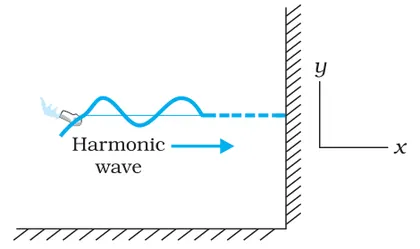
Chapter “Waves” (Class XI, Physics – Part II) introduces mechanical waves as organised disturbances that transport energy and information without bulk transport of matter. The chapter explains types of waves (transverse vs longitudinal, progressive vs standing), presents the mathematical description of a sinusoidal (harmonic) wave and the one‑dimensional wave equation, and develops relations among wavelength, frequency, angular frequency and wave number (v = λf = ω/k). It covers wave propagation on a stretched string (including v = sqrt(T/μ)), energy transport, reflection at boundaries and the principle of superposition. Using superposition the chapter derives conditions for interference and standing (stationary) waves, identifies nodes and antinodes, and obtains normal modes and allowed frequencies for strings and air columns (fixed/fixed, open/open and closed/open). The material is important because it provides the foundation for acoustics, optics, quantum waves and many practical applications (musical instruments, resonators, signal transmission). By the end of the chapter the student will be able to: classify waves; write and analyse the wave function y(x,t) for travelling…
Learning Objectives
- Define transverse and longitudinal waves with suitable examples
- Explain basic wave parameters: amplitude, wavelength, frequency, period, wave number and phase
- Derive the mathematical expression of a progressive sinusoidal wave and interpret the phase velocity
- Apply the relation v = fλ to solve numerical problems on wave speed, frequency and wavelength
- Sketch and interpret displacement–time and displacement–distance graphs for sinusoidal waves and determine phase differences
- Describe energy transport in mechanical waves and relate intensity to amplitude and energy flow
- State and apply the principle of superposition to predict resultant displacement in interference of waves
- Determine conditions for constructive and destructive interference and solve problems on beats including beat frequency
Topics in this chapter
16 topics · tap a topic title to jump straight to it.
Introduction
What is a wave? A wave is a disturbance that travels through space and/or a material medium, transferring energy (but not net matter) from one point to another. Waves are produced by an oscillating or vibrating source.
Mechanical vs Electromagnetic: Mechanical waves require a material medium (e.g., sound in air, waves on a string). Electromagnetic waves (e.g., light, radio) do not need a medium and can travel in vacuum.
Types by particle motion: Transverse waves: particles oscillate perpendicular to the direction of wave propagation (e.g., waves on a string, electromagnetic waves). Longitudinal waves: particles oscillate parallel to propagation (e.g., sound waves, slinky compressions).
Progressive (traveling) vs Stationary waves: Progressive waves carry energy and move through the medium. Stationary (standing) waves result from the superposition of two progressive waves moving in opposite directions and do not transport net energy along the medium.
Basic wave parameters: Amplitude (A) — maximum displacement from equilibrium; Wavelength (λ) — distance between successive points in phase (e.g., crest to crest); Period (T) — time for one complete oscillation; Frequency (f) — oscillations per second (f = 1/T); Wave speed (v) — speed of propagation of the disturbance.
Wave function (one-dimensional sinusoidal progressive wave): A common form is y(x,t) = A sin(kx − ωt + φ) or y(x,t) = A cos(kx − ωt + φ). Here A is amplitude, k is the wave number (spatial rate of phase change), ω is the angular frequency (temporal rate of phase change), and φ is the initial phase. The argument (kx − ωt + φ) is the phase. A + sign corresponds to a wave traveling in the −x direction.
Relations among parameters: k = 2π/λ, ω = 2πf, and v = ω/k = λf. Phase difference between two points separated by Δx at the same time is Δφ = kΔx = (2π/λ)Δx. For the same point between two times separated by Δt the phase change is Δφ = −ωΔt.
Energy and superposition: Energy transported by a wave depends on amplitude and frequency. When two or more waves meet, they superpose (principle of superposition), producing interference (constructive or destructive) and, under special conditions, standing waves.
- Sound waves from a speaker (longitudinal mechanical wave traveling through air).
- Water surface waves and ripples in a pond (particles move approximately perpendicular — transverse behavior on surface).
- Vibrations on a plucked guitar string (transverse waves; standing modes produce musical notes).
- Seismic P-waves (longitudinal) and S-waves (transverse) generated by earthquakes.
- Light from the Sun (electromagnetic transverse wave propagating through space).
- Slinky demonstrations: compressions travel (longitudinal) or transverse pulses along the coil.
- Wave function (1D sinusoidal): y(x,t) = A sin(kx − ωt + φ) or y(x,t) = A cos(kx − ωt + φ)
- Wave number: k = 2π/λ
- Angular frequency: ω = 2πf
- Frequency and period: f = 1/T
- Wave speed: v = λ f = ω / k
- Phase difference (same time, separation Δx): Δφ = k Δx = (2π/λ) Δx
Classification of Waves
What is a wave? A wave is a disturbance that transfers energy and information from one place to another without net transport of matter. Waves are classified according to different criteria — by the medium required, particle motion, direction of propagation, spatial form and temporal behaviour.
1. By medium
- Mechanical waves: Need a material medium (solid, liquid or gas). Examples: sound, waves on a string, water surface waves, seismic waves. They transport energy through particle interactions.
- Electromagnetic (EM) waves: Do not require a medium; can travel in vacuum. Examples: light, radio, X-rays. EM waves are transverse and consist of oscillating electric and magnetic fields.
2. By particle motion
- Transverse waves: Particle displacement is perpendicular to direction of propagation. Example: waves on a string, EM waves.
- Longitudinal waves: Particle displacement is parallel to propagation. Example: sound waves in air, P (primary) seismic waves.
3. By wavefront or geometry
- Plane waves: Wavefronts are (approximately) planes. Useful model for waves far from sources.
- Spherical waves: Wavefronts are spheres from a point source; amplitude typically decays ~1/r and intensity ~1/r².
- Cylindrical waves: Wavefronts are cylinders (line sources), amplitude decays ~1/√r.
4. By temporal/spatial behaviour
- Progressive (traveling) waves: Disturbance moves through the medium; example form: y(x,t)=A cos(kx - ωt + φ).
- Standing (stationary) waves: Result from interference of two opposite traveling waves of same frequency and amplitude. Characterized by nodes (zero displacement) and antinodes (maximum). Example form: y(x,t)=2A sin(kx) cos(ωt).
- Periodic vs non-periodic: Periodic waves repeat in time (sinusoidal, harmonic); pulses are non-periodic.
- Forced vs free: Forced waves are sustained by a driving source; free waves evolve after initial disturbance.
Key physical distinctions and notes
- In progressive waves, particles at different positions are generally out of phase by kΔx. In standing waves, all points between two adjacent nodes oscillate in phase, while segments separated by a node are in antiphase.
- Energy transport occurs in progressive waves; standing waves store energy in regions but do not transport net energy along the medium.
- For spherical sources intensity falls as 1/r² (inverse-square law).
Summary: Choose classification by asking: Is a medium required? How do particles move? Are wavefronts planar or spherical? Is the pattern traveling or stationary? Understanding these distinctions helps explain behavior of sound, light, strings, pipes and seismic phenomena.
- Transverse: waves on a taut string, electromagnetic waves (visible light, radio).
- Longitudinal: sound waves in air, compressions and rarefactions in a slinky along its length, P-waves in earthquakes.
- Spherical: sound from a point source (loudspeaker), intensity falls ≈1/r².
- Standing: vibrating guitar string (nodes at fixed ends), organ pipe resonances (air column).
- Progressive: ocean waves traveling towards shore, a pulse along a rope.
- General travelling wave: y(x,t) = A cos(kx - ωt + φ) or A sin(kx - ωt + φ).
- Wave number: k = 2π/λ.
- Angular frequency: ω = 2πf.
- Wave speed (general): v = ω/k = fλ.
- Transverse wave on a string: v = √(T/μ), where T = tension, μ = linear mass density.
- Speed of sound in an ideal gas: v = √(γP/ρ) or v = √(γRT/M).
Wave Parameters
What is a wave? A wave is a disturbance that transfers energy and information through a medium (mechanical waves) or through space (electromagnetic waves) without net transport of matter. Waves can be transverse (displacement ⟂ direction of propagation, e.g., light, string waves) or longitudinal (displacement ∥ direction of propagation, e.g., sound).
Wave parameters — definitions and meaning
- Displacement y(x,t): Instantaneous disturbance of the medium at position x and time t. Example form for a sinusoidal travelling wave: y(x,t) = A sin(kx − ωt + φ).
- Amplitude (A): Maximum displacement from equilibrium. Determines maximum energy transported (energy ∝ A² for small linear waves).
- Wavelength (λ): Smallest distance along the direction of propagation after which the wave pattern repeats. Measured in metres.
- Period (T): Time for one complete oscillation at a fixed point. Measured in seconds.
- Frequency (f): Number of oscillations per second: f = 1/T. Unit: hertz (Hz).
- Angular frequency (ω): ω = 2πf = 2π/T, measured in rad/s. Appears in wave equations with sin or cos.
- Wave number (k): k = 2π/λ, measured in rad/m. Determines spatial oscillation.
- Wave speed (v): Speed at which a phase (e.g., crest) moves: v = fλ. Also v = ω/k.
- Phase (kx − ωt + φ): Argument of the sine or cosine. Two points are in the same phase when their phase difference is an integer multiple of 2π.
- Phase difference (Δφ): Between two points separated by Δx at same time: Δφ = kΔx = (2π/λ)Δx. Between two times at same point: Δφ = ωΔt.
General sinusoidal travelling wave (one-dimensional)
y(x,t) = A sin(kx − ωt + φ) describes a wave travelling in the +x direction. If the sign on ωt is +, the wave travels in the −x direction. Here φ is the initial phase (phase constant).
Physical notes
- Amplitude sets maximum disturbance and relates to energy: larger A → more energy (in many cases energy ∝ A²).
- Waves transport energy and information; the medium’s particles typically oscillate around equilibrium but do not travel with the wave (except in some nonlinear or mass transport cases).
- Phase velocity is the speed of a point of constant phase: v_p = ω/k. For nondispersive media v_p = constant and v = fλ.
Units summary: A (m), λ (m), T (s), f (Hz), ω (rad/s), k (rad/m), v (m/s).
- Sound waves in air: longitudinal waves. Audible frequency range ≈ 20 Hz–20 kHz. Typical speed at 20°C ≈ 343 m/s, so wavelength of a 340 Hz tone is λ = v/f ≈ 1 m.
- Waves on a stretched string (transverse): plucked guitar string shows standing waves; fundamental frequency f1 = v/(2L) where L is string length.
- Water surface waves: visible crests and troughs; amplitude is wave height/2, wavelength measured between crests.
- Light (electromagnetic) waves: transverse waves in vacuum with speed c ≈ 3×10^8 m/s; frequency and wavelength related by c = fλ (visible light f ~ 4×10^14–7.5×10^14 Hz).
- Seismic waves: P-waves (longitudinal) and S-waves (transverse) travel at different speeds in Earth’s interior; wavelength depends on frequency and speed.
- Wave equation (sinusoidal travelling wave): y(x,t) = A sin(kx − ωt + φ) or A cos(kx − ωt + φ)
- Wavelength and wave number: k = 2π/λ
- Angular frequency and frequency: ω = 2πf = 2π/T
- Frequency and period: f = 1/T
- Wave speed (relation between v, f and λ): v = fλ
- Also v = ω/k
Mathematical Representation of a Traveling Wave
What is a traveling wave?
A traveling wave is a disturbance that moves through a medium (or through space for electromagnetic waves) carrying energy without permanent transport of matter. At any instant the wave has a shape that shifts in space as time progresses.
General idea and functional form
If the shape of the disturbance at time t = 0 is y = f(x), then after time t the same shape will have moved a distance vt (for speed v), so the displacement at position x and time t is: y(x,t) = f(x – vt). This is the basic mathematical statement that the whole profile is translated without changing its form.
Sine wave (most common example)
For a sinusoidal wave (simple harmonic wave) with amplitude A and initial phase φ, the traveling wave can be written as:
y(x,t) = A sin[kx – ωt + φ] (wave traveling in +x direction)
y(x,t) = A sin[kx + ωt + φ] (wave traveling in –x direction)
Here k is the wave number and ω is the angular frequency. kx – ωt + φ is called the phase. When the phase is constant, that point on the wave (e.g., a crest) moves with the phase velocity v.
Relations between parameters
The parameters are related as follows:
- Wave number: k = 2π/λ, where λ is wavelength (distance between successive crests).
- Angular frequency: ω = 2πf, where f is frequency (cycles per second).
- Period: T = 1/f = 2π/ω.
- Wave speed (phase velocity): v = ω/k = λf.
Derivation (short)
Start from y(x,0) = A sin(kx + φ). After time t the same pattern moves by vt, so y(x,t) = A sin[k(x – vt) + φ] = A sin[kx – kvt + φ]. Since ω = kv, this becomes A sin(kx – ωt + φ).
Wave equation (differential form)
A function y(x,t) representing a wave satisfies the one-dimensional wave equation:
∂²y/∂x² = (1/v²) ∂²y/∂t²
This equation shows how spatial curvature relates to temporal acceleration for waves traveling at speed v.
Phase and group velocity (brief)
The phase velocity v_phase = ω/k describes how a point of constant phase moves. For wave packets (superposition of many frequencies) the envelope moves with group velocity v_group = dω/dk (usually introduced later).
Transverse vs longitudinal
If displacement is perpendicular to propagation direction (e.g., string, water surface) the wave is transverse. If displacement is along propagation direction (e.g., sound in air) it is longitudinal. The mathematical form y(x,t)=f(x–vt) still applies, but the physical quantity represented (pressure, displacement, electric field) differs.
Key physical ideas to note
- Crests and troughs move with speed v; individual particles of the medium oscillate about equilibrium positions (they do not travel with the wave for transverse waves).
- Changing the sign in kx – ωt vs kx + ωt reverses propagation direction.
- Initial phase φ shifts the entire wave along x at t = 0.
This mathematical representation allows calculation of wavelength, frequency, speed, and instantaneous displacement at any position and time and is fundamental to understanding interference, reflection, and other wave phenomena covered later in Class 11.
- Wave on a stretched string: pluck a guitar string — transverse sinusoidal pulses travel along the string (use y(x,t)=A sin(kx±ωt+φ) to model).
- Water surface waves: small-amplitude ripples on a pond surface approximate y(x,t)=A sin(kx−ωt) (transverse motion of surface).
- Sound waves in air: pressure variations travel as longitudinal waves; a plane sound wave can be modelled by p(x,t)=P0 cos(kx−ωt).
- Light as an electromagnetic wave: electric field E(x,t)=E0 cos(kx−ωt) for a monochromatic plane wave in vacuum (transverse field).
- Seismic P and S waves: P-waves (longitudinal) and S-waves (transverse) traveling through Earth.
- y(x,t) = f(x − vt) (general traveling wave to the +x direction)
- y(x,t) = A sin(kx − ωt + φ) or A cos(kx − ωt + φ) (sinusoidal traveling wave)
- k = 2π/λ (wave number)
- ω = 2πf (angular frequency)
- v = ω/k = λf (wave speed)
- T = 1/f = 2π/ω (period)
One-dimensional Wave Equation
What is a one-dimensional wave? A one-dimensional wave is a disturbance that travels along a single spatial dimension (x) as a function of position and time, y(x,t). Examples include a pulse on a string, a longitudinal compression in a spring (slinky) along its length, or an approximation to sound in a long narrow tube.
Wave equation — physical derivation (brief): Consider a small element of a stretched string under tension T and linear mass density μ. For small transverse displacements y(x,t) and small slopes, the net transverse force on the element ≈ T · ∂^2y/∂x^2 · Δx. By Newton's 2nd law, μ·Δx·∂^2y/∂t^2 = T·Δx·∂^2y/∂x^2. Cancelling Δx gives the one-dimensional wave equation:
∂^2y/∂x^2 = (1/c^2) · ∂^2y/∂t^2, where c = √(T/μ) is the wave speed on the string.
General solution: The most general solution of the 1D wave equation is a superposition of a right-moving and a left-moving disturbance:
y(x,t) = f(x - c t) + g(x + c t),
where f and g are arbitrary twice-differentiable functions. A single travelling pulse corresponds to f (or g) only.
Harmonic (sinusoidal) waves: A common special solution is a sinusoidal travelling wave:
y(x,t) = A · sin(k x - ω t + φ) (right-moving)
Key relations for sinusoidal waves: k = 2π/λ (wave number), ω = 2π f (angular frequency), c = ω/k = λ f (phase speed). For a string, c = √(T/μ).
Standing waves: When two equal-amplitude sinusoidal waves travel in opposite directions, they form a standing wave with nodes and antinodes. Example: y(x,t) = 2A · sin(kx) · cos(ωt).
Physical meaning of the wave equation: It states that curvature in space (∂^2y/∂x^2) produces acceleration in time (∂^2y/∂t^2) and links them through the square of wave speed c^2. Solutions describe how disturbances propagate without changing shape (for non-dispersive media).
When to use: Use the 1D wave equation to model transverse waves on strings, longitudinal pulses in springs/tubes (with appropriate variable), or plane waves approximated in one dimension. Apply boundary conditions (fixed/free ends) to find allowed modes (standing waves) and frequencies.
- A pulse traveling along a stretched string after plucking a guitar string — modeled by y(x,t)=f(x-ct).
- Sinusoidal transverse waves on a violin or guitar string: y(x,t)=A sin(kx−ωt+φ) with c=√(T/μ).
- A compression pulse traveling along a long slinky (longitudinal 1D wave).
- Sound wave approximated as a 1D wave in a long narrow pipe (plane wave approximation).
- EM plane wave in one dimension (in vacuum it satisfies the same form of wave equation with c = speed of light).
- Wave equation: ∂^2y/∂x^2 = (1/c^2) · ∂^2y/∂t^2
- General solution: y(x,t) = f(x - c t) + g(x + c t)
- Sinusoidal wave: y(x,t) = A sin(kx - ωt + φ)
- Relations: k = 2π/λ, ω = 2πf, c = ω/k = λ f
- Wave speed on a stretched string: c = √(T/μ) where T = tension, μ = linear mass density
- Standing wave (two opposite travelling waves): y(x,t) = 2A sin(kx) cos(ωt)
Velocity of Wave Propagation
Definition: The velocity of wave propagation (wave speed) is the speed at which a particular phase of the wave (e.g., a crest) travels through the medium. Its SI unit is metre per second (m/s).
From a traveling sinusoidal wave: For y(x,t) = A sin(kx - ωt), a point of constant phase satisfies kx - ωt = constant. Differentiating gives dx/dt = ω/k. Thus the phase velocity v = ω/k. Using k = 2π/λ and ω = 2πf, this reduces to the familiar relation v = λ f.
Dependence on medium (examples): Wave speed depends on the properties of the medium, not on the amplitude (for linear waves). Examples:
- Transverse waves on a stretched string: v = sqrt(T/μ), where T is tension and μ is linear mass density (kg/m).
- Longitudinal waves in a solid or fluid: v = sqrt(B/ρ), where B is bulk modulus and ρ is density.
- Speed of sound in an ideal gas: v = sqrt(γRT/M) or v = sqrt(γP/ρ) (γ = ratio of specific heats).
- Electromagnetic waves in a medium: v = c/n, where c is speed of light in vacuum and n is refractive index.
Phase and group velocity: In dispersive media the phase velocity v_p = ω/k depends on frequency, and wave packets travel with the group velocity v_g = dω/dk. For non-dispersive media ω ∝ k and v_g = v_p.
Key practical points: • v = λ f connects spatial wavelength and temporal frequency. • Changing medium properties (tension, density, elasticity, temperature) changes v. • Many real-life phenomena (dispersion, attenuation) affect how signals travel and whether different frequencies move at different speeds.
- Sound in air at 20°C: about 343 m/s (depends on temperature); hearing a thunderclap after seeing lightning — time delay gives speed estimate.
- Vibration on a guitar string: frequency set by string length and tension; pluck produces standing waves whose speed on the string is v = sqrt(T/μ).
- Light slowing in glass: optical speed v = c/n; a pulse of light travels slower in glass than in vacuum.
- Water surface waves: shallow-water speed ≈ sqrt(g h) (depends on depth h), showing medium-dependent speed.
- Seismic P and S waves: P-waves (longitudinal) travel faster than S-waves (transverse) because of different elastic constants.
- v = λ f
- v = ω / k
- Transverse wave on string: v = sqrt(T / μ) (T = tension, μ = mass per unit length)
- Longitudinal (bulk) waves: v = sqrt(B / ρ) (B = bulk modulus, ρ = density)
- Speed of sound (ideal gas): v = sqrt(γ R T / M) = sqrt(γ P / ρ)
- Electromagnetic in medium: v = c / n
Particle Velocity and Acceleration
Definition: In a mechanical wave, each medium particle executes simple harmonic motion about its equilibrium position. Particle velocity and particle acceleration are the time derivatives of the particle displacement field y(x,t).
Displacement (general form): y(x,t) = a sin(kx - ωt + φ) or a cos(kx - ωt + φ), where a = amplitude, k = wave number, ω = angular frequency, φ = phase.
Particle velocity (instantaneous): v_p(x,t) = ∂y/∂t. For y = a sin(kx - ωt + φ),
v_p(x,t) = -a ω cos(kx - ωt + φ).
This shows particle velocity is sinusoidal in time at each fixed x, with amplitude aω and depends on position through kx.
Particle acceleration: a_p(x,t) = ∂^2y/∂t^2. For y = a sin(kx - ωt + φ),
a_p(x,t) = -a ω^2 sin(kx - ωt + φ) = -ω^2 y(x,t).
Thus particle acceleration is proportional to and opposite in sign to displacement (characteristic of simple harmonic motion). Its amplitude is aω^2.
Key phase relations:
- Displacement y and acceleration a_p are 180° out of phase (a_p = -ω^2 y).
- Velocity v_p is 90° out of phase with displacement y (for sine form v_p ∝ −cos(...)).
Distinguish particle velocity from wave speed: Particle velocity v_p is the local oscillatory speed of a medium particle. Wave speed (c) = ω/k is the speed at which phase or disturbances travel along the medium; c is not the same as v_p in general.
Units: displacement y (m), particle velocity v_p (m/s), particle acceleration a_p (m/s²).
- Sound wave in air: air molecules oscillate back and forth (longitudinal). Particle velocity is the local oscillatory speed of air parcels, while the sound wave propagates at the speed of sound (~343 m/s in air at 20°C).
- Transverse wave on a string: each point on the string moves up and down. At an antinode particle velocity and acceleration amplitudes are largest; at a node both are zero.
- Slinky (longitudinal pulse): coils oscillate forward and backward — particle velocity varies sinusoidally in time at each coil.
- Water surface waves: water particles follow approximately circular orbits; their instantaneous horizontal/vertical velocities are particle velocities, smaller than the wave phase speed.
- Displacement: y(x,t) = a sin(kx - ωt + φ) or y = a cos(kx - ωt + φ)
- Particle velocity: v_p(x,t) = ∂y/∂t = -a ω cos(kx - ωt + φ) (for sine form)
- Particle acceleration: a_p(x,t) = ∂^2y/∂t^2 = -a ω^2 sin(kx - ωt + φ) = -ω^2 y(x,t)
- \[Maximum particle speed: v_{p,max} = a ω\]
- \[Maximum particle acceleration: a_{p,max} = a ω^2\]
- Angular frequency and frequency: ω = 2πf = 2π/T
Energy Transport in Waves
Basic idea: A progressive wave transports energy from one place to another without a net transport of matter. Energy in a mechanical wave exists as kinetic energy (due to motion of the medium) and potential energy (due to deformation/strain in the medium). In contrast, standing waves do not transport energy along the medium; energy only oscillates locally between kinetic and potential forms.
Transverse wave on a stretched string — local energy: Consider a string with linear mass density μ under tension T, with transverse displacement y(x,t). For a small element of length dx the instantaneous kinetic energy is
dK = (1/2) μ dx (∂y/∂t)^2.
The potential energy (from the work done in stretching, valid for small slopes) is
dU = (1/2) T dx (∂y/∂x)^2.
So the instantaneous energy density (energy per unit length) is
u(x,t) = (1/2) μ (∂y/∂t)^2 + (1/2) T (∂y/∂x)^2.
Sinusoidal travelling wave: For y(x,t) = A sin(kx - ωt), ∂y/∂t = −A ω cos(kx − ωt), ∂y/∂x = A k cos(kx − ωt). Using T k^2 = μ ω^2 (since v = ω/k = sqrt(T/μ)), the time-averaged kinetic and potential energy densities are equal. The time-averaged total energy density is
⟨u⟩ = (1/2) μ A^2 ω^2 / 2 + (1/2) T A^2 k^2 / 2 = (1/2) μ A^2 ω^2 / 2 + (1/2) μ A^2 ω^2 / 2 = μ A^2 ω^2 / 2. (Equivalently ⟨u⟩ = (1/2) μ ω^2 A^2 / 2 + ... simplifies to μ A^2 ω^2 /2.)
Power transmitted: Instantaneous power (energy flow rate) across a cross-section at x is P(x,t) = −T (∂y/∂x)(∂y/∂t).
For the sinusoidal travelling wave the time-averaged power transmitted along the string is
⟨P⟩ = ⟨u⟩ v = (1/2) μ ω^2 A^2 v,
showing ⟨P⟩ ∝ A^2 and ∝ ω^2. Thus larger amplitude or higher frequency waves carry more energy per unit time.
Intensity: Intensity I is power per unit area normal to propagation. For a plane mechanical wave in a medium of density ρ and speed v, the average intensity is
⟨I⟩ = (1/2) ρ v ω^2 A^2.
For spherical waves energy spreads over area 4πr^2, so intensity falls as 1/r^2 (inverse-square law): ⟨I(r)⟩ ∝ 1/r^2.
Standing waves vs progressive waves: In a standing wave (sum of two oppositely travelling waves of equal amplitude) the net power transmitted along the medium is zero: energy sloshes between kinetic and potential forms at fixed spatial points; antinodes have maximum energy oscillation, nodes have zero.
Key physical points to remember: - Energy transported by a wave ∝ amplitude^2. - No net transfer of matter with a travelling wave (only energy and information). - Average energy density × wave speed = average energy flux (power per unit area) = intensity. - Standing waves do not transport net energy along the medium.
- Guitar string: pluck a string → transverse travelling waves carry energy to the bridge where it is dissipated as sound; louder plucks (larger A) produce higher energy and louder sound (intensity ∝ A^2).
- Sound from a speaker: longitudinal pressure waves transport energy through air; intensity falls roughly as 1/r^2 from a point-like source in free space.
- Water surface waves: energy is transmitted across the surface — floating objects have oscillatory motion but are not carried permanently with the wave (except in breaking waves).
- Seismic waves: P and S waves carry energy through Earth; amplitude and frequency determine amount of energy delivered to structures.
- Microwave or light beam (electromagnetic waves): carry energy and momentum; intensity determines heating or radiation pressure (EM waves are not mechanical but illustrate energy transport).
- Transverse displacement: y(x,t) = A sin(kx - ωt)
- Linear mass density: μ (mass per unit length), wave speed on string: v = √(T/μ)
- Instantaneous kinetic energy of element dx: dK = (1/2) μ dx (∂y/∂t)^2
- Instantaneous potential energy of element dx: dU = (1/2) T dx (∂y/∂x)^2
- Instantaneous energy density: u(x,t) = (1/2) μ (∂y/∂t)^2 + (1/2) T (∂y/∂x)^2
- Average energy density for sinusoidal wave: ⟨u⟩ = (1/2) μ A^2 ω^2 / 2 + (1/2) T A^2 k^2 / 2 = μ A^2 ω^2 / 2
Principle of Superposition
Definition: The Principle of Superposition states that when two or more waves traverse the same region of a medium, the resultant displacement at any point and time is the algebraic sum of the displacements due to the individual waves, provided the medium is linear and deformations are small.
When it applies: The principle holds for linear media (no nonlinear response), for small amplitudes, and for waves that meet at the same point. For stable interference patterns the sources must be coherent (constant phase relation and usually same frequency).
Mathematical statement (two sinusoidal waves): Let two travelling waves of same frequency ω and wavenumber k be
- y₁(x,t) = A₁ sin(kx − ωt)
- y₂(x,t) = A₂ sin(kx − ωt + φ) (φ = phase difference)
R = √(A₁² + A₂² + 2A₁A₂ cos φ)
and the resultant displacement can be written y = R sin(kx − ωt + θ).
Special cases:
- φ = 0 (in phase): R = A₁ + A₂ (constructive interference).
- φ = π (out of phase): R = |A₁ − A₂| (destructive interference if A₁ = A₂ gives R = 0).
Relation with path difference and wavelength: If the phase difference arises from a path difference Δx, then φ = (2π/λ)Δx. Thus interference conditions are
- Constructive: Δx = nλ → φ = 2nπ
- Destructive: Δx = (n + 1/2)λ → φ = (2n + 1)π
Intensity: Intensity I ∝ (amplitude)², so for two waves
I ∝ R² = A₁² + A₂² + 2A₁A₂ cos φ.
This shows intensity is not simply additive because of the cross term (interference term).Standing waves: Superposition of two equal-amplitude sinusoidal waves travelling in opposite directions (y₁ = A sin(kx − ωt), y₂ = A sin(kx + ωt)) gives
y = 2A cos(kx) sin(ωt),
which is a standing wave with nodes (cos(kx)=0) and antinodes (|cos(kx)|=1).Beats: For two waves of nearly equal frequencies f₁ and f₂, superposition gives amplitude modulation with beat frequency f_beat = |f₁ − f₂|. The instantaneous amplitude varies as the envelope whose frequency is half the sum and whose modulation frequency is the difference.
Physical note: Superposition is a vector (or algebraic) addition of displacements. Energy considerations require attention: instantaneous energies may cancel locally (leading to nodes), but total energy is conserved when one includes both kinetic and potential energies and energy transport.
- Noise‑cancelling headphones: they produce an inverted sound wave that destructively interferes with ambient noise.
- Young's double-slit experiment: coherent light from two slits interferes to produce bright (constructive) and dark (destructive) fringes on a screen.
- Thin-film colours (soap bubbles, oil films): interference between reflections from top and bottom surfaces produces colours depending on film thickness (path difference).
- Beats in sound: two tuning forks or instruments slightly off pitch produce a loud–soft modulation at the beat frequency |f1 − f2|.
- Standing waves on a string and resonance in musical instruments: fixed‑end strings show nodes and antinodes due to superposition of opposite travelling waves.
- Radio/antenna interference patterns: constructive/destructive interference creates regions of stronger or weaker signal.
- Principle: y_total(x,t) = y1(x,t) + y2(x,t) + ...
- Two sinusoidal waves (same k, ω): y1 = A1 sin(kx − ωt), y2 = A2 sin(kx − ωt + φ); Resultant amplitude: R = √(A1² + A2² + 2 A1 A2 cosφ)
- Resultant displacement: y = R sin(kx − ωt + θ) with appropriate θ
- Intensity (proportional): I ∝ R² = A1² + A2² + 2 A1 A2 cosφ
- Path difference → phase: φ = (2π/λ) Δx; constructive: Δx = nλ; destructive: Δx = (n + 1/2)λ
- Standing wave (equal opposite waves): y = 2A cos(kx) sin(ωt); nodes at cos(kx)=0 → kx = (2n+1)π/2
Interference of Waves
Interference of Waves
Interference is the phenomenon in which two or more coherent waves superpose to produce a resultant wave whose amplitude (and hence intensity) varies spatially and/or temporally. It is a direct consequence of the principle of superposition: when waves meet, their displacements add algebraically.
Key requirements
- Coherence: Sources must have a constant phase relationship (temporal and spatial coherence). Monochromatic light from the same source split into two beams is commonly used.
- Superposition: Waves must overlap in the region of observation.
Basic description (two-wave case)
Consider two harmonic waves of the same frequency and amplitude arriving at a point with a phase difference δ. The individual displacements may be written as
E1 = E0 cos(ωt) , E2 = E0 cos(ωt + δ).
Using trigonometric identities the resultant amplitude becomes 2E0 cos(δ/2) and the intensity (proportional to amplitude squared) is
I = 4I0 cos²(δ/2), where I0 is intensity due to one wave.
Phase difference and path difference
- Phase difference δ is related to path difference Δx by δ = (2π/λ)·Δx.
- Constructive interference (bright fringe): Δx = nλ (or δ = 2πn), n = 0, ±1, ±2,...
- Destructive interference (dark fringe): Δx = (n + 1/2)λ (or δ = (2n+1)π).
Young's double-slit experiment (standard geometry)
Two slits separated by distance d act as coherent sources. A screen at distance D (≫ d) shows bright and dark fringes. Using small-angle approximations (sin θ ≈ tan θ ≈ y/D):
- Fringe position for mth bright: y_m = (mλD)/d.
- Fringe width (distance between consecutive bright fringes): β = λD/d.
- Path difference ≈ d sin θ ≈ dy/D.
Intensity for unequal amplitudes
If intensities of the two waves are I1 and I2 and phase difference is δ, then
I = I1 + I2 + 2√(I1I2) cos δ.
Visibility (contrast) of fringes: V = (I_max - I_min)/(I_max + I_min) = 2√(I1I2)/(I1 + I2).
Types of interference
- Division of wavefront: Example: Young's double-slit (a single wavefront split into two parts).
- Division of amplitude: Example: Thin film interference, Lloyd's mirror, Fresnel’s biprism (a beam is partly reflected/transmitted so amplitudes divide).
Thin film interference (brief)
Light reflected from the two surfaces of a thin film of thickness t and refractive index μ produces interference. Consider phase changes on reflection (phase change of π occurs when reflecting from higher refractive index):
- Effective path difference (for near-normal incidence): Δx = 2μt.
- With one phase reversal (one reflection gives π shift): constructive: 2μt = (m + 1/2)λ; destructive: 2μt = mλ.
- With two or zero phase reversals (no net π): constructive: 2μt = mλ; destructive: 2μt = (m + 1/2)λ.
Important remarks
- Interference patterns depend on coherence length — if path difference exceeds coherence length, fringes wash out.
- Interference is wavelength-dependent; polychromatic light produces overlapping, less distinct fringes (colours in thin films).
Applications
- Newton's rings, anti-reflection coatings, interferometers (Michelson), thin-film coatings, holography, metrology (precise distance/flatness measurements).
- Young's double-slit experiment: demonstration of bright and dark fringes on a screen using a single monochromatic source and two narrow slits.
- Thin-film colours on soap bubbles and oil slicks: different film thicknesses cause constructive interference for different wavelengths producing colours.
- Newton's rings: concentric bright and dark rings formed by interference between a curved lens and a flat glass plate.
- Anti-reflection coatings on lenses: a thin coating causes destructive interference of reflected light at certain wavelengths, reducing reflection.
- Noise-cancelling headphones (sound interference): incoming noise is cancelled by producing a wave of nearly equal amplitude and opposite phase (destructive interference).
- Resultant intensity (equal amplitudes): I = 4 I0 cos^2(δ/2), where δ is phase difference, I0 is intensity from one wave.
- Phase–path relation: δ = (2π/λ) · Δx, where Δx is path difference and λ is wavelength.
- Constructive condition: Δx = n λ (δ = 2π n), n = 0, ±1, ±2, ...
- Destructive condition: Δx = (n + 1/2) λ (δ = (2n + 1) π).
- Two-source general intensity: I = I1 + I2 + 2 √(I1 I2) cos δ.
- Fringe position (double slit): y_m = (m λ D) / d, where D is screen distance, d is slit separation, m = 0, ±1, ±2,...
Beats
What are beats?
Beats are the periodic variations in amplitude that occur when two harmonic waves of nearly equal frequencies interfere. The resulting motion shows a rapid oscillation at about the average frequency, whose amplitude is slowly modulated (increased and decreased) at the beat rate.
Derivation (simple case, equal amplitudes)
Consider two simple harmonic waves of equal amplitude A and almost-equal angular frequencies omega1 and omega2 arriving in phase:
y1 = A cos(omega1 t), y2 = A cos(omega2 t)
Using the trigonometric identity for the sum of cosines, the resultant displacement is
y = y1 + y2 = 2A cos((omega1 - omega2)/2 * t) cos((omega1 + omega2)/2 * t).
Interpretation:
- The factor cos((omega1 + omega2)/2 * t) is a rapid oscillation at approximately the average angular frequency (carrier).
- The factor 2A cos((omega1 - omega2)/2 * t) is a slowly varying envelope that modulates the carrier amplitude.
Beat frequency and period
Let f1 and f2 be the frequencies (in Hz) and Delta f = |f1 - f2|. Then the beat frequency (number of amplitude maxima per second) is
f_b = |f1 - f2|.
The beat period (time between successive amplitude maxima) is
T_b = 1 / |f1 - f2|.
In angular-frequency form the envelope argument is cos(pi Delta f t) because (omega1 - omega2)/2 = pi (f1 - f2).
Unequal amplitudes
If amplitudes are different, y = A1 cos(omega1 t) + A2 cos(omega2 t). The resultant still shows modulation, but the maximum and minimum amplitudes of the envelope are:
A_max = A1 + A2, A_min = |A1 - A2|.
If A1 and A2 differ greatly, beats are less pronounced or may be unnoticeable.
Intensity (energy) variation
Since intensity ∝ amplitude^2, for equal amplitudes the time-averaged intensity varies as
I(t) ∝ A^2 [1 + cos(2 pi Delta f t)],
so intensity is modulated at the beat frequency Delta f.
Perception and applications
Audible beats: when two musical tones of nearly equal frequency are played, human hearing perceives beats if Delta f is small (typically up to a few Hz; rough threshold ~5–7 Hz for clear beats). Beats are exploited in musical instrument tuning, heterodyning in radio and optics (mixing two frequencies to obtain difference-frequency signals), and in diagnostics of mechanical systems (detecting close resonances).
When beats do not occur
If the two frequencies are identical and waves remain in fixed phase relation, there are no beats (result is a steady standing amplitude). If frequencies differ greatly, the amplitude modulation is too rapid to be perceived as beats and the ear hears two distinct tones instead.
- Tuning musical instruments: a musician adjusts one string until beats between that string and a reference tone disappear (Delta f -> 0).
- Two tuning forks with slightly different frequencies produce audible beats equal to the frequency difference.
- Heterodyne radio receiver: mixing a received signal with a local oscillator creates beats (difference frequency) that fall into the receiver’s intermediate-frequency range.
- Optical heterodyning: two laser beams of nearly equal optical frequency produce intensity beats at their frequency difference; detected by a photodiode (used in interferometry and spectroscopy).
- Coupled mechanical oscillators: energy transfer between two oscillators with nearly equal natural frequencies produces amplitude beats.
- y = A cos(omega1 t) + A cos(omega2 t) = 2A cos((omega1 - omega2)/2 * t) cos((omega1 + omega2)/2 * t)
- Delta f = |f1 - f2|
- Beat frequency: f_b = |f1 - f2|
- Beat period: T_b = 1 / |f1 - f2|
- Envelope (using frequencies): y = 2A cos(pi Delta f t) cos(2 pi f_avg t), where f_avg = (f1 + f2)/2
- Amplitude extremes for unequal amplitudes: A_max = A1 + A2, A_min = |A1 - A2|
Standing Waves
Definition: A standing wave is a wave pattern produced by the superposition of two identical waves traveling in opposite directions. The resulting motion is a fixed pattern of nodes (points of zero displacement) and antinodes (points of maximum oscillation) that does not travel along the medium.
How they form (mathematical sketch):
Take two sinusoidal waves of equal amplitude A and angular frequency ω, moving in opposite directions:
y1 = A sin(kx - ωt),
y2 = A sin(kx + ωt).
Superposing: y = y1 + y2 = 2A sin(kx) cos(ωt). This shows a spatial factor 2A sin(kx) (the amplitude envelope) and a temporal factor cos(ωt) — the oscillation at each point is in time but the envelope is fixed in space.
Important features:
- Nodes: points where sin(kx)=0 ⇒ kx = nπ ⇒ x = n(λ/2) (n = 0,1,2,...). Displacement is always zero.
- Antinodes: points where |sin(kx)| = 1 ⇒ x = (2n+1)λ/4. Maximum amplitude = 2A.
- No net energy transport along the medium (energy oscillates locally between kinetic and potential forms).
- Phase: all points between two successive nodes oscillate in phase; adjacent segments separated by a node oscillate 180° out of phase.
Standing waves in bounded systems (boundary conditions)
- String fixed at both ends (length L): nodes at both ends → allowed wavelengths λn = 2L/n and frequencies fn = nv/(2L), n = 1,2,3,... (these are the harmonics).
- Open pipe (both ends open): displacement antinodes at open ends, same allowed λn and fn as a string fixed at both ends.
- Closed pipe (one end closed, one open): closed end is a displacement node and open end is an antinode. Allowed wavelengths are λn = 4L/n and frequencies fn = nv/(4L) with n = 1,3,5,... (only odd harmonics).
Physical significance: Standing waves explain modes of vibration in musical instruments (strings and air columns), resonance phenomena, and spatial patterns of pressure or displacement (e.g., hot spots in a microwave oven due to standing electromagnetic waves).
- Guitar or violin string vibrating: string fixed at both ends producing harmonics (n = 1, 2, 3...).
- Organ pipe and flute (open-open): air column supports standing pressure/displacement waves with wavelengths λn = 2L/n.
- Clarinet or a closed organ pipe (open-closed): only odd harmonics appear, λn = 4L/n.
- Microwave oven: standing electromagnetic waves inside the cavity create hot and cold spots on food.
- Standing waves on a stretched rope or slinky when the rope is driven at resonant frequencies.
- Wave velocity: v = f λ
- Wave number: k = 2π/λ
- Angular frequency: ω = 2π f
- Standing wave displacement (example form): y(x,t) = 2A sin(kx) cos(ωt) (or y = 2A cos(kx) sin(ωt) depending on phase)
- Node positions: x_n = n λ/2 (n = 0,1,2,...)
- Antinode positions: x_a = (2n+1) λ/4
Normal Modes, Harmonics and Resonance
Normal modes
A normal mode is a pattern of vibration in which every point of the system oscillates sinusoidally with the same frequency and a fixed phase relation. For many bounded systems (strings, air columns, plates) boundary conditions allow only discrete normal modes. Each normal mode has a characteristic frequency called a natural frequency.
Standing waves and mathematical form
Standing (stationary) waves arise by superposition of two travelling waves of equal amplitude and frequency moving in opposite directions. For a one-dimensional system (e.g. a stretched string) the displacement can be written as:
y(x,t) = 2A sin(kx) cos(ωt),
where k = 2π/λ and ω = 2πf. Nodes (y=0 at all t) occur where sin(kx)=0 and antinodes (max amplitude) where |sin(kx)|=1.
Harmonics and overtones
For a string of length L fixed at both ends boundary conditions require nodes at x=0 and x=L. Allowed wavelengths are λ_n = 2L/n (n = 1,2,3,...). Corresponding frequencies (normal-mode frequencies) are:
f_n = n(v / 2L) , where v is wave speed on the string.
Here n=1 is the fundamental (first harmonic). n=2 is the second harmonic (first overtone), etc. The set of frequencies f, 2f, 3f,... are called harmonics (integer multiples of the fundamental).
Pipes and boundary conditions
For air columns the allowed modes depend on end conditions:
- Open–open pipe: λ_n = 2L/n and f_n = n(v/2L) (n = 1,2,3,...). All harmonics present.
- Open–closed pipe: λ_n = 4L/(2n-1) and f_n = (2n-1)(v/4L) (n = 1,2,3,...). Only odd harmonics (1st, 3rd, 5th ...) occur.
Resonance
Resonance is the large amplitude response of a system when driven by an external force whose frequency matches (or is very close to) one of the system's natural frequencies. A driven damped oscillator has amplitude strongly peaked at the resonant frequency. In musical instruments resonance of strings and air columns amplifies certain frequencies, producing rich tones.
Effect of damping and quality factor
With damping, resonance peak broadens and amplitude is reduced. The quality factor Q measures sharpness of resonance: Q = ω0 / Δω where ω0 is resonant angular frequency and Δω is the full width at half maximum (FWHM) of the amplitude peak.
Key physical ideas (summary)
- Normal modes are allowed standing-wave patterns satisfying boundary conditions.
- Harmonics are frequency components at integer multiples of the fundamental (for systems that permit them).
- Resonance occurs when an external driving frequency matches a natural frequency — large amplitude results, limited by damping.
- Guitar or violin string: plucked string gives standing waves; tones are the string's harmonics (f_n = n v/2L).
- Flute (open–open pipe): supports all harmonics; different fingering changes effective L and hence fundamental frequency.
- Clarinet (approx. open–closed): favors odd harmonics (gives a characteristic timbre).
- Tuning fork: struck and vibrates at its natural frequency; can force another identical fork into vibration by resonance.
- Wine glass shattering: if a singer matches the glass's resonant frequency and provides enough amplitude, the glass may fracture.
- Bridge oscillations (e.g., Tacoma Narrows): wind or periodic forcing can resonate with structure’s modes and cause large motion (structural resonance).
- Wave speed on a stretched string: v = sqrt(T / µ), where T = tension, µ = linear mass density.
- Standing wave form: y(x,t) = 2A sin(kx) cos(ωt), with k = 2π/λ, ω = 2πf.
- Fixed–fixed (string or open–open pipe): λ_n = 2L / n, f_n = n (v / 2L), n = 1,2,3,...
- Open–closed pipe: λ_n = 4L / (2n - 1), f_n = (2n - 1) (v / 4L), n = 1,2,3,...
- Nodes positions: x_node = m (λ/2), m = 0,1,2,...; Antinodes: x_antinode = (2m+1) (λ/4).
- Relation between angular frequency and frequency: ω = 2πf.
Reflection and Phase Change at Boundaries
What is reflection at a boundary?
When a wave traveling in one medium meets a boundary with another medium, part (or all) of the wave can be reflected back into the first medium. The reflected wave may suffer a phase change (inversion) depending on the nature of the boundary.
Mechanical waves on a string (simple picture)
Consider a transverse pulse on a string meeting a boundary where string properties change or the end is attached/loose:
- Fixed end: The end enforces zero transverse displacement. To satisfy this, the reflected pulse is inverted (phase shift of π).
- Free end: The end enforces zero transverse force (slope = 0). The reflected pulse returns without inversion (no phase change).
- General change of string properties: If a pulse goes from a lighter (lower impedance) to a heavier (higher impedance) string the reflected wave is inverted; from heavier to lighter it is not inverted. The inversion is tied to the sign of the amplitude reflection coefficient.
Electromagnetic waves (light) at normal incidence)
For light at normal incidence on a planar boundary between media of refractive indices n1 and n2, the complex amplitude reflection coefficient is r = (n1 - n2)/(n1 + n2). If r is negative (that is n2 > n1) the reflected electric field undergoes a phase change of π (inversion). If r is positive (n2 < n1) there is no phase change. Energy reflectance (fraction of incident intensity reflected) is R = |r|^2.
Physical reason for phase change
Phase change arises from boundary conditions: fields/displacements must match at the interface. When the boundary acts like a 'hard' constraint (higher impedance/denser medium or a fixed end), the sign must flip to satisfy continuity. When it acts like a 'soft' constraint (lower impedance or free end), no sign flip is needed.
Consequences
Phase changes on reflection lead to measurable effects such as node/antinode placement in standing waves, constructive or destructive interference (e.g., thin-film colors), and the behavior of pulses on ropes or transmission lines.
Short summary
Reflection occurs at mismatched boundaries; the sign of the amplitude reflection coefficient determines whether there is a phase shift of π (inversion) or not. The mathematical form of the coefficient depends on the relevant impedances (mechanical or optical).
- A transverse pulse on a rope hitting a wall (fixed end) returns inverted — demonstration in labs with a rope tied to a rigid support.
- A pulse on a rope tied to a ring that can move freely (free end) returns non-inverted.
- Light incident from air (n≈1.0) onto glass (n≈1.5) — reflected beam from the front surface undergoes a π phase shift (inversion).
- Thin-film interference (soap bubble or oil film): phase changes on reflection plus path differences produce vivid colors.
- Transmission line (electrical): impedance mismatch between line and load produces reflected voltage waves; sign depends on relative impedances and causes standing waves.
- Wave speed on a stretched string: v = sqrt(T/μ), where T = tension, μ = linear mass density.
- Characteristic (mechanical) impedance of a string: Z = sqrt(T μ).
- Amplitude reflection coefficient (general, mechanical): r = (Z2 - Z1)/(Z2 + Z1). Sign of r determines phase (r < 0 → π shift).
- Amplitude reflection coefficient for normal incidence of light (Fresnel): r = (n1 - n2)/(n1 + n2). If n2 > n1, r < 0 ⇒ phase change of π.
- Power/Intensity reflectance: R = |r|^2 (fraction of incident intensity reflected).
- Amplitude transmission coefficient (light, normal incidence): t = 2 n1/(n1 + n2). Power transmittance: T = (n2/n1) |t|^2.
Doppler Effect
Doppler Effect
Definition: The Doppler effect is the apparent change in frequency (or wavelength) of a wave observed when there is relative motion between the source of the wave and the observer.
Qualitative description: If the source and observer move closer, the observed frequency increases (pitch goes up for sound). If they move apart, the observed frequency decreases (pitch goes down). For a moving source, wavefronts in front get compressed (shorter wavelength) and those behind get stretched (longer wavelength). For a moving observer, the observer encounters wavefronts more or less frequently depending on the direction of motion.
Physical picture: Consider sound in air (medium at rest). When the source moves toward the observer, during the period T = 1/f the source advances, so successive crests are emitted closer together → reduced wavelength → higher observed frequency. When the observer moves toward a stationary source, the observer meets wavefronts more often, so the observed frequency increases.
Derivation (brief):
- Moving observer (source fixed): Relative speed of waves w.r.t observer = v ± v_o, where v is wave speed and v_o is observer speed (take + when observer moves toward source). Wavelength remains λ = v/f. Hence f' = (v ± v_o)/λ = (v ± v_o)/v · f.
- Moving source (observer fixed): During one period T = 1/f the source moves by v_s·T, so the wavelength becomes λ' = v/f ∓ v_s/f = (v ∓ v_s)/f (use ∓: take − when source moves toward observer). Observed frequency f' = v/λ' = v/( (v ∓ v_s)/f ) = f · v/(v ∓ v_s).
- Both moving: Combine both effects to get the general formula below.
Sign convention (use carefully): General formula f' = f · (v ± v_o)/(v ∓ v_s). Use +v_o when observer moves toward source, −v_o when away. Use −v_s when source moves toward observer, +v_s when source moves away from observer.
Limitations: The classical Doppler formulas above apply to waves in a medium (e.g., sound) where the medium defines the wave speed. For electromagnetic waves (light) in vacuum, relativistic Doppler formula must be used.
- Ambulance siren: As the ambulance approaches you, the siren sounds higher; after it passes, the siren sounds lower.
- Passing train: Whistle pitch rises while approaching and falls when moving away due to compressed and stretched sound waves.
- Radar speed gun: Sends radio waves to a moving car; frequency shift of reflected waves gives the car's speed using the Doppler effect.
- Weather Doppler radar: Measures frequency shifts of returned microwave signals from moving raindrops to determine wind velocity and storm rotation.
- Astronomy: Light from an object moving away is redshifted (lower frequency); approaching objects are blueshifted. Used to measure stellar radial velocities and cosmic expansion.
- General (classical): f' = f · (v ± v_o) / (v ∓ v_s), where v = wave speed in medium, v_o = observer speed, v_s = source speed. Choose signs: +v_o if observer moves toward source, −v_o if away; −v_s if source moves toward observer, +v_s if away.
- Moving observer (source fixed): f' = f · (v ± v_o) / v.
- Moving source (observer fixed): f' = f · v / (v ∓ v_s).
- Wavelength for moving source: λ' = (v ∓ v_s)/f.
- Approximate small-speed shift (v_rel << v): Δf ≈ f · (v_rel / v), where v_rel is relative radial speed toward/away.
- Relativistic Doppler (for light): f' = f · sqrt((1 + β) / (1 − β)), where β = v/c and v is source speed along the line of sight (use sign of v for approach/ recession).
Applications and Examples
Overview
The chapter on Waves explains how oscillations travel energy and information without transport of matter. The same principles — wave speed, superposition, interference, standing waves, resonance and the Doppler effect — underpin many everyday technologies and natural phenomena.
Key application areas
- Musical instruments and acoustics — standing waves on strings and in air columns form harmonics that determine pitch and tone quality. Design of instruments, concert halls and speaker placement uses wave theory and resonance.
- Medical ultrasound and SONAR — high-frequency sound waves reflect from structures; time-of-flight and intensity give images (medical scanning) or distances (sonar).
- Communication — electromagnetic waves (radio, microwaves, optical) transmit information. Wave concepts such as wavelength, frequency and interference matter for antennas, fiber optics and wireless networks.
- Seismology — P and S seismic waves reveal Earth’s interior because their speeds and paths change with material properties.
- Noise control and cancellation — destructive interference can reduce unwanted sound (active noise control uses phase-inverted waves).
- Engineering and safety — resonance can amplify vibrations (bridges, buildings, machinery). Designers avoid resonant excitation or include damping.
- Nondestructive testing — ultrasonic and elastic waves detect cracks and defects inside materials by reflections and mode conversions.
- Everyday effects — beats for tuning instruments, Doppler shifts in moving sources (sirens), diffraction limiting the resolution of optical instruments.
How the basic concepts apply
- Speed, wavelength and frequency: v = fλ links measurable quantities. For example, the pitch of a flute changes when effective length L changes because allowed frequencies (harmonics) change.
- Standing waves: fixed boundary conditions give modes: strings and pipes have discrete harmonics used to produce musical notes. Node and antinode positions explain vibration patterns and timbre.
- Interference and diffraction: superposition causes constructive/destructive patterns — important in acoustical design (dead spots, echoes) and optical devices (gratings, resolution).
- Doppler effect: relative motion between source and observer shifts frequency; used in radar, medical flow meters (Doppler ultrasound), and astronomy (red/blue shift).
- Resonance and Q-factor: when driving frequency equals natural frequency, amplitude increases; damping determines how sharp the resonance is. Applied in musical instrument design and avoided in structures.
Summary
Wave theory provides compact formulas and qualitative rules that explain and predict many technologies — musical acoustics, medical imaging, seismic investigation, communications and engineering safety. Mastery of the core relations (v = fλ, standing-wave conditions, interference criteria, Doppler formula) lets you analyze and design practical systems.
- Guitar string: pluck produces standing waves; fundamental f1 = v/(2L) and overtones at integer multiples; timbre depends on relative harmonic amplitudes.
- Organ pipe: open-open pipe frequencies fn = n(v/2L); closed-open pipe has only odd harmonics fn = n(v/4L) (n = 1,3,5…).
- Tuning by beats: when two near frequencies f1 and f2 are played, beat frequency = |f1 − f2|; used by musicians to tune instruments.
- Doppler radar and ambulance siren: moving source/observer changes observed frequency f' = f (v ± vo)/(v ∓ vs); used in speed detection and medical flow measurement.
- Ultrasound imaging: high-frequency sound pulses reflect from tissue boundaries; echo timing gives depth and structure.
- Seismic waves: P-waves (longitudinal) travel faster than S-waves (transverse); their arrival times locate earthquake epicentres and reveal Earth’s interior.
- Wave speed: v = fλ
- Harmonic wavenumber and angular frequency: k = 2π/λ, ω = 2πf
- Traveling wave (one-dim.) example: y(x,t) = A sin(kx − ωt + φ)
- Standing wave on string (fixed ends): y(x,t) = 2A sin(kx) cos(ωt); nodes at kx = nπ
- String fundamental frequency: f1 = v/(2L); overtones fn = n v/(2L), n = 1,2,3…
- Open–open pipe: fn = n v/(2L); closed–open pipe: fn = n v/(4L) for n = 1,3,5…
Key Concepts
- Wave
- A disturbance that transfers energy and momentum through a medium or space without transport of matter.
- Transverse wave
- A wave in which particles of the medium vibrate perpendicular to the direction of wave propagation.
- Longitudinal wave
- A wave in which particles of the medium vibrate parallel to the direction of wave propagation.
- Wavelength (λ)
- The distance between two successive points in phase on a wave (e.g., crest to crest or compression to compression).
- Frequency (f)
- The number of oscillations or cycles of the wave that pass a point per unit time (measured in hertz, Hz).
- Period (T)
- The time taken for one complete oscillation or cycle of the wave; T = 1/f.
- Amplitude (A)
- Maximum displacement of a particle of the medium from its mean (equilibrium) position.
- Wave velocity (v)
- The speed at which a wave disturbance travels through a medium; related by v = f·λ.
- Phase
- A measure (usually in radians or degrees) of the position within the cycle of oscillation at a given time and place.
- Phase difference
- The difference in phase between two points on a wave or between two waves; determines constructive or destructive combination.
- Wave number (k)
- Spatial frequency of a wave, defined as k = 2π/λ, with units radian per metre; relates spatial variation to phase.
- Wavefront
- A surface (or line in 2D) joining points on a wave that have the same phase.
- Crest
- The point of maximum positive displacement in a transverse wave.
- Trough
- The point of maximum negative displacement in a transverse wave.
- Superposition principle
- When two or more waves overlap, the resultant displacement is the algebraic sum of individual displacements.
- Interference
- The phenomenon resulting from superposition where waves combine to produce regions of reinforcement (constructive) or cancellation (destructive).
- Standing wave
- A wave pattern formed by superposition of two identical waves traveling in opposite directions, showing fixed nodes and antinodes.
- Node
- A point on a standing wave that remains permanently at zero displacement (destructive superposition).
- Antinode
- A point on a standing wave where the amplitude is maximum (constructive superposition).
- Doppler effect
- The change in observed frequency (or wavelength) of a wave due to relative motion between source and observer.
End-of-Chapter Trial Paper & Test Questions
Topic-wise questions to test your understanding of every concept in this chapter.
-
Distinguish between transverse and longitudinal waves with one example each. / अनुप्रस्थ और अनुदैर्ध्य तरंगों में अंतर एक-एक उदाहरण सहित बताइए।
Show answer
In a transverse wave the particles oscillate perpendicular to the direction of propagation (e.g., wave on a string); in a longitudinal wave the particles oscillate parallel to the direction of propagation (e.g., sound wave in air). / अनुप्रस्थ तरंग में कण संचरण की दिशा के लंबवत कंपन करते हैं (जैसे डोरी पर तरंग); अनुदैर्ध्य तरंग में कण संचरण की दिशा के समानांतर कंपन करते हैं (जैसे वायु में ध्वनि तरंग)।
-
A wave is represented by y(x,t) = A sin(kx − ωt + φ). What does the term (kx − ωt + φ) represent and what does a + sign before ωt indicate? / एक तरंग y(x,t) = A sin(kx − ωt + φ) से व्यक्त होती है। पद (kx − ωt + φ) क्या दर्शाता है और ωt से पहले + चिह्न क्या इंगित करता है?
Show answer
The term (kx − ωt + φ) is the phase of the wave, and φ is the initial phase. A + sign before ωt corresponds to a wave travelling in the −x direction. / पद (kx − ωt + φ) तरंग की कला है तथा φ प्रारंभिक कला है। ωt से पहले + चिह्न −x दिशा में गतिमान तरंग को दर्शाता है।
-
A tuning fork of frequency 340 Hz produces sound in air where the speed of sound is 340 m/s. Calculate the wavelength. / 340 Hz आवृत्ति का एक स्वरित्र द्विभुज वायु में ध्वनि उत्पन्न करता है जहाँ ध्वनि की चाल 340 m/s है। तरंगदैर्ध्य ज्ञात कीजिए।
Show answer
Using v = fλ, λ = v/f = 340/340 = 1 m. / v = fλ का उपयोग करते हुए, λ = v/f = 340/340 = 1 मीटर।
-
State the principle of superposition of waves and give the condition for constructive interference in terms of path difference. / तरंगों के अध्यारोपण के सिद्धांत को बताइए और पथांतर के पदों में रचनात्मक व्यतिकरण की शर्त दीजिए।
Show answer
The principle states that when two or more waves meet, the resultant displacement at any point is the algebraic sum of the individual displacements. Constructive interference occurs when the path difference Δx = nλ (n = 0, 1, 2, …). / सिद्धांत कहता है कि जब दो या अधिक तरंगें मिलती हैं, तो किसी बिंदु पर परिणामी विस्थापन अलग-अलग विस्थापनों का बीजगणितीय योग होता है। रचनात्मक व्यतिकरण तब होता है जब पथांतर Δx = nλ (n = 0, 1, 2, …) हो।
-
Two tuning forks of frequencies 256 Hz and 260 Hz are sounded together. Find the beat frequency and explain what beats are. / 256 Hz और 260 Hz आवृत्ति के दो स्वरित्र एक साथ बजाए जाते हैं। विस्पंद आवृत्ति ज्ञात कीजिए और बताइए कि विस्पंद क्या हैं।
Show answer
Beat frequency f_b = |f₁ − f₂| = |260 − 256| = 4 Hz. Beats are the periodic variations in amplitude (loudness) produced when two waves of nearly equal frequencies superpose. / विस्पंद आवृत्ति f_b = |f₁ − f₂| = |260 − 256| = 4 Hz। विस्पंद आयाम (प्रबलता) में आवधिक परिवर्तन हैं जो लगभग समान आवृत्ति की दो तरंगों के अध्यारोपण से उत्पन्न होते हैं।
-
On what factors does the speed of a transverse wave on a stretched string depend? Write the formula. / तनी हुई डोरी पर अनुप्रस्थ तरंग की चाल किन कारकों पर निर्भर करती है? सूत्र लिखिए।
Show answer
The speed depends on the tension T in the string and its linear mass density μ, given by v = √(T/μ). It increases with tension and decreases with linear mass density. / चाल डोरी में तनाव T और उसके रैखिक द्रव्यमान घनत्व μ पर निर्भर करती है, जो v = √(T/μ) द्वारा दी जाती है। यह तनाव के साथ बढ़ती है और रैखिक द्रव्यमान घनत्व के साथ घटती है।
-
Why does a standing wave not transport net energy along the medium, unlike a progressive wave? / एक अप्रगामी तरंग प्रगामी तरंग के विपरीत माध्यम में नेट ऊर्जा का संचरण क्यों नहीं करती?
Show answer
A standing wave is formed by two equal waves travelling in opposite directions, so the energy carried by each cancels in net flow; energy only oscillates locally between kinetic and potential forms at nodes and antinodes. / अप्रगामी तरंग विपरीत दिशाओं में गतिमान दो समान तरंगों से बनती है, अतः प्रत्येक द्वारा वहन ऊर्जा नेट प्रवाह में निरस्त हो जाती है; ऊर्जा केवल निस्पंदों और प्रस्पंदों पर गतिज और स्थितिज रूपों के बीच स्थानीय रूप से दोलन करती है।
-
For a particle in a sinusoidal wave y = A sin(kx − ωt), how is the particle acceleration related to its displacement? / ज्या तरंग y = A sin(kx − ωt) में किसी कण के लिए, कण त्वरण उसके विस्थापन से कैसे संबंधित है?
Show answer
The particle acceleration a_p = −ω²y, i.e., it is proportional to and opposite in sign to the displacement, which is the characteristic of simple harmonic motion. / कण त्वरण a_p = −ω²y, अर्थात यह विस्थापन के समानुपाती और विपरीत चिह्न का होता है, जो सरल आवर्त गति का अभिलक्षण है।
Related Laws & Principles
Explore allFoundational laws & principles behind this chapter. Each one opens a full page — what it says, why it matters, five practice questions and the mistakes to avoid.