Overview
This chapter introduces how animals reproduce and ensure the continuity of their species. It compares the two broad modes of reproduction — asexual and sexual — and explains common asexual methods seen in animals (binary fission, budding, fragmentation, regeneration and parthenogenesis) with simple examples. It then describes sexual reproduction: formation of male and female gametes, fertilisation (external and internal), and basic reproductive structures in animals. The chapter also covers types of development after fertilisation (oviparous, viviparous, ovoviviparous), patterns of growth and change such as direct and indirect development, and metamorphosis (complete and incomplete) with examples like butterfly, frog and cockroach. Importance: understanding reproduction helps explain how populations persist, how genetic variation arises (through sexual reproduction and meiosis), and why different animals have evolved diverse reproductive strategies suited to their environments. The chapter links biological concepts to everyday life — e.g., life cycles of familiar animals, parental care, and the role of reproduction in biodiversity. Key themes: distinctions between asexual and…
Learning Objectives
- Define reproduction and list the major types of reproduction in animals
- Define asexual reproduction and describe common methods such as binary fission, budding, fragmentation and spore formation
- Define sexual reproduction and explain gamete formation, fertilization and zygote development
- Differentiate between internal and external fertilization and give two examples of each
- Compare oviparous and viviparous modes of development with suitable examples
- Explain hermaphroditism and cite examples of animals that exhibit it
- Describe the life cycles of a frog and a butterfly, identifying the key stages of metamorphosis
- Explain regeneration and illustrate its significance with examples like planaria and starfish
Topics in this chapter
13 topics · tap a topic title to jump straight to it.
Introduction to Reproduction
What is reproduction?
Reproduction is the biological process by which organisms produce new individuals of the same kind (offspring). It ensures continuity of species, transfer of hereditary traits and helps maintain population size.
Why reproduction is important
It maintains species identity across generations, enables repair of populations after losses, and (in sexual reproduction) creates genetic variation that helps species adapt to changing environments.
Two main types of reproduction
- Asexual reproduction: A single parent produces offspring without the fusion of gametes. Offspring are genetically identical (clones) to the parent. Common in many simple animals and single-celled organisms.
- Sexual reproduction: Involves two parents (male and female) and the fusion of male and female gametes (sperm and egg). Offspring inherit a mix of parental traits and show variation.
Common methods of asexual reproduction in animals
- Binary fission – One cell divides into two (e.g., Amoeba).
- Budding – New individual grows from the body of parent (e.g., Hydra).
- Regeneration / Fragmentation – A part of the body grows into a whole new animal (e.g., starfish, planaria).
- Parthenogenesis – Development of an egg without fertilization (seen in some insects, certain lizards; in honeybees unfertilized eggs become males).
Key features of sexual reproduction
- Production of specialized sex cells (gametes) by meiosis: sperm (male) and egg (female).
- Fertilization: fusion of sperm and egg to form a zygote which develops into an embryo.
- Types of fertilization: external (eggs fertilised outside the body — e.g., many fishes and amphibians) and internal (fertilisation inside the body — e.g., humans, birds, mammals).
- Modes of birth: oviparous (lay eggs — e.g., hen), viviparous (live young develop inside mother — e.g., humans), and ovoviviparous (eggs hatch inside mother, young born live — some snakes and sharks).
Advantages and disadvantages (brief)
- Asexual: Advantages — rapid population increase, no need for mate. Disadvantages — no genetic variation, vulnerable to changing environments.
- Sexual: Advantages — genetic variation, better adaptation to changes. Disadvantages — requires time and energy to find mates, slower population growth.
Simple cellular perspective
In multicellular animals, most body cells are diploid (2n). Gametes are haploid (n). Fertilization restores the diploid number in the zygote (n + n = 2n). Cell division for growth/repair uses mitosis; gamete formation uses meiosis.
Key terms to remember: gamete, zygote, fertilization (internal/external), asexual (budding, binary fission, regeneration), sexual (oviparous, viviparous, ovoviviparous), parthenogenesis, diploid (2n), haploid (n).
- Amoeba — binary fission (one cell splits into two identical cells).
- Hydra — budding (a bud grows from the parent and detaches).
- Planaria and starfish — regeneration (a cut piece can grow into a full animal).
- Frog — external fertilization and oviparous (eggs laid in water; sperm fertilizes outside).
- Human — internal fertilization and viviparous (embryo develops inside mother; live birth).
- Honeybee — parthenogenesis for male drones (unfertilized egg develops into male).
- Chromosome relation at fertilization: sperm (n) + egg (n) = zygote (2n)
- Mitosis (somatic cell division): 2n (parent) → 2 × 2n (two identical daughter cells)
- Meiosis (gamete formation): 2n (parent) → 4 × n (four haploid gametes)
- Population doubling in ideal binary fission: N_g = N_0 × 2^g (N_0 = initial individuals, g = generations)
Asexual Reproduction — Overview
Definition: Asexual reproduction is a mode of reproduction in which a single parent produces offspring without the fusion of gametes. The offspring are genetically nearly identical to the parent (clones) because they arise by mitotic cell divisions.
Key characteristics:
- Only one parent is involved.
- No formation or fusion of sex cells (gametes).
- Offspring are genetically very similar to the parent (low genetic variation).
- Usually fast and can produce many offspring in a short time.
- Common in unicellular organisms and some multicellular plants and animals.
Main methods of asexual reproduction (short descriptions):
- Binary fission: A single cell divides into two equal parts. Typical in amoeba, bacteria, and many protozoa.
- Budding: A new organism develops from a small outgrowth (bud) on the parent and detaches later (hydra, yeast).
- Fragmentation and regeneration: The body of the parent breaks into pieces, each piece grows into a new organism (planaria, some starfish).
- Spore formation: Spores (single cells with protective coats) are released and grow into new organisms (some fungi, mosses, ferns, bread mould).
- Vegetative propagation: New plants grow from parts of the parent plant such as stems, roots, or leaves (potato tubers, runners in strawberry, grafting in horticulture).
- Parthenogenesis: An egg develops into an individual without fertilisation (some insects, bees, certain reptiles).
Biological basis: Asexual reproduction generally involves mitosis, the cell-division process that ensures daughter cells receive identical genetic material.
Advantages: Fast population increase, no need to find a mate, useful in stable environments, requires less energy.
Disadvantages: Low genetic variation reduces adaptability to changing environments and increases vulnerability to disease and environmental changes.
Difference from sexual reproduction (brief): Sexual reproduction involves two parents, formation and fusion of gametes, and produces genetically varied offspring; asexual involves one parent, no gametes, and produces clones.
- Binary fission: Amoeba and many bacteria (one cell splits into two).
- Budding: Hydra and yeast (a small bud grows and detaches).
- Fragmentation and regeneration: Planaria (body fragments regenerate into whole worms).
- Spore formation: Bread mould (Rhizopus) produces spores that disperse and germinate.
- Vegetative propagation: Potato tubers producing new plants from eyes; runners in strawberry plants.
- Parthenogenesis: Some bees (male drones arise from unfertilised eggs) and certain lizards.
- Simple population doubling (discrete generations): N = N0 × 2^n (N0 = initial number, n = number of generations/doublings)
- Relating time and generations: n = t / g (t = total time, g = generation time), so N = N0 × 2^(t/g)
- If doubling occurs continuously with rate r (approximation): N(t) = N0 × e^(r t) (useful for modelling exponential growth)
Types of Asexual Reproduction
Asexual reproduction is a mode of reproduction in which a single parent produces offspring without the fusion of gametes. The offspring are genetically identical (clones) of the parent. Asexual reproduction is common in lower animals and some invertebrates and protozoa. It is usually faster than sexual reproduction and does not require a mate.
Binary fission: A single organism divides into two equal daughter cells. Common in unicellular organisms like Amoeba and many bacteria (protozoa for Class 8 focus). Process: nucleus divides followed by cytoplasmic division.
Multiple fission: The nucleus divides several times and the cell splits into many daughter cells at once. Seen in some protozoans such as Plasmodium (the malaria parasite).
Budding: A new organism develops as an outgrowth (bud) from the parent and later detaches or remains attached as a colony. Typical example: Hydra (also seen in yeast).
Fragmentation: The body of the parent breaks into several pieces, and each piece develops into a complete organism. Example: Planaria (a flatworm).
Regeneration: A type of fragmentation where lost or damaged parts regrow into a whole organism or restore function. Starfish can regrow arms; some annelid worms can regenerate lost segments.
Spore formation: Many lower organisms form spores that can survive unfavorable conditions and germinate into new individuals when conditions improve. Although more common in fungi and some protists, certain lower animal-like organisms (some protozoa and sponges) form resistant spores or spore-like stages.
Parthenogenesis: Development of an egg into a new individual without fertilization. Occurs in some insects (e.g., male bees/drones arise from unfertilized eggs), some reptiles and fish.
Advantages: Rapid population increase, no need to find a mate, less energy expenditure. Disadvantages: Little or no genetic variation, which reduces adaptability to changing environments.
- Binary fission: Amoeba divides into two identical amoebae.
- Multiple fission: Plasmodium producing many merozoites inside red blood cells.
- Budding: Hydra forms a bud that grows and detaches to become a new hydra.
- Fragmentation: Planaria cut into pieces; each piece grows into a new worm.
- Regeneration: Starfish regrows lost arms; if part of central disc remains, a whole starfish can form.
- Spore formation: Some protozoans and lower animals form resistant spores under harsh conditions.
- Discrete binary-division growth (generations): N = N0 × 2^n, where N0 = initial number of individuals, n = number of generations (divisions).
- Generations from time: n = t / T, where t = total time elapsed, T = duration of one generation (time between divisions).
- Continuous exponential growth (useful for microbes with overlapping generations): N(t) = N0 × e^(r t), where r = intrinsic growth rate, t = time, e = 2.718...
Detailed Examples of Asexual Methods
Overview: Asexual reproduction produces offspring from a single parent without the fusion of gametes. Offspring are genetically identical (clones) to the parent. In animals and some protists, common asexual methods are binary fission, multiple fission, budding, fragmentation & regeneration, and parthenogenesis.
- Binary fission: A single cell divides into two equal daughter cells. It is common in unicellular organisms (e.g., Amoeba, many bacteria). The parent cell copies its genetic material, grows, and splits into two.
- Multiple fission (schizogony): The nucleus divides several times before the cytoplasm divides, producing many daughter cells at once. Seen in some protozoans like Plasmodium (malaria parasite).
- Budding: A new organism develops as a small outgrowth (bud) on the parent. The bud may detach (forming a separate individual) or remain attached as in colonies. Examples: Hydra (animal) and yeast (fungus—commonly used for illustration).
- Fragmentation and regeneration: The body breaks into pieces (fragmentation) and each piece grows into a complete organism (regeneration). Seen in planaria and some annelids; starfish regenerate lost arms (regeneration).
- Parthenogenesis: Development of an egg into an individual without fertilization. Occurs in some insects (aphids, certain bees—male honeybees or drones arise from unfertilized eggs), some reptiles and rotifers.
Biological significance: Asexual reproduction allows rapid increase in numbers, colonisation of habitats, and reproduction without the need to find a mate. However, lack of genetic variation can reduce adaptability to changing environments.
- Binary fission: Amoeba divides into two daughter Amoebae; many bacteria (e.g., Escherichia coli) reproduce by binary fission.
- Multiple fission: Plasmodium (malaria parasite) undergoes multiple nuclear divisions inside red blood cells or liver cells producing many merozoites.
- Budding: Hydra forms a bud on its body that grows and detaches to become a new hydra. Yeast reproduces by budding (example from fungi).
- Fragmentation and regeneration: Planaria (flatworm) can be cut into pieces and each piece regenerates into a whole worm; starfish can regrow lost arms and sometimes whole individuals from an arm.
- Parthenogenesis: Male honeybees (drones) develop from unfertilized eggs; aphids can produce offspring parthenogenetically during favourable seasons.
- Discrete doubling (binary fission): N = N0 × 2^n, where N0 = initial population, n = number of generations (fission events).
- Generations from time: n = t / g, where t = total time and g = generation time (time between successive fissions). Combine to get N(t) = N0 × 2^(t/g).
- Continuous exponential growth (approximation): N(t) = N0 × e^(r t), where r = intrinsic growth rate. Relation to generation time: r = (ln 2) / g.
- Multiple offspring factor (k offspring per event): N = N0 × k^n (useful for multiple fission or budding where k>2).
Sexual Reproduction — Overview
What is sexual reproduction?
Sexual reproduction is a mode of reproduction in which two parents (usually a male and a female) contribute special cells called gametes. The male gamete (sperm) fuses with the female gamete (egg or ovum) during fertilization to form a zygote. The zygote develops by cell division and differentiation into a new organism.
Main steps
- Formation of gametes: Gametes are produced by meiosis and are haploid (n), i.e., they contain half the chromosome number of body (somatic) cells.
- Fertilization: Fusion of two haploid gametes (sperm + egg) produces a diploid (2n) zygote.
- Development: Zygote divides by mitosis and differentiates to form a multicellular organism.
Types of fertilization
- External fertilization: Gametes fuse outside the body often in water (e.g., frogs, many fishes). Requires aquatic environment and often large numbers of gametes.
- Internal fertilization: Gametes fuse inside the body of the female (e.g., humans, birds, mammals). Usually fewer gametes are released and more parental care is common.
Genetic variation
Sexual reproduction mixes genes from two parents, producing offspring with new combinations of traits. Variation arises from meiosis (crossing over and independent assortment) and random fusion of gametes. This variation is important for adaptation and evolution.
Advantages and disadvantages (brief)
- Advantages: Genetic variation, adaptation to changing environment, elimination of harmful mutations over generations.
- Disadvantages: Requires two parents, slower than asexual reproduction, need for finding mate, less number of offspring in many species.
Relation to cell division
Meiosis produces haploid gametes (reduces chromosome number). After fertilization, mitosis produces many cells of the developing organism and maintains the diploid chromosome number.
- Human: Internal fertilization — sperm fertilizes egg inside the female; zygote implants and develops into embryo (mammalian pregnancy).
- Frog: External fertilization — female lays eggs in water and male releases sperm over them; tadpoles hatch and undergo metamorphosis to adult frogs.
- Chicken (bird): Internal fertilization — fertilized egg develops outside the mother's body inside a shell; embryo develops by using yolk nutrients.
- Earthworm: Sexual reproduction between two hermaphrodite individuals — exchange of sperm followed by fertilized egg development in a cocoon.
- Butterfly: Internal fertilization — eggs laid by female hatch into caterpillars, which metamorphose into adult butterflies.
- Gamete chromosome relation: If somatic cell = 2n, then gamete = n.
- Fertilization (chromosome sense): n (sperm) + n (egg) = 2n (zygote).
- Approximate number of possible chromosomal combinations (independent assortment): 2^n (where n = haploid number).
- Simple probability (one gene, two alleles): chance of inheriting a particular parental allele from one parent = 1/2 (50%).
Fertilization
Definition: Fertilization is the process in sexual reproduction where a male gamete (sperm) fuses with a female gamete (ovum/egg) to form a single cell called a zygote. The zygote develops into a new individual.
Types of fertilization
- External fertilization: Gametes are released into the external environment (usually water) and fusion occurs outside the parents’ bodies. Common in many fishes and amphibians.
- Internal fertilization: Fusion of gametes occurs inside the female’s body. Typical of terrestrial animals such as mammals, birds, reptiles, and many insects.
Steps of fertilization (generalized)
- Gametogenesis: Formation of sperm and ova by meiosis (gametes are haploid, n).
- Gamete encounter: Sperm meets ovum (by spawning in water or by copulation/insemination in internal fertilization).
- Fusion of nuclei: The nuclei of sperm and ovum fuse to form a zygote (diploid, 2n).
- Cleavage and development: Zygote undergoes cell divisions (cleavage) and develops into an embryo. In mammals the embryo implants in the uterus.
Fertilization in humans (brief)
- Internal fertilization. Ovulation releases an ovum from the ovary into the fallopian tube.
- Sperm deposited in the female reproductive tract swim to meet the ovum in the fallopian tube.
- One sperm penetrates the egg membrane; their nuclei fuse to form the zygote.
- The zygote divides, forms a blastocyst, and implants in the uterine wall to continue development.
Biological significance
- Restores diploid chromosome number (2n) and combines genetic material from two parents, increasing variation in the offspring.
- Different strategies (external vs internal) reflect trade-offs between number of gametes produced and parental care/offspring survival.
Advantages and disadvantages (summary)
- External: Produces many gametes, but many are lost; little or no parental care; dependent on water.
- Internal: Higher chance of fertilization and protection of embryo, often fewer gametes and more parental investment.
- Human fertilization (internal): Sperm meets ovum in the fallopian tube, forms zygote, implants in uterus.
- Frog fertilization (external): Female frog lays eggs in water and male releases sperm over them; fertilization occurs externally.
- Salmon spawning (external): Large numbers of eggs and sperm are released into water; many offspring but high mortality.
- Birds (internal fertilization with egg-laying): Fertilization occurs inside female; fertilized egg develops into an embryo inside a shelled egg.
- Sea urchin broadcast spawning (external): Gametes released into sea; often used in laboratory studies of fertilization.
- sperm (n) + ovum (n) → zygote (2n) (restoration of diploid number)
- Fertilization rate (%) = (number of eggs fertilized / total eggs released) × 100
- Genetic contribution: offspring genotype = combination of alleles from both parents (not a numeric formula but a principle of inheritance)
Development and Life Cycles
What is development and life cycle?
Development is the sequence of changes an organism undergoes from fertilisation to adult form. A life cycle is the complete series of stages in the life of an organism — from birth/egg → growth → reproduction → death — often repeated across generations.
Basic sequence of development
- Fertilisation: sperm + egg → zygote.
- Early development: zygote divides by mitosis (cleavage) into an embryo.
- Embryogenesis and differentiation: cells specialise to form tissues and organs (organogenesis).
- Juvenile/growth stage: young form grows and develops further structures.
- Adult: capable of reproduction; life cycle completes when it produces gametes or eggs.
Types of development
- Direct development: the young resemble the adult at birth/hatching (smaller, immature). Example: human, chick. No dramatic body form change.
- Indirect development (metamorphosis): the young (larva/nymph) differ markedly from the adult and undergo distinct transformations.
Kinds of metamorphosis
- Complete metamorphosis (holometaboly): four distinct stages — egg → larva → pupa → adult. Example: butterfly, housefly, silkworm. Larva and adult occupy different habitats/roles.
- Incomplete metamorphosis (hemimetaboly): three stages — egg → nymph → adult; nymph resembles miniature adult and gradually acquires adult structures (wings, reproductive organs). Example: cockroach, grasshopper.
Other classifications of births
- Oviparous: eggs laid outside (birds, many reptiles, most insects).
- Viviparous: young develop inside mother and are born live (mammals like humans).
- Ovoviviparous: eggs develop inside mother but hatch internally or just before laying (some snakes, certain fishes).
Key concepts to remember
- Different species have life cycles adapted to their environment (food, predation, habitat).
- Metamorphosis allows separation of life stages to reduce competition for resources between young and adults.
- Development depends on both genetic instructions and environmental conditions (temperature, nutrition).
- Human: Direct development. Zygote → embryo (in uterus) → baby → child → adult; internal fertilisation and viviparous.
- Frog: Indirect development with metamorphosis. Egg → tadpole (aquatic, gills) → tadpole with legs → adult frog (lungs, terrestrial).
- Butterfly: Complete metamorphosis. Egg → caterpillar (larva) → pupa (chrysalis) → adult butterfly.
- Cockroach: Incomplete metamorphosis. Egg → nymph (resembles adult, no wings) → adult; moulting occurs as it grows.
- Silkworm: Complete metamorphosis. Useful example for stages and economic importance (cocoon → silk).
- Simple exponential population growth: N(t) = N0 × e^(r t) — N(t): population at time t, N0: initial population, r: intrinsic growth rate.
- Growth rate from counts: r = (ln N(t) − ln N0) / t
- Doubling time (for exponential growth): t_d = ln(2) / r
- Survival rate (%) = (Number surviving to a stage / Initial number at start) × 100 — useful when comparing larval mortality.
- Net reproductive rate (basic demography concept): R0 = Σ (l_x × m_x) — l_x: proportion surviving to age x, m_x: average offspring per individual at age x (advanced concept; useful for population studies).
Reproduction in Human Beings — Male Reproductive System
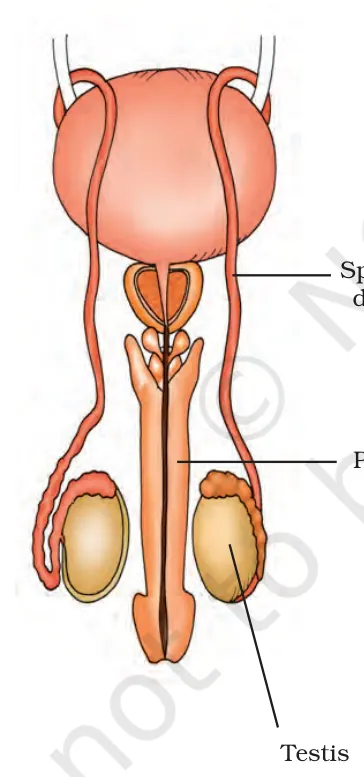
The male reproductive system produces male gametes (sperm), delivers them to the female reproductive tract and secretes hormones (mainly testosterone) that control development and sexual behaviour. The main parts are external (penis and scrotum) and internal (testes, epididymis, vas deferens, accessory glands and urethra).
- Testes: Two oval glands placed in the scrotum. Each testis contains hundreds of coiled seminiferous tubules where spermatogenesis (production of sperm) occurs. Interstitial (Leydig) cells between tubules secrete testosterone.
- Scrotum: A pouch of skin that holds the testes outside the body to keep them a few degrees cooler than the abdominal cavity—essential for normal sperm formation.
- Epididymis: A long, coiled tube on the back of each testis where sperm mature and are stored.
- Vas deferens (sperm duct): A muscular tube that transports sperm from epididymis to the ejaculatory ducts during ejaculation.
- Seminal vesicles: Paired glands that add nutrient-rich fluid (mainly fructose) to sperm—this fluid makes up a large part of semen.
- Prostate gland: Secretes a slightly alkaline fluid that helps neutralize the acidic environment of the female reproductive tract and aids sperm survival and motility.
- Bulbourethral (Cowper's) glands: Produce a small amount of lubricating fluid released before ejaculation.
- Urethra: A common tube for the passage of semen (and urine when not ejaculating) through the penis to the exterior.
- Penis: External organ that becomes erect during sexual arousal to allow deposition of semen in the female tract.
Spermatogenesis (brief): Spermatogonial stem cells in seminiferous tubules divide by mitosis and meiosis to form spermatids, which differentiate into spermatozoa (sperm). Process takes about 64–72 days. Sertoli cells support and nourish developing sperm.
- Spermatogonia (diploid) → primary spermatocytes (mitosis → meiosis I)
- Primary spermatocytes → secondary spermatocytes (meiosis I)
- Secondary spermatocytes → spermatids (meiosis II)
- Spermatids → spermatozoa (maturation)
Hormonal control: The hypothalamus releases GnRH → pituitary secretes FSH and LH. FSH acts on Sertoli cells to support spermatogenesis; LH stimulates Leydig cells to produce testosterone. Testosterone promotes development of male secondary sexual characteristics (deep voice, facial/pubic hair, increased muscle mass) and feedback-regulates the pituitary/hypothalamus.
Functional points:
- Ejaculation: rhythmic contractions expel semen containing sperm and glandular fluids through the urethra.
- Semen composition: a mix of sperm (small fraction by volume) and seminal fluids from seminal vesicles, prostate, and bulbourethral glands.
- Fertility factors: sperm count, motility (movement), morphology (shape) and semen volume are important for fertility.
- Common clinical notes: temperature, lifestyle (smoking, alcohol, heat exposure), infections and hormonal imbalances can reduce sperm quality. Vasectomy is a surgical method of male sterilization by cutting the vas deferens.
Summary: The male reproductive system is specialised for producing large numbers of mobile sperm, supporting their maturation, and delivering them to achieve fertilisation, all under hormonal control.
- Puberty: Around puberty, increased secretion of testosterone leads to growth of facial and pubic hair, deepening of the voice, and onset of sperm production. These are examples of secondary sexual characteristics.
- Vasectomy: A common contraceptive procedure in which the vas deferens are cut and sealed so sperm cannot enter the ejaculate. Semen volume remains similar but contains no sperm, preventing fertilisation.
- Heat and fertility: Men who frequently use hot baths or sit for long periods (e.g., laptop on lap) may have temporarily reduced sperm counts because high scrotal temperatures impair spermatogenesis.
- Infertility illustration: If a man has semen volume = 2.5 ml and sperm concentration = 10 million/ml (below normal), total sperm per ejaculate = 2.5 × 10 = 25 million (this is lower than the WHO reference lower limit of ≈39 million total sperm/ejaculate).
- Total sperm per ejaculate = sperm concentration (million/ml) × semen volume (ml). Example: 50 million/ml × 3 ml = 150 million total sperm.
- Sperm motility (%) = (number of motile sperm / total sperm observed) × 100. Example: if 60 of 100 sperm are motile, motility = 60%.
- Spermatogenesis duration ≈ 64–72 days (time required for a spermatogonial cell to become a mature spermatozoon).
- WHO reference lower limits (useful thresholds, not mathematical formulas): semen volume ≥ 1.5 ml; sperm concentration ≥ 15 million/ml; total sperm count ≥ 39 million per ejaculate; total motility ≥ 40%.
Reproduction in Human Beings — Female Reproductive System
Overview
The female reproductive system produces female gametes (ova), provides a site for fertilisation, and supports development of the embryo and foetus until birth. It is controlled by hormones and works in a cyclic manner called the menstrual cycle.
Main Parts and Functions
- Ovaries: Two oval glands that produce ova (eggs) and secrete hormones oestrogen and progesterone. Each month a primary follicle matures into a Graafian follicle and releases an ovum (ovulation).
- Fallopian tubes (Oviducts): Paired tubes that collect the ovum from the ovary. Fertilisation of the ovum by a sperm normally occurs here.
- Uterus (Womb): Muscular pear-shaped organ where the fertilised egg implants and the embryo/foetus develops. The inner lining is the endometrium.
- Cervix: Narrow, lower part of the uterus that opens into the vagina. It acts as a gateway and produces mucus that changes during the cycle.
- Vagina: Muscular canal that receives the penis during intercourse and serves as the birth canal.
- External genitalia (vulva): Protective structures including labia, clitoris, and openings for the urethra and vagina.
Menstrual Cycle (Approx. 28 days)
The menstrual cycle is divided into three main phases:
- Menstrual phase (Day 1–3 to 7): Shedding of the endometrium if fertilisation has not occurred — menstrual bleeding.
- Follicular (Proliferative) phase (variable, approx. Day 6–14): FSH stimulates follicle growth in the ovary; the maturing follicle secretes oestrogen, which causes the endometrium to thicken.
- Luteal (Secretory) phase (approx. Day 15–28): After ovulation, the ruptured follicle becomes the corpus luteum and secretes progesterone (and some oestrogen), which readies the endometrium for implantation. If fertilisation does not occur, corpus luteum degenerates, hormone levels fall, and menstruation begins.
Hormonal Control
Key hormones from the pituitary and ovaries coordinate the cycle:
- FSH (Follicle Stimulating Hormone): From anterior pituitary, stimulates follicle growth.
- LH (Luteinising Hormone): Triggers ovulation (sharp mid-cycle surge) and corpus luteum formation.
- Oestrogen: From follicles; promotes endometrium growth and triggers LH surge when high.
- Progesterone: From corpus luteum; maintains endometrium for implantation.
Fertilisation and Implantation
When sperm and ovum meet in the fallopian tube, fertilisation forms a zygote which divides and becomes a blastocyst. The blastocyst implants into the endometrium of the uterus and develops into an embryo and later a foetus. The placenta forms to exchange nutrients, gases and wastes between mother and foetus.
Clinical/Everyday Points
- Typical menarche (first menstruation) occurs around 10–14 years; menopause is usually between 45–55 years.
- Regular cycles and timing of ovulation are important for family planning; contraception methods work at different points of the process.
Note: Diagrams are especially helpful: an anatomical labelled diagram of the female reproductive system and graphs showing hormone levels across the cycle make the concepts clear.
- Monthly menstruation: A girl of age 13 may experience bleeding for 3–7 days about every 28 days — this is the menstrual phase when the endometrium sheds.
- Ovulation and conception: If ovulation occurs on day 14 of a 28-day cycle, intercourse around day 12–15 can result in sperm meeting the ovum in the fallopian tube and fertilisation taking place.
- Pregnancy timeline: After successful implantation, the pregnancy normally lasts about 280 days (≈40 weeks). The placenta supplies nutrients and oxygen to the developing foetus.
- Hormone changes: Before mid-cycle, rising oestrogen causes the endometrium to thicken; a sudden LH surge triggers ovulation; afterwards, progesterone rises to maintain the lining.
- Approximate ovulation day ≈ (Menstrual cycle length) − 14. Example: For a 28-day cycle, ovulation ≈ day 14.
- Fertile window ≈ Ovulation day ± 4 days (sperm can survive up to ~5 days; ovum viable ~12–24 hours).
- Average gestation ≈ 280 days ≈ 40 weeks ≈ 9 months.
- Typical menstrual cycle length (average) ≈ 28 days (individual cycles may range ~21–35 days).
Pregnancy, Birth and Lactation
Overview
Pregnancy, birth and lactation describe how mammals (including humans) produce offspring and feed them after birth. Pregnancy (gestation) starts at fertilization and ends with birth; lactation is the production of milk by mammary glands to nourish the newborn.
1. Pregnancy (Gestation)
- Fertilization: A sperm cell fuses with an egg (ovum) to form a zygote. In most mammals fertilization occurs in the fallopian tube.
- Early development: The zygote divides and becomes an embryo. The embryo implants into the uterine wall where it continues to develop.
- Placenta and umbilical cord: The placenta forms a connection between mother and fetus. It supplies oxygen and nutrients and removes waste. The umbilical cord carries blood between fetus and placenta.
- Amniotic sac and fluid: The fetus floats in amniotic fluid inside the amniotic sac. This protects it from mechanical shocks and helps temperature regulation.
- Gestation period: The time from fertilization (or from the first day of last menstrual period in humans) to birth. Gestation lengths vary by species (see examples).
2. Birth (Parturition)
- Onset of labour: Hormonal signals (e.g., increase in oxytocin and changes in progesterone/estrogen balance) cause uterine contractions.
- Stages of labour:
- Dilation stage — cervix opens (dilates) to allow passage of the baby.
- Expulsion stage — strong uterine contractions push the baby out through the birth canal.
- Placental stage — after birth, the placenta (afterbirth) is expelled.
- Types of birth: Most mammals give live birth (viviparous). Some animals (e.g., many fishes, reptiles) lay eggs (oviparous); a few mammals like the platypus are egg-laying (monotremes).
3. Lactation (Milk Production)
- Mammary glands: Specialized glands in female mammals that produce milk. Mammary tissue develops under hormonal control during pregnancy.
- Milk composition: Contains water, lactose (sugar), fats, proteins, vitamins and antibodies. First milk (colostrum) is rich in antibodies and nutrients to protect the newborn.
- Hormonal control: Prolactin stimulates milk production; oxytocin causes the milk ejection (let‑down) reflex during suckling.
- Benefits: Milk provides balanced nutrition, immune protection, and helps mother–young bonding. Exclusive breastfeeding is recommended for human infants for the first 6 months.
Important points to remember
- Placenta is vital for exchange of oxygen, nutrients and waste (but maternal and fetal blood do not directly mix).
- Labor is a natural sequence of coordinated uterine contractions and cervical changes that allow birth.
- Lactation is governed by supply and demand — increased suckling increases milk production through hormonal feedback.
- Human pregnancy: Average gestation ≈ 9 months (about 280 days from last menstrual period). Development stages: embryo → fetus → birth; breastfeeding supplies colostrum then mature milk.
- Cow: Gestation ≈ 9–10 months. After calving, the cow produces milk for the calf (and dairy production) — milking frequency influences milk yield.
- Dog: Short gestation ≈ 58–63 days. Litter-bearing mammals often give birth to several young at once.
- Elephant: Very long gestation ≈ 22 months — newborn calves are relatively well-developed.
- Mouse: Very short gestation ≈ 19–21 days — many offspring per litter and rapid reproductive cycles.
- Estimated Due Date (human, common rule): EDD = First day of Last Menstrual Period (LMP) + 280 days (≈ 40 weeks).
- Gestational age conversion: weeks × 7 = days (e.g., 40 weeks × 7 = 280 days).
- Breastfeeding energy estimate (typical adult mother): additional ≈ 500 kcal/day above normal diet to support milk production (approximate guideline, varies by individual).
- Relationship between fetal age and gestational age: Gestational age (by LMP) ≈ fetal age + 2 weeks (because gestational age counts from LMP, about 2 weeks before ovulation/conception).
Classification by Development Strategy
What it means: Classification by development strategy groups animals according to how their young develop after fertilisation — whether the offspring resemble the adult immediately (direct development) or pass through distinctly different stages (indirect development) such as larvae and pupae.
1. Direct development
Young that hatch or are born resemble the adult in body form and habits. Growth is mainly an increase in size and sexual maturity. There is no larval stage or abrupt transformation.
- Features: no dramatic change in body plan, same habitat and feeding as adult, internal or external development possible.
- Examples: mammals (human, cow), birds (hen), many reptiles.
2. Indirect development (metamorphosis)
Offspring pass through one or more distinct stages that differ in form, habitat and feeding. Metamorphosis reduces competition between young and adults and allows specialised life stages.
a) Complete metamorphosis (holometabolous)
- Typical stages: egg → larva → pupa → adult.
- Characteristics: larva is specialised for feeding/growth; pupa is non-feeding reorganisation stage; adult is for dispersal and reproduction.
- Examples: butterfly (caterpillar → pupa/chrysalis → butterfly), housefly, beetles.
b) Incomplete/metamorphosis (hemimetabolous)
- Typical stages: egg → nymph → adult.
- Characteristics: nymph resembles a small adult but may lack wings or reproductive organs; gradual change through moulting.
- Examples: cockroach, grasshopper, dragonfly (adds aquatic nymph for some).
c) Amphibian-type metamorphosis
- Example: frog — egg → aquatic larva (tadpole with gills, tail) → adult (lungs, legs). This involves major habitat and organ changes.
Hormonal control
Metamorphosis is hormonally regulated: in insects by ecdysone and juvenile hormone; in amphibians by thyroid hormones (e.g., thyroxine).
Why this classification matters
- Explains life-cycle adaptations (feeding, dispersal, survival).
- Useful in pest control, conservation and understanding ecological roles of different stages.
- Human (direct development): newborn looks like small adult and grows in size and maturity.
- Butterfly (complete metamorphosis): egg → caterpillar (larva) → chrysalis (pupa) → adult butterfly.
- Grasshopper (incomplete metamorphosis): egg → nymph (resembles adult but wingless) → adult.
- Frog (amphibian metamorphosis): egg → tadpole (aquatic larva with gills) → frog (terrestrial adult with lungs).
- Cockroach (incomplete): egg case → nymph stages (multiple moults) → adult cockroach.
- Growth rate (linear) = (Final size - Initial size) / Time period
- Percent growth = ((Final size - Initial size) / Initial size) × 100
- Stage survival (%) = (Number surviving to stage / Number at start) × 100
Reproductive Health and Ethics
What is reproductive health? Reproductive health means physical, mental and social well‑being in all matters relating to the reproductive system. It is not just the absence of disease or infirmity but includes the ability to have a responsible, satisfying and safe sex life, the capability to reproduce, and the freedom to decide if, when and how often to do so.
Main components of reproductive health
- Puberty and development: Understanding bodily changes during adolescence (menstruation, secondary sexual characteristics) and maintaining hygiene.
- Maternal health: Care during pregnancy, safe delivery and postnatal care to protect the mother and child.
- Family planning and contraception: Information and access to safe methods to plan number and spacing of children.
- Prevention and treatment of STIs (sexually transmitted infections): Awareness, testing and treatment (example: HIV, syphilis).
- Mental and social well‑being: Emotional readiness for relationships, respect, consent and freedom from coercion.
Basic practices for good reproductive health
- Maintain personal hygiene (regular bathing, menstrual hygiene using clean sanitary products).
- Get regular medical checkups; seek doctor’s advice for contraception or pregnancy care.
- Use protection (e.g., condoms) to prevent STIs and unintended pregnancy.
- Follow vaccination recommendations (e.g., HPV vaccine where available) to prevent certain reproductive cancers and infections.
- Adopt healthy diet and avoid harmful substances (tobacco, alcohol, drugs) especially during pregnancy.
Ethics related to reproductive health
- Consent and privacy: Medical decisions related to reproduction must be made with informed consent and confidentiality.
- Respect and equality: Everyone has the right to information and services regardless of gender, caste or income. Discrimination (for example, against girls before or after birth) is unethical and illegal.
- Responsible use of technology: Pre‑natal diagnostic tools must not be misused for sex determination leading to female foeticide. Laws such as the PC&PNDT Act (in India) prohibit misuse.
- Age and marriage: Ethical concern about child marriage — young people should not be forced into marriage or parenthood before they are physically and emotionally ready.
- Accurate information and education: Schools and families should provide age‑appropriate sex education so young people can make informed, ethical choices.
How this links to reproduction in animals (Class 8 context)
In animals we study how reproduction ensures survival of species. In humans, knowledge of reproductive health and ethics helps individuals and communities to plan families, prevent disease, and protect rights — balancing biological facts with social responsibility.
- Using condoms reduces the chance of getting HIV and other STIs and helps prevent unintended pregnancy.
- HPV vaccination in adolescent girls (and boys where available) helps prevent cervical cancer later in life.
- Spacing births by using family planning methods (e.g., oral pills, IUDs) improves the health of mother and child.
- A government health camp offering free antenatal care and iron supplements to pregnant women in a village.
- A school programme that teaches students about puberty, menstrual hygiene and where to seek help.
- Refusal of sex-selective abortion because of the PC&PNDT law and community campaigns against female foeticide.
- Incidence rate = (Number of new cases in a time period / Population at risk during that period) × 1,000 (or 100,000). — Useful to describe how often an infection occurs.
- Prevalence = (Total number of existing cases at a given time / Total population) × 100. — Shows how widespread a condition is.
- Contraceptive Prevalence Rate (CPR) = (Number of women using any contraceptive method / Total women of reproductive age) × 100.
- \[Simple population growth (useful to illustrate need for family planning): N(t) = N0 × e^{r t}\]\[where N0 = initial population\]\[r = growth rate\]\[t = time. (Class 8 level: introduce concept qualitatively.)\]
- Doubling time ≈ 0.693 / r (where r is the growth rate). — Shows how quickly a population would double at a constant growth rate.
Comparison and Summary
Overview
Reproduction in animals ensures continuity of species. It occurs mainly in two broad ways: asexual and sexual reproduction. Each mode has characteristic methods, advantages and disadvantages.
Asexual reproduction
- Single parent; no fusion of gametes.
- Offspring are genetically identical (clones) to the parent — little or no variation.
- Common types: binary fission (Amoeba), budding (Hydra), fragmentation and regeneration (Planaria, some starfish), and parthenogenesis (some insects and reptiles).
- Fast and energetically inexpensive — good for stable environments and rapid population increase.
Sexual reproduction
- Usually two parents (or hermaphrodite individuals exchanging gametes). Male and female gametes (sperm and egg) fuse to form a zygote.
- Causes genetic variation among offspring — beneficial for adaptation and evolution.
- Fertilization can be external (eg. many fishes, frogs) or internal (eg. mammals, birds, reptiles). Development may be oviparous (egg laid outside body), viviparous (young born live after inside development), or ovoviviparous (eggs hatch inside mother).
- Slower and more energy-consuming but increases survival in changing environments through variation and parental care.
Key comparisons (summary)
- Parents: Asexual = one; Sexual = two (usually).
- Genetic makeup: Asexual = identical clones; Sexual = genetically varied offspring.
- Speed & numbers: Asexual often faster, produces many offspring quickly; Sexual slower with fewer offspring but higher adaptive value.
- Adaptability: Asexual suited to stable conditions; Sexual favours long-term adaptability and evolution.
- Care: Asexual species often provide little parental care; many sexually reproducing animals show parental investment (eg. birds, mammals).
Exceptions & special cases
- Hermaphrodites (earthworms, many snails) possess both male and female reproductive organs and can exchange gametes.
- Haplodiploidy in bees: males develop from unfertilized (haploid) eggs (an example of parthenogenesis producing males).
- Some species can use both modes — e.g., certain starfish can regenerate (asexual) but also reproduce sexually.
Takeaway: Asexual reproduction gives rapid increase in numbers but low variation; sexual reproduction promotes genetic diversity and better long‑term survival in changing environments. Understanding both helps explain animal life cycles, population dynamics and evolution.
- Amoeba — binary fission (asexual): one cell divides into two identical cells.
- Hydra — budding (asexual): a bud forms on the parent, grows and detaches as a new individual.
- Planaria — fragmentation and regeneration (asexual): a cut piece regenerates into a whole worm.
- Honeybee — parthenogenesis: male (drone) develops from an unfertilized egg; female from fertilized egg.
- Frog — external fertilization and oviparous: eggs are laid in water and sperm fertilizes them outside the body.
- Human — internal fertilization and viviparous: embryo develops inside the mother; live birth follows.
- Haploid + Haploid = Diploid (n + n = 2n) — gamete fusion during fertilization produces a zygote with combined chromosome number.
- Discrete population growth for asexual reproduction: N_after_n_generations = N0 × r^n (where N0 = initial number, r = number of offspring per parent each generation, n = number of generations).
- Simple continuous growth (useful approximation): N(t) = N0 × e^(rt) (r = intrinsic growth rate, t = time) — shows rapid increase possible in asexual reproduction under ideal conditions.
Key Concepts
- Reproduction
- Biological process by which organisms produce new individuals of the same kind.
- Sexual reproduction
- Type of reproduction involving fusion of male and female gametes to form a zygote, producing genetically varied offspring.
- Asexual reproduction
- Type of reproduction where a single parent produces offspring without gamete fusion; offspring are genetically similar to parent.
- Fertilisation
- Fusion of a male gamete (sperm) and a female gamete (egg) to form a zygote.
- External fertilisation
- Fertilisation that occurs outside the body of the parent, usually in water, where eggs and sperms are released.
- Internal fertilisation
- Fertilisation that occurs inside the body of the female, where sperm reaches the egg internally.
- Zygote
- The single cell formed immediately after fertilisation; it develops into an embryo.
- Embryo
- Early developmental stage after the zygote divides and differentiates into tissues and organs.
- Metamorphosis
- Series of distinct developmental changes an animal undergoes from juvenile to adult form.
- Larva
- Immature, often worm-like stage of an animal that looks different from the adult and usually undergoes metamorphosis.
- Pupa
- A non-feeding, often inactive stage in complete metamorphosis during which the larva transforms into the adult.
- Nymph
- Juvenile stage in incomplete metamorphosis that resembles the adult but is usually smaller and lacks fully developed wings or reproductive organs.
- Oviparous
- Animals that lay eggs outside the mother's body; embryos develop in the egg.
- Viviparous
- Animals in which the embryo develops inside the mother and offspring are born alive.
- Ovoviviparous
- Animals that produce eggs which hatch inside the mother's body so that young are born live; no placental nourishment.
- Hermaphrodite
- An organism that has both male and female reproductive organs and can often produce both gamete types.
- Parthenogenesis
- A form of asexual reproduction in which an egg develops into an individual without fertilisation.
- Binary fission
- Asexual reproduction where a single organism divides into two equal daughter organisms.
- Budding
- A form of asexual reproduction in which a new organism grows from a bud on the parent and may detach.
- Regeneration
- Ability of an organism to regrow lost or damaged body parts; in some species, entire new individuals can form from fragments.
End-of-Chapter Trial Paper & Test Questions
Topic-wise questions to test your understanding of every concept in this chapter.
-
Which of the following is an example of asexual reproduction by budding? (a) Amoeba dividing into two (b) Hydra producing a small outgrowth that detaches (c) Butterfly laying eggs (d) Frog undergoing external fertilisation निम्नलिखित में से कौन-सा मुकुलन द्वारा अलैंगिक जनन का उदाहरण है? (a) अमीबा का दो भागों में विभाजन (b) हाइड्रा से छोटा उभार निकलकर अलग होना (c) तितली का अंडे देना (d) मेंढक का बाह्य निषेचन
Show answer
(b) Hydra producing a small outgrowth that detaches / हाइड्रा से छोटा उभार निकलकर अलग होना — Budding is a form of asexual reproduction where a new organism develops from an outgrowth (bud) on the parent body, as seen in Hydra. / मुकुलन अलैंगिक जनन का एक रूप है जिसमें जनक के शरीर पर उभार (बड) से नया जीव विकसित होता है, जैसा हाइड्रा में देखा जाता है।
-
In which type of fertilisation do sperm and egg fuse outside the body of the female? (a) Internal fertilisation (b) External fertilisation (c) Parthenogenesis (d) Budding किस प्रकार के निषेचन में शुक्राणु और अंडाणु मादा के शरीर के बाहर मिलते हैं? (a) आंतरिक निषेचन (b) बाह्य निषेचन (c) अनिषेकजनन (d) मुकुलन
Show answer
(b) External fertilisation / बाह्य निषेचन — In external fertilisation, gametes are released into the environment (usually water) and fuse outside the female's body, as seen in frogs and many fishes. / बाह्य निषेचन में युग्मक बाहरी वातावरण (प्राय: जल) में छोड़े जाते हैं और मादा के शरीर के बाहर मिलते हैं, जैसा मेंढक और अनेक मछलियों में होता है।
-
Animals that give birth to live young (as in humans) are called ________. / ऐसे जंतु जो जीवित शिशु को जन्म देते हैं (जैसे मनुष्य) ________ कहलाते हैं।
Show answer
Viviparous / जरायुज — Viviparous animals develop their offspring inside the mother's body and give birth to live young. / जरायुज जंतु अपने शिशु को माँ के शरीर के अंदर विकसित करते हैं और जीवित शिशु को जन्म देते हैं।
-
In sexual reproduction, the chromosome number of a gamete (sperm or egg) is ________ the chromosome number of a body (somatic) cell. / लैंगिक जनन में युग्मक (शुक्राणु या अंडाणु) की गुणसूत्र संख्या एक शरीर (कायिक) कोशिका की गुणसूत्र संख्या की ________ होती है।
Show answer
Half / आधी — Gametes are haploid (n), containing half the chromosome number of diploid (2n) somatic cells. Fertilisation restores the diploid number in the zygote. / युग्मक अगुणित (n) होते हैं, जिनमें द्विगुणित (2n) कायिक कोशिकाओं की आधी गुणसूत्र संख्या होती है। निषेचन से युग्मनज में द्विगुणित संख्या पुनः स्थापित होती है।
-
True or False: Offspring produced by asexual reproduction show high genetic variation compared to offspring from sexual reproduction. / सत्य या असत्य: अलैंगिक जनन से उत्पन्न संतानें लैंगिक जनन से उत्पन्न संतानों की तुलना में अधिक आनुवंशिक विविधता दिखाती हैं।
Show answer
False / असत्य — Asexual reproduction produces offspring that are genetically identical (clones) to the parent; it is sexual reproduction that introduces genetic variation through mixing of genes. / अलैंगिक जनन से आनुवंशिक रूप से समान (क्लोन) संतानें उत्पन्न होती हैं; आनुवंशिक विविधता लैंगिक जनन में जीन के मिश्रण से आती है।
-
True or False: The butterfly undergoes incomplete metamorphosis, with only three stages: egg, nymph and adult. / सत्य या असत्य: तितली अपूर्ण रूपांतरण से गुजरती है, जिसमें केवल तीन अवस्थाएँ होती हैं: अंडा, अप्सरा और वयस्क।
Show answer
False / असत्य — The butterfly undergoes complete metamorphosis with four stages: egg → larva (caterpillar) → pupa (chrysalis) → adult. Incomplete metamorphosis (three stages) is seen in cockroaches and grasshoppers. / तितली पूर्ण रूपांतरण से गुजरती है जिसमें चार अवस्थाएँ होती हैं: अंडा → लार्वा (इल्ली) → प्यूपा (क्रिसालिस) → वयस्क। अपूर्ण रूपांतरण (तीन अवस्थाएँ) तिलचट्टे और टिड्डे में होता है।
-
What is regeneration in animals? Give one example. / जंतुओं में पुनर्जनन क्या है? एक उदाहरण दीजिए।
Show answer
Regeneration is the ability of an organism to regrow lost or damaged body parts and in some cases to develop a complete new individual from a fragment. Example: Planaria (flatworm) — if cut into pieces, each piece can regenerate into a whole organism. Starfish can also regenerate lost arms. / पुनर्जनन जीव की वह क्षमता है जिससे वह खोए या क्षतिग्रस्त शरीर के अंगों को पुनः उगा सकता है और कुछ मामलों में एक टुकड़े से पूरा नया जीव विकसित हो सकता है। उदाहरण: प्लेनेरिया (चपटा कृमि) — टुकड़ों में काटने पर प्रत्येक टुकड़ा पूरे जीव में पुनर्जनन कर सकता है। स्टारफिश भी खोई हुई भुजाओं का पुनर्जनन कर सकती है।
-
Differentiate between oviparous and viviparous animals with one example each. / अंडज और जरायुज जंतुओं में अंतर बताइए, प्रत्येक का एक उदाहरण दीजिए।
Show answer
Oviparous animals lay eggs that develop outside the mother's body (example: hen/chicken). Viviparous animals retain the developing young inside the mother's body and give birth to live offspring (example: humans, dogs). / अंडज जंतु ऐसे अंडे देते हैं जो माँ के शरीर के बाहर विकसित होते हैं (उदाहरण: मुर्गी)। जरायुज जंतु विकासशील शिशु को माँ के शरीर के अंदर रखते हैं और जीवित संतान को जन्म देते हैं (उदाहरण: मनुष्य, कुत्ता)।
Related Laws & Principles
Explore allFoundational laws & principles behind this chapter. Each one opens a full page — what it says, why it matters, five practice questions and the mistakes to avoid.