Overview
Introduction: Chapter 'Light' introduces light as a form of energy that enables us to see objects. It describes natural and artificial sources of light, how light travels (rectilinear propagation) and how it interacts with matter (transmission, absorption, reflection). The chapter explains formation of shadows (including umbra and penumbra), distinguishes regular and diffused reflection, and develops the basic laws of reflection. It also covers image formation by plane mirrors, lateral inversion, multiple reflections (practical devices such as periscopes and kaleidoscopes), and the qualitative behaviour and everyday uses of spherical mirrors (concave and convex). Importance: This chapter builds foundational ideas in optics needed for higher classes and everyday life. Understanding light explains common phenomena (shadows, mirrors, vision), supports practical skills (making and reading ray diagrams), and connects to technology (mirrors, periscopes, vehicle mirrors, torches). It trains observational, experimental and reasoning skills essential in science. Key themes: sources of light; transparent, translucent and opaque media; rectilinear propagation of light; shadows, umbra and…
Learning Objectives
- Define light, luminous and non-luminous objects and give examples.
- Explain rectilinear propagation of light and apply it to describe formation of shadows and eclipses.
- State and explain the laws of reflection and apply them to simple problems.
- Draw ray diagrams for a plane mirror and determine the position, size, and nature (virtual/real, erect/inverted) of the image.
- Describe the terms pole, centre of curvature, principal axis and focal point for spherical mirrors and state focal length.
- Draw ray diagrams for concave and convex mirrors for various object positions and predict the nature and position of images.
- Distinguish between regular and diffused reflection and give examples of each.
- Define refraction of light and refractive index; explain refraction at a plane surface.
Topics in this chapter
6 topics · tap a topic title to jump straight to it.
Nature and sources of light
What is light? Light is a form of energy that enables vision. It is produced by certain objects and travels outward from them. Light allows us to see objects when it reaches our eyes and carries information about colour, brightness and shape.
Basic nature of light (class 8 level)
- Light travels in straight lines. This is why shadows and sharp edges of shadows form and why ray diagrams (with straight arrows) are useful.
- Light behaves as an electromagnetic wave and is characterized by wavelength (λ) and frequency (ν). In everyday school physics we use the wave picture to explain colours, spectra and phenomena such as reflection and refraction.
- Light carries energy. Different processes produce light (see production mechanisms below).
Sources of light
- Luminous (primary) sources: Objects that produce their own light. Examples: Sun, stars, candle flame, electric bulb, LED, firefly. These can be natural (Sun, stars, fireflies) or artificial (bulbs, LEDs, neon signs).
- Non-luminous (secondary) sources: Objects that do not produce their own light but reflect light from luminous objects. Examples: Moon, planets, walls, books, clothes.
How light is produced (common mechanisms)
- Incandescence: heating a material till it glows (filament bulb, candle flame).
- Combustion: chemical burning (candle, fire).
- Electric discharge: current through a gas (neon signs, fluorescent tube during discharge stage).
- Fluorescence and phosphorescence: absorption and re-emission of light; fluorescence emits quickly (fluorescent tubes), phosphorescence emits slowly (glow-in-the-dark materials).
- Electroluminescence: light produced by passing current through a semiconductor (LEDs).
- Bioluminescence and chemiluminescence: chemical reactions in living organisms or chemicals produce light (fireflies, glow sticks).
Important consequences
- Because light travels in straight lines, objects cast shadows; the shape and sharpness of a shadow depend on the size and distance of the source.
- Light intensity from a point source decreases with distance (approx. according to the inverse-square law), so objects farther from a source appear dimmer.
- Visible light is only a small part of the electromagnetic spectrum (approx. 400–700 nm). Different wavelengths correspond to different colours.
Note for advanced curiosity (not required for basic class 8 problems): Light can also be described in particle terms (photons). Quantum formulas such as E = h×ν give the energy per photon, but these are usually introduced later.
- Sun: natural luminous source producing light by nuclear reactions (appears white-yellow).
- Moon: non-luminous; it reflects sunlight and hence appears bright at night.
- Incandescent bulb: produces light by heating a metal filament (incandescence).
- LED torch: produces light by electroluminescence (efficient and cool-running).
- Fluorescent tube: uses electric discharge and phosphors (fluorescence) to emit visible light.
- Candle flame: luminous due to combustion producing heat and light.
- Speed of light in vacuum: c = 3.0 × 10^8 m/s
- Wave relation: c = λ × ν (where λ = wavelength in metres, ν = frequency in Hz)
- Speed of light in a medium: v = c / n (n is the refractive index of the medium)
- Inverse-square law (point source approximation): Intensity I ∝ 1/r^2 (I decreases as distance r from the source increases)
- Photon energy (advanced): E = h × ν (h is Planck's constant; typically taught later)
Propagation of light
What is propagation of light?
Propagation of light means the way light travels from a source through space or a medium. In a homogeneous medium (like air or vacuum) light travels in straight lines. This principle is called rectilinear propagation of light.
Key ideas and definitions
- Ray: an imaginary line that shows the path along which light travels.
- Beam: a group of rays. Types: parallel beam, divergent beam, convergent beam.
- Point source: a small light source whose size can be ignored compared to distances involved; it produces sharp shadows.
- Extended source: a source with appreciable size; it can produce partial shadows (penumbra) and full shadows (umbra).
- Shadow: a dark region formed when an opaque object blocks light from a source. It has an umbra (completely dark) and sometimes a penumbra (partly lit) if the source is extended.
Experiments that show rectilinear propagation
- Pinhole experiment: light passing through a small hole forms a bright spot on a screen directly opposite the hole showing straight-line travel.
- Multiple holes in card with a screen behind: only holes that lie on a straight line with source and screen form bright images.
- Shadow formation with a point source: sharp shadow; with an extended source: umbra and penumbra appear.
When does light not travel in straight lines?
Light appears to change direction when it is reflected from surfaces, refracted when entering another medium, or scattered by particles. But within a uniform medium between interactions, it travels straight.
Simple geometry and similar triangles
Many practical results (for example from a pinhole camera) follow from similar triangles: the size of the image is proportional to the distances involved.
- Shadow of a tree on a sunny day: sharp umbra if the sun is treated as a point source for that scale, with faint penumbra near edges because the sun is an extended source.
- Pinhole camera (camera obscura): an inverted image of a scene is formed on the screen by straight rays passing through a small hole.
- Laser pointer: produces an almost parallel beam showing straight-line propagation; the beam produces a small bright spot on a distant wall.
- Headlights of a car: produce divergent beams that illuminate the road ahead; objects block the beams and cast shadows.
- Distance = speed × time, d = v × t (for light in vacuum v ≈ 3.0 × 10^8 m/s).
- Inverse square law (point source intensity): I ∝ 1 / r^2, or for total power P, I = P / (4π r^2).
- Magnification (pinhole camera / simple geometry): m = image height / object height = image distance / object distance (hi/ho = di/do).
Reflection of light
What is reflection of light?
Reflection of light is the bouncing back of light rays when they strike a surface that does not absorb the light completely. The reflected light then travels in a new direction.
Types of reflection
- Regular (specular) reflection: Occurs from smooth, polished surfaces (like a mirror). Parallel incident rays remain parallel after reflection and form clear images.
- Diffused reflection: Occurs from rough surfaces (like paper or cloth). Parallel rays scatter in many directions, so no clear image is formed.
Laws of reflection
- 1. The incident ray, the reflected ray and the normal to the surface at the point of incidence all lie in the same plane.
- 2. The angle of incidence (i) is equal to the angle of reflection (r): i = r.
Plane mirror image formation
A plane mirror forms a virtual image which is: upright, laterally inverted (left-right reversed), of the same size as the object, and located at the same distance behind the mirror as the object is in front of it. The image cannot be obtained on a screen because it is virtual.
How to draw a ray diagram for a plane mirror
Draw the mirror as a straight line. From a point on the object, draw two incident rays to the mirror. At each point of incidence, draw the normal and reflect the rays such that angle of incidence = angle of reflection. Extend the reflected rays backward behind the mirror; their intersection gives the position of the virtual image.
Everyday examples and uses
Mirrors (bathroom, dressing), rear-view and side mirrors in vehicles, periscopes in submarines, reflecting surfaces in optical instruments, seeing your face in a calm pond (regular reflection), and diffuse reflection allowing us to see non-shiny objects.
Simple experiments you can try
Place a small object in front of a plane mirror and measure object distance and image distance — they will be equal. Shine a narrow beam (from a laser pointer or ray-box) on different surfaces to see regular vs diffused reflection.
- Seeing your face clearly in a flat mirror (regular reflection).
- Reading text on a sheet because light diffusely reflected from the paper reaches your eyes.
- Using a rear-view mirror to see vehicles behind you (plane mirror property: virtual upright image).
- Periscope in a submarine uses two plane mirrors to change the direction of light and let you see over obstacles.
- Angle of incidence = Angle of reflection → i = r
- For a plane mirror: image distance (di) = object distance (do)
- Linear magnification for a plane mirror: m = height of image / height of object = 1 (image same size)
Multiple reflection and applications
What is multiple reflection?
Multiple reflection is the successive reflection of light from two or more reflecting surfaces (usually plane mirrors). Each reflection follows the law of reflection: angle of incidence = angle of reflection. When light reflects repeatedly between mirrors, several images of an object are formed.
How multiple images are formed
When an object is placed between or in front of two plane mirrors, light from the object reflects from one mirror to the other and back. Each reflected ray appears to come from a virtual image. Those virtual images act as new object positions for further reflections, producing additional images. For two mirrors the images appear arranged symmetrically about the line of intersection (or bisector) of the mirrors.
Special cases
- Parallel mirrors (θ = 0°): the reflections repeat indefinitely and we see an infinite number of images (e.g., two facing dressing-room mirrors).
- Mirrors at an angle (θ > 0°): a finite number of images are seen depending on the angle between the mirrors. For certain angles the images are symmetrically placed in a circular pattern around the object.
Qualities of images
Images formed by plane mirrors (single or multiple reflections) are virtual (cannot be projected on a screen), erect (upright), and of the same size as the object. In multiple reflections these properties hold for every image formed by plane mirrors.
Useful formula (two plane mirrors)
If two plane mirrors are inclined at an angle θ, the number of images N formed is given by:
N = (360 / θ) − 1, when 360/θ is an integer. If 360/θ is not an integer, the number of images equals the integer part (floor) of 360/θ. Special note: when θ = 0 (parallel mirrors) we get infinitely many images.
Why this matters
Multiple reflections are used to create special visual effects and are exploited in many optical devices and safety features. Understanding how images form and where they appear helps in designing instruments and practical systems.
- Two facing dressing-table mirrors (parallel mirrors) that produce a seemingly endless row of images.
- Kaleidoscope: a tube with three or more mirrors set at angles; multiple reflections create symmetric, repeating patterns.
- Periscope: uses two plane mirrors (or prisms) to reflect light twice so one can see over obstacles (submarines, trench periscopes).
- Corner-cube retroreflector (three mutually perpendicular mirrors): light entering is reflected back parallel to the incoming beam — used in road reflectors, bicycle reflectors, and lunar laser-ranging reflectors.
- Security/supermarket convex mirror systems and hall-of-mirrors fun-house effects that use multiple reflections to give wide or repeated views.
- Law of reflection: angle of incidence (i) = angle of reflection (r).
- Number of images formed by two plane mirrors inclined at angle θ: N = (360 / θ) − 1 (when 360/θ is an integer).
- If 360/θ is not an integer, then N = floor(360/θ) (take the integer part).
- Special case: θ = 0° (parallel mirrors) → N = ∞ (infinite images).
Experiments and activities
Experiments and activities in the Class 8 chapter on Light are designed to demonstrate the basic properties of light: its straight-line propagation, reflection, refraction and dispersion. Below are clear, classroom-friendly experiments with expected observations and short explanations.
Pinhole camera (shows light travels in straight lines and image formation)
- Materials: a cardboard box, white screen (paper), a small pin or needle, tape.
- Procedure: make a tiny hole in one side of the box; place a white paper on the opposite inner side as a screen. Point the hole toward a bright object (window, lamp, distant scene).
- Observation: an inverted image of the object appears on the screen.
- Explanation: rays from different parts of the object pass through the small hole in straight lines and cross, producing an inverted image. Reducing hole size sharpens the image but reduces brightness.
Shadow, umbra and penumbra (shows straight line propagation and multiple sources)
- Materials: small opaque object, screen (white paper), a single torch and optionally a second torch.
- Procedure: place the object between torch and screen and vary distances of object and torch from the screen.
- Observation: a dark central region (umbra) and a lighter surrounding region (penumbra) appear when more than one light source is used. Shadow size changes with distances.
- Explanation: rays blocked by the object form the umbra; partial blockage from different sources forms the penumbra. Shadow size increases when the object is closer to the light source and decreases when it is closer to the screen.
Verification of the laws of reflection using a plane mirror
- Materials: plane mirror, protractor, pencil, pins or ray box, white sheet of paper.
- Procedure: place the mirror on the paper and draw its normal. Direct a ray of light (or mark a pencil ray) at the mirror and measure the angle of incidence and the reflected ray.
- Observation: the measured angle of incidence equals the angle of reflection; incident ray, reflected ray and normal lie in the same plane.
- Explanation: this verifies the two laws of reflection: (1) angle of incidence = angle of reflection, and (2) incident ray, normal and reflected ray are coplanar.
Apparent depth (refraction at a water surface)
- Materials: a coin, a bowl or glass beaker, water.
- Procedure: drop the coin to the bottom of the bowl. Look from an angle above the rim and note where the coin appears. Add water and repeat.
- Observation: when water is added, the coin appears to move upward (appears at a shallower depth).
- Explanation: light from the coin bends away from the normal when it passes from water to air; the brain traces these rays back in straight lines causing the coin to appear at a shallower position (apparent depth).
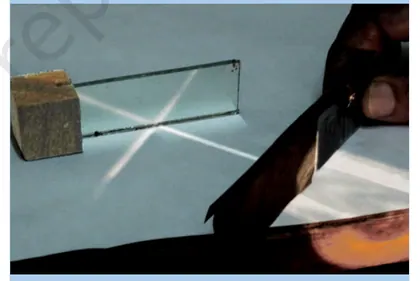
Refraction through a glass slab (lateral displacement)
- Materials: rectangular glass slab, ray box or laser pointer, protractor, white paper.
- Procedure: place the slab on paper, draw its outline. Shine an oblique ray at the slab, mark the incident and emergent rays and their directions. Measure incident and refracted angles. Trace the emergent ray backward to see the lateral shift.
- Observation: the emergent ray is parallel to the incident ray but shifted sideways (lateral displacement).
- Explanation: on entering the slab light bends toward the normal (from air to glass) and on leaving it bends away; because the two refractions are at parallel surfaces, the emergent ray is parallel to the incident ray but displaced.
Dispersion using a glass prism
- Materials: triangular glass prism, white light source (narrow beam), white screen.
- Procedure: shine the narrow white beam on one face of the prism and observe the emerging light on the screen.
- Observation: white light splits into colours (violet to red) — a visible spectrum.
- Explanation: different wavelengths refract by different amounts (dispersion); shorter wavelengths (violet) refract more than longer (red).
Safety notes: avoid shining lasers into eyes; handle glass carefully; use low-power light sources for classroom demos.
Tips for classroom measurement: use a ray box and protractor for accurate angle measurements; repeat observations for different angles or distances and record data to plot graphs (see suggestions below).
- Pinhole camera: camera obscura is the basic principle behind photographic pinhole cameras and early cameras.
- Shadows: sundials use the position and length of a shadow to tell time (sunlight straight-line propagation).
- Plane mirrors: bathroom mirrors produce laterally inverted images of people but the size remains equal to the object.
- Apparent depth: when you look at a coin at the bottom of a water-filled glass, it appears raised — fishermen use this effect to estimate fish depth incorrectly if not corrected for refraction.
- Periscope: uses plane mirrors placed parallel to each other to let a person see over obstacles (law of reflection).
- Prisms in optics: prisms are used in binoculars and spectroscopes to disperse or redirect light.
- Law of reflection: angle of incidence (i) = angle of reflection (r).
- Snell's law (refraction): n1 × sin(i) = n2 × sin(r), where n1 and n2 are refractive indices of the two media.
- Lateral displacement by a slab: d = t × sin(i - r) / cos(r), where t is thickness, i is angle of incidence and r is angle of refraction.
- Image properties for a plane mirror: image distance = object distance (v = u), image is laterally inverted and same size as object.
- Simple similar triangles for pinhole camera / small-angle imaging: image size / object size = image distance / object distance (hi/ho = v/u).
- Inverse-square behaviour for point-like sources (illumination): Intensity ∝ 1 / distance^2 (useful when measuring brightness vs distance).
Applications and everyday phenomena
Light behaviour (reflection, refraction, dispersion and scattering) explains many everyday observations and devices. The basic rules — light travels in straight lines, reflects from surfaces following the law of reflection, and bends at the boundary of two media according to Snell's law — let us understand and design common optical tools and explain natural phenomena.
Reflection and mirrors: A plane mirror produces a virtual, laterally inverted image of the same size as the object. Law of reflection: the angle of incidence equals the angle of reflection. Uses: shaving/vanity mirrors, periscopes, kaleidoscopes, rear-view mirrors (plane and convex), flat-surfaced signalling (periscope lets one see over obstacles by two reflections).
Shadows and eclipses: When an opaque object blocks light from a source, it casts a shadow. A sharp shadow (umbra) forms with a point-like source; extended sources give umbra and partial shadow (penumbra). Solar and lunar eclipses are large-scale shadow events caused by the Moon and Earth blocking sunlight.
Refraction and apparent displacement: Light bends when entering a denser or rarer medium. Common effects: a straight stick appears bent in water, a coin at the bottom of a cup appears higher (apparent depth), and lenses in spectacles, cameras and microscopes focus or spread rays to form images.
Dispersion and rainbows: White sunlight disperses into colours because different wavelengths refract by different amounts in a raindrop. Combined refraction and internal reflection in drops produce the primary rainbow (bright band around ~42° for red light). Secondary rainbows are formed by two internal reflections and appear at larger angles with reversed colour order.
Scattering and sky colours: Shorter wavelengths (blue) are scattered more by air molecules (Rayleigh scattering ∝ 1/λ^4), making the sky appear blue. At sunrise and sunset, light travels a longer path through the atmosphere so blue is scattered away and red/orange dominate.
Twinkling of stars and mirage: Twinkling (stellar scintillation) is due to rapid changes in atmospheric refraction as starlight passes through turbulent layers. Mirages (e.g., shimmering water on a road) arise from refraction in layers of air with varying temperatures, bending rays to produce displaced or inverted images.
Total internal reflection and optical fibres: When light tries to move from a denser to a rarer medium at angles greater than the critical angle, it reflects completely inside. This effect is used in optical fibres to guide light over long distances with low loss (communications, endoscopes).
Understanding these principles allows explanation of practical devices (spectacles, cameras, periscopes), safety features (rear-view mirrors), and natural phenomena (rainbows, blue sky, mirages, eclipses).
- Plane mirror: virtual image appears as far behind the mirror as the object is in front — used in dressing mirrors and periscopes.
- Periscope: two plane mirrors set parallel let a submarine see above the surface by successive reflections.
- Shadows: an object creates umbra and penumbra depending on the size of the light source; solar eclipse occurs when Moon's umbra reaches Earth.
- Apparent depth: a coin at the bottom of a shallow bowl appears raised when viewed from above due to refraction at the water surface.
- Rainbow: sunlight disperses in raindrops; primary bow forms around ~42° with red outside and violet inside.
- Blue sky and red sunset: Rayleigh scattering scatters short wavelengths (blue) more; longer path at sunrise/sunset removes blue, leaving red/orange.
- Law of reflection: angle of incidence = angle of reflection (i = r).
- Snell's law (refraction): n1 · sin(i) = n2 · sin(r).
- Refractive index relative to vacuum: n = c / v (c is speed of light in vacuum, v is speed in medium).
- Critical angle (for n1 > n2): sin(theta_c) = n2 / n1 (total internal reflection when incidence angle > theta_c).
- Rayleigh scattering (qualitative relation): scattered intensity ∝ 1 / (wavelength)^4 (explains stronger scattering of blue light).
- Apparent depth (approx): apparent depth ≈ real depth / n (for small viewing angles and medium of refractive index n).
Key Concepts
- Light source
- An object that emits its own light by chemical, electrical or nuclear processes.
- Luminous object
- An object that produces and emits visible light.
- Non-luminous object
- An object that does not produce its own light but is seen by reflected light.
- Transparent
- A material that allows light to pass through it clearly so objects can be seen distinctly.
- Translucent
- A material that allows some light to pass but scatters it, so objects are not seen clearly.
- Opaque
- A material that does not allow light to pass through; it either absorbs or reflects light.
- Reflection of light
- The bouncing back of light from a surface into the same medium.
- Refraction of light
- The bending of light when it passes from one medium to another with different optical density.
- Incident ray
- The ray of light that strikes a surface at the point of incidence.
- Reflected ray
- The ray of light that leaves the surface after reflection.
- Normal (to the surface)
- An imaginary line perpendicular to the reflecting surface at the point of incidence.
- Angle of incidence
- The angle between the incident ray and the normal at the point of incidence.
- Angle of reflection
- The angle between the reflected ray and the normal; equal to the angle of incidence (law of reflection).
- Plane mirror
- A flat reflective surface that forms virtual, erect images of the same size as the object.
- Concave mirror
- A spherical mirror with the reflective surface curved inward; it converges parallel rays and can form real or virtual images.
- Convex mirror
- A spherical mirror with the reflective surface bulging outward; it diverges rays and forms only virtual, diminished images.
- Focal point (F)
- The point where parallel rays of light converge (concave) or appear to diverge from (convex) after reflection; distance from mirror is focal length.
- Principal axis
- The straight line passing through the center of curvature and the pole (vertex) of a spherical mirror.
- Real image
- An image formed by actual convergence of reflected rays; it can be obtained on a screen and may be inverted.
- Virtual image
- An image formed by apparent divergence of rays; the rays do not actually meet and the image cannot be projected on a screen.
End-of-Chapter Trial Paper & Test Questions
Topic-wise questions to test your understanding of every concept in this chapter.
-
Which of the following is a luminous object? / निम्नलिखित में से कौन-सी दीप्तिमान वस्तु है? (a) Moon / चंद्रमा (b) Book / किताब (c) Sun / सूर्य (d) Wall / दीवार
Show answer
(c) Sun / सूर्य — The Sun produces its own light by nuclear reactions, making it a luminous (primary) source. / सूर्य परमाणु अभिक्रियाओं द्वारा स्वयं प्रकाश उत्पन्न करता है, इसलिए यह दीप्तिमान (प्राथमिक) स्रोत है।
-
The law of reflection states that the angle of incidence is equal to the angle of: / परावर्तन का नियम कहता है कि आपतन कोण किसके कोण के बराबर होता है: (a) Refraction / अपवर्तन (b) Reflection / परावर्तन (c) Incidence again / पुनः आपतन (d) Dispersion / परिक्षेपण
Show answer
(b) Reflection / परावर्तन — The first and most important law of reflection states that the angle of incidence equals the angle of reflection (i = r). / परावर्तन के नियमानुसार आपतन कोण परावर्तन कोण के बराबर होता है (i = r)।
-
Two plane mirrors are inclined at 60°. How many images of an object placed between them will be formed? / दो समतल दर्पण 60° के कोण पर झुके हैं। उनके बीच रखी वस्तु के कितने प्रतिबिम्ब बनेंगे? (a) 3 / 3 (b) 4 / 4 (c) 5 / 5 (d) 6 / 6
Show answer
(c) 5 / 5 — Using N = (360/θ) − 1 = (360/60) − 1 = 6 − 1 = 5. / सूत्र N = (360/θ) − 1 = (360/60) − 1 = 5 का उपयोग करते हैं।
-
The image formed by a plane mirror is _______ (virtual/real) and _______ (erect/inverted). / समतल दर्पण द्वारा बना प्रतिबिम्ब _______ (आभासी/वास्तविक) और _______ (सीधा/उल्टा) होता है।
Show answer
Virtual / आभासी; Erect / सीधा — A plane mirror forms a virtual, erect image of the same size as the object, located as far behind the mirror as the object is in front. / समतल दर्पण वस्तु के बराबर आकार का आभासी तथा सीधा प्रतिबिम्ब बनाता है।
-
Diffused reflection occurs from _______ surfaces, while regular reflection occurs from _______ surfaces. / विसरित परावर्तन _______ सतहों से होता है, जबकि नियमित परावर्तन _______ सतहों से होता है।
Show answer
Rough / खुरदरी; Smooth/Polished / चिकनी/पॉलिश की हुई — Rough surfaces scatter parallel rays in all directions (diffused), whereas smooth surfaces keep parallel rays parallel after reflection (regular/specular). / खुरदरी सतह समानांतर किरणों को सभी दिशाओं में बिखेरती है (विसरित), जबकि चिकनी सतह उन्हें समानांतर बनाए रखती है (नियमित)।
-
True or False: Light travels in curved paths in a uniform medium. / सत्य या असत्य: प्रकाश एकसमान माध्यम में वक्र पथों पर चलता है।
Show answer
False / असत्य — Light travels in straight lines in a uniform medium (rectilinear propagation). It only bends at the boundary between two different media (refraction) or when reflected. / प्रकाश एकसमान माध्यम में सीधी रेखाओं में यात्रा करता है (प्रकाश का सरल-रेखीय संचरण)। यह केवल दो माध्यमों की सीमा पर मुड़ता है।
-
What is lateral inversion? Give one everyday example. / पार्श्व-व्युत्क्रमण क्या है? एक रोज़मर्रा का उदाहरण दीजिए।
Show answer
Lateral inversion is the left-right reversal of an image formed by a plane mirror — the left side of an object appears as the right side in the image. Example: The letter 'b' appears as 'd' in a plane mirror. / पार्श्व-व्युत्क्रमण का अर्थ है समतल दर्पण में बने प्रतिबिम्ब का बाएँ-दाएँ पलटना — वस्तु का बायाँ भाग प्रतिबिम्ब में दाएँ दिखता है। उदाहरण: अक्षर 'b' दर्पण में 'd' दिखाई देता है।
-
Name two optical instruments that use multiple reflections and briefly state how each works. / दो प्रकाशीय उपकरणों के नाम बताइए जो बहु-परावर्तन का उपयोग करते हैं और संक्षेप में बताइए कि प्रत्येक कैसे काम करता है।
Show answer
1. Periscope: Uses two plane mirrors set parallel at 45° to reflect light twice, allowing one to see over obstacles. 2. Kaleidoscope: Uses three mirrors fixed at 60° to each other; multiple reflections create beautiful symmetric patterns. / 1. पेरिस्कोप: 45° पर लगे दो समतल दर्पण प्रकाश को दो बार परावर्तित कर बाधाओं के ऊपर देखने देते हैं। 2. कैलाइडोस्कोप: 60° के कोण पर लगे तीन दर्पण बहु-परावर्तन द्वारा सुंदर सममित पैटर्न बनाते हैं।
Related Laws & Principles
Explore allFoundational laws & principles behind this chapter. Each one opens a full page — what it says, why it matters, five practice questions and the mistakes to avoid.