Overview
Chapter: Sound (Science – VIII) introduces the nature, production and propagation of sound and its practical applications. Students learn that sound is produced by vibrating bodies and travels as longitudinal waves through solids, liquids and gases; its speed depends on the medium. The chapter explains key phenomena such as reflection of sound (echo), reverberation, and the human perception of sound — pitch, loudness and quality — and relates these to frequency, amplitude and waveform. It also covers the structure and working of the human ear, hearing range (audible, infrasonic, ultrasonic) and uses of sound (musical instruments, SONAR, medical ultrasound), plus common hearing problems and measures for protection. Important classroom activities and experiments (tuning-fork demonstrations, echo experiments, resonance in pipes, comparison of sound transmission in different media) develop observational, measurement and interpretation skills. Overall the chapter builds conceptual understanding, everyday relevance and experimental competence in acoustics at the Class 8 level.
Learning Objectives
- Define sound and classify it as a longitudinal wave, distinguishing it from transverse waves
- Explain how sound is produced by vibrating bodies and transmitted through solids, liquids and gases
- Describe the characteristics of sound (frequency, wavelength, amplitude, pitch, loudness and quality) and relate them to perception
- State and apply the relation v = fλ to calculate speed, frequency or wavelength of sound in problems
- Calculate the speed of sound in air at a given temperature using the empirical relation (v ≈ 331 + 0.6T) and interpret results
- Explain the reflection of sound, formation of echo and reverberation, and state the conditions required for an audible echo
- Describe an experimental method (echo method or resonance tube) to determine the speed of sound and analyse sources of error
- Compare audible sound, ultrasound and infrasound and state major applications of ultrasound (medical imaging, SONAR, cleaning)
Topics in this chapter
12 topics · tap a topic title to jump straight to it.
Production of Sound
What is production of sound?
Sound is produced when an object vibrates. The vibration of the object makes the nearby particles of the medium (usually air) vibrate. These vibrating particles create regions of compression and rarefaction that travel as longitudinal waves. When these waves reach our ear, they make the eardrum vibrate and we hear sound.
How it happens (step-by-step):strong>
- Initial vibration: An object (string, tuning fork, vocal cord, diaphragm of a speaker, etc.) moves back and forth about its mean position.
- Particle motion: The vibrating object pushes and pulls adjacent air particles, producing alternating high-pressure (compression) and low-pressure (rarefaction) regions.
- Wave propagation: These compressions and rarefactions travel through the medium as longitudinal sound waves.
- Reception: When the sound waves reach a receiver (ear, microphone), they cause its membrane to vibrate and the brain (or instrument) interprets these vibrations as sound.
Important characteristics that come from production:
- Frequency (f) determines the pitch: higher frequency → higher pitch. The frequency depends on how fast the source vibrates (for example, tighter string → higher frequency).
- Amplitude determines loudness: larger amplitude of vibration → louder sound.
- Wavelength (λ) and speed (v): In a given medium, speed and frequency determine wavelength by v = fλ.
- Medium & conditions: Speed of sound and how far sound carries depend on the medium (air, water, solid) and conditions such as temperature and density.
Key points to remember:
- Only vibrating objects produce sound; if vibration stops, sound stops.
- Sound is a longitudinal wave consisting of compression and rarefaction.
- Pitch, loudness and quality (timbre) of sound depend on source characteristics (shape, size, tension, material) and the pattern of vibrations.
- Plucking a guitar string: the string vibrates and produces sound; tighter or shorter string → higher pitch.
- Tuning fork struck on a rubber pad: the prongs vibrate, creating compressions and rarefactions in air.
- Speaking or singing: vocal cords vibrate; air column in throat and mouth shapes the sound (different pitches and timbres).
- Flute or organ pipe: blown air causes the air column inside to vibrate, producing sound at characteristic frequencies (resonance).
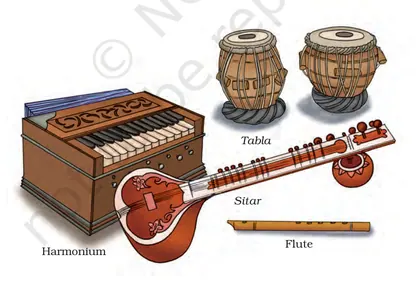
- Drum or tabla: membrane vibrates when struck, producing sound; larger membrane → lower pitch.
- Loudspeaker: electrical signal moves the diaphragm back and forth, producing pressure variations in air (sound).
- v = f × λ (speed = frequency × wavelength)
- f = 1 / T (frequency is the reciprocal of the time period)
- v ≈ 331 + 0.6 T (speed of sound in air in m/s; T in °C, approximate)
- I ∝ 1 / r² (sound intensity decreases roughly as the inverse square of distance r from a point source)
- I = P / (4πr²) (intensity I, power P emitted uniformly from a point source, distance r)
Vibration and Nature of Sound
What is sound? Sound is a form of energy produced when an object vibrates. These vibrations set the surrounding particles of a medium (solid, liquid or gas) into motion and travel as mechanical waves to our ears. Sound cannot travel in vacuum.
How sound is produced and propagated
- When a body vibrates (for example, a plucked guitar string or a struck tuning fork), it causes successive compressions and rarefactions in the surrounding medium.
- These variations (regions of higher and lower pressure) travel away from the source as longitudinal waves. In a longitudinal wave particles oscillate back and forth parallel to the direction of wave travel.
- Particles of the medium do not travel with the wave permanently; they only vibrate about their mean positions and pass the disturbance on to adjacent particles.
Characteristics of sound
- Amplitude: Maximum displacement of particles from mean position. Larger amplitude → greater loudness.
- Frequency (f): Number of vibrations per second (measured in hertz, Hz). Higher frequency → higher pitch.
- Period (T): Time for one complete vibration. T = 1/f.
- Wavelength (λ): Distance between two successive compressions (or rarefactions).
- Pitch: How high or low a sound is perceived — related to frequency.
- Loudness: A subjective measure related to amplitude and intensity. Intensity ∝ (amplitude)^2.
- Timbre: Quality or colour of sound produced by different sources even at same pitch and loudness (depends on overtones).
Important facts
- Human audible range: about 20 Hz to 20,000 Hz (20 kHz).
- Speed of sound depends on medium: generally fastest in solids, slower in liquids, slowest in gases. For air at 20°C, v ≈ 343 m/s.
- Speed in air changes with temperature approximately as v ≈ 331 + 0.6·T(°C).
Simple demonstrations: Strike a tuning fork and touch it lightly to water — ripples or splashes show vibration. Hold a stretched string and pluck to see/feel vibrations. Bring a vibrating tuning fork near your ear through air vs soaked in water to compare transmission.
- Tuning fork: When struck, the prongs vibrate and produce sound; dipping it in water shows visible vibrations and changes the sound.
- Guitar or sitar string: Plucking causes the string to vibrate and create musical notes; changing string tension changes pitch (frequency).
- Loudspeaker: Electrical signal makes the cone vibrate, compressing air to produce sound waves we hear.
- Human voice: Vocal cords vibrate when air passes through them; different tension and length change pitch.
- Thunder: Rapid expansion of air due to lightning creates compressions that travel as sound in air.
- v = f × λ (wave speed = frequency × wavelength)
- f = 1 / T (frequency is inverse of period)
- T = 1 / f (period is inverse of frequency)
- Approx. speed of sound in air: v ≈ 331 + 0.6 × T(°C) (m/s)
- Intensity ∝ (Amplitude)^2 (loudness related to square of amplitude)
Propagation of Sound and Media
What is propagation of sound?
Propagation of sound means the transfer of sound energy from the source to the listener through a medium by means of vibrations of the particles of the medium. Sound travels as a longitudinal wave — particles of the medium vibrate to and fro along the direction of wave travel creating compressions and rarefactions.
Need for a medium
Sound requires a material medium (solid, liquid or gas) to travel because it is transferred by particle-to-particle interactions. It cannot travel through a vacuum. Example: thunder is not heard inside a vacuum chamber.
How particle motion transmits sound
When an object vibrates (e.g., a tuning fork), it pushes neighbouring air molecules. These molecules push their neighbours and so on, passing the disturbance forward. Energy (not the particles themselves) moves through the medium.
Dependence on medium
The speed of sound depends on the medium’s elasticity and density. In general: speed in solids > speed in liquids > speed in gases, because solids are more rigid (higher elastic modulus) and transmit vibrations faster. For example (approximate values at room temperature): air ~343 m/s, water ~1480 m/s, steel ~5000 m/s.
Effect of temperature
In gases (air) the speed of sound increases with temperature because molecules move faster and transmit pressure changes more quickly. A useful approximate formula for air is v ≈ 331 + 0.6T (m/s), where T is temperature in °C.
Reflection and transmission at boundaries
When sound meets a boundary between two media part of it is reflected (echo) and part is transmitted. The amount depends on the impedance (related to density and elasticity) of the two media. This explains why you can sometimes hear people on the other side of a wall (transmitted sound) and why echoes occur from large hard surfaces.
Attenuation
Sound intensity decreases with distance and due to absorption by the medium (energy converted to heat). High-frequency sounds are absorbed faster than low-frequency sounds.
- Echo from a cliff or a large building (reflection of sound).
- Hearing thunder after lightning — sound travels through air from cloud to ground.
- Stethoscope: doctor hears heart sounds transmitted through air tubes and chest wall.
- Sonar/echolocation: bats and ships use reflection of sound waves to locate objects.
- Sound through a wall or pipe — vibrations travel faster in solid structures than through air.
- Medical ultrasound: high-frequency sound waves transmitted through body tissues and reflected back to form images.
- v = distance / time (speed of sound; units: m/s)
- v = f × λ (relationship between speed v, frequency f, and wavelength λ)
- v_air ≈ 331 + 0.6T (m/s), where T is temperature in °C — approximate for dry air)
- v_in_fluid = sqrt(B / ρ) (B = bulk modulus of the fluid, ρ = density)
- v_in_solid = sqrt(E / ρ) (E = Young's modulus for longitudinal waves in a rod, ρ = density)
- I ∝ A^2 (intensity I of a sound wave is proportional to the square of its amplitude A)
Speed of Sound and Quantitative Relations
What is speed of sound?
Speed of sound is how fast a sound wave travels through a medium. It is the distance travelled by the sound wave per unit time. The SI unit is metre per second (m/s).
Basic definition and formula
Speed (v) = distance / time. For waves, the relation between speed, frequency and wavelength is:
v = f × λ (where f is frequency, λ is wavelength)
Typical values
In air at 20 °C, speed of sound ≈ 343 m/s. In general: solids > liquids > gases (sound travels fastest in rigid, elastic media).
Dependence on temperature (for air)
The speed of sound in air increases with temperature. A simple practical formula for ordinary temperatures is:
v_air (m/s) ≈ 331 + 0.6 × T (°C)
Measuring speed of sound using echo
If you produce a sharp sound at distance d from a reflecting surface (cliff or wall) and measure the time t between the sound and its echo, the sound travels to the wall and back (distance 2d). So:
v = 2d / t
Example quantitative relations to remember
- v = distance / time (general)
- v = f × λ (wave relation)
- v_air ≈ 331 + 0.6 T (°C) (temperature dependence)
- Echo method: v = 2d / t
Factors affecting speed of sound
- Medium: solids (highest), liquids, gases (lowest).
- Elasticity: greater elasticity of the medium increases speed.
- Density: higher density tends to reduce speed if elasticity does not increase proportionally.
- Temperature: in gases, higher temperature increases speed.
Connection to hearing: pitch and loudness
Frequency determines pitch (high f → high pitch). Amplitude relates to loudness (larger amplitude → louder sound). For a given speed, higher frequency means smaller wavelength (λ = v/f).
Practical uses
Echo and sonar to measure distances, ultrasound imaging (medical), navigation and communication in air and underwater, estimating distance of thunderstorm by time delay between lightning and thunder.
- Echo from a cliff: If you shout while standing 170 m from a cliff and hear the echo after 1.0 s, speed = 2d/t = 2×170 / 1.0 = 340 m/s.
- Thunder and lightning: See lightning and count seconds until thunder (t). Approximate distance to storm (in metres) ≈ v_air × t. Using v ≈ 340 m/s: distance ≈ 340 × t.
- Measuring with a tuning fork and resonance tube: Known frequency f and measured wavelength λ from resonance allow calculation v = f × λ.
- Underwater sonar: Sound travels about 4–5 times faster in water (~1480 m/s) than in air, so submarines use sonar pings and time delay to find distances.
- Medical ultrasound: High-frequency sound travels through body tissues (liquids/soft solids) and echoes from boundaries give images; v in soft tissue is used to convert time to distance.
- v = distance / time (general definition of speed) — units: m/s
- v = f × λ (wave relation: speed = frequency × wavelength). Example: if f = 256 Hz and λ = 1.33 m, v = 256 × 1.33 ≈ 341 m/s.
- Echo (reflection) method: v = 2d / t (sound travels to reflector and back).
- Approximate variation with air temperature: v_air (m/s) ≈ 331 + 0.6 × T(°C).
- Rearranged relations: λ = v / f and f = v / λ (useful to find wavelength or frequency).
Characteristics of Sound
Sound is a form of energy produced by vibrating objects and transmitted through a medium (solid, liquid or gas) as longitudinal waves. Several observable properties — called characteristics of sound — describe how sound behaves and how we perceive it. The main characteristics are pitch, loudness, quality (timbre), and speed. Below is a simple description of each and how they depend on measurable quantities.
1. Pitch
- Definition: Pitch is how high or low a sound seems to a listener.
- Physical cause: Pitch is determined by the frequency (f) of the sound wave. Higher frequency → higher pitch; lower frequency → lower pitch.
- Perception: Humans typically hear frequencies from about 20 Hz to 20,000 Hz; musical notes have specific frequencies.
2. Loudness
- Definition: Loudness is how strong or soft a sound seems.
- Physical cause: Loudness is related to the amplitude of the sound wave and to the wave's intensity (power per unit area). Larger amplitude (and higher intensity) → louder sound.
- Perception and units: Loudness is perceived subjectively and is often measured objectively as sound level in decibels (dB).
3. Quality (Timbre)
- Definition: Quality or timbre is what makes two sounds with the same pitch and loudness sound different (for example, a flute and a violin playing the same note).
- Physical cause: Timbre depends on the waveform shape and the presence and relative strengths of harmonics (overtones) in the sound.
4. Speed of Sound
- Definition: Speed is how fast the sound wave travels through a medium.
- Dependence: Speed depends on the medium and its properties (temperature for gases, and density/elasticity for solids and liquids). In air at 20°C, speed ≈ 343 m/s.
Other related ideas
- Wavelength (λ): Distance between two successive compressions or rarefactions. Related to speed and frequency by v = fλ.
- Frequency (f): Number of vibrations per second (Hz). f = 1/T where T is the time period.
- Intensity and amplitude: Intensity is proportional to amplitude squared (I ∝ A²), so small changes in amplitude give larger changes in intensity.
Understanding these characteristics helps explain many everyday phenomena (why a whistle is high-pitched, why a thunderclap is loud but low in pitch, why two instruments sound different even when playing the same note, and how echoes allow distance measurement).
- Pitch: A whistle (high frequency) vs a drum (low frequency).
- Loudness: A person speaking loudly has larger amplitude/intensity than when whispering; moving farther from the speaker makes the sound quieter.
- Quality/Timbre: The same musical note played on a flute and a violin sounds different because of different harmonics.
- Speed and Echo: Shouting toward a cliff produces an echo; measuring the time between shout and echo helps calculate distance using speed of sound.
- Wavelength/frequency relation: When a tuning fork of known frequency is struck, it sets the air into waves with wavelength λ = v/f.
- Speed (basic): v = distance / time (m/s)
- Wave relation: v = f × λ (where v = speed of sound in m/s, f = frequency in Hz, λ = wavelength in m)
- Frequency: f = 1 / T (T is the time period in seconds)
- Intensity-amplitude relation (qualitative): I ∝ A² (intensity proportional to square of amplitude)
- Sound level (decibels, advanced): L (dB) = 10 × log10(I / I₀), where I₀ = 1×10⁻¹² W/m² (reference threshold of hearing)
Audible Range, Infrasound and Ultrasound
Definition
Sound is a mechanical wave produced by vibrating bodies. The audible range is the range of sound frequencies that can be heard by the average human ear. Frequencies below the audible range are called infrasound and frequencies above it are called ultrasound.
Ranges (typical)
- Infrasound: frequencies < 20 Hz
- Audible sound (human hearing): about 20 Hz to 20 000 Hz (20 kHz). This range narrows with age and exposure to loud sounds.
- Ultrasound: frequencies > 20 000 Hz (20 kHz)
Key physical relation
The fundamental relation between wave speed, frequency and wavelength is:
v = f × λ
where v is the speed of sound (≈ 343 m/s in air at 20 °C), f is frequency in hertz (Hz), and λ is wavelength in metres (m).
Characteristic properties
- Infrasound has very long wavelengths (many metres) and can travel long distances with little attenuation. It diffracts around obstacles easily.
- Audible sound wavelengths range from metres (low Hz) to millimetres/centimetres (high kHz), and are used for communication, music and hearing-based sensing.
- Ultrasound has short wavelengths (millimetre or smaller in air/liquid) and can resolve small details; it is strongly attenuated in air but transmits well in liquids and solids.
Detection and biological examples
- Many animals hear beyond the human audible range: dogs and bats hear higher frequencies (ultrasound used by bats for echolocation), while elephants and some whales produce and detect infrasound for long-distance communication.
Uses
- Infrasound: monitoring earthquakes and volcanoes, studying atmospheric phenomena, long-range animal communication detection.
- Audible sound: speech, music, alarms and everyday hearing.
- Ultrasound: medical imaging (sonography), industrial non-destructive testing, SONAR, cleaning small parts, ultrasonic welding.
Human hearing sensitivity & intensity
The threshold of hearing (typical) corresponds to an intensity I0 = 1×10⁻¹² W/m². Sound level in decibels is given by:
β = 10 log10(I / I0) (in dB)
Threshold of pain corresponds to about 1 W/m² → β ≈ 120 dB.
Simple examples using v = f × λ
- For f = 20 Hz, λ = v/f ≈ 343 / 20 ≈ 17.15 m (infrasound wavelength in air).
- For f = 20 000 Hz, λ = 343 / 20000 ≈ 0.01715 m ≈ 1.7 cm (upper audible/low ultrasound wavelength in air).
Summary
Infrasound, audible sound and ultrasound are simply classifications by frequency. Their wavelengths and propagation behavior differ, which determines how they are used in nature and technology.
- Infrasound: Elephants communicate using low-frequency rumbles (a few Hz to tens of Hz) that travel long distances through the ground and air.
- Audible sound: Human conversation typically uses frequencies from about 100 Hz to 4 kHz, which are most important for speech intelligibility.
- Ultrasound: Bats emit ultrasonic pulses (tens to hundreds of kHz) and use echoes to locate insects (echolocation).
- Ultrasound in medicine: A diagnostic ultrasound probe transmits high-frequency sound into the body; echoes form images of internal organs (sonography).
- Infrasound monitoring: Volcanoes and large explosions produce infrasound that can be detected kilometres away to provide early warnings.
- v = f × λ (speed of sound = frequency × wavelength)
- λ = v / f (wavelength = speed / frequency)
- f = v / λ (frequency = speed / wavelength)
- Sound level (decibels): β = 10 log10(I / I0), where I0 = 1×10⁻¹² W/m² (threshold of hearing).
Reflection of Sound: Echo and Reverberation
Reflection of sound is the bouncing back of sound waves when they strike a surface that does not absorb all the sound. Like light, sound waves obey the law of reflection: the angle of incidence equals the angle of reflection (useful when treating sound as rays for large smooth surfaces).
Echo: An echo is a distinct repetition of a sound heard when the reflected sound arrives at the listener's ear after a short delay. For the reflected sound to be heard as a separate sound (an echo) the time gap between the original sound and the reflected sound must be large enough (usually >= 0.1 s for human hearing). Echoes are produced by large hard surfaces such as cliffs, tall buildings, or empty halls.
Reverberation: Reverberation is the persistence of sound in an enclosed space due to multiple reflections from walls, floor and ceiling. If reflections arrive in quick succession (time gaps < 0.1 s) they overlap the original sound and are heard as a prolonged or 'echoey' effect rather than separate echoes. Reverberation increases loudness and fullness of sound but too much reverberation reduces speech clarity.
Why echo vs reverberation depends on distance and time:
- If a reflecting surface is far enough that the round-trip travel time of sound is ≥ 0.1 s → you hear a distinct echo.
- If the surface is nearer so reflections return sooner (< 0.1 s) → reflections overlap → reverberation.
Practical control: Reverberation can be reduced by using sound-absorbing materials (curtains, carpets, foam panels) or by changing room geometry. Concert halls are designed to provide a suitable reverberation time for music, while classrooms aim for low reverberation for speech intelligibility.
Connections & applications: Echo principles are used in sonar and echo-sounding to measure distance (ships, fish-finders), and animals such as bats and dolphins use reflected sound for echolocation.
- Shouting towards a cliff: you hear your shout return as a clear echo if the cliff is far enough away.
- Empty large hall or theatre: you may hear reverberation (prolonged sound) rather than distinct echoes because many reflections overlap.
- Bats emitting high‑frequency chirps and listening to reflections to locate insects (echolocation).
- Sonar/echo-sounder in ships: send a sound pulse and calculate distance to seabed from time taken for echo to return.
- Cathedral or church: long reverberation time makes music sound full but decreases speech clarity.
- v = d / t (speed = distance ÷ time)
- For reflection from a single flat surface: 2d = v × t_echo ⇒ d = (v × t_echo) / 2 (d is distance to reflector, t_echo is round-trip time)
- Condition for a distinct echo: t_echo ≥ 0.1 s ⇒ minimum distance d_min = 0.05 × v (for v ≈ 340 m/s, d_min ≈ 17 m)
- Reverberation time (advanced, Sabine formula): T = 0.161 × V / A (T in seconds, V = room volume in m³, A = total absorption in m²; used in acoustical design)
Human Ear: Structure and Working
Introduction
The human ear is the organ of hearing and also helps maintain balance. It converts sound waves (mechanical vibrations in air) into electrical signals that the brain interprets as sound.
Structure of the Ear
- Outer ear (External ear): Consists of the pinna (auricle) and the ear canal (external auditory meatus). The pinna collects and funnels sound waves into the ear canal toward the eardrum.
- Middle ear: An air-filled cavity containing the tympanic membrane (eardrum) and three tiny bones called ossicles — malleus (hammer), incus (anvil) and stapes (stirrup). The Eustachian tube connects the middle ear to the throat to equalize pressure.
- Inner ear: Contains the cochlea (a fluid-filled, spiral structure for hearing) and the vestibular apparatus (semicircular canals and vestibule) for balance. The cochlea contains the basilar membrane and hair cells (sensory receptors) connected to the auditory (cochlear) nerve.
How the Ear Works (Step-by-step)
- Collection: Sound waves in air are collected by the pinna and travel down the ear canal.
- Vibration of eardrum: Sound waves strike the tympanic membrane and cause it to vibrate with the same frequency as the incoming sound.
- Transmission and amplification: Vibrations are transferred from the eardrum to the ossicles. Because the tympanic membrane has a larger area than the oval window and due to the lever action of the ossicles, pressure at the oval window is increased (middle ear amplification). Typical overall pressure gain ≈ 20–25× (area ratio × lever effect), helping efficiently transmit sound into the fluid of the inner ear.
- Fluid waves in cochlea: The stapes pushes on the oval window, producing pressure waves in the cochlear fluid. These waves create a travelling wave along the basilar membrane.
- Frequency mapping and receptor activation: Different frequencies cause maximum displacement of the basilar membrane at different places (high frequencies near the base, low frequencies near the apex). Hair cells at the location of maximum displacement bend and convert mechanical motion into nerve impulses (electrochemical signals).
- Signal to brain: The auditory nerve carries these impulses to auditory centres in the brain where they are interpreted as pitch, loudness and quality of sound.
Key functional points
- Pitch depends on frequency (Hz): higher frequency → higher pitch.
- Loudness depends on amplitude (greater amplitude → louder sound). Loudness is related to sound intensity and is measured on a logarithmic decibel (dB) scale.
- Protection: Muscles (stapedius and tensor tympani) and reflexes reduce transmission of very loud sounds; the Eustachian tube equalizes pressure; earwax (cerumen) traps dust and microbes.
Common issues
- Conduction hearing loss: when outer or middle ear cannot transmit sound well (e.g., earwax blockage, otitis media).
- Sensorineural hearing loss: damage to hair cells or auditory nerve (e.g., prolonged exposure to loud noise, certain drugs, aging).
- Ear popping: pressure changes (airplane) — Eustachian tube opening equalizes pressure.
Summary
The ear is a mechanical-to-electrical transducer. Its three-part structure (outer, middle, inner) collects, amplifies and converts sound waves into nerve signals, which the brain interprets as sound.
- Hearing a whistle: High frequency (about 3–4 kHz) produces a high-pitched sound; hair cells near the cochlear base respond.
- Airplane take-off/landing: Ears 'pop' due to rapid pressure change; swallowing opens the Eustachian tube to equalize pressure.
- Loud music with earphones: Large amplitude increases intensity; prolonged exposure above ~85 dB can damage hair cells and cause permanent hearing loss.
- Plugging your ear with a finger: Reduces sound intensity reaching the eardrum (attenuation), making sounds quieter.
- Tuning-fork on mastoid (bone conduction): Vibrations travel through skull bones to cochlea, bypassing outer/middle ear; used in hearing tests (Weber and Rinne).
- Otitis media (middle ear infection): Fluid in middle ear reduces mobility of the eardrum and ossicles, causing reduced hearing (conduction loss).
- Wave relation: v = f × λ (speed of sound v in air ≈ 343 m/s at 20°C; f = frequency in Hz; λ = wavelength in m)
- Sound intensity level (decibels): β = 10 log10(I / I0) where I0 = 10^-12 W/m^2 (threshold of hearing)
- Change in level: Δβ = 10 log10(I2 / I1) (useful to compare loudness changes)
- Inverse-square law for intensity: I ∝ 1 / r^2 (sound intensity decreases roughly with the square of distance from a point source)
- Intensity ∝ (amplitude)^2 (if amplitude doubles, intensity increases by factor of 4)
Musical Instruments and Sound Production
What produces sound in musical instruments? Musical instruments produce sound when some part of the instrument vibrates. These vibrations set the surrounding air into periodic motion (sound waves) which reach our ears. The audible properties of the sound are:
- Pitch — related to the frequency of vibration (higher frequency = higher pitch).
- Loudness — related to the amplitude of vibration (larger amplitude = louder sound).
- Timbre (quality) — determined by the waveform and presence of overtones/harmonics (gives instruments their distinct sound).
Types of instruments and how they produce sound
- String instruments (guitar, sitar, violin): Sound is produced by vibrating strings. The string vibrates in standing-wave patterns with nodes and antinodes. The body or soundboard of the instrument amplifies the sound by resonance.
- Wind instruments (flute, organ pipe, clarinet): Sound arises from vibrating columns of air inside tubes. The tube supports standing waves; whether the tube is open at both ends or closed at one end affects allowed frequencies (harmonics).
- Percussion instruments (tabla, drums, xylophone): Sound is produced by vibrating membranes or bars. The shape and material determine the set of modes and resulting timbre.
- Tuning forks and bells: Metal parts vibrate and excite air; tuning forks are useful for demonstrating pure tones (dominant single frequency).
Standing waves and resonance
Musical notes correspond to standing waves. For a stretched string fixed at both ends, only certain wavelengths (and hence frequencies) fit as standing waves: those with nodes at the ends. Similarly, air columns in pipes form standing waves with nodes and antinodes depending on boundary conditions. Resonance occurs when a vibrating source drives another object or air column at one of its natural frequencies, greatly increasing amplitude (e.g., soundbox of a guitar, sympathetic vibration of another tuning fork).
How changing instrument parameters changes sound
- For strings: increasing tension raises the pitch; increasing length lowers the pitch; thicker strings (greater mass per unit length) lower the pitch.
- For pipes: a longer air column gives lower pitch; shortening the effective length (e.g., pressing holes on a flute) raises pitch. An open-open pipe and an open-closed pipe have different series of harmonics.
- Loudness can be changed by striking/ plucking/ bowing harder (larger amplitude) or by changing resonance/efficiency of the soundboard/body.
Important observable features for Class 8
- Sound needs a medium to travel (air, water, solids).
- Pitch & frequency relationship (higher frequency corresponds to higher pitch).
- Quality or timbre arises from presence of harmonics besides the fundamental frequency.
Summary: Musical instruments produce sound by vibrating parts (strings, air columns, membranes, bars). The pitch depends mainly on frequency which in turn depends on physical parameters (length, tension, effective length of air column, mass per unit length). Resonance and standing waves decide the allowed notes and the richness (timbre) of the sound.
- Guitar: Plucking a string produces standing waves on the string; pressing the string at different frets shortens effective length and raises pitch.
- Flute: Blowing across the mouthpiece makes the air column inside vibrate; opening holes shortens the effective length and raises pitch.
- Tabla/drum: Striking the stretched membrane creates complex vibration modes; the body and membrane control pitch and timbre.
- Tuning forks: A struck fork vibrates at a nearly pure single frequency; holds as a reference pitch for tuning.
- Organ pipes: Open-open pipe produces harmonics at n*v/2L, closed-open pipe produces odd harmonics at (2n-1)*v/4L; length determines the note.
- Wave speed: v = f * λ (v = speed of sound in the medium, f = frequency, λ = wavelength)
- Frequency and period: f = 1 / T (T is the time period of one vibration)
- Fundamental frequency of a stretched string: f1 = (1 / 2L) * sqrt(Tension / μ) (L = string length, μ = mass per unit length)
- Harmonics for a string fixed at both ends: fn = n * f1 (n = 1,2,3 ...)
- Open-open pipe (air column): fn = n * v / (2L) (n = 1,2,3 ...)
- Open-closed pipe (one end closed): fn = (2n - 1) * v / (4L) (n = 1,2,3 ...; only odd harmonics)
Noise and Noise Pollution
What is noise? Noise is an unwanted, unpleasant or disturbing sound. Unlike a musical tone (which is regular and has a definite pitch), noise is generally irregular, random and contains many frequencies. Examples: honking, engine roar, construction hammering.
What is noise pollution? Noise pollution is the presence of excessive or disturbing sound that harms human health, wildlife, or the environment. It occurs when sound levels are too high or persist long enough to cause annoyance, hearing damage, stress or other negative effects.
Characteristics that make sound a noise
- Unpleasant or unwanted.
- Irregular waveform (broad frequency content).
- Loudness and duration often high.
- Occurs at times or places when silence is expected (night, hospitals, schools).
Major sources: road traffic, rail and air transport, factories and construction sites, loudspeakers and public events, household appliances, firecrackers.
Effects on health and environment: short-term—annoyance, difficulty in concentrating, sleep disturbance; long-term—permanent hearing loss, stress, high blood pressure, reduced work/school performance, disturbance to wildlife.
How we measure and compare sound: Sound energy received per unit area is called sound intensity (I, in W/m²). Because human hearing spans a very wide range of intensities, sound is commonly measured in decibels (dB), a logarithmic scale. Typical reference values: threshold of hearing ≈ 0 dB (I0 = 1×10⁻¹² W/m²), normal conversation ≈ 60 dB, heavy traffic ≈ 80–90 dB, threshold of pain ≈ 120–130 dB.
Control and prevention: use silencers and mufflers, maintain vehicles and machines, create noise barriers, plant trees, enforce time limits for loud activities, use ear protection (ear-plugs), move noisy industries away from residential areas, follow local noise regulations.
- Traffic noise: continuous honking and engine sounds near a busy road causing sleep disturbance and stress for nearby residents.
- Construction noise: jackhammers and drills at a building site creating high-level intermittent noise that affects nearby schools and hospitals.
- Loudspeakers at events: amplified music at festivals or religious events causing discomfort and hearing risk for nearby people.
- Airport and aircraft noise: repeated takeoffs and landings near residential zones causing long-term annoyance and possible health effects.
- Household noise: loud television, music or power tools used at night affecting neighbours’ sleep and concentration.
- Sound intensity: I (W/m²) — energy per second per unit area.
- Decibel (sound level): L = 10 · log10(I / I0) where I0 = 1×10⁻¹² W/m² (reference intensity).
- Relative change in level: ΔL = 10 · log10(I2 / I1).
- Amplitude-intensity relation: I ∝ A² (intensity ∝ square of wave amplitude).
- Inverse-square law for a point source: I ∝ 1 / r², so when distance r is doubled, intensity falls by ~4 times and level decreases by ≈ 6 dB.
Applications of Sound
Sound is a mechanical wave that travels through a medium (air, water, solids). Different ranges of sound frequency — infrasonic (below 20 Hz), audible (20 Hz–20 kHz) and ultrasonic (above 20 kHz) — have many practical uses. Applications of sound exploit properties such as speed, reflection (echo), transmission, frequency (pitch) and intensity (loudness).
Main categories of applications
- Communication: Speech, telephones, radios, microphones and loudspeakers convert between sound and electrical signals to send information.
- Navigation & detection (echolocation and SONAR): Bats and dolphins use echolocation. SONAR (Sound Navigation and Ranging) sends a pulse and uses the echo to detect objects and measure distance under water.
- Medical uses (ultrasound): Ultrasonic waves are used in imaging (sonography), blood-flow measurement (Doppler ultrasound) and physiotherapy.
- Industrial & cleaning: Ultrasonic cleaning removes dirt from jewellery and precision parts; nondestructive testing uses sound to find cracks in materials.
- Music & entertainment: Musical instruments, concert-hall acoustics and audio systems rely on controlled sound production and reflection (reverberation).
- Measurement & surveying: Echo-sounding for ocean depth, range-finders and certain surveying instruments use sound wave travel-time measurements.
- Everyday devices: Alarms, ultrasonic pest repellents, door sensors and parking sensors use ultrasonic pulses.
- Safety and standards: Sound level meters measure noise; noise control and insulation reduce harmful effects of excessive sound (noise pollution).
Key physical ideas used in applications
- Reflection & echo: Time delay between emission and reception gives distance (used in SONAR and echo-sounding).
- Frequency & pitch: High frequencies (ultrasound) provide better resolution in imaging and cleaning but do not travel as far in air.
- Intensity & loudness: Intensity decreases with distance (approximately inverse-square law in free field), relevant for speaker placement and noise control.
- Doppler effect: Change of frequency with relative motion is used in Doppler ultrasound to measure blood flow speed and in some speed-detection systems.
Practical considerations and limits
- Air absorption increases with frequency — ultrasonic waves are good for short-range/high-resolution tasks (cleaning, imaging) but not long-distance air communication.
- In water, sound travels faster and with lower attenuation than in air, so SONAR is highly effective underwater.
- Excessive sound intensity damages hearing — noise control, safe exposure limits and sound-insulating materials are important in design.
Summary: Sound is used for communication, sensing, medical diagnosis and treatment, industrial cleaning and inspection, entertainment, and safety. Choosing the right frequency, intensity and medium is essential for each application.
- Echolocation by bats and dolphins: emit sound pulses and listen to echoes to detect obstacles and prey.
- SONAR on ships and submarines: measure ocean depth, locate objects by timing echoes (distance = (speed of sound × time)/2).
- Medical ultrasound (sonography): use high-frequency sound to produce images of internal organs and monitor foetuses.
- Ultrasonic cleaning: high-frequency vibrations in a liquid remove dirt from small or delicate parts.
- Speakers, microphones and telephones: convert electrical signals to sound and back for human communication.
- Architectural acoustics: design of auditoria and classrooms to control reverberation for clear sound.
- Speed of sound (approx. in air at temperature T°C): v = 331 + 0.6·T (m/s). Example: at 20°C, v ≈ 343 m/s.
- Wave relation: v = f × λ (speed = frequency × wavelength), where f is frequency (Hz) and λ is wavelength (m).
- Distance from echo timing: distance to object = (v × t) / 2, where t is total time between emission and echo reception.
- Basic distance formula for travel: d = v × t (used when one-way travel is considered).
- Inverse-square law for intensity (approx.): I ∝ 1 / r^2, where r is distance from a point source in free field.
- Sound level in decibels: β = 10 · log10(I / I0), where I0 = 1×10^-12 W·m^-2 (threshold of hearing).
Measurement, Intensity and Attenuation
Measurement, Intensity and Attenuation
What is sound intensity? Sound intensity measures the amount of sound energy passing per second through a unit area placed normal (at right angles) to the direction of sound propagation. It tells us how strong or loud a sound is at a point. Intensity depends on the power of the sound source and the distance from the source.
How do we measure loudness? Loudness is related to intensity but is a subjective sensation measured in decibels (dB). A small change in intensity can produce a noticeable change in loudness because the ear responds roughly logarithmically.
Key ideas — intensity and distance: For a point-like source that radiates sound uniformly in all directions, the energy spreads over the surface of a sphere. The spherical surface area grows as 4πr², so intensity falls with the square of the distance. This is called the inverse-square law: intensity decreases rapidly as you move away from the source.
Attenuation (reduction) of sound: Attenuation means loss of sound strength as it travels. Attenuation is caused by three main processes: absorption (medium converts sound energy to heat), scattering (sound redirected by obstacles), and reflection/refraction (energy redirected away from original path). In many media and practical situations, the intensity decreases approximately exponentially with distance because of absorption:
I(x) = I0 e−αx, where α is the attenuation coefficient and x is distance traveled.
Decibel scale: Because the range of sound intensities the ear can detect is huge, we use a logarithmic scale. The sound level β in decibels is defined by β = 10 log10(I / I0), where I0 is a reference intensity (commonly 10−12 W/m², approx. hearing threshold).
Summary of relations:
- Intensity = Power / Area (I = P / A).
- Inverse-square law for point sources: I ∝ 1 / r².
- Exponential attenuation in absorbing media: I(x) = I0 e−αx.
- Sound level in decibels: β = 10 log10(I / I0).
Why this matters in daily life: - At concerts you feel loud sound close to speakers because intensity is high; moving back reduces intensity quickly. - In a hall sound may get weaker because of absorption by curtains and people. - Higher frequency sounds (treble) are often absorbed more quickly than low frequency (bass), which is why bass travels farther.
Practical tips: - To protect hearing, avoid prolonged exposure above 85 dB. - Use sound-absorbing materials (carpets, curtains) to reduce echoes and intensity in rooms. - Microphones and speakers must be positioned considering the inverse-square law to get desired loudness.
- Standing near a loudspeaker at a concert: moving to double the distance from the speaker roughly reduces the sound intensity to one-fourth (inverse-square law).
- Whisper vs. shout: A whisper has much lower intensity than a shout; the decibel difference corresponds to a large ratio of intensities even if decibel numbers look moderate.
- Soundproofing a room: Carpets and curtains absorb sound (increase attenuation) reducing echoes and lowering intensity that reaches other rooms.
- Ultrasound in medical imaging: High-frequency ultrasound is useful for detailed images but attenuates faster in tissue than lower frequencies, limiting penetration depth.
- Hearing protection: A chainsaw (~110 dB) exposes workers to intensities that can damage hearing quickly; ear protection reduces the sound level reaching the ear (reduces I and hence β).
- I = P / A (Intensity = Power flow per unit area; units: W/m²)
- I ∝ 1 / r² (Inverse-square law for a point source radiating uniformly)
- \[I(x) = I₀ e^{−αx} (Exponential attenuation\]\[α = attenuation coefficient\]\[x = distance)\]
- \[β = 10 log₁₀(I / I₀) (Sound level in decibels\]\[I₀ ≈ 10^{−12} W/m²)\]
- A practical note: an increase of 10 dB corresponds to a tenfold increase in intensity (I_new = 10 × I_old)
Key Concepts
- Sound
- A form of energy produced by vibrating objects that travels as a longitudinal wave through a medium.
- Vibration
- Back-and-forth motion of an object about a mean position that generates sound when transferred to a medium.
- Medium
- Material (solid, liquid or gas) through which sound waves travel by particle interaction.
- Longitudinal wave
- A wave in which particles of the medium vibrate parallel to the direction of wave propagation, typical of sound.
- Compression
- Region in a longitudinal wave where particles are closest together and pressure is higher.
- Rarefaction
- Region in a longitudinal wave where particles are furthest apart and pressure is lower.
- Frequency
- Number of vibrations or oscillations per second of a vibrating body; measured in hertz (Hz).
- Amplitude
- Maximum displacement of particles from their mean position; related to the energy and loudness of sound.
- Wavelength
- Distance between two consecutive corresponding points (e.g., two compressions) in a wave.
- Pitch
- How high or low a sound appears to a listener; depends mainly on frequency.
- Loudness
- Perception of sound intensity by the ear; depends on amplitude and distance from the source.
- Quality (Timbre)
- Characteristic of a sound that allows us to distinguish different sources producing the same pitch and loudness.
- Echo
- Reflection of sound from a surface that is heard after a delay from the original sound.
- Reflection of sound
- Bouncing back of sound waves from a surface when they cannot pass through it.
- Reverberation
- Multiple reflections of sound in an enclosed space that persist after the source has stopped, causing prolonged sound.
- Noise
- Unwanted or unpleasant sound that is irregular and lacks a definite pitch or pattern.
- Resonance
- Phenomenon where an object vibrates with increased amplitude when driven by another vibrating object at its natural frequency.
- Speed of sound
- Rate at which sound waves travel through a medium; depends on the medium's properties and temperature.
- Ultrasound
- Sound waves with frequencies higher than the upper limit of human hearing (above ~20 kHz); used in imaging and cleaning.
- Sonar
- Technique using sound waves (often ultrasonic) to detect objects and measure distance by timing echoes.
End-of-Chapter Trial Paper & Test Questions
Topic-wise questions to test your understanding of every concept in this chapter.
-
Sound is produced when an object vibrates. Which of the following correctly describes sound as a wave? (a) Sound is a transverse wave that can travel in vacuum (b) Sound is a longitudinal wave that requires a medium to travel (c) Sound is a transverse wave that requires a medium (d) Sound is an electromagnetic wave ध्वनि तब उत्पन्न होती है जब कोई वस्तु कंपन करती है। निम्नलिखित में से कौन ध्वनि को तरंग के रूप में सही ढंग से वर्णित करता है? (a) ध्वनि एक अनुप्रस्थ तरंग है जो निर्वात में यात्रा कर सकती है (b) ध्वनि एक अनुदैर्ध्य तरंग है जिसे यात्रा के लिए माध्यम चाहिए (c) ध्वनि एक अनुप्रस्थ तरंग है जिसे माध्यम चाहिए (d) ध्वनि एक विद्युत चुंबकीय तरंग है
Show answer
(b) Sound is a longitudinal wave that requires a medium to travel / ध्वनि एक अनुदैर्ध्य तरंग है जिसे यात्रा के लिए माध्यम चाहिए — In a longitudinal wave, particles vibrate parallel to the direction of wave travel, forming compressions and rarefactions. Sound cannot travel in vacuum. / अनुदैर्ध्य तरंग में कण तरंग की यात्रा की दिशा के समानांतर कंपन करते हैं, संपीडन और विरलन बनाते हैं। ध्वनि निर्वात में नहीं जा सकती।
-
If the speed of sound in air is 340 m/s and a tuning fork produces a frequency of 680 Hz, what is the wavelength of the sound? (a) 0.5 m (b) 5 m (c) 2 m (d) 0.05 m यदि वायु में ध्वनि की चाल 340 m/s है और एक ट्यूनिंग फोर्क 680 Hz आवृत्ति उत्पन्न करती है, तो ध्वनि की तरंगदैर्ध्य क्या होगी? (a) 0.5 m (b) 5 m (c) 2 m (d) 0.05 m
Show answer
(a) 0.5 m — λ = v/f = 340/680 = 0.5 m. Using the wave relation v = fλ, wavelength = speed ÷ frequency. / λ = v/f = 340/680 = 0.5 m। तरंग संबंध v = fλ का उपयोग करके, तरंगदैर्ध्य = चाल ÷ आवृत्ति।
-
The pitch of a sound depends on its ________, while the loudness depends on its ________. / ध्वनि की तारता (pitch) उसकी ________ पर निर्भर करती है, जबकि प्रबलता (loudness) उसकी ________ पर निर्भर करती है।
Show answer
Frequency; Amplitude / आवृत्ति; आयाम — Higher frequency → higher pitch; larger amplitude → greater loudness (intensity ∝ amplitude²). / अधिक आवृत्ति → अधिक तारता; बड़ा आयाम → अधिक प्रबलता (तीव्रता ∝ आयाम²)।
-
For a distinct echo to be heard, the minimum distance between the source and the reflecting surface should be about ________ metres (assuming speed of sound = 340 m/s). / स्पष्ट प्रतिध्वनि सुनने के लिए, स्रोत और परावर्तक सतह के बीच न्यूनतम दूरी लगभग ________ मीटर होनी चाहिए (ध्वनि की गति = 340 m/s मानें)।
Show answer
17 metres / 17 मीटर — For an echo to be heard separately, the sound must return after at least 0.1 s. Minimum distance d = (v × t)/2 = (340 × 0.1)/2 = 17 m. / प्रतिध्वनि अलग से सुनने के लिए, ध्वनि को कम से कम 0.1 s बाद लौटना चाहिए। न्यूनतम दूरी d = (v × t)/2 = (340 × 0.1)/2 = 17 m।
-
True or False: Ultrasound has frequencies below 20 Hz and is used in medical imaging. / सत्य या असत्य: पराश्रव्य ध्वनि की आवृत्ति 20 Hz से कम होती है और इसका उपयोग चिकित्सा इमेजिंग में किया जाता है।
Show answer
False / असत्य — Ultrasound has frequencies above 20,000 Hz (above the upper limit of human hearing). Infrasound has frequencies below 20 Hz. Ultrasound is used in medical imaging (sonography). / पराश्रव्य की आवृत्ति 20,000 Hz से अधिक होती है (मानव श्रवण की ऊपरी सीमा से ऊपर)। अपश्रव्य की आवृत्ति 20 Hz से कम होती है। पराश्रव्य का उपयोग चिकित्सा इमेजिंग (सोनोग्राफी) में किया जाता है।
-
True or False: The speed of sound is highest in gases and lowest in solids. / सत्य या असत्य: ध्वनि की गति गैसों में सबसे अधिक और ठोसों में सबसे कम होती है।
Show answer
False / असत्य — The speed of sound is highest in solids (e.g., steel ~5000 m/s), intermediate in liquids (~1480 m/s in water) and lowest in gases (~343 m/s in air). / ध्वनि की गति ठोसों में सबसे अधिक (जैसे स्टील ~5000 m/s), द्रवों में मध्यम (~1480 m/s जल में) और गैसों में सबसे कम (~343 m/s वायु में) होती है।
-
What is SONAR? State one application of it. / सोनार क्या है? इसका एक उपयोग बताइए।
Show answer
SONAR stands for Sound Navigation And Ranging. It is a technique that uses ultrasonic sound waves to detect objects and measure distances by timing the echo. Application: Ships use SONAR to measure the depth of the ocean (sea floor) — a pulse is sent downward and the time taken for the echo to return is measured; depth = (speed of sound in water × time)/2. / SONAR का अर्थ है ध्वनि नेविगेशन और रेंजिंग। यह एक तकनीक है जो पराश्रव्य ध्वनि तरंगों का उपयोग करके प्रतिध्वनि की समय-माप से वस्तुओं का पता लगाती और दूरियाँ मापती है। उपयोग: जहाज महासागर की गहराई (समुद्र तल) मापने के लिए SONAR का उपयोग करते हैं — नीचे की ओर एक पल्स भेजी जाती है और प्रतिध्वनि वापस आने में लगे समय को मापा जाता है; गहराई = (जल में ध्वनि की गति × समय)/2।
-
Describe the structure of the human ear and explain how it converts sound waves into signals sent to the brain. (Name at least three parts.) / मानव कान की संरचना का वर्णन कीजिए और बताइए कि यह ध्वनि तरंगों को मस्तिष्क को भेजे जाने वाले संकेतों में कैसे परिवर्तित करता है। (कम से कम तीन भागों का नाम लीजिए।)
Show answer
The human ear has three regions. (1) Outer ear: The pinna collects sound waves and funnels them into the ear canal to the eardrum (tympanic membrane). (2) Middle ear: The eardrum vibrates and transmits vibrations through three tiny bones (ossicles) — malleus, incus and stapes — amplifying the sound and passing it to the oval window. (3) Inner ear: The cochlea (fluid-filled spiral structure) contains hair cells on the basilar membrane. Different frequencies cause maximum vibration at different positions; hair cells convert mechanical motion to electrical nerve impulses that travel via the auditory nerve to the brain, which interprets them as sound. / मानव कान के तीन भाग होते हैं। (1) बाहरी कान: पिन्ना ध्वनि तरंगों को इकट्ठा करके कान नलिका में कान के पर्दे (टिम्पेनिक झिल्ली) तक पहुँचाती है। (2) मध्य कान: कान का पर्दा कंपित होता है और तीन छोटी हड्डियों (अस्थि-शृंखला) — मैलियस, इनकस और स्टेप्स — के माध्यम से कंपन को प्रवर्धित करके अंडाकार खिड़की तक पहुँचाता है। (3) आंतरिक कान: कोक्लीया (तरल भरी सर्पिल संरचना) में बेसिलर झिल्ली पर रोम कोशिकाएँ होती हैं। अलग-अलग आवृत्तियाँ अलग-अलग स्थानों पर अधिकतम कंपन उत्पन्न करती हैं; रोम कोशिकाएँ यांत्रिक गति को श्रवण तंत्रिका के माध्यम से मस्तिष्क को भेजे जाने वाले विद्युत तंत्रिका आवेगों में बदलती हैं, जिसे मस्तिष्क ध्वनि के रूप में समझता है।
Related Laws & Principles
Explore allFoundational laws & principles behind this chapter. Each one opens a full page — what it says, why it matters, five practice questions and the mistakes to avoid.