Overview
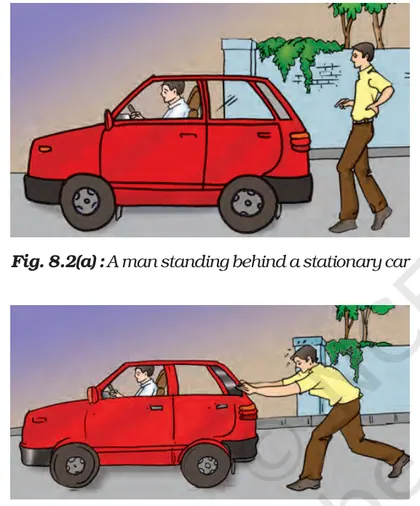
Introduction: This chapter introduces the concepts of force and pressure — two central ideas in mechanics. Force is described as a push or pull that can change the shape or motion of an object. Pressure describes how a force is distributed over an area. The chapter explains different kinds of forces (contact and non-contact, balanced and unbalanced) and how forces are measured. It then develops the idea of pressure in solids, liquids and gases, shows how pressure depends on force and area (P = F/A), and explores practical consequences such as why sharp objects penetrate more easily, why pressure in a liquid increases with depth and acts in all directions, and how atmospheric pressure affects everyday life. Importance: Understanding force and pressure helps explain everyday phenomena (walking, cutting, fluid flow, weather) and underlies many technologies (hydraulic presses, brakes, pumps, barometers). The chapter builds reasoning and quantitative skills through experiments and simple calculations, preparing students for later topics in physics and engineering. Key themes: - Definition and effects of force (change of shape, motion, direction, speed) - Types of forces: contact…
Learning Objectives
- Define force and pressure and state their SI units and symbols
- Explain the effects of forces on the motion and shape of objects, with everyday examples
- Differentiate between contact and non-contact forces and list common examples (gravitational, magnetic, electrostatic)
- Illustrate balanced and unbalanced forces using free-body diagrams and determine the resultant force
- Calculate pressure exerted by a force on a surface using P = F/A and solve numerical problems
- Compare pressure in solids, liquids and gases and explain why liquid pressure acts in all directions
- Apply Pascal's law to explain hydraulic machines and solve related pressure and force problems
- Describe atmospheric pressure and explain how a simple mercury barometer measures it
Topics in this chapter
8 topics · tap a topic title to jump straight to it.
Force
What is a force? A force is a push or a pull that can change the state of rest or motion of an object or change its shape. Force is a vector (it has magnitude and direction). The SI unit of force is the newton (N), where 1 N = 1 kg·m/s².
Effects of a force
- It can start or stop motion, or change the speed or direction of motion (produce acceleration).
- It can change the shape or size of an object (deformation).
- It can produce rotation (torque or moment).
Types of forces
- Contact forces: forces that occur when bodies touch — e.g., friction, normal reaction, tension in a rope, applied push or pull.
- Non-contact (field) forces: forces that act at a distance — e.g., gravitational force, magnetic force, electrostatic force.
Balanced and unbalanced forces: When all forces on an object add up (vector sum) to zero, they are balanced and there is no change in motion. If the vector sum is non-zero, the forces are unbalanced and the object accelerates in the direction of the resultant force.
How we represent and measure force
- Graphically by arrows (length = magnitude, arrowhead = direction).
- Measured using instruments like a spring balance (in newtons) or a force sensor.
Key related concepts
- Weight: the gravitational force on a mass (W = mg).
- Normal reaction: the supporting force from a surface, equal and opposite to components of other forces perpendicular to that surface.
- Friction: a contact force opposing relative motion between surfaces.
Newton's laws (brief)
- First law (inertia): a body remains at rest or in uniform motion unless acted on by a net external force.
- Second law: the net force on a body is equal to mass × acceleration (F_net = ma).
- Third law: for every action there is an equal and opposite reaction.
Understanding forces uses simple vector addition (resultant force) and helps explain everyday phenomena — from pushing a book across a table to planets orbiting the Sun.
- Pushing a door — applied force opens it (contact force).
- Kicking a football — the foot exerts a force that changes the ball’s speed and direction.
- A book resting on a table — weight (gravity) downward balanced by normal reaction upward (balanced forces).
- Apple falling from a tree — gravitational force accelerates the apple (non-contact force).
- Stretching a spring — applied force causes extension; within elastic limit it follows Hooke’s law.
- Braking a bicycle — frictional force between brake pads and wheel reduces speed.
- Unit: 1 newton (N) = 1 kg·m/s²
- Weight: W = m × g (m in kg, g ≈ 9.8 m/s²)
- Newton's second law: F_net = m × a
- Hooke's law (elastic spring): F = k × x (k = spring constant, x = extension)
- Pressure (related concept): P = F / A (force per unit area)
- Resultant of two perpendicular forces: R = √(F1² + F2²)
Measurement of Force
What is force? A force is a push or a pull that can change the state of motion of an object or deform it. Force is a vector (has magnitude and direction). The SI unit of force is the newton (N). A force of 1 N gives a mass of 1 kg an acceleration of 1 m/s².
Instruments used to measure force
- Spring balance (newton-meter): The most common classroom instrument. A spring balance has a spring fixed at one end and a hook at the other. When a load is hung, the spring stretches; the extension is shown on a calibrated scale which gives the force (weight) acting on the hook. It is usually graduated in newtons.
- Beam balance / weighing scale: Measures mass by comparison. A bathroom scale measures the normal reaction (which equals weight when at rest) and is calibrated to display mass in kg.
How a spring balance works
- Within its elastic limit, the extension of the spring is proportional to the applied force (Hooke's law). The scale is calibrated using known weights so the extension reading is given directly as force (N).
- To calibrate, hang known masses and mark the corresponding extensions. Convert the mass m (kg) to its weight W = mg (N) using g ≈ 9.8 m/s² and label the scale accordingly.
Measuring weight and its relation to mass
- Weight W is the gravitational force on a mass: W = mg. Here m is mass (kg) and g is acceleration due to gravity (~9.8 m/s² on Earth). Weight is measured in newtons.
- A spring balance measures weight (force). A beam balance compares masses and reads mass (kg) directly because it compares two masses under same g.
Precautions and limitations
- Do not exceed the elastic limit of the spring; otherwise Hooke's law fails and the balance will be inaccurate.
- Avoid jerks or quick motions; take steady readings. Read at eye level to avoid parallax error and ensure the pointer is at rest.
- Spring balances measure magnitude of force; direction must be noted separately.
- Calibration depends on local g; absolute conversion between mass and force uses local value of g.
Summary Measurement of force in Class 8 focuses on using instruments like the spring balance to measure forces (weights) in newtons, understanding W = mg, Hooke's law (F ∝ x for springs in elastic limit), calibration of scales, and being aware of sources of error.
- Weighing fruits using a spring balance: hang the fruit on the hook and read the force in newtons (or mass in kg if the scale is calibrated for mass).
- Using a bathroom scale to measure your weight: the scale shows mass (kg) by measuring the normal reaction equal to your weight and dividing by g in calibration.
- Measuring the pull in a tug-of-war with a spring balance attached to the rope to compare forces exerted by teams.
- Compressing a known spring and measuring the force needed to compress it by a certain amount; verify Hooke's law (F = kx).
- Calibrating a spring balance: hang known masses (e.g., 0.1 kg, 0.2 kg) and mark the corresponding force values using W = mg (use g ≈ 9.8 m/s²).
- Estimating the force needed to push open a door by attaching a spring balance to the handle and pulling steadily.
- SI unit of force: 1 newton (1 N) = 1 kg·m/s²
- Weight (gravitational force): W = m · g (m in kg, g ≈ 9.8 m/s², W in N)
- Hooke's law for springs (elastic limit): F = k · x (k = spring constant in N/m, x = extension in m)
- Spring constant from experiment: k = F / x
- Newton's second law (basic relation): F = m · a
- Conversion: 1 kilogram-force (kgf) ≈ 9.8 N
Friction
What is friction? Friction is the force that opposes relative motion or tendency of motion between two surfaces in contact. It acts along the surfaces and always in a direction opposite to the motion or impending motion.
Why does friction occur? At the microscopic level, even seemingly smooth surfaces have irregularities (bumps and valleys). When surfaces contact, these irregularities and microscopic adhesion produce a resisting force — friction.
Types of friction
- Static friction: Acts when two surfaces are not moving relative to each other. It adjusts up to a maximum value (limiting friction) to prevent motion.
- Kinetic (sliding) friction: Acts when one surface slides over another. It is usually less than the maximum static friction and approximately constant for dry contact.
- Rolling friction: Resists the motion when an object rolls over a surface; usually much smaller than sliding friction.
- Fluid friction: Resistance experienced by objects moving through a fluid (liquid or gas). It depends on speed and fluid properties.
Key points / laws
- Static friction acts up to a maximum value: it can have any value from zero up to a limit depending on the applied force.
- Limiting static friction is generally greater than kinetic friction for the same surfaces.
- Friction depends on the nature of the surfaces and the normal (contact) force, not directly on contact area (for rigid bodies in simple cases).
Advantages and disadvantages
- Advantages: enables walking, driving, writing, holding objects, braking.
- Disadvantages: causes wear, heat, energy loss; makes motion harder in machines.
Ways to change friction
- To reduce friction: lubricants (oil/grease), polishing, using ball bearings, streamlining (for fluids).
- To increase friction: roughening surfaces, using rubber soles, adding treads on tires, increasing normal force.
- Walking: friction between shoes and ground prevents slipping and lets you push off.
- Writing with a pen: friction between pen tip and paper produces marks.
- Car brakes: friction converts kinetic energy to heat to slow the vehicle.
- Pushing a heavy box: you feel static friction first; when it starts moving, kinetic friction acts.
- Ball bearings in a bicycle wheel: reduce sliding friction by changing it to rolling friction.
- Tires on wet road: tread patterns increase friction and channel water away to avoid skidding.
- Frictional force (general): F_f ≤ μ_s N (static friction up to its limit)
- Limiting (maximum static) friction: F_max = μ_s N
- Kinetic (sliding) friction: F_k = μ_k N
- For rolling friction: F_roll ≈ μ_r N (μ_r is usually very small)
- Notes: μ_s and μ_k are coefficients of static and kinetic friction respectively; μ_k < μ_s. N is the normal reaction (usually equals weight mg on horizontal surface).
Pressure
Definition: Pressure is the force applied perpendicular to the surface of an object per unit area of that surface. Mathematically, pressure (P) = Force (F) / Area (A).
SI unit: pascal (Pa). 1 Pa = 1 N/m². Other common units: kPa, atm, mmHg, bar.
Understanding the idea: For the same force, a smaller contact area gives a larger pressure, and a larger contact area gives a smaller pressure. Thus pressure depends on two factors: the magnitude of the applied force and the area over which the force acts.
Pressure in solids: When a force acts on a solid surface (for example a nail pushed into wood), the stress concentrated over the nail’s small tip produces large pressure which allows penetration. If the same force is spread over a larger area (a blunt object), pressure is smaller and penetration does not occur.
Pressure in liquids and gases: Molecules in fluids (liquids and gases) exert pressure in all directions. In a liquid at rest, pressure increases with depth because of the weight of the liquid above. The pressure due to a liquid column of height h is given by p = ρgh (ρ = density, g = acceleration due to gravity). Total pressure at depth below the free surface equals atmospheric pressure plus ρgh.
Atmospheric pressure: The air around us exerts pressure on everything. We experience about 101325 Pa (≈1 atm) at sea level. Effects of atmospheric pressure can be demonstrated with a suction cup, a drinking straw, or a barometer.
Applications & principles: Pascal's principle: a change in pressure applied to a confined fluid is transmitted undiminished throughout the fluid. This is used in hydraulic lifts and brakes. Hydraulic machines use the relation F1/A1 = F2/A2 to multiply force.
Simple experiments to try:
- Press a nail and a blunt object with the same force onto soft clay to see difference in penetration.
- Stand on one heel or both feet to feel difference in pressure; try with shoes of different sole areas.
- Fill a plastic bottle with water, poke holes at different heights and observe flow rates to see increasing pressure with depth.
- A sharp nail vs a blunt nail: same force, sharp nail makes a hole because of smaller area → larger pressure.
- High-heeled shoes exert more pressure on the floor than flat shoes because heel area is smaller.
- Lying on a bed of nails: many nails increase total contact area so pressure at each nail tip is small and you don’t get hurt.
- Hydraulic lift: small force on a small-area piston raises a large load on a large-area piston using pressure transmission (F1/A1 = F2/A2).
- Water pressure in a swimming pool increases as you go deeper; divers feel more pressure on their bodies at greater depths.
- P = F / A (Pressure = Force ÷ Area)
- SI unit: 1 Pa = 1 N/m²
- Hydrostatic pressure: p = ρ g h (pressure due to a liquid column of height h)
- Total pressure at depth: P_total = P_atmosphere + ρ g h
- Hydraulic relation: F1 / A1 = F2 / A2 (used in hydraulic presses and lifts)
Pressure in Liquids
What is pressure in liquids?
Pressure in a liquid at a given point is the force exerted by the liquid per unit area on a surface in contact with it. It acts in all directions (downwards, sideways and upwards) at a point inside the liquid.
Key ideas
- Dependence on depth: Pressure in a liquid increases with depth. The deeper you go, the greater the pressure because the weight of the liquid column above the point increases.
- Independence from container shape and amount: For the same depth and same liquid, pressure does not depend on the shape of the container or the total volume of liquid. Two containers with different shapes but the same depth at a point have the same pressure at that depth.
- Pascal's principle: A change in pressure applied to an enclosed fluid is transmitted undiminished to every part of the fluid and to the walls of its container. This is the basis for hydraulic lifts and brakes.
- Atmospheric contribution: Measured pressure at a point inside a liquid is the sum of atmospheric pressure acting on the free surface plus the pressure due to the liquid column.
Why pressure acts in all directions
Because liquids have molecules that move and collide, a small element of liquid transmits forces to neighboring elements in every direction. Thus pressure at a point is scalar but results in forces on surfaces oriented any way.
Practical demonstrations
- Make holes at different depths in a bottle filled with water: water jets from deeper holes come out with greater force and reach farther — showing pressure increases with depth.
- Communicating vessels (two connected containers): liquid levels become the same on both sides regardless of container shapes — showing equal pressure at the same horizontal level.
- Dam walls and the increasing water pressure with depth — design thicker at the bottom.
- Water supply in tall buildings — water pressure at taps on higher floors is lower unless pumps are used.
- Holes in the side of a bucket or tank at different heights — deeper holes produce stronger jets.
- Hydraulic jack/press — small force on a small-area piston produces larger force on a large-area piston (Pascal's principle).
- Communicating vessels — water levels equalize in connected containers of different shapes.
- Syringes and hydraulic brakes — pressure applied is transmitted through the fluid to do work elsewhere.
- Pressure (general) p = F / A, where F is normal force (N) and A is area (m^2). Unit: Pascal (Pa) = N/m^2.
- Hydrostatic pressure p_liquid = ρ g h, where ρ is liquid density (kg/m^3), g is acceleration due to gravity (~9.8 m/s^2), and h is depth (m).
- Total pressure at a point below a free surface p_total = p_atm + ρ g h, where p_atm is atmospheric pressure (~101325 Pa at sea level).
- Force on a horizontal area at depth F = p_liquid × A = ρ g h × A.
Hydraulic Systems and Pascal's Law
Pascal's law (statement): When pressure is applied to a confined fluid, the pressure is transmitted undiminished in all directions throughout the fluid.
Conditions: The fluid must be confined and (for practical hydraulic systems) nearly incompressible and at rest.
Pressure and transmission: Pressure is defined as force per unit area: P = F / A. If a force F1 is applied on a small piston of area A1 in a connected fluid, the pressure produced is P = F1 / A1. According to Pascal's law, this same pressure acts on a larger piston of area A2, producing an output force F2 = P × A2 = (F1 / A1) × A2. Thus a small input force can produce a large output force if A2 > A1.
Mechanical advantage: The force multiplication (ideal, neglecting losses) is F2 / F1 = A2 / A1. Hydraulic systems trade force for distance: the larger piston moves a smaller distance than the smaller piston.
Why it works: Fluids transmit pressure equally; the rigidity of pistons and incompressibility of fluid ensure the applied pressure acts on all surfaces at the same level. Energy conservation implies force multiplication comes with reduced displacement on the larger piston.
Simple numeric example: If A1 = 2 cm² and A2 = 50 cm² and you push the small piston with F1 = 10 N, pressure P = 10 N / (2×10⁻⁴ m²) = 50,000 Pa. Output force F2 = P × A2 = 50,000 Pa × 5×10⁻³ m² = 250 N. So a 10 N input gives 250 N output (neglecting friction).
Common components in hydraulic systems: pistons/cylinders, fluid (oil), valves, pipes, and a pump for powered systems. Hydraulic systems are widely used where large forces and smooth control are required.
- Hydraulic jack (car jack): a small input force on a small piston raises a car by producing a larger force on a larger piston.
- Hydraulic press: used in factories to press, mould or crush materials by multiplying force using large-area cylinders.
- Hydraulic brakes in vehicles: pressure applied at the brake pedal is transmitted to brake pads at each wheel to produce braking force.
- Excavators and hydraulic lifts: use hydraulic cylinders to move heavy loads, control arms and buckets smoothly.
- Hydraulic steering systems: transmit steering forces from the wheel to the steering mechanism with smooth control.
- Pressure: P = F / A (units: Pascal, Pa = N/m²)
- Pascal's law in two-piston system: F1 / A1 = F2 / A2 → F2 = F1 × (A2 / A1)
- Mechanical advantage (ideal): MA = F2 / F1 = A2 / A1
- Hydrostatic pressure with depth (related concept): P = P0 + ρ g h (ρ = fluid density, g = acceleration due to gravity, h = depth)
Pressure in Gases and Atmospheric Pressure
What is pressure?
Pressure is the force acting on a unit area of a surface. In symbols, P = F / A. In the SI system the unit of pressure is pascal (Pa), where 1 Pa = 1 N/m². Common larger units are kilopascal (kPa) and atmosphere (atm).
Pressure in gases — origin and behaviour
Gas pressure is caused by the continuous, rapid collisions of gas molecules with the walls of their container. Each collision exerts a tiny force on the wall; the sum of many collisions per unit area produces a measurable pressure.
- Dependence on number of molecules (n): More molecules (higher density) → more collisions per second → higher pressure (if volume and temperature are constant).
- Dependence on temperature (T): Increasing temperature increases the average speed of molecules → more frequent and more forceful collisions → pressure increases if volume is fixed.
- Dependence on volume (V): Reducing the volume (compressing the gas) increases collision frequency → pressure increases (if temperature is fixed).
These relations are summarized by simple gas laws (qualitatively for Class 8): at constant temperature, pressure is inversely related to volume; at constant volume, pressure increases with temperature.
Atmospheric pressure
Atmospheric pressure is the pressure exerted by the weight of the air column above a unit area of Earth’s surface. At sea level the atmospheric pressure is about 101,325 Pa (≈ 101.3 kPa) or 1 atmosphere (1 atm). It can be measured using a mercury barometer or an aneroid barometer.
How a mercury barometer works
A glass tube filled with mercury is inverted into a mercury reservoir. The column of mercury stabilizes at a height where the weight of the mercury column balances the atmospheric pressure. The relation used is P_atm = ρ g h, where ρ is the density of mercury, g is gravitational acceleration, and h is the height of the mercury column. At sea level h ≈ 760 mm (76 cm) of Hg.
Everyday effects of atmospheric pressure
Atmospheric pressure explains many common phenomena: why we breathe (air moves from high to low pressure), why liquids boil at lower temperatures at high altitudes (lower atmospheric pressure), why ears pop during altitude change (pressure difference across the eardrum), why suction cups stick (external atmospheric pressure pushes them onto surfaces), and why a sealed can can collapse if internal pressure is reduced (e.g., by condensing steam).
Measurements and safety notes
Pressure instruments include manometers (U-tube), mercury barometers, and aneroid barometers. When doing demonstrations with mercury, follow safety rules — many school demonstrations use water manometers or safe vacuum pumps instead.
- Syringe: When the piston is pulled back, gas pressure inside decreases and air is drawn in; when pushed, pressure increases and air is forced out.
- Balloon: Heating air inside a balloon increases molecular speed → pressure increases and balloon expands (if elastic).
- Tyres: Air inside a tyre is at a higher pressure than atmospheric pressure; this supports the vehicle’s weight.
- Drinking with a straw: Sucking reduces pressure inside your mouth; higher atmospheric pressure pushes liquid up the straw.
- Boiling point at high altitude: On a mountain, lower atmospheric pressure makes water boil at temperatures below 100 °C.
- Mercury barometer: A 76 cm column of mercury corresponds roughly to 1 atm at sea level; as weather/altitude changes, the height changes.
- P = F / A (Pressure = Force divided by Area). Units: Pa (N/m²).
- 1 atm = 101325 Pa ≈ 101.325 kPa ≈ 760 mm Hg (≈ 76 cm Hg).
- Pressure difference in a liquid column: ΔP = ρ g h (ρ = density, g = 9.8 m/s², h = height of column). Commonly used for barometers and manometers.
- Boyle’s law (qualitative for gases at constant temperature): P₁V₁ = P₂V₂ (pressure ∝ 1/volume).
- Pressure–temperature relation at constant volume (qualitative): P ∝ T (in kelvin).
Applications and Everyday Examples
What is pressure? Pressure is the force applied per unit area. It tells us how concentrated a force is. Mathematically, pressure = force/area. The SI unit is the pascal (Pa), where 1 Pa = 1 N/m2.
Why area matters: For the same force, a smaller contact area produces a larger pressure and a larger area produces a smaller pressure. This explains why sharp objects cut easily and why snowshoes prevent sinking into snow.
Pressure in fluids: In liquids and gases, pressure acts in all directions. Hydrostatic pressure inside a fluid increases with depth and depends on the fluid density and gravity. Pascal's law states that a pressure applied to a confined fluid is transmitted equally in all directions — this is the basis of hydraulic machines.
Everyday significance: Many devices and natural phenomena use pressure principles: cutting tools, footwear design, vehicle tyres, pumps, hydraulic lifts, blood pressure in our bodies, barometers for weather, and water supply systems. Understanding pressure helps to design safer and more efficient tools and systems.
- Key qualitative points: smaller area → larger pressure; deeper in a liquid → larger pressure; confined fluid transmits pressure equally.
- Practical consequences: reduce pressure where you want to avoid damage (broad bases, cushions) and increase pressure where you need penetration or lift (knife tip, nail, hydraulic jack).
- Sharp knife vs blunt knife: same force, smaller area at the edge produces higher pressure, so sharp knives cut easily.
- High-heeled shoes vs flat shoes: heel concentrates weight on a small area → higher pressure, can damage floors and sink into soft ground; sneakers distribute weight → lower pressure.
- Snowshoes: increase contact area with snow to reduce pressure so a person does not sink.
- Nails and needles: pointed tips give very small area so large pressure makes penetration possible.
- Hydraulic car jack and hydraulic brakes: a small force on a small-area piston creates the same rise in pressure transmitted to a larger-area piston to lift heavy loads (Pascal's law).
- Syringe: pushing the plunger increases pressure in the confined fluid, forcing liquid out through the needle.
- Pressure (p) = Force (F) / Area (A) → p = F / A (SI unit: pascal, Pa = N/m²)
- Hydrostatic pressure at depth (h): p = ρ g h (ρ = density of fluid, g = acceleration due to gravity)
- Total pressure at depth including atmospheric pressure: p_total = p_atm + ρ g h
- Pascal's law for hydraulic systems: F1 / A1 = F2 / A2 (pressure transmitted equally in a confined fluid)
- Force from mass and acceleration: F = m a (often used to compute force before finding pressure)
- Unit conversions: 1 Pa = 1 N/m²; 1 atm ≈ 101325 Pa; 1 bar = 100000 Pa
Key Concepts
- Force
- A push or pull that can change the state of rest or motion of an object; has magnitude and direction.
- Contact force
- A force that acts on an object through direct physical contact between objects.
- Non-contact force
- A force that acts at a distance without physical contact between the bodies.
- Balanced forces
- Two or more forces equal in magnitude and opposite in direction whose resultant is zero; no change in motion.
- Unbalanced force
- Forces that do not cancel each other; resultant is nonzero and causes acceleration or change of motion.
- Resultant force
- A single force which has the same effect as the combined action of all forces acting on a body.
- Frictional force
- Force that opposes relative motion or tendency of motion between two surfaces in contact.
- Normal reaction (Normal force)
- Contact force exerted by a surface on an object perpendicular to the surface.
- Tension
- Pulling force transmitted along a stretched string, rope or cable.
- Elastic force
- Restoring force produced by a deformed elastic body that tends to return it to its original shape.
- Gravitational force
- Attractive force between two masses; on Earth it causes objects to fall toward the ground.
- Weight
- Force with which a body is attracted towards Earth; weight = mass × gravitational acceleration (W = m x g).
- Pressure
- Force acting per unit area on a surface (P = F/A).
- Pascal (unit of pressure)
- SI unit of pressure equal to one newton per square metre (1 Pa = 1 N/m^2).
- Newton (unit of force)
- SI unit of force: the force that gives a mass of 1 kg an acceleration of 1 m/s^2 (1 N = 1 kg·m/s^2).
- Thrust
- A force acting perpendicular to a surface; often used for the total force exerted by a fluid on a surface.
- Upthrust (Buoyant force)
- Upward force exerted by a fluid on an object immersed in it, opposing the object's weight.
- Atmospheric pressure
- Pressure exerted by the weight of the Earth's atmosphere on bodies at the surface.
- Hydrostatic pressure
- Pressure at a point in a fluid at rest that depends on the fluid's density, depth and gravity (P = ρ g h).
- Pascal's law
- Pressure applied to a confined fluid is transmitted equally and undiminished in all directions throughout the fluid.
End-of-Chapter Trial Paper & Test Questions
Topic-wise questions to test your understanding of every concept in this chapter.
-
The SI unit of pressure is the pascal. 1 pascal is equal to: (a) 1 N/cm² (b) 1 N/m² (c) 1 kg/m² (d) 1 N·m दाब की SI इकाई पास्कल है। 1 पास्कल बराबर है: (a) 1 N/cm² (b) 1 N/m² (c) 1 kg/m² (d) 1 N·m
Show answer
(b) 1 N/m² — Pascal is defined as one newton of force per square metre of area (P = F/A). / पास्कल को एक वर्ग मीटर क्षेत्रफल पर एक न्यूटन बल के रूप में परिभाषित किया जाता है (P = F/A)।
-
A force of 200 N acts on an area of 0.5 m². What is the pressure? (a) 100 Pa (b) 400 Pa (c) 250 Pa (d) 0.0025 Pa 0.5 m² क्षेत्रफल पर 200 N का बल लगता है। दाब कितना होगा? (a) 100 Pa (b) 400 Pa (c) 250 Pa (d) 0.0025 Pa
Show answer
(b) 400 Pa — P = F/A = 200/0.5 = 400 Pa. Pressure equals force divided by area. / P = F/A = 200/0.5 = 400 Pa। दाब = बल ÷ क्षेत्रफल।
-
Pressure in a liquid at rest ________ with increasing depth because the weight of the liquid column above increases. / स्थिर तरल में दाब गहराई बढ़ने पर ________ है क्योंकि ऊपर की द्रव स्तंभ का भार बढ़ता है।
Show answer
Increases / बढ़ता है — Hydrostatic pressure p = ρgh; as depth h increases, pressure increases linearly with depth. / जलस्थैतिक दाब p = ρgh; गहराई h बढ़ने पर दाब रेखीय रूप से बढ़ता है।
-
Pascal's law states that pressure applied to a confined fluid is transmitted ________ throughout the fluid. / पास्कल का नियम कहता है कि एक बंद तरल पर लगाया गया दाब पूरे तरल में ________ रूप से प्रेषित होता है।
Show answer
Undiminished (equally in all directions) / बिना कमी के (सभी दिशाओं में समान रूप से) — This principle is the basis of hydraulic machines like hydraulic lifts and brakes. / यह सिद्धांत हाइड्रोलिक लिफ्ट और ब्रेक जैसी हाइड्रोलिक मशीनों का आधार है।
-
True or False: A sharp knife cuts more easily than a blunt one because it applies more force. / सत्य या असत्य: तेज चाकू कुंद चाकू से अधिक आसानी से काटता है क्योंकि यह अधिक बल लगाता है।
Show answer
False / असत्य — A sharp knife cuts more easily because its edge has a very small area, so the same force creates much greater pressure (P = F/A). The force is the same; it is the smaller contact area that increases pressure. / तेज चाकू अधिक आसानी से काटता है क्योंकि उसकी धार का क्षेत्रफल बहुत कम होता है, इसलिए समान बल से बहुत अधिक दाब बनता है। बल समान होता है; कम संपर्क क्षेत्रफल दाब बढ़ाता है।
-
True or False: Gravitational force is a contact force because gravity acts on objects near the Earth. / सत्य या असत्य: गुरुत्वाकर्षण बल एक संपर्क बल है क्योंकि गुरुत्व पृथ्वी के पास की वस्तुओं पर कार्य करता है।
Show answer
False / असत्य — Gravitational force is a non-contact (field) force; it acts at a distance without physical contact between objects. / गुरुत्वाकर्षण बल एक असंपर्क (क्षेत्र) बल है; यह वस्तुओं के बीच भौतिक संपर्क के बिना दूरी पर कार्य करता है।
-
A hydraulic press has a small piston with area A₁ = 2 cm² and a large piston with area A₂ = 40 cm². If a force of 20 N is applied on the small piston, what force does the large piston exert? / एक हाइड्रोलिक प्रेस में छोटा पिस्टन A₁ = 2 cm² और बड़ा पिस्टन A₂ = 40 cm² है। यदि छोटे पिस्टन पर 20 N बल लगाया जाए, तो बड़ा पिस्टन कितना बल लगाएगा?
Show answer
F₂ = F₁ × (A₂/A₁) = 20 × (40/2) = 20 × 20 = 400 N. Using Pascal's law, F₁/A₁ = F₂/A₂, so F₂ = 400 N. / F₂ = F₁ × (A₂/A₁) = 20 × (40/2) = 20 × 20 = 400 N। पास्कल के नियम से, F₁/A₁ = F₂/A₂, इसलिए F₂ = 400 N।
-
What is atmospheric pressure and what instrument is used to measure it? / वायुमंडलीय दाब क्या है और इसे मापने के लिए किस यंत्र का उपयोग होता है?
Show answer
Atmospheric pressure is the pressure exerted by the weight of the air column above a unit area of Earth's surface. At sea level it is approximately 101,325 Pa (1 atm ≈ 76 cm of mercury column). A mercury barometer is used to measure atmospheric pressure; the height of the mercury column (about 760 mm) corresponds to the atmospheric pressure. / वायुमंडलीय दाब पृथ्वी की सतह के एक इकाई क्षेत्रफल के ऊपर वायु स्तंभ के भार द्वारा डाला गया दाब है। समुद्र तल पर यह लगभग 101,325 Pa (1 वायुमंडल ≈ पारे का 76 cm स्तंभ) होता है। पारा बैरोमीटर से वायुमंडलीय दाब मापा जाता है; पारे के स्तंभ की ऊँचाई (लगभग 760 mm) वायुमंडलीय दाब के अनुरूप होती है।
Related Laws & Principles
Explore allFoundational laws & principles behind this chapter. Each one opens a full page — what it says, why it matters, five practice questions and the mistakes to avoid.